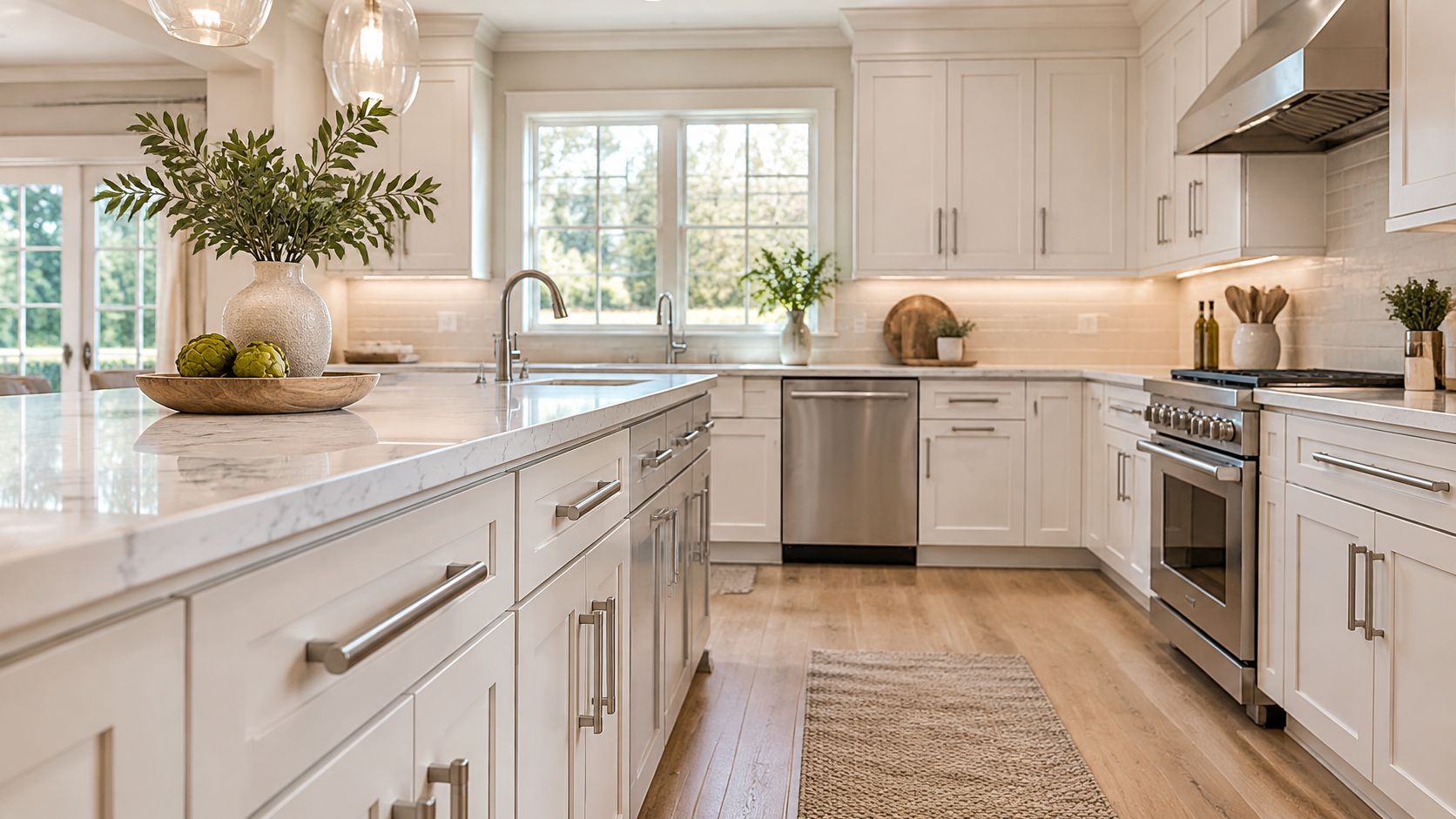
Kitchen cabinets with stainless steel handles are a specification decision, not a last minute accessory. The right choice comes down to four separate questions you're often sold as one: grade, finish, size, and cleaning.
Stainless is not self-sanitizing. Grade sets corrosion resistance, finish decides how fingerprints and cleaner film show, size decides whether the pull is comfortable in your hand, and cleaning decides what the metal can tolerate without dulling. I would settle those four before the cabinet order, not after the doors are hung.
Table of Contents
- Choose the Right Stainless Grade for Your Handles
- Why Stainless Steel Handles Hold Up in Daily Use
- Match Handle Styles to Your Cabinet Style and Countertop
- Design Examples for Stainless Handles
- Sizing Pulls and Checking Comfort Before You Order
- Finish, Cleaning and Hygiene Limits for Handles
- What Stainless Handles Add to a Cabinet Budget
- Lock Your Handle Grade and Finish Before You Order
Choose the Right Stainless Grade for Your Handles
Start with Type 304 for most kitchens, including typical South Jersey homes. It holds up to daily moisture, food residue, and repeated wiping without paying for corrosion protection you don't need. Step up only when the exposure justifies it.
Houzz's U.S. Kitchen Trends Study found that 96% of renovating homeowners upgraded their cabinets either completely or partially, while 70% chose complete cabinet replacement. Those cabinets get grabbed thousands of times, so the alloy is its own decision, separate from shape, finish, and how you clean the pull.
What the Grade Numbers Mean
Type 304 contains roughly 18-20% chromium and 8-10.5% nickel. Chromium supports the passive corrosion resistance that keeps stainless from rusting like plain steel. Nickel improves corrosion performance and formability. That mix is why 304 works as a general purpose pull in a standard kitchen.
A higher grade does not make a handle self-sanitizing. Grade only changes how the metal stands up to chlorides and moisture. Finish, hand comfort, and cleaning stay separate choices.
Type 316 resists chloride induced corrosion better than 304. I'd specify it for coastal homes, rooms with persistent humidity, frequent salt handling, or aggressive cleaning habits. Type 430 costs less and can serve a dry interior, but its ferritic composition gives you less chloride resistance than 304 or 316. It's the wrong shortcut near a sink.
Stainless steel grades for cabinet handles
| Grade | Chloride resistance | Best fit | Watch for |
|---|---|---|---|
| Type 304 | Moderate; about 18-20% chromium and 8-10.5% nickel | Standard kitchens, including most South Jersey homes | Confirm the grade on the spec; avoid chloride-heavy cleaners |
| Type 316 | Higher than 304 | Coastal homes, salt exposure, humidity or aggressive cleaning | Higher cost; confirm the grade on the spec |
| Type 430 | Lower than 304 | Dry interiors on a tight budget | Not suited to humid or salty areas |
Two Checks Before You Order
Don't trust the word stainless on a listing. Ask the supplier to state the grade in writing on the product specification. A stainless look finish on a different base metal won't perform like solid stainless. If the spec sheet won't name 304, 316, or 430, treat that as your answer.
Match the fasteners to the pull. Avoid pairing stainless pulls with unprotected carbon steel fasteners. Dissimilar metal contact and embedded iron particles can create brown staining that looks like the handle failed. Use stainless screws, keep steel wool away during installation, and wipe the door face before you tighten anything down.
Practical rule: 304 by default, 316 where salt and moisture are constant, 430 only where the room stays dry.
Why Stainless Steel Handles Hold Up in Daily Use
Stainless resists kitchen wear because its corrosion resistance comes from a thin oxide film that forms naturally on the surface. It isn't paint and it isn't a plated coating that chips to expose a weaker metal underneath. When you scratch it lightly through normal use, the surface doesn't behave like a painted pull with a bare spot.
That film helps handles resist rust, weathering, and everyday exposure. Stainless is also recyclable and built for long service life, which matters when you're drilling holes in cabinet doors you expect to keep for decades. A neutral pull that coordinates with a sink and appliances won't date as fast as a novelty finish, either.
Where Stainless Still Fails
Stainless isn't immune. Pitting, crevice corrosion, galvanic corrosion, and stress corrosion can all occur, and chloride ions in wet conditions are the usual trigger for localized damage. Salt water, salty air, and chlorine heavy cleaners sitting on the surface give chlorides time to work.
Picture three spots in a real kitchen. A pull on a sink side drawer gets splashed daily and dried rarely. A handle near a dishwasher steam vent stays damp after every cycle. A bar pull by the range gets grabbed with oily, salty hands while someone cooks. Those three handles live harder lives than a pull on a linen cabinet, even in the same room.
That's the trade off. Stainless gives you a long lasting, neutral accent that coordinates with appliances and sinks, provided the grade, finish, and installation suit the exposure. If a handle will sit in constant wet or salty conditions, don't buy on looks alone. Move up a grade and commit to rinsing and drying it.
Match Handle Styles to Your Cabinet Style and Countertop
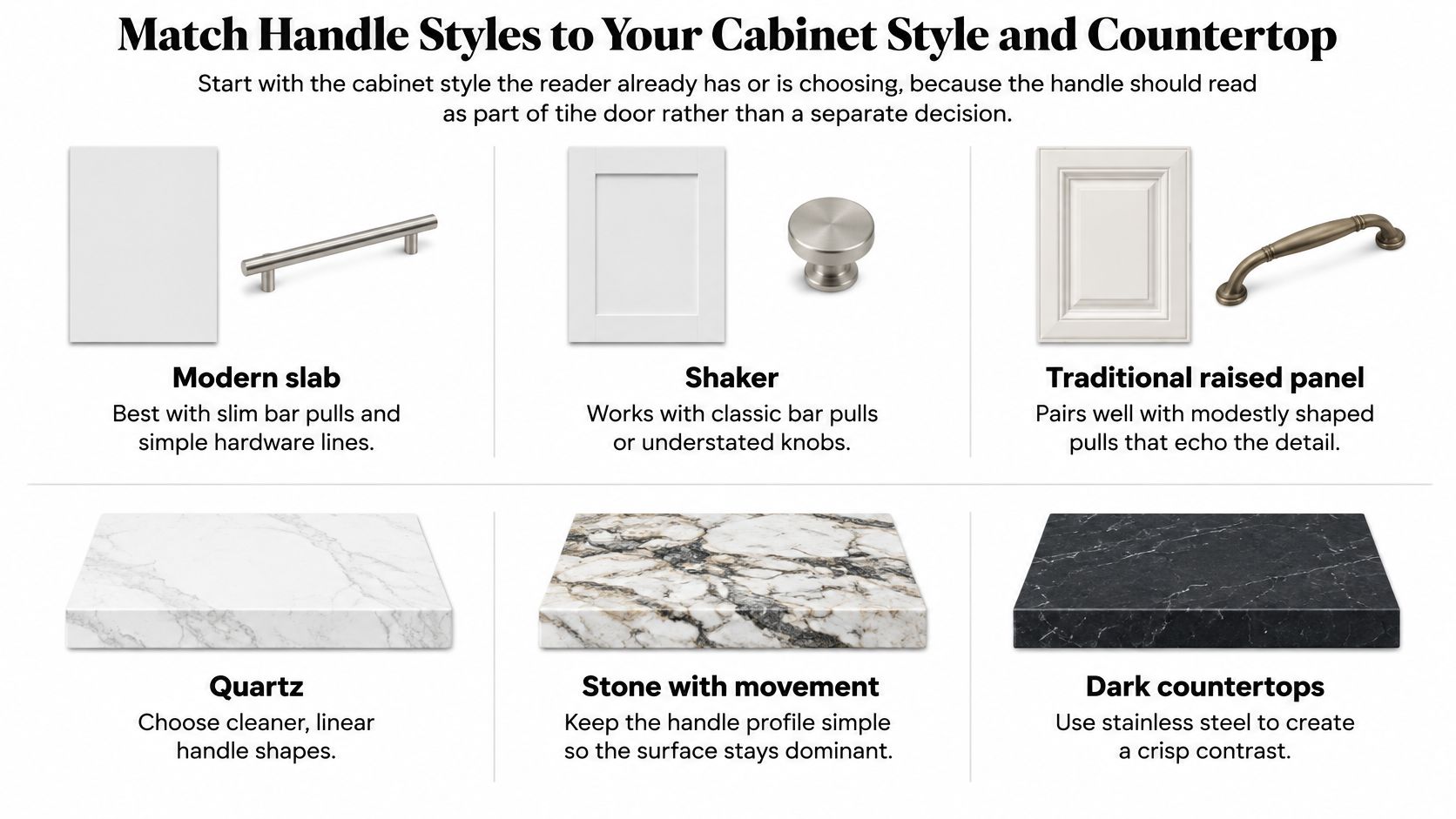
Start with the door you already have or you're choosing, because the handle should read as part of that door. A pull that fights the door profile looks added on, no matter how good the metal is. Use the pairings below as your first filter, then test scale in person.
Handle style pairings by cabinet style
| Cabinet style | Handle choice | Stainless finish | Countertop pairing |
|---|---|---|---|
| Traditional (raised panels, crown details) | Bar pulls or small knobs with a classic profile | Brushed or satin | Natural stone with soft veining or granite |
| Transitional (classic shaker, updated finish) | Slim bar pulls on drawers, knobs on doors | Brushed | Quartz in warm white or light gray |
| Contemporary (clean lines, slab doors) | Finger pulls, edge pulls or long bar pulls | Brushed or matte-toned | Sintered stone or quartz in a solid or subtle pattern |
Reading the Three Pairings
Traditional cabinets with raised panels and crown details already carry a lot of shape. A classic bar pull or small knob in brushed stainless echoes that detail without adding a second focal point. Natural stone with soft veining suits the same logic, since the handle stays quiet and lets the stone move.
Transitional shaker doors are the easiest match. Slim bar pulls give drawers a clean horizontal line, while knobs keep doors simple and familiar. Quartz in warm white or light gray keeps the palette calm, so brushed stainless reads as a link to the faucet and appliances rather than a statement. If you're weighing whether stainless should stand alone or sit beside another metal, our guide to mixed metal cabinet hardware walks through those combinations. For broader context on balancing metal against wood and stone in a room, Guynn Furniture & Mattress on metal accents is a useful primer.
Contemporary slab doors need hardware that doesn't interrupt a flat face. Finger pulls, edge pulls, or a long bar pull with a simple profile keep the line clean. Sintered stone or quartz in a solid or subtle pattern does the same work on the counter.
Avoid two mismatches. A mirror polished handle on a rustic wood door looks borrowed from a different kitchen, and oversized bar pulls crowded across narrow slab doors create clutter. Before you choose, check four things together: cabinet style, door profile, countertop surface, and lighting, because stainless changes character under warm pendants versus daylight.
Design Examples for Stainless Handles
Say a traditional kitchen has raised panel doors, crown molding, and natural stone with soft veining. A brushed stainless bar pull of moderate length works because its profile has enough presence for a detailed door, but its muted finish doesn't compete with the stone. Keep the pull shorter than the rail it's mounted on, so the ends don't crowd the panel molding.
A transitional shaker kitchen in warm white takes a different split. Put slim brushed bar pulls on the drawers and small knobs on the doors, then pair them with quartz in warm white or light gray. The stainless sits beside the range hood and faucet, and the brushed surface hides the handling marks that show on a family kitchen's most used drawers. Our roundup of kitchen cabinet hardware trends shows how that door and drawer split is being used now.
Two More Specific Cases
For a contemporary kitchen with flat slab doors and integrated appliances, choose brushed edge pulls or finger pulls in a matte tone with sintered stone in a subtle pattern. Nothing projects from the face, nothing catches a hip in a tight galley, and the metal shows only as a thin line when light hits the edge. It's the cleanest option, but it's also the least forgiving if your hands are wet, so test it before committing a whole kitchen to it.
A South Jersey coastal home makes a different call. On a sink side drawer that catches splash and salty air, I'd use a Type 316 bar pull even if the rest of the room could run 304. The scale stays the same, but the alloy matches the exposure. In every case, a physical mockup in your own light confirms scale faster than a product photo.
Sizing Pulls and Checking Comfort Before You Order
A 96 mm pull that looks right on a product page can still jam your knuckles on a drawer under 18 inches. Size the hardware to the door or drawer first, then check whether the grip is comfortable before you drill.
Center-to-center is the distance between the two mounting holes. Projection is how far the handle stands off the face. That gap decides whether your knuckles clear the cabinet.
Pull spacing and placement by door and drawer size
| Location | Placement | Center-to-center |
|---|---|---|
| Drawers under 18 in wide | Centered on the drawer front | 96 mm common; confirm on drawer front |
| Base cabinet doors | Upper corner opposite the hinge, 2-3 in from the edges | Single knob, or a short pull confirmed against the door rail width |
| Tall pantry or wall doors | Upper third, opposite the hinge side | Longer pull confirmed by door height, keeping both holes on the rail or a reinforced area |
Measuring steps for each of those locations sit in our cabinet hardware placement guide. Hold the actual pull against the door before you order a full set from a chart.
The Comfort Test Most Guides Skip
Stainless that resists wear and corrosion still has to be comfortable in the hand. Alloy grade and finish do not set grip diameter, projection, or how hard you have to pinch. Those are separate decisions, and a durable pull can still be the wrong one to live with.
Check four things past appearance:
- Pull length: Can you open a loaded drawer one handed without your fingers crowding the mounts?
- Projection: Do your knuckles clear the door when you grip quickly?
- Grip diameter: Can someone with reduced finger strength hold it without pinching?
- Adjacent clearance: Does the pull hit a neighboring door, appliance handle, or countertop edge at full swing?
Tape a sample, or screw one pull, on a base cabinet, a wall cabinet, a drawer, and a bathroom vanity. Open each one handed, then with wet hands, then while carrying a pan. In low evening light, see whether the metal disappears against the cabinet color. Low contrast hardware is harder to find by eye when your hands are full.
A highly polished cylindrical pull can turn slippery, and a thin, sharply edged design can dig into fingers despite looking modern in a photo.
Run the same sequence with everyone who uses the kitchen daily. In a multigenerational house, or if you plan to stay put, a knob that needs a tight pinch becomes a daily obstacle, not a style detail.
Finish, Cleaning and Hygiene Limits for Handles
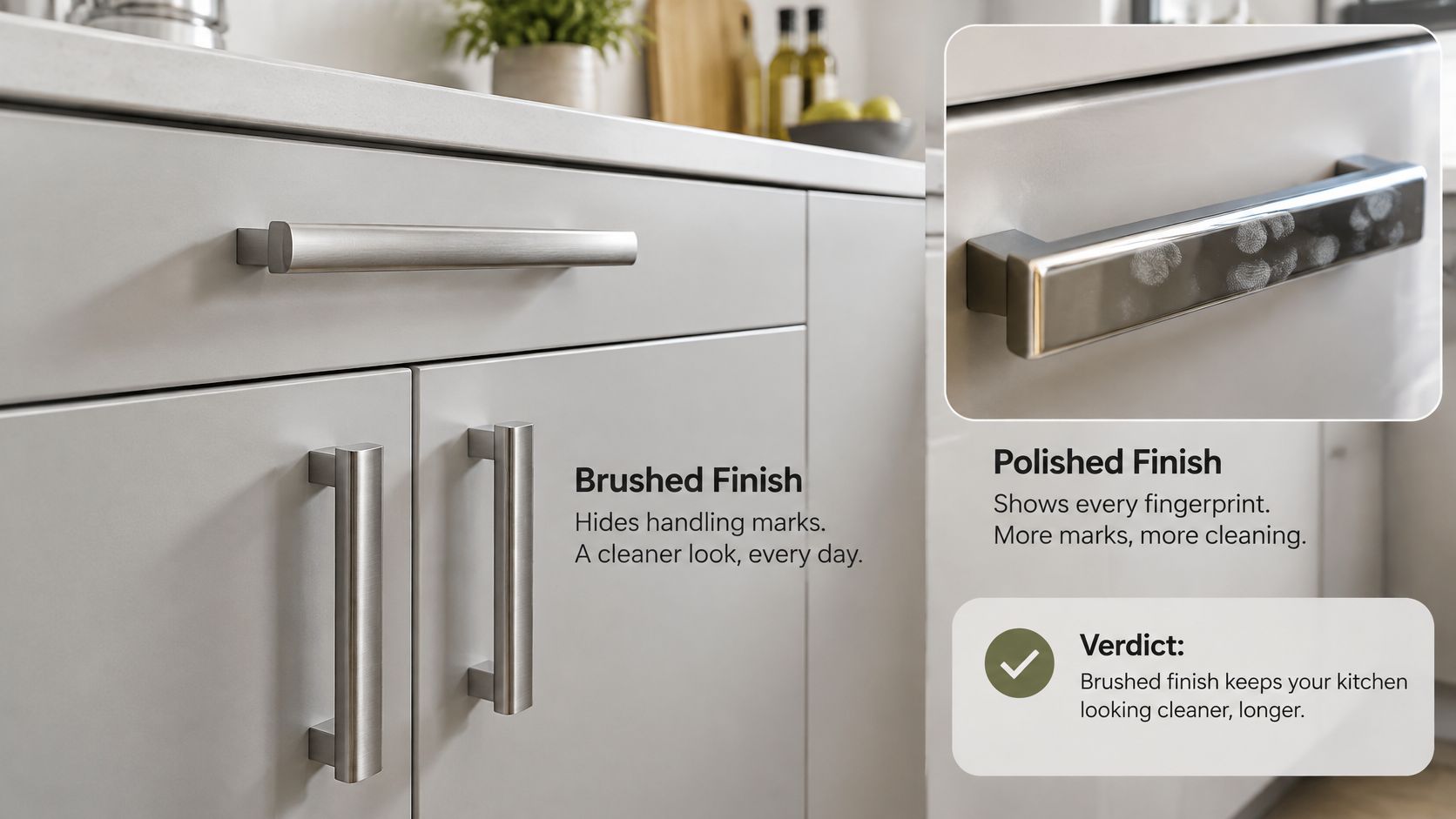
Choose brushed first for high touch doors and drawers. A brushed or directional finish masks handling marks, while polished or mirror finishes show every fingerprint and suit low touch accents or display cabinets better. Specify the finish before you debate small price differences between pulls, because you'll look at fingerprints every day.
The British Stainless Steel Association's guidance on surface finishes, treatments and cleaning makes the same distinction: smooth polished or mirror-like stainless surfaces show fingerprints more readily, while brushed or directional finishes visually mask handling marks and are generally better suited to high-touch cabinet doors and drawers. Give your supplier three requests in writing:
- Consistent brushed finish: Every pull from the same finish batch, so grain direction and tone match across a run of drawers.
- Finish named on the order: Brushed, satin, or polished written out, not left to a photo.
- Matching trim where possible: Appliance handles and sink trim checked against a physical sample in your light.
If you're comparing stainless against a warmer nickel tone, our notes on brushed nickel hardware explain where the two finishes diverge. For a wider look at how metal finishes behave alongside other materials in a finished room, Willis Furniture & Mattress on metal accents offers helpful background.
Stainless handle finishes compared
| Finish | Fingerprint visibility | Best fit |
|---|---|---|
| Brushed (directional) | Low; masks handling marks | High-touch doors and drawers |
| Satin or matte | Low to moderate | Modern and contemporary kitchens |
| Polished or mirror | High; shows fingerprints | Low-touch accents and display cabinets |
Stainless Is Not Self Sanitizing
Correct a common overpromise now. Stainless steel is inert and does not have an active antimicrobial effect, a distinction drawn clearly in Euro Inox guidance on stainless steel in hygienic applications, which notes stainless steel is inert and does not have an active antimicrobial effect. Its benefit is a smooth, nonporous, corrosion resistant surface that you can clean and disinfect repeatedly without the surface breaking down.
Geometry decides how clean a handle stays in practice. Deep knurling, seams, narrow crevices, and decorative transitions retain oils and debris even when the metal itself wipes clean. If hygiene is your priority, pick a smooth bar pull with soft transitions and few seams over an ornate design with recesses you can't reach with a cloth.
A Handle Specific Cleaning Routine
- Wipe loose debris: Use a dry, soft microfiber cloth so grit doesn't scratch during washing.
- Wash: Use mild soap or mild detergent in warm water, which lifts grease without attacking the surface.
- Follow the grain: On brushed finishes, wipe along the grain rather than across it to reduce streaking.
- Rinse: Wipe with a clean cloth dampened in clean water so detergent doesn't dry on the metal.
- Dry thoroughly: Buff dry right away, because standing water leaves spots and gives chlorides time to work.
- Check the traps weekly: Run the cloth around knurling, seams, and the mounts where oils collect.
Avoid abrasive powders, steel wool, and cleaners containing chlorides or heavy chlorine. They can scratch the passive surface or promote localized corrosion, which turns an easy care pull into a pitted one. Don't over-tighten mounting screws either, since that can distort thin decorative parts or damage the cabinet face.
Frequency matters more than the metal. Handles get touched with wet, greasy, or contaminated hands and are often cleaned less than countertops or sinks, so a pull can be the dirtiest surface in an otherwise clean kitchen. In homes with children, pets, allergy concerns, or heavy cooking, clean handles on the same schedule as the counter. Stainless reduces your maintenance burden. It doesn't replace routine cleaning or hand hygiene.
What Stainless Handles Add to a Cabinet Budget
Handles are a small line inside a cabinet budget, but they touch every door. Cabinets dominate what you spend, so treat hardware as its own line item rather than absorbing it into a vague allowance. That way a grade upgrade becomes a visible decision instead of a surprise at ordering.
Work the math as a planning example, not a quote. For example, if you price a hypothetical kitchen at 30 to 40 doors and drawers, even a modest per handle difference multiplies across the full count, and a premium solid bar at several times the price of a basic pull can move the hardware total from a few hundred dollars to well over a thousand. Run your own count door by door, including the pantry, trash pullout, and appliance panels people forget.
What Raises the Hardware Total
Four factors drive cost more than style does:
- Grade: Type 316 costs more than 304 for the same shape.
- Construction: A solid bar costs more than a hollow tube of the same length.
- Length: Longer center-to-center pulls use more metal and often jump a price tier.
- Mounting work: Older doors that need holes filled and redrilled add labor to a simple swap.
Our breakdown of cabinet hardware installation cost separates the product price from that labor so you can budget both. Keep the cabinet number in view as your anchor. For a semi-custom, medium-size kitchen, the cabinet cost is at least $15,000 in most cases, which puts even a premium handle set in proportion.
Ask for handle quantities, grades, and finishes written into the quote. That single line prevents the most common budget problem, where the allowance assumed a basic pull and you selected a long solid bar. It also locks the finish name, so replacements years later can be matched.
Lock Your Handle Grade and Finish Before You Order

Changing a pull after the doors are drilled means filled holes or a compromise you see every day. Lock grade, finish, and size for every door and drawer before the cabinet order is placed, and run the one-hand test on a mockup first.
The Cabinet Coach works with South Jersey homeowners, including Cherry Hill and nearby towns. Start with a complimentary video consultation to review the kitchen layout, cabinet door samples, and countertop choice. The mobile showroom then brings cabinet styles and brushed and polished stainless finishes to the house, so hardware is judged side by side in the room's own light rather than on a screen. Design services cover cabinetry, countertops, hardware, and tile for kitchen and bathroom remodels. In material selection, clients walk through complementary pieces, from the tile backsplash to the hardware.
Watch how that selection process comes together before you book:
The gallery shows real kitchens and bathrooms from South Jersey homes, with all three cabinet styles side by side. Notice how brushed stainless reads against each door color. Bring door samples and the countertop choice to the consultation, and test two pull lengths against the widest drawer. Grade, finish, and length are separate decisions. I would not let a single "stainless" label stand in for all three. That step turns kitchen cabinets with stainless steel handles from a product search into a finished specification.
Book a complimentary video consultation to review the layout, door samples, and countertop choice, then lock the stainless grade, finish, and pull size for every door and drawer before anything is ordered. Visit The Cabinet Coach to schedule and see finished South Jersey kitchens in the gallery.