
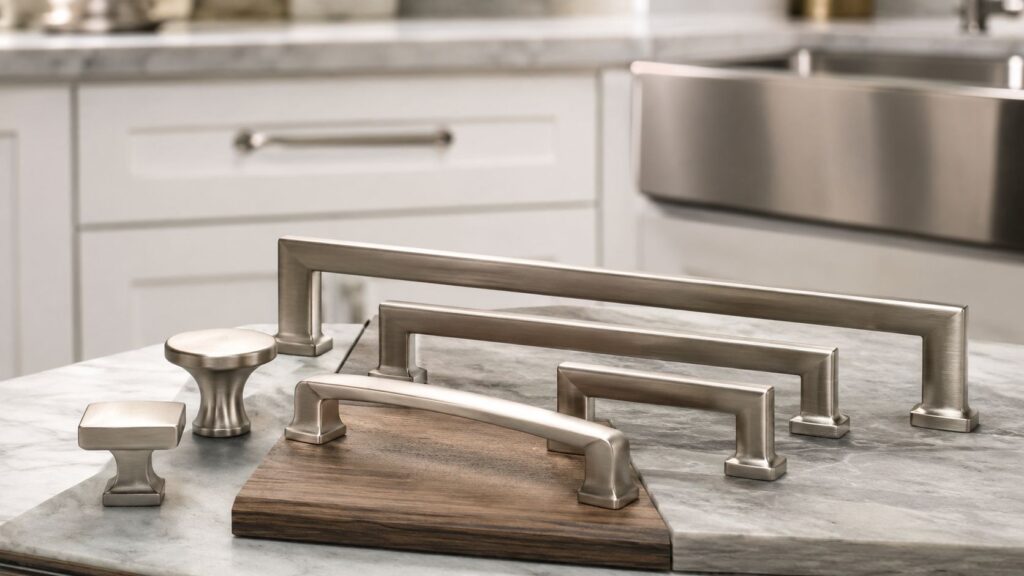
The cabinet doors are off, the breakfast nook is half-demolished, and the hardware samples are scattered across a temporary worktop. You're trying to choose between matte black, polished chrome, and brushed nickel before the new cabinets arrive, while your contractor is waiting for an answer that seems simple until you place the samples beside the countertop.
Many Cherry Hill and South Jersey remodels slow down at this point. The finishes look interchangeable on a screen, but they behave differently under kitchen lighting, around shower moisture, and beside existing faucets. Brushed nickel hardware is the dependable middle-ground choice, not a leftover finish. It offers a softer look than chrome, less visual weight than black, and enough flexibility to work with both painted cabinetry and wood tones.
The important qualification is that the label alone doesn't tell you how well a product will hold up. The base metal, coating method, installation, and cleaning routine matter just as much. You also need to separate brushed nickel from satin nickel, because manufacturers often use those names inconsistently. This guide gives you a practical way to choose, pair, measure, maintain, and source brushed nickel hardware before your next shipment arrives.
Table of Contents
- A Remodel Moment Worth Getting Right
- What Brushed Nickel Hardware Is
- Brushed Nickel vs Other Popular Finishes
- Styling and Pairing Across Kitchens and Baths
- Maintenance and How Long It Really Lasts
- Installation and Measurement Essentials
- Why Homeowners Source Hardware With The Cabinet Coach
- Your Next Step Toward a Cohesive Remodel
A Remodel Moment Worth Getting Right
The old drawer pulls in a 1980s Cherry Hill kitchen often reveal the problem before the cabinets do. The plating has worn where hands have grabbed it for years, the screw holes no longer feel perfectly secure, and every new sample looks like it might work until it's held against the cabinet color and countertop.
That decision deserves more attention than a quick catalog order. Hardware sits at eye level and gets handled constantly, so its finish affects both the character of the room and the way the renovation feels several years later. Matte black can create a crisp contrast, polished chrome can sharpen a contemporary room, and brushed nickel can connect the two without forcing the design into one narrow style.
Brushed nickel remains a standardized finish in major plumbing and hardware catalogs. Mountain Plumbing's finish matching guide lists brushed nickel as a named standard finish, identified as BRN, and its later guide continues to include brushed nickel alongside satin nickel and vibrant brushed nickel. That continued catalog presence makes it a practical specification, not a temporary novelty.
The decision you actually need to make
Don't ask only whether brushed nickel is attractive. Ask whether it suits the way your household uses the room.
- For a busy kitchen: Choose it when you want a finish that doesn't spotlight every fingerprint or water mark.
- For a mixed-material kitchen: Use it when stainless appliances, a nickel faucet, wood cabinetry, or white paint already need a visual bridge.
- For a bathroom: Consider it when you want warmth without the maintenance burden and glare of a highly polished surface.
- For a partial remodel: Verify the existing faucet, lighting, hinges, and exposed plumbing before ordering cabinet hardware.
A useful starting point is to treat the finish as a surface system rather than a color chip. You'll get a better result by checking what the product is made from, how its finish is applied, and whether an actual sample works in your lighting.
What Brushed Nickel Hardware Is
For a Cherry Hill remodel, start with the construction rather than the showroom label. Brushed nickel hardware is typically a nickel-plated finish with a matte, brushed texture. Mechanical abrasion creates the directional grain and muted sheen. The handle or knob underneath is usually another metal, so nickel covers the piece instead of forming the entire object.
That base-metal reality matters in a kitchen or bath. Handling, abrasive cleaners, and scratches can wear through the coating. Guidance on brushed nickel finish durability identifies the common failure as finish loss that exposes the base metal, not nickel itself rusting. Humidity can make that exposure more vulnerable, a relevant concern in bathrooms and homes near the coast.
Brushing also controls the look. The texture scatters reflected light, making fingerprints and small smudges less conspicuous than they appear on polished chrome. It does not make the hardware immune to damage. It gives everyday use a softer visual effect.
Read the specification, not just the finish name
The label creates avoidable confusion. One manufacturer may use brushed nickel, another satin nickel, and both products may appear nearly identical. Some manufacturers use those names for surfaces with different grain, warmth, or sheen. Finish codes and samples provide better evidence than the marketing term.
Check these details before ordering:
- Base metal: Confirm the substrate and whether the product is intended for humid locations.
- Finish description: Compare the finish code, sheen, and sample.
- Coating information: Ask how the finish is applied and whether a protective topcoat is included.
- Actual sample: View the hardware beside the faucet, cabinet door, countertop, and lighting in your home.
The finish choice also needs to work with the hardware layout. Use this knobs vs pulls kitchen guide for grip decisions, then review this cabinet hardware selection guide for scale and placement before committing to a product family.
Specification rule: A product page that gives only the finish name and no construction details provides incomplete information. Ask for the base metal, application method, and sample before approving the order.
Brushed Nickel vs Other Popular Finishes
A finish board becomes useful only when you test it against real conditions. In a small South Jersey bathroom, polished chrome may reflect every water mark, while matte black can become the strongest visual element in the room. In a kitchen with white cabinets and stainless appliances, brushed nickel usually integrates more subtly.
Polished chrome is the most reflective option in this group. It gives modern cabinetry a sharp, bright edge, but that same reflectivity makes fingerprints, splashes, and uneven grout lines more noticeable. Matte black offers stronger contrast and a more graphic look, though it can make a compact bath feel visually busy if the room already has dark tile or trim.
Satin nickel is the difficult comparison because the names overlap. Many manufacturers use satin nickel and brushed nickel interchangeably, while others produce surfaces with different grain, warmth, or sheen. Don't approve a mixed order based on the word “nickel.” Put the samples together.
| Finish | Reflectivity | Maintenance Burden | Best Paired With | Typical Use Case |
|---|---|---|---|---|
| Brushed nickel | Low to moderate, with visible directional texture | Moderate, with careful cleaning required | White cabinetry, wood tones, stainless appliances, nickel plumbing | Transitional kitchens, family baths, practical remodels |
| Satin nickel | Low, often smoother and slightly warmer | Moderate, depending on coating | Traditional cabinetry, softer stone, warm lighting | Classic and transitional interiors |
| Polished chrome | High and mirror-like | Higher visibility for spots and fingerprints | Contemporary tile, crisp white surfaces, modern lighting | Sleek kitchens and baths |
| Matte black | Very low, with strong contrast | Moderate, dust and residue can stand out | White, pale gray, wood, and monochrome palettes | Modern, industrial, or high-contrast rooms |
| Oil-rubbed bronze | Low, dark, and character-rich | Moderate, with variation between products | Warm wood, traditional cabinetry, aged details | Farmhouse, craftsman, and historic-inspired rooms |
Where brushed nickel earns its place
In a Haddonfield or Voorhees kitchen, brushed nickel is often the easiest finish to coordinate. It works with white and wood-toned cabinetry, sits comfortably near stainless appliances, and avoids the intense glare of chrome. It also doesn't impose the heavy contrast that black or bronze can create on a small cabinet wall.
Its weakness is visual restraint. If every surface in the room is smooth and pale, brushed nickel may look generic. Add interest through a fluted pull, a textured backsplash, a wood accent, or a light fixture with a related tone. For current cabinet planning, this kitchen cabinet hardware trends guide can help you compare shape and scale without confusing a design trend with a durability decision.
Zanda's commercial finish data provides a useful market signal. The company reported selling 29 brushed nickel products for every satin chrome product, and said brushed nickel represented over 45% of finish selections among its clients in that market. Read that as evidence of strong acceptance, not as a reason to buy blindly. The physical product still matters more than the popularity of its label.
Styling and Pairing Across Kitchens and Baths
In a Cherry Hill, Haddonfield, or Voorhees kitchen, brushed nickel succeeds when the surrounding finishes share its visual temperature. Check the faucet, pot filler, lighting, and visible plumbing beside the cabinet hardware under the room's actual lighting. They can come from different manufacturers, but the shapes and undertones should look related.
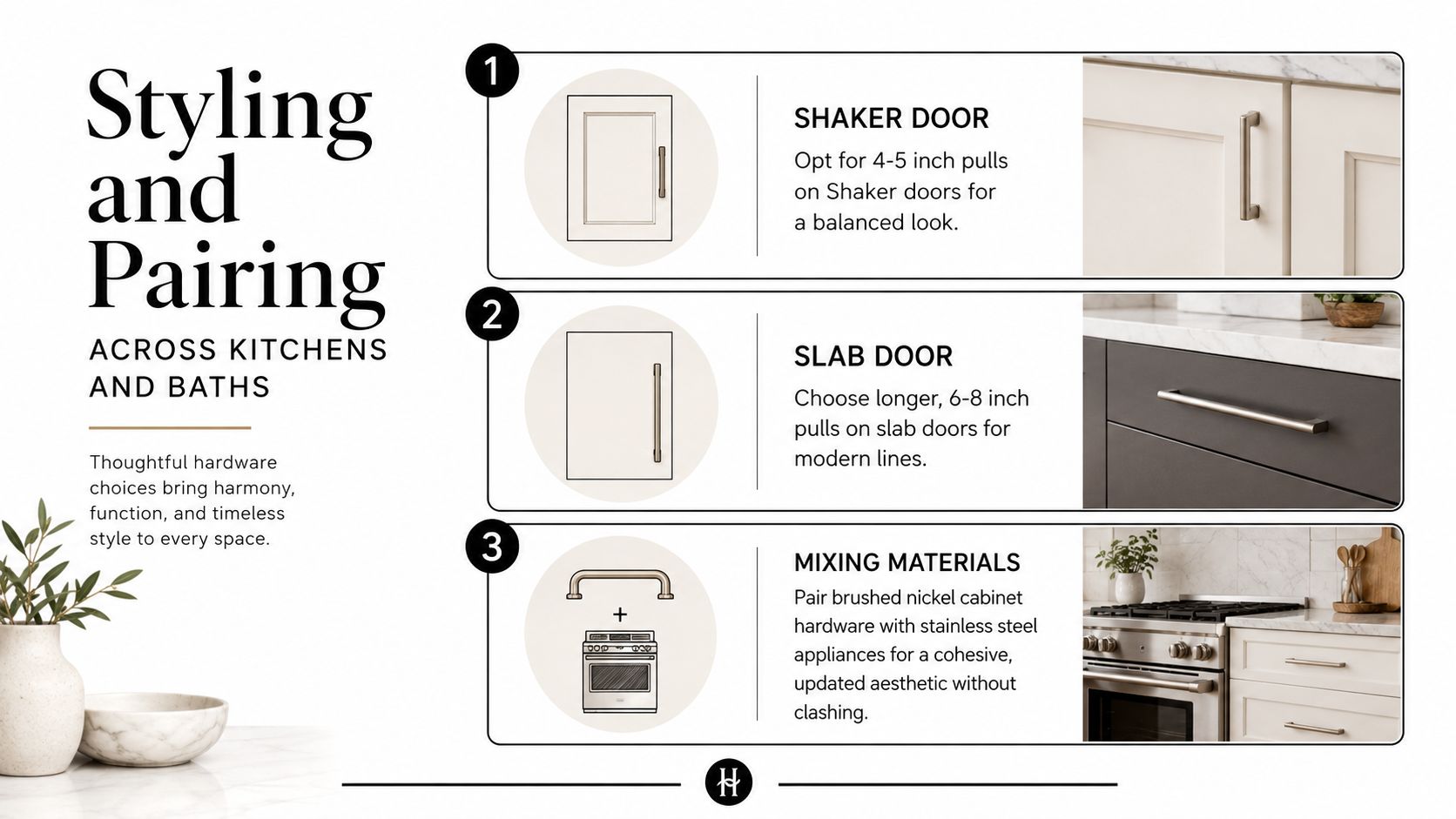
Match the pull shape to the cabinet profile first. Straight bar pulls suit Shaker and slab doors because their geometry follows the cabinet lines. Cup or bin pulls fit furniture-style and inset cabinetry, where their traditional form feels intentional. A decorative pull still looks wrong on a clean slab door, even when the finish matches.
Build a hierarchy across the room
Use brushed nickel on the cabinet pulls, faucet, and one visible lighting element when the kitchen needs a clear anchor. Stainless appliances can sit beside it because both belong to a cool metallic family, even though their surfaces differ.
Keep the hardware scale tied to the doors. Shorter pulls suit smaller Shaker doors, while longer pulls give broad slab drawers better proportion. Limit the dominant metal mix in one room. A third finish needs a deliberate role, not an accidental appearance through an overlooked hinge or decorative object.
Repeat the main finish in meaningful locations. Cabinet pulls, the faucet, and a pendant frame create enough visual continuity without forcing every metal to match.
Bathrooms give brushed nickel a straightforward supporting role. Use it across a widespread lavatory faucet, shower trim, towel bars, and vanity pulls. Against Carrara-look quartz, the finish can appear warmer and softer. Gray veining and bright LED lighting can make it read cooler, so compare a physical hardware sample with the stone before approving the order.
Cabinet color and countertop undertone matter just as much. Review these countertop and cabinet combinations before finalizing the metal. Brushed nickel remains a dependable middle ground in 2026, but product labels create confusion. Some listings use “satin nickel” for a similar appearance, while the base metal and coating can differ. Check the actual product specifications and sample before assuming two finishes will coordinate.
An older South Jersey colonial may already contain polished chrome or brass. Keep one existing finish only when it looks intentional and appears elsewhere in the room. Otherwise, replace the most prominent pieces first, then judge the balance before introducing another metal.
Maintenance and How Long It Really Lasts
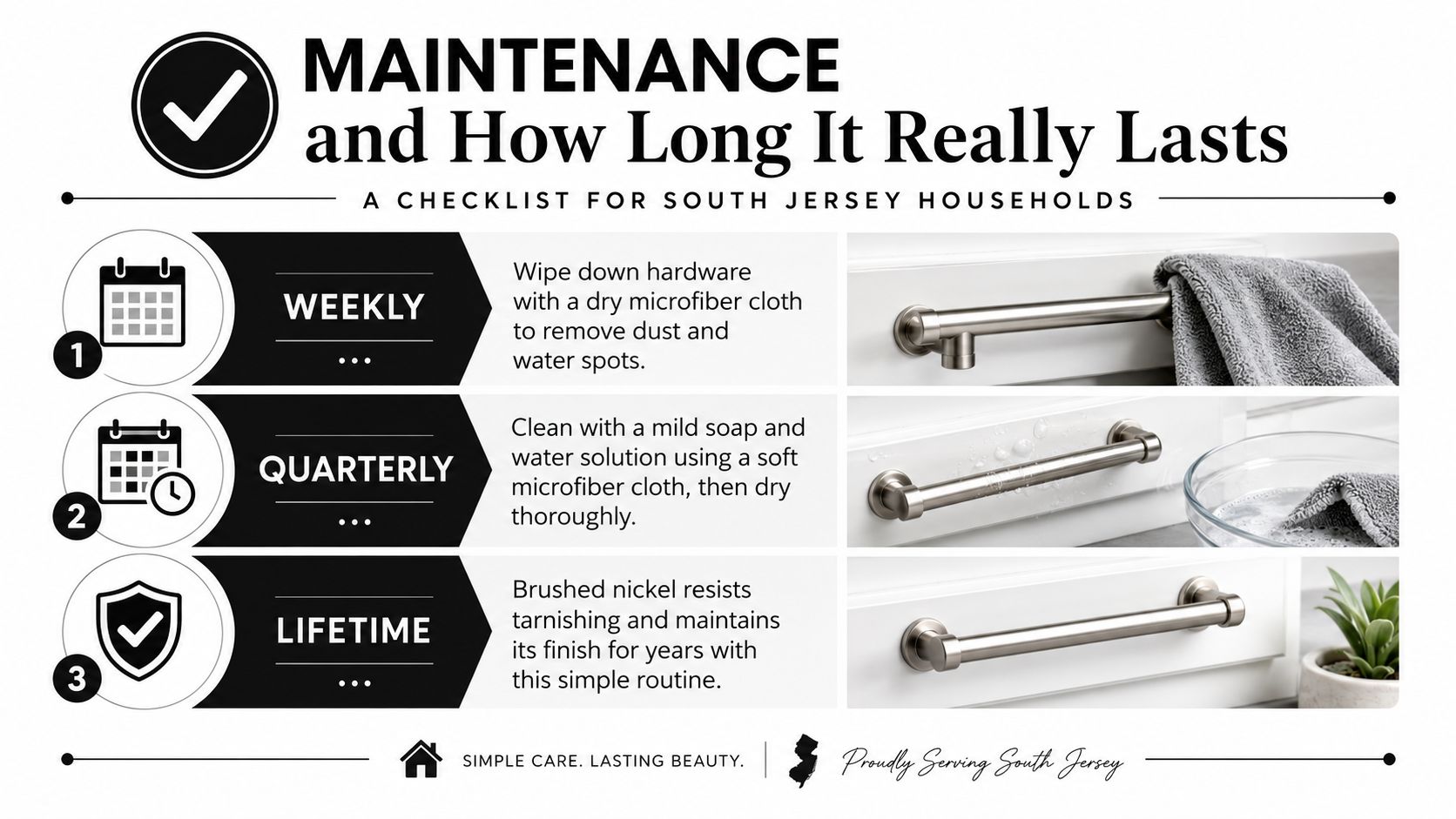
Brushed nickel hardware lasts when you clean it like a coated finish, not like bare metal. The surface can tolerate ordinary household use, but abrasive products and rough tools can create fine scratches that gradually dull the texture or expose the substrate.
For routine care, use mild soap, water, and a soft, lint-free cloth. Wipe the hardware, then dry it immediately. Manufacturer guidance for brushed nickel care and maintenance specifically discourages abrasive pads, abrasive cleaners, metal polish, ammonia, alcohol, and soaking. It also recommends cleaning door hardware at least monthly to reduce grime buildup and moisture retention.
A routine that works in a real household
- After wet use: Dry faucet handles, shower controls, and nearby pulls with a microfiber cloth instead of letting water sit.
- During regular cleaning: Use a small amount of mild soap diluted in water, wipe gently, and remove all residue.
- At least monthly: Clean frequently handled door hardware, especially around the kitchen, mudroom, and bathroom.
- Avoid entirely: Skip bleach, ammonia, alcohol, metal polish, abrasive sponges, and descaling products unless the manufacturer explicitly approves them.
South Jersey homes near the shore face more humid air, while some inland households deal with mineral spotting from well water. Both conditions make drying more important. The finish doesn't fail because a room is used; it fails faster when moisture, residue, and friction stay on the surface.
Don't accept a universal lifespan promise for brushed nickel hardware. Independent guidance notes that durability depends heavily on the base metal and coating method, and budget pieces can deteriorate quickly in humid bathroom conditions. Look for pitting, peeling, green spotting, or exposed darker metal. Those signs indicate coating or substrate failure, not ordinary dirt that needs stronger cleaner.
Installation and Measurement Essentials
Measure before you shop. A pull's advertised overall length isn't the measurement that determines whether it fits existing holes. You need the center-to-center distance, which is the space between the centers of the mounting screws.
Record four details for every existing pull:
- Center-to-center spacing: Measure from screw center to screw center, preferably in millimeters and inches.
- Overall length: Measure the full end-to-end dimension so the replacement doesn't collide with adjacent doors.
- Projection: Check how far the hardware extends from the cabinet face, especially beside a narrow walkway.
- Door or drawer thickness: Confirm the screw can pass through the material and engage the pull without bottoming out.
Common drawer banks may use 3-inch or 3-3/4-inch hole spacing, but don't assume the old hardware follows a standard. Existing cabinets often contain unusual spacing, and a small error can force you to fill, repaint, replace, or visibly live with a misaligned hole.
| Component | Center-to-Center | Typical Location | Screw Length |
|---|---|---|---|
| Cabinet knob | Single hole | Doors and small fronts | Match the cabinet thickness and hardware depth |
| Short pull | Existing spacing, often 3 inches or 3-3/4 inches | Smaller doors and narrow drawers | Confirm against the actual door or drawer front |
| Medium pull | Existing spacing, often wider than short pulls | Standard drawer banks | Choose after measuring the material |
| Appliance pull | Larger spacing designed for heavy fronts | Panel-ready refrigerators and dishwashers | Follow the manufacturer's mounting specification |
Prevent a drilling mistake
For a replacement project, buy one sample before ordering the full quantity. Install it on a representative door, open nearby drawers, and check whether fingers can wrap comfortably around the grip.
For new holes, use a drilling jig or template. A cardboard mock-up works as a quick visual check, especially when you're deciding whether knobs or pulls should align vertically, horizontally, or along a consistent rail. Mark the centerline on painter's tape, not directly on the finished cabinet.
Be cautious with particleboard doors and drawer fronts that already have holes. New holes placed slightly off-center can be difficult to disguise, and the repair may look worse than the original hardware. The cabinet hardware placement guide is useful for establishing consistent alignment across a full cabinet wall.
Installation rule: Never order the complete set until one piece has been mounted and tested on the actual cabinet.
Why Homeowners Source Hardware With The Cabinet Coach
A brushed nickel order can go wrong before installation. One brand's satin nickel may look warmer than another's, a faucet may arrive with a different silvery tone, or replacement pulls may miss the existing holes. Returning hardware wastes time. Re-drilling finished cabinet doors creates a larger repair problem.
For South Jersey homeowners, physical comparison is the practical advantage of a mobile showroom. Samples can be viewed beside cabinet color, countertop veining, backsplash, appliances, and lighting instead of judged from a small product photograph. Warm wood stains can make brushed nickel appear cooler, while gray quartz can emphasize its silvery character. This side-by-side check also exposes the satin-nickel naming confusion and helps distinguish a finish label from the base metal and coating underneath.
The Cabinet Coach brings cabinetry, countertop, hardware, and tile selections into an in-home design process. Its Cabinet Coach experience includes consultation and project guidance for decisions tied to cabinet layout, plumbing fixtures, and installation timing. That coordination matters more than treating hardware as a separate online purchase.
When guided sourcing earns its place
DIY ordering works when hole spacing is confirmed, the finish already suits the room, and the replacement involves a small, straightforward group of pieces. An in-home consultation makes more sense when the renovation includes several manufacturers, mixed metals, or existing conditions that limit your choices.
- The project is phased: Some fixtures remain while cabinets, vanity hardware, or lighting change.
- The finish name is unclear: Satin nickel, brushed nickel, and related variants appear on the same sample board.
- The cabinets are finished: Incorrect drilling could leave visible holes or require repairs.
- The lighting varies: Warm pendants, cool LEDs, and daylight can change how metal appears.
- The schedule is tight: Lead times and backorders may affect cabinet installation or final trim work.
The value is coordinated judgment, not access to more products. A specialist can compare samples, verify measurements, identify a finish mismatch, and flag whether a product suits placement near a sink, shower, dishwasher, or range. They can also keep the hardware decision aligned with the cabinet style and the room's existing metal finishes.
This approach fits Cherry Hill, Haddonfield, Voorhees, and nearby South Jersey communities, where an older colonial layout may be receiving new cabinetry and modern plumbing. Brushed nickel remains a dependable middle-ground finish in 2026, but the product still needs scrutiny. Choose hardware that looks selected with the room, not attached after the renovation was finished.
Your Next Step Toward a Cohesive Remodel
Brushed nickel hardware is a sound choice when you want a finish that sits between warm and cool, polished and muted, traditional and contemporary. It won't solve every design problem, and the name doesn't guarantee quality. Choose the product by its construction and coating, then judge the finish beside the materials already in your home.
Use this short checklist before placing an order:
- Photograph the room in daylight: Include cabinets, countertops, backsplash, faucet, appliances, and exposed lighting.
- Measure every existing hole: Record center-to-center spacing, overall length, projection, and cabinet thickness.
- Compare physical samples: Put brushed nickel beside satin nickel and any existing chrome or brass instead of relying on catalog labels.
- Plan the finish hierarchy: Decide which metal leads, which one supports it, and whether a third finish is necessary.
- Test one piece first: Mount a sample on a representative door or drawer before buying the complete set.
- Match maintenance to the household: If the hardware will sit beside a shower, sink, dishwasher, or range, favor a product with clear construction information and commit to gentle cleaning.
The most dependable result comes from treating hardware as part of the renovation design, not as a final accessory. A coordinated review of cabinet style, countertop, faucet, lighting, existing holes, and finish samples can prevent the small errors that become expensive after installation.
The Cabinet Coach provides in-home guidance for coordinating cabinet hardware, cabinetry, countertops, tile, and plumbing finishes across South Jersey kitchen and bathroom remodels. Visit The Cabinet Coach to arrange a consultation and review brushed nickel samples in your actual space before you order.