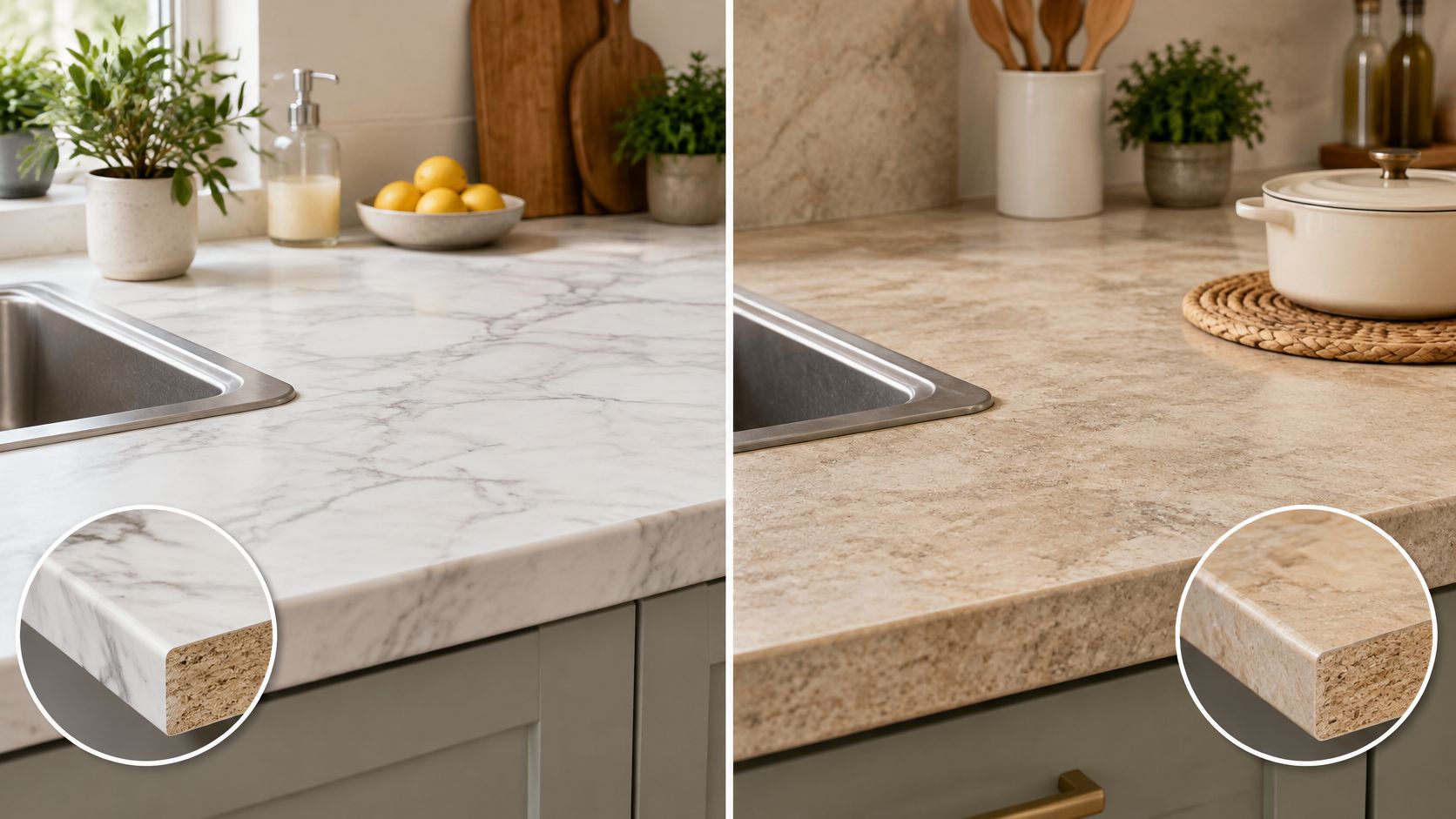
Choosing between Formica and laminate is less like choosing between competing materials and more like choosing a brand within a material category. The brand name alone doesn't tell you whether a countertop belongs beside your range, how its sink opening will be protected, or what's underneath the decorative surface. Those are specification questions, and they're the questions that make a useful countertop comparison.
Table of Contents
- Formica vs Laminate Countertops Side by Side
- How Formica and Generic Laminate Are Built
- Choosing the Right Laminate Grade for Each Surface
- Where Heat, Scratches and Water Damage Start
- Keeping Laminate Countertops Looking New
- What Formica and Laminate Cost Over Time
- Which Laminate to Specify for Your Kitchen or Bath
Formica vs Laminate Countertops Side by Side
Formica is a brand of high-pressure decorative laminate, or HPL; laminate countertop is the broader material category. The practical comparison is Formica-branded HPL against another manufacturer's specified HPL product, not Formica against an entirely different material.
The Smithsonian's Formica company history records that the Formica Products Company was founded in Cincinnati in 1913, with a name derived from “for mica” because its original electrical-insulation material replaced mineral mica. That industrial origin helps explain the familiar name, but it doesn't establish which current product is right for your kitchen.
Formica-branded HPL vs generic laminate countertops
| Criterion | Formica-branded HPL | Generic laminate countertop |
|---|---|---|
| Type | High-pressure decorative laminate from one manufacturer | Laminate category made by many brands |
| Construction | Resin-impregnated layers bonded to a substrate | Comparable layered paper, resin and substrate build |
| Surface resin | Melamine-based wear layer in decorative grades | Manufacturer's specified resin system |
| Short-term heat | Published general-purpose limits apply to the specified grade | Use the named product's technical data sheet |
| Prolonged heat | Sustained heat can separate laminate from its substrate | Verify the manufacturer's sustained-heat warning |
| Best fit | Kitchen and bath surfaces when the grade is specified | Budget-conscious projects when the grade is verified |
The distinction is easier to see when the brand and category sit side by side.
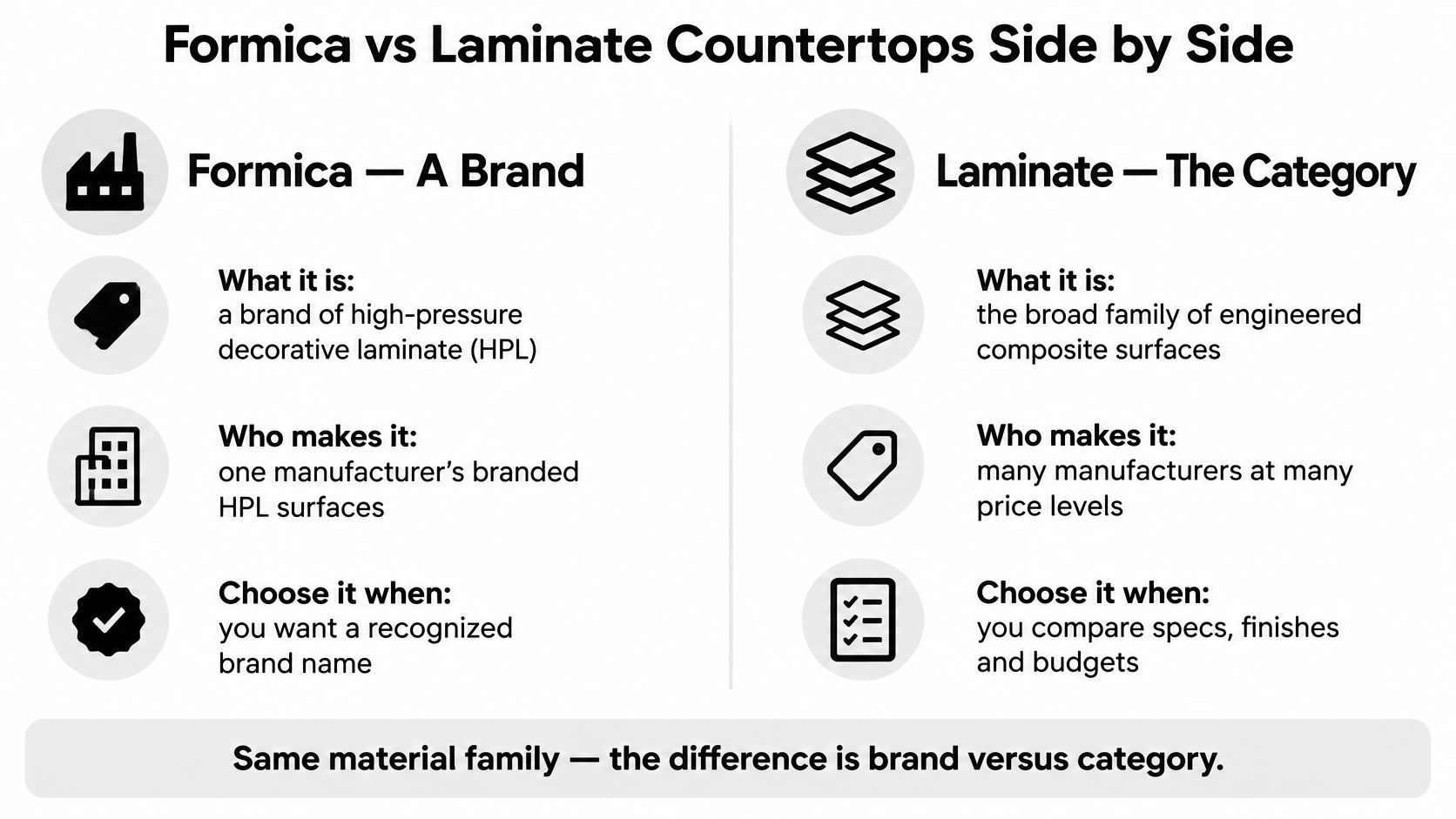
What the name does and doesn't add
A named brand gives you an identifiable manufacturer and a product range to investigate. It doesn't replace the need for a product code, technical sheet, or installation specification. Likewise, a quote that says only laminate leaves too much unresolved to judge its value.
When comparing Formica vs laminate countertops, start with these checks:
- Grade: Confirm that the sheet is rated for the surface where it will be installed.
- Substrate: Identify the board beneath the laminate, rather than judging only the sample's face.
- Seam placement: Ask where the fabricator will join sections, especially around wet areas.
Say competing quotes show similar stone-look finishes. If one identifies the laminate grade and substrate while the other lists only a color, they aren't yet comparable offers.
If you're still deciding whether laminate suits your habits at all, our countertop material comparison helps frame that broader choice. Once you've chosen laminate, judge the complete countertop assembly rather than the familiarity of its label.
How Formica and Generic Laminate Are Built
A conventional laminate countertop is an engineered composite, not a solid slab. The National Building Museum's account of historic Formica laminate describes the paper-and-resin construction and the development of a harder melamine-resin surface over earlier phenolic-resin technology.
Think of the countertop as a protective decorative sheet attached to a supporting board. The sheet supplies the visible finish and wearing surface; the board supplies the countertop's body.
This cross-section separates those jobs.
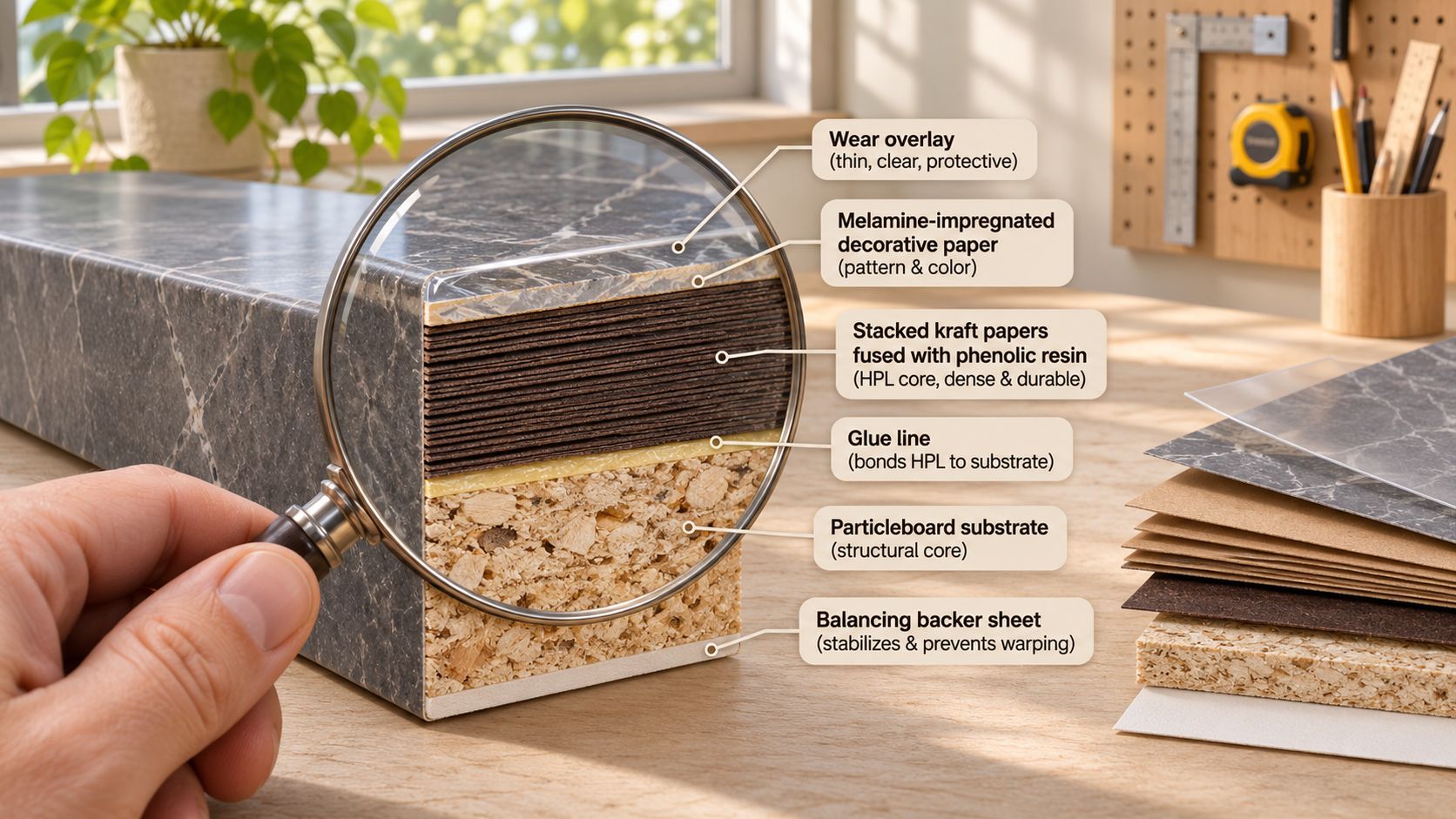
Read the assembly from the top down
- Protective surface: The resin-rich face provides the smooth, nonporous working surface. In decorative grades, melamine resin contributes hardness and wear resistance.
- Decorative paper: The printed layer supplies the color, wood appearance, or stone-like pattern. A convincing stone print is still a decorative layer, not stone throughout the counter.
- Reinforcing layers: Resin-impregnated paper layers are compressed under heat and pressure to form the laminate sheet.
- Supporting substrate: The finished laminate is bonded to a board such as particleboard or medium-density fiberboard, commonly called MDF.
The distinction between sheet and substrate matters when looking at a thick countertop edge. Its apparent thickness doesn't tell you the thickness or grade of the decorative laminate itself.
Compare assemblies, not just faces
A Formica sample and another manufacturer's sample can look equally suitable while representing different finished constructions. Texture, edge treatment, board selection, and fabrication all belong in the comparison.
For example, a flat sample doesn't show how an applied edge meets the top. Nor does it show the bond between the sheet and board or the support beneath an overhang. Those details become visible only when you review an edge sample and the proposed assembly.
Practical rule: A countertop sample shows the finish. An assembly specification tells you what you're buying.
The nonporous face also shouldn't be confused with a moisture-proof countertop from top to bottom. The surface and supporting board have different properties, so a good specification identifies both. That's why two counters made with comparable decorative sheets can behave differently once installed.
Choosing the Right Laminate Grade for Each Surface
Use horizontal-rated laminate for worktops and vertical-rated laminate for panels. Grade numbers identify particular products, so confirm the manufacturer's stated application instead of assuming the same numbering system applies across brands.
The laminate technical documentation identifies minimum ball-impact performance of 30 inches for Grade 12 horizontal material and 20 inches for Grade 20 vertical material, with a 400-cycle minimum wear result cited under ANSI/NEMA LD3 testing.
Laminate grades and where each belongs
| Grade and use | Ball-impact minimum | Wear minimum | Typical placement |
|---|---|---|---|
| Grade 12 horizontal | 30 in | 400 cycles minimum, ANSI/NEMA LD3 | Kitchen worktops and heavy-use counters |
| Grade 20 vertical | 20 in | 400 cycles minimum cited, ANSI/NEMA LD3 | Backsplashes, cabinet fronts and low-impact surfaces |
What the tests actually tell you
Ball-impact testing helps distinguish materials intended for different levels of impact exposure. A kitchen worktop must accommodate the possibility of a dropped utensil or a knock from a heavy appliance. A cabinet end panel has a different job.
The test height isn't permission to drop a pan from that height. Test equipment, impact conditions, and the finished countertop assembly differ from whatever happens in your kitchen.
Wear testing is similarly useful as a controlled comparison, not a household calendar. A cycle result doesn't translate directly into years of service, and it doesn't establish that the surface will withstand knife cuts.
Passing a wear test doesn't turn a decorative laminate surface into a cutting board.
Separate standards from product promises
The same technical documentation reports that Formica Infiniti meets minimum ISO 4586-2 and ANSI/NEMA LD3-2005 requirements, lists a “slight effect” for boiling-water and high-temperature resistance, and classifies its 50 to 100 linear glass-scratch cycles as moderate. Those are product-specific findings, not blanket promises for every Formica finish or every laminate counter.
Read the test description alongside the result. Scratch resistance, wear resistance, impact resistance, and heat resistance describe different stresses; a favorable result in one doesn't establish equal performance in the others.
Turn the grade into a usable specification
Start with the intended surface, then match the exact product:
- Worktop: Request written confirmation of a horizontal rating.
- Wall or cabinet panel: Confirm that the selected vertical product suits the exposure.
- Finished edge: Make sure the chosen sheet and fabrication method suit the proposed profile.
- Supporting board: Keep the substrate specification attached to the laminate selection.
A decorative pattern may be available in more than one grade or finish. Approving the color shouldn't inadvertently approve whichever sheet happens to be quoted.
Our guide to how to choose kitchen countertops helps connect these technical decisions with cooking habits, appearance, and the rest of the remodel. The useful outcome is a named product with a stated application, not just a reassuring brand name.
Where Heat, Scratches and Water Damage Start
A tough top surface doesn't protect every part of a laminate countertop equally. Heat can affect the bond beneath it, a knife can damage the decorative face, and water can reach the supporting board through an opening.
Heat can damage the bond
For its general-purpose Grade 10/HGS laminate, Formica's technical guidance states that short-term exposure can reach approximately 275°F (135°C), but prolonged exposure at or above 140°F (60°C) may separate the laminate from its substrate.
Those are different exposure conditions, not competing ratings. Brief contact and sustained heating don't place the same demands on the assembly, so the higher figure isn't a safe operating temperature for an appliance left running on the counter.
Use a heat-protective trivet under hot cookware and suitable protection beneath heat-generating appliances. For a slow cooker or countertop oven, follow both the appliance's clearance instructions and the countertop manufacturer's protection requirements.
Cuts affect the visible surface
A knife can mark or cut the decorative surface even when the laminate performs well under ordinary wear. Use a cutting board for food preparation, including quick jobs such as slicing a lemon or trimming bread.
Don't try to remove a cut by sanding the countertop. Unlike a material with the same appearance throughout its thickness, laminate has a decorative face that you can damage further by abrading it.
Water needs only an entry point
The important water paths are sink cutouts, countertop joints, dishwasher-side seams, and exposed board edges. Water that gets past the protective surface can swell particleboard or MDF beneath it.
Consider a sink area that looks clean and intact across its broad surface. A small opening at the rim or nearby joint can still expose the board, which is why the quality of that junction matters more than the appearance of the surrounding print.
| Hazard | Protective habit | Detail to verify |
|---|---|---|
| Hot cookware or appliances | Use suitable heat protection | Appliance location and countertop instructions |
| Knives | Prepare food on a cutting board | An accessible prep-board storage spot |
| Water at openings | Wipe up pooling water | Sealed cutouts, joints, and exposed edges |
Inspect sink edges and seams regularly for lifting, gaps, or swelling. If an edge starts to rise, address the moisture source before treating the visible joint.
The published heat figures apply to the specified Formica general-purpose product. Don't accept those limits for another manufacturer's laminate unless its own technical sheet supports them.
Keeping Laminate Countertops Looking New
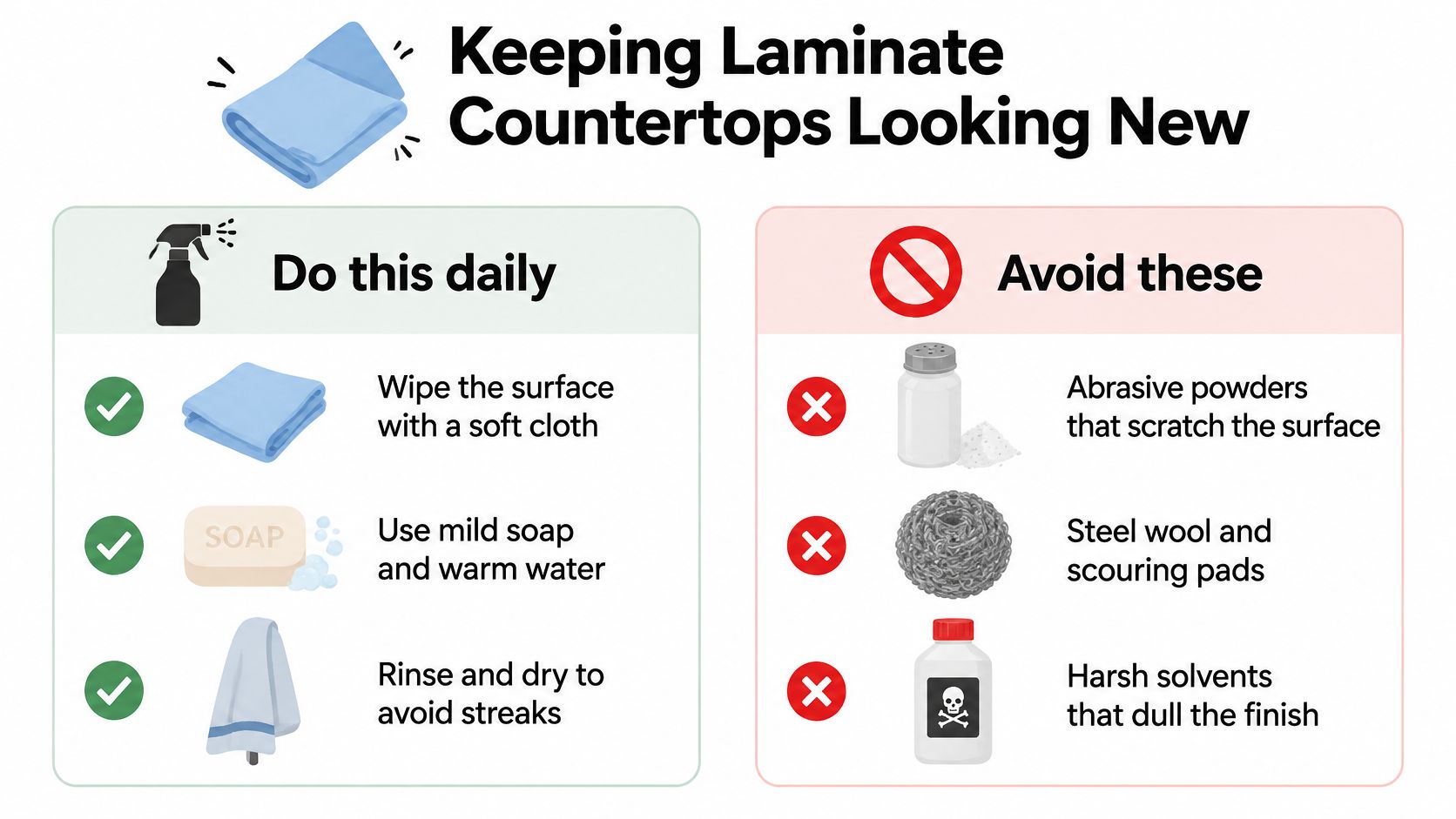
For routine cleaning, use a soft cloth, mild soap, and warm water, then rinse away residue and dry the surface. Apply cleaner to the cloth rather than soaking joints or letting liquid collect along the sink.
Keep the basic care routine visible and uncomplicated.
Clean without wearing away the finish
Avoid abrasive powders, steel wool, and aggressive scouring pads. Don't reach for a harsh solvent just because a mark resists the first wipe; confirm that any stronger cleaner is approved for the named laminate.
For grease or dried food, let a compatible non-abrasive cleaner soften the residue, then lift it with a soft cloth or non-scratch pad. Rinse and dry rather than repeatedly scrubbing the same spot.
- At seams: Remove residue gently and leave the joint dry.
- Around sinks: Dry the rim and the countertop-to-backsplash junction.
- Under appliances: Unplug and move portable appliances safely before cleaning and drying beneath them.
Our laminate countertop cleaning guide provides a practical reference for the cleaning routine. Keep the product's own care instructions with your remodeling paperwork.
The following video offers an additional visual reference.
Treat repairs differently from cleaning
A compatible, color-matched laminate repair kit can disguise some small chips or scratches. It won't make a damaged decorative layer new again, and it won't correct a swollen board or failed bond.
Have lifting seams or deep damage assessed before applying filler or fresh sealant. Keep the pattern code, finish code, and a usable offcut if available, so a fabricator can evaluate a repair or replacement match.
Inspect sink caulk during routine maintenance. Replace it when it cracks or pulls away, using a sealant compatible with the sink and countertop materials rather than covering loose, contaminated caulk with another bead.
What Formica and Laminate Cost Over Time
Don't treat the difference between quote totals as a brand premium until you've matched the specifications. A custom edge, different substrate, additional fabrication, or removal work can change the offer without changing the decorative laminate brand.
Neither a Formica label nor an unnamed laminate description establishes value by itself. Compare the work each fabricator has included.
Quote line items to compare
| Line item | What to request |
|---|---|
| Material per linear foot | Grade, thickness and brand stated |
| Sink cutout and faucet holes | Count and sealing method |
| Edge profile | Profile and treatment named |
| Seam count | Number and placement of joints |
| Substrate upgrade | Particleboard or MDF type stated |
| Old top removal | Included or billed separately |
Separate purchase price from ownership cost
A lower initial quote isn't necessarily a saving if it omits moisture protection or specifies an unsuitable product. Conversely, paying more for a recognized name doesn't automatically buy better edge fabrication or installation.
Use a simple ownership calculation: total installed cost divided by a realistic service-life assumption gives an estimated annual cost. Treat that service life as an assumption, not a manufacturer promise, and consider how repair or early replacement would affect the comparison.
Our countertop pricing by material guide can help organize the broader budget. For the actual purchase, use current fabricator prices rather than a national estimate applied to an unknown layout.
Make the bids comparable
- Match the scope: Use the same layout, backsplash, edge, and removal requirements.
- Identify the assembly: Request the substrate type and the exact laminate product.
- Document protection: Ask how sink cutouts and seams will be sealed.
- Clarify exclusions: Identify plumbing, disposal, and other work outside the countertop price.
Place competing bids side by side before choosing. If one total is substantially different, ask the fabricator to identify the specification or scope difference instead of assuming the brand explains it.
Which Laminate to Specify for Your Kitchen or Bath
Specify by location first, then choose the pattern and manufacturer. The right laminate for a cabinet panel isn't automatically the right laminate for the worktop beside it.
Specification by application
| Application | Recommended grade | Key precaution |
|---|---|---|
| Kitchen worktop beside the range | Horizontal-rated | Trivets for hot pans and protection from sustained appliance heat |
| Kitchen worktop near the sink | Horizontal-rated | Sealed sink cutout and sealed dishwasher-side seams |
| Bathroom vanity top | Horizontal-rated | Sealed sink cutout and edges protected from standing water |
| Island with overhang | Horizontal-rated | Supported overhang to prevent sag and edge damage |
| Backsplash or wall panel | Vertical-rated | Low-impact use outside direct water spray |
| Cabinet fronts or end panels | Vertical-rated | Appropriate edge treatment and low-impact use |
A busy family kitchen
Choose a horizontal-rated product and plan where hot cookware will land before finalizing the layout. Put the trivet where someone taking a pan off the range will use it, not in a distant drawer.
Think about wet work in the same practical way. A dishwasher unloading area, drying rack, and sink rim all influence where moisture collects, so review the proposed joints against those daily tasks.
Before approving fabrication: Mark the sink, appliances, joints, and overhang supports on the same drawing.
For an island, check support as part of the design rather than treating it as an installation detail to resolve later. The laminate choice and the supporting cabinetry need to work together.
A bathroom vanity or investment property
A bathroom vanity still needs a horizontal-rated top even though it isn't used for cooking. Give attention to the sink opening, faucet area, and places where wet toiletries or washcloths may sit.
For a rental or resale project, keep the specification clear enough that substitutions are visible. Write the required horizontal rating for worktops and the appropriate vertical rating for panels into the agreement, along with the product identification and edge treatment.
Budget discipline means paying for the right application, not upgrading every visible panel to a worktop specification. It also means refusing a vague description that makes an unsuitable substitution difficult to spot.
A coordinated design-led kitchen
Once the performance requirements are settled, compare the countertop with the cabinet door, flooring, backsplash tile, and hardware together. A pattern that looks restrained on a small chip may appear much busier across an island.
Our guide to granite-look laminate countertops helps narrow the visual direction without confusing a stone-like print with stone performance. Check texture and sheen as carefully as color.
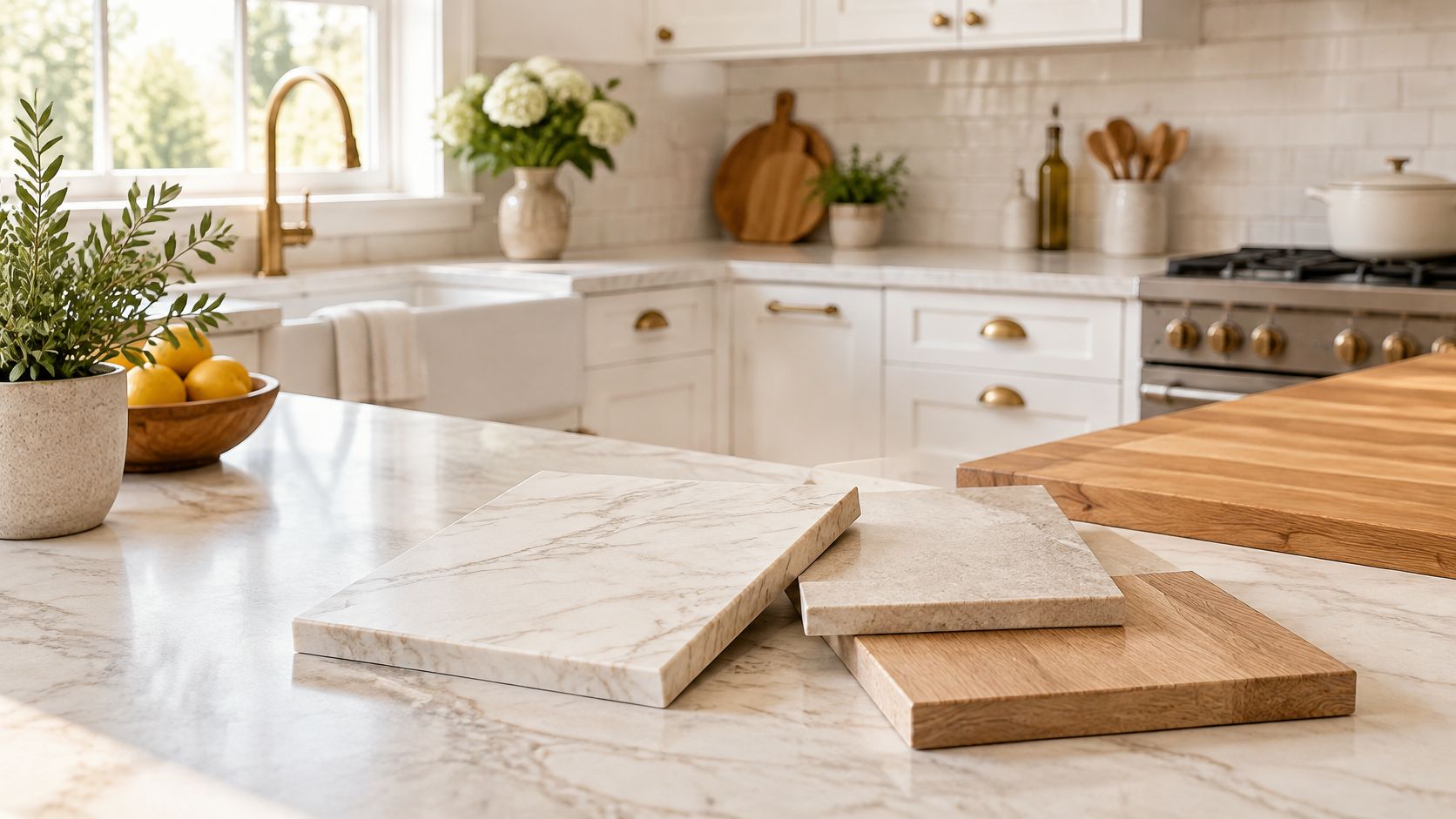
At The Cabinet Coach, we help customers choose countertop surfaces that match their cabinet style and withstand daily use. We bring full-size samples of cabinetry, countertops, hardware, and tile to the home for comparison with an experienced guide, so selections can be judged under the home's own lighting.
We also guide the complementary choices, from backsplash tile to hardware, rather than selecting the countertop in isolation. That's useful whether you're remodeling a Cherry Hill kitchen or coordinating a bathroom elsewhere in South Jersey.
Before ordering, request the product grade in writing, compare fabricator quotes line by line, and review full-size samples at home. Choose the brand after the assembly meets your needs, not instead of checking it.
The Cabinet Coach brings cabinetry, countertop, hardware, and tile samples to your home and helps coordinate selections around your style, budget, and daily use. Visit The Cabinet Coach to arrange a consultation and compare laminate options alongside the cabinet finishes and details planned for your kitchen or bath.