
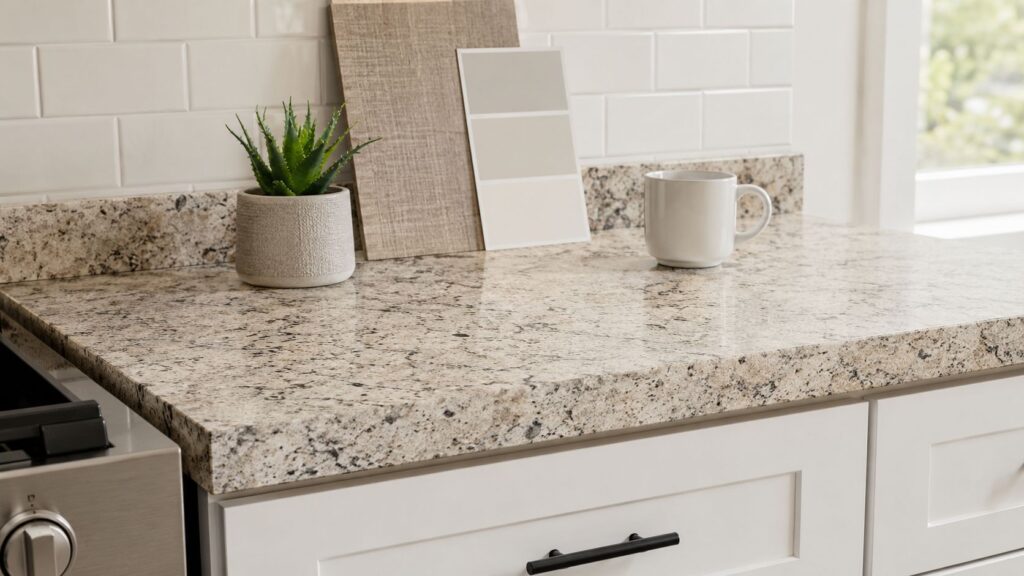
You're probably in the same spot a lot of South Jersey homeowners hit during kitchen planning. You want the rich, grounded look of granite. You want the kitchen to feel finished, not builder-basic. Then the estimates start coming in, and suddenly the countertop line item gets a lot more attention than you expected.
That's where granite look alike laminate countertops come into the conversation. Not as the old shortcut people remember from decades ago, but as a realistic design option for the right project, the right budget, and the right timeline. In many kitchens, they can absolutely deliver the visual effect a homeowner wants.
The part most articles skip is what happens after the install, especially in a humid South Jersey home. A countertop can look great in a sample or on day one and still be the wrong choice if moisture gets into the core around seams, sink edges, or poorly sealed transitions. That's the trade-off worth understanding before you commit.
Table of Contents
- The High-End Kitchen Look Without the High-End Price Tag
- What Exactly Are Granite Look Laminate Countertops
- The Real Pros and Cons for South Jersey Homeowners
- Laminate Compared to Granite Quartz and Solid Surface
- How to Make Laminate Countertops Look Genuinely High-End
- Installation and Expert Guidance in South Jersey
The High-End Kitchen Look Without the High-End Price Tag
A common remodel scenario looks like this. The cabinets are staying or getting painted, the backsplash is overdue, and the homeowner wants the counters to do most of the visual lifting. Granite is the inspiration. The budget says otherwise.
That doesn't automatically mean the kitchen has to settle for a flat, dated surface. Modern laminate has changed enough that many homeowners are surprised by what's available once they start sampling current lines instead of picturing what they saw in older homes. If your goal is to improve the look of the room without pushing the whole project into premium-stone pricing, laminate deserves a serious look.
Granite look alike laminate countertops work best when the homeowner is clear-eyed about the job they need the material to do. If the project is a style refresh, a resale-minded update, a first-home improvement, or a smart budget remodel, laminate can be a very sensible choice. It gives you room to spend elsewhere, such as better lighting, cabinet hardware, paint, tile, or layout improvements that may affect daily life more than the countertop material alone.
For many kitchens, the smartest remodel isn't the one with the most expensive surface. It's the one with the best balance of appearance, durability, and budget.
If you're trying to stretch dollars across the whole room, these budget kitchen upgrades that create visible impact often matter just as much as the countertop itself.
What Exactly Are Granite Look Laminate Countertops
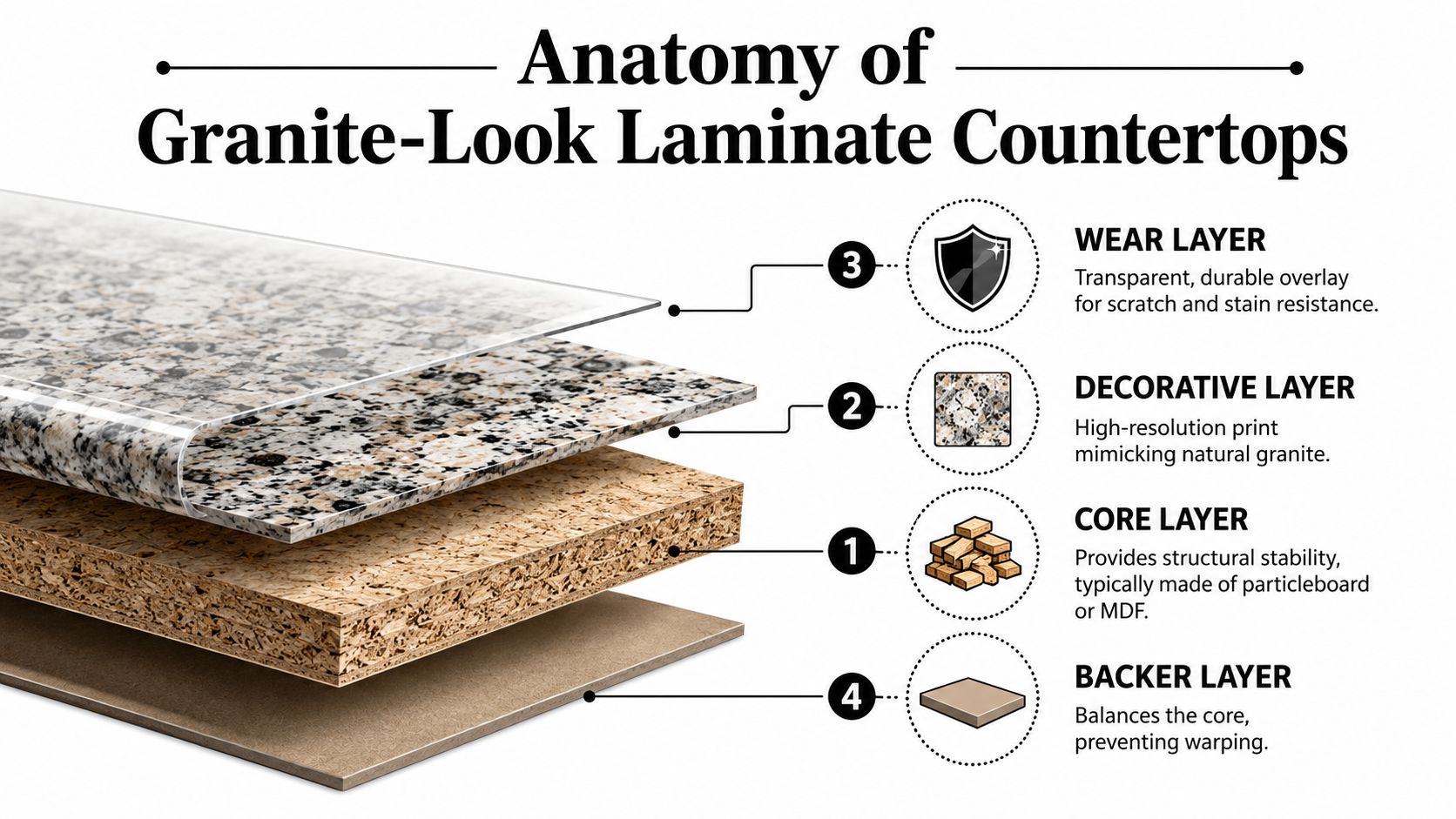
Granite look alike laminate countertops are built surfaces designed to mimic natural stone through printed pattern, texture, and finish. They aren't stone slabs. They're layered products, and understanding those layers helps explain both the appeal and the limitations.
How the build-up works
At the center is usually a particleboard or MDF core. That core provides shape and structure. On top of it sits the decorative printed layer that carries the granite pattern. Above that is a protective wear layer that helps the surface stand up to normal kitchen use. A balancing layer underneath helps keep the assembly stable.
A simple way to think about it is this. The visual realism comes from the printed and textured top. The long-term risk comes from the wood-based core underneath if moisture reaches it.
That's why laminate can look convincing from across the room and still need more care around sinks, seams, faucet penetrations, and exposed edges than stone does.
Why today's patterns look better
Older laminate had a reputation for obvious repetition and limited style choices. Current products are different. Granite look-alike laminate countertops now offer over 100 distinct colors, patterns, and textures, including high-fidelity reproductions of popular natural stone looks, according to Marble.com's laminate versus granite cost and design comparison.
That same source notes the cost difference that keeps laminate relevant. The average total installation cost for laminate countertops ranges between $800 and $1,700, or about $10 to $50 per square foot, while granite typically runs $35 to $100 per square foot with total installation costs between $2,000 and $4,500. Marble.com also states laminate is 60% to 75% more affordable than granite in that comparison.
Those numbers matter, but what matters in design terms is what they buy you. Laminate gives homeowners access to dramatic veining, speckled mineral looks, soft movement, deep charcoal patterns, warm beige stone visuals, and lighter marble-inspired surfaces without committing the budget to natural slab material.
Practical rule: Sample laminate in the actual kitchen light. A pattern that looks like granite under showroom lighting can read flatter under north-facing windows or warm recessed cans.
Finish matters too. Some laminates come in matte or softly textured finishes that reduce glare and make the print feel more stone-like. Others look better in smaller kitchens because they don't reflect every ceiling light. If you're comparing options, it helps to review current Formica countertop styles and construction details so you can separate older laminate assumptions from what's on the market now.
The Real Pros and Cons for South Jersey Homeowners
The sales pitch for laminate is easy. The honest evaluation takes a little more care, especially in South Jersey where humidity can punish weak details.
Where laminate works well
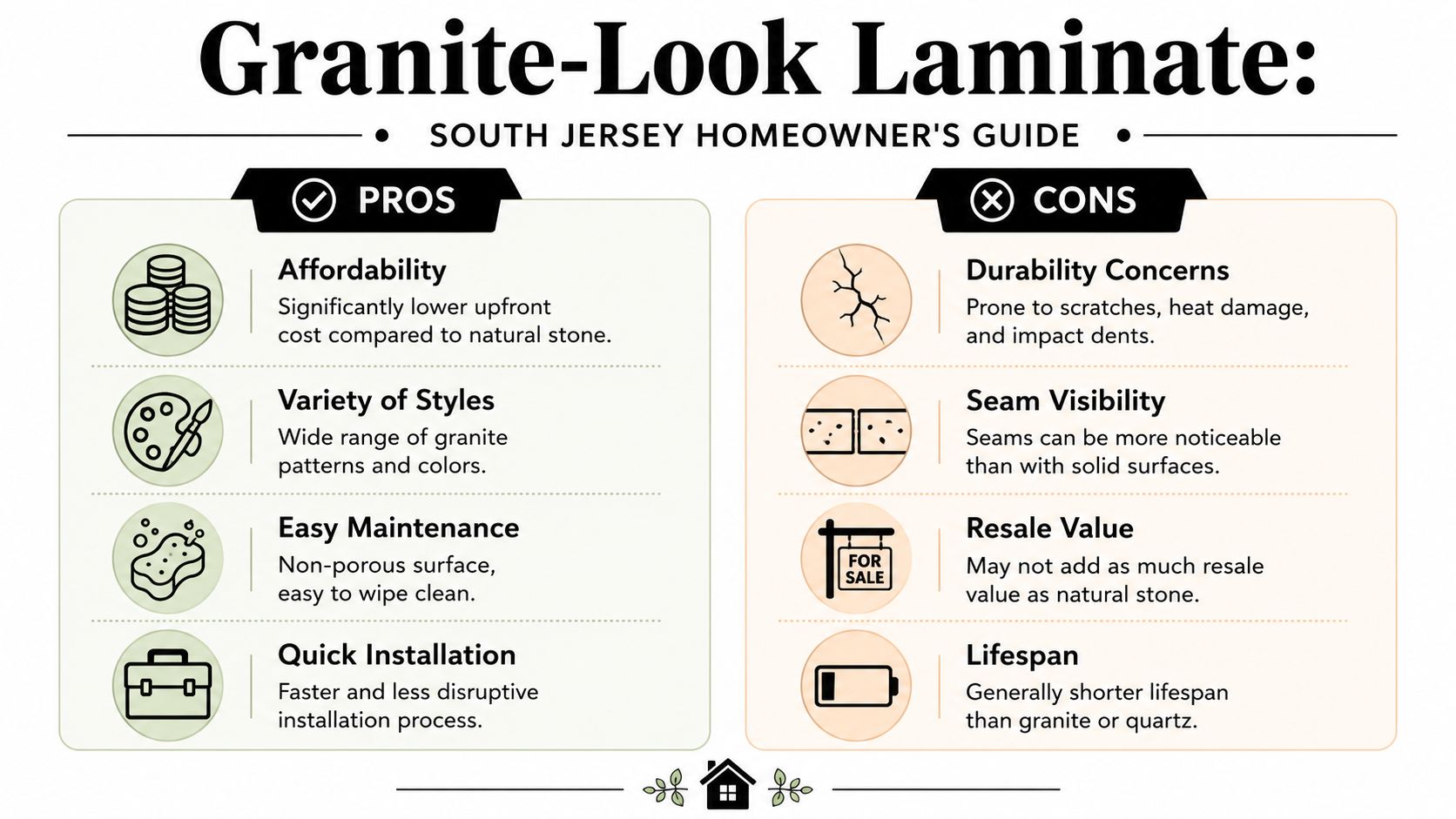
Laminate succeeds when the project needs a polished look at a lower entry cost and the household is realistic about wear. It's easy to wipe down, available in a wide style range, and usually faster and simpler to fit than heavier stone products. For guest kitchens, light-use homes, condos, rental turnovers, and budget-conscious remodels, that can be exactly the right answer.
It also works when visual consistency matters more than natural variation. Some homeowners don't want the unpredictability of natural slab movement. They want a controlled pattern that coordinates cleanly with painted cabinets, a backsplash, and hardware.
Short-term and medium-term goals are where granite look alike laminate countertops usually make the most sense. If you want the room to look finished now and you may rework the kitchen later, laminate can be a smart bridge material.
Where South Jersey humidity changes the decision
This is the issue generic guides miss. In a humid climate, laminate doesn't just age from knives, heat, and daily use. It can fail from moisture entering vulnerable points and swelling the core from inside.
According to Countertops Contractors' guide to countertops that look like granite but cost less, laminate countertops often last about five years under typical use before showing wear, and in humid climates like South Jersey's, the particleboard core can experience edge swelling and degradation in as little as 12 to 18 months.
That timeline doesn't mean every laminate top fails that fast. It means the failure window gets much shorter when water repeatedly reaches sink cutouts, seams, end caps, dishwasher-adjacent edges, or backsplash joints.
In South Jersey kitchens, the danger spot usually isn't the middle of the run. It's the edge near the sink where small daily splashes keep returning to the same seam.
A few warning signs show up before major failure:
- Raised edges: The front edge or sink perimeter starts to feel slightly puffed or uneven.
- Seam telegraphing: Joints become more visible, especially when light hits from the side.
- Softness near cutouts: The material around the sink or faucet no longer feels crisp and firm.
- Surface change at corners: Patterned laminate may still look intact while the substrate underneath begins moving.
If a homeowner in Cherry Hill, Haddonfield, or near more moisture-prone zones wants a long-term countertop, I'd be cautious about using laminate around any area where standing water is common. The granite pattern can hide the early stages of swelling, which is part of why people are caught off guard by it.
Laminate Compared to Granite Quartz and Solid Surface
Most homeowners aren't choosing between laminate and nothing. They're choosing between laminate, granite, quartz, and solid surface. The right answer depends on whether you care most about upfront cost, long-term durability, maintenance style, or visual feel.
How each material behaves in daily use
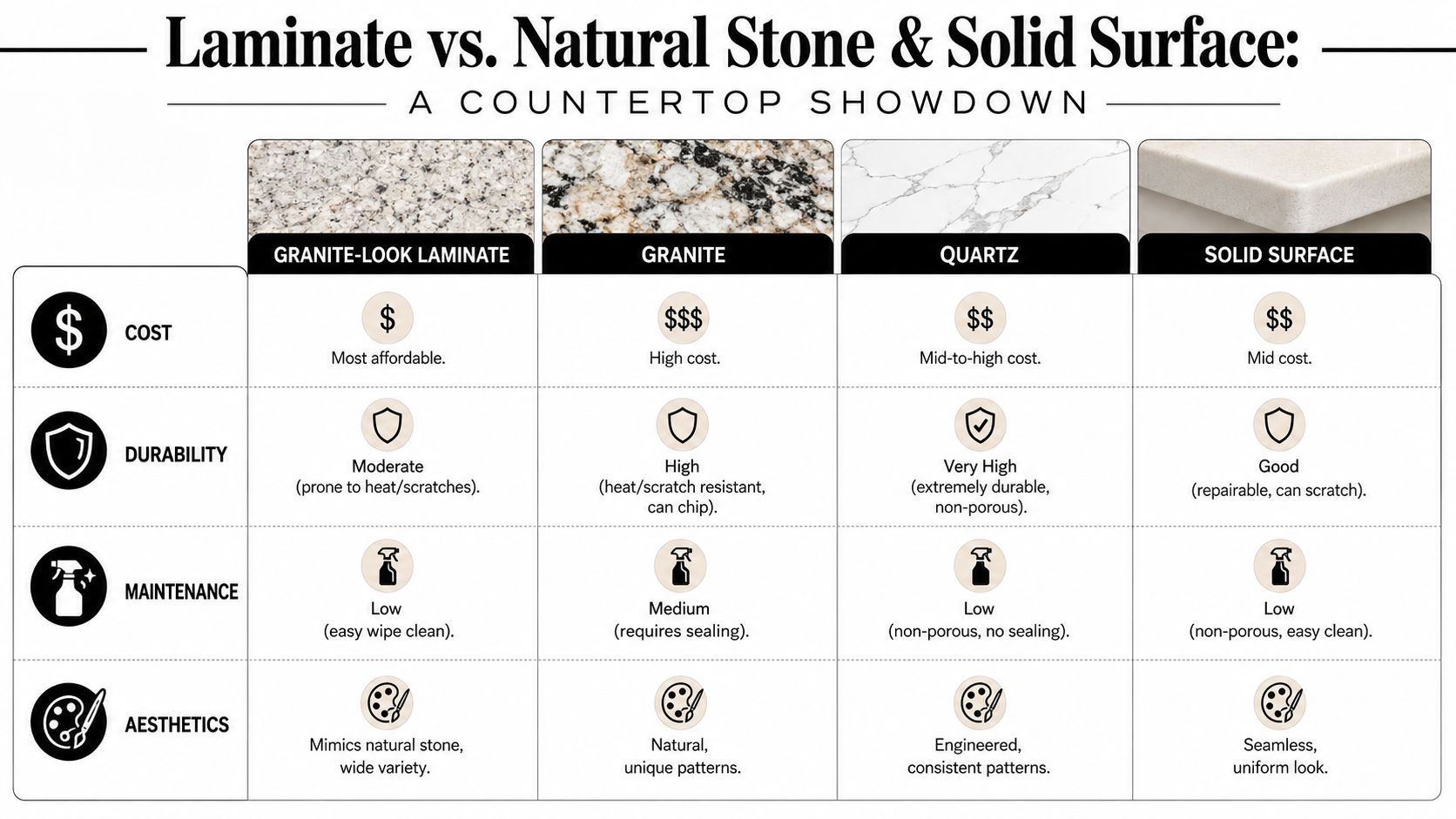
Laminate is the budget leader. It offers broad design flexibility and easy cleanup, but it's less forgiving around heat, impact, seam exposure, and moisture entry. It looks better today than many people expect. It still doesn't behave like stone.
Granite is for homeowners who want a natural slab, strong heat tolerance, and a surface built for the long haul. It has a more permanent feel in the room and a visual depth laminate can imitate but not fully match. It's a bigger initial investment.
Quartz appeals to people who want an engineered stone look with a non-porous surface and a more controlled pattern than natural granite. It often fits households that want a durable premium countertop without the character shifts found in natural slabs.
Solid surface sits in a different lane. It doesn't usually try to pass as granite as convincingly as laminate or engineered stone does, but it offers a clean, integrated appearance and repairability that some homeowners value more than stone mimicry.
If you want a broader look at countertop categories before deciding, this overview of different countertop material options is a useful companion.
A practical decision table
| Material | Best for | Watch out for | Look and feel |
|---|---|---|---|
| Laminate | Budget remodels, light to moderate use, quick cosmetic improvement | Moisture at seams and sink areas, heat, visible wear over time | Can mimic granite well, especially in current patterns |
| Granite | Long-term kitchens, natural material lovers, heat-heavy cooks | Higher upfront cost, natural variation may not suit every design | Deep, authentic stone movement |
| Quartz | Premium remodels, low-maintenance households, consistent design | Not everyone likes the uniformity of engineered patterns | Clean, polished, controlled |
| Solid surface | Seam-conscious designs, softer contemporary looks | Can scratch and doesn't deliver the same stone realism | Smooth, uniform, integrated appearance |
Choose laminate when the project is budget-first and timeline-aware. Choose stone when the countertop needs to be a long-term fixture, not a temporary visual win.
How to Make Laminate Countertops Look Genuinely High-End
Laminate looks expensive when the whole composition is disciplined. It looks cheap when the room asks it to do too much on its own.
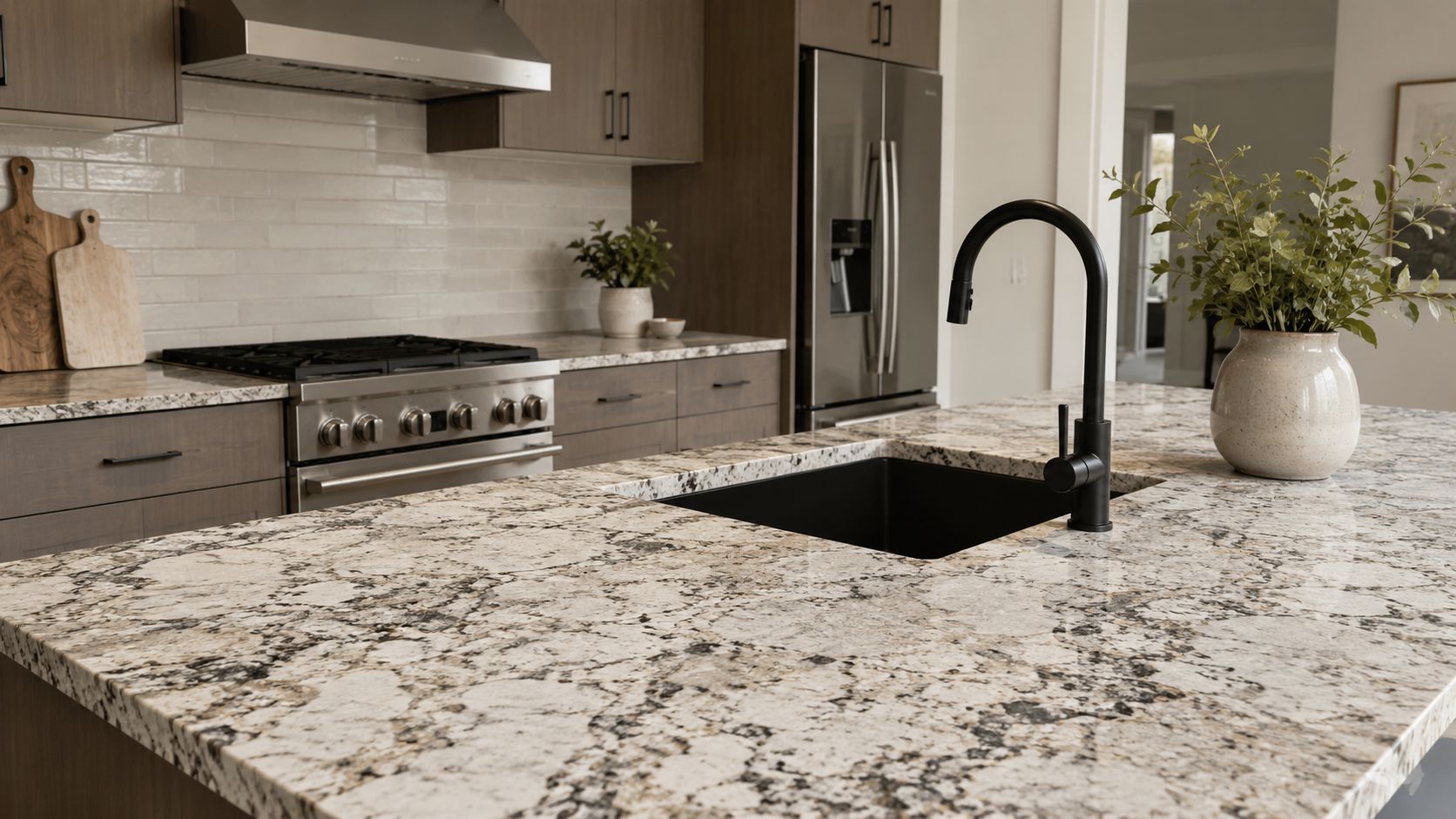
Design moves that improve the result
Start with the pattern. The best granite-look laminates usually have movement that feels believable at kitchen scale. Not too busy, not too flat. In smaller kitchens, a quieter pattern often reads more upscale because it doesn't fight with cabinet lines, backsplash grout joints, and appliance finishes.
Edge profile matters more than many homeowners expect. A better edge can make the countertop feel more intentional and less like a thin sheet wrapped over a box. This is one area where reviewing countertop edge profile options pays off before you order.
A few pairings consistently work well:
- Dark granite-look laminate with white cabinets: This gives strong contrast and tends to feel classic rather than trendy.
- Warm taupe or brown stone pattern with cream or greige cabinetry: Useful in homes where stark white would feel out of place.
- Charcoal or black pattern with matte black hardware: Works best when the rest of the room stays restrained.
- Soft gray pattern with simple backsplash tile: Good for kitchens that need brightness without a glossy, cold finish.
Keep the backsplash simple if the laminate has visible movement. A loud countertop plus a loud backsplash is usually what makes laminate feel less convincing.
Details that give laminate away
The fastest way to lose the high-end effect is poor seam planning. If a seam lands in a high-visibility zone, your eye goes to the seam instead of the pattern. Good layout reduces that problem. So does choosing sink and faucet placements that don't crowd transitions.
Another giveaway is mismatched surrounding finishes. A granite-look top paired with dated oak tones, shiny brass from another era, and an overly busy backsplash rarely feels current. Laminate needs support from the rest of the kitchen.
This short video is helpful if you want to see how finish and edge details affect the final impression.
A few practical choices help a lot:
- Use larger, simpler hardware: It gives the kitchen a more refined look.
- Limit competing patterns: Let the countertop be the main surface story.
- Choose a sink that suits the material: Practical compatibility matters as much as style.
- Control shine levels: Matte and satin combinations often look more elegant than too many glossy surfaces.
A laminate countertop looks most believable when the kitchen is edited. Fewer competing elements make the stone pattern work harder and look better.
Installation and Expert Guidance in South Jersey
Laminate is one of those materials people often assume is easy because it's affordable. The material may be budget-friendly, but a clean result still depends on accurate measurement, careful cutouts, neat edge treatment, and tight control around every place water can get in.
That matters even more in South Jersey. If the sink cutout isn't finished properly or the backsplash transition is sloppy, the countertop can start aging long before the homeowner expected. And if you're selecting laminate for a long-ownership home, the math deserves attention. According to Classic Granite's comparison of laminate and granite longevity, laminate may need replacement multiple times within a 20- to 30-year period, while granite is designed to last a lifetime with minimal maintenance. The same source states the cumulative expense of replacing laminate 4 to 6 times over 30 years can approach or exceed a one-time granite investment.
That doesn't mean laminate is the wrong choice. It means laminate is the right choice only when its lifespan, moisture sensitivity, and installation demands match the homeowner's real plan for the space.
If you're weighing options for a Cherry Hill or South Jersey remodel and want help coordinating material choices with cabinetry, layout, and installation quality, it helps to start with experienced kitchen remodeling contractors in New Jersey who understand how these materials perform in local homes.
If you want practical guidance instead of showroom guesswork, The Cabinet Coach can help you sort through countertop options in your own home. Their mobile showroom and design process make it easier to compare laminate, stone, cabinetry, hardware, and finish combinations in the actual light and conditions where your kitchen will live.