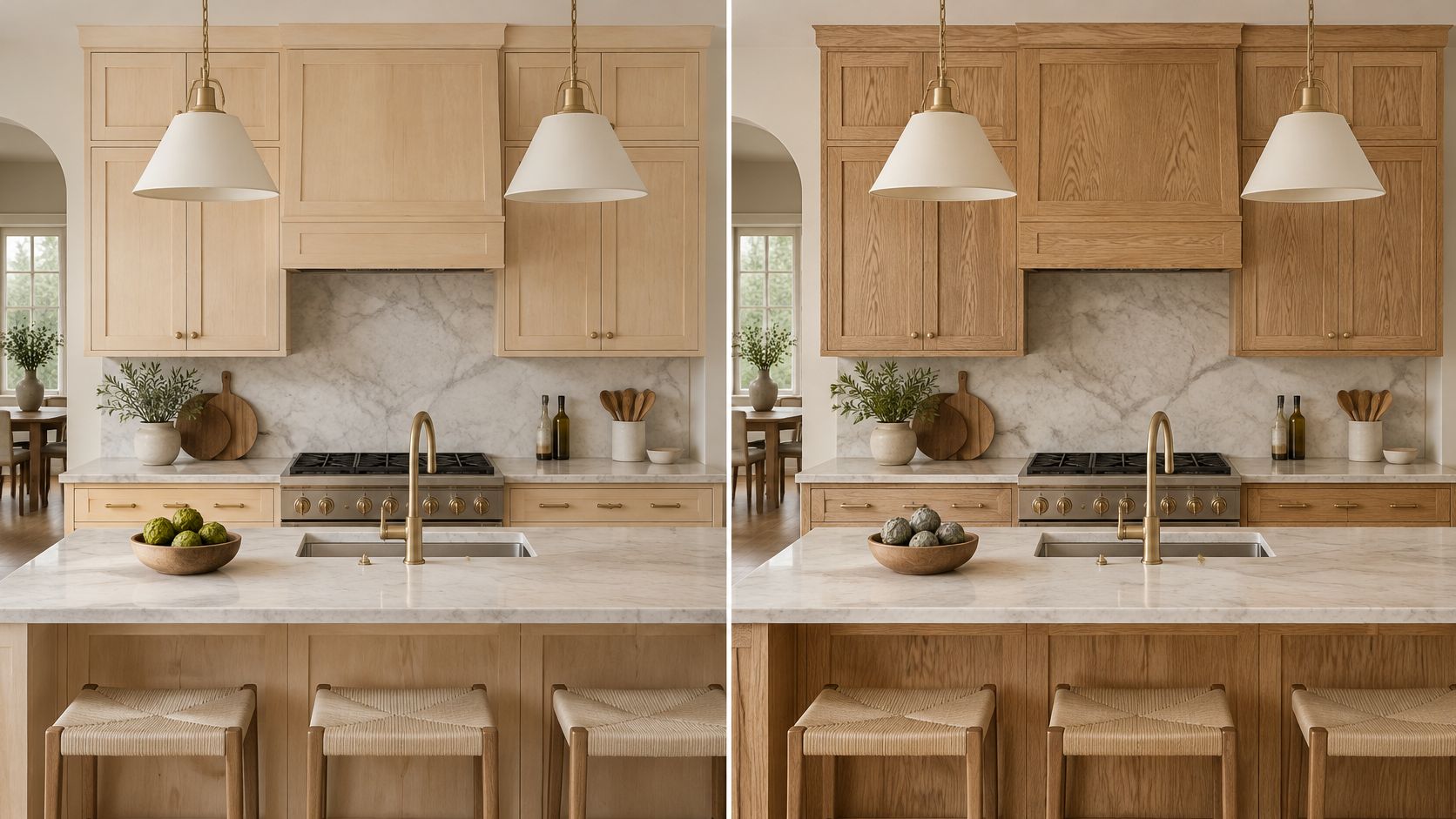
The advice you hear most often about maple vs oak cabinets is that maple is the harder wood, so it's the safe pick for a busy kitchen. The number behind that advice is real. The conclusion drawn from it usually isn't. Hard maple does take more force to dent, but the margin over oak is narrower than showroom chatter suggests, and hardness has never been the reason a homeowner regrets a kitchen five years later.
What people regret is a finish that went patchy under a dark stain, a cathedral grain pattern that turned out louder on a full wall than it looked on a sample chip, or white paint that shows every open pore of the wood beneath it. Those are finish-and-use problems, not strength problems.
Both species are hardwoods. Both outlast the appliances around them. The one you should buy depends on the finish you want, the light in the room, and who lives there. That is the frame I'd use with any client deciding between them.
Table of Contents
- Maple vs Oak Cabinets at a Glance
- How Grain and Color Differ by Species
- Hardness and Dent Resistance in Daily Kitchens
- Stain, Paint and Finish Results Compared
- Which Species Fits Your Kitchen Situation
- Cost, Upkeep and the Buyer Checklist
- Confirm the Species Before You Order
Maple vs Oak Cabinets at a Glance
Neither wood wins on every criterion. Maple resists indentation slightly better, oak takes stain more evenly and hides small marks, maple paints to a smoother surface, and oak carries more visual character on a large wall.
| Criterion | Hard maple | Oak (red or white) |
|---|---|---|
| Janka hardness at 12% moisture | 1,450 lbf | Red oak 1,290 lbf; white oak 1,360 lbf |
| Grain pattern | Fine, subdued and uniform | Prominent, open and visually active |
| Visual direction | Light, painted or clear-coated, contemporary | Traditional, rustic or textured |
| Species to specify on a quote | Hard maple, not softer maple varieties | Red or white oak, named exactly |
The table ranks indentation resistance. It doesn't promise a cabinet that stays free of damage, because the finish, the construction and the moisture in your kitchen decide far more than the species line does. Read it as a tiebreaker, not a verdict.
Two naming traps catch most buyers. "Maple" on a spec sheet can mean hard maple or a softer maple variety, and the softer material isn't in the same hardness class. "Oak" can mean red or white oak, which differ in tone and in grain. The exact species printed on the quote matters more than the label on the sample door.
Working rule: settle grain character and finish first, then check durability and upkeep against your household. Reverse that order and you end up defending a species that doesn't suit the room.
Each part below takes one row of that table and turns it into a decision you can act on.
How Grain and Color Differ by Species
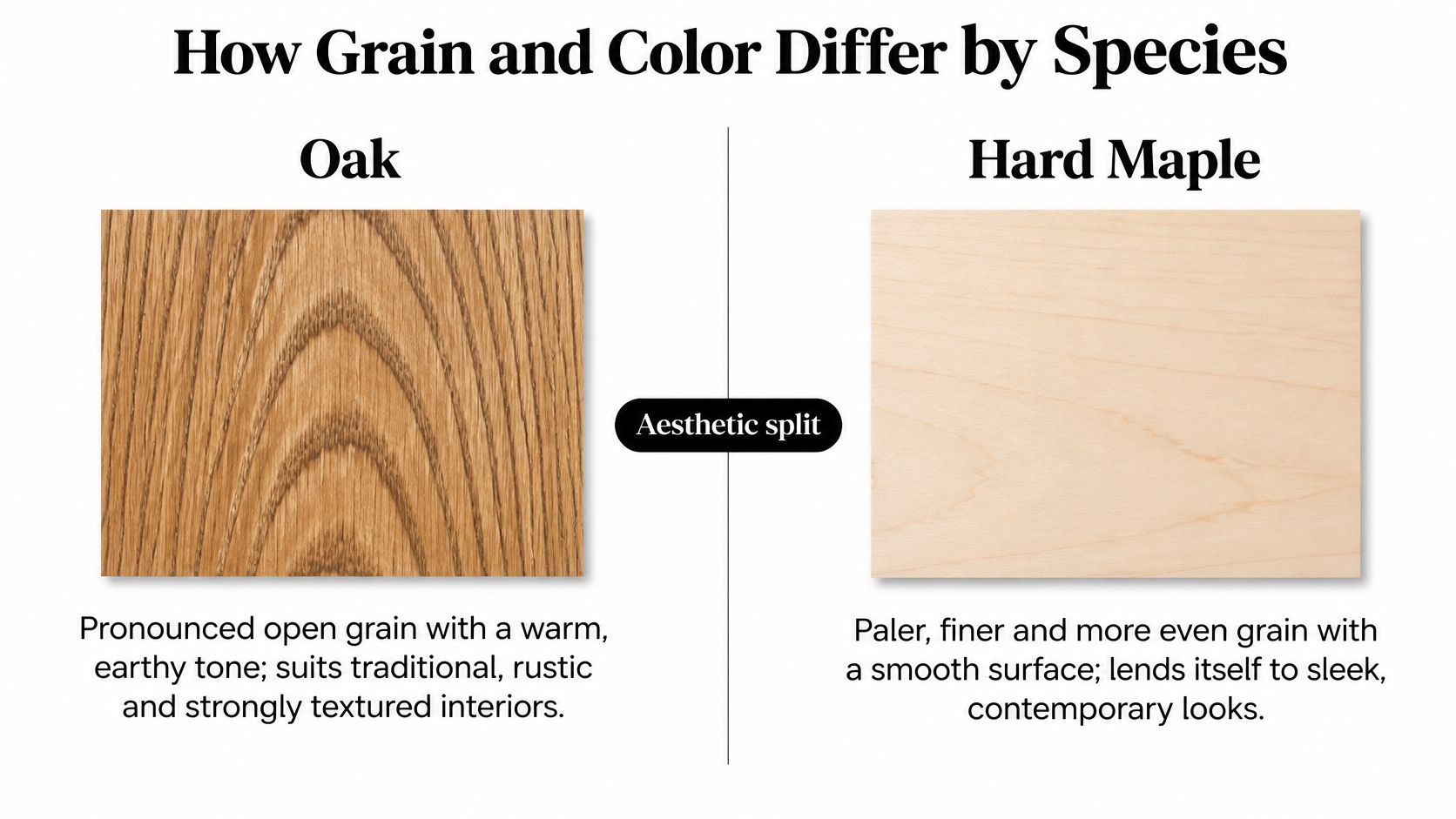
Oak and maple aren't two shades of the same cabinet. They're two design directions in North American hardwood use, and the split is old. Oak has traditionally been recognized for a pronounced open grain, while hard maple is associated with a paler appearance and a finer, more subdued grain, as the USDA Forest Products Laboratory wood handbook sets out.
Density explains part of the feel in the hand. The same reference places common hardwood densities broadly within about 20 to 55 pounds per cubic foot at dry conditions, which is why species and moisture content affect weight, machining, transportation and structural behavior. A denser board machines crisper and feels heavier. It also costs more to cut and to move.
Same board, three door styles
Traditional raised panel. A raised panel pushes grain into a profile that catches light at different angles, so oak's arches and stripes become part of the architecture. Maple's fine grain mostly disappears into the shape, which is why a maple raised panel reads as formal and quiet rather than rustic.
Transitional shaker. The frame breaks the door face into rails, stiles and a flat center panel, dividing the grain into smaller fields. Oak still shows its pattern on every piece. Maple reads almost as a painted surface with a faint texture. This is the style where the two species look most alike in photographs and least alike in person.
Contemporary slab. A slab door shows face grain across one large, uninterrupted field, so grain character is at its most visible. A book-matched oak slab wall is a statement. The same wall in maple is a pale, calm plane.
That is the whole difference in one line. Oak's grain is part of the design, while maple's uniformity sits in the background.
If the cabinet color still has to be reconciled with floors and countertops, this guide to choosing kitchen cabinet colors puts those three decisions in the same conversation. And when the renovation reaches beyond the kitchen, choosing the right hardwood furniture covers how species choice holds up over decades of daily use.
Finish shifts both species in ways that are easier to see than to describe:
Compare full-size door samples in your own kitchen, in morning light and again after dark. Grain reads differently at 8 a.m. and 8 p.m., and showroom downlights flatter both species equally.
Hardness and Dent Resistance in Daily Kitchens
The gap is measurable but not dramatic. At approximately 12% moisture content, hard maple rates 1,450 pounds-force on the Janka scale while northern red oak rates 1,290 lbf, a difference of about 160 lbf, or roughly 12% greater resistance to the standardized indentation, according to USDA Forest Service hardness data. White oak falls between them at approximately 1,360 lbf.
The test itself is simple. A steel ball 0.444 inch in diameter is pressed halfway into the wood surface and the force required is recorded. That makes it a useful comparative indicator for cabinet doors, drawer fronts and other frequently touched or impact-prone components.
Translate it into kitchen events: a dropped can of tomatoes, a pan swung into a door front, a drawer pull that gets knocked, a toy dragged along a base cabinet. Door and drawer fronts take most of that punishment.
What the rating doesn't cover
The rating describes solid wood at a standard moisture level. It doesn't describe a cabinet system. A well-finished solid oak door can outlast a thinly finished maple veneer door, because the finish takes the daily wear and the substrate decides whether the panel moves. Finish quality decides whether a dent appears at all. Moisture from a sink or dishwasher changes how a door behaves over a decade. Edge design and installation decide whether a chip becomes a five-minute repair or a replacement order.
Where the number earns its keep: it separates hard maple from the softer maple varieties sold under the same label. It does not separate a good oak cabinet from a mediocre maple one.
For a wider view of what makes any wood durable, this breakdown of durable wood puts hardness next to stability and rot resistance. Within cabinetry, the wood types used for kitchen cabinets differ in ways the Janka scale never captures.
Ask the maker three questions before you sign:
- Is the door solid or veneered, and over what substrate? A veneered door on a stable core can be excellent, but the answer changes the dent story.
- Which finish system, and how many coats? Conversion varnish and catalyzed lacquer wear very differently from a simple sealed lacquer.
- How are the door edges sealed? End grain and machined edges are where moisture gets in and where a finish fails first.
The answers tell you more about year five than the species name does.
Stain, Paint and Finish Results Compared
Finish behavior is where the two species separate for good, and it's the part a bare sample board never shows you.
| Finish or repair | Hard maple | Oak |
|---|---|---|
| Clear or light stain | Pale, can blotch unless conditioned | Grain shows strongly; stain deepens the pattern |
| Dark stain | Can look uneven without careful sanding and conditioner | Hides variation well while the grain stays visible |
| Paint | Smooth, uniform base for even coverage | Grain can telegraph through paint unless filled |
| Scratch or patch touch-up | Smooth surface shows marks and patch lines more | Grain helps repairs blend in |
Hard maple's tight, fine grain is the reason it paints so well and the reason it stains so badly without preparation. The fibers absorb color at different rates, so a dark stain lands in patches unless the maker uses a conditioner, a gel stain or a sprayed toner. Factory-finished dark maple looks even because the shop controls all three. A weekend dark stain on maple usually doesn't.
Oak goes the other way. Its open pores drink stain quickly and hold color in the grain, so a dark stain emphasizes the pattern rather than flattening it. Under paint, that same open grain telegraphs through the film unless it's filled first, which means grain filler, extra sanding and a shellac-based primer on every door and face frame.
If you're still circling a color, Aqua Painting's kitchen stain colour tips are a useful second opinion on how tones behave once they hit the wood.
Finish steps and touch-ups
Ask any maker how many finish steps the process uses, and ask for a sample carrying the full finish stack on the actual species, not a bare board. Our cabinet finishes typically use a minimum of a five-step finish process. In material selection we walk clients through the complementary pieces, from the tile backsplash to the hardware, because a finish only reads correctly next to everything else in the room.
Repairs behave differently too. A scratch or a filled chip shows more on a smooth maple face. On oak the grain breaks up the line and the repair disappears from a few feet away. Either species can be refinished, but only while the face has enough material left to sand.
To test it yourself, stain or paint a board of each species under the same light, let it cure fully, then check it in daylight and again at night. The paint and stain guidance for cabinets walks through the order of steps so the comparison is fair.
Which Species Fits Your Kitchen Situation
Choose the wood for the look you want to live with and the wear you expect, not for a small difference in hardness alone.
| Household or project | Lean toward | Why it fits |
|---|---|---|
| Painted or light contemporary kitchen | Hard maple | Its fine texture suits an even paint finish and clean lines. |
| Traditional or rustic look with visible grain | Oak | Prominent grain adds character and helps small marks blend in visually. |
| Heavy daily use, young children or frequent heavy cookware | Hard maple with a durable finish | It has the highest indentation resistance of the three commonly compared species. |
| Older home with dark stain and limited light | Oak, with a lighter finish | Grain adds visual texture, while a lighter finish avoids making a dim room feel darker. |
| Resale or rental property | Either species, with a neutral finish | Finish and cabinet construction matter more for broad appeal than species alone. |
Hard maple measures about 1,450 lbf on the Janka side-hardness scale at 12% moisture, compared with 1,360 lbf for white oak and 1,290 lbf for northern red oak, according to the USDA Forest Service hardness data report cited earlier. That is a modest edge, not immunity to dents. Cabinet construction, joinery, finish quality and substrate also affect how the finished kitchen holds up.
The practical trade-off is visual. Maple's fine texture gives painted and clear-coated cabinets a quieter appearance. Oak's open grain creates more pronounced texture under stain and can make minor marks less noticeable. In a busy kitchen, choose based on whether you prefer a smooth, understated surface or a more forgiving, visibly grained one.
Two rooms where style did the deciding
A Springfield homeowner working with The Cabinet Coach chose warm gray shaker cabinets, subtle brushed brass hardware and oak floors. The combination shows how cabinet color, door style and flooring can shape the room's character without making wood species the sole decision.
In the Marlton Lakes project, white transitional cabinets with island seating and simple shaker-style doors set the direction. Brushed gold hardware and a polished chrome faucet completed the mix. Neither project depended on a hardness comparison to establish its style.
For a closer look at maple's restrained appearance in a modern room, see this modern kitchen with maple cabinets. Choose the species that suits the finish and the way you want the kitchen to age.
Cost, Upkeep and the Buyer Checklist
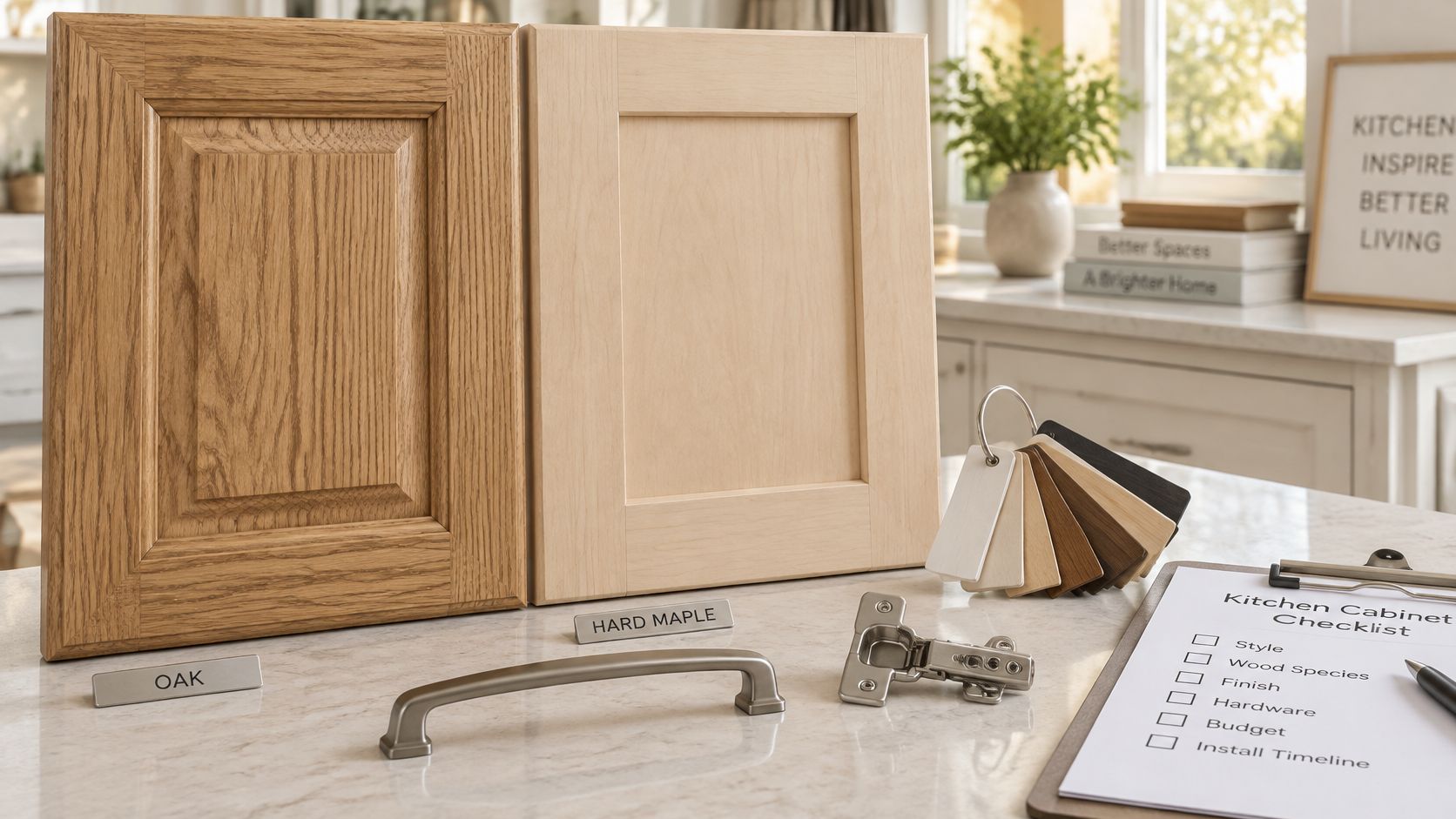
Price is not a contest between maple and oak alone. Wood availability and grade, door style, finish steps, hardware and cabinet construction all affect the quote. Compare the species using the same door style and finish, and ask for itemized pricing so you can see what changes the total. This guide to cabinet cost per linear foot offers another way to frame the budget.
Upkeep is similar for both woods. Clean either with a mild damp cloth and mild soap, and protect the surfaces from standing water near the sink and prolonged heat from appliances. Both can be refinished. Maple's smoother face may show wear more plainly, while oak's visible grain can make small marks less conspicuous.
Sustainability is a longevity question
Environmental impact depends on sourcing, panel construction, coatings, transportation, expected service life and whether doors can be repaired or refinished. A species label alone does not establish which cabinet has the lower impact. Homeowners may also consider finish emissions and the use of recycled or sustainably sourced materials.
The lower-impact cabinet is often the one that lasts, can be repaired locally and remains visually acceptable to its owner.
The checklist
- Choose the grain character. Decide whether you prefer oak's more pronounced texture or maple's more uniform appearance.
- Set the finish direction. Choose stain, paint or clear coat, and decide whether the wood grain should remain visible.
- Consider how wear will read. Think about the kitchen's daily use and whether you would rather see a smoother face or grain that can help disguise minor marks.
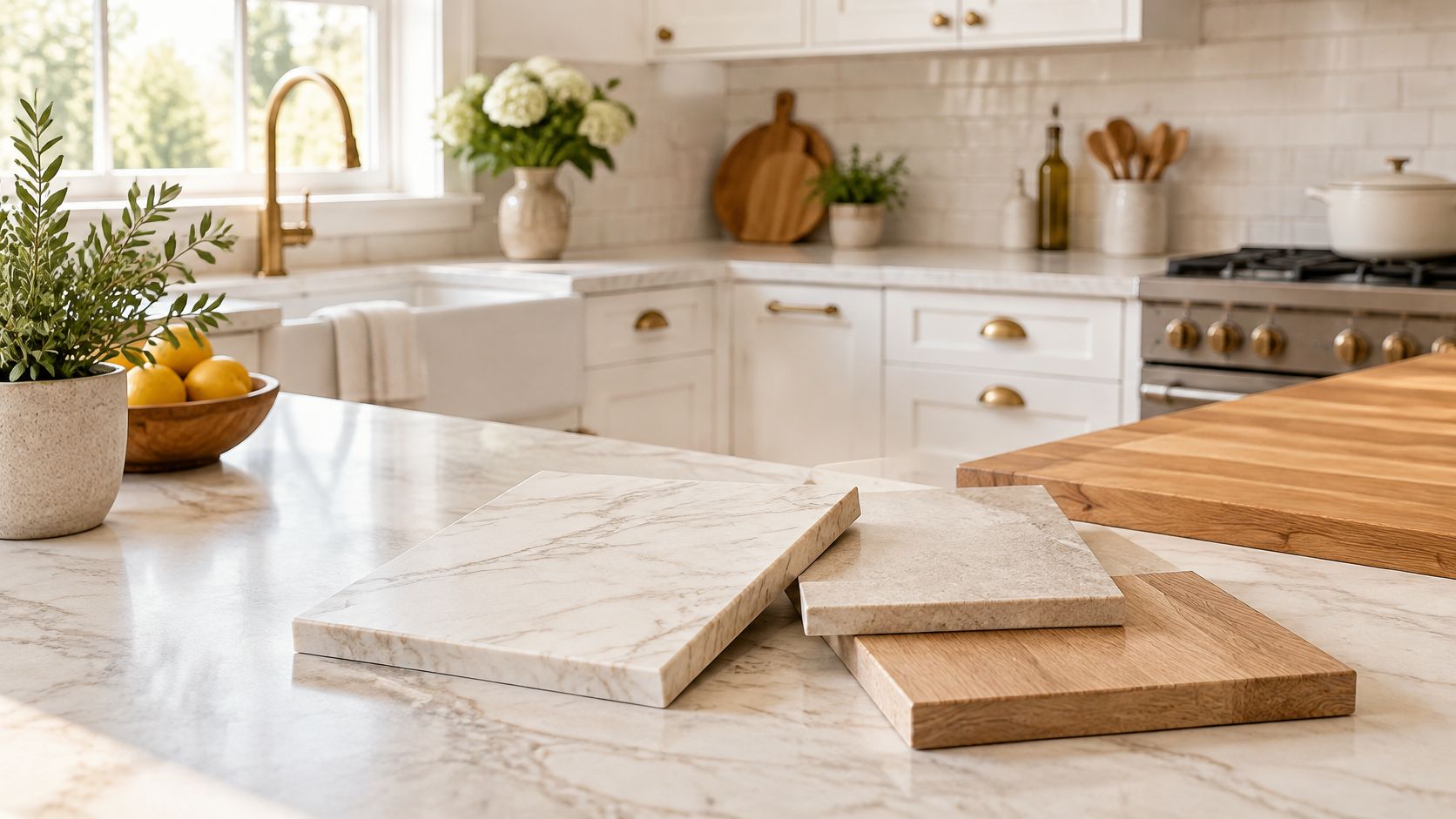
- Compare full-size samples at home. The Cabinet Coach brings full-size samples of cabinetry, countertops, hardware and tile to the home, where you can compare them under your lighting and against your decor.
- Review the specifications. Confirm the wood species, solid or veneered door construction, finish process and details of composite parts.
- Compare itemized quotes. Keep door style, finish and hardware consistent so the differences in price are clear.
Seeing all three cabinet styles side by side in real South Jersey projects can help clarify the door style before you settle on a species. The right choice depends on how the wood's grain, finish and expected wear will suit your kitchen over time.
Confirm the Species Before You Order
Read the quote line by line before you sign it. "Maple cabinets" and "oak cabinets" are marketing phrases, not specifications. What you want to see is hard maple named explicitly, or red oak or white oak named explicitly, on the door, the drawer fronts and the face frame, with the box material listed separately.
Three details get left off quotes and cause the most disappointment later.
Solid versus veneered doors. A veneered door on a stable core is a legitimate product and can be the more dimensionally stable choice in a humid kitchen. It is not the same object as a solid door, and it should be priced accordingly. Ask which one you're buying.
The finish schedule. Number of coats, product type, whether the back of the door is finished, and whether edges are sealed. That's where the durability you're paying for lives.
The species on the sample versus the species on the order. Ask for the sample's species and finish code to be written into the order. If the sample door is hard maple and the order says "maple," you've lost the distinction that made you choose it.
One more habit worth building: keep the sample. When a door needs a touch-up in year three, the shop can match the finish from the code on the order, and the sample tells you whether the repair blended or not. Order the species, the finish and the door style as one decision, in writing, and the rest of the renovation has a fixed reference point.
If you're weighing maple against oak and want to see both under your own kitchen lighting, The Cabinet Coach brings full-size samples of cabinetry, countertops, hardware and tile to your home and walks you through them against your floors and counters. We can compare all three cabinet styles side by side and talk through the exact species, finish schedule and construction behind each quote, so the choice is settled on how the cabinet will look and wear in your room rather than on a spec sheet. Start with a visit at The Cabinet Coach and bring your floor sample with you.