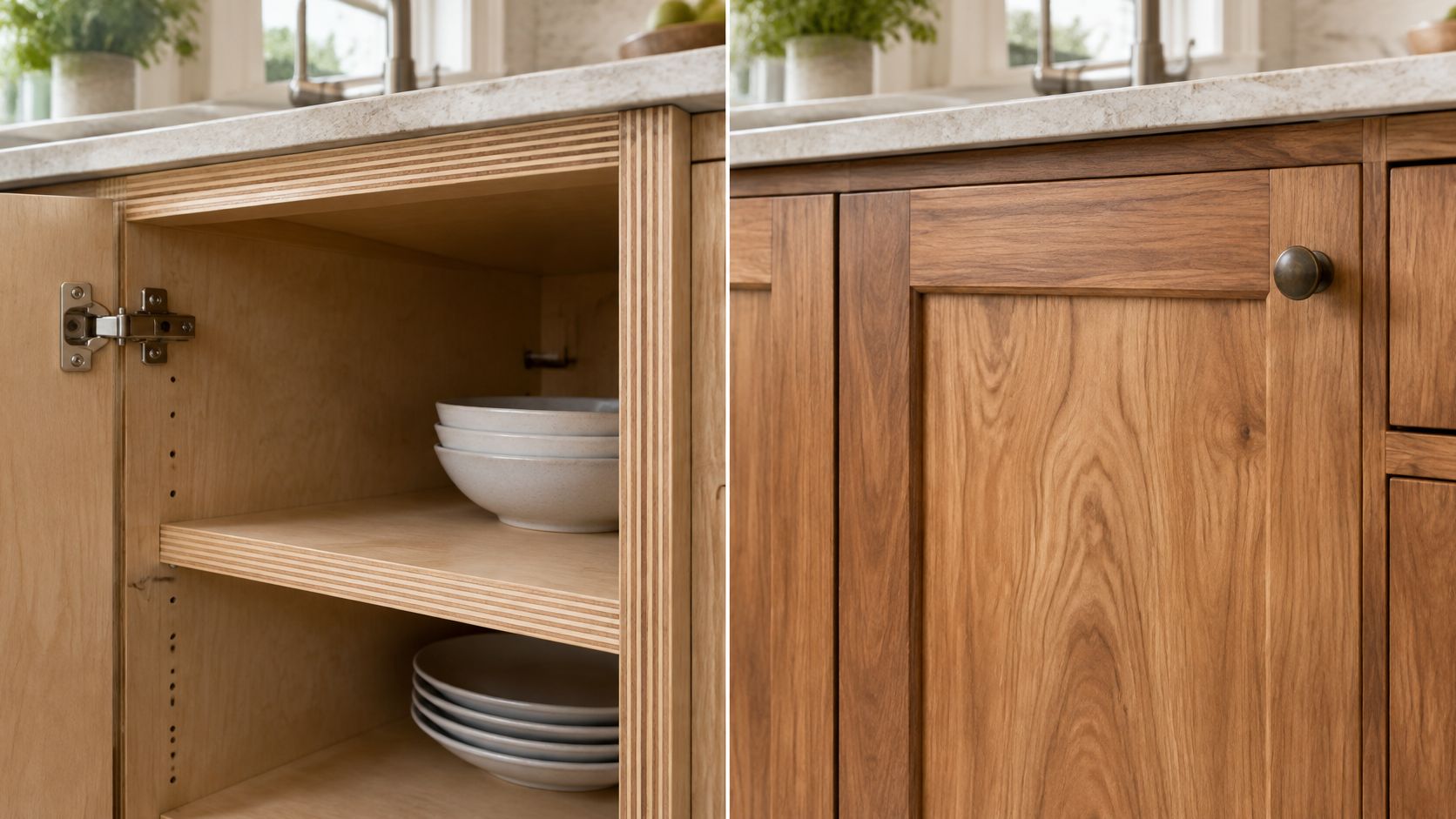
The advice to buy solid wood cabinets if you want them to last leaves out the most important question: which part of the cabinet are you buying? A wide cabinet side, a profiled door, and a sink-base floor don't face the same demands. Paying for the same material everywhere can mean spending more without getting a better cabinet.
For homeowners comparing plywood vs solid wood cabinets, construction quality and moisture exposure deserve more attention than the label on the showroom display. A carefully assembled plywood box with repairable hardwood fronts is often a more sensible choice than an all-solid-wood cabinet that doesn't allow for seasonal movement.
Table of Contents
- Plywood vs Solid Wood at a Glance
- How Each Material Is Built
- How Moisture Changes Each Material
- Strength and Fastener Holding Compared
- Which Cabinet Parts Suit Each Material
- Cost, Lifespan and Quality Checks Before You Buy
- Maintenance and Repair Over Time
- Choosing Plywood or Solid Wood for Your Remodel
Plywood vs Solid Wood at a Glance
Neither material wins everywhere. Choose plywood for broad structural panels and solid wood for visible, shaped, repairable components.
| Criterion | Plywood | Solid wood |
|---|---|---|
| Dimensional stability | Stable in both panel directions | Moves mainly across the grain as humidity changes |
| Moisture tolerance | Resists movement but is not waterproof | Can swell, cup or split if restrained |
| Edge screw holding | Weaker at panel edges than on the face | Holds screws well in comparable material |
| Repairability | Damaged veneer is hard to repair cleanly | Can be sanded, refinished and re-milled |
| Typical cabinet use | Boxes, sides, bottoms and shelves | Doors, face frames, drawer fronts and trim |
The practical verdict is a hybrid cabinet: plywood for the large, flat, load-bearing box, with solid wood where appearance, profiling, and repair matter. That combination isn't a compromise. It assigns each material a job it handles well.
Read the label carefully
This comparison describes typical construction, not every product sold under either name. A cabinet advertised as solid wood may have hardwood doors and a different material inside the box. Likewise, plywood can describe panels with very different cores, face veneers, adhesive systems, and edge treatments.
The phrase real wood doesn't resolve those differences. Both lumber and wood veneers come from trees, but that tells you little about whether a shelf has adequate support or a sink cutout has been sealed.
For a broader furniture-material comparison, Giorgi Bros. Furniture's guide helps homeowners compare solid wood, plywood and MDF. Use that context to understand the categories, then judge cabinets by their actual components rather than assuming that a bookshelf specification transfers directly to a kitchen.
Buying rule: A well-built plywood box can be a better purchase than a poorly designed solid-wood box.
Before comparing quotes, sort your planned cabinets into boxes and visible faces. Include sides, backs, bottoms, and shelves in the first group; put doors, drawer fronts, face frames, and trim in the second. That simple separation makes a vague material claim much easier to question.
How Each Material Is Built
Plywood starts with layers
Plywood combines thin wood veneers with adjacent grain directions arranged across one another. This cross-laminated construction is the defining feature, not the decorative wood species on the surface.
The inner layers form the core, while the face veneer supplies the exposed appearance. A walnut-looking panel, for example, doesn't necessarily contain walnut throughout its thickness. Ask whether the panel has a veneer core or a composite core rather than treating every wood-faced sheet as equivalent plywood.
At an unfinished edge, veneer-core plywood reveals its stacked layers. On finished cabinetry, edge banding or a solid-wood strip usually covers that edge, so inspect a sample or request the written construction specification.
Solid wood starts with lumber
Solid-wood components are milled from boards. A wide panel is commonly assembled by edge-gluing narrower boards, with the grain running in the same general direction.
That construction gives a cabinetmaker material for routed profiles, shaped edges, and traditional joints. It also means the maker must account for movement instead of fastening every part as though it were an inert sheet.
For help separating engineered panels from lumber, Tip Top Furniture engineered wood advice provides useful background. Our guide to kitchen cabinet wood types helps connect the construction choice to the grain and appearance you want.
Adhesives deserve their own question
An attractive face veneer doesn't identify the panel's adhesive or exposure classification. Interior-use and moisture-resistant glue systems aren't interchangeable, and an exterior-rated bond doesn't make an entire finished cabinet waterproof.
Before approving an order, request:
- Core construction: Identify what sits beneath the face veneer.
- Ply arrangement: Ask how the panel is built, not just how many layers it contains.
- Adhesive classification: Get the actual designation rather than a general moisture-resistant claim.
- Component materials: Confirm whether door frames, center panels, and face frames use lumber or engineered panels.
How Moisture Changes Each Material
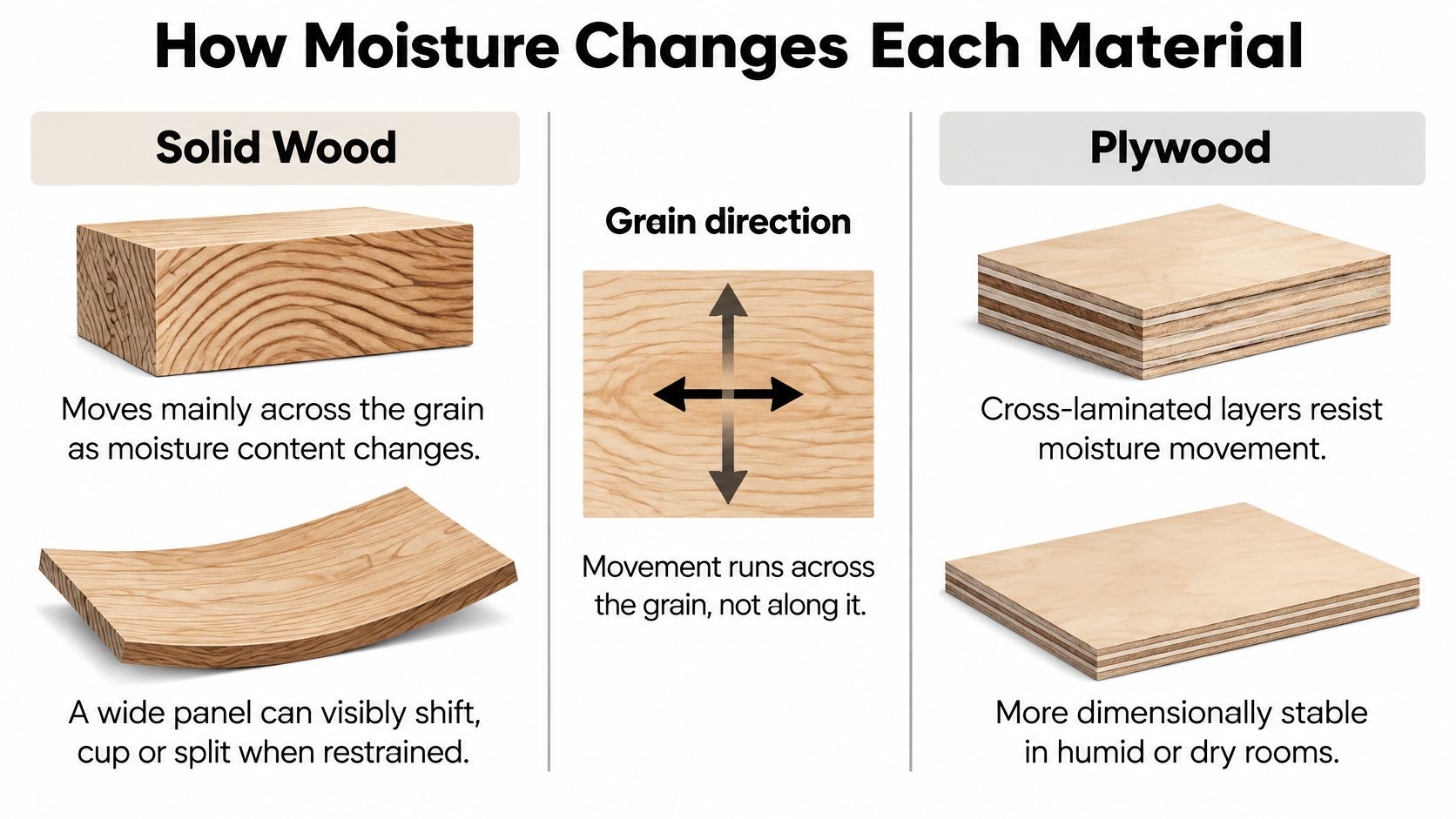
Solid wood changes dimension mainly across its grain as its moisture content changes. A wide panel can therefore change width enough to stress a joint, interfere with a neighboring component, or cup when its faces experience unequal conditions. Rigidly restraining that movement can turn a manageable material characteristic into a split panel.
Plywood's alternating veneer directions restrain movement across the sheet. That makes it useful for cabinet sides and bottoms, where staying flat and square matters more than accommodating a shaped profile.
The grain-direction difference is easier to understand visually.
What the moisture figures actually mean
The following moisture-response figures come from U.S. Forest Service and Forest Products Laboratory findings; the strength changes concern wood under the stated moisture conditions, not a predicted loss of capacity for every finished cabinet.
| Measure | Figure |
|---|---|
| Plywood linear hygroscopic expansion, 30% to 90% relative humidity | About 0.15% typical |
| Strength near fiber saturation, wood in general | Falls roughly 40% to 60%, depending on property and species |
| Shear strength parallel to grain, 6% moisture to water-soaked | Falls 30% to 60% |
| Tensile strength perpendicular to grain, water-soaked | Falls as much as 65% |
| Solid wood linear movement over the same humidity swing | No single figure applies across species, grain orientations, and panel widths |
These are different measures, not competing product ratings. Dimensional change describes movement; strength loss describes mechanical behavior under wet conditions. Neither tells you that a finished cabinet can safely tolerate a plumbing leak.
Control water at its entry points
In South Jersey kitchens and bathrooms, distinguish seasonal indoor humidity from direct wetting. Conditioned air helps manage the former. A leaking supply connection or dishwasher hose requires a repair, not a better cabinet-material label.
Plywood can still swell, warp, or delaminate after prolonged wetting. Solid wood remains suitable for kitchens when the maker uses movement-tolerant construction and protects exposed surfaces.
For a sink cabinet, inspect pipe penetrations, the floor-to-side joints, and any raw edge left after installation. Our guide to the kitchen cabinet under the sink addresses that particularly vulnerable location.
Use the table as a reminder that moisture affects both shape and strength, then make drying spills and checking plumbing part of normal upkeep. Don't rely on the finish to contain standing water indefinitely.
For an additional visual explanation, watch the accompanying video.
Strength and Fastener Holding Compared
Strength isn't one property. A shelf resisting bending, a cabinet back resisting racking, and a hinge screw resisting withdrawal all impose different demands. Species, panel grade, thickness, support spacing, and loading direction change the result.
A Forest Products Laboratory survey of furniture and cabinet manufacture reported that edge screw withdrawal in panel products was typically 75% to 80% of face withdrawal, while Douglas-fir plywood face withdrawal was about 85% of side-grain solid wood. Those comparisons explain why hardware location matters, but they aren't universal ratings for every modern cabinet panel.
Give the fastener a sound connection
- Use the panel face where the hardware permits. Hinges and slide brackets need an approved mounting pattern with enough sound material around each screw. Shelf pins likewise need clean, accurately bored holes rather than oversized holes patched during installation.
- Reinforce unavoidable edge connections. A properly fitted glue block or solid mounting strip can improve the connection. A longer screw helps only when it reaches sound material without breaking through the opposite surface.
- Drill appropriate pilot holes. Match the bit to the screw and material, particularly near panel edges or in dense hardwood. Don't keep driving after the screw has seated, because overtightening can strip the hole.
- Test the actual joint. Use an offcut of the specified panel with the intended screw and bracket before repeating an unfamiliar hardware pattern throughout the kitchen.
The objective isn't to install the largest screw that fits. It's to transfer the load through a connection designed for the material and hardware.
Judge the assembly, not just the wood
A drawer can use attractive hardwood yet still fail because its bottom is poorly retained or its slides are mismatched to the load. Our explanation of dovetail drawers helps distinguish a drawer-side joint from the rest of the drawer's construction.
A stronger material won't rescue a stripped screw hole, an unsupported shelf, or an installation screw that misses its intended support.
For everyday service, prioritize stable sheet construction for the box and deliberate joinery at the parts people pull, push, and load. Solid wood's screw-holding advantages are useful, but only when the grain direction, fastener placement, and joint design support the connection.
Which Cabinet Parts Suit Each Material
| Cabinet part | Better material | Main reason |
|---|---|---|
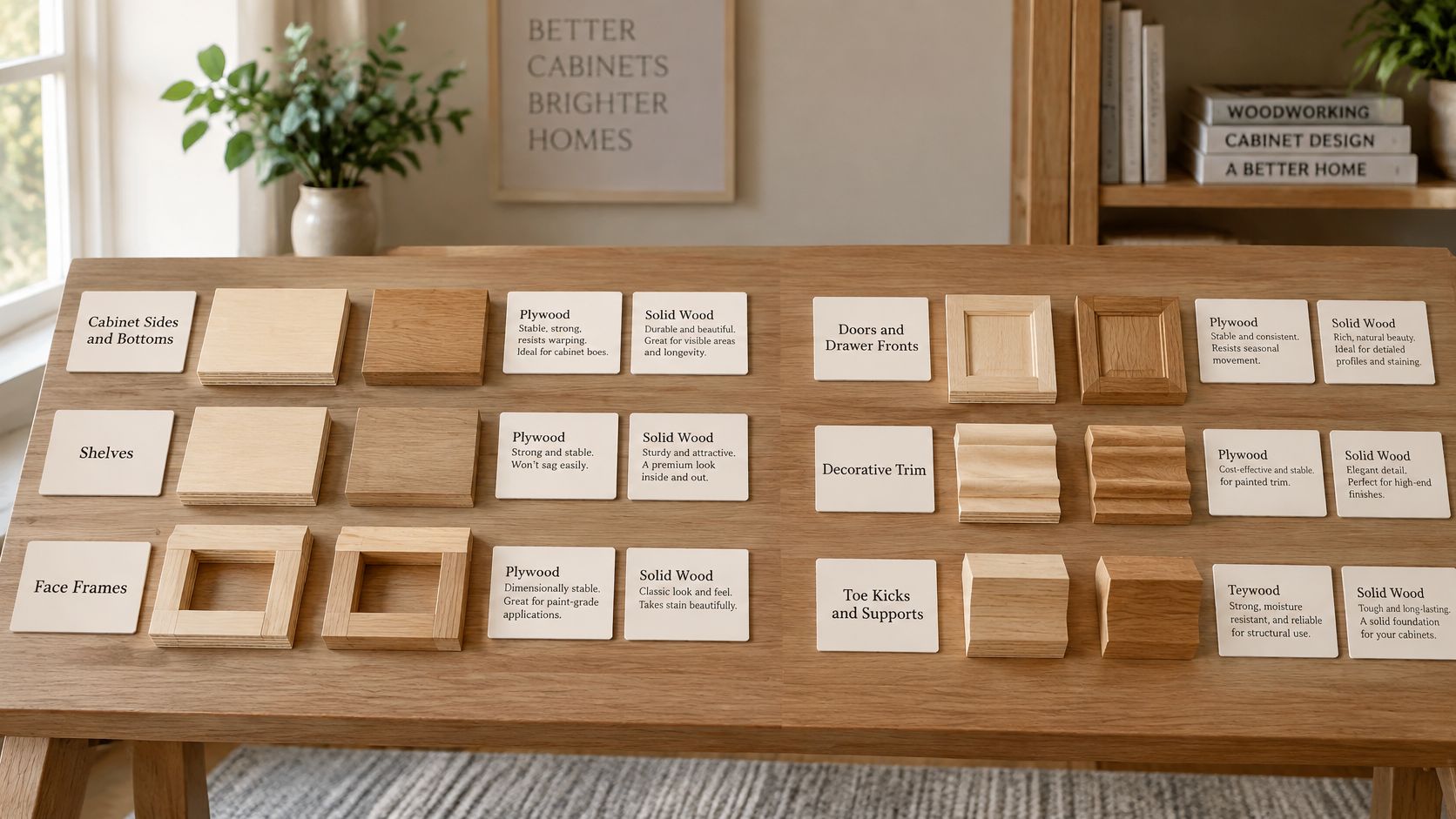
| Cabinet sides and bottoms | Plywood | Large flat panels stay dimensionally stable |
| Shelves | Plywood | Stiff sheet construction works well with adequate thickness and support |
| Face frames | Solid wood | Takes joinery well and repairs cleanly |
| Doors and drawer fronts | Solid wood, or plywood core with a solid-wood face veneer | Appearance and profiling matter most |
| Decorative trim and moldings | Solid wood | Crisp profiles that can be refinished |
| Sink-base floor | Sealed plywood | Practical panel construction, with leaks still requiring prompt attention |
Shelves need support, not promises
Plywood is a sensible shelf material, but it isn't sag-proof. A shelf carrying stacked dishes needs an appropriate span, thickness, and support arrangement. An unsupported long shelf can disappoint even when the panel itself is good.
APA's plywood guidance identifies bending strength and stiffness, tension, compression, shear, and bearing as relevant engineering properties. Cross-lamination provides useful stiffness in both panel directions, but cabinetmakers still need to match the panel to its load.
Ask whether a wide shelf needs a front stiffener, a center divider, or a shorter unsupported span. That is a more productive discussion than asking whether plywood is strong.
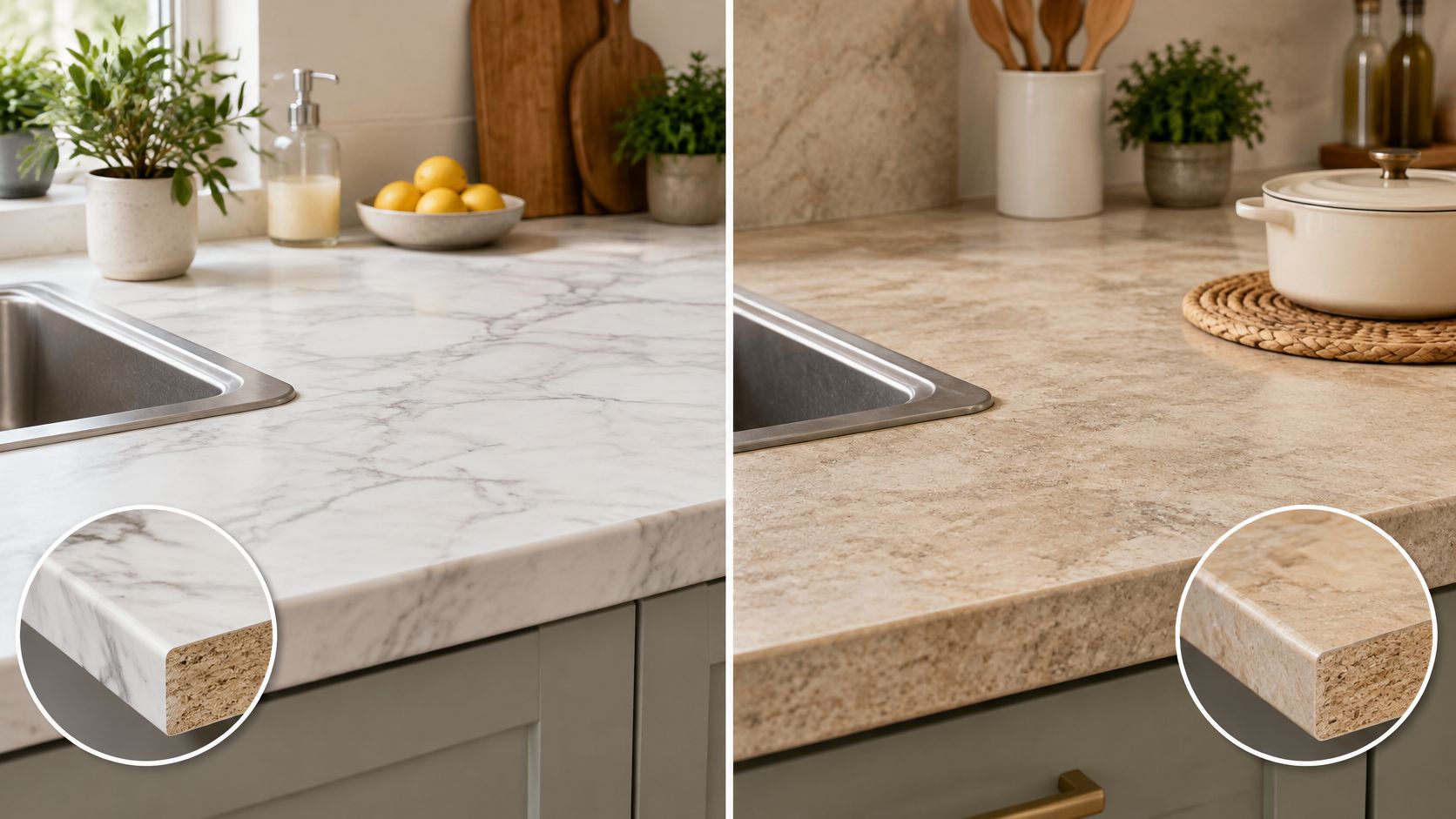
Material samples help make the differences between sheet edges, face veneers, and solid lumber visible.
A door can contain both materials
A solid-wood frame with a veneered plywood center panel can provide the look of wood without making the entire door from glued-up lumber. Conversely, a solid center panel needs construction that lets it move within its frame.
Don't confuse a thin face veneer with a thick, repairable hardwood component. Both can look attractive, but the available repair options differ when a door gets a deep gouge.
We offer custom cabinetry with choices of wood types, finishes, and door styles, including transitional shaker and contemporary designs. Choose the visible treatment for your taste and budget, then confirm that its underlying construction suits the door size and profile.
Specify the hidden details
Compare panel thickness, veneer quality, adhesive classification, and edge treatment together. More thickness isn't a substitute for adequate support, and a decorative hardwood edge doesn't prove the core is well made.
The sink-base floor also needs access for inspection. A liner may help contain small spills, but it shouldn't conceal wet joints or make a persistent leak harder to notice.
Put this question on the material schedule: Which exact parts are plywood, and which are solid wood? Include backs, drawer bottoms, exposed end panels, and center door panels rather than accepting a single description for the whole cabinet.
Cost, Lifespan and Quality Checks Before You Buy
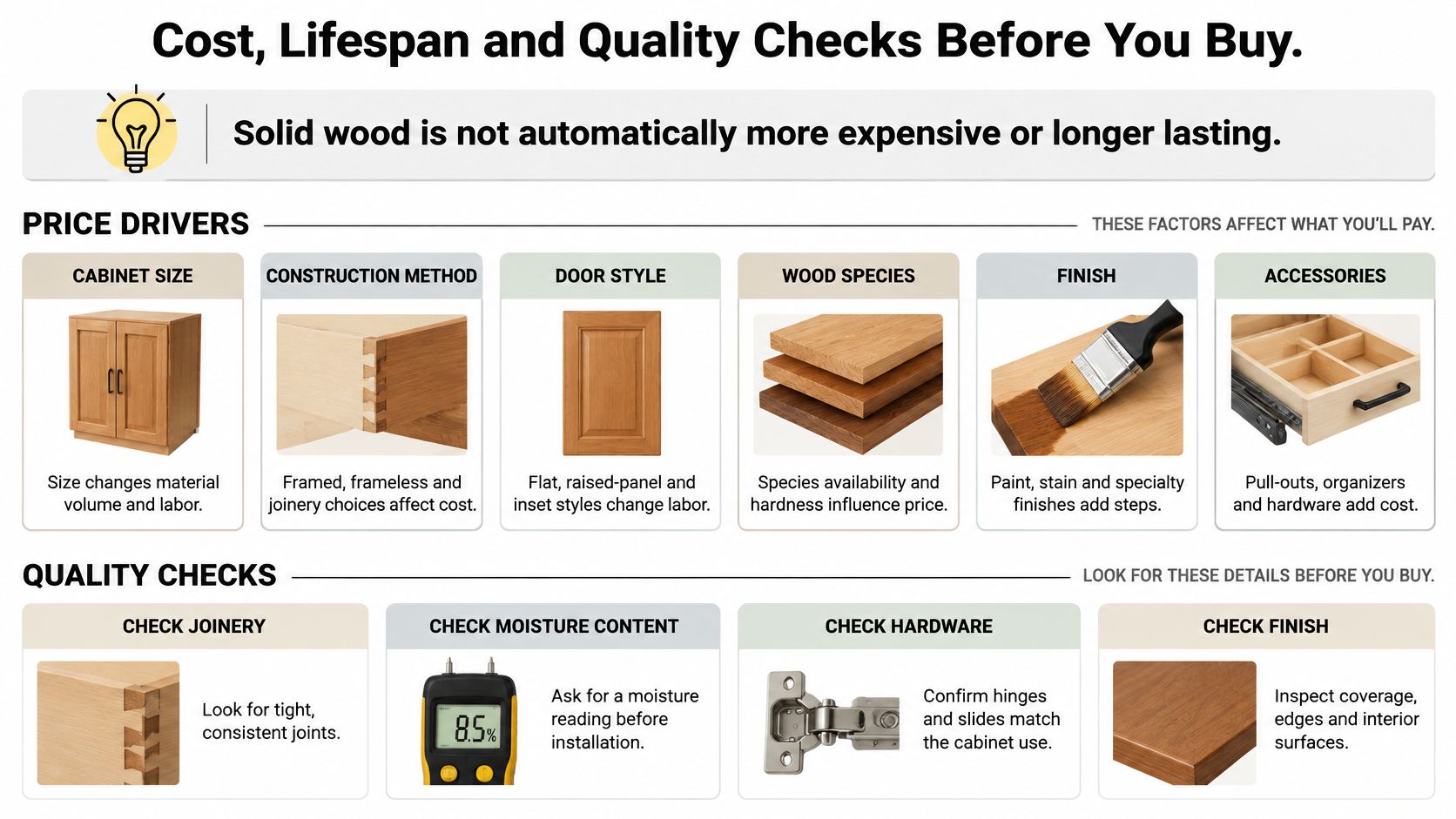
Solid wood isn't automatically the most expensive or longest-lasting option. Cabinet size, construction method, door style, wood species, finish, and accessories all affect the price. Elaborate fronts and specialty finishes can make a plywood-box cabinet more expensive than a simpler cabinet built with less costly lumber.
For a basic kitchen cabinet installation, our costs start around $5,000 for materials and labor. That's a starting point, not a quote for every room; use our guide to cabinet cost per linear foot to understand what a price comparison includes.
Separate service life from the material label
With proper upkeep, our custom cabinetry solutions can last 15 to 20 years, often much longer. That expectation depends on how the cabinet is built, installed, used, and maintained, not on putting solid wood everywhere.
A low price loses its appeal if the quote omits finished end panels, adequate shelf support, or the hardware needed for daily use. Compare equivalent scopes before deciding that one material costs less.
This checklist highlights the construction and price questions to settle before ordering.
Check emissions and written specifications
The EPA's composite wood product guidance sets a federal formaldehyde emission limit of 0.05 parts per million for hardwood plywood. Request compliance documentation rather than assuming that a wood-faced product has no adhesive-related emissions.
Before approving the order, check:
- Panel documentation: Confirm composite-panel compliance, core type, and the adhesive system.
- Edge protection: Identify who seals installation cuts and plumbing openings.
- Finish specification: Confirm the coating, cleaning instructions, and touch-up method.
- Hardware suitability: Match hinges and slides to the intended door and drawer use.
- Warranty coverage: Read which components are covered and how moisture damage is treated.
For sustainability, start by evaluating what can remain in service. Replacing sound boxes solely to obtain a different material label may be less useful than retaining them and improving worn fronts or hardware. Consider repairability, responsible sourcing, and compliant panels together rather than treating either material as automatically greener.
Maintenance and Repair Over Time
Plywood boxes need attention at edges and penetrations. Check any cut made for plumbing, wiring, or a repair, because installers can expose unfinished material even when the original panel arrived fully finished.
After a leak, empty the cabinet and inspect the floor, lower side edges, back, and toe kick. Dry the area thoroughly and check for lifted veneer, softened edges, separation between layers, or a musty odor before putting stored items back.
Follow a practical upkeep routine
- Dry spills promptly. Pay particular attention to the sink rim, dishwasher side, door bottoms, and vanity floor. Don't leave wet cleaning cloths draped over doors.
- Manage room moisture. Use kitchen extraction and bathroom exhaust fans, and keep the home conditioned rather than allowing repeated damp-to-dry extremes.
- Inspect hidden areas routinely. Shine a flashlight around supply valves, drain fittings, and the cabinet floor. Investigate staining rather than covering it with a liner.
- Repair finish damage early. Reseal exposed edges with a compatible coating, and use the cabinet manufacturer's approved touch-up system.
- Check moving hardware. Tighten loose mounting screws and adjust hinges or slides only after confirming that the cabinet is dry and square.
Repair the material you actually have
Solid-wood doors and trim often allow careful sanding and refinishing. Clean and degrease first, test finish compatibility in a concealed area, and sand only enough to prepare the surface. Don't fill a moving split until you've addressed its cause.
Thin plywood face veneers need a lighter approach. Aggressive sanding can expose the underlying layer, and swollen or delaminated panels generally need replacement rather than cosmetic filler.
Repair priority: Stop the water source before repairing the cabinet. A fresh finish over damp material won't solve the problem.
A cabinet that stays dry and receives small repairs promptly has a better chance of remaining useful than one bought for its material label and then neglected. Maintenance doesn't need to be complicated, but it does need to reach the hidden parts.
Choosing Plywood or Solid Wood for Your Remodel
A kitchen used every day
For a kitchen with a sink, dishwasher, and regular cookware storage, I'd choose quality plywood boxes with carefully protected edges and solid-wood fronts where repairability matters. Put equal attention into shelf support, drawer construction, and installation.
Choose door species and finish around the appearance you want, not as an indirect way of specifying the box. A stained shaker front and a contemporary veneered slab can both sit on well-built cabinetry, but they need different conversations about profiles, edges, and future touch-ups.
A bathroom with frequent humidity
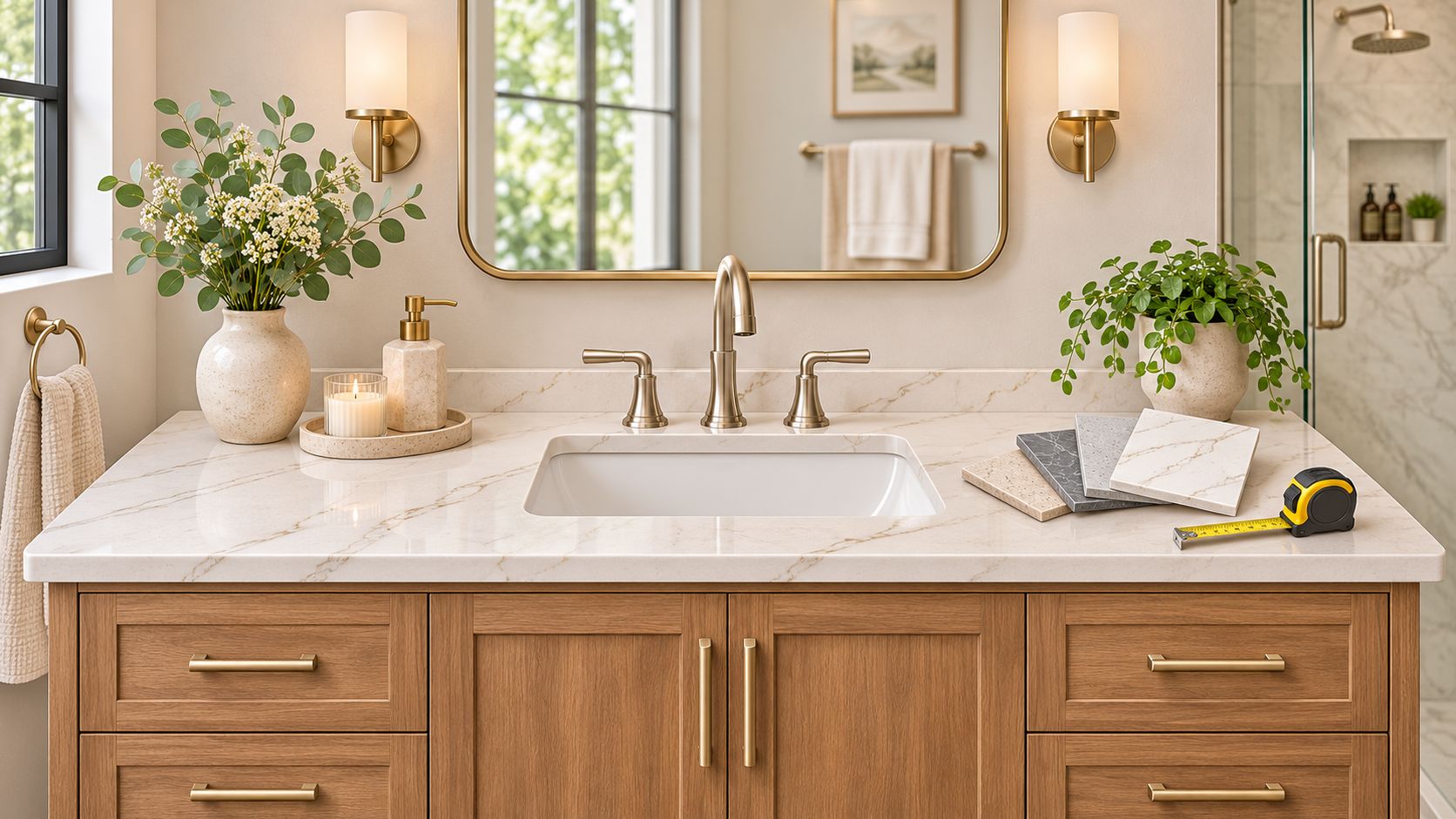
For a vanity, I'd prioritize a plywood box with sealed plumbing cutouts, a suitable finish, and access to drain and supply connections. Use solid wood selectively for doors and trim that can be maintained without dismantling the vanity.
Ventilation is part of that specification. A more expensive cabinet won't compensate for persistent condensation or an unnoticed drain leak, so include exhaust performance and plumbing access in the remodel discussion.
A rental or resale project
On a tighter budget, start with the existing boxes. If they're sound, square, and suitable for the layout, evaluate repairs or a front replacement before committing to demolition.
If replacement is necessary, prioritize dependable box construction, cleanable finishes, and replaceable hardware over an all-solid-wood claim. Spend on the features occupants will use, such as functional drawers and accessible storage, rather than hidden material upgrades with no clear benefit.
Make the hybrid choice specific
A hybrid build is the default recommendation for many homes, but the word hybrid isn't a specification. You still need a component list, finish samples, a moisture-protection plan, and clear warranty terms.
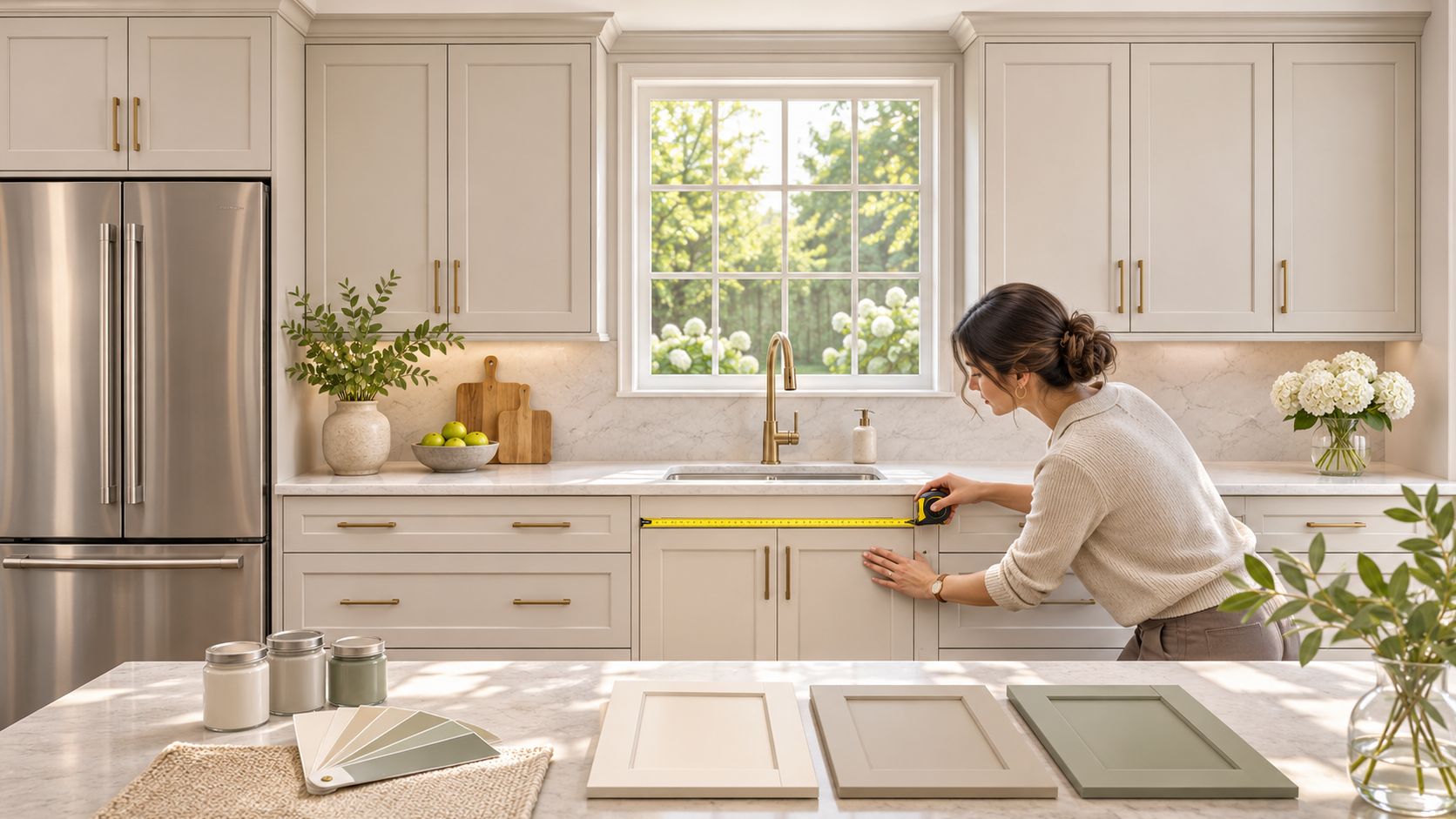
Our material-selection process helps coordinate cabinetry, countertops, fixtures, and finishes with your style and budget. We bring full-size samples of cabinetry, countertops, hardware, and tile to the home so you can compare them with an experienced guide under your own lighting.
If environmental priorities influence the project, our guide to eco-friendly kitchen cabinets can help frame choices around materials and continued usefulness. Those decisions should support the room's actual demands rather than override them.
- Request the material schedule: Identify the box, shelves, backs, drawer components, doors, and trim.
- Review samples at home: Look at grain, sheen, edge details, and adjacent surfaces together.
- Confirm vulnerable details: Resolve sink openings, dishwasher-adjacent surfaces, and component warranty coverage before ordering.
This week, request the material list for your planned cabinets and check each component against the cabinet-parts table. That document will tell you more about likely performance than choosing a winner in the abstract.
The Cabinet Coach offers in-home material comparisons and cabinetry design for kitchens, bathrooms, laundry rooms, home offices, and living-area built-ins. Visit The Cabinet Coach to arrange a complimentary video consultation and discuss where plywood, solid wood, and a carefully specified combination fit your remodel.