
Most advice about cabinet cost per linear foot is bad advice. It gives homeowners a neat, simple number, and that number usually falls apart the second real design decisions show up.
If you're renovating in South Jersey, that's a problem. Homeowners in Cherry Hill, Haddonfield, Moorestown, Medford, and Mount Laurel don't buy a mythical “average kitchen.” They buy drawer bases, pantry cabinets, decorative panels, crown, fillers, finished ends, rollout trays, and installation that has to deal with old walls, uneven floors, and real-life layouts. That's why online pricing shortcuts keep producing quotes that feel “too high” when they are just more complete.
A better approach is to stop treating cabinet pricing like a price tag on a shelf. Treat it like a system. You need to know what the metric means, what determines cost, and how to budget from the bottom up instead of from a marketing number. If you're still in the planning phase, start with a realistic kitchen remodel planning process before you chase pricing.
Table of Contents
- Budgeting Your Kitchen Remodel A Vague Starting Point
- The Linear Foot Myth What This Metric Really Means
- The Real Factors That Determine Cabinet Costs
- Typical Cabinet Cost Ranges in South Jersey
- Sample South Jersey Kitchen Project Estimates
- How to Create Your Accurate Cabinet Budget
- Your Next Step to a Perfect South Jersey Kitchen
Budgeting Your Kitchen Remodel A Vague Starting Point
Most homeowners start in the same place. They search for cabinet cost per linear foot because they want a fast budget number before they commit to design work. That instinct makes sense. The problem is that the number feels precise while hiding the parts of the project that determine your total.
In South Jersey, that gap shows up quickly. A kitchen in a Collingswood twin, a Moorestown colonial, and a newer home in Voorhees may all have similar wall lengths, but they won't price the same. Ceiling height, trim detail, cabinet depth changes, appliance panels, and install conditions all matter more than a generic average.
Why the shortcut fails
Linear foot pricing sounds like flooring or countertop pricing. Cabinets don't work that way. A simple shelf base, a sink base, and a wide drawer stack don't carry the same cost just because they each cover wall space.
Then add the choices homeowners care about:
- Storage function: More drawers, pull-outs, tray dividers, and pantry accessories change the quote fast.
- Visible finish details: Painted ends, finished panels, valances, and molding packages separate a basic kitchen from a polished one.
- Fit and layout challenges: South Jersey homes often need fillers, scribes, and on-site adjustments because walls and floors aren't perfect.
Practical rule: If a pricing method ignores cabinet-by-cabinet differences, it's only a rough conversation starter. It is not a working budget.
What a useful budget needs
A real cabinet budget should answer four questions:
- What tier are you buying? RTA, stock, semi-custom, or custom.
- What boxes are in the plan? Not just the wall length.
- What finish package are you choosing? Door style, paint or stain, panels, and moldings.
- What does installation involve locally? Old-house corrections and detailed trim work aren't freebies.
That's the difference between an online estimate and a quote you can build around. If you want to avoid sticker shock, stop asking for one number and start asking for the full list of components.
The Linear Foot Myth What This Metric Really Means
The phrase cabinet cost per linear foot sounds like an industry standard. It isn't. It's a simplified sales tool, and in my opinion, it has confused more homeowners than it has helped.
What the number actually is
Cabinetry is never sold by the linear foot in retail or manufacturing. The “linear foot” number is a marketing metric created by pricing a pictured 10' x 10' kitchen display and dividing the total by 20 feet, which leaves out molding and other important costs, as explained in Main Line Kitchen Design's breakdown of the 10 x 10 kitchen myth.
That's why homeowners get misled. The number isn't fake in the sense that someone made it up from nowhere. It's misleading because it represents a hypothetical display, not your kitchen.
What it leaves out
A linear foot average can't tell you the difference between cheap and expensive cabinet runs that happen to be the same length. It also can't capture details that routinely show up on real projects.
Here's what gets flattened or ignored:
- Cabinet mix: Drawer bases cost differently than door bases. Tall pantry units are different again.
- Decorative work: Crown, light rail, toe detail, and finished ends often sit outside the baseline.
- Hardware and upgrades: Better hinges, better slides, and interior accessories don't disappear because the wall is still the same length.
- Site conditions: Installers price the room they have to work in, not the fantasy kitchen in a brochure.
The linear foot number is a starting point for a conversation. It is not a purchase format, and it is not how professionals build a quote.
Why this matters in South Jersey
South Jersey homeowners often compare a showroom estimate to a real proposal and assume the proposal is inflated. Usually, the opposite is true. The proposal is itemized. The estimate was stripped down.
That matters most in older homes around Collingswood, Haddonfield, Merchantville, and parts of Cherry Hill, where fitting cabinets cleanly can require more trim, more customization, and more labor than a generic online calculator assumes. If you want an accurate number, price the actual cabinet list, not the wall length.
The Real Factors That Determine Cabinet Costs
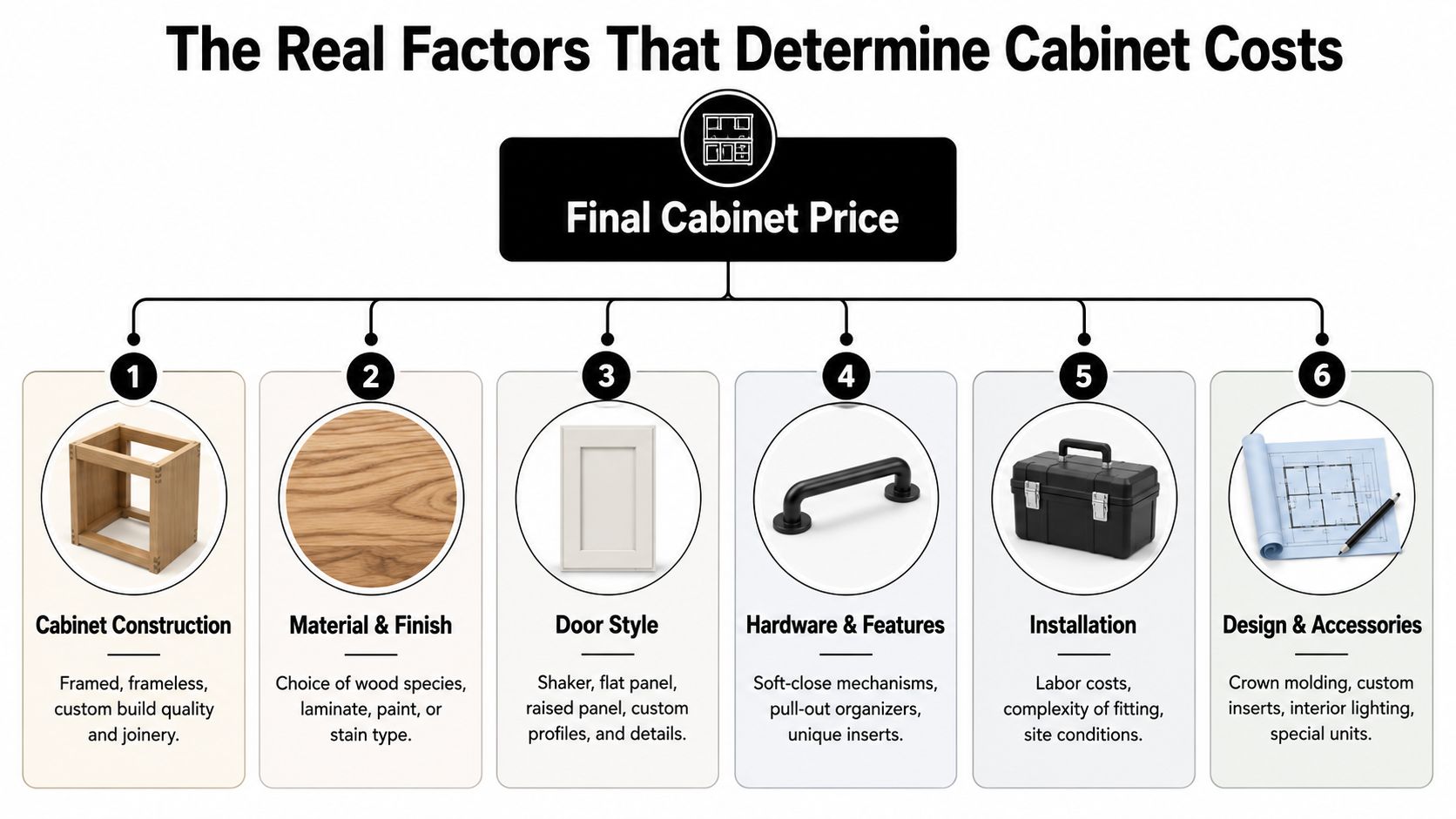
Once you stop chasing the myth, cabinet pricing gets clearer. Not simpler, but clearer. The total comes from your choices, and some choices move the budget far more than others.
Cabinet tier drives the whole conversation
Material costs make up 60–70% of the total project budget, and the common pricing ranges by tier are RTA at $75–$200 per linear foot, stock at $150–$300, semi-custom at $250–$500, and custom at $400–$1,200+, with frameless construction capable of nearly doubling the cost compared to framed equivalents, according to Cabinets City's cabinet cost analysis.
That spread is the reason generic advice falls apart. “Cabinets” is not one category. RTA and custom live in different worlds.
If you're sorting through options, a good place to clarify the tradeoffs is this guide on how to choose kitchen cabinets.
Construction and design details change pricing fast
Framed, frameless, inset, full overlay, slab, shaker, beaded, flush end panels, exposed furniture legs. These aren't style-only decisions. They affect manufacturing complexity, alignment tolerance, and installation time.
A frameless box with a clean European look can price very differently from a framed cabinet with a simpler overlay door. Inset looks beautiful, but it demands tighter precision. That precision costs money.
For homeowners who want to understand what pros review before fabrication, Millwork shop drawings are useful. They show how detailed cabinet documentation gets once dimensions, fillers, panels, and installation conditions become real.
Materials and finishes matter more than many homeowners expect
Paint-grade MDF, plywood construction, wood veneer, and solid wood details don't sit in the same pricing lane. Neither do standard stains versus specialty paint finishes. South Jersey clients often prioritize painted cabinetry, and painted work usually demands a higher level of finish consistency than homeowners realize.
A few common cost movers:
- Wood species and substrate: MDF and laminate hold the entry point lower than premium hardwood choices.
- Finish type: Paint, stain, glaze, and specialty textures each price differently.
- Visible surfaces: Finished interiors, matching end panels, and custom hood treatments all add up.
Here's a solid visual explanation of what pros look at during design and selection:
Features are where “small upgrades” become a large number
Soft-close hinges sound minor. Drawer organizers sound minor. A trash pull-out, spice pull-out, tray storage, appliance garage, mixer lift, and rollout shelves all sound minor too. Add enough “minor” upgrades and your estimate changes significantly.
My advice: Spend on the cabinets you touch every day. Drawer stacks, trash pull-outs, and pantry function usually earn their keep faster than decorative flourishes.
The mistake isn't upgrading. The mistake is upgrading blindly. Decide where function matters most, then concentrate your budget there.
Typical Cabinet Cost Ranges in South Jersey
National averages are useful for orientation, not for decision-making. South Jersey projects have their own pricing rhythm because local labor, older housing stock, finish expectations, and the level of customization homeowners want all influence the final number.
For custom cabinetry in the United States, the commonly cited range is $500 to $1,200 per linear foot, with high-end luxury cabinets exceeding $1,200 per linear foot. A full custom kitchen renovation typically falls between $15,000 and over $40,000, and installation adds 10–20% of the cabinet expense, based on custom kitchen cabinet pricing guidance from Ask a Cabinet Maker.
A practical South Jersey pricing table
Use the table below as a planning tool, not a substitute for a cabinet schedule. The point is to frame expectations before you start comparing quotes.
| Cabinet Tier | Material Cost / LF (Estimate) | Installed Cost / LF (Estimate) | Best For |
|---|---|---|---|
| RTA | Lower end of the market | Lower end once assembly and fit are kept simple | Tight budgets, simple layouts, utility spaces |
| Stock | Entry to lower-mid range | Broader spread because installation quality varies a lot | Fast-turn projects with standard sizes |
| Semi-custom | Mid-range planning number | Common sweet spot for many South Jersey remodels | Homeowners wanting flexibility without full custom |
| Custom | Often aligns with the national custom range above | Higher once trim, panels, and local install complexity are included | Older homes, exact-fit layouts, premium finish expectations |
Why local quotes often feel higher
In this market, homeowners usually aren't comparing bare-bones boxes to bare-bones boxes. They're comparing a stripped-down web estimate to a local quote that includes the things they specifically asked for.
That typically means:
- More detailed finish packages: South Jersey kitchens often include decorative panels, crown, and furniture-style details.
- Tighter fit requirements: Many homes need custom fillers, height adjustments, and better use of awkward walls.
- Professional installation expectations: Clients expect cabinets to look built-in, not dropped in.
If you're deciding between tiers, this comparison of custom vs semi-custom cabinets helps narrow the field. For many homes in Camden and Burlington County, semi-custom is the value play, while full custom makes sense when the room refuses to fit standard logic.
The right way to read these ranges
Don't treat ranges as promises. Treat them as guardrails. The lowest end of any tier usually assumes fewer upgrades, simpler install conditions, and less decorative work. The higher end reflects more exacting finish standards and more project-specific parts.
A realistic budget starts with the cabinet tier you're actually willing to buy, not the cheapest number you can find online.
That one change saves a lot of wasted meetings.
Sample South Jersey Kitchen Project Estimates
Real budgets make more sense when you look at actual project types. Not fake showroom kitchens. Normal local homes with normal constraints.
Scenario one Collingswood galley kitchen
A smaller galley kitchen in a Collingswood twin might use 22 linear feet of semi-custom cabinetry. On paper, that sounds manageable. In reality, the quote depends on what fills those 22 feet.
A typical cabinet list might include more drawers than expected because narrow galley kitchens benefit from better storage efficiency. It may also need finished end panels because sides stay visible in tighter layouts. If the homeowner wants upper cabinets to run taller for extra storage, the trim package changes too.
What raises the proposal in a kitchen like this isn't just cabinet quantity. It's the mix. A run filled with drawer bases, pantry storage, decorative skin panels, and trim won't behave like a basic shelf-cabinet estimate.
Scenario two Mount Laurel open-concept kitchen
A larger open kitchen in a Mount Laurel single-family home might use 35 linear feet of custom cabinetry plus an island. Such configurations make online estimating especially sloppy. Islands introduce back panels, furniture ends, seating overhang coordination, and often storage on multiple faces.
The quote also grows because custom projects usually carry more finish detail and more installation precision. Homeowners who compare these kitchens to simplistic web calculators often ask why the actual total is so far off.
Cabinets City captures that disconnect directly: many homeowners ask why a 30 linear foot custom quote lands at $16K instead of $9K based on a $300 per foot estimate, and one major reason is that custom installation alone can add $271 to $474 per linear foot. That specific gap is discussed in their analysis of kitchen base cabinet costs and installation ranges, which is also why the old 10 x 10 kitchen shortcut keeps misleading people.
What these examples teach you
Both kitchens prove the same point. Wall length is only the frame. The price comes from the cabinet list and the install reality.
A smarter homeowner reviews quotes in layers:
- Cabinet boxes: How many units, and what types?
- Visible details: Which panels, moldings, and decorative elements are included?
- Functional upgrades: Which accessories are essential, and which are optional?
- Installation scope: What site corrections, trim work, and fit details are built into the labor?
If two quotes use the same linear footage but different cabinet mixes, they are not comparable quotes.
That's why “per foot” conversations should end early. Itemized proposals tell you where your money is going. Linear foot math doesn't.
How to Create Your Accurate Cabinet Budget
If you want a cabinet budget that survives first contact with reality, build it from the room upward. Don't start with a national average and hope your kitchen behaves.
Start with the cabinet schedule
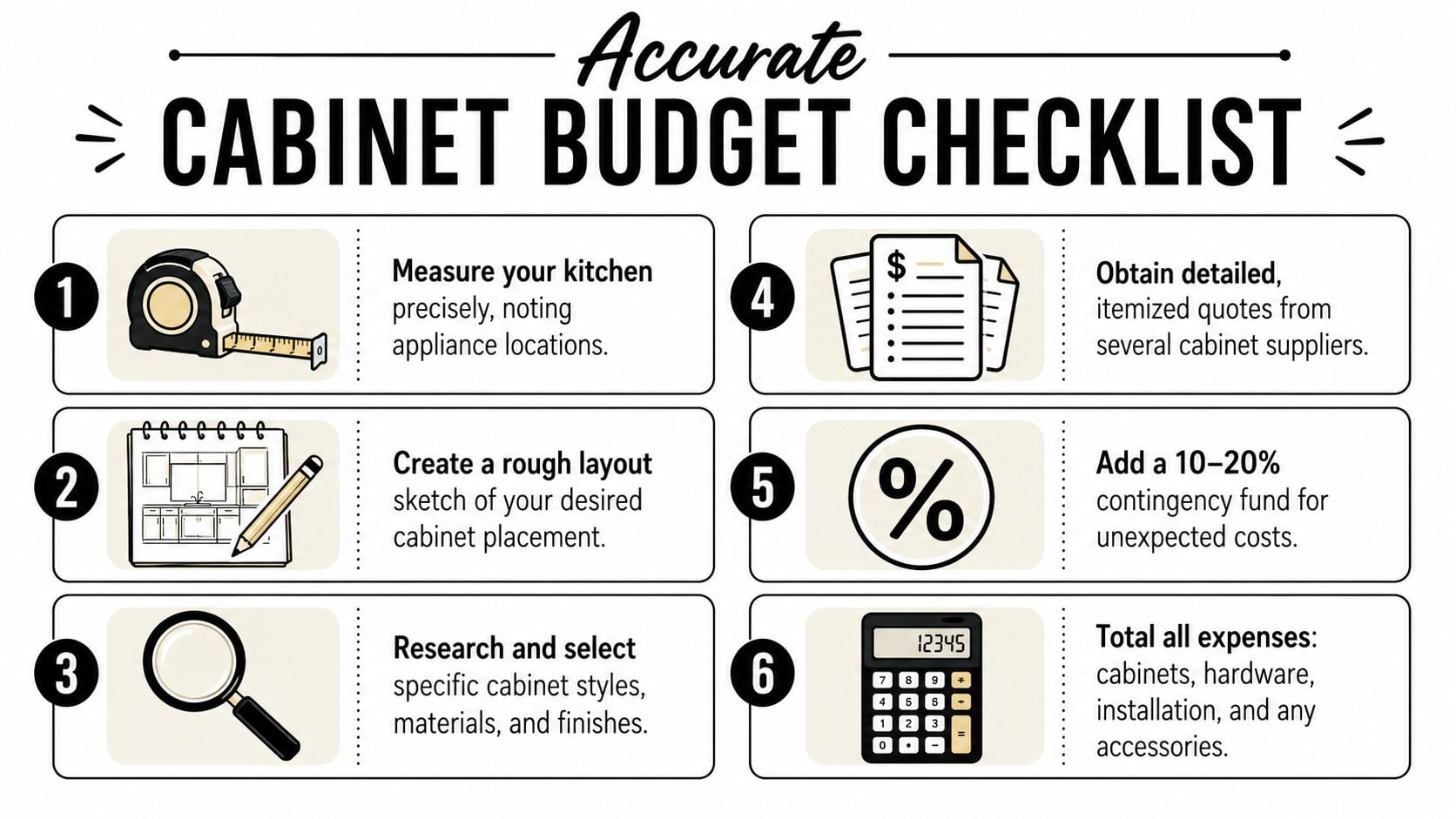
Measure the room carefully. Mark appliance locations, windows, doors, and ceiling changes. Then list the actual cabinet types you think you'll need. Base with drawers. Sink base. Trash pull-out. Pantry. Wall cabinet. Open shelf area. Island storage.
This first draft doesn't need to be pretty. It needs to be specific.
Price in layers, not in one lump
Use a good, better, best approach instead of pretending there's one correct number. Assign one rough tier to the cabinet boxes, another to finish details, and another to installation complexity.
A practical checklist:
- Count boxes first: Stop estimating by room length.
- Separate needs from wants: Storage function should usually beat decorative extras.
- Flag visible upgrades: Panels, molding, and finished ends deserve their own line in your thinking.
- Expect professional installation costs: Don't bury labor inside a fantasy material number.
- Leave room for change: Kitchens almost always reveal something once the design gets real.
Keep installation and accessories visible
One of the biggest homeowner mistakes is treating hardware, trim, and installation like minor side notes. They aren't. They shape the final look as much as the cabinet brand does.
For custom cabinetry, installation commonly adds 10–20% of the cabinet expense, based on the pricing guidance cited earlier from Ask a Cabinet Maker. That's a strong reminder that cabinet budgeting isn't just about boxes.
A useful working habit is to request itemized quotes that separate:
- Cabinetry
- Panels and moldings
- Hardware and organizers
- Installation
- Any specialty modifications
Budget discipline: If a quote looks surprisingly low, check what's missing before you celebrate.
That one habit will protect you from most pricing surprises.
Your Next Step to a Perfect South Jersey Kitchen
The biggest mistake homeowners make is trusting a pricing shortcut over a real design. Cabinet cost per linear foot has value only as a loose orientation tool. The moment you start making actual choices, it stops being enough.
A good kitchen budget is built from cabinet types, finish details, accessories, and installation scope. That's how you avoid the usual cycle of false hope, sticker shock, and compromise. It's also how you protect the parts of the project that matter most, like storage function, finish quality, and a clean fit in a real South Jersey home.
If you want a number you can trust, get an itemized design proposal from someone who will measure the room, review your priorities, and translate your wish list into actual cabinet components. A guided kitchen design consultation is the point where budget and design finally start speaking the same language.
The fastest way to stop guessing is to work with The Cabinet Coach, South Jersey's mobile cabinet showroom. You get expert guidance, curated selections, and a budget conversation based on your actual kitchen, not a misleading industry shortcut.