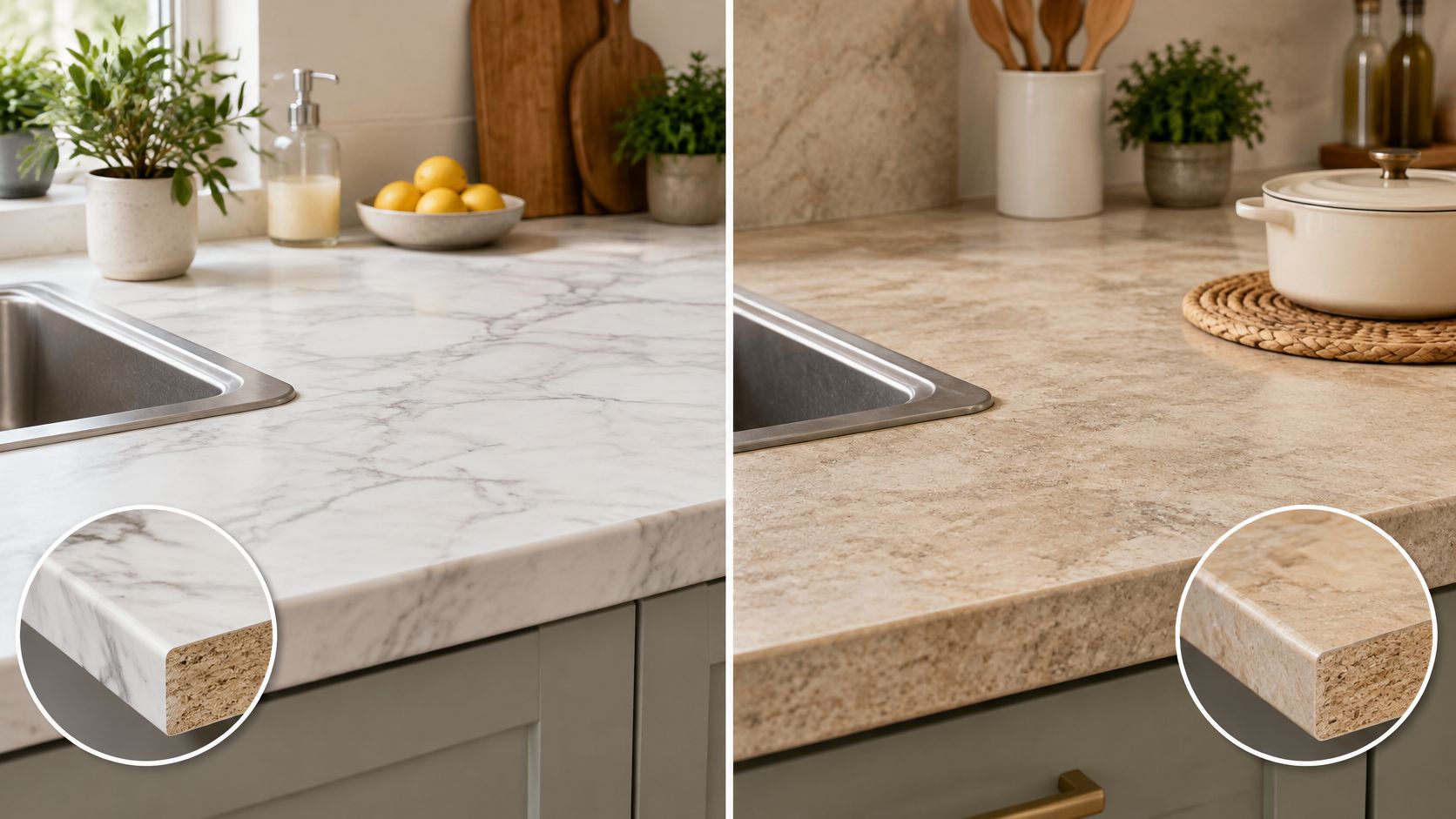
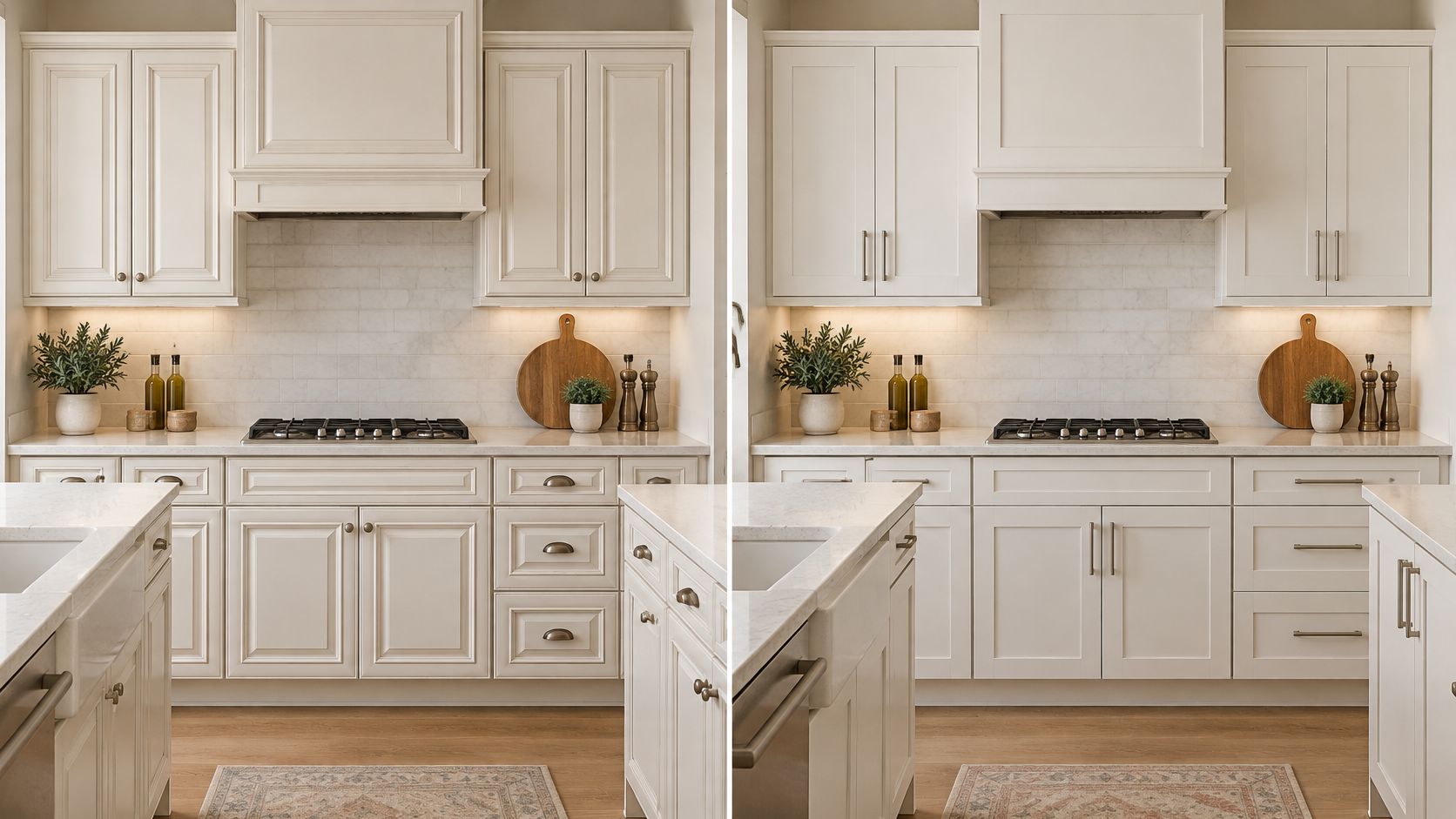
The most repeated advice about refacing vs refinishing cabinets is a price ladder. Refinishing sits on the cheap rung, refacing on the middle rung, replacement at the top, so climb as high as the budget allows. The numbers behind that ladder are roughly right. The order is wrong.
Two kitchens with the same 28 doors can land thousands of dollars apart on the same afternoon, and the finish isn't what separates them. The boxes decide first, then the layout, then what gets sprayed or glued inside your house, then how many days the room sits unusable.
Refinishing and refacing are both skins over a carcass. One changes the coating. The other changes the doors, the drawer fronts, and the visible faces. Neither one touches the box, the plumbing, or the wall, so the carcass votes first and the finish gets what's left.
Table of Contents
- Refacing and Refinishing Side by Side
- Check the Boxes Before You Compare Bids
- What Each Crew Actually Does
- Finish Systems That Change the Price
- Air Quality Downtime and Timeline
- Match Your Kitchen to Refinish Reface or Replace
Refacing and Refinishing Side by Side
Here's the split to carry into a contractor conversation. Refinishing keeps your doors, drawer fronts, frames, and boxes and changes only the coating on them. Refacing keeps the boxes and the current layout, discards the doors and drawer fronts, and wraps the exposed frames in veneer or laminate to match the new fronts. Everything else in this comparison follows from that one difference in scope.
| Criterion | Refinishing | Refacing |
|---|---|---|
| What stays | Doors, drawer fronts, frames, and boxes | Boxes and the existing layout |
| What changes | Coating by cleaning, sanding, stain, or paint | New doors, drawer fronts, and veneer or laminate on exposed frames |
| Typical project cost | About $1,500–$4,500, some estimates to $5,000 | About $5,000–$13,000 |
| Unit pricing | Usually priced by the kitchen | About $150–$450 per linear foot |
| Versus full replacement | Lowest spend when doors and layout still work | Generally 30%–50% below replacement |
| Expected service life | About 3–8 years for many field finishes (gel stain 5–8); sprayed systems 10–15 | About 15–30 years for veneer on a sound substrate |
| Style and layout | Color and sheen can change; door style and layout cannot | Door style can change; layout cannot |
| Best first question | Are these doors still worth keeping? | Are the boxes sound but the doors outdated? |
A cabinet update decision tool published by Carolina Renew, drawing on national consumer-service estimates, puts a typical refinishing project at roughly $1,500–$4,500 while professional refacing commonly lands around $5,000–$13,000, or about $150–$450 per linear foot, generally 30%–50% below full cabinet replacement. That is the gap most homeowners already expect to see.
What they don't expect is how much of the durability gap comes from the substrate rather than the product. That same comparison estimates typical refinished finishes at about 3–8 years and refaced veneers at approximately 15–30 years, and it cites U.S. Environmental Protection Agency figures showing furniture and furnishings entering municipal solid waste reached 12.1 million tons in 2018 against 2.2 million tons in 1960. Keeping serviceable boxes is the quiet argument behind both processes.
Where those ranges come from
They're national compilations, not a Cherry Hill, Moorestown, or Voorhees bid. Your linear footage, door profile, finish system, and box condition move the number further than any average does. A 1990s kitchen with dry plywood boxes and 22 linear feet of run sits nowhere near the middle of a national band, and neither does a five-piece run with water damage under the sink.
Practical rule: Treat a published range as a screen for shortlisting, not a quote. Count your own linear feet first, and double the footage on any wall that carries both uppers and lowers, because ten feet of wall with cabinets top and bottom is twenty linear feet of cabinetry.
If you're still deciding whether the boxes deserve to stay at all, it helps to compare cabinet refacing and replacement costs before you shortlist anyone, since the two converge faster than most guides admit once you start counting countertops and backsplash work.
Check the Boxes Before You Compare Bids
A $2,900 refinishing quote on cabinets with a swollen sink base isn't a bargain. It's a film of coating over a problem you'll pay for twice, once now and once when the box fails anyway. The same logic sinks a mid-range reface: new doors on a soft frame buy you a newer-looking version of the same failure.
The key decision here is structural before it's cosmetic, and you can handle most of it yourself with a flashlight and ten minutes before any contractor rings the bell.
The inspection walk
Go in this order, because it moves from the most expensive failure to the cheapest.
- Sink base floor. Kneel, open the doors, and press the floor panel. Soft spots, dark staining, or particleboard that has swollen and crumbled mean that box is finished. Look at the clips that hold the false drawer front too; rust there means water has been sitting.
- Dishwasher end panel. Steam from a poorly vented dishwasher cooks the panel beside it for years. Check for bubbled veneer, peeling laminate, and a panel you can push in with a thumb.
- Hinge screws. Open every door and give the screws a firm turn with a screwdriver. If they spin in stripped holes, the stile has lost its bite, and new hinges on the same screw holes won't hold either.
- Drawers and openings. Pull each drawer out and look at the bottom for a sag, check the slides for cracks, and sight across the face frame to see whether the openings are still square.
- Wall attachment. Push a tall pantry or a wall run near the top corner. Movement at the wall means you're looking at fastening and possibly framing, not a finish problem.
Then judge the layout on its own, because no door or coating change fixes geometry. A refrigerator door that hits the island, a sink with no landing either side, no room for a trash pullout, or a corner that swallows a whole run of cabinets will still be there after the prettiest reface.
The numbers say most renovating homeowners don't keep everything and don't replace everything. The 2026 Houzz U.S. Kitchen Trends Report found that 68% of renovating homeowners replaced all cabinets while 27% replaced only some, so a partial keep is common, but common isn't the same as correct for your kitchen.
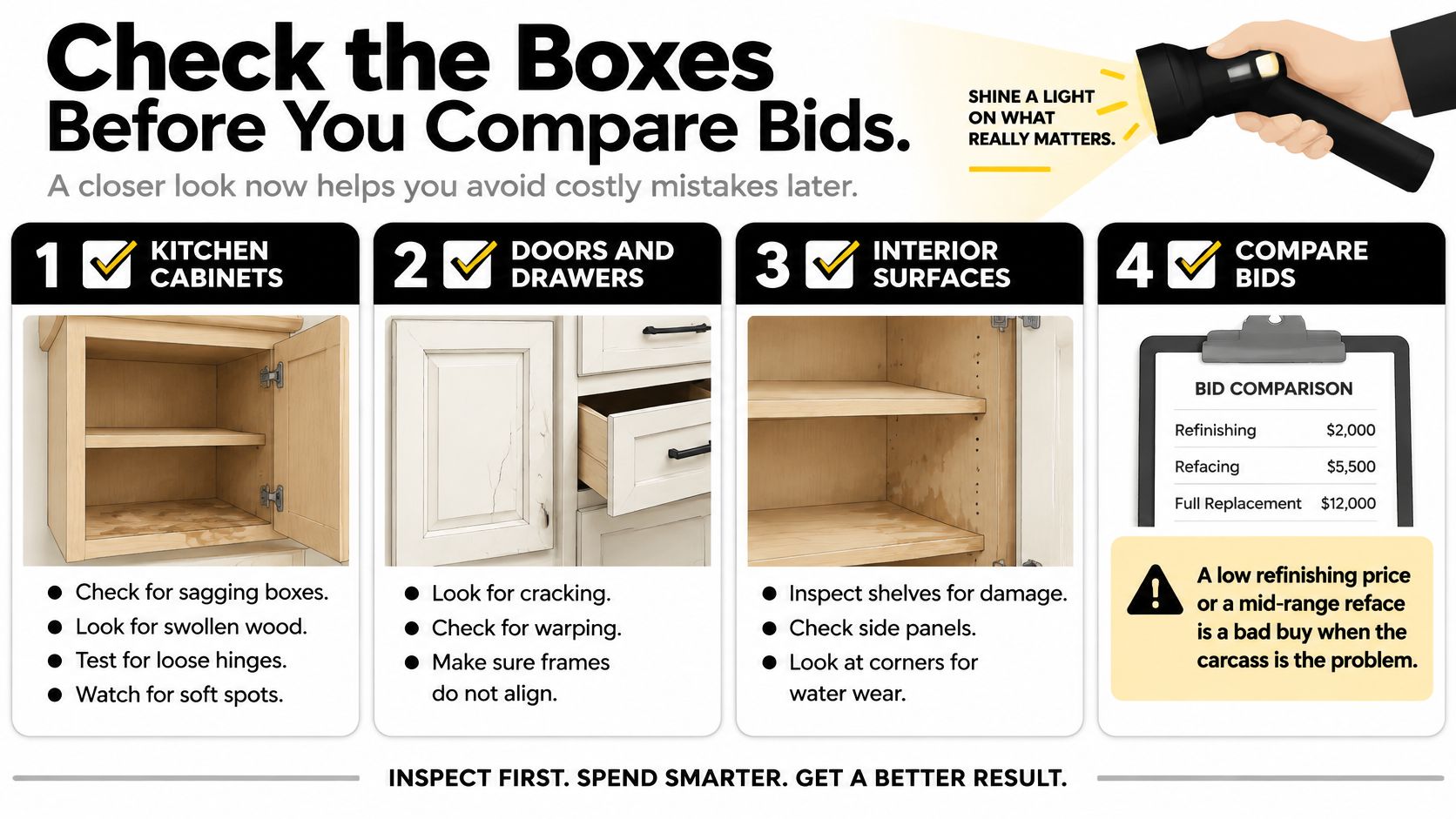
A clean reface on a failing carcass doesn't deliver a new kitchen. It delivers a newer-looking version of the same leak, usually with a warranty that excludes the substrate.
Three outcomes cover almost every kitchen. Sound boxes and a layout the cook likes can stay for either refinish or reface. One wet base under a leaking sink can come out and be replaced as a single cabinet while the rest of the run gets refaced. A layout that fights the room, or swelling that has spread past one box, goes to new cabinetry, and you'll want real numbers on the cost of kitchen cabinet refacing versus replacement before you commit either way.
What Each Crew Actually Does
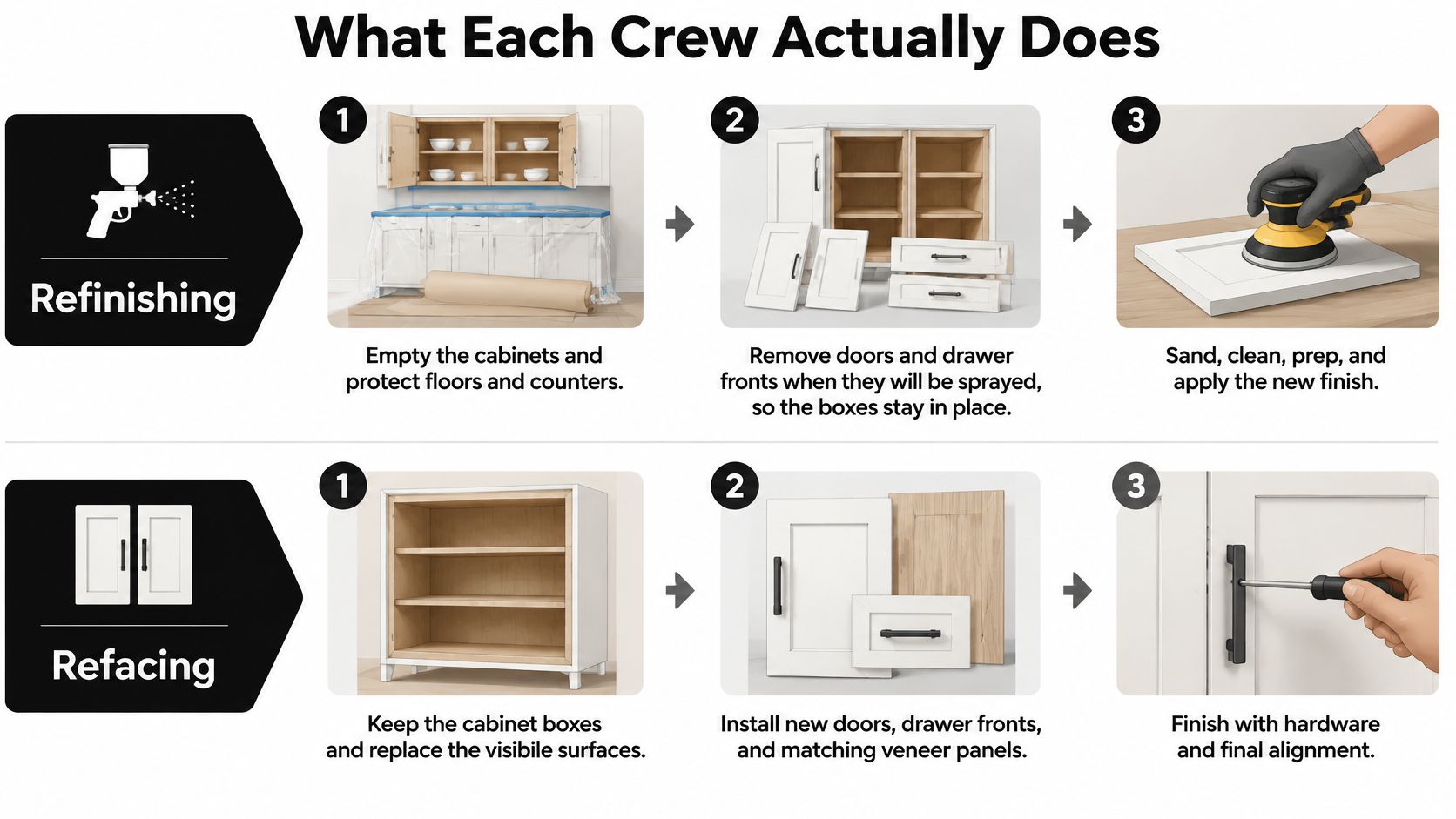
Knowing the order of work tells you what you're paying for and where a bid can cut a corner. The two jobs diverge in the first hour and never really meet again.
Refinishing, step by step
- Empty and protect. Cabinets come out of service, and floors, counters, and the range hood get masked. Anything sprayed travels, so plastic goes up on more surfaces than you'd guess.
- Pull the doors and drawer fronts when they'll be sprayed. Finished flat on a rack or in a booth, a door gets an even film with no runs collecting along the panel edge.
- Degrease, sand, and fill. Kitchen grease is the enemy of adhesion, especially above a cooktop. Minor dings get filled before anything goes on.
- Prime, then apply stain or paint. Sprayed beats brushed on a door face every time, because a brush leaves a film thickness that varies with the hand holding it.
- Cure, rehang, adjust. Hinges and slides go back on and get aligned. Cure time is part of the job, not a formality, and rehanging early traps solvent under hardware.
Refacing, step by step
- Measure every opening, stile, rail, and end panel. Refacing is a millwork order, so a missed reveal becomes a shimmed door later.
- Order doors, drawer fronts, and the matching skin. Wood veneer, laminate, and rigid thermofoil all behave differently at an edge, so the material gets chosen alongside the door style.
- Strip the old fronts and hardware. Boxes stay bolted to the wall the entire time.
- Clad the exposed frames and end panels in matching material so the new doors look built-in rather than bolted on.
- Hang and align. New fronts, new hinges, new pulls, then the fussy part: making reveals consistent across the run.
The shared limit is the part people miss. Neither job builds a new box, moves a wall, adds a drawer bank, or relocates the sink, range, or dishwasher.
Refacing has been sold as a distinct service long enough that this confusion isn't new. A 2004 trade-industry account from Blackburns Interiors reports one contractor first offered refacing in 1983, when few homeowners knew the option existed, and that by 2003 refacing had grown to 32% of that company's residential business while a simpler restoration service fell from 72% to 45%. The category has been sliding between the two jobs ever since.
Your test is a two-part question. If only the color or sheen is wrong, refinishing fits. If the door style is what you dislike, refinishing can't help you and refacing is the honest answer. Homeowners searching for cabinet refinishing near me usually discover in the first ten minutes of the visit that they want one job and had been quoted the other.
Finish Systems That Change the Price
Two kitchens with the same door count can land at opposite ends of a range, and the film usually explains it. Coatings aren't one product with one lifespan, so the name on the can matters more than the number of coats.
| System | Reported life | Best fit | Weak point |
|---|---|---|---|
| Gel stain over an existing finish | 5–8 years | Light color shift on sound wood | Sits on the old film and wears sooner |
| Conversion varnish | 8–15 years | High-touch painted or clear cabinets | Fails without correct prep and cure |
| Factory-quality sprayed finish | 10–15 years | Doors finished in a spray booth | Cannot save failing veneer or swollen board |
| Wood veneer reface | About 15–30 years | Real-wood look on solid boxes | Edges and water at the sink base |
| Laminate or rigid thermofoil reface | About 15–30 years if edges stay sealed | Smooth modern doors | Heat, peeling edges, and wet end panels |
Available industry cost estimates compiled by RealCostIQ place professionally refinished cabinets at approximately $1,500–$5,000 for a typical kitchen, with gel stains over an existing finish lasting only 5–8 years, conversion-varnish systems generally reported at roughly 8–15 years, and factory-quality sprayed finishes commonly projected at about 10–15 years.
What each system is actually for
Gel stain is a color job on a surface that's already sealed and sound. It's the right answer when you want a slightly deeper tone on oak and nothing more, and the wrong answer when anyone promises ten years out of it.
Conversion varnish is a high-solids system for cabinets that get handled daily, and it lives or dies on preparation and cure. Ask what gets sanded, to what grit, and how many hours the doors sit before rehang. A crew that can't answer in specifics is guessing.
A factory-quality sprayed finish is the benchmark a booth exists to hit. Doors sprayed flat, in controlled conditions, with a catalyzed product, look and wear differently from a door brushed in a humid garage.
On the refacing side, wood veneer can be sanded and restained years later, which makes it the repairable choice. Laminate is tough in the middle and vulnerable at the edge. Rigid thermofoil gives you a smooth modern face, then tells you about the oven beside it.
Buying line: The cheapest bid is usually a shorter-lived film, not a better deal. Ask for the coating name, the sanding steps, the cure time, and the warranty terms, and don't accept the word paint as an answer.
South Jersey makes this visible. A humid July slows cure and traps solvent, and a January of dry forced heat opens hairline checks in a film that went on too thin. A soft latex or a rushed clear shows fingerprints and water rings within a season, long before the ten-year mark anyone promised.
When you're weighing doors and skins, the cabinet refacing materials comparison is worth reading before you fall for a sample, because thermofoil, laminate, and veneer fail in different ways at the same price point.
Air Quality Downtime and Timeline
A new door can look finished on day one and still leave the kitchen unusable until the film hardens. The invoice is the easy comparison. The harder question is whether the family sleeps in the house on Tuesday and when the cooktop comes back on. Indoor air and downtime often decide refinish versus reface more reliably than a price ranking, because the work happens in the room you eat in.
Can you stay home during the job
Usually yes, with conditions. Guidance on formaldehyde and VOC exposure in kitchen cabinets recommends choosing no-VOC products where the color allows, ventilating the room, and letting finishes dry fully before reinstallation. In practice that means windows open and a fan moving air, doors and drawers kept off the boxes until the film is hard, and food-contact surfaces wiped down before the first meal goes back in.
Where the doors get finished changes the disruption. Doors sprayed off-site at a shop shorten the odor window inside the house considerably, because the bulk of the solvent flashes somewhere else. Doors finished in place can sideline the kitchen for days. The schedule question and the coating question are the same question.
Ask each contractor for a written day-by-day schedule that names the days the kitchen is unusable, and ask what the warranty excludes. A warranty that covers the film but not the substrate tells you what the company expects to fail.
Refacing cuts on-site coating work, but it isn't emission-free. Adhesives, laminate, thermofoil, and new composite doors still deserve a check for smell, heat resistance near the range, and whether a damaged front can be repaired or has to be reordered in a matching dye lot.
Homeowners are increasingly choosing smaller, partial kitchen updates and living through them rather than emptying the house for a full tear-out. That choice pays only if the boxes underneath can carry the new face. A pretty door on a weak carcass is a false saving: the kitchen is down twice, once for the cosmetic job and again when the sink base fails.
The waste question cuts both ways
Keeping sound boxes avoids demolition waste and the dumpster in the driveway. Replacing a rotting sink base can prevent a second project two years later, which is its own kind of waste. If floors are also on the list, the sequencing matters more than the material choice, and restore kitchen floors without removing cabinets covers how to plan that order so the cabinets aren't pulled twice.
Plan the household side before signing anything. Decide where meals come from for the week, which bathroom stays in service if a vanity is in scope, and what gets cleared off the counters the night before. Then line the work up against the wider kitchen renovation timeline so a cabinet job doesn't collide with countertop templating.
Match Your Kitchen to Refinish Reface or Replace
Four South Jersey kitchens, four verdicts, and none of them decided by the price ladder.
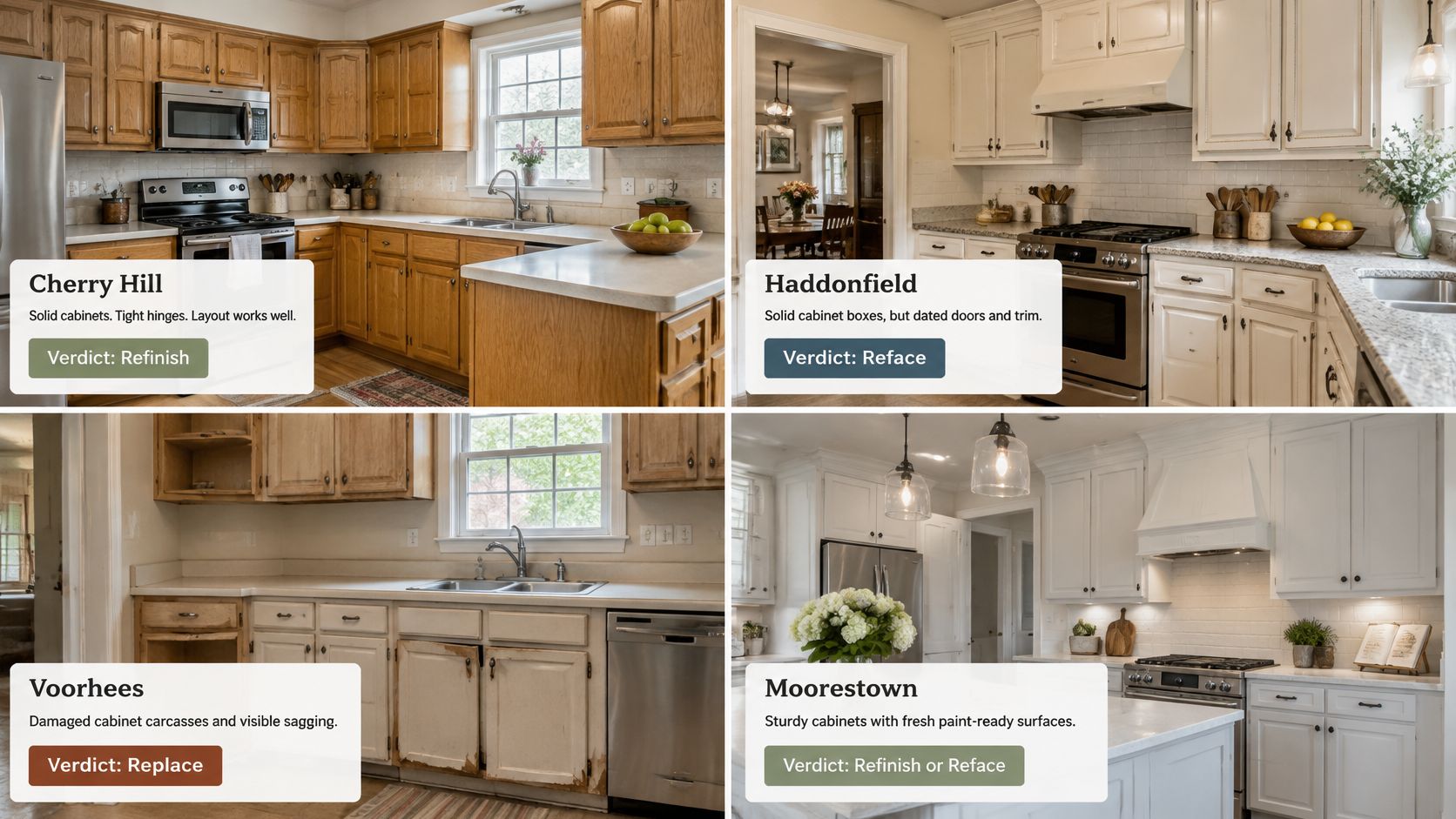
A Cherry Hill colonial with square raised-panel oak. The boxes are plywood and dry, the hinges still bite, and the cook likes where everything sits. Twelve linear feet of uppers and lowers, no water history, doors that close flush. Verdict: refinish, in a warm gray or a clearer stain, and keep the doors. You're preserving better material than a stock replacement would put back.
Solid maple boxes in Mount Laurel or Evesham with heavy raised panels. Nothing is wrong with the carcass. The style is the problem, and no coating fixes a profile. Verdict: reface. A frame that accepts a new hinge pattern can move between a traditional raised panel, a transitional shaker, and a contemporary slab, and the style choice is where most of the visible change lives. Sarah, a Springfield homeowner working with The Cabinet Coach, landed on a warm gray shaker with subtle brushed brass hardware and oak floors, which is a style decision a paint can couldn't have delivered on those doors.
A 1990s thermofoil kitchen in Pennsauken or Voorhees. The foil is peeling at the drawer edges and lifting near the dishwasher, but the boxes are dry and solid. Verdict: reface, because you can't successfully paint a film that's already letting go. New fronts and a matching skin solve it in one pass.
Here's the same comparison in motion, if you'd rather watch the two processes before you name your own scene:
A soft sink base or a galley that blocks the refrigerator. Slow leak, swollen board, no landing beside the sink, and a fridge door that fouls the opposite run. Verdict: replace the damaged run or the layout. Painting or cladding this kitchen spends the budget and leaves the daily irritation in place.
The decision in three lines
- Refinish when the doors, hinges, and layout are sound and the goal is color or sheen.
- Reface when the boxes pass the checks but the door style is dated, or the existing fronts are physically failing.
- Replace fully or partially when particleboard is swollen, doors are warped, or the workflow is wrong.
Notice what all three share: none of them is a price decision until the structure is settled. A quote is only comparable to another quote once both cover the same scope, and the scope starts with what's behind the door.
Name the scene that matches your kitchen, take photos of the sink base and the dishwasher end panel, and write down the two or three things that must not change, whether that's the pantry location, the window wall, or the drawer stack you use every day. Then book an in-home review of box condition before you look at a single sample door, which is exactly the order cabinet refacing vs replacement guidance recommends, and the order that keeps a pretty new front off a tired box. Finishes on our cabinetry run a minimum five-step process for the same reason the inspection comes first: the film only performs if what's under it does.
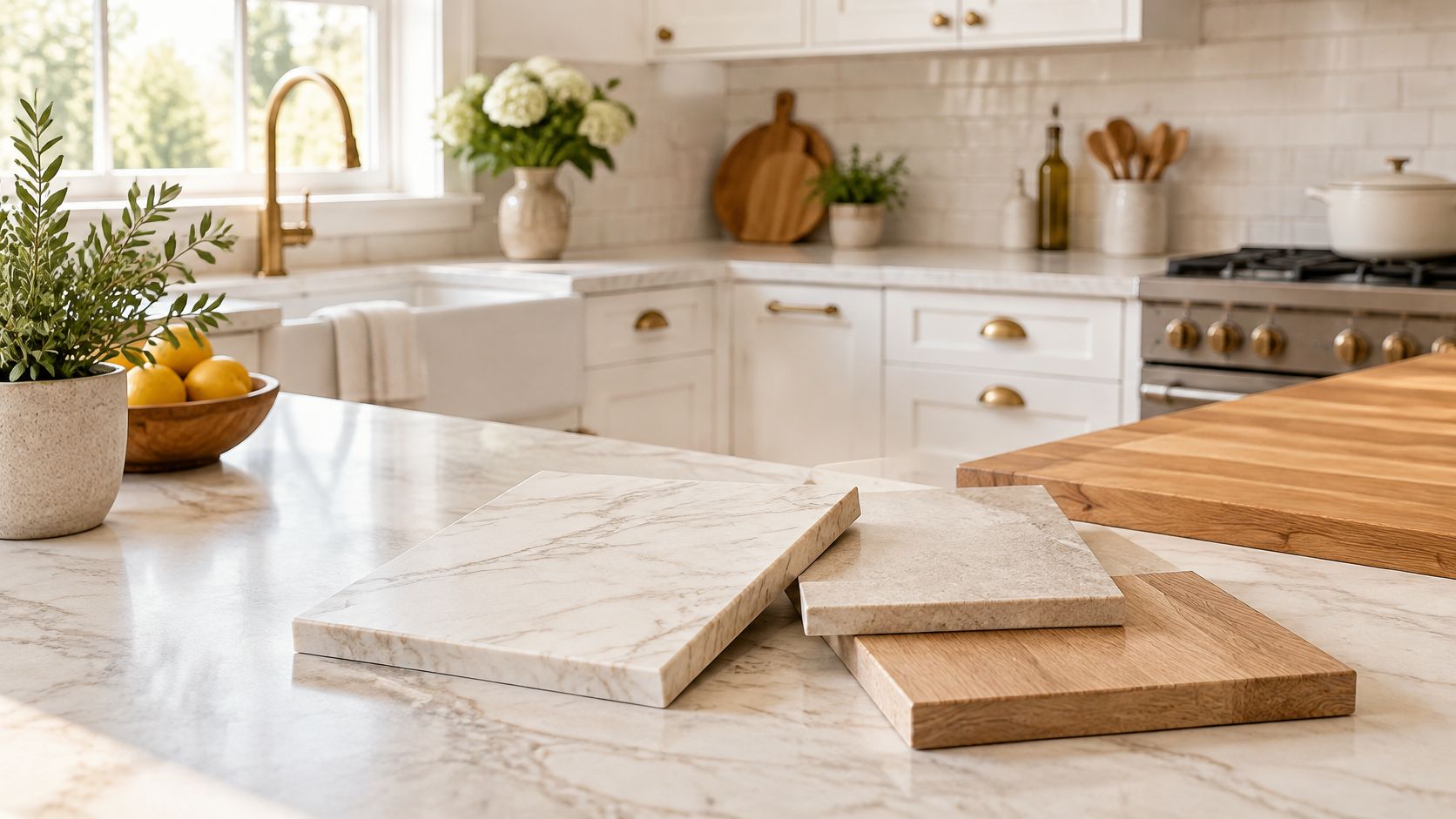
The Cabinet Coach brings full-size cabinet, countertop, hardware, and tile samples to your South Jersey kitchen, so you can hold a transitional shaker front against your existing oak in your own light before anyone orders a door. If your boxes pass the inspection, our team walks the layout, the finish system, and the day-by-day schedule with you, from three cabinet styles in traditional, transitional, and contemporary profiles through coordinated counters and backsplash. Start with a complimentary video consultation at The Cabinet Coach and settle the carcass question first, because that's the one that decides your budget.