
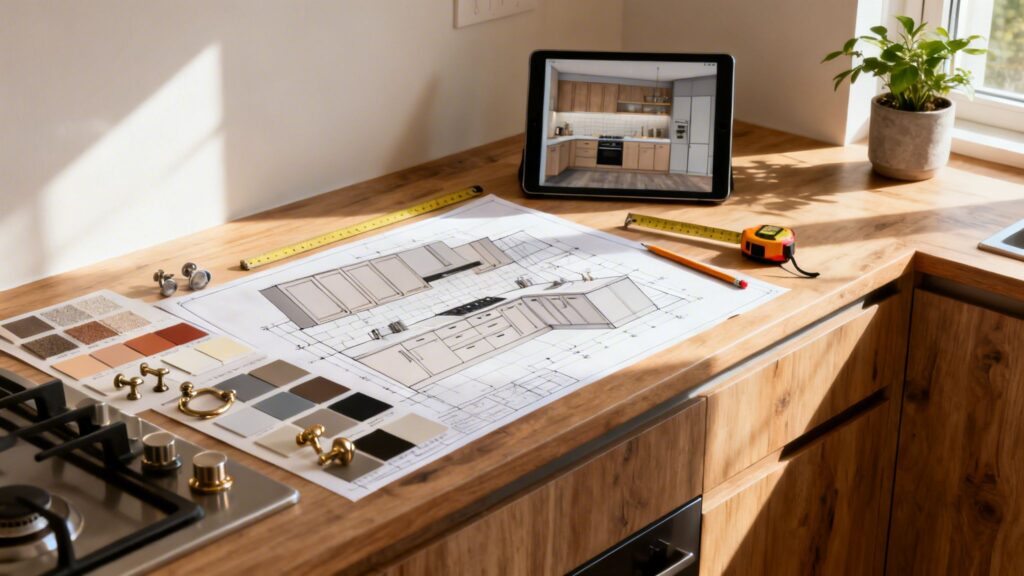
You’re probably standing in your current kitchen noticing the same problems every day. The corner cabinet eats pans. The refrigerator door blocks the path. The lighting is fine until you need to chop vegetables. In South Jersey, especially in older homes around Haddonfield, Moorestown, Collingswood, and Merchantville, those frustrations usually come with crooked walls, tight footprints, and a layout that made sense for a different era.
That is why how to plan a kitchen remodel matters more than the finishes you pin first. Good planning keeps the project from turning into a string of expensive mid-construction decisions. It also helps you make peace with the house you have, rather than trying to force every kitchen into the same showroom-perfect rectangle.
Table of Contents
- First Steps Your Vision and Budget
- Designing Your Perfect South Jersey Kitchen
- Mapping Your Remodel Timeline from Start to Finish
- Assembling Your Team and Navigating Local Permits
- Smart Shopping for Cabinets Countertops and More
- Common Remodeling Pitfalls and How to Avoid Them
- Your South Jersey Kitchen Remodel Checklist
First Steps Your Vision and Budget
A South Jersey kitchen remodel usually starts the same way. You are standing in a kitchen that technically works, but every routine takes longer than it should. In a Haddonfield foursquare, that may mean tight walkways and too little landing space by the range. In a Moorestown colonial, it may mean a large room with poor storage in all the wrong places.
Start there. A good plan begins with daily friction, not finishes.
Before choosing cabinet colors or countertop slabs, write down what slows you down now. Be specific. Note where groceries pile up, where trash interrupts prep, where doors collide, and where lighting falls short at night. In older South Jersey homes, small layout flaws tend to stack up over time because many of these kitchens were built for a different way of living.

Separate must-haves from nice-to-haves
Homeowners get into trouble when every idea carries the same weight. A better approach is to sort decisions into three buckets before any design work gets too far.
- Must-haves: Better storage, safer lighting, wider clearances, stronger ventilation, easier cleanup, appliances that open and function properly
- Nice-to-haves: A pot filler, a slab backsplash, decorative glass cabinets, a built-in coffee station, specialty inserts in every drawer
- House-specific fixes: A stubborn corner cabinet, a dropped ceiling line, a radiator, uneven floors, original trim you want to preserve
That third bucket matters more in South Jersey than many homeowners expect. I see it all the time in older homes around Collingswood, Haddonfield, and Merchantville. Once walls are opened, real conditions show up fast. Plaster repairs, out-of-level floors, old wiring paths, and framing that does not land where the original plan assumed can all affect cost before a single finish is chosen.
Build the budget before you build the wish list
Budget should shape the project early. If it does not, the design gets revised over and over, and each revision costs time, energy, and usually money.
Set a total investment range first. Then decide what that number needs to cover. Is this a cosmetic update with better storage and lighting, or a true layout correction with electrical, plumbing, flooring, and possible structural work? Those are very different projects, especially in older South Jersey homes where walls, ceiling lines, and utility locations may limit what makes sense.
One practical rule helps. If the layout mostly supports how you cook, clean, and move through the room, fix the biggest pain points first instead of forcing a full gut remodel just because the kitchen looks dated.
Pre-planning protects the budget
The expensive mistakes usually happen before construction starts. Cabinet sizes affect appliance openings. Flooring choices affect dishwasher height. Vent hood decisions affect duct runs. In older homes, one early assumption can create three extra changes later.
A planning phase should answer the basic job-site questions before materials are ordered:
- Field measurements: Check walls, windows, soffits, ceiling changes, door swings, and anything else that affects fit
- Scope decisions: Decide what stays, what moves, and what gets replaced
- Allowance planning: Identify where selections are fixed and where some price flexibility is still needed
- Lead-time review: Order made-to-order products on a schedule that matches the build
- Permit discussion: Confirm permit needs before plumbing, electrical, or layout changes are locked in
For South Jersey homeowners, I also recommend seeing materials in your own space before making final calls. Light changes from street to street and house to house. A painted door sample that looks warm in a showroom can read flat or yellow in an older kitchen with shaded exposure. That is one reason a local mobile showroom service can save you from expensive second-guessing.
If you want a grounded starting point before speaking with trade partners, this kitchen remodeling planning guide before hiring a contractor lays out the early decisions clearly.
Designing Your Perfect South Jersey Kitchen
A kitchen plan starts to feel real when movement, storage, and materials begin working together. Homeowners often discover the prettiest idea is not always the best fit for the house as the plan comes together.

Start with how you move
The best kitchen layouts support repeated daily tasks. Coffee. Lunch packing. Cleanup. Grocery unloading. Meal prep. The old work triangle still matters, but a modern kitchen often works better when you think in zones instead.
That means placing prep space where it is useful, keeping dish storage close to the dishwasher, and making sure trash access does not interfere with cooking. A family that cooks nightly needs something different from a homeowner who mostly reheats, entertains, and wants visual calm.
South Jersey homes add another layer. A narrow galley in Collingswood may need leaner cabinetry and smarter appliance placement. A larger Moorestown kitchen may handle an island, but only if the clearances really work once stools, doors, and traffic are accounted for.
Older South Jersey homes need honest design
Generic advice often falls apart when facing specific challenges in older South Jersey homes. A 2023 Houzz report notes that many remodels involve layout challenges, yet a smaller proportion of guides address angled walls. That gap matters in older local homes where the room is not a perfect box. The same Houzz discussion notes that mobile showrooms can provide on-site laser measurements and 3D modeling to optimize irregular flows in historic homes, which is especially relevant in towns with older housing stock like Haddonfield and Moorestown. The reference is in this Houzz discussion on odd-angled kitchen spaces.
When a kitchen has awkward angles, the answer is usually not to fight every inch of it. Better results come from respecting the architecture and designing around it.
What tends to work:
- Use odd corners deliberately: A difficult angle can become tray storage, shallow pantry space, or a visual break instead of a failed attempt at standard cabinetry.
- Reduce visual crowding: In smaller, older rooms, too many tall elements can make the kitchen feel boxed in.
- Customize where the room demands it: Fillers, finished panels, and depth adjustments matter more in older houses than in new construction.
- Think ahead for long-term comfort: Rounded corners, easier-to-grip hardware, and more forgiving clearances help kitchens age well.
Good design in an older home does not pretend the room is brand new. It makes the room feel intentional.
For homeowners who do not want to shuttle between multiple showrooms, The Cabinet Coach offers a mobile showroom model with in-home product review, design guidance, and material coordination. In older homes, that kind of on-site process is useful because cabinet, countertop, hardware, and tile decisions can be tested against the actual room conditions.
Choose finishes where you can see them
A material board can look perfect under showroom lighting and feel completely different once it is next to your floor, wall color, and natural daylight. That is why finish selection should happen in context.
Cabinet door style, countertop pattern, backsplash tile, and hardware should support the architecture of the house. In South Jersey, many homeowners want an updated kitchen that still feels right with older millwork, brick facades, or traditional room transitions. That usually means choosing clean, durable finishes without chasing novelty.
A backsplash is a good example. It has to work with cabinet color, grout maintenance, lighting, and countertop movement. A loud tile can look exciting in isolation and exhausting once the room is finished. If you are weighing tile options, this guide to selecting a tile backsplash can help narrow the field.
A short visual walk-through can also help you look at layout and finish choices more critically before anything is ordered.
Mapping Your Remodel Timeline from Start to Finish
Kitchen remodels feel less overwhelming when you know the order of operations. Most stress comes from not knowing what should happen next, or from assuming two trades can work in the same space at the same time when they cannot.
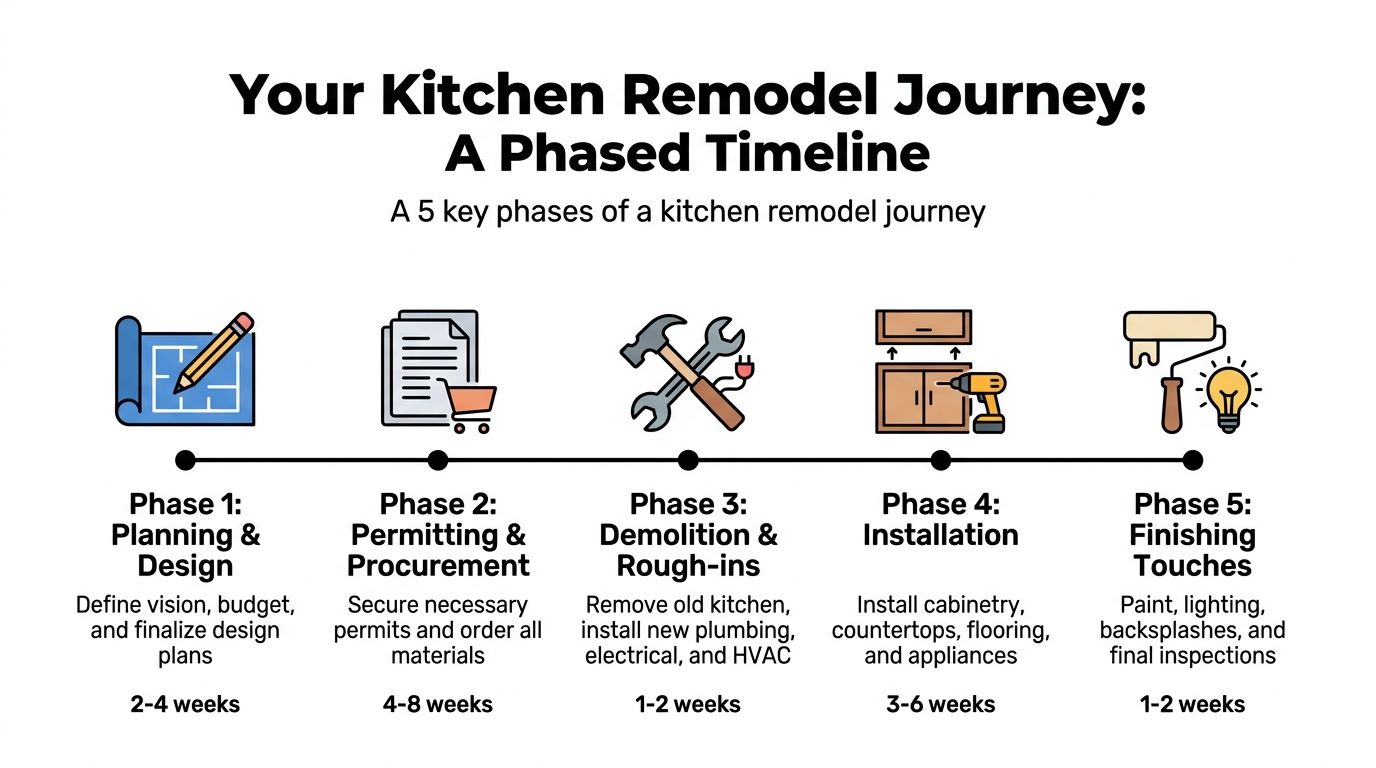
What the construction sequence usually looks like
For a mid-range New Jersey kitchen project, a benchmark remodel timeline spans 6 to 12 weeks for projects in the $40K to $80K range, according to Payless Kitchen Cabinets’ remodel checklist. That benchmark breaks down into demolition, rough-ins, drywall and paint, flooring, cabinet installation, countertops and backsplash, and final finishing work.
Here is the sequence in plain language:
- Demolition: The old kitchen comes out and the space gets opened up.
- Rough-ins: Electricians and plumbers place the systems behind the walls.
- Wall repair and paint prep: Drywall is closed and surfaces get ready for finish work.
- Flooring: This often needs to happen before countertops so heights and transitions work correctly.
- Cabinets: Once the room is ready, the cabinet run is set and leveled.
- Countertops and backsplash: Template first, then fabrication, then installation.
- Final stage: Fixtures, appliances, punch-list items, and closeout.
That sequence matters. If someone installs pieces out of order, you can create fit problems, damage finished surfaces, or force a trade to redo work.
Where timelines slip
Delays are rarely caused by one dramatic problem. More often, they come from a stack of small planning misses.
Common reasons include:
- Late product selections: If the sink, appliance specs, or hardware are undecided, trades pause.
- Measurement surprises: Older homes reveal uneven walls, floors, and framing.
- Poor trade coordination: One delay pushes every task behind it.
- Change orders: Midstream design revisions almost always extend the schedule.
The same benchmark source notes that unplanned projects can significantly extend this timeline. That is a useful reminder that the calendar is not just about construction speed. It is about decision quality before the first day of demolition.
Ask for a written sequence, not just a finish date. A realistic phase-by-phase schedule tells you much more than a verbal promise.
Assembling Your Team and Navigating Local Permits
A kitchen remodel is not one hire. It is usually a chain of specialists whose work overlaps. If nobody is coordinating them, the homeowner becomes the coordinator by default. That sounds manageable until appliance specs do not match cabinet openings and the electrician needs answers the cabinet plan never addressed.
Who should handle what
A smoother project starts with clear roles.
- Kitchen designer: Translates goals, measurements, storage needs, and finish selections into a workable plan.
- General contractor or design-build lead: Manages scheduling, site conditions, sequencing, and accountability.
- Electrician and plumber: Handle rough-ins, fixture locations, and code-related work.
- Countertop fabricator: Templates after cabinetry is installed and confirms field conditions.
- Installer or finish carpenter: Sets cabinetry accurately and deals with trim, fillers, and fit.
The cheapest path is not always the least expensive once mistakes show up. In older South Jersey homes, hidden conditions are common enough that you want people who know how to problem-solve, not just install to a perfect-box assumption.
Ask direct questions before you hire:
- Are you registered and insured in New Jersey?
- Who is measuring the room and when?
- Who orders the cabinetry and verifies appliance specs?
- Who pulls permits if permits are required?
- Who is my single point of contact once work begins?
A coordinated approach often saves more frustration than trying to hire each piece separately. If you are comparing structures, this explanation of architect versus design-build decisions helps clarify which setup fits different projects.
Permits are not a side issue
Homeowners sometimes assume kitchen permits only matter if walls move. In reality, permit needs often come up when electrical or plumbing changes are involved. In towns across Camden and Burlington Counties, that can affect outlet locations, lighting changes, venting, plumbing moves, and inspection requirements.
Skipping permits is risky for obvious reasons. It can also create trouble later when you sell, refinance, or need to document completed work.
What usually helps:
- Get the permit conversation in writing early.
- Make sure trade scope matches the approved plan.
- Do not order final materials before the layout is settled.
- Confirm who schedules inspections.
The strongest teams treat permits and documentation as part of the job, not as an afterthought the homeowner has to chase down.
Smart Shopping for Cabinets Countertops and More
Shopping decisions shape how your kitchen works every day, but they do not all deserve the same weight. In South Jersey remodels, I usually see homeowners overspend on visible accents and underspend on the pieces they touch 50 times a day. In an older Haddonfield bungalow or a Moorestown colonial, that mistake shows up fast because the room is already working against you with tighter walls, odd corners, and less forgiving storage.
Where the money usually belongs
As noted earlier, minor kitchen remodels often hold value well when the scope stays disciplined. The stronger return usually comes from smart allocation, not from loading the room with premium finishes in every category.
Cabinets usually take the biggest share for a reason. They control storage capacity, drawer function, door swing, trash pullout placement, and how efficiently the kitchen uses its footprint. In many South Jersey homes, especially where the original kitchen was built for a smaller appliance package, better cabinet planning solves more problems than a high-end countertop ever will.
Sample Kitchen Remodel Budget Allocation
| Kitchen Component | Recommended Allocation | Sample Budget |
|---|---|---|
| Cabinets | Largest share | Highest priority investment |
| Countertops | Mid-range share | Depends on material and edge profile |
| Flooring | Moderate share | Best tied to adjoining rooms |
| Lighting, hardware, backsplash, finishing touches | Controlled share | Easy category to overspend in |
That table is a guide, not a formula. A kitchen with custom storage around an existing radiator, sloped ceiling, or narrow galley layout may need more cabinet budget and less decorative spend.
What is worth paying for
Cabinets are where cheap decisions get expensive. Lower-grade boxes, weak drawer glides, and shallow storage design can make a new kitchen feel old within a year. If you are sorting through framed, full-access, painted, stained, stock, and semi-custom options, this South Jersey cabinet buying guide for local homeowners helps narrow the field.
Countertops need a different filter. Quartz works well for busy households that want low maintenance and a consistent pattern. Granite still appeals to homeowners who want natural movement and do not mind a little variation from slab to slab. But the best choice depends on how you live. If kids drop lunchboxes on the counter, if you bake often, or if you want the backsplash to be the focal point, those details should drive the decision.
Flooring has to relate to the rest of the house. In South Jersey, many kitchens open into original hardwoods, older dining rooms, or small rear additions with a different floor height. A beautiful tile can still be the wrong pick if the transition feels abrupt or creates a height problem at the doorway.
A few rules save money and regret:
- Spend on storage function before decorative upgrades. Deep drawers, pullouts, and smart corner solutions earn their keep.
- Touch hardware before you buy it. Finish color is only part of it. Grip, weight, and scale matter.
- Choose countertop slabs and cabinet samples together. South Jersey natural light changes a lot from morning to late afternoon.
- Keep backsplash in a supporting role unless the room is otherwise very simple. Busy tile plus busy counters usually reads smaller, not richer.
- Ask how each material wears, not just how it looks on day one. Painted finishes, matte surfaces, and textured floors all age differently.
If you want help comparing finishes without driving from showroom to showroom, a local mobile showroom can make this part much easier. Seeing cabinet doors, countertop samples, and hardware in your own kitchen light often leads to better decisions than choosing everything under store lighting.
Common Remodeling Pitfalls and How to Avoid Them
Most remodel mistakes are predictable. They happen when homeowners act too late on decisions that should have been settled early, or when they chase a look without thinking about how the room will be used.
Mistakes that cost the most
Changing your mind after demolition is one of the costliest habits in kitchen remodeling. Once walls are open and trades are scheduled, even a reasonable change can ripple through ordering, labor, and timing.
Another common problem is underestimating the disruption. If you do not set up a temporary coffee station, microwave area, and basic cleanup spot, the project feels harder than it needs to. The construction may be manageable. Living through it without a plan is what wears people down.
Contractor selection is another danger point. A low number on paper can look attractive until communication breaks down or details start getting missed. A kitchen has too many moving parts for vague scope and verbal assumptions.
What holds up over time
Trend-heavy choices usually age faster than homeowners expect. A striking detail can be worth it if you love it, but the room still needs a steady backbone.
What tends to age better:
- Simple cabinet profiles: They give you flexibility with paint, hardware, and decor later.
- Layered lighting: Good task lighting matters more than one dramatic fixture.
- Quiet fixed finishes: Let permanent elements stay calm and bring personality in with easier-to-change pieces.
- Practical storage: Deep drawers, well-placed trash pull-outs, and accessible daily-use storage almost never feel like mistakes.
The kitchen you will enjoy longest is usually the one that solves work, storage, and cleanup first. Style comes through more clearly when those basics are handled well.
For a quick reality check before you commit, these remodeling mistakes to avoid are worth reviewing.
Your South Jersey Kitchen Remodel Checklist
A South Jersey kitchen remodel can get complicated fast, especially in older homes where nothing is quite standard. In Haddonfield, Moorestown, and similar neighborhoods, I often see tight work zones, uneven walls, older windows that affect cabinet runs, and doorways that make appliance delivery harder than expected. A checklist keeps those details from turning into change orders.
Use this as a working document from the first planning meeting through final punch list.
Your planning checklist
- Write down your daily frustrations: Note what slows you down during cooking, storage, cleanup, and traffic flow.
- Rank your priorities: Label each item as must-have, nice-to-have, or specific to your house.
- Set the scope early: Decide whether you are refreshing the current layout or changing walls, plumbing, or appliance locations.
- Measure and photograph everything: Keep appliance specs, window heights, ceiling details, soffits, and awkward corners in one file.
- Confirm your budget distribution: Make sure the money matches your priorities before you choose finishes.
- Choose materials together, not one by one: Review cabinetry, countertops, hardware, flooring, and tile in the actual light of your home.
- Check your team carefully: Confirm registration, insurance, written scope, communication process, and who will handle permit submissions.
- Review local permit needs: Structural work, electrical updates, plumbing changes, and ventilation corrections often require approvals in South Jersey towns.
- Plan for lead times: Custom cabinets, specialty countertops, and some appliances can affect your start date more than demolition does.
- Set up for construction: Create a temporary kitchen area before demo starts, with coffee, microwave access, and a cleanup station.
- Track every selection and approval: Keep finish choices, appliance model numbers, and signed revisions in one place.
- Walk the finished room slowly: Check reveals, drawer operation, hardware placement, paint touch-ups, caulk lines, and final punch-list items before sign-off.
The strongest remodels are usually the ones that respected the house from the start. In South Jersey, that often means planning around older framing, existing radiator lines, settled floors, or a dining room opening you do not want to lose. Good decisions made in the right order save money and stress later.
If you want help turning your ideas into a workable plan, The Cabinet Coach offers South Jersey homeowners a mobile showroom experience with design guidance, curated product selections, and a complimentary video consultation to get the process started.
Prepared with Outrank app