

If you're standing in your kitchen in Cherry Hill, Haddonfield, Moorestown, or Voorhees wondering why the room never quite works, you're not alone. Most homeowners start with color in mind. They think about white cabinets, warm wood, maybe a new island. Then they realize the problem isn't just the look. It's the cabinet doors that collide, the dead corner nobody can reach, the pantry that holds less than it should, and the nagging feeling that one wrong decision will be expensive.
That’s why learning how to choose kitchen cabinets has less to do with chasing inspiration photos and more to do with making smart decisions in the right order. Cabinets shape how your kitchen functions every morning, how it feels when friends are over, and how buyers judge the room later. If you want to visualize a beautiful kitchen remodel, start with the element that controls the room most.
Table of Contents
- Setting the Stage for Your South Jersey Kitchen Remodel
- Defining Your Kitchen's Style and Layout
- Decoding Cabinet Materials and Construction Quality
- Choosing Finishes, Hardware, and Smart Storage
- Budgeting and Planning Your Project Timeline
- The Smart Way to Finalize Selections in South Jersey
Setting the Stage for Your South Jersey Kitchen Remodel
A lot of South Jersey remodels start the same way. A homeowner has lived with the kitchen long enough to know what’s wrong, but not long enough to feel confident about fixing it. In Cherry Hill, that might mean an older layout with too few drawers. In Moorestown, it might mean painted cabinets that looked fresh years ago and now show every nick. In Haddonfield, it often means a room with angles and proportions that don’t behave like the kitchens in national design articles.

The cabinet decision usually feels overwhelming because it carries so much weight. According to 2026 kitchen ROI data from Kitchen Cabinet Kings, cabinets are upgraded by 84% of renovating homeowners. The same report notes that minor kitchen remodels can return 113% ROI, and that cabinets represent nearly 50% of total remodel budgets. It also shows where taste is moving right now: Shaker-style doors lead at 58%, and wood finishes at 29% have narrowly moved ahead of white at 28% for the first time in nearly a decade.
That tells you two things. First, cabinets aren't a side decision. Second, the right choice usually isn't the flashiest one.
Practical rule: If you’re torn between what photographs well and what works well, choose the cabinet plan that improves the room every day. Good-looking kitchens still fail when the storage is wrong.
Most homeowners need a process before they need a product. That’s where planning matters. A clear remodel roadmap, including layout review, storage priorities, and finish decisions, helps avoid expensive changes later. This guide on how to plan a kitchen remodel is a useful place to organize those early decisions before you start comparing door samples.
Defining Your Kitchen's Style and Layout
The easiest mistake is choosing a cabinet style in isolation. A door sample can look perfect in a showroom and completely wrong once it’s sitting next to your floors, your trim, and the natural light in your actual kitchen.
Start with the house, not the showroom
South Jersey homes have range. A colonial in Haddonfield usually asks for different cabinet lines than a newer home in Voorhees. That doesn't mean you have to match the house rigidly. It means the cabinets should feel believable in the space.
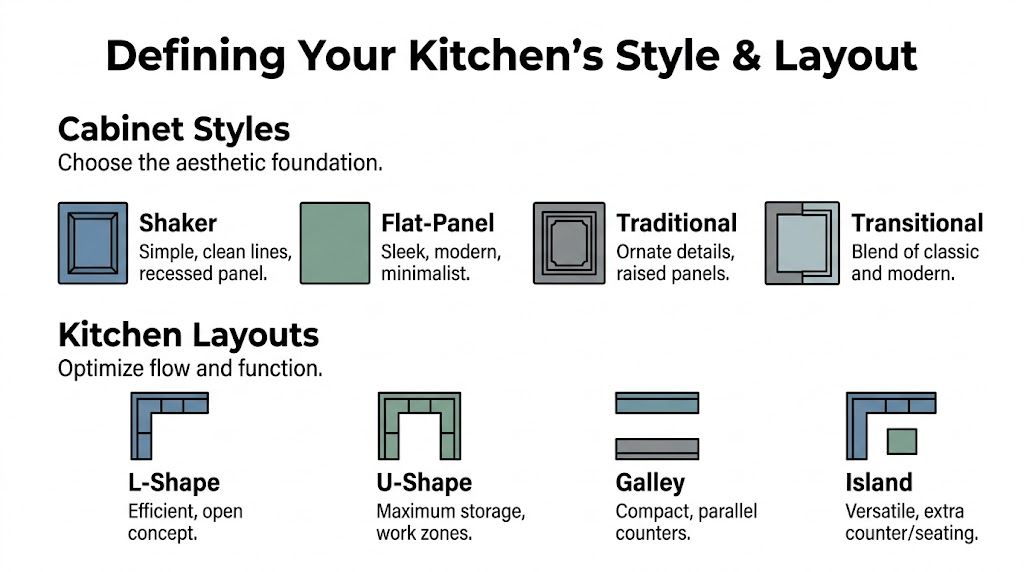
A simple way to narrow style is to group options by how much visual detail they carry:
- Shaker doors work in almost every setting because the profile is simple and flexible. They fit painted kitchens, stained wood kitchens, and mixed-material spaces without fighting the architecture.
- Flat-panel doors feel cleaner and more architectural. They’re often a strong fit in contemporary homes or in remodels where you want the backsplash and lighting to carry more of the design.
- Traditional raised-panel doors bring more formality. They can suit older homes, but they can also make a modest kitchen feel heavier if the room already has a lot of trim and detail.
- Transitional styles split the difference. These are often the safest move when one homeowner wants warm and classic while the other wants clean and current.
Style should support function, not distract from it. If you're still sorting out traffic flow, appliance spacing, and prep zones, review the kitchen work triangle before locking in cabinetry. A beautiful layout that cooks poorly won't get better after installation.
Measure the room you actually have
This matters more in South Jersey than many homeowners expect. Standard cabinet advice often assumes square rooms and clean right angles. Older local homes don't always cooperate.
According to Legacy Cabinets’ discussion of angled kitchen corners, standard cabinet guides often fail to address non-90-degree kitchen angles common in older South Jersey homes, and design professionals note that these slanted angles require custom software for accurate layouts. That same source points to a 15% rise in angled kitchen queries in 2025.
If you've got a slanted wall, a narrow passage, or a corner that seems deeper than it should be, don't force a stock solution onto it. That’s how homeowners end up with inaccessible blind corners, doors that can’t fully open, or upper cabinets that stop short and waste valuable wall height.
In older Haddonfield kitchens, the right answer is often less about adding more cabinetry and more about scaling cabinet depth, height, and placement to the room’s odd geometry.
Here’s what usually works better in awkward layouts:
- Map the fixed points first. Windows, doors, radiators, soffits, and appliance clearances control the plan.
- Protect movement paths. A slightly smaller island often works better than a crowded one.
- Use vertical space intelligently. Tall cabinets can recover storage lost in strange corners.
- Let one corner go if needed. Sometimes the best corner cabinet is no corner cabinet at all. A better adjacent cabinet run can outperform a complicated insert.
A practical layout should feel calm when you’re cooking. If you have to sidestep an open dishwasher to reach a drawer, or if your trash pull-out blocks the prep zone, the cabinet plan needs more work.
Decoding Cabinet Materials and Construction Quality
Cabinet quality is where homeowners either protect their budget or accidentally waste it. Two kitchens can look similar on day one and age very differently because of what’s under the finish.
Stock, semi-custom, and custom mean different compromises
Start with the basic categories. Stock cabinets come in standard sizes and fixed options. They can work well in straightforward rooms, especially when the layout is simple and the measurements cooperate. The downside is fit. If the room has quirks, fillers and compromises pile up quickly.
Semi-custom cabinets usually give homeowners the best middle ground. You get more flexibility with dimensions, finishes, and storage features without going all the way into full bespoke pricing. In many South Jersey kitchens, especially older ones, this is the category that solves the most problems without overbuilding the project.
Custom cabinets make sense when the room demands exact sizing, unusual heights, integrated appliance panels, or detailed architectural matching. They can be the right call. They can also be unnecessary if the room doesn’t require that level of precision.
Spend custom money where the room is custom. Don’t spend it on standard walls just because the label sounds better.
What separates a sturdy cabinet from a disposable one
The most useful technical checkpoint is construction. According to Smith and Vallee’s guide to choosing cabinet makers, homeowners should ask for 3/4" thick plywood carcasses and joinery such as dovetail or mortise-tenon, which reduces sagging by 60% over staples. The same source notes that premium specs benchmarked by the NKBA can yield a 25-30 year lifespan, compared to 10-15 years for standard stock options.
That’s the difference between cabinets that still feel solid years from now and cabinets that start telegraphing wear early.
For cabinet boxes, the main conversation is usually plywood vs. particleboard. For doors, many homeowners also compare painted MDF and wood, especially when they want a smooth painted finish or a stained wood look. If you want a deeper breakdown of door materials, this guide to MDF vs. wood cabinet doors is worth reading before you finalize samples.
Here’s a practical comparison for the cabinet box itself:
| Material | Cost | Durability | Moisture Resistance |
|---|---|---|---|
| Plywood | Higher | Strong and stable for long-term use | Better choice in kitchens where humidity and spills happen |
| Particleboard | Lower | More vulnerable to wear and fastener fatigue over time | Less forgiving when exposed to moisture |
That table looks simple because the main decision is simple. In a kitchen, water always wins eventually. Steam, sink splashes, mopping, and seasonal humidity test every cabinet box you install.
A simple quality check you can use in a consultation
When you're comparing cabinet lines, ask direct questions and ask them in plain English. If a rep or contractor can’t answer clearly, keep going.
Use this checklist:
Box construction
Ask whether the cabinet box is plywood and whether the carcass is 3/4" thick.Joinery
Look for dovetail or mortise-tenon details instead of stapled shortcuts.Drawer operation
Open the drawer fully. It should extend smoothly and close softly without racking.Door feel
The door should feel firm at the hinge side, not loose or hollow.Interior finish
Check whether the inside is easy to clean and whether shelves feel substantial under hand pressure.
One more thing matters here. Hardware quality often shows up before homeowners know how to name it. A drawer that glides smoothly, stays aligned, and doesn't slam tells you a lot about the line.
If a cabinet sample looks good but feels light, wobbly, or noisy, believe your hands. Small warning signs rarely improve after installation.
Choosing Finishes, Hardware, and Smart Storage
Once the cabinet structure is right, the kitchen starts to become personal. Finish, hardware, and storage details determine whether the room feels warm, sharp, formal, relaxed, or easy to live with.
Pick a finish that fits your life
Painted cabinets and stained wood cabinets both work. The right choice depends on your home, your tolerance for maintenance, and how much texture you want in the room.
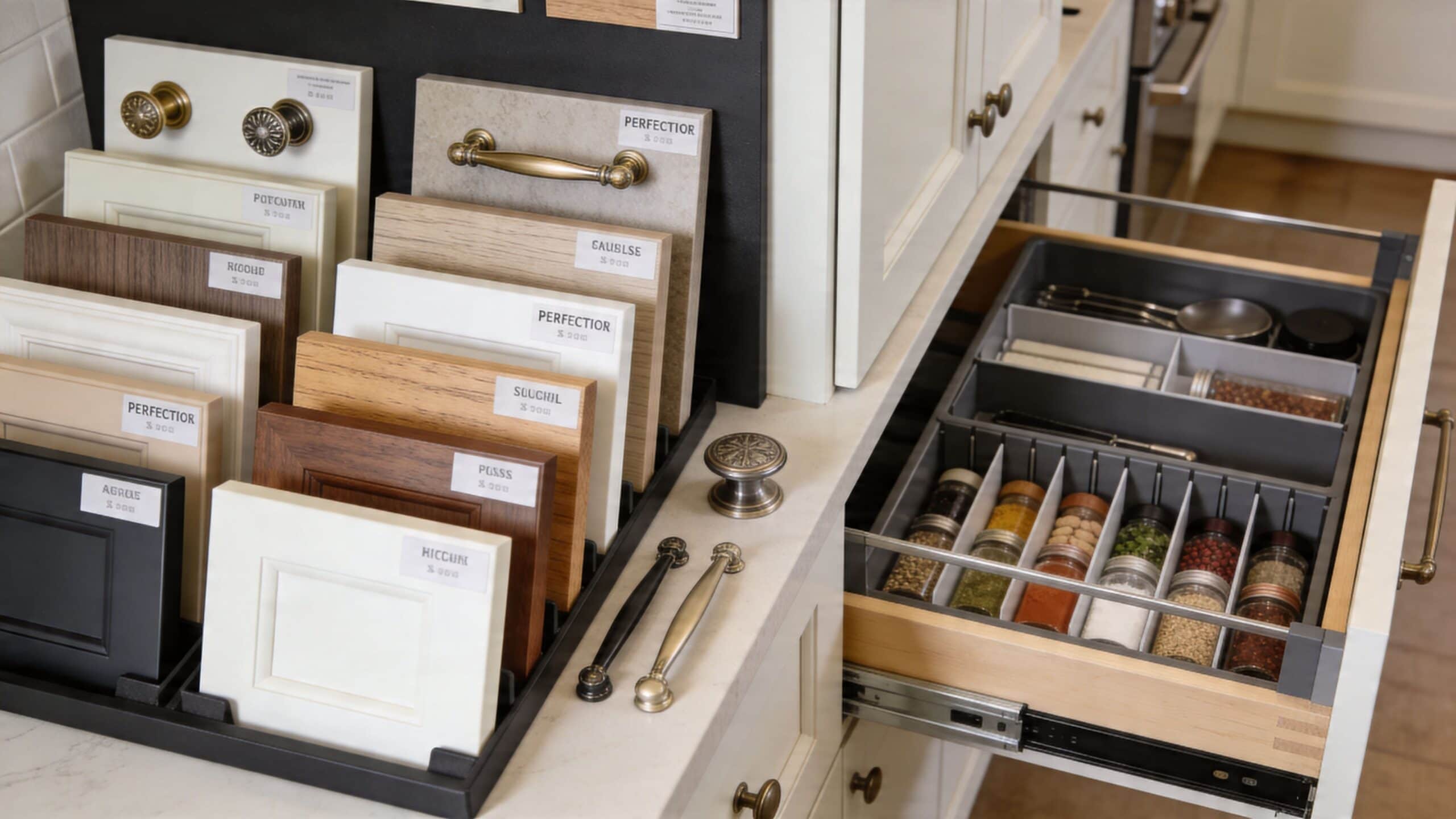
Paint gives a crisp, clean look. It’s often the easiest way to brighten a dim kitchen or unify a room with mixed materials. Stain shows grain and tends to feel warmer, especially in homes with older floors or original trim. Wood also hides day-to-day wear differently than paint does.
A few finish rules hold up well:
- Choose in your own lighting. Morning sun, recessed lights, and under-cabinet lighting all change how a finish reads.
- Match the visual weight to the room. Dark finishes can ground a large kitchen. In a smaller room, they need careful balance.
- Think beyond the first photo. The finish has to work on a cloudy winter afternoon too.
Low-sheen, practical finishes usually age better than finishes chosen only for drama.
Hardware changes the tone fast
Hardware is small, but it changes the personality of the kitchen immediately. The same Shaker door can lean modern with a long matte pull, classic with a round knob, or more transitional with a softened bar pull.
The safest approach is consistency in metal finish and intention in shape. If the cabinets are simple, the hardware can do a little more. If the doors already have a strong profile, quieter hardware usually gives a cleaner result. If you want inspiration before choosing, this look at kitchen cabinet hardware trends can help you compare styles without overcomplicating the decision.
Storage should solve a daily irritation
The best storage upgrades aren't random accessories. They fix something that annoys you now.
According to the earlier ROI data from Kitchen Cabinet Kings, 94% of updated cabinets now include specialty storage features such as pullout bins, tray drawers, and spice organization. That tells you these features are no longer fringe upgrades. They’ve become part of what homeowners expect from a usable kitchen.
Ask yourself what currently goes wrong in your kitchen:
Trash is always in the way
A pull-out waste cabinet keeps the main prep area cleaner and more efficient.Spices vanish in upper cabinets
A shallow drawer insert or vertical pull-out keeps them visible.Sheet pans and cutting boards get buried
Tray dividers turn a messy stack into a reachable zone.Corner cabinets waste space
In some kitchens, a specialized corner solution helps. In others, better drawer storage nearby works better than forcing a complicated mechanism.
A quick video can help you see how these details work in practice before you commit:
Most kitchens don’t need every insert available. They need the right few.
Budgeting and Planning Your Project Timeline
Cabinet budgets get off track when homeowners try to decide everything at once. It’s better to separate the decisions into two buckets. What must perform well, and what would be nice to have.
Where to spend and where to hold back
Cabinets often become the biggest line item in the room, so your choices need to match your goals. According to Houzz’s article on smart cabinet investments, kitchen cabinets often become the single most expensive feature in a remodel. That same source says 55% of homebuyers consider cabinet quality a decisive factor, and that real estate professionals generally recommend midrange cabinets as the best balance of appearance, durability, and ROI potential for 10+ years.
That recommendation lines up with what works in real projects. Midrange cabinets usually deliver the strongest blend of decent construction, solid finish options, and practical customization. Entry-level products can look acceptable at first but often reveal their limitations in drawer action, finish durability, and interior storage. Very high-end cabinetry can be worth it, but only if the room, the home, and your priorities justify the spend.
A smart budget usually protects these first:
- Cabinet box quality over decorative upgrades
- Drawer function over novelty accessories
- Usable storage over filler cabinetry
- Timeless door style over trend-driven detailing
If you're comparing renovation paths, this breakdown of the cost of kitchen cabinets refacing can help clarify whether replacement or refacing makes more sense for your situation.
Buyers may not know joinery terms, but they notice when cabinets feel solid, drawers glide well, and the kitchen looks thoughtfully planned.
Timeline problems usually start before ordering
Homeowners often ask how long cabinets take. The honest answer is that the timeline depends on the cabinet type, the level of customization, and how complete your decisions are before the order is placed.
What slows projects down most often isn't just manufacturing. It’s hesitation and rework. A door style gets chosen before the layout is resolved. An appliance spec changes after drawings are complete. A finish looks different at home than it did under showroom lighting. Those are avoidable problems, but only if you make selections in the right sequence.
A steady process usually looks like this:
- Finalize the layout first
- Confirm appliances and key dimensions
- Choose cabinet construction level
- Approve door style and finish
- Lock hardware and storage details
- Place the order only after those pieces align
Busy households in South Jersey often benefit from fewer decision points, not more. When the process is organized, the timeline tends to stay calmer. When cabinet decisions are made piecemeal, the whole remodel feels longer than it needs to.
The Smart Way to Finalize Selections in South Jersey
The last step is where many remodels either come together or drift into second-guessing. Homeowners usually don’t struggle because they lack taste. They struggle because cabinet choices are easier to judge in the room where they’ll live.
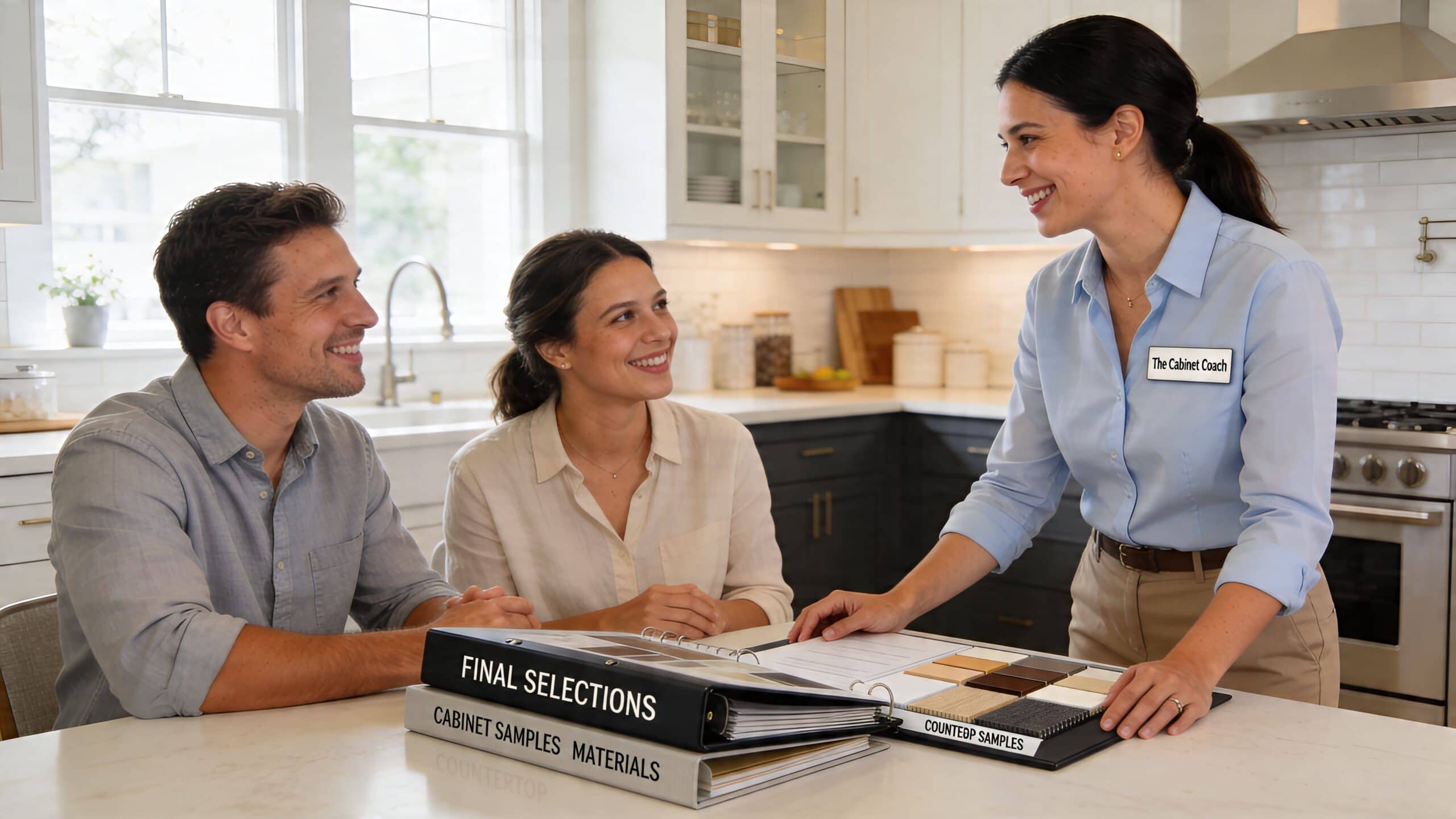
That matters in South Jersey homes with mixed lighting, older walls, unusual corners, and finishes that need to relate to existing floors or trim. A cabinet door that seems perfect under bright showroom lights can look flat, yellow, or too stark once it’s brought into your kitchen.
According to Truly Home Cabinets’ cabinetry guide, professional consultations can raise success rates to 92% and reduce budget overruns by 18%. The same source says that in-home 3D renderings can boost client satisfaction by as much as 35% because homeowners can align selections visually before ordering.
That’s the practical case for handling selections in context. A mobile showroom approach lets homeowners compare door styles, finishes, hardware, and layout options against their own lighting and architecture. The Cabinet Coach offers that format in South Jersey, bringing samples and design guidance into the home so layout discussions, material choices, and visual decisions happen in the actual space instead of in abstraction.
Good cabinet decisions rarely come from staring at one sample chip. They come from seeing the full combination together, in the room, before the order is final.
If you want confidence in your cabinet order, insist on three things. Real measurements, clear drawings, and samples viewed at home. That’s what keeps a remodel from becoming a string of expensive guesses.
If you're ready to sort through styles, materials, storage, and budget with less stress, The Cabinet Coach offers a practical next step. You can start with a simple conversation, review options in your own kitchen, and make cabinet decisions with the room, the lighting, and the layout right in front of you.