The usual advice for modern black kitchens is to add white countertops and call the room balanced. That isn't enough. Black kitchens aren't automatically gloomy, and a pale counter won't rescue poor task lighting, awkward circulation, or cabinet finishes that show every greasy handprint. The problem isn't black itself. It's choosing black without a balancing strategy.
Start with how you use the room. A frequent cook needs cleanable surfaces around the range; a family kitchen needs handles that keep hands off cabinet fronts; an entertaining space needs enough light to work comfortably after sunset. Then decide where black belongs, whether that's full cabinetry, a single island, textured tile, or smaller metal accents.
Restraint helps, too. The Lewis and Sheron Textiles minimalist guide offers a useful companion perspective when coordinating the kitchen with adjoining living spaces. You don't need every surface to compete for attention.
Design priority: Choose the dark surface, its lighter counterpart, and its lighting together. Don't approve them as separate decisions.
The most livable combinations also account for cleaning, door movement, grout, and repairability. These design ideas balance visual impact with the details you'll notice every time you cook.
Table of Contents
- 1. Full Matte Black Cabinetry
- 2. Black Lower Cabinets with Light Upper Cabinets
- 3. Black Kitchen Island with a Light Perimeter
- 4. Black Shaker-Style Cabinets
- 5. Black Quartz or Granite Countertops
- 6. Black Hardware and Plumbing Fixtures
- 7. Black Zellige or Textured Tile Backsplash
- 8. Black Stainless Steel and Black Appliance Finishes
- 9. Black Metal Open Shelving and Frame Accents
- 10. Black and Warm Wood Combination
- 10 Modern Black Kitchen Ideas at a Glance
- Bring Your Black Kitchen Vision Home
1. Full Matte Black Cabinetry
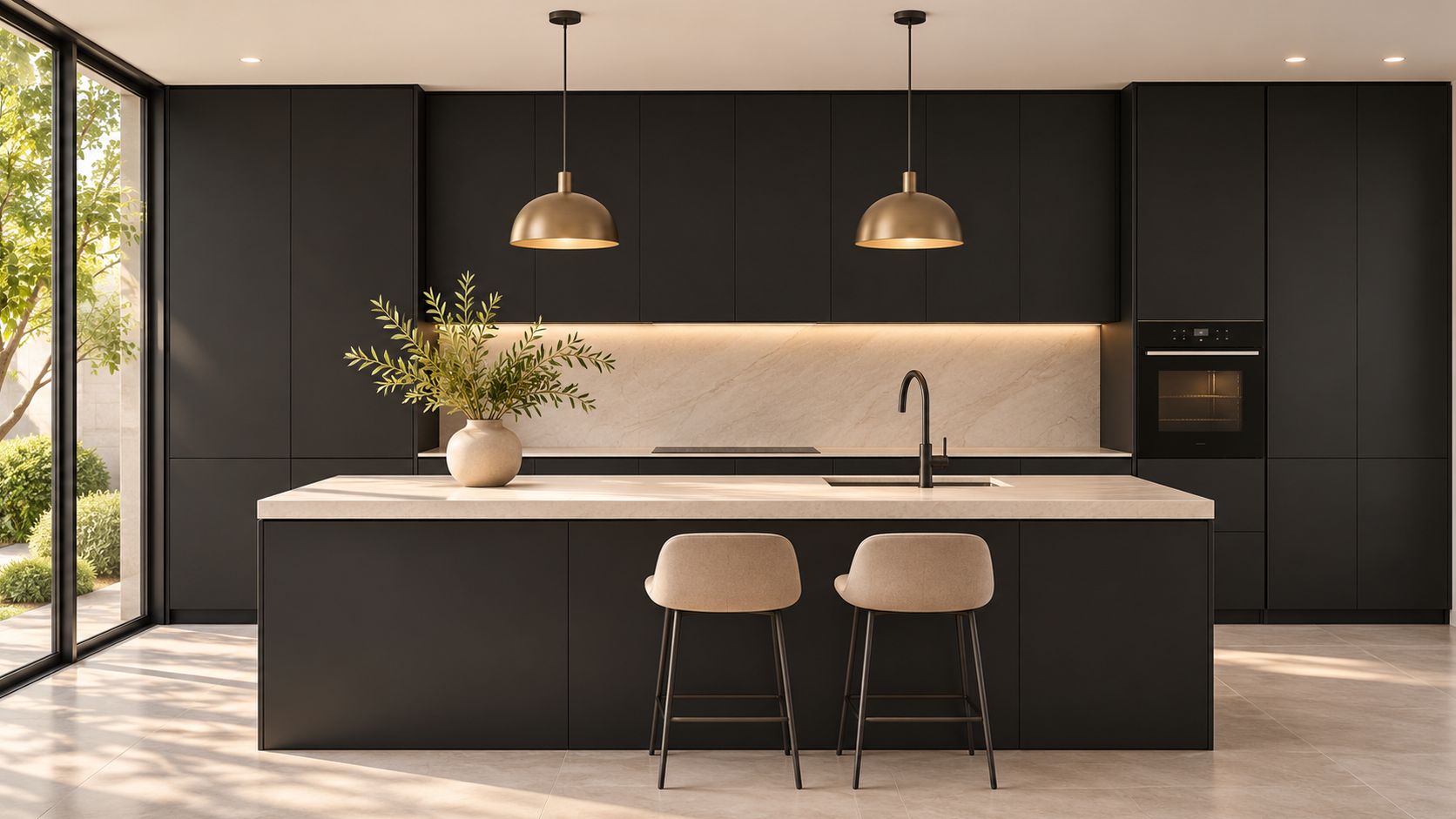
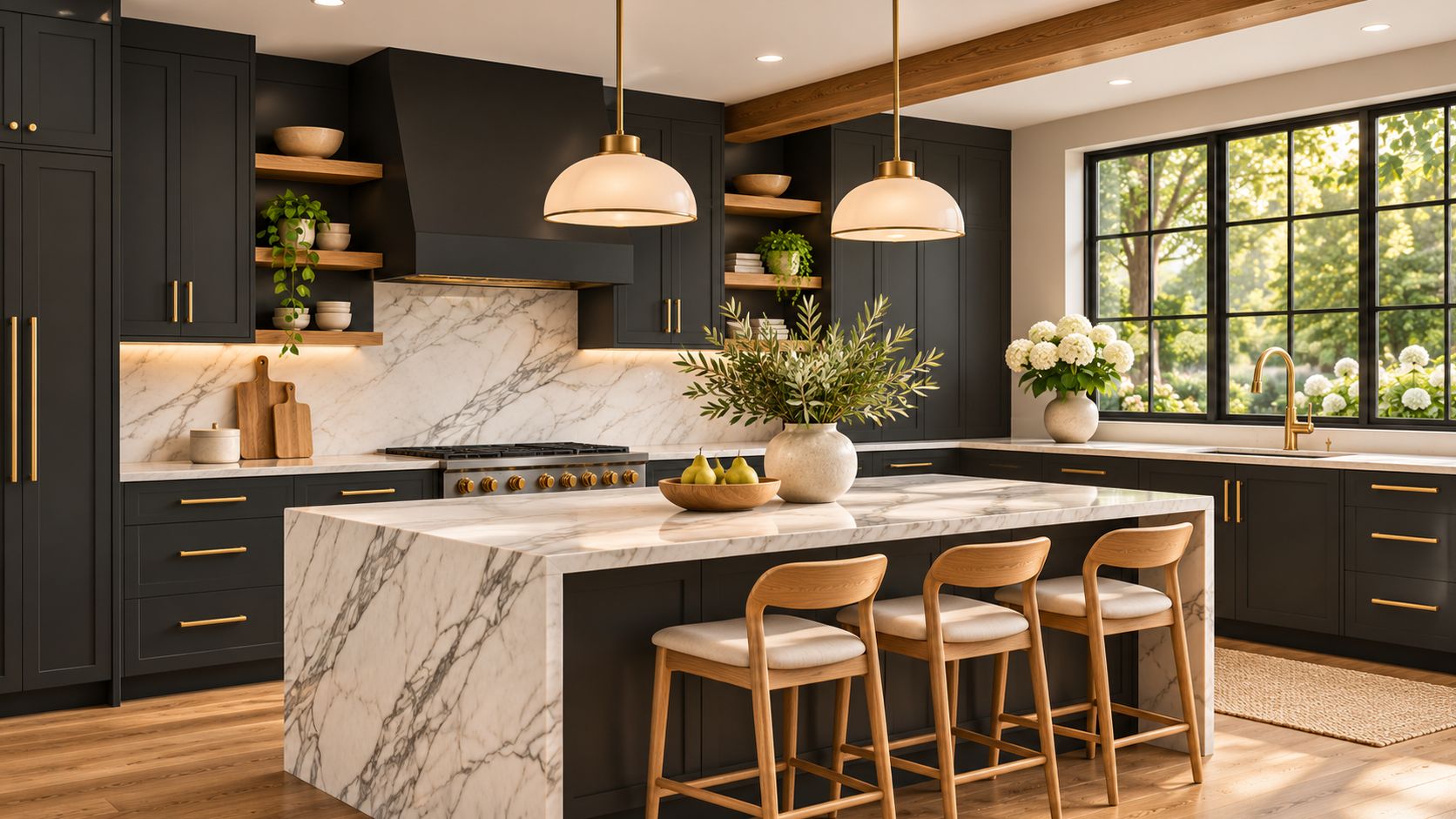
Full black cabinetry works best when you deliberately leave other surfaces light. In an open-plan kitchen, black slab doors can create a composed backdrop, while a pale countertop, warm floor, and bright ceiling prevent the cabinetry from becoming an uninterrupted dark enclosure.
Matte describes appearance, not maintenance performance. A textured laminate, painted door, and soft-touch finish can all look matte yet respond differently to fingerprints, grease, and repeated wiping. The JB Saeed Studio black-cabinet guide explains the relationship between dark finishes, low light reflectance, sheen, and layered illumination.
Test the Finish, Not Just the Color
Request a finished door rather than relying on a small color chip. Stand it vertically beside the flooring, inspect it under daylight and evening lighting, and test an inconspicuous area using the supplier's approved cleaning method.
- Finish system: Ask whether the cabinet uses catalyzed paint, conversion varnish, laminate, or another factory-applied system. Get the care instructions before ordering.
- Lighting placement: Put task lighting beneath wall cabinets so your body doesn't block the light while you prepare food.
- Touch points: Fit usable pulls rather than repeatedly gripping the edges of dark doors.
For a busy household, I'd choose a slightly textured black finish over a perfectly smooth, dead-flat surface if sample testing shows fewer visible marks. Don't trade daily usability for a showroom-perfect appearance. Keep a matching finish reference and touch-up information with the project records.
2. Black Lower Cabinets with Light Upper Cabinets
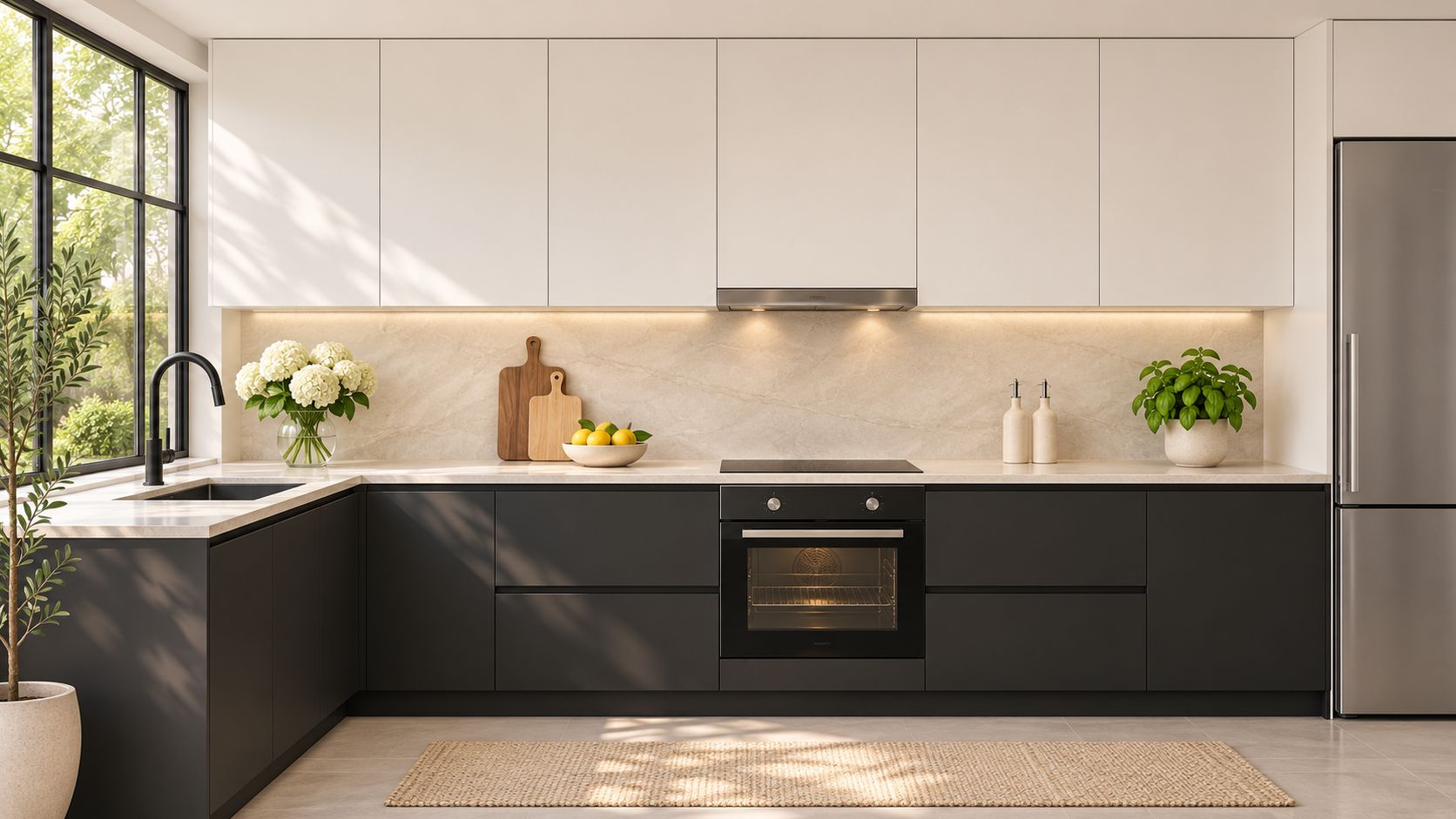
A kitchen with limited daylight doesn't need to abandon black. Put it below the countertop and keep the upper cabinets warm white, cream, or pale wood. You'll retain the contrast without surrounding your eye line with dark doors.
This is a useful approach for a compact Cherry Hill kitchen where wall cabinets provide essential storage. Removing them for open shelves might look lighter in a rendering, but it can leave everyday dishes without a practical home.
Resolve the Transitions
The tricky parts of two-tone cabinetry are the tall pantry, refrigerator enclosure, and exposed cabinet ends. Decide whether each belongs to the light upper composition or the dark base composition before approving elevations.
A tall black pantry can look intentional at the end of a run, but it can also interrupt an otherwise bright wall. Show it alongside the window, hood, and refrigerator rather than judging its color in isolation.
- Undertones: Compare cream uppers against the actual black door. A cool charcoal and yellow cream may clash under evening light.
- Hardware: Repeat a finish family across both tiers, even if pull lengths vary with drawer size.
- End panels: Specify finished sides, fillers, and toe kicks so unfinished transitions don't undermine the contrast.
Use these two-tone kitchen cabinet ideas to compare arrangements before settling on the split. A consistent door profile keeps the composition calm, while color provides the variation. Carry the black onto an island only if the room still has enough visual relief.
3. Black Kitchen Island with a Light Perimeter
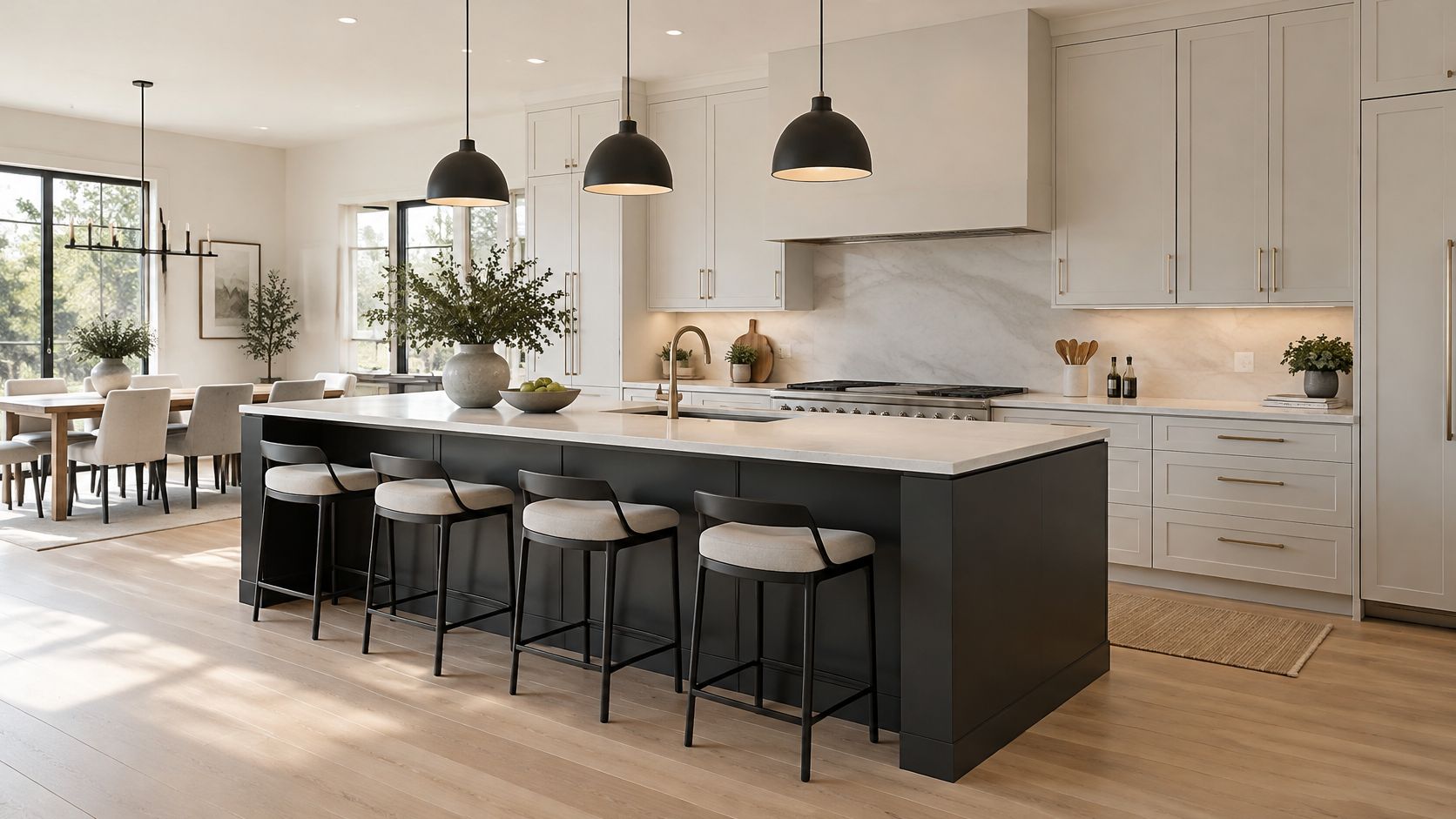
An island is a good place to concentrate black, but only after the layout works. A beautiful dark centerpiece isn't useful if an open dishwasher blocks the route to the refrigerator or someone seated at the counter traps the cook.
Black remains a selective cabinet choice: 2% of respondents chose black kitchen cabinets in Houzz's 2025 study, according to Martha Stewart's report. An island lets you use the color without committing every cabinet surface.
Lay out the island for open doors, occupied stools, and people carrying dishes, not just for the empty room.
Mock Up the Working Space
Mark the proposed island footprint on the floor with painter's tape. Add cardboard outlines for countertop overhangs, then open nearby appliances and pull out chairs. Have another person walk through while you stand at the sink or range.
For an open-concept Moorestown kitchen, a black island with a pale perimeter can define the cooking area without adding a wall. Keep the seating face simple, and choose a countertop that suits food preparation as well as entertaining.
Review kitchen island ideas and layout considerations before fixing the island's dimensions. Pendant size and placement should follow the usable countertop, not just the room's centerline.
Leave lighting sightlines clear. Large opaque pendants can obscure views across an otherwise open kitchen. Check them from a seated position and from the adjoining room before approving the fixtures.
4. Black Shaker-Style Cabinets
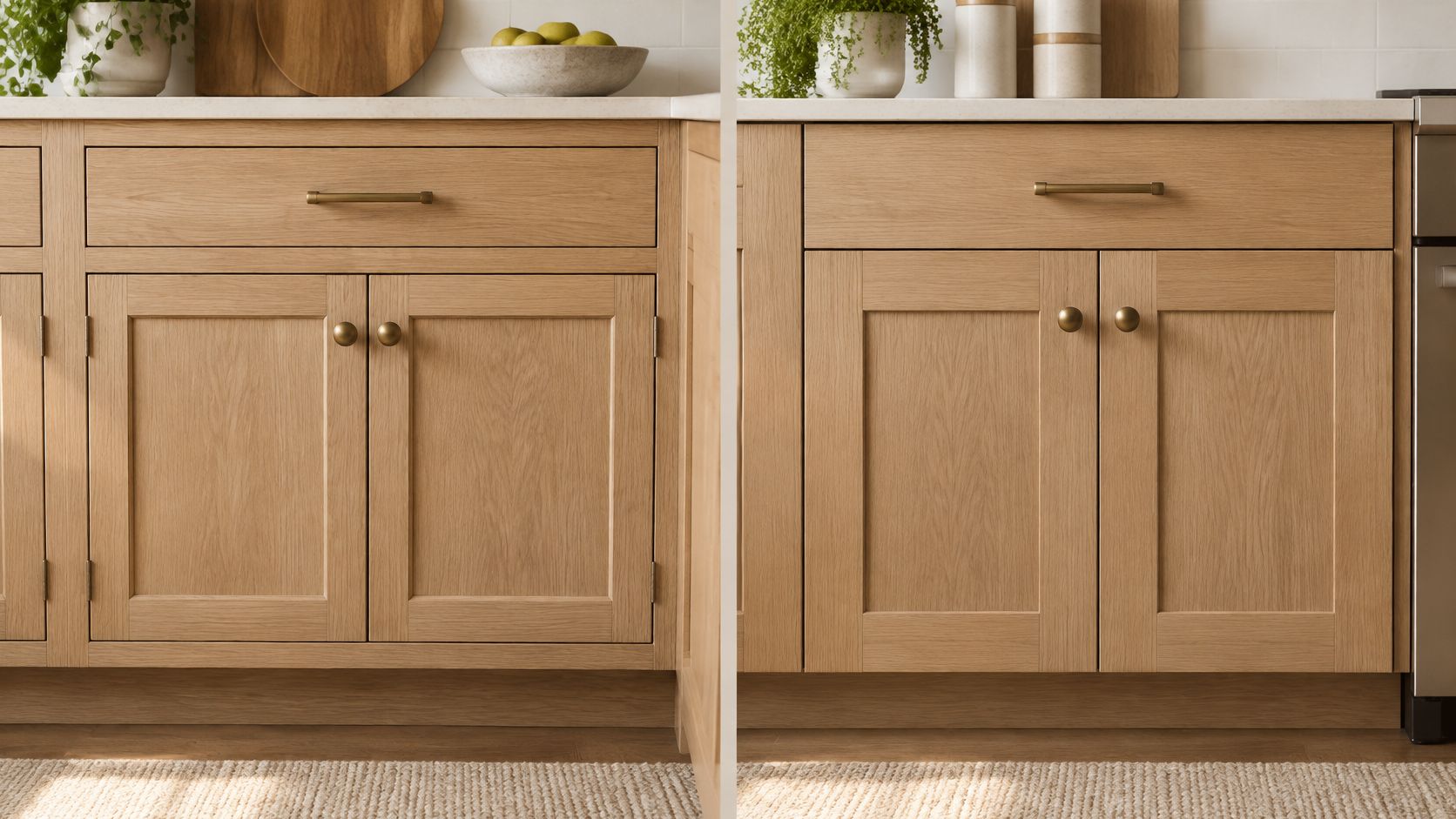
Black Shaker doors suit homeowners who want a darker kitchen without the uninterrupted planes of slab cabinetry. The recessed panel gives the finish some depth, making the style a useful bridge between a traditional house and a contemporary interior.
For a South Jersey colonial with existing wood floors and substantial window trim, black Shaker cabinets can feel more connected to the architecture than glossy handleless doors. Pair them with a quiet light countertop rather than adding another busy pattern.
Choose a Frame You Can Clean
The lower rail of a Shaker door collects dust and cooking residue. A heavily detailed profile adds more edges to wipe, so examine the sample from the side, not just straight on.
A simple frame and restrained sheen usually make the better working kitchen. Satin can be a useful compromise between a chalky appearance and a reflective surface, but the complete coating system matters more than its marketing name.
- Factory finish: Confirm the coating, care requirements, and readiness for use at delivery.
- Topcoat compatibility: Don't request a separate clear coat unless it's part of the manufacturer's tested finish system.
- Hardware access: Choose pulls with enough finger room that rings and fingernails don't repeatedly scrape the door.
- Repair expectations: Find out whether damaged doors can be refinished locally or need replacement.
Brushed brass softens the contrast; brushed nickel gives a quieter result. Avoid adding ornate hardware just because the door is traditional. The Shaker profile already supplies detail, and a straightforward pull keeps the overall kitchen modern.
5. Black Quartz or Granite Countertops
Black countertops introduce a strong horizontal element without requiring dark cabinetry. In a kitchen with cream or greige doors, they can provide enough contrast on their own, especially when the backsplash stays light.
Houzz's 2025 Kitchen Trends Study found that 8% of surveyed renovating homeowners selected black as the main countertop color, as reported by Floor Covering Weekly. That's a countertop finding, not evidence that homeowners broadly prefer all-black rooms.
Compare the Actual Surface
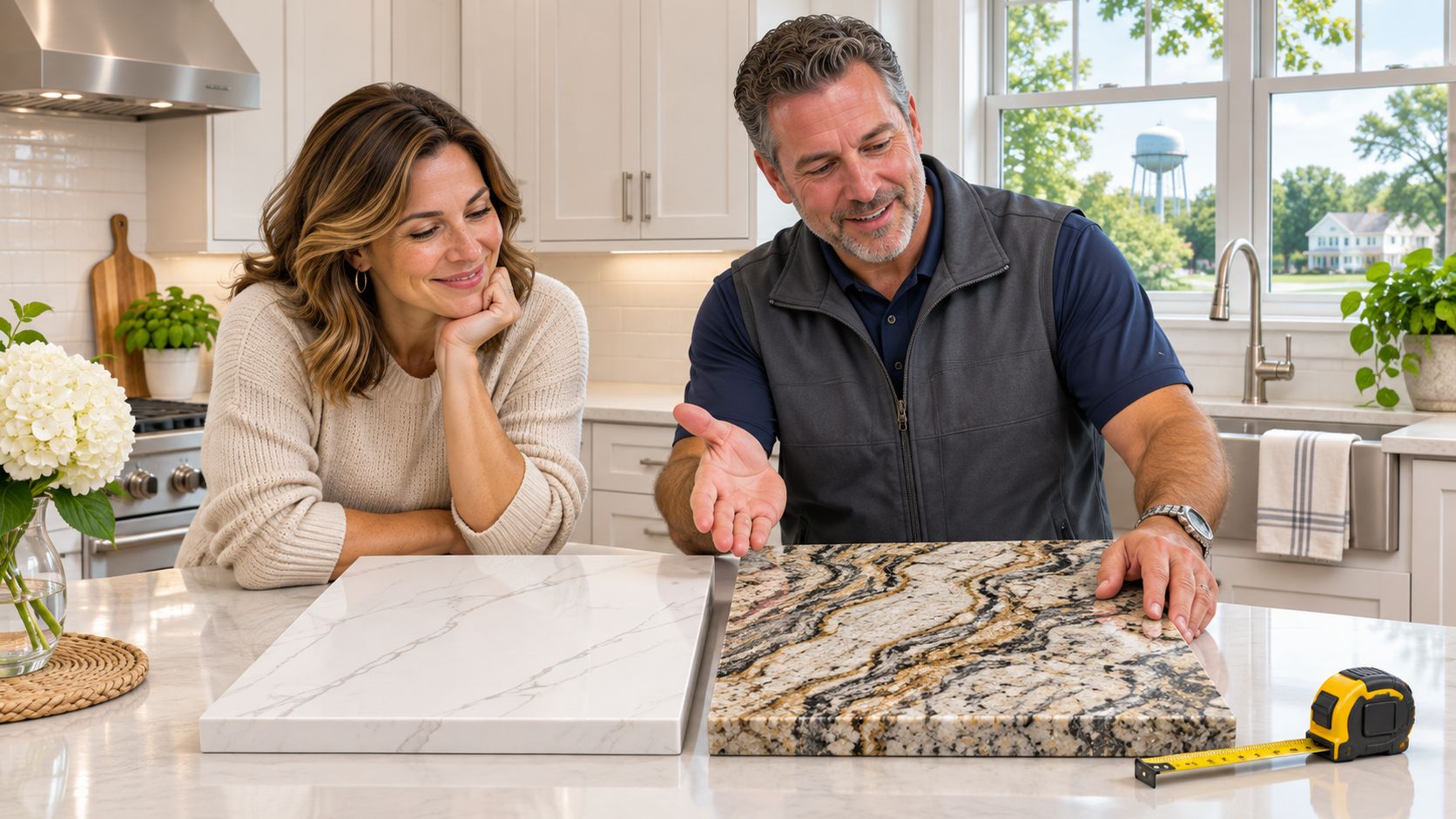
A honed finish reduces mirror-like glare, but it doesn't guarantee freedom from oily marks. Polished stone may reveal reflections and dried droplets; a low-sheen surface may make grease more apparent. View the slab or a substantial sample under directional light.
For a household that cooks daily, compare materials by the work they'll receive:
- Engineered quartz: Review heat precautions and approved cleaners. Plan somewhere safe to put hot cookware.
- Granite: Confirm whether the selected stone needs sealing and how to check its condition.
- Porcelain: Discuss edge construction and vulnerable corners with the fabricator before choosing a thin-looking profile.
Approve seams and edges before fabrication. A seam that crosses prominent veining or lands in an exposed preparation area can be more noticeable than expected on a dark surface.
For a light-cabinet kitchen with a black counter, a pale backsplash helps distinguish the work surface from the wall. Keep a countertop sample near the sink during selection so you can judge how dried water and soap residue will look.
6. Black Hardware and Plumbing Fixtures
Start with hardware if you like black but aren't ready to replace cabinets. Black pulls on warm white Shaker doors, paired with a black faucet, can create a deliberate connection without making the entire room darker.
Don't assume every matte black finish matches. Some appear brown, blue, or charcoal beside another manufacturer's product. Compare the faucet, cabinet pull, and light fixture samples together before ordering a complete set.
Prioritize the Parts You Touch
A pull needs comfortable finger clearance and a shape that won't snag clothing at an aisle corner. Test a sample on a door or drawer front, and check the existing hole spacing if you're replacing hardware rather than replacing cabinetry.
For the faucet, inspect more than its color. Check handle travel against the backsplash, pull-down hose movement, and whether the spout reaches the useful part of the sink.
- Finish protection: Read the actual finish warranty and its cleaning exclusions rather than assuming all black coatings perform alike.
- Cleaning access: Keep enough room around the faucet base to wipe away water.
- Visual coordination: Repeat black where it already appears in window frames or appliances, but don't force every metal surface to match.
The counter also changes how the faucet reads. This quartz-versus-granite countertop comparison can help you coordinate the surrounding material rather than selecting the plumbing in isolation.
For a rental upgrade, straightforward pulls and a readily serviceable faucet are more practical than unusual finishes with uncertain replacement availability. Keep the model and finish information for future maintenance.
7. Black Zellige or Textured Tile Backsplash
Texture can keep a black backsplash from looking flat. Handmade zellige catches light across irregular faces, while textured porcelain can provide movement with a more controlled appearance.
The trade-off is cleaning. Around a frequently used range, deep relief and uneven edges give grease more places to settle. Choose texture you're willing to wipe, not just texture that looks appealing under showroom lighting.
Specify the Grout with the Tile
Build a grouted sample board before installation. Black grout can visually merge the joints; charcoal gives subtle definition; pale grout turns each tile into a stronger graphic shape.
A stain-resistant cementitious grout or compatible epoxy grout may suit the installation, but confirm suitability with the tile manufacturer. Test delicate or irregular tile faces for scratching and staining during grouting, and use flexible sealant at changes of plane rather than treating those joints like the middle of the wall.
- Tile variation: Dry-lay handmade pieces so the installer can distribute differences in tone and thickness.
- Lighting angle: Check the sample beneath the intended task lighting, which may exaggerate surface irregularities.
- Range conditions: Confirm the backsplash assembly is suitable for the appliance and its installation requirements.
For a kitchen with pale cabinets and oak floors, a black tiled splash can provide enough depth without dark uppers. Keep the countertop relatively quiet so the tile's variation remains legible.
Watch the installation details, especially how irregular tiles meet adjacent surfaces.
8. Black Stainless Steel and Black Appliance Finishes
A dark refrigerator can blend into black cabinetry, but black stainless isn't interchangeable with matte black. Different appliance finishes vary in undertone, sheen, handle design, and coating construction.
Compare actual samples or appliances together. Even within a manufacturer's range, a refrigerator and dishwasher may not look identical under the same lighting. Don't rely on separately edited product photographs.
Plan for Scratches and Replacement
Ask what creates the dark appearance and what happens if the surface scratches. Some finishes depend on a coating, so abrasive cleaning or damage can leave a conspicuous mark. Fingerprint resistance is a product-specific feature, not a promise attached to every dark appliance.
Before ordering: Read the finish-care instructions and cosmetic warranty exclusions with the same attention you give the appliance dimensions.
For a family kitchen with black base cabinets, a dark dishwasher can reduce visual interruption. Keep the surrounding backsplash lighter if the appliance wall already includes a dark refrigerator and oven stack.
The practical checks still come first:
- Door movement: Verify refrigerator doors can open far enough to remove internal drawers beside walls or panels.
- Ventilation: Preserve the clearances required by the appliance manufacturer.
- Replacement access: Make sure the appliance can be removed without dismantling permanent adjacent work.
Coordinate the surrounding wall with these black kitchen backsplash tile ideas, but avoid making every finish equally dark and glossy. A quieter backsplash or wood accent can separate the appliance shapes and make the composition easier to read.
9. Black Metal Open Shelving and Frame Accents
Black metal works best as a line rather than a solid mass. Shelf brackets, window frames, and hood trim can give a light kitchen definition while leaving most wall surfaces bright.
For a kitchen with a good window view, black framing can establish a focal point without another dark cabinet run. Coordinate the interior appearance with the building's exterior; the Breaking Glass Co. exterior styling tips offer a useful companion reference for that broader decision.
Keep Display Storage Deliberate
Open shelves aren't a direct substitute for closed cupboards. They expose dishes to dust and cooking residue, and every visible item becomes part of the room's appearance.
Use them where the contents justify the cleaning. A short shelf holding frequently used mugs beside the coffee station is usually more practical than shelves full of rarely handled decorative pieces beside the range.
- Anchoring: Locate framing or specify suitable structural backing before the wall finish is complete.
- Capacity: Confirm the shelf and bracket assembly can support the intended dishes, not just the empty shelf.
- Finish: Choose a kitchen-suitable coated metal finish and protect cut edges or damaged areas from moisture.
- Placement: Keep shelf corners out of head paths and away from doors that swing into them.
Balance hard black lines with warm material. An oak shelf on black brackets feels less severe than an entirely metal assembly against a dark wall.
Keep bulky pantry goods and mismatched food containers behind doors. The room will feel more open because the visible storage is controlled, not because you've removed useful cabinetry.
10. Black and Warm Wood Combination
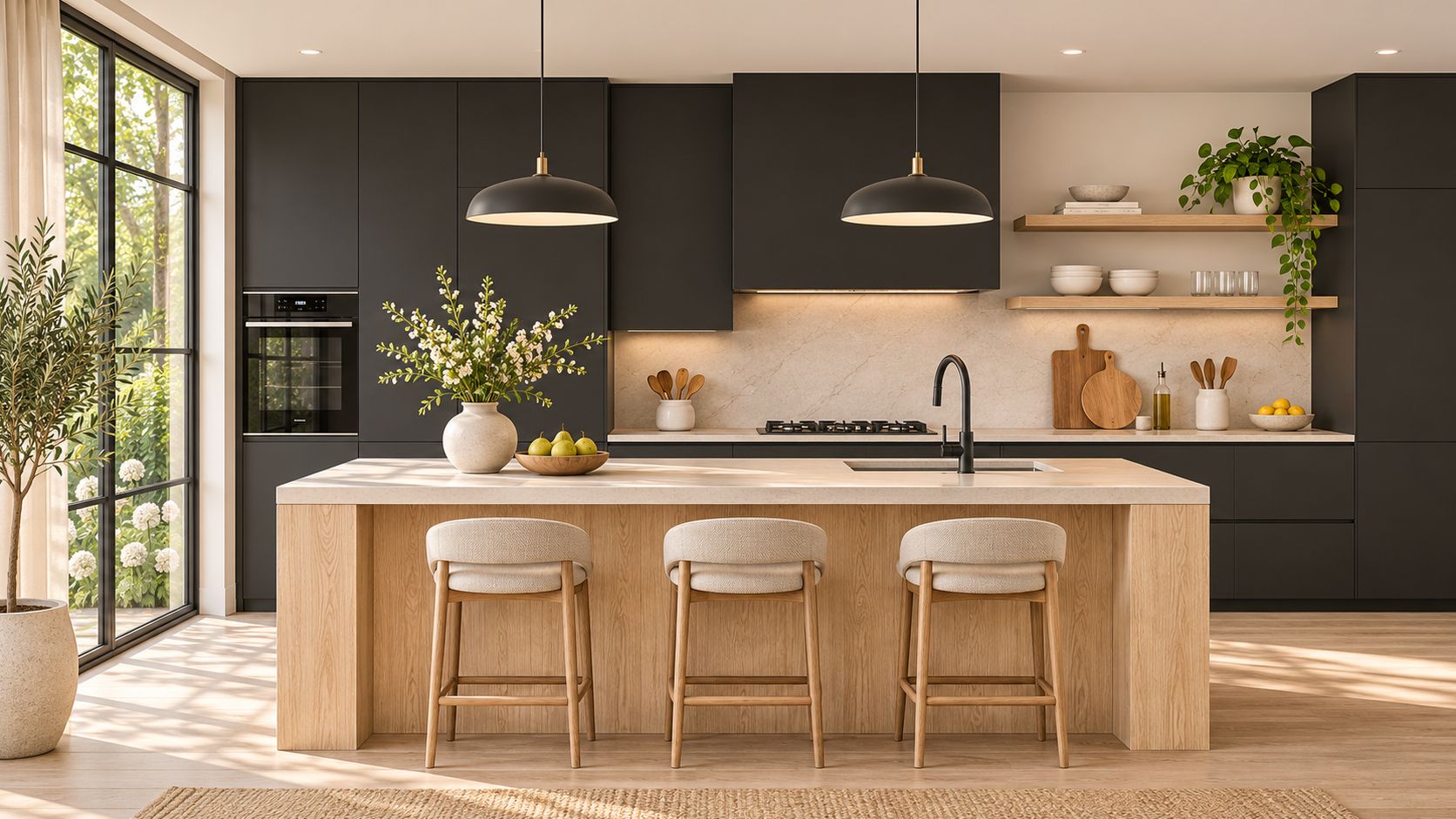
Warm wood can soften modern black kitchens without weakening the contrast. A wood island, walnut shelf, or oak cabinet section introduces grain and variation beside the more uniform dark finish.
The mistake is selecting wood from an isolated sample. Flooring, cabinet veneer, stools, and ceiling beams may all have different undertones, and black makes those differences easier to notice.
Give Each Material a Job
For a black perimeter kitchen with an oak island, let the island provide warmth and the backsplash provide brightness. Avoid adding a heavily patterned counter, strongly figured wood hood, and contrasting decorative tile unless there's a clear reason for each.
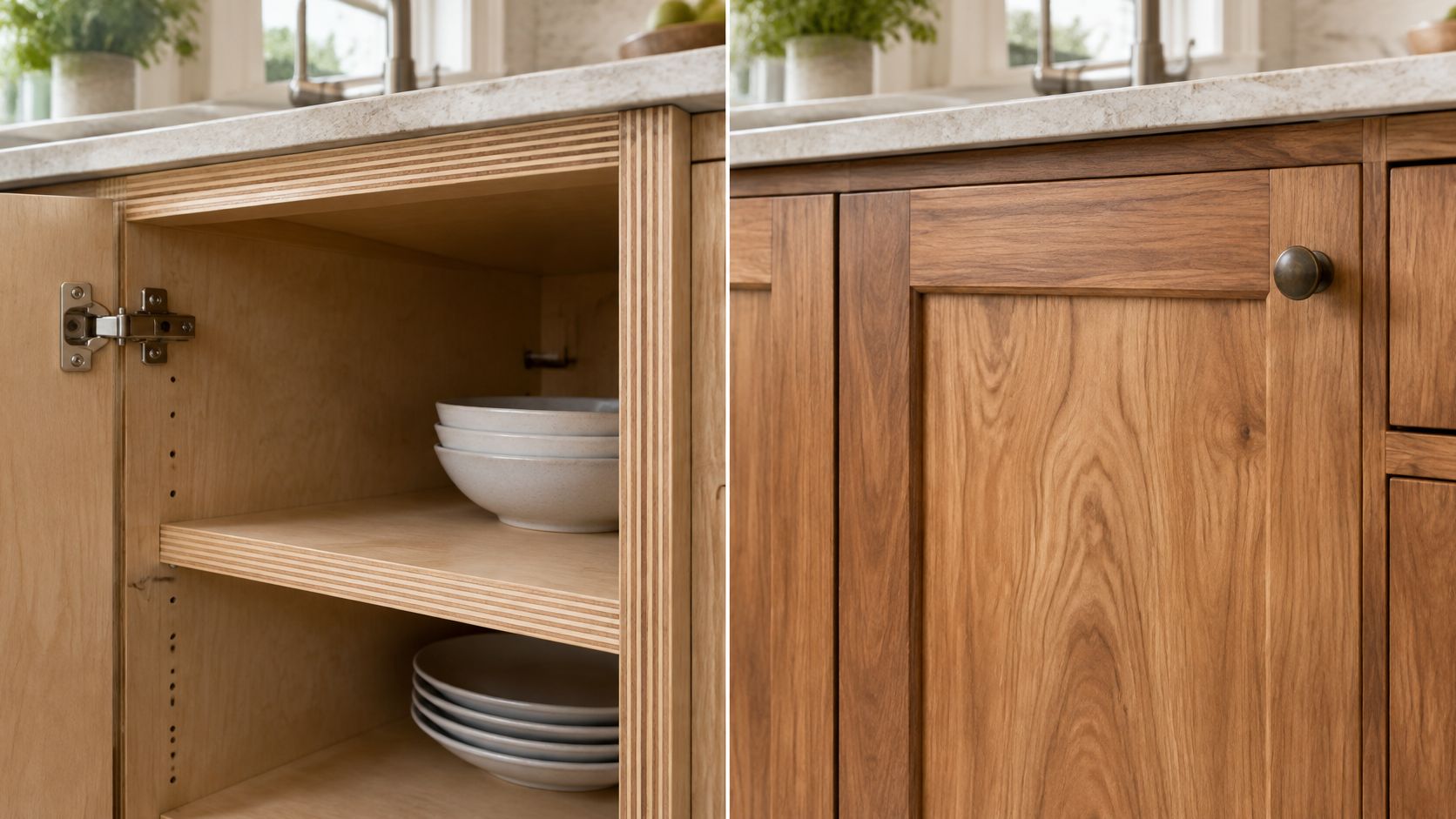
Wood species alone doesn't determine appearance. Grain cut, stain, clear finish, and lighting all influence the result. Compare finished samples vertically for doors and horizontally for counters or shelves.
- Existing flooring: Decide whether new wood should closely coordinate or deliberately contrast. An almost-match can look accidental.
- Wet areas: Protect exposed edges and end grain near sinks, and select a finish intended for kitchen conditions.
- Large panels: Review grain direction and how neighboring veneer panels will relate before fabrication.
A wood countertop requires a different maintenance commitment from a wood cabinet front. Don't specify it beside the sink just because the island sample looks inviting.
For a busy home, a durable light countertop over wood island cabinetry often gives the warmth people want without adding a vulnerable work surface. Carry a small amount of the same wood tone into the adjoining room so the kitchen feels connected rather than staged.
10 Modern Black Kitchen Ideas at a Glance
Scan the table for the balance each idea strikes: where the brightness comes from, how much light the room needs, and what the cost looks like next to a full black cabinet run.
| Idea | Best For | Key Pairings | Light Requirement | Relative Cost |
|---|---|---|---|---|
| Full Matte Black Cabinetry | Bold, cohesive kitchens, especially open-plan spaces | Light countertops or backsplash, metal hardware, warm pendants | Layered task, ambient, and under-cabinet lighting; light counters and backsplash keep prep surfaces bright | Highest commitment in this list |
| Black Lower Cabinets with Light Upper Cabinets | Adding contrast while keeping the kitchen bright | Soft-white or cream uppers, coordinated hardware, light countertops | Light uppers reflect ambient light; under-cabinet strips keep the dark run workable | Often lower than full black cabinetry |
| Black Kitchen Island with a Light Perimeter | Spacious kitchens with room for a central focal point | Light perimeter cabinets, pale countertops, pendant lights | Hang pendants low enough to light the island surface; open layouts benefit from natural light | Moderate; usually less than refitting the full cabinet run |
| Black Shaker-Style Cabinets | Traditional or transitional kitchens seeking a classic profile | Brass or aged-bronze hardware, light countertops | Warm under-cabinet lighting keeps dark doors legible; metallic hardware picks up nearby light | Moderate; comparable to other painted cabinet finishes |
| Black Quartz or Granite Countertops | Kitchens seeking contrast with light or neutral cabinets | Light cabinetry and backsplash; honed or matte surfaces | Light cabinetry and backsplash do the balancing; polished surfaces bounce light, honed ones read flatter | Mid to upper range; sits alongside other premium stone |
| Black Hardware and Plumbing Fixtures | Affordable updates without replacing cabinetry | Matching pulls, faucet, lighting, or black appliances | Works with varied lighting; check samples under your kitchen lighting before buying | Low-cost update |
| Black Zellige or Textured Tile Backsplash | Adding texture and a focal wall to a kitchen | Light cabinetry, coordinated grout, simple finishes | Light cabinetry balances the dark wall; glossy glaze reflects task light back into the room | Higher than basic ceramic tile |
| Black Stainless Steel and Black Appliance Finishes | Coordinated modern kitchens or dark cabinetry schemes | Black cabinetry, hardware, and matching appliances | Dark appliance faces recede in dim rooms; strong ambient lighting keeps them reading as part of the scheme | Black stainless may cost more than standard stainless |
| Black Metal Open Shelving and Frame Accents | Industrial or modern farmhouse accents without added cabinetry | Light walls, warm wood, natural textiles | Open frames keep sightlines clear; add spots or sconces if the shelf wall sits away from windows | Lower to moderate; stock brackets are inexpensive, custom frames more |
| Black and Warm Wood Combination | Kitchens needing warmth and balance alongside dark finishes | White oak, walnut, or natural ash; stone and natural textiles | Warm-toned bulbs keep the wood from going flat; a light counter or backsplash carries the brightness | Moderate to higher; small wood accents stay affordable, full wood fronts cost more |
The light column matters as much as the cost column. A cheaper idea that ignores lighting can still produce a dark, hard-to-clean room, while the pricier option often buys built-in balance.
Bring Your Black Kitchen Vision Home
Black kitchens succeed when warmth, light, and daily use are planned from the beginning. The cabinet color should never be the only resolved decision. Approve it alongside the floor, countertop, backsplash, hardware, and lighting so you can judge the whole room rather than a collection of attractive samples.
You don't need to use every idea. Black base cabinets, light uppers, a warm wood accent, and layered lighting can create a complete composition. If you prefer full black cabinetry, give the ceiling, backsplash, and work surfaces enough brightness to keep food preparation comfortable.
Make the Decisions in a Useful Order
Resolve the layout before choosing decorative finishes. Check appliance doors, walking routes, seating, and storage access, then test the materials where they'll be used.
- See the samples at home: Hold doors upright beside existing flooring and inspect them under both daylight and evening lighting.
- Test the maintenance: Compare fingerprints, dried water, and approved cleaning methods on surfaces you're considering.
- Review the transitions: Confirm exposed cabinet sides, countertop seams, backsplash edges, and the connections between different finishes.
Our mobile showroom brings samples directly to South Jersey homeowners, making those comparisons possible in the room itself. That matters more than judging black finishes beneath unfamiliar showroom lights.
Sarah and Tom's project shows how a dark accent can work without dark cabinetry everywhere. Their kitchen combined white transitional cabinets, a light gray island, brushed gold hardware, a matte black faucet, and pendants above the island. The result depended on the relationship between finishes, not on making every element match.
Explore our gallery of real South Jersey kitchens and bathrooms, then compare contemporary cabinetry with clean lines, slab doors, and warm modern textures against the more framed appearance of Shaker doors. Focus on which approach fits your home and cleaning habits rather than trying to reproduce a photograph exactly.
Plan for the final handover, too. Protect finished surfaces during construction and establish a sensible post remodel cleanup order before unpacking dishes and using the kitchen.
A complimentary video consultation is a practical starting point. Bring photographs of the room, your preferred dark finishes, and the problems you want the renovation to solve. You'll make better choices when the conversation begins with how the kitchen needs to work.
The Cabinet Coach offers a complimentary video consultation and a mobile showroom that brings cabinetry, countertop, hardware, and tile samples to your South Jersey home. Visit The Cabinet Coach to start planning a modern black kitchen and compare dark finishes against your own flooring and lighting before committing.