
You're probably standing in your kitchen right now, looking at cabinets, paint chips, appliance specs, and a dozen countertop tabs open on your phone. Quartz looks polished. Butcher block feels warm. Solid surface sounds practical. Then Formica comes up, and you pause because you know the name, but maybe you also picture an older laminate top from decades ago.
That hesitation is common. Formica is familiar, but many homeowners don't realize how much laminate has changed. Today's options can look far more refined than people expect, and the construction behind them is more engineered than the old “it's just plastic” label suggests.
If you're sorting through comparing kitchen countertop materials and trying to decide what makes sense for your home, it helps to slow down and define the material first. A practical planning guide like how to choose kitchen countertops can help with the bigger remodel picture, but the core starting point is simpler: what are Formica countertops, really, and when are they the right fit?
Table of Contents
- Choosing Your Perfect Countertop Starts Here
- The Anatomy of a Modern Formica Countertop
- The Real Pros and Cons of Formica Countertops
- Beyond Woodgrain Appearance and Style Options
- Formica vs The Competition A Head-to-Head Comparison
- Care Tips Lifespan and Common Myths
- Is Formica Right for Your South Jersey Remodel
Choosing Your Perfect Countertop Starts Here
A countertop decision usually starts as a style question and turns into a daily-life question. A family in South Jersey may begin by saying they want something “clean and bright,” but after a few minutes the true issues come out. They need a surface that can handle school lunches, coffee spills, craft projects, grocery bags dragged across the edge, and a remodel budget that already feels stretched by cabinets and labor.
That's where Formica often comes back into the conversation.
For some homeowners, the name brings up diners, utility rooms, or an older kitchen they grew up with. For others, it signals an affordable option but not a serious design choice. Both reactions miss what makes modern laminate worth a fresh look. Formica countertops can be a smart answer when you want a wide range of looks, straightforward upkeep, and a surface that fits real-world remodeling decisions instead of fantasy-kitchen expectations.
Formica isn't the right choice for every kitchen. But it is often a better choice than homeowners first assume.
The useful way to think about this material is not “cheap versus expensive.” It's fit versus mismatch. If you love the idea of a low-fuss surface, want more freedom with pattern and color, and understand the few places where laminate needs protection, it can be a very sensible pick.
A good countertop decision usually comes down to a few practical questions:
- How hard do you use your kitchen? A careful cook and a household with young kids don't use surfaces the same way.
- What bothers you more? Some people hate visible seams. Others care more about stain cleanup or cost control.
- Where are the weak points? Around sinks, exposed edges, and hot cookware habits, details matter more than showroom looks.
- What do you want the room to feel like? Light wood, marble-look, soft matte neutrals, and pattern all change the mood.
When people ask what are Formica countertops, they're usually asking two things at once. What is the material made of, and is it good enough for a kitchen they'll use every day? The answer gets clearer once you understand how it's built.
The Anatomy of a Modern Formica Countertop
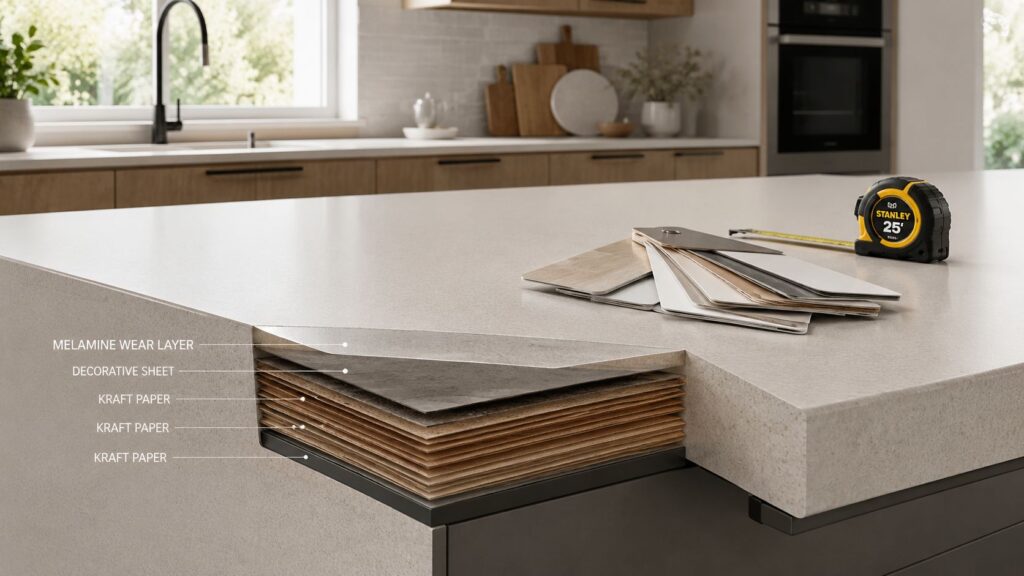
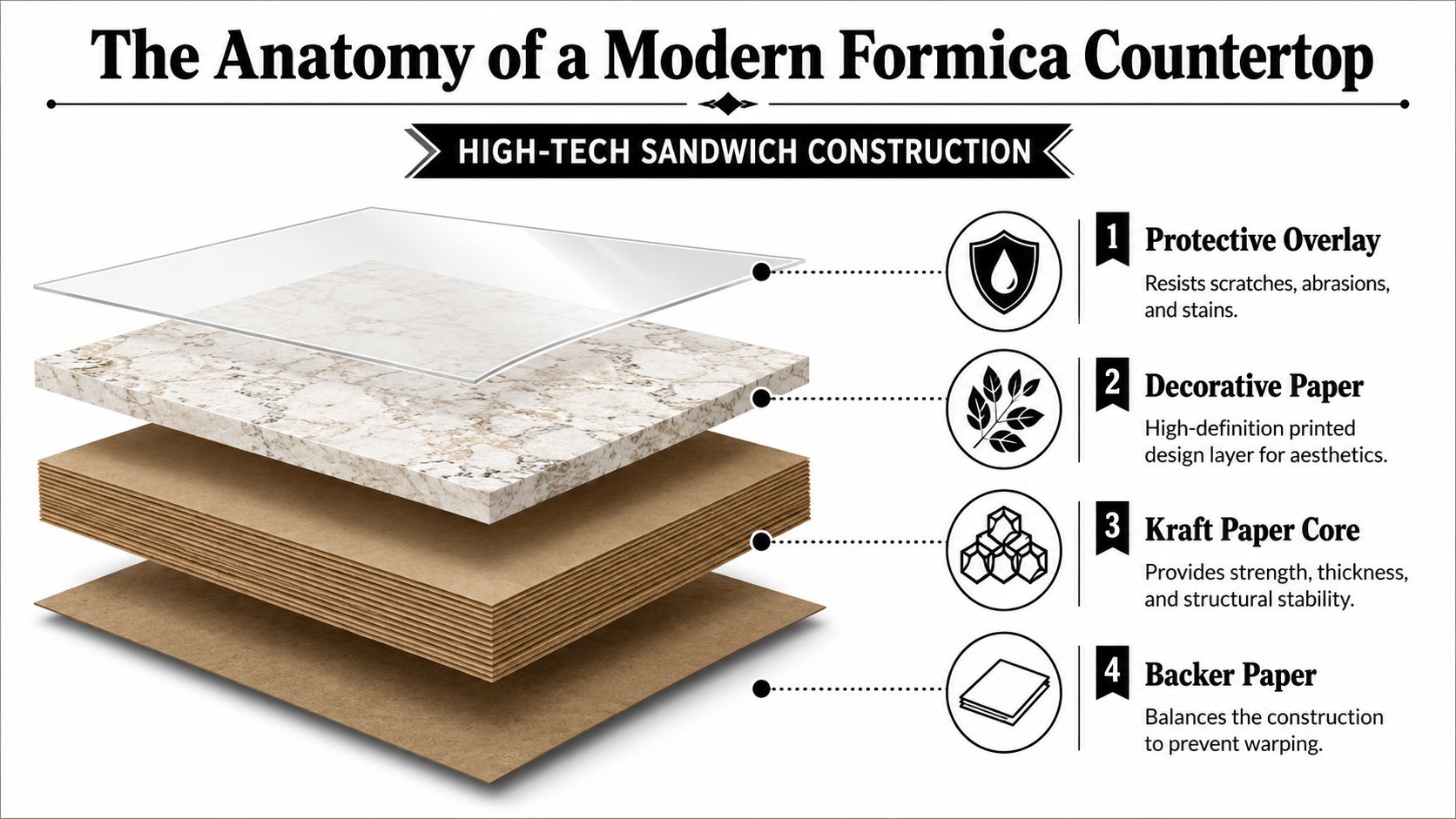
Formica countertops are a type of high-pressure laminate. The easiest way to understand them is to picture a high-tech sandwich. Several layers do different jobs, and they're fused together under heat and pressure to create a finished surface.
Why it's more than just plastic
Formica is made from layers of kraft paper and plastic phenolic resins, topped with a decorative sheet and a protective melamine resin wear layer, as described in this overview of how Formica countertops are made and how the brand began. The material uses cellulose layers impregnated with plastic resins, then solidified under intense heat and pressure into a durable, heat-resistant surface.
That layered build explains why laminate can feel surprisingly sturdy in everyday use. The top isn't just a printed sheet sitting loosely on a board. It's part of a compressed, engineered assembly designed to resist scratches, moisture, and normal kitchen wear better than many people expect.
Another detail that helps clear up confusion is the name itself. Formica was invented in 1912 by Daniel J. O'Conor and Herbert A. Faber at Westinghouse as a replacement for mica in electrical insulation, which is why the name came from “for mica.” That origin matters because it reminds you this material began as a technical solution, not a decorative afterthought.
How the layers work together
Here's the simple breakdown:
- Top protective layer: This is the wear surface. It helps the countertop resist scratches, stains, and moisture in daily use.
- Decorative printed layer: This creates the look you see, whether that's marble, concrete, woodgrain, or a solid color.
- Kraft paper build-up layers: These provide body and strength.
- Backing and substrate support: The laminate itself is typically bonded to a supporting base to create the finished countertop assembly.
If you've ever wondered why some laminate tops have crisp square edges and others have softer rolled profiles, fabrication plays a big role. Edge style changes how the countertop looks, feels, and handles cleanup at corners and seams. If you want a quick visual primer, this guide to countertop edge options is useful for seeing how profile choices affect the finished result.
Practical rule: When evaluating laminate, don't judge it by color alone. Ask how the edge is made, how the sink area is detailed, and what substrate is underneath.
That's the difference between thinking of Formica as a surface pattern and understanding it as a countertop system. Once you see the anatomy, the pros and cons make much more sense.
The Real Pros and Cons of Formica Countertops
Formica works well when its strengths line up with how you live. It disappoints people when they expect it to behave like a thicker, heavier premium surface while treating it the same way. That's why the honest version matters more than the sales version.
Where Formica works very well
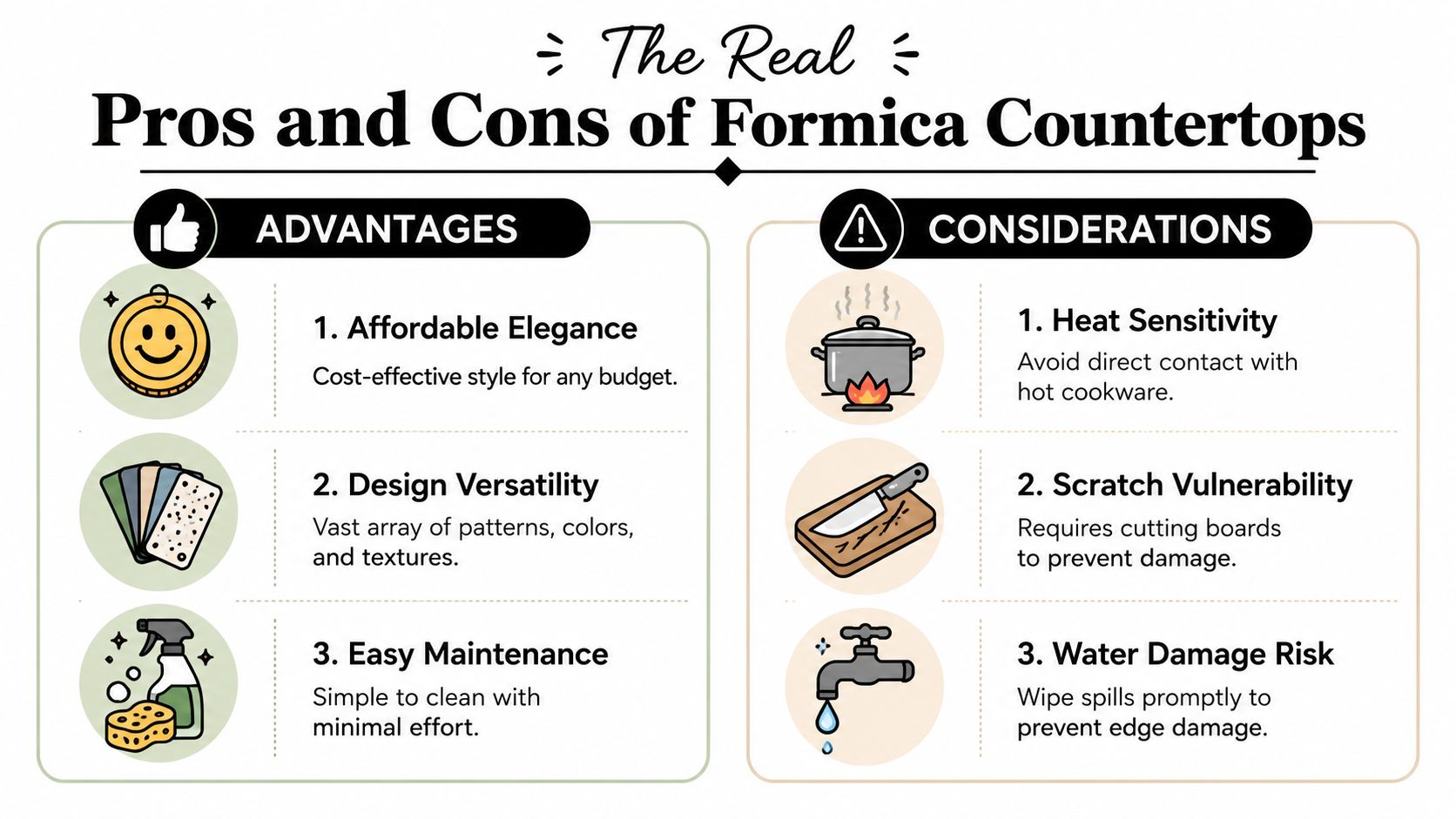
The first advantage is value. Laminate gives homeowners a broad design range without pushing the budget into the territory of quartz or stone. That makes it appealing in full kitchens, rental properties, laundry rooms, mudrooms, bathrooms, and secondary prep spaces.
The second advantage is style flexibility. Formica can mimic wood, stone, and abstract finishes in ways that let you shape the room without locking yourself into one expensive material choice. If you like changing the look of your home over time, laminate gives you room to prioritize layout, cabinetry, lighting, and hardware too.
The third advantage is easy everyday cleanup. For most households, a soft cloth and mild cleaner handle normal messes just fine. You don't need a complicated maintenance routine or specialty sealing schedule.
A few practical wins homeowners often appreciate:
- Family-friendly use: It's a comfortable surface for breakfast, homework, and routine kitchen traffic.
- Design freedom: You can pair a quieter cabinet color with a more expressive countertop pattern, or keep the whole room restrained and simple.
- Accessible remodeling: If your budget needs to cover flooring, backsplash, paint, and appliances too, laminate can keep the overall project balanced.
For readers also weighing other midrange surfaces, this neutral explanation of what Corian countertops are can help clarify how laminate differs from solid surface.
Where you need to be careful
The main caution is heat. Formica's general purpose grade laminate is engineered to resist ordinary heat sources up to 275°F (135°C), according to the Formica technical specification for laminate grades. That sounds reassuring, and it is, but it doesn't mean you should set a hot pan from the stove directly on the surface.
In real life, that means trivets and hot pads aren't optional. A toaster or coffee maker is one thing. A blazing skillet or Dutch oven is another.
The other common issue is surface damage from sharp or rough use. Laminate handles ordinary wear well, but knives, dragged ceramic bottoms, and abrasive scrubbing can leave marks. Unlike some other materials, deep gouges aren't always easy to make disappear cleanly.
Then there's water management, especially at seams, edges, and sink cutouts. The face of the laminate resists moisture well, but exposed transitions are where trouble can start if installation is sloppy or water sits too long.
Good laminate performance depends as much on fabrication and habits as on the sheet material itself.
That doesn't make Formica fragile. It means it rewards realistic use. Homeowners who use cutting boards, wipe standing water, and protect the surface from direct heat usually have a much better experience than those who treat it like an indestructible slab.
Beyond Woodgrain Appearance and Style Options
A lot of homeowners still picture laminate as a yellowed top with a dark line at the edge and a fake wood pattern that announces itself from across the room. That image is outdated. Current Formica designs can look much more restrained, more refined, and better suited to today's kitchens.
Today's patterns look more intentional
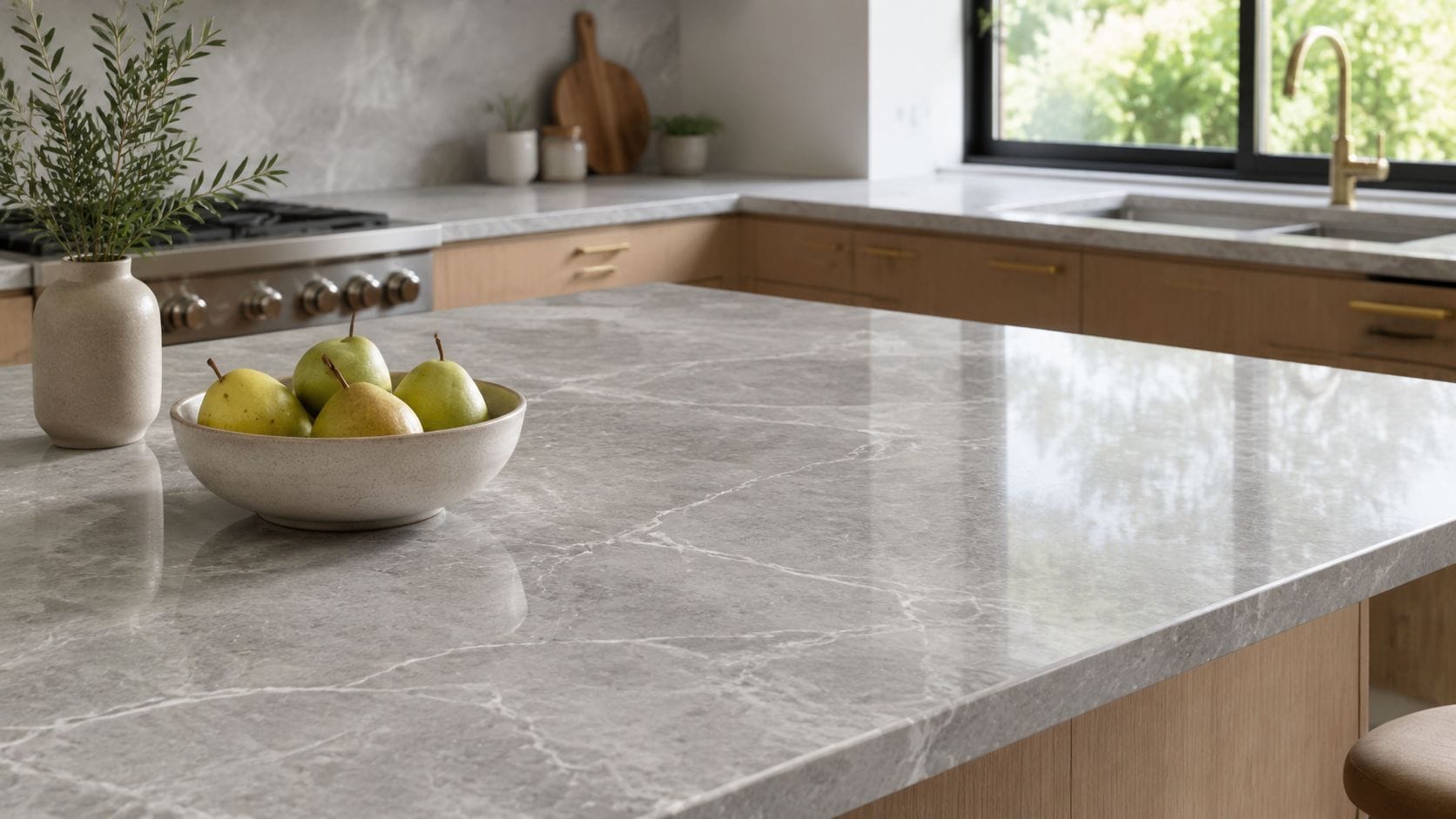
Modern laminate doesn't have to pretend to be luxury stone to work. In many kitchens, the best-looking Formica choices are the ones that embrace a clean marble look, a soft concrete tone, a subtle textile-inspired pattern, or a quiet woodgrain that supports the cabinetry instead of competing with it.
That matters because design success usually comes from coordination, not from choosing the most expensive surface in the room. A well-selected laminate pattern paired with the right cabinet door, hardware finish, backsplash tile, and lighting temperature can feel cohesive and current.
A few style directions that often work well:
- Marble-look laminates: Good for bright kitchens where you want movement without the maintenance anxiety some people feel around natural stone.
- Soft neutrals and solids: Useful when the cabinets or backsplash already carry visual weight.
- Wood-inspired patterns: Better in spaces where you want warmth but don't want the upkeep concerns of real wood counters.
Why post-forming matters in real kitchens
The discussion becomes more contemporary with Post-forming, a fabrication method that allows laminate to be heated and bent into smoother, more continuous shapes instead of forcing a hard break at every edge. According to Formica's buyer guidance on modern laminate countertop design and post-forming, this allows smooth, continuous edge profiles and even integrated sink designs, which significantly reduce the risk of water intrusion at edges and sink rims compared with traditional drop-in sinks that rely on sealant.
That one detail solves an older laminate complaint many people still assume is unavoidable.
For South Jersey homes, that matters. Kitchens and baths deal with humid summers, wet umbrellas, damp towels, sink splash, and the everyday moisture that collects around active family spaces. A smoother edge profile and better sink detailing can make the countertop easier to wipe down and less vulnerable at the points where water usually lingers.
The technical side supports that design flexibility too. For post-formed edges with a 5/8-inch (15.9mm) or greater outside radius, Formica uses grade 12/HGP, which has a nominal thickness of 0.035 inches (0.9mm) and a weight of 0.252 pounds per square foot, as outlined in this post-forming laminate specification from Lowe's. That thinner profile helps fabricators bend the laminate without cracking and create coved edge conditions that reduce the tiny gaps where grime and moisture can collect.
In a busy kitchen, the prettiest detail is often the one that makes cleanup easier every day.
So when homeowners ask what are Formica countertops today, part of the answer is visual. The more important part is fabrication. The way the laminate is formed and finished often determines whether it reads like an old budget top or a clean, durable modern surface.
Formica vs The Competition A Head-to-Head Comparison
A Formica selection isn't made in isolation. It's often a choice among Formica, quartz, solid surface, and butcher block, usually after seeing samples that all look good for different reasons. The right choice depends less on trend and more on what tradeoffs you're comfortable living with.
Countertop Material Comparison
| Material | Cost (per sq. ft. installed) | Durability | Heat Resistance | Maintenance |
|---|---|---|---|---|
| Formica laminate | Budget-friendly | Good for normal household use, but can scratch or chip if abused | Handles ordinary kitchen heat, but hot cookware should not go directly on it | Easy daily cleaning, with attention to edges and standing water |
| Quartz | Higher than laminate | Very strong surface for busy kitchens | Better suited to routine kitchen use, but heat protection is still wise | Low routine maintenance |
| Solid surface | Midrange to higher than laminate | Repairable and uniform throughout | Moderate heat tolerance | Easy to clean and refinish in some cases |
| Butcher block | Varies by wood and build | Can dent and scratch, but often repairable | Not ideal for hot cookware without protection | Requires more regular care |
If you're trying to budget the broader remodel, this overview of countertop costs per square foot can help frame how surface choices affect the total project.
How to read the tradeoffs
Choose Formica when you want design flexibility, straightforward upkeep, and a countertop that leaves room in the budget for better cabinetry, layout improvements, or upgraded appliances. It's especially appealing when the kitchen needs to look polished without turning the countertop into the single most expensive line item.
Choose quartz when durability is the top priority and you're comfortable spending more for a heavier, slab-based material. Many homeowners love quartz because it gives them a premium look and a solid feel with less day-to-day worry about stains.
Choose solid surface when uniform appearance and repairability matter more than having a stone look. This category can be a practical middle path for people who want a uniform material and a softer, integrated appearance around sinks and backsplashes.
Choose butcher block when warmth and natural texture matter most, and you're happy to participate in the maintenance. It can be beautiful, but it asks more from the homeowner.
A simple way to sort it out is to rank your priorities:
- Budget control
- Appearance
- Tolerance for maintenance
- Resistance to heat and scratching
- How long you plan to stay in the home
If budget lands first or second on your list, Formica deserves serious consideration. If your main goal is the hardest possible surface and budget is flexible, quartz may rise to the top. If you want a softer integrated look, solid surface may fit better. If you love the natural aging of wood, butcher block becomes a lifestyle choice as much as a design choice.
The mistake is expecting one material to win every category. None of them does.
Care Tips Lifespan and Common Myths
A Formica countertop usually performs best when homeowners treat it like a practical finished surface, not a workshop bench and not a delicate collectible. Good habits are simple, and they prevent most of the complaints people associate with laminate.
Simple habits that help laminate last
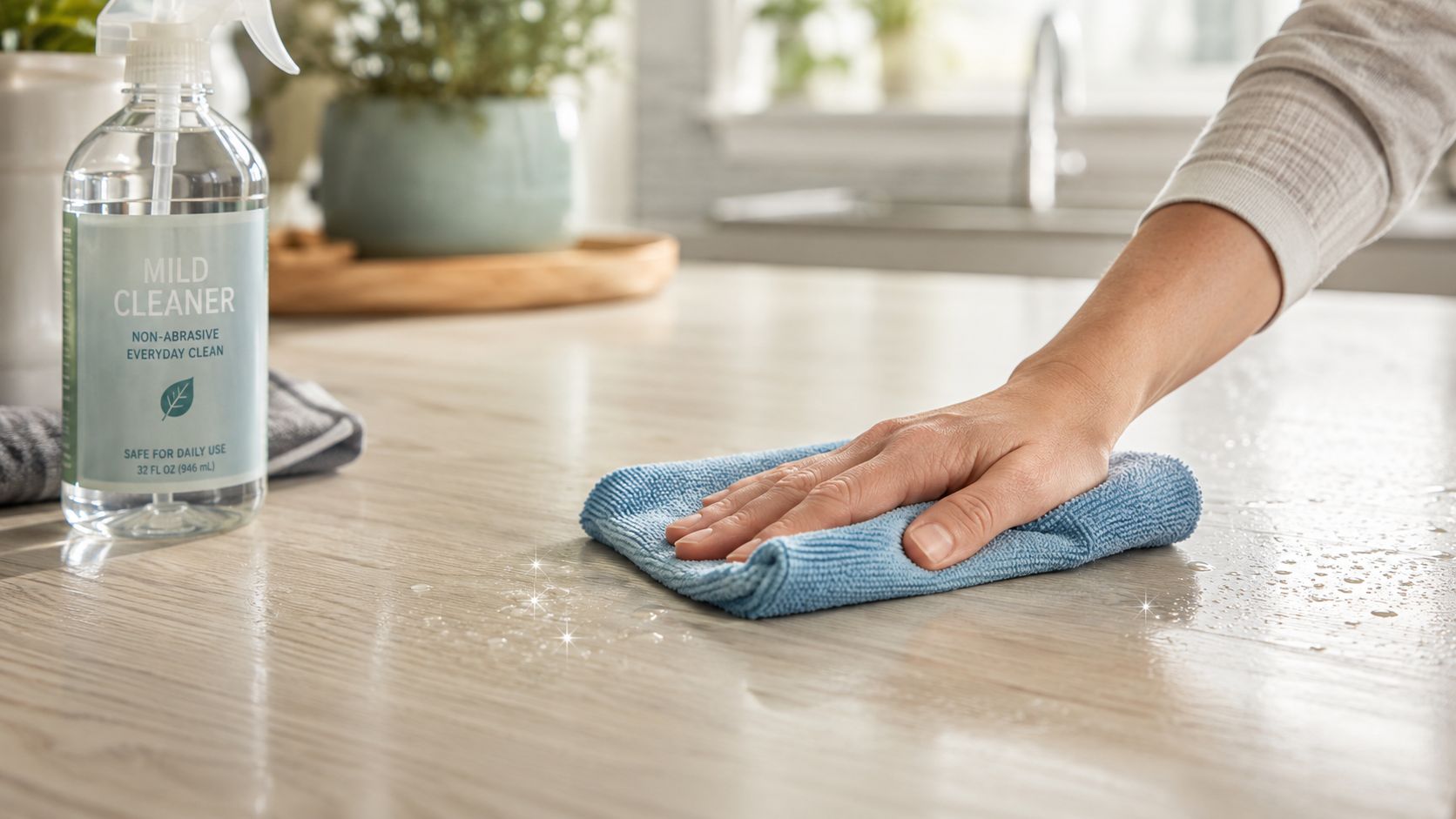
For everyday cleaning, use a soft cloth or microfiber towel with mild soap and water or a gentle non-abrasive cleaner. The goal is to remove residue without dulling the finish or scuffing the wear layer.
These habits make the biggest difference:
- Use cutting boards: Don't slice directly on the laminate, even if you're in a hurry.
- Protect against heat: Set hot cookware on trivets or pads, not on the counter.
- Wipe water promptly: Pay attention around seams, sink edges, and corners.
- Skip abrasive scrubbers: Rough pads and harsh cleaners can wear the surface visually over time.
Laminate usually ages well when daily care is boring and consistent.
As for lifespan, homeowners often hear a wide range. In practice, Formica countertops commonly last 10 to 20 years in many homes, depending on installation quality, edge detailing, moisture exposure, and how carefully the kitchen is used. A guest bath vanity and a heavily used family kitchen won't age at the same pace.
Three myths that confuse homeowners
Myth one: Formica always looks cheap.
Old laminate sometimes did. Modern laminate doesn't have to. The final impression depends on pattern choice, edge profile, sink integration, cabinet pairing, and the rest of the room.
Myth two: Water instantly ruins it.
Not exactly. The surface itself is designed to resist everyday moisture. Trouble usually starts when water repeatedly gets into vulnerable transitions, especially poorly detailed edges or sink areas, and sits there.
Myth three: It's outdated by definition.
That's more about memory than current product design. Laminate can absolutely look dated, but so can quartz, tile, or wood if the color, pattern, or detailing is off. Material doesn't date a kitchen by itself. Design decisions do.
The homeowners happiest with Formica are usually the ones who understand what it does well, protect it where needed, and choose a look that fits the house instead of chasing a showroom trend.
Is Formica Right for Your South Jersey Remodel
For many South Jersey homes, Formica makes sense because remodeling is rarely about countertops alone. You may be updating cabinets, changing the layout, replacing flooring, improving storage, or trying to make an older kitchen feel brighter and easier to use without letting the budget run away.
Homes where it makes a lot of sense
Formica is often a strong fit for:
- Family kitchens where easy cleanup matters and the budget has to stretch across the whole project
- Bathrooms and laundry rooms where style still matters, but so does practicality
- Investment or resale updates where a fresh, clean look matters more than a luxury-material label
- Secondary spaces like beverage stations, mudrooms, and home offices with built-in counters
It can also be a smart option when you care more about achieving a balanced, well-designed room than about owning the most premium countertop category on paper.
What matters in South Jersey kitchens
Homes in Cherry Hill, Voorhees, and surrounding Camden and Burlington County communities often deal with a mix of older layouts, active households, and seasonal humidity. In that setting, countertop decisions tend to reward practical details. Sink transitions, edge construction, and surfaces that clean up quickly matter every single day.
If you're planning a larger renovation, a kitchen planning guide like how to plan a kitchen remodel helps connect the countertop choice to cabinets, circulation, storage, and appliance placement so the final room works as a whole.
So, what are Formica countertops? They're engineered laminate surfaces built from layered paper and resin, finished with a decorative face and protective top layer, then fabricated into countertops that can be stylish, easy to live with, and budget-conscious. They aren't the best option for every homeowner. But they are a very good option for people who want smart design, sensible maintenance, and room in the budget for the rest of the remodel.
If you're planning a kitchen or bath update in South Jersey and want help choosing the right countertop, cabinet style, and overall design direction, The Cabinet Coach can bring that decision-making process into your home with a mobile showroom and guided remodel support. That makes it easier to compare finishes in your own lighting, coordinate materials with confidence, and create a space that fits the way you live.