
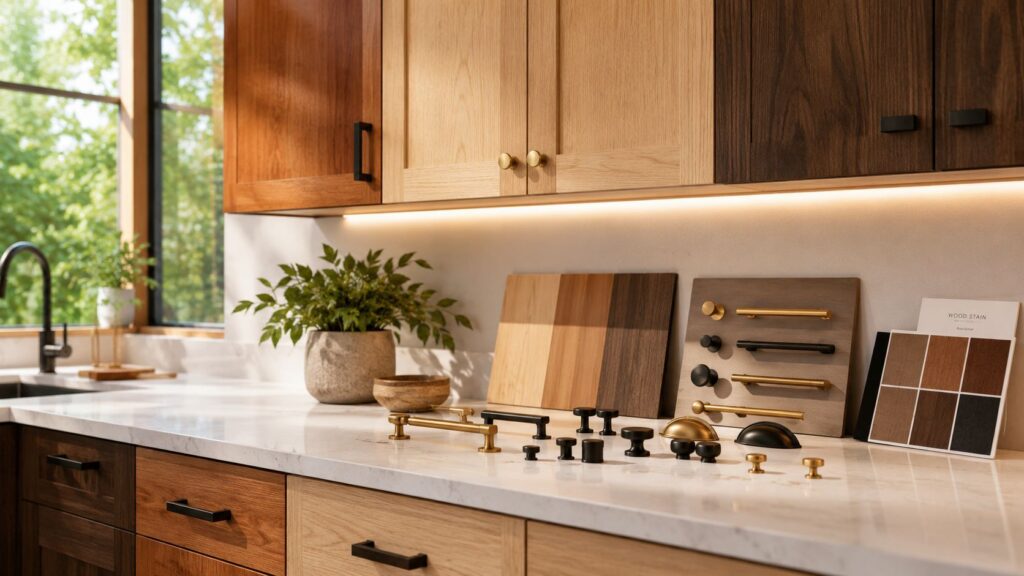
Wood has passed white. In Houzz's 2026 Kitchen Trends Study, as reported by NAR, 29% of renovating homeowners chose wood-toned cabinetry, while white fell to 28%. That shift matters because it tells us something bigger than color preference. Homeowners want kitchens that feel grounded, lived-in, and warmer than the glossy all-white rooms that dominated for years.
In South Jersey, that trend lands a little differently. A warm wood finish can look beautiful in a newer open-plan kitchen, but it also has to work in an older Haddonfield foursquare, a Moorestown colonial, or an Audubon bungalow where light, insulation, and seasonal moisture swings don't behave like they do in a brand-new build. Good cabinet design isn't just about taste. It's about matching species, finish, layout, and construction to the way your house lives.
Table of Contents
- Why Warm Wood Cabinets Are Making a Comeback in 2026
- Selecting the Perfect Wood Species and Stain
- How to Style Your Warm Wood Cabinets
- The Role of Lighting and Layout in a Wood Kitchen
- Before and After Real Kitchen Transformations
- A South Jersey Homeowner's Guide to Cabinet Durability
- Your Questions About Warm Wood Kitchens Answered
Why Warm Wood Cabinets Are Making a Comeback in 2026
Wood cabinetry is back at the center of kitchen design because homeowners want rooms that feel lived in, not over-edited.
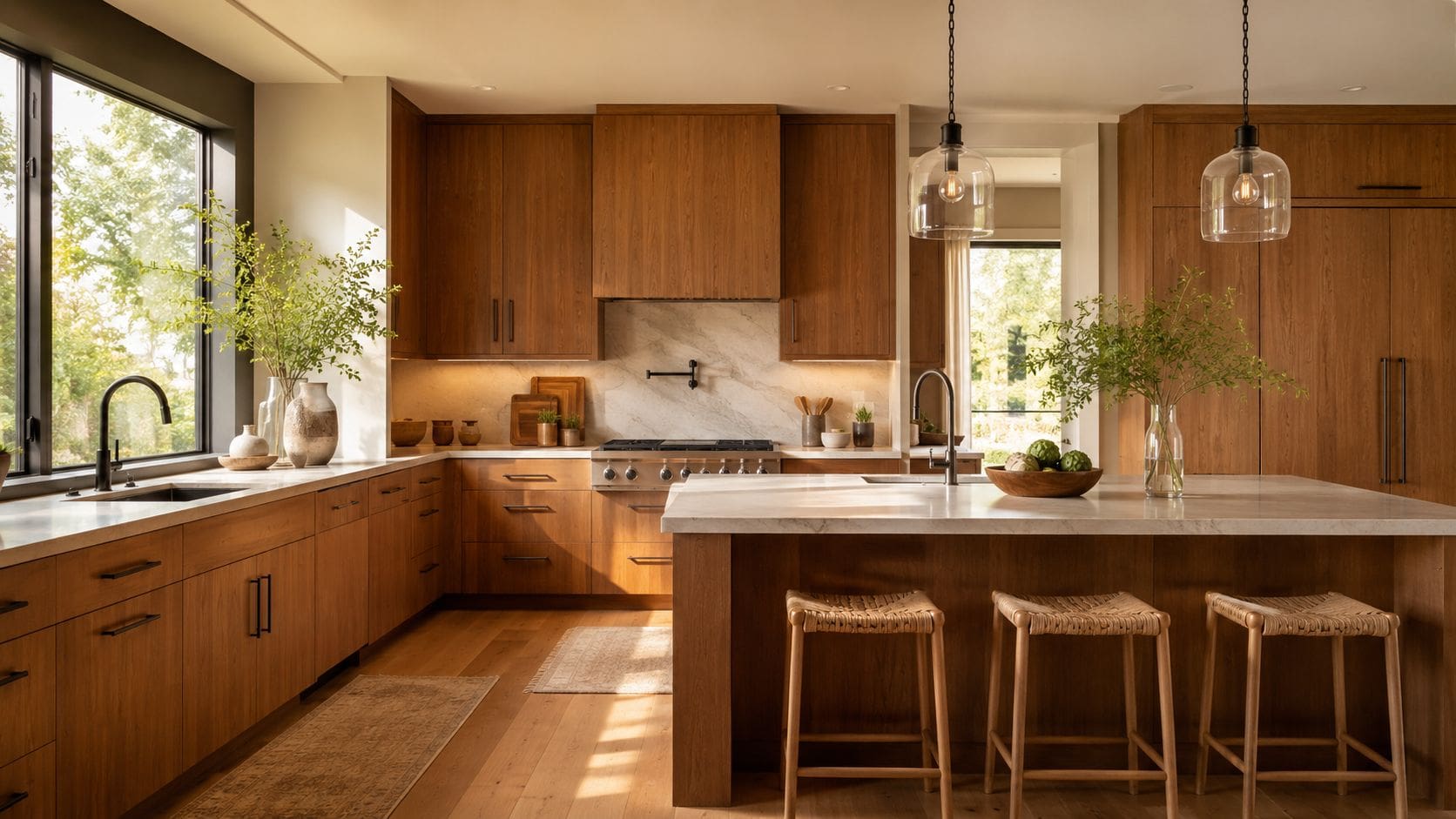
As noted earlier, current remodeling data shows wood tones edging past white in kitchen renovations. That lines up with what I see in South Jersey consultations. Homeowners still want a clean kitchen, but they also want depth, variation, and materials that do not feel sterile by year two.
Warm wood solves a problem white kitchens often create in older houses. Many South Jersey homes have original casing, mixed flooring, patched plaster, or uneven natural light from older window layouts. In those rooms, painted cabinets can make every surrounding surface look more mismatched. Wood does a better job of tying old and new together because grain, color variation, and a softer finish give the eye somewhere natural to land.
That is a big reason medium and light wood tones feel current. They add warmth without dragging the room backward, and they work with the finishes homeowners are already choosing, including quiet countertops, softer metals, and less reflective surfaces.
I give clients a simple rule. If the house already has character, the cabinetry should support it.
Warm wood also has a longer style runway. A painted color usually pins the kitchen to a specific moment. A well-chosen wood species and stain can read modern, transitional, or classic depending on the door style and hardware. That flexibility matters in older South Jersey properties, where the kitchen rarely exists in isolation from the rest of the home.
Material quality plays into the comeback too. Homeowners are paying closer attention to durability, repairability, and how cabinets will look after years of daily use. Guidance on selecting quality hardwood for style helps explain why solid hardwood options continue to appeal to buyers who want warmth and longevity, not just a trend photo.
For a local read on what is shifting in remodels right now, these 2026 kitchen trends for South Jersey homes explain the move toward warmth and materiality.
Selecting the Perfect Wood Species and Stain
A good wood choice starts with use, not color. The cabinet door you love online may be the wrong fit if your kitchen gets hard daily wear, if your house runs dry in winter and humid in summer, or if you don't want a busy grain pattern.
Kitchen Cabinet Kings' guide to wood cabinet types identifies cherry, hickory, and walnut as the most durable recommended species for warm wood kitchen cabinets, with better resistance to wear and moisture than options like maple or MDF. The same source lists maple at $250 to $400 per linear foot and MDF at $100 to $280 per linear foot, which is useful because it reminds homeowners that cheaper isn't the same as better long term.
What each wood does well
Here's the practical comparison I'd use at the start of a project.
| Warm Wood Species Comparison | Durability & Hardness | Grain Pattern | Cost Indicator |
|---|---|---|---|
| Cherry | Strong choice for daily-use kitchens | Fine, calmer grain | Higher than budget materials |
| Hickory | Very tough and impact-resistant | More movement and variation | Mid to upper range |
| Walnut | Durable and naturally rich-looking | Smooth, refined grain | Premium |
| Maple | Serviceable but less durable than the top warm-wood picks cited above | Generally cleaner grain | $250 to $400 per linear foot |
| MDF | Budget-oriented, not a hardwood species | No natural grain | $100 to $280 per linear foot |
Cherry works well when you want warmth without visual noise. It has a more refined look, so it suits traditional kitchens, inset cabinetry, and spaces where the backsplash or countertop already carries a lot of pattern.
Hickory isn't subtle. If you like variation, movement, and a more rustic or casual feel, it delivers that. If you want a quiet, minimal kitchen, it can be too active.
Walnut is the refined option. It reads deeper, smoother, and more architectural. In the right room, walnut can make even a simple cabinet profile feel custom.
For homeowners interested in selecting quality hardwood for style, furniture-grade hardwood guidance can also sharpen your eye for grain, hardness, and how different species age.
Stain versus natural finish
Here, many kitchens go off track. People choose a species for one reason, then finish it in a way that hides the very quality they paid for.
A natural finish puts the grain forward. It works best when the wood itself is attractive and the room benefits from authenticity. White oak, walnut, and cleaner cherry selections usually shine here.
A stain gives you more control. That's helpful when you want a warmer amber tone, a softer brown, or more consistency from door to door. It can also help align the cabinetry with older flooring or adjacent trim.
Use this filter before deciding:
- Choose natural when the species has beautiful character and you want the room to feel organic.
- Choose stain when you need tighter color control across a larger kitchen.
- Be careful with heavy stain if your room is small or dim. It can flatten grain and make cabinetry look heavier than it is.
- Don't force uniformity on a naturally expressive wood. Some variation is what makes it believable.
If you're comparing painted and stained cabinetry side by side, this paint versus stain cabinet guide is useful for sorting out maintenance, look, and fit.
How to Style Your Warm Wood Cabinets
Styling wood cabinets is mostly about restraint. The cabinets already bring texture, undertone, and presence. The rest of the kitchen should support them, not compete with them.
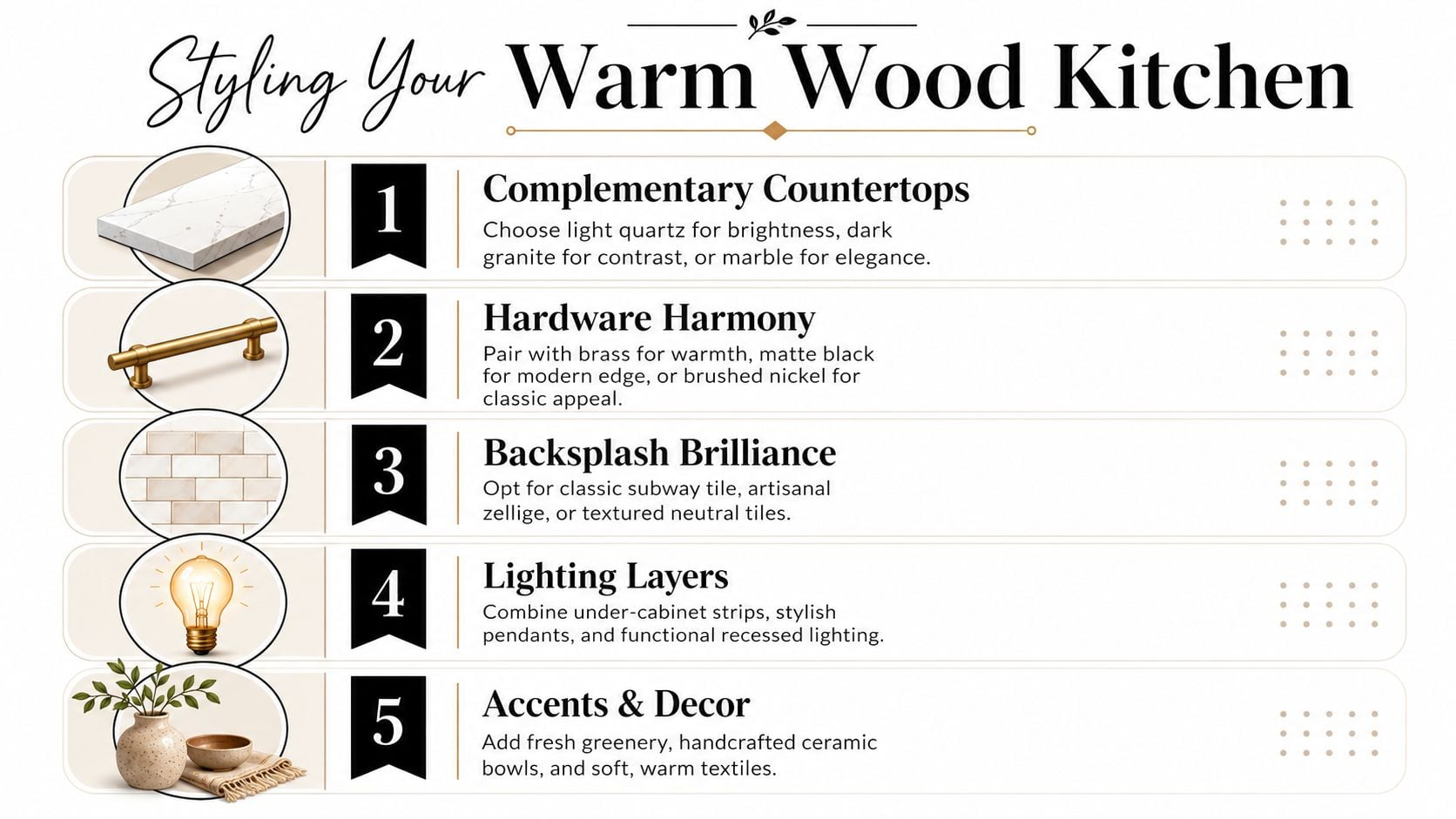
The strongest pairings are the ones that create contrast without temperature conflict. According to Emily's Interiors on warm wood kitchen cabinet ideas, lighter countertops such as white quartz or pale gray stone create the best visual balance with warm wood. The same guidance recommends brushed gold and warm brass as natural hardware partners, with matte black as a cleaner modern contrast.
Countertops that lighten the room
Warm wood needs breathing room. A pale surface above and around it keeps the kitchen from feeling bottom-heavy.
Good matches include:
- White quartz for brightness and easy visual lift
- Pale gray stone when you want a softer contrast than stark white
- Marble-look surfaces if the room needs a little movement without another strong color
What usually doesn't work is pairing medium or dark warm wood with a similarly dark counter in a room that lacks strong natural light. That combination can make even a decent-size kitchen feel compressed.
Wood reads heavier than a paint chip. Always judge it beside the actual countertop sample, not in isolation.
If your kitchen gets limited daylight, I'd prioritize the lightest countertop you can live with aesthetically, then add warmth back through hardware, stools, and lighting.
A close look at current kitchen cabinet hardware trends also helps when you're trying to decide whether the room needs softness or contrast.
Hardware that works with the grain
Hardware isn't a small decision. It's the jewelry line everyone notices, especially on a wood cabinet where the metal sits directly against visible grain.
Use these pairings as your baseline:
- Warm brass or brushed gold if you want the cabinetry to feel collected and inviting
- Matte black when the room needs a sharper outline and a more contemporary edge
- Avoid overly polished chrome if your wood leans warm. The cool reflectivity can feel disconnected
Handle shape matters too. A simple bar pull or slim tab pull fits cleaner slab and contemporary doors. A more sculpted pull can work on shaker or traditional profiles, but only if the rest of the room supports that level of detail.
Here's a quick visual primer before you finalize the full palette.
Color and surface pairings that feel current
Warm wood doesn't need a beige-only supporting cast. It looks stronger when it has one or two controlled contrasts around it.
The best supporting elements tend to be:
- Muted greens on walls, tile, or accessories. They echo the natural direction that makes wood attractive in the first place.
- Textured backsplash tile in white, cream, greige, or handmade-look finishes that add variation without noise.
- Soft black accents through lighting or seating to keep the room from turning too sweet.
- Mixed cabinetry when needed. Warm wood base cabinets with lighter uppers can open up a room and keep eye level brighter.
If you're styling for an older South Jersey home, let the wood be the honest material in the room. Then keep everything above it lighter, simpler, and quieter.
The Role of Lighting and Layout in a Wood Kitchen
Wood isn't static. It changes all day.
The same cabinet can look honeyed in morning sun, flat under cool recessed lighting, and almost muddy at night if the bulbs are wrong. That's why a wood kitchen has to be designed as a lighting project as much as a cabinetry project.
Light changes wood more than people expect
A layered plan works best. You need general room light, task light where you prep and cook, and selective accent light so the cabinets read as a material instead of a dark wall.
Focus on three layers:
- Ambient light from recessed fixtures or a central ceiling plan that gives the room overall visibility
- Task light under upper cabinets so counters aren't shadowed
- Decorative light from pendants or sconces that add warmth and depth
Under-cabinet lighting is the workhorse. It brightens the backsplash, helps countertops look cleaner and more useful, and stops lower wood cabinetry from carrying all the visual weight. For many kitchens, under-cabinet lighting installation guidance is what turns a nice design into one that performs.
If the cabinets look too dark at night, the problem often isn't the stain. It's the lighting plan.
Layout moves that prevent visual heaviness
Large uninterrupted runs of warm wood can look handsome in a showroom and too dense in a real house. The fix is usually composition, not abandoning wood.
A few layout strategies work especially well:
- Break up upper runs with a window wall, open shelving, or a lighter upper cabinet finish
- Use a contrasting island if the perimeter already carries a lot of wood
- Keep tall pantry banks controlled so one side of the room doesn't become a monolith
- Repeat lighter surfaces on counters, backsplash, and walls to keep the room balanced
In older South Jersey homes, kitchen footprints are often narrower and more segmented. That makes visual weight more noticeable. A smart layout can preserve the warmth of wood while keeping pathways, sightlines, and adjacent rooms feeling connected.
Before and After Real Kitchen Transformations
The most convincing argument for warm wood isn't a trend report. It's what happens when an awkward kitchen finally starts to feel right.
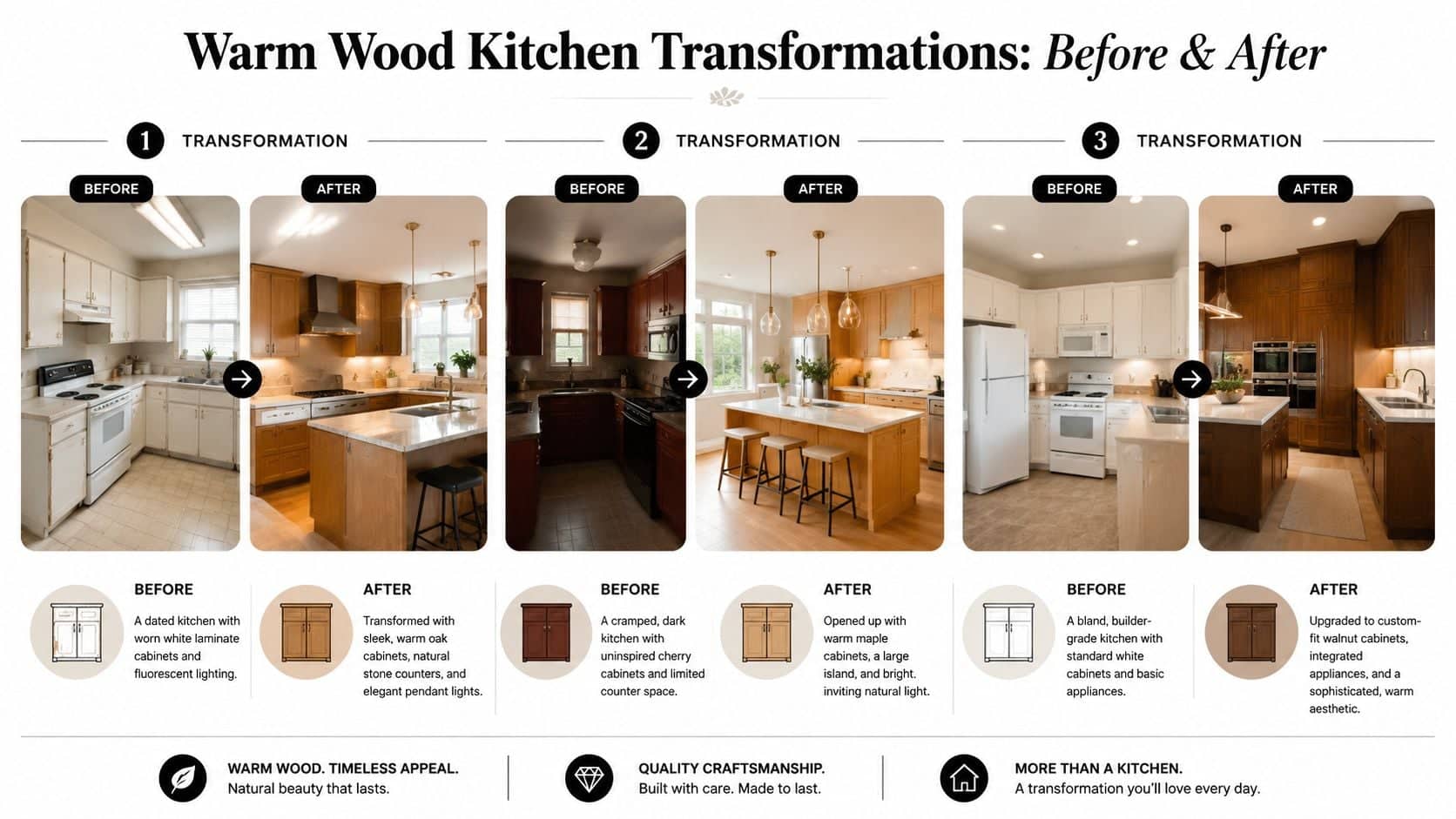
When the old kitchen feels flat
Some older kitchens aren't offensively outdated. They're just lifeless. The cabinets may be white laminate, the lighting harsh, and every surface reads as one continuous pale plane.
Warm wood changes that by reintroducing hierarchy. The cabinetry gives the eye a place to land. A light counter above it and a textured backsplash behind it create depth that the old room never had. Suddenly, the kitchen doesn't feel like a utility space. It feels like part of the home.
When the room feels too dark
This is a common fear. Homeowners remember dark cherry kitchens from years ago and assume any wood cabinet will make the room smaller.
That only happens when the whole palette goes dark together. A better after condition uses a lighter, cleaner wood tone, reflective counters, and stronger task lighting. In a narrow galley or small L-shape, even changing to wood on the base cabinets while keeping the upper half light can make the room feel more intentional and more open at the same time.
A bright kitchen isn't always a white kitchen. It's a balanced one.
When builder-grade details waste potential
Builder-grade kitchens often have one main problem. They use decent square footage poorly. Short uppers, awkward soffits, filler-heavy layouts, and generic door styles leave the room looking temporary.
Warm wood cabinetry helps most when it's paired with better fit. Think taller cabinetry, cleaner appliance integration, a more useful island, or a pantry wall that stores daily clutter. The transformation isn't only visual. It changes how the kitchen functions on a busy weekday.
Three before-and-after patterns show up again and again:
- From sterile to layered by swapping flat white surfaces for wood, stone, and softer metal finishes
- From cramped to useful by correcting cabinet placement and improving work zones
- From generic to custom by choosing a species and finish that relate to the house instead of fighting it
The best remodels don't look trendy. They look inevitable, like the room should've been built that way in the first place.
A South Jersey Homeowner's Guide to Cabinet Durability
Older South Jersey houses ask tougher questions than most cabinet articles answer. You can love the look of warm wood and still wonder what happens when the house gets dry in winter, sticky in summer, and drafty around the edges all year.
That concern is legitimate. The problem is that the guidance homeowners need is often thin. As noted in this discussion of environmental variance and older homes, the impact of temperature and moisture swings on warm wood cabinet durability is rarely addressed with solid technical guidance for historic South Jersey properties.

Older homes need better material decisions
In places like Haddonfield, Collingswood, Moorestown, Audubon, and Merchantville, many kitchens sit inside homes that weren't built with modern insulation and climate consistency in mind. Rooms can run warmer near one exterior wall and cooler near another. Humidity can vary from season to season in a way homeowners in newer construction don't deal with as much.
That doesn't mean wood is a bad choice. It means construction details matter more.
Look closely at these decisions:
- Door and panel construction because some profiles handle movement more gracefully than others
- Core material choices for cabinet boxes and certain components in variable environments
- Finish quality because a good finish helps the cabinet hold up to daily kitchen conditions
- Installation precision so reveals, clearances, and alignment stay clean as the house shifts slightly over time
If you're weighing cabinet box materials in particular, this plywood versus MDF cabinet comparison is one of the more useful starting points.
What to ask before you order cabinets
Homeowners usually ask, "Will wood cabinets crack in an old house?" The better question is, "Which wood, which construction method, and which finish make the most sense for my specific house?"
Ask your designer or cabinet supplier:
- How will this finish look if the room's light changes a lot over the day?
- Which components are solid wood and which are engineered?
- How is the cabinet box built, and why is that the right choice for my house?
- What happens near older windows, exterior walls, or rooms with uneven heating?
A good cabinet plan for a pre-1950s South Jersey home respects the house. It doesn't pretend every kitchen lives in a sealed modern envelope.
Your Questions About Warm Wood Kitchens Answered
Warm wood cabinets keep showing up in kitchen projects for one simple reason. Homeowners get tired of kitchens that feel flat, cool, and disconnected from the rest of the house. That helps explain why industry forecasting around modern kitchen cabinet ideas points to medium wood tones as the leading direction, with light wood tones close behind. Those finishes bring back texture, warmth, and a more settled look that fits how people want to live.
In older South Jersey homes, that matters even more. A 1950s ranch in Cherry Hill or a foursquare in Haddonfield usually has more trim, more room-to-room character, and less of the blank-slate feel you get in new construction. Warm wood often belongs there more naturally than a stark painted finish.
FAQ
Are warm wood cabinets just a trend?
No. Stain colors change over time, but wood cabinets have held their place through modern, traditional, and transitional kitchens for decades. The better question is whether the species, stain depth, and door style fit your house.
Can I mix wood and painted cabinets?
Yes. In many South Jersey kitchens, that split gives you the best balance. Wood on the island or base cabinets adds depth and warmth, while painted uppers keep older rooms from feeling heavy, especially if ceiling height is modest.
What if my kitchen is small?
Small kitchens can look excellent in wood. The trick is to manage contrast and reflection. I usually pay close attention to countertop brightness, backsplash tone, and fixture placement before I decide how much wood the room can carry.
What wood look feels the most current right now?
Medium and lighter wood tones have the strongest pull right now. They read warmer and cleaner than dark espresso finishes, and they hide everyday dust and fingerprints better than many very pale painted surfaces.
What's the first decision I should make?
Start with the room itself. Check the natural light, the flooring, the fixed trim color, and the age of the house. In an older South Jersey property, those conditions shape the right cabinet finish more than a sample chip ever will in a showroom.
If you're planning a kitchen remodel in Cherry Hill, Haddonfield, Moorestown, Audubon, or anywhere across Camden and Burlington County, The Cabinet Coach gives you a practical way to sort through warm wood cabinet options without guessing. Their mobile showroom brings cabinetry, countertops, hardware, and finish samples to your home, so you can compare materials in your actual light, against your floors, walls, and trim. That's the smartest way to choose cabinetry for an older South Jersey house where context matters.