
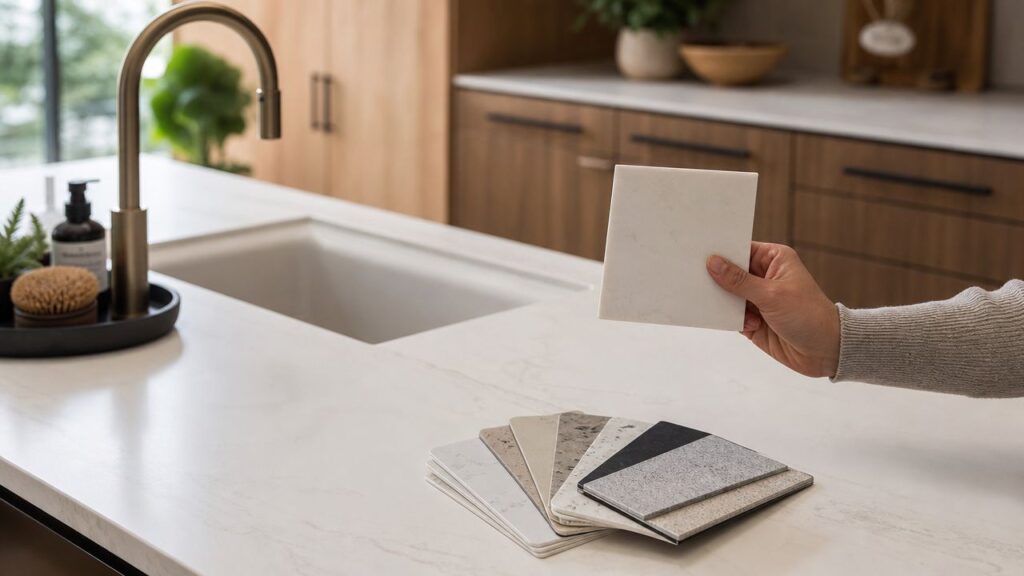
You're standing in your kitchen with cabinet samples on one side, tile ideas on the other, and a dozen countertop names floating around your head. Quartz. Granite. Laminate. Then someone mentions Corian, and the reaction is usually the same: “Wait, what is that exactly?”
That confusion is normal. Most homeowners don't start a remodel knowing the difference between a brand, a material category, and a design application. They just want a kitchen or bathroom that looks clean, works hard, and doesn't blow up the budget halfway through. If you're still sorting through layout, cabinets, finishes, and timing, this kind of step-by-step kitchen renovation advice can help organize the bigger picture before you lock in materials.
Corian is one of those products people have heard of for years, but they often don't understand where it fits. If you're comparing surfaces and trying to make a smart decision for daily use, this guide pairs well with a broader look at how to choose kitchen countertops. The short version is this: Corian can be a very practical choice, especially when you're planning a coordinated kitchen or bath remodel instead of just swapping out one countertop.
Table of Contents
- Your Guide to Corian Countertops
- What Is a Corian Countertop Actually Made Of
- The Pros, Cons, and Lifespan of Corian
- Corian Countertop Cost Expectations for 2026
- How Corian Compares to Quartz, Granite, and Laminate
- See Corian Samples in Your South Jersey Home
Your Guide to Corian Countertops
A lot of remodels start with a simple question that turns out not to be simple at all: what are Corian countertops, and are they still a smart choice? Homeowners often ask that after they've already looked at quartz slabs, natural stone yards, and budget-friendly options that seem fine online but feel underwhelming in person.
Corian is often misunderstood because people talk about it as if it belongs in one narrow lane. It doesn't. In the right project, it can solve design problems that other materials can't solve cleanly. In the wrong project, it can frustrate you.
That's why I like to explain Corian in practical terms, not showroom terms. It matters less whether a material sounds premium and more whether it fits the way you cook, clean, and use the room every day.
Corian makes the most sense when you want a smooth, continuous look and you care about how the countertop connects to sinks, backsplashes, and surrounding surfaces.
If you're planning a kitchen or bathroom as one coordinated package, Corian deserves a closer look. If you want a countertop that can take rough treatment from hot pans and sharp cookware without much thought, you should know its limits before you sign off.
What Is a Corian Countertop Actually Made Of
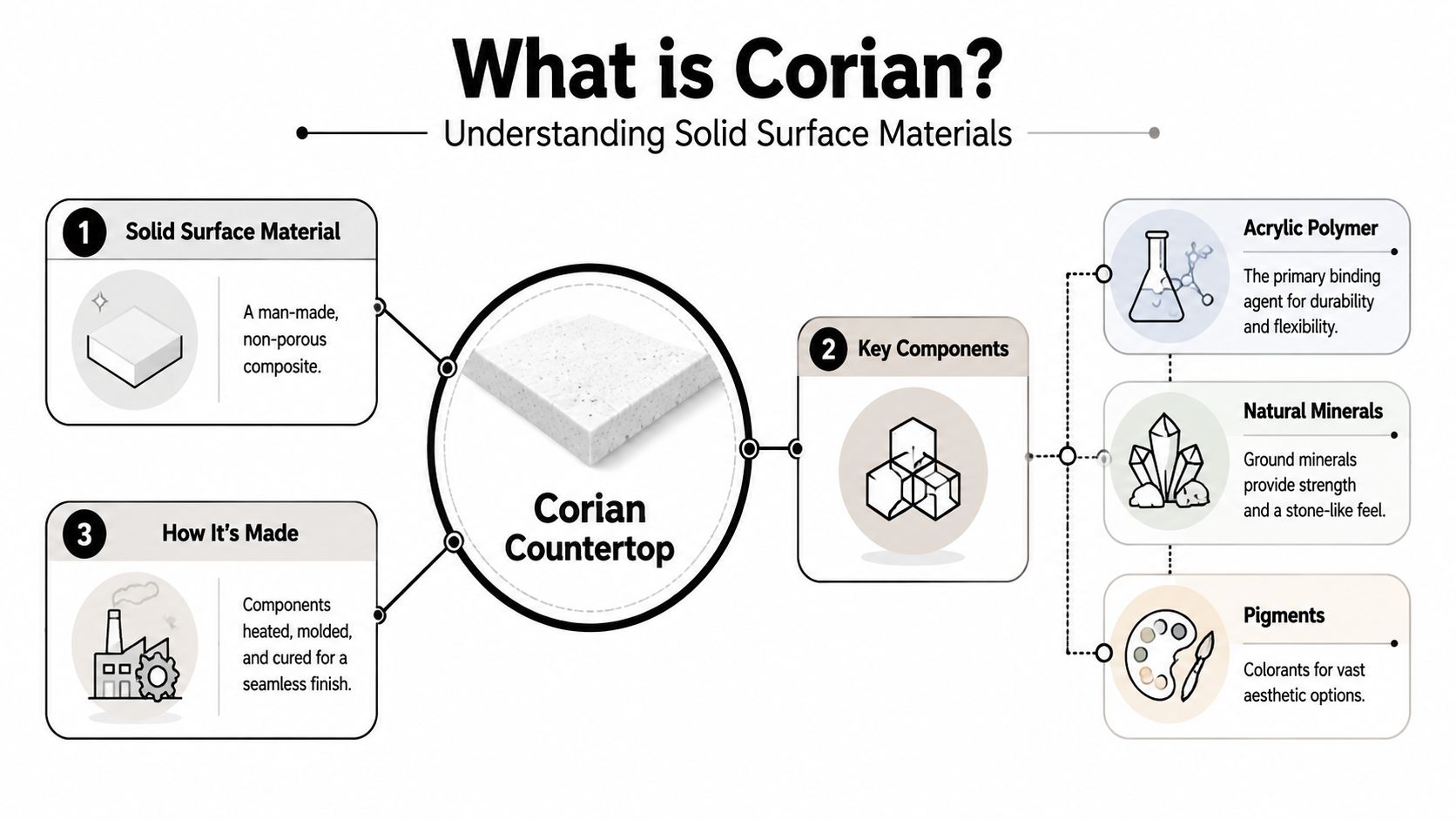
Corian is a brand of solid-surface material, not a natural stone. That distinction matters because it tells you how the material behaves, how it's fabricated, and what kinds of designs it allows.
The simplest way to think about it is as a recipe. Corian is made from a blend of acrylic resin and minerals, molded into a solid, consistent sheet. DuPont describes Corian as a solid-surface composite made of approximately 1/3 acrylic resin (PMMA) and 2/3 natural minerals, and notes that its non-porous, homogeneous composition is what allows inconspicuous seams and resistance to stains and moisture penetration. DuPont also states that it was first introduced in 1971, creating the solid-surface category in the process, as detailed in DuPont's Corian material overview.
Why solid surface means something different
“Solid surface” doesn't just mean the top feels substantial. It means the material is consistent through its thickness, rather than being a thin decorative layer over a core. That affects repairability. If the surface gets scratched or dulled, a fabricator can often work the top back into shape because the material isn't just coated on top.
That's also why Corian behaves differently from laminate. Laminate is a layered product. Corian is a solid-surface composite. Those aren't interchangeable terms.
Why the history still matters
Corian has been around long enough that many people use the name the way they use a category label. That happened for a reason. According to a history summary from BSF Solid Surfaces, Corian was developed by DuPont in 1967 and introduced publicly at the National Association of Home Builders convention in 1971 in Houston, Texas. That launch helped define an entirely new category of countertop material, and the original release was reportedly white only, which reflects how early solid-surface products emphasized utility and hygiene first, before decorative options expanded, as described in this history of solid-surface materials.
Practical rule: If you want a material that can be shaped, joined, and integrated into a larger design concept, the composition matters just as much as the color.
For homeowners, that's the key point. Corian isn't just “another countertop.” It's a man-made surface built to be fabricated in ways that natural stone and layered products usually can't match.
The Pros, Cons, and Lifespan of Corian
Corian is one of the few countertop materials that can make some remodels easier and some households harder. Whether it works depends on how you use the room, how much maintenance you'll tolerate, and whether the design advantages matter enough to offset the trade-offs.
Where Corian works especially well
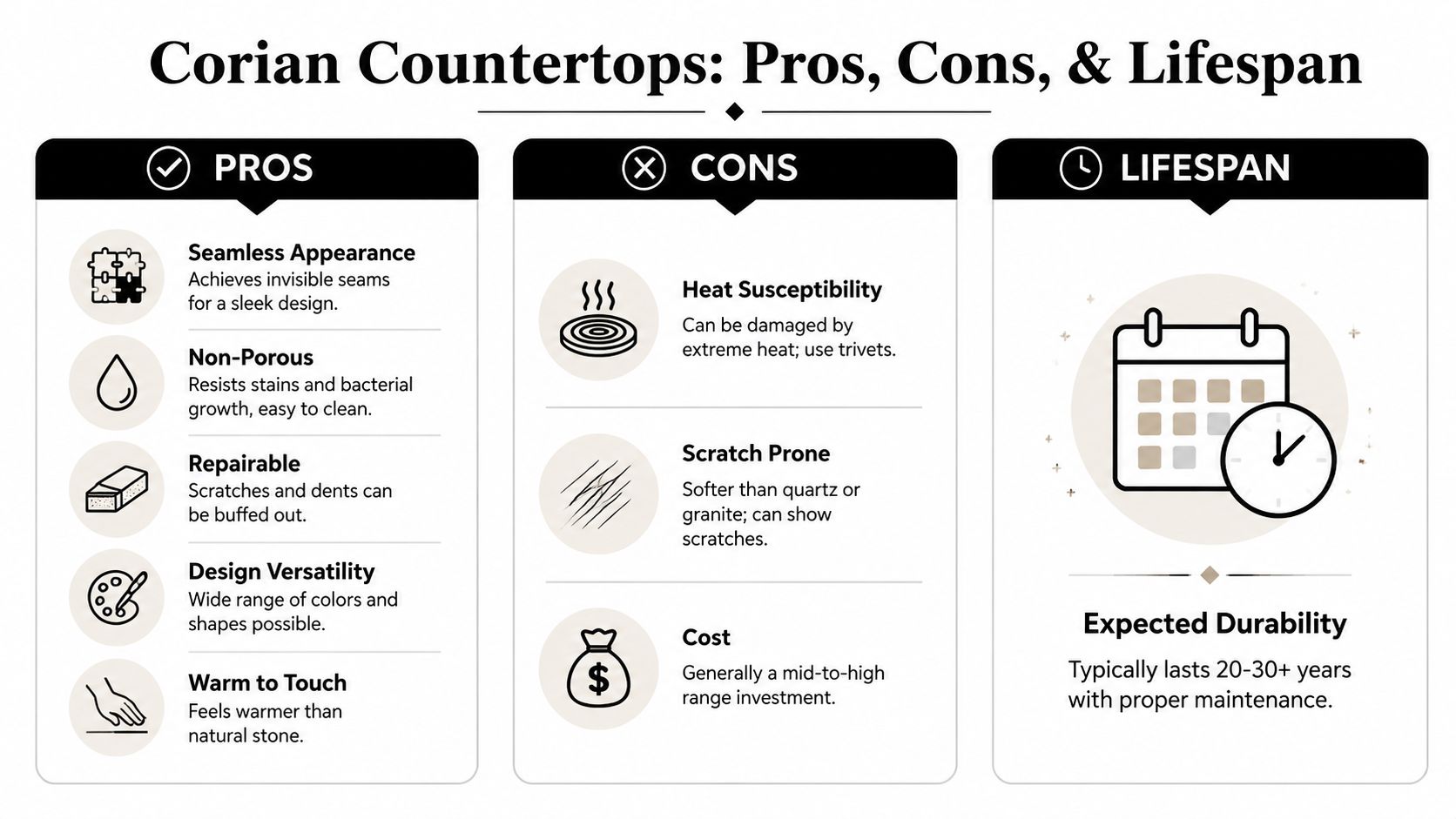
The biggest strength is the continuous appearance. On a long run of countertop, that matters visually. In a bathroom vanity, it matters even more because the whole installation can feel cleaner and less chopped up.
Corian also works well for remodels that need pieces to connect neatly. If you want the countertop to flow into the backsplash, or the sink to feel integrated rather than dropped in as a separate object, Corian is one of the better tools for that job. In projects where homeowners are removing dated tops and trying to create a simpler, more unified look, that's a meaningful advantage.
Its non-porous makeup is another practical plus. Day to day, that means routine wipe-downs are straightforward, and you're not dealing with the same concerns people often associate with more porous surfaces.
A few strong points stand out in real homes:
- Integrated design options: Corian is well suited to sinks, low-profile backsplashes, and continuous surfaces that don't look pieced together.
- Repair potential: Light wear is often less final than it feels on harder, brittle materials. Minor surface issues can often be addressed rather than forcing a full replacement.
- Comfort under hand: Many homeowners notice it feels less cold and hard than stone, especially in bathrooms and secondary prep areas.
If you're already planning a full remodel and not just a top swap, it also helps to understand how removal and replacement affect the rest of the room. This guide on how to replace kitchen countertops is useful because countertop decisions rarely happen in isolation.
Where homeowners get disappointed
Corian isn't the right fit for every kitchen. The first issue is scratching. Compared with harder materials, it's softer. In a busy kitchen where someone drags a heavy appliance, cuts carelessly, or slides rough-bottom cookware across the surface, wear shows sooner.
The second issue is heat. I'm very direct about this with homeowners. If you tend to pull a hot pan off the stove and set it down wherever there's space, Corian requires better habits. Trivets and hot pads aren't optional. They're part of owning the material responsibly.
Hot cookware and Corian don't mix well. If your kitchen runs on fast, informal cooking, that's a real lifestyle consideration, not a minor footnote.
Some people also expect Corian to look exactly like stone, and that's where expectations need adjusting. It has its own look. Some colors are crisp and modern. Some read softer and more understated. But if your goal is dramatic natural veining and visual depth, you may end up happier with another material.
What long-term ownership looks like
Corian can hold up well over time when the household treats it appropriately. It isn't a set-it-and-forget-it surface in the same way some homeowners expect from harder engineered materials, but it also offers a kind of forgiveness that brittle surfaces don't. If a section gets worn, dulled, or lightly damaged, the conversation is often about refinishing rather than ripping everything out.
That's a big reason Corian still has a place in kitchen and bath design. It's not about pretending there are no downsides. It's about knowing which downsides are manageable in your house.
A reasonable ownership mindset looks like this:
| Daily reality | What it means for you |
|---|---|
| You wipe counters often | Corian is easy to live with |
| You use trivets consistently | Heat risk becomes more manageable |
| You want a sink and top to read as one piece | Corian becomes much more attractive |
| You're rough on work surfaces | Another material may be safer |
Some materials win on brute toughness. Corian wins when clean transitions, integrated elements, and repairability matter more than maximum hardness.
Corian Countertop Cost Expectations for 2026
Budget is where a lot of countertop conversations get real fast. Homeowners might like the look of a material, but the project still has to work with cabinets, plumbing, tile, lighting, and labor. Corian usually lands in the middle of that discussion, not at the very bottom and not at the top.
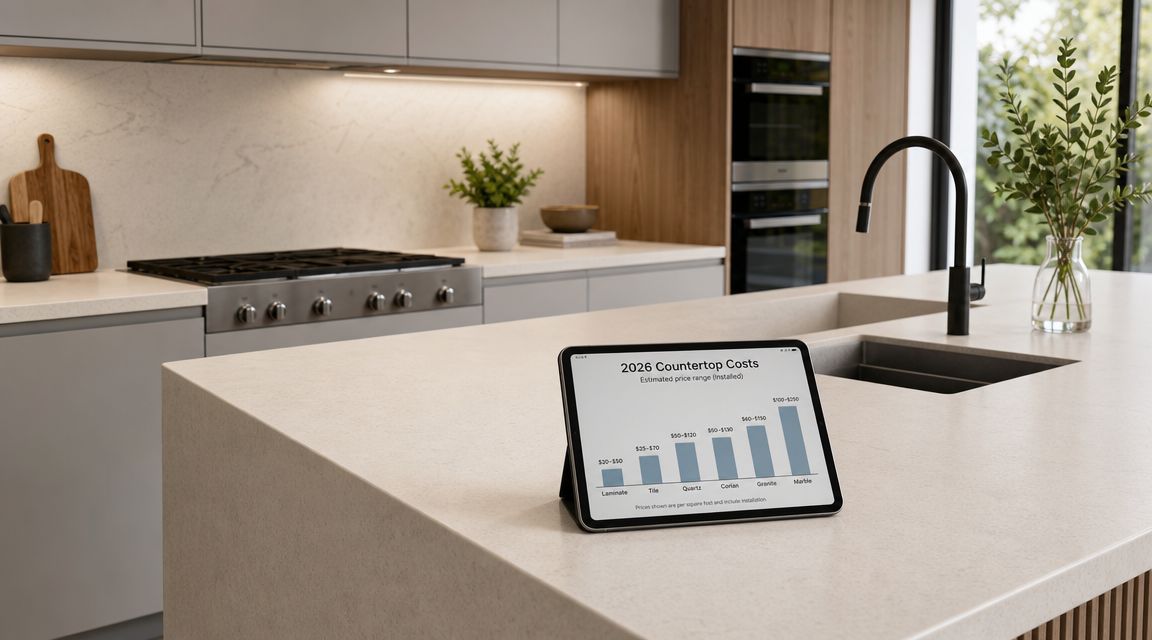
Industry comparisons typically place Corian in the range of $40 to $80 per square foot installed, which positions it as a middle-ground choice that's often more affordable than premium quartz while offering more versatility and durability than laminate, according to Caesarstone's Corian versus quartz cost comparison.
What the installed price range usually means
That installed range is helpful, but it's only a starting point. A simple straight-run vanity top is one thing. A kitchen with corners, sink cutouts, special edge details, and coordinated backsplash work is another.
Corian pricing often makes sense for homeowners who want a cleaner custom look without moving into the higher end of stone pricing. If you're trying to compare several materials side by side before getting estimates, this breakdown of countertop cost per square foot helps frame the budgeting conversation.
What pushes the quote up or down
Fabrication details matter with Corian. The quote can move based on choices like these:
- Color and pattern selection: Some options are more straightforward, while others are priced more like upgraded finishes.
- Integrated features: If you want the sink and surrounding surfaces to work as one coordinated assembly, that adds fabrication labor.
- Shape complexity: Curves, unusual transitions, and custom details are often where Corian shines, but they also affect cost.
- Edge treatment and backsplash scope: A plain edge is different from a more finished profile, and a basic backsplash is different from a more integrated design.
A short visual can help if you're still early in the decision process and want to see countertop planning in context.
The practical budgeting takeaway is simple. Don't price Corian as if you're only buying a slab. Price it as a fabricated part of the whole room. That's where its value shows up, and that's also where the estimate becomes more accurate.
How Corian Compares to Quartz, Granite, and Laminate
A lot of South Jersey homeowners get to this stage with cabinet samples on the table, a sink decision still up in the air, and three different opinions from friends about what countertop they should buy. That is usually the moment Corian starts to make more sense, or gets ruled out quickly. It depends on what the full remodel needs to do.
One useful outside read for broader kitchen material advice for homeowners is looking at how different surfaces fit different priorities. The right choice usually comes down to daily use, cleaning habits, and whether you are designing a coordinated kitchen or bath or just replacing a worn top.
Countertop Comparison
Corian stands apart because it can be fabricated into more than a flat work surface. It can include an integrated sink, a coved backsplash, and transitions that help the counter work with the rest of the room instead of stopping at the cabinet line.
| Feature | Corian (Solid Surface) | Quartz | Granite | Laminate |
|---|---|---|---|---|
| Seams | Often inconspicuous | Usually visible on larger runs | Usually visible on larger runs | Visible at joints and edges |
| Heat tolerance | Requires care with hot items | Better for busy cooking habits | Better for hot cookware habits | Not ideal for heat exposure |
| Scratch resistance | Moderate, can show wear | Stronger day to day | Stronger day to day | Surface wear can show over time |
| Repair approach | Surface issues may be refinished | Repairs are less forgiving | Repairs depend on damage | Damaged sections often mean replacement |
| Integrated sink potential | Excellent | Limited | Limited | Limited |
| Best fit | Coordinated modern remodels | Busy kitchens needing toughness | Natural stone look | Tight budgets |
Durability and heat
Quartz and granite are usually better picks for households that cook hard and set down hot pans without thinking. Corian needs more discipline. I tell clients to plan on trivets and hot pads, not because the material is fragile, but because heat can mark it in a way that creates avoidable repair work later.
Laminate also needs care, but for different reasons. Its weak points are often edges, surface wear, and moisture trouble at joints over time.
Corian earns its place for a different reason. It gives you a repairable, workable surface that can solve design problems the harder materials do not solve as cleanly.
Maintenance and day-to-day use
For daily cleaning, Corian is simple. Wipe it down, keep standing stains from sitting too long, and it stays presentable without a lot of fuss. That makes it appealing in bathrooms, kids' baths, laundry rooms, and kitchens where people want a smooth-looking surface without grout lines or sink rims catching grime.
Quartz is also low maintenance in normal use. Granite can be a great fit too, but some homeowners do not want natural variation, visible pattern movement, or the upkeep questions that come with stone. If you are still weighing stone seriously, this guide to granite countertop installation costs helps put that option in budget context.
A simple rule helps here. If the top priority is maximum toughness, quartz and granite often move ahead. If the top priority is a cleaner-looking integrated setup, Corian becomes much more competitive.
Design flexibility and overall look
Design flexibility is Corian's key differentiator. In a real remodel, that matters more than many homeowners expect.
A coordinated bath vanity is a good example. If the plan includes a sink that flows directly into the top, a backsplash transition that is easy to wipe, and fewer creases where water and toothpaste collect, Corian can handle that as one fabricated assembly. Quartz and granite usually cannot deliver that same integrated result in the same way. Laminate cannot either.
The same idea shows up in kitchens. If the room includes painted cabinets, a simple door style, and a cleaner visual line from counter to wall, Corian often supports that look better than a busier stone pattern. If the remodel is centered on dramatic veining or a natural slab appearance, quartz or granite will usually fit the design intent better.
Corian works best when the countertop is part of the room plan, not a separate purchase made after everything else is decided.
- Choose Corian if integrated sinks, coved backsplashes, and a coordinated kitchen or bath matter most.
- Choose quartz if you want stronger scratch and heat performance with a stone-inspired look.
- Choose granite if natural movement and character are part of the design goal.
- Choose laminate if initial price is the main driver and you can accept more visible wear points.
See Corian Samples in Your South Jersey Home
Corian makes the most sense when you can look at it in the actual room, next to your cabinet door, flooring, wall color, and lighting. On a sample chip in a showroom, it's easy to underestimate what makes it useful. In your own kitchen or bath, the value becomes clearer. You start seeing how an integrated sink, simple backsplash transition, or softer visual profile might support the whole remodel.
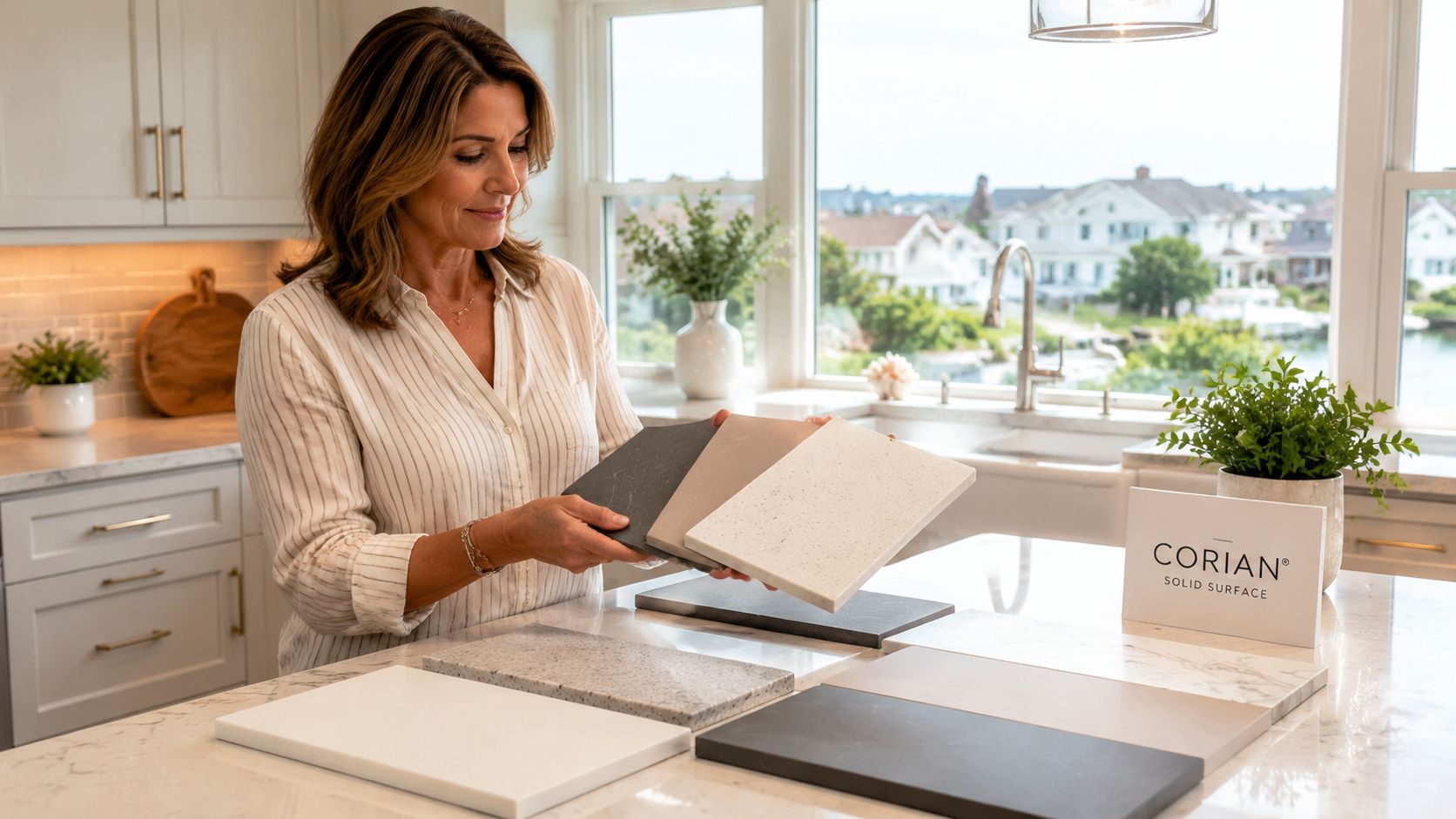
That's especially true in South Jersey homes where remodels often involve more than one decision at once. You're not only picking a countertop. You're balancing cabinet style, backsplash material, sink type, flooring transition, and how the room will function on a normal Tuesday morning.
For homeowners comparing surfaces throughout the house, even articles about adjacent materials can help sharpen your thinking. For example, this discussion on choosing vinyl or laminate is a reminder that material decisions always involve trade-offs between look, performance, and budget. Countertops are no different.
If you want to evaluate Corian in context, an in-home process is usually more useful than staring at disconnected samples under store lighting. That's one reason some homeowners prefer a mobile cabinet showroom approach, where countertop, cabinetry, hardware, and finish selections can be reviewed together in the room where they'll live. The Cabinet Coach offers that kind of in-home selection support for South Jersey remodels, including projects in Cherry Hill, Voorhees, and Moorestown.
The right countertop doesn't just look good on its own. It needs to make sense with the cabinets, sink, wall color, and how you actually use the space.
If Corian is on your shortlist, seeing full material combinations in your home will tell you more in one visit than a stack of isolated samples ever will.
If you're planning a kitchen or bathroom remodel in South Jersey and want help sorting through Corian, quartz, granite, and other countertop options in the context of the whole room, schedule a consultation with The Cabinet Coach. A complimentary video consultation is a practical first step if you want to discuss layout, budget, coordinated materials, and which surfaces fit the way your home works.