

Countertops typically cost $15 to $70 per square foot installed, and for a standard 55-square-foot kitchen, the average total lands around $2,200, with a broader range of $825 to $3,850 depending on material and complexity. That per-square-foot number matters, but it’s only part of the total investment because your final bill also includes fabrication, cutouts, edge work, delivery, and installation.
If you're standing in your kitchen in Cherry Hill, Haddonfield, Voorhees, or Medford trying to figure out whether your remodel budget is realistic, you're asking the right question. The cost of countertops per square foot is where most homeowners start, but it’s rarely where the project ends.
A lot of people get tripped up by quotes that sound simple at first. A slab price looks manageable, then the estimate grows once the fabricator adds sink openings, seams, edge details, and labor. That’s normal in this trade, but it shouldn’t be confusing. A good countertop quote should tell you exactly what you’re paying for and why.
Table of Contents
- Your Guide to Understanding Countertop Costs
- Countertop Material Costs Per Square Foot
- What Is Included in Your Countertop Quote
- How to Calculate Your Countertop Project Cost
- Smart Ways to Save Money on New Countertops
- Project Timeline and Return on Investment
- The Cabinet Coach Simplifies Your South Jersey Project
- Frequently Asked Countertop Questions
Your Guide to Understanding Countertop Costs
Most first-time remodelers start in the same place. They pick a material they like, search the cost of countertops per square foot, and expect a clean answer. Then they find five different price ranges and no clear way to compare them.
That confusion makes sense. Countertops aren’t a shelf item you pull off a rack. They’re a custom product measured to your cabinets, cut to your sink and cooktop, polished at the edges, transported carefully, and installed inside a working home. Two kitchens with the same square footage can end up with very different totals because the layout, material, and fabrication details change the job.
Why square-foot pricing helps, but only up to a point
Square-foot pricing is useful because it gives you a fast way to sort materials into rough budget levels. Laminate sits at the affordable end. Quartz usually lands in the middle to upper-middle range. Natural stones can swing wider depending on slab quality and design choices.
What doesn’t work is treating square-foot pricing like a final quote. A homeowner may compare quartz and granite based only on material cost, then get surprised when one kitchen needs extra seams or a more complicated sink cutout. That’s why it helps to look at material, fabrication, and installation as separate parts of one project.
Practical rule: If a quote sounds low, ask what it leaves out before you ask what material it includes.
What South Jersey homeowners usually need to know first
In Camden and Burlington Counties, the questions are usually practical. Which surface holds up best to daily cooking? Which one is easiest to clean? Which quote is complete, and which one is only showing the slab? Which upgrade is worth paying for, and which one just looks good on paper?
That’s where side-by-side guidance matters. If you’re still narrowing down materials, this countertop comparison for Cherry Hill homeowners is a good companion read because it helps connect price with day-to-day performance.
Countertop Material Costs Per Square Foot
Material choice drives most of the budget. According to HomeAdvisor’s countertop cost guide, in 2026 the average cost of kitchen countertops ranges from $15 to $70 per square foot installed, with laminate at $8 to $27 per square foot and engineered quartz at $15 to $70 per square foot. That same source notes a typical 55-square-foot kitchen averages $2,200, though kitchens can land much lower or much higher depending on the surface selected.
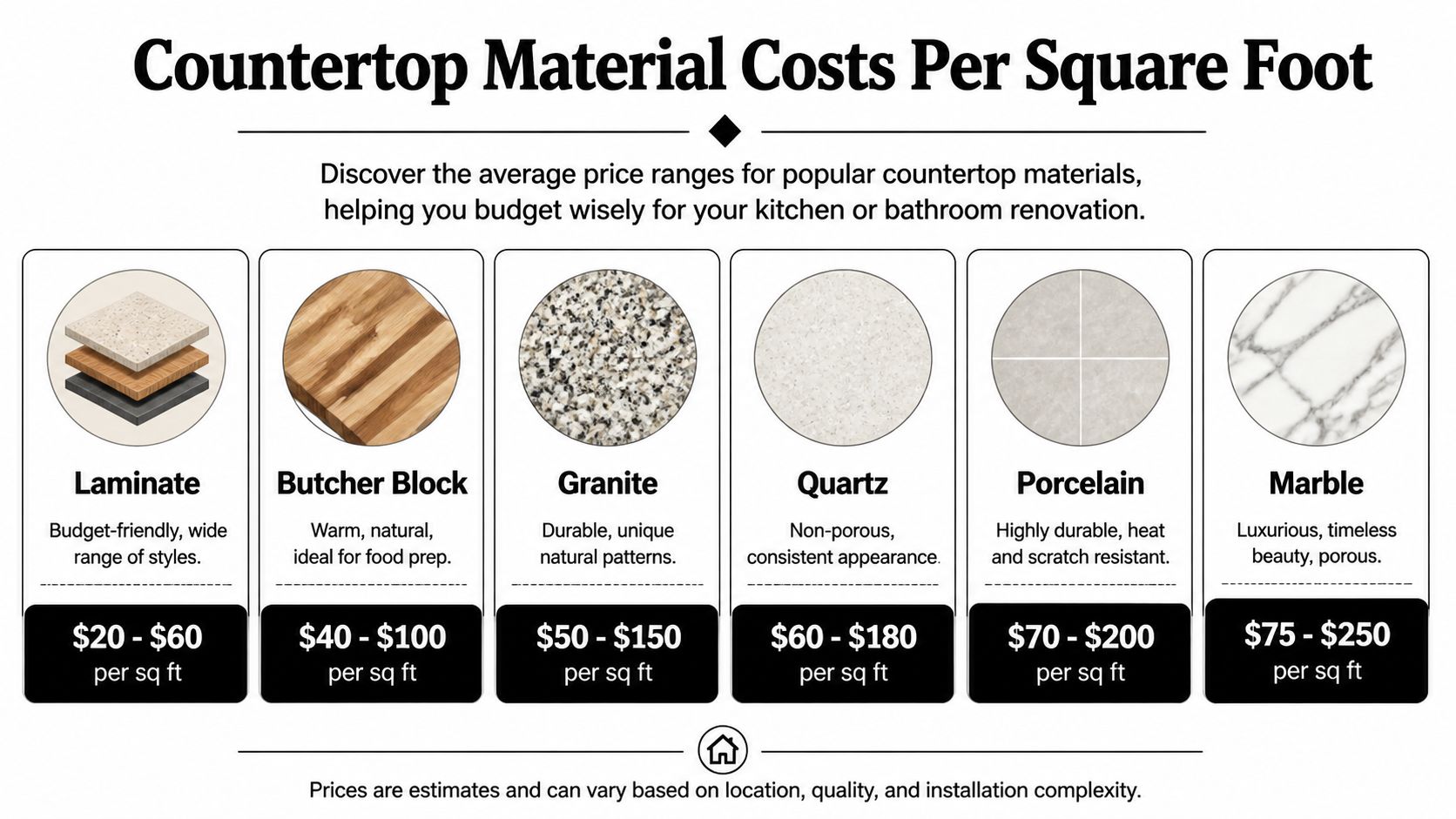
A practical comparison by material
Here’s the easiest way to think about it. Don’t just ask what each surface costs. Ask how it behaves in a real kitchen.
| Material | Verified price range | What works well | What to watch |
|---|---|---|---|
| Laminate | $8 to $27 per sq ft | Budget remodels, clean appearance, quick value decisions | It won’t give you the weight or feel of stone |
| Granite | $15 to $140 per sq ft | Natural variation, strong durability, good fit for busy kitchens | It needs maintenance attention over time |
| Quartz | $15 to $70 per sq ft | Non-porous, stain resistant, low-maintenance for busy households | Premium looks can push quotes upward |
| Porcelain | $3 to $28 per sq ft | Sleek appearance, good fit for modern designs | Fabrication skill matters a lot |
| Wood or butcher block | $10 to $38 per sq ft | Warm, softer look, inviting in traditional or transitional kitchens | Upkeep is part of ownership |
| Solid surface | $20 to $75 per sq ft | Seam-conscious installations, smooth integrated look | Not everyone likes the feel compared with stone |
What works for different households
Laminate still earns its place. If the goal is a fresh kitchen without stretching the budget, laminate is often the smartest move. It’s especially useful when cabinets, flooring, and lighting all need attention at the same time.
Quartz is the easiest recommendation for many busy homes. It’s popular because it’s non-porous and resists stains and bacteria, which makes daily cleanup straightforward. For people who want a polished kitchen without signing up for ongoing sealing, quartz usually checks the most boxes.
Granite works when you want natural movement and don’t mind a little maintenance. Every slab looks different, which is either the main attraction or the reason some homeowners avoid it. In a South Jersey kitchen that gets used hard, granite still performs well when the material is chosen carefully and fabricated properly.
The best countertop isn’t the most expensive one. It’s the one that matches how your kitchen actually gets used on a Tuesday night.
Premium surfaces and value decisions
If you’re looking at marble, quartzite, recycled glass, or specialty stone, the conversation shifts from pure budget to priorities. Some materials deliver a standout look but ask more from you in upkeep. Others cost more upfront because of sourcing, fabrication, or slab rarity.
That’s why broad comparison guides can help early in the process. Northpoint Construction's countertop guide is a useful outside reference when you want another side-by-side look at performance traits before you visit slabs.
For a more design-focused decision, this guide on how to choose kitchen countertops helps tie material choice to cabinet color, lifestyle, and overall remodel goals.
What Is Included in Your Countertop Quote
The line that confuses homeowners most is the one that sounds the simplest. “Countertops, price per square foot.” That line can include almost everything, or barely anything.
A complete quote usually wraps together the slab, shop work, field measurements, cutting, polishing, transport, and install. A thin quote may only show material. That’s why two bids for what looks like the same kitchen can be far apart.
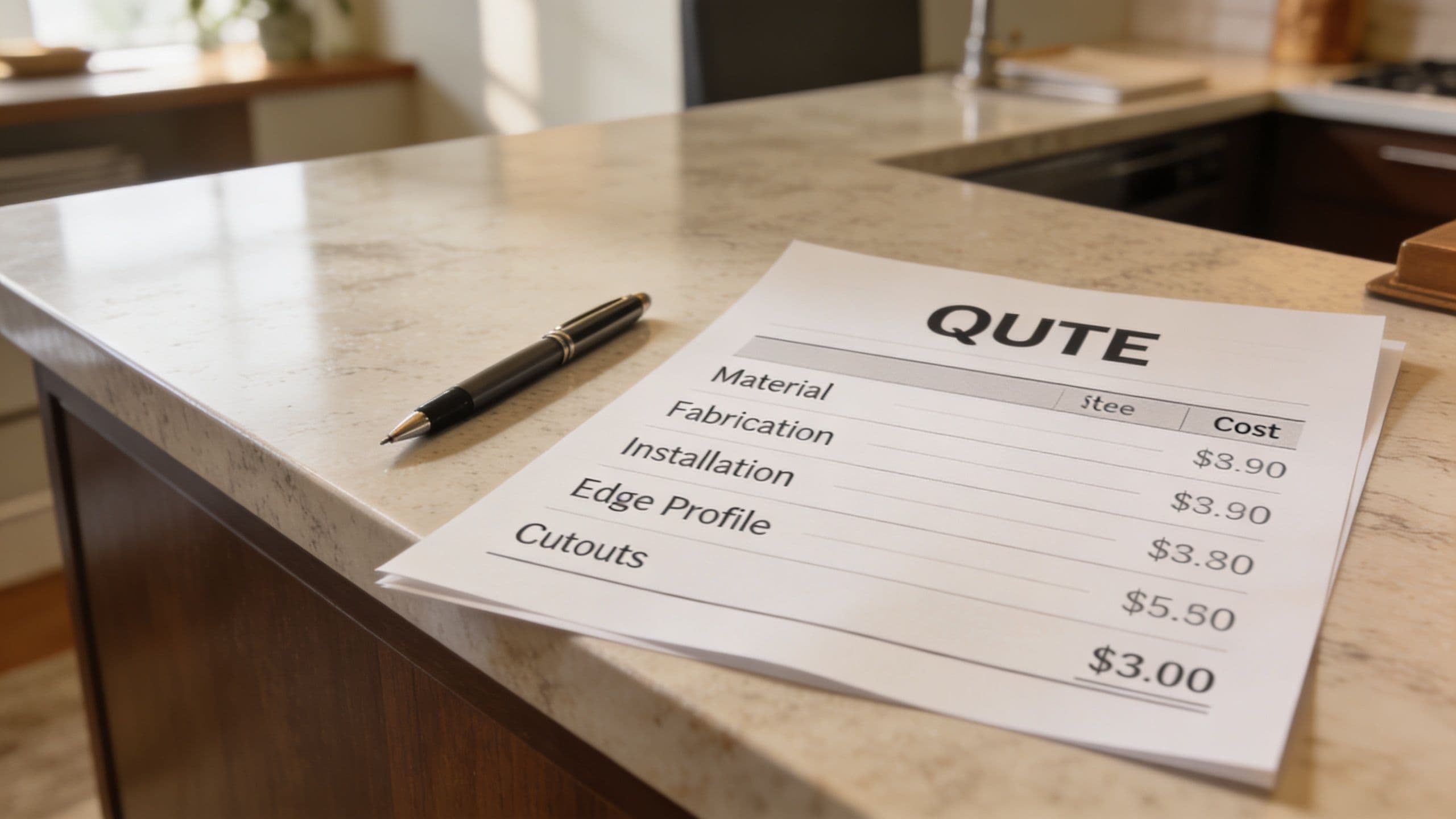
Fabrication is a major part of the price
According to McHenry Interiors’ countertop cost estimation guide, fabrication alone accounts for $50 to $100 per square foot, with sink cutouts adding $200 to $500 each and detailed edge profiles like ogee adding $10 to $25 per linear foot compared with simpler options.
That matters because fabrication is where the project becomes custom. The slab has to be measured to your kitchen, cut to fit your walls and appliances, polished at visible edges, and prepared so the finished surface sits properly on the cabinets.
The quote items that change the total
Here are the line items that usually move a countertop quote up or down:
- Cutouts for sinks and cooktops. A large farmhouse sink opening is not the same job as a simple drop-in sink.
- Edge profile selection. Straight and eased edges keep costs under control. Decorative profiles add shop time.
- Seams. Bigger kitchens and long runs often require seams, and seam placement affects both appearance and labor.
- Backsplash work. Some homeowners assume it’s included. Often it’s priced separately.
- Removal of existing tops. Old laminate comes off differently than heavier stone.
- Access to the kitchen. Tight entries, stairs, and long carries can affect installation planning.
What a transparent estimate looks like
A solid quote should answer three questions right away:
- What material is being priced
- What fabrication details are included
- What installation tasks are excluded
If any of that is missing, ask for clarification in writing. You want to know whether the estimate includes template, sink cutout, edge profile, tear-out, and delivery before you compare one contractor against another.
If you can’t tell where the money is going, you can’t tell whether the quote is high or simply complete.
How to Calculate Your Countertop Project Cost
You don’t need perfect shop drawings to build a realistic budget. You just need a tape measure, a notepad, and a simple way to translate your kitchen layout into square footage.

Step one, measure the runs
Measure each countertop section by length and depth. Most kitchens have standard-depth counters, so the easiest method is to calculate each section separately, then add them together.
A simple worksheet might look like this:
- Perimeter run one. Length x depth
- Perimeter run two. Length x depth
- Island or peninsula. Length x depth
- Small side sections. Length x depth
Add those sections together to estimate your total square footage. It won’t replace a final template, but it will get you close enough to compare materials accurately.
Example one, smaller kitchen with straightforward layout
Say you have a compact galley kitchen with two main runs and no island. You total the sections and end up close to the standard-size kitchen used in many planning guides.
If you use engineered quartz at $15 to $70 per square foot from the earlier pricing range, your material budget has a broad spread. Then you add the fabrication side, which earlier guidance places at $50 to $100 per square foot, plus any sink cutout charges and edge upgrades already discussed above. That’s why a quartz project that looks moderate at first glance can land in a noticeably higher finished range after fabrication and installation are included.
For homeowners trying to map this into the larger kitchen budget, this breakdown of kitchen remodeling costs helps put countertops in context with cabinetry, flooring, lighting, and labor.
Example two, L-shaped kitchen with island
An L-shaped kitchen with an island takes more planning because waste, seams, and cutouts usually matter more than in a basic galley.
Here’s the practical approach:
- Measure the L in separate legs, not as one shape.
- Measure the island separately.
- Count every opening, especially sink and cooktop locations.
- Decide on the edge style early, because edge changes affect labor.
- Assume the final quote will reflect layout complexity, not just square footage.
That’s where homeowners often underestimate cost. The slab may cover the square footage, but the shop still has to fabricate around corners, create clean seams, and finish visible sides well.
For another remodel-planning perspective outside our market, planning your Seattle kitchen renovation is a useful example of how countertop costs fit into the full remodel stack rather than sitting alone as a line item.
A short visual can help if you’d rather see the measuring process in motion:
Smart Ways to Save Money on New Countertops
Saving money on countertops doesn’t mean choosing the cheapest surface in the room. It means paying for the parts that matter and trimming the ones that don’t improve daily use.
Keep the design simple where it counts
If your budget is tight, standard edge profiles are one of the easiest places to stay disciplined. Most homeowners notice the slab color and finish long before they notice whether the edge is eased or decorative.
The same idea applies to layout. Straight runs are easier to fabricate than kitchens with lots of turns, interruptions, or specialty shapes. A cleaner layout often gives you a cleaner quote.
Match the material to the job
Not every section of a kitchen has to carry the same burden. A family that cooks hard every day may get more value from quartz on the main prep runs than from chasing a premium natural stone strictly for appearance.
If sustainability matters to you, some choices can also carry long-term value. According to Ranney Blair’s countertop cost discussion, butcher block runs $30 to $70 per square foot, FSC-certified sourcing can add $10 to $20 per square foot, and that upgraded sourcing can extend lifespan to 20+ years. The same source notes that certain sustainable countertop choices can boost a South Jersey home’s resale value by 5% to 7%.
Worth weighing: A lower-maintenance surface can save more frustration over time than a lower sticker price saves on day one.
Use financing strategically, not emotionally
Good savings decisions usually happen before ordering, not after the slab is in the shop. Set your essential criteria first. That might be a non-porous surface, a lighter color family, or a coordinated look with new cabinetry.
Then decide where to compromise. If you need breathing room, this guide to kitchen remodel financing options can help you think through budget timing without making rushed material decisions.
Project Timeline and Return on Investment
Countertop projects move in stages, not in one straight line. First comes material selection and quote review. Then the kitchen gets field-measured. After that, the slab goes to fabrication, and installation happens once the cabinets and surrounding work are ready.
In real remodeling work, timing often depends on coordination. Cabinets have to be level. Appliance specs need to be confirmed. Sink selections can’t still be floating around at the last minute. Homeowners usually feel delays when one of those decisions is still open.
Why countertops still make sense as an upgrade
Countertops are one of the upgrades buyers see immediately and use every day. That’s part of why they carry more weight than some less visible remodel expenses.
According to Freedonia Group’s US countertops industry study, countertops can deliver a 60% to 70% return on investment, and the US countertops market reached $7.4 billion in 2023. Those numbers don’t guarantee the same result on every home, but they do confirm that countertops remain a meaningful remodeling investment.
The local value question
In South Jersey, return isn’t only about resale. It’s also about getting a kitchen that functions better for your household and feels finished when the rest of the remodel is done right.
If you’re still organizing the full scope, this checklist on how to plan a kitchen remodel helps homeowners line up decisions in the right order so countertops don’t become a late-stage scramble.
The Cabinet Coach Simplifies Your South Jersey Project
South Jersey homeowners run into a few local realities that national countertop articles usually miss. Prices don’t always behave like the national average, and the process gets harder when you’re driving from showroom to showroom trying to compare samples under different lighting with different quote formats.

Why the local model matters
One of the more useful regional observations comes from HomeYou’s discussion of countertop costs and showroom markups, which notes that mobile showrooms can save South Jersey homeowners 20% to 30% in traditional showroom markups, with potential savings of $10 to $20 per square foot on quartz, while regional pricing can run 15% to 25% above national averages.
That lines up with what many homeowners feel during quote shopping. The challenge isn’t just the slab price. It’s the time spent comparing partial information, trying to match samples to the home, and coordinating separate vendors.
Where guided help pays off
A mobile showroom approach solves a very practical problem. Instead of choosing materials under warehouse lighting, homeowners can compare countertop samples against their cabinetry, flooring, wall color, and natural light right in the kitchen.
That usually leads to better decisions and fewer late changes. It also makes quote review easier because someone is helping you sort what’s included, what’s optional, and what may affect the schedule.
Some of the best savings in a remodel come from avoiding the wrong selection before fabrication starts.
Frequently Asked Countertop Questions
Is quartz or granite better for a busy kitchen
For many households, quartz is easier to live with because it’s non-porous and low-maintenance. Granite is still a strong choice if you want natural variation and you’re comfortable with upkeep.
Why is one quote much lower than another
Usually because one quote includes less. Material-only pricing and fully installed pricing can look similar at a glance if the estimate isn’t itemized.
Is laminate still worth considering
Yes. If the remodel budget has to cover cabinets, flooring, paint, and lighting too, laminate can be a smart decision instead of a compromise that feels temporary.
Do edge styles really affect cost
Yes. Basic edges are usually the most budget-friendly. Decorative profiles take more fabrication time and show up as an added charge.
If you want help sorting real countertop options in your own kitchen, The Cabinet Coach brings the showroom to South Jersey homeowners with guided material selection, transparent planning, and coordinated remodel support that makes the process easier to understand from the first measurement to the final install.