
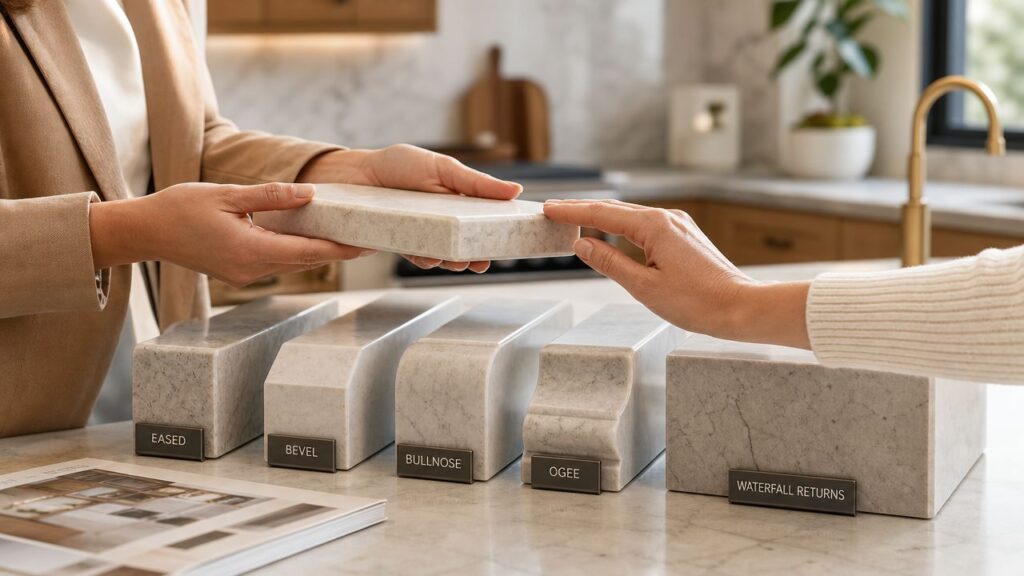
You're probably at the point in your kitchen remodel where the big choices feel manageable, but the smaller ones keep multiplying. Cabinet door style. Hardware finish. Countertop material. Then someone asks what edge profile you want, and suddenly you're staring at samples that all seem similar until they don't.
That decision matters more than most homeowners expect. The edge is where your hand lands every day, where kids bump into corners, where crumbs collect, and where chips often start. It also changes how the whole slab reads, whether your kitchen leans sleek and modern, soft and family-friendly, or more formal and decorative.
Around South Jersey, that choice often comes down to lifestyle as much as style. A Moorestown colonial, a Haddonfield classic kitchen, and a newer Voorhees open-plan home can all use beautiful stone. But they won't always want the same edge. If you're also still sorting through surface options, this countertop selection resource is a helpful starting point, and this outside expert kitchen countertop guide gives a broader material overview before you narrow the finish details.
Table of Contents
- Why Your Countertop Edge Is More Than Just a Detail
- The Foundation Standard Countertop Edge Profiles
- Elevating Your Design Premium and Decorative Edges
- Modern Statements Waterfall and Mitered Edge Designs
- Matching Edges to Materials and Thickness
- Beyond Looks Cost Durability and Maintenance
- See and Feel the Difference Your South Jersey Consultation
Why Your Countertop Edge Is More Than Just a Detail
A countertop edge isn't trim. It's part of how the counter performs. Historical guidance has moved away from treating edges as pure ornament and toward safety, maintenance, and material fit. Marble Systems explains that a straight edge is a sharp 90-degree profile, while an eased edge softens that corner for better comfort and safety, and it also describes eased edges as among the safest and most low-maintenance choices in current design guidance in this countertop edge profile overview.
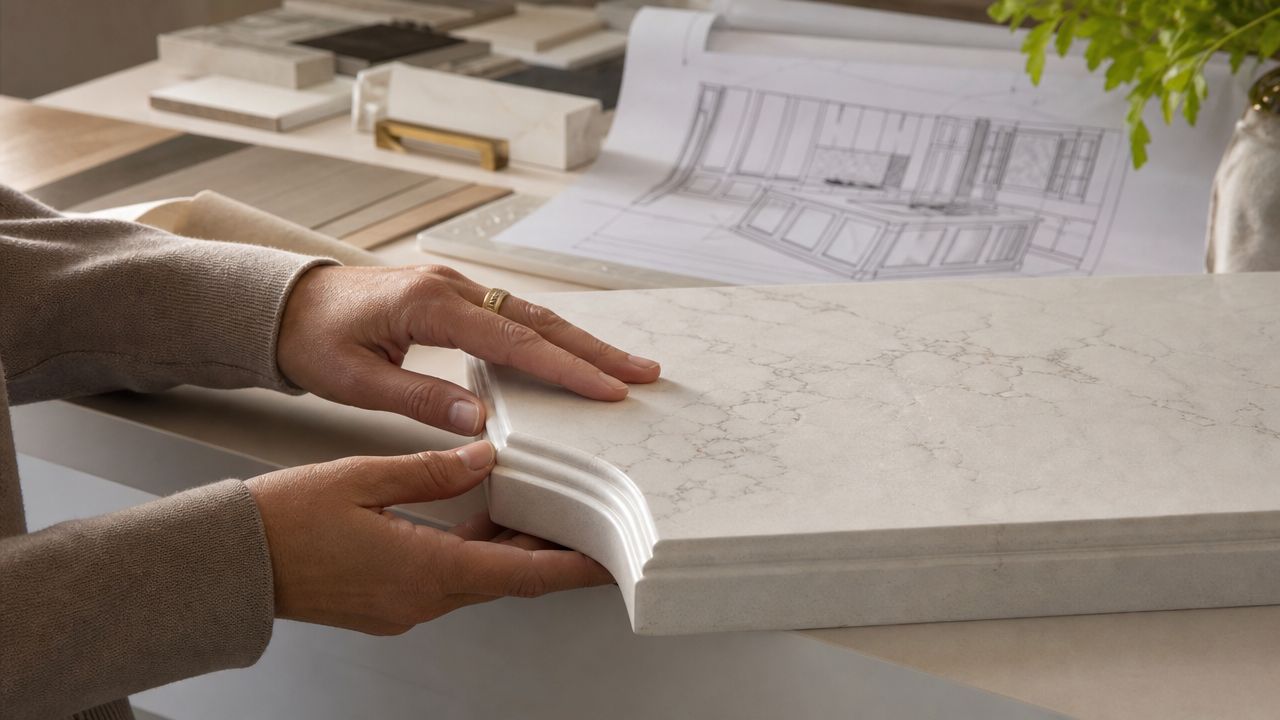
That shift matches what happens in real kitchens. Homeowners don't call later because an edge looked too plain on day one. They call because a sharp corner caught a hip, a detailed groove holds grime, or an exposed corner chipped after normal daily use.
The small detail that affects daily use
An edge changes three things immediately:
- How the counter feels when you lean against it at the sink or island
- How forgiving it is if something hard hits the corner
- How much effort cleaning takes around the front run of the slab
In a busy family kitchen, those points matter more than whether the profile looked dramatic on a sample board.
Practical rule: If the edge sits on a hard-working perimeter counter, performance usually matters more than ornament.
Why homeowners notice it late
Color and pattern are often chosen first. That makes sense. Stone leads visually. But edge selection should happen while you're still thinking about who uses the kitchen, how formal the room feels, and whether the slab itself already carries enough movement.
A crisp profile can look beautiful in a clean-lined space. A softened one can make the same kitchen easier to live with. That's why countertop edges options shouldn't be treated like a last-minute add-on after the slab is already picked and the cabinets are on order.
The Foundation Standard Countertop Edge Profiles
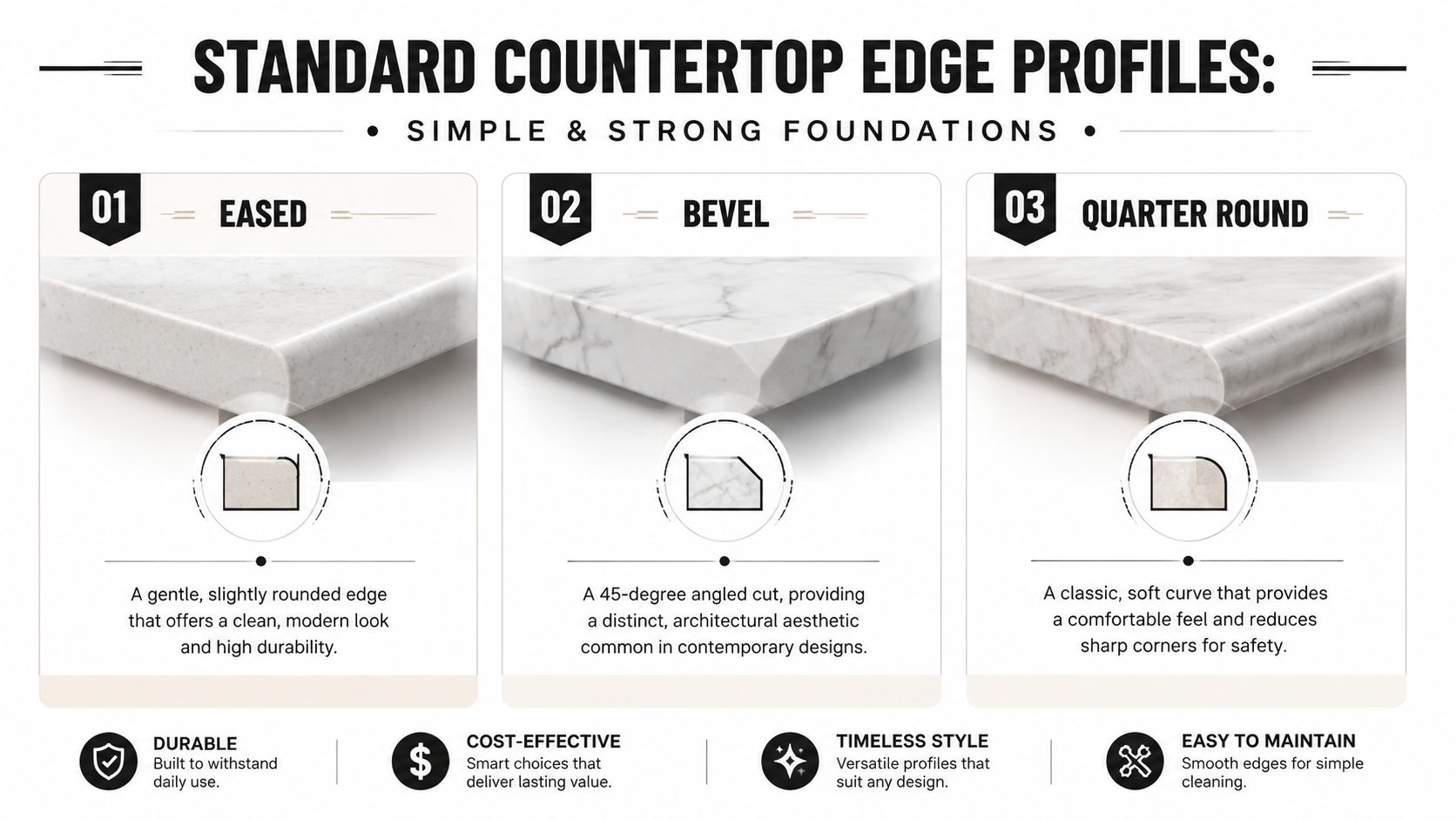
Most kitchens don't need a fancy profile. They need one that suits the cabinets, supports the material, and won't become annoying after six months of real use. That's one reason simple edges still dominate the market. SlabWise reports that eased and flat-polish edges make up 65% of countertop installations in this summary of popular countertop edge choices.
Start with the common options before looking at decorative upgrades. In many kitchens, the standard profile ends up being the smartest answer.
The profiles most homeowners start with
Eased edge
Think of an eased edge like taking a block with a sharp corner and lightly softening it. It still reads straight. It still looks modern. But it's less harsh at the arris, which helps with comfort and can reduce the chance of visible edge damage at that exposed corner.
This is usually the safest default if you want a current kitchen that won't feel fussy.
Bevel edge
A bevel cuts the top edge at an angle. It adds a little architecture without moving into traditional territory. On the right slab, especially one with subtle movement, a bevel can catch light nicely and create a cleaner transition than a rounded profile.
It's a good choice for homeowners who want something sharper than a bullnose but not as plain as a softened straight line.
Here's a quick visual reference before comparing them in the room:
Quarter round
Quarter round introduces a softer curve. It doesn't have the full rolled shape of a classic bullnose, but it removes visual sharpness and feels comfortable at an island or breakfast counter.
It fits transitional kitchens well, especially where the cabinetry has a little detail and the homeowners want softness without a heavy decorative statement.
What works well in South Jersey kitchens
The right standard edge often follows the style of the house more than the trend of the moment.
| Home style | Edge that usually fits | Why it works |
|---|---|---|
| Newer open-plan homes in Voorhees or Mount Laurel | Eased or bevel | Clean lines, simple cabinetry, less visual clutter |
| Transitional remodels in Cherry Hill | Eased or quarter round | Balances modern surfaces with warmer finishes |
| Older homes in Haddonfield or Collingswood | Quarter round or eased | Softens the stone without making it look too formal |
A few practical notes matter here too:
- For family kitchens: Rounded or softened profiles are usually easier to live with than sharp corners.
- For small kitchens: Simpler edges keep the room from feeling overdesigned.
- For patterned stone: A restrained profile lets the material do the work.
Most homeowners are happier with a standard edge that suits the slab than a decorative edge chosen because it looked expensive in a showroom.
Elevating Your Design Premium and Decorative Edges
Decorative edges still have a place. The question isn't whether they're beautiful. Many are. The better question is whether they earn their cost and maintenance in the specific kitchen you're building.
That question matters even more now because mainstream kitchen design keeps leaning cleaner and simpler. Guidance around current style direction consistently positions eased and straight edges as popular in modern kitchens, while profiles like ogee remain tied to traditional or luxury looks in this discussion of choosing the right countertop edge.
When decorative edges earn their keep
An ogee brings an S-shaped curve that feels formal and established. In the right kitchen, especially one with inset cabinetry, detailed moldings, or furniture-style islands, it can make the stone feel custom rather than stock.
A Dupont edge has more visual drama. It reads upscale and deliberate. It often suits larger kitchens where the counters can handle a stronger profile without feeling crowded.
A cove edge is the quieter option in this group. It gives you a softer decorative shadow line without the same level of visual weight as an ogee.
These are the situations where decorative countertop edges options make sense:
- Statement islands: A premium profile can give the island a furniture-like presence.
- Traditional homes: In Moorestown, Haddonfield, or older Medford properties, a plain edge can sometimes feel underdressed against classic millwork.
- Large kitchens: Decorative shaping needs breathing room. Bigger rooms carry it better.
Where they can work against you
Decorative edges ask more of the stone and more of the homeowner. More shaping means more fabrication effort. More curves and transitions mean more surfaces to wipe. More detail also means more opportunity for the edge to compete with a heavily veined or busy slab.
The practical drawbacks usually show up in daily use:
- Cleaning: Grooves and undercuts collect dust, crumbs, and sticky residue more easily than a simple eased front.
- Durability: Intricate shaping leaves less room for abuse at vulnerable points.
- Style fit: Ornate edges can look disconnected in a flat-panel, minimalist kitchen.
If you love a decorative edge, use it where people will notice it most. Usually that's the island, not every perimeter run.
That approach gives you the custom look without turning every linear foot of countertop into a higher-maintenance surface.
Modern Statements Waterfall and Mitered Edge Designs
Some edge choices don't just finish the slab. They redefine the whole kitchen. Waterfall and mitered designs turn the countertop into a larger architectural element, which is why they're so often used in contemporary spaces.
These details are less about touching the front edge and more about how the stone reads from across the room.
What each one actually does
A waterfall carries the countertop material vertically down the side of the cabinetry to the floor or near the floor. It creates a monolithic effect that works especially well on islands. In a modern South Jersey kitchen with open sightlines from the family room, that can make the island feel like a piece of furniture carved from one slab.
A mitered edge joins pieces at an angle so the counter appears thicker than the actual slab. You get the visual heft of a substantial stone edge without using one massive solid thickness all the way through. It's a common way to create a bolder modern look while controlling material strategy.
A laminated edge can also build visual thickness at the front. It's less about a sculpted profile and more about changing proportion.
Where precision matters most
These treatments look simple only when the fabrication is excellent. They're not forgiving. If the seams are off, the eye goes straight to them.
For homeowners planning a replacement rather than a full new build, this guide to replacing kitchen countertops helps clarify when the cabinet condition, layout, and measurement accuracy can support more advanced stone detailing.
What usually works best:
- Use them as focal features. A waterfall island often makes more sense than trying to force the look across every surface.
- Choose slabs with intent. Veining, finish, and seam placement have to be considered together.
- Confirm support details early. Thick-looking edges and vertical stone runs need coordination, not guesswork.
In a sleek kitchen in Cherry Hill or Mount Laurel, these designs can be striking. In a smaller or more traditional room, they can feel too heavy if the rest of the cabinetry and architecture don't support the move.
Matching Edges to Materials and Thickness
The best edge is rarely chosen in isolation. It should follow the material. Stone hardness, pattern movement, and slab thickness all change what makes sense.
Industry guidance notes that harder stones such as quartzite take longer to profile, and it also emphasizes that waterfall or mitered edges require explicit grain matching because alignment mistakes are highly visible. It further notes that waterfall edges tend to work best on veined materials where continuity can be emphasized, while subtler patterns can make seams stand out more in this guide to countertop edge profiles and waterfall details.
Material first edge second
A practical showroom workflow looks like this:
Choose the material family
Quartz, granite, marble, and quartzite don't all respond to profiling the same way.Study the slab pattern
Fine speckling, soft movement, and bold veining all interact differently with the front edge and any seam.Then choose the edge
Once you know hardness and pattern, the edge choice becomes much clearer.
That order prevents a common mistake. Homeowners fall in love with a profile name before asking whether it suits the slab they picked.
For example, a dramatic veined stone may benefit from a restrained eased edge so the material stays front and center. A quieter slab may have room for a little more shaping. If you're still comparing the surfaces themselves, this outside SouthRay Kitchen & Bath countertop guide is useful for sorting the material side before locking the edge, and this local Cherry Hill countertop material comparison helps narrow the fit for homes in this market.
Thickness changes the look more than many people expect
Thickness affects style just as much as the profile does. A thin, simple slab edge can feel crisp and contemporary. A thicker-looking front can make the kitchen feel more substantial or more formal depending on the cabinet style below it.
A few reliable pairings:
- Thin visual profile plus flat-panel cabinetry: modern and sleek
- Moderate thickness plus shaker cabinetry: transitional and broadly appealing
- Thicker front edge with furniture-style details: more traditional presence
Don't ask the edge to do the slab's job. If the material is already dramatic, let the profile stay quiet.
That's especially true in South Jersey homes where many remodels aim for a balanced, resale-friendly look rather than a highly stylized one.
Beyond Looks Cost Durability and Maintenance
The overlooked part of edge selection is ownership. Not showroom ownership. Real ownership. The kind that includes wiping tomato sauce off the island, watching a child swing a backpack around a corner, and living with the same surface for years.
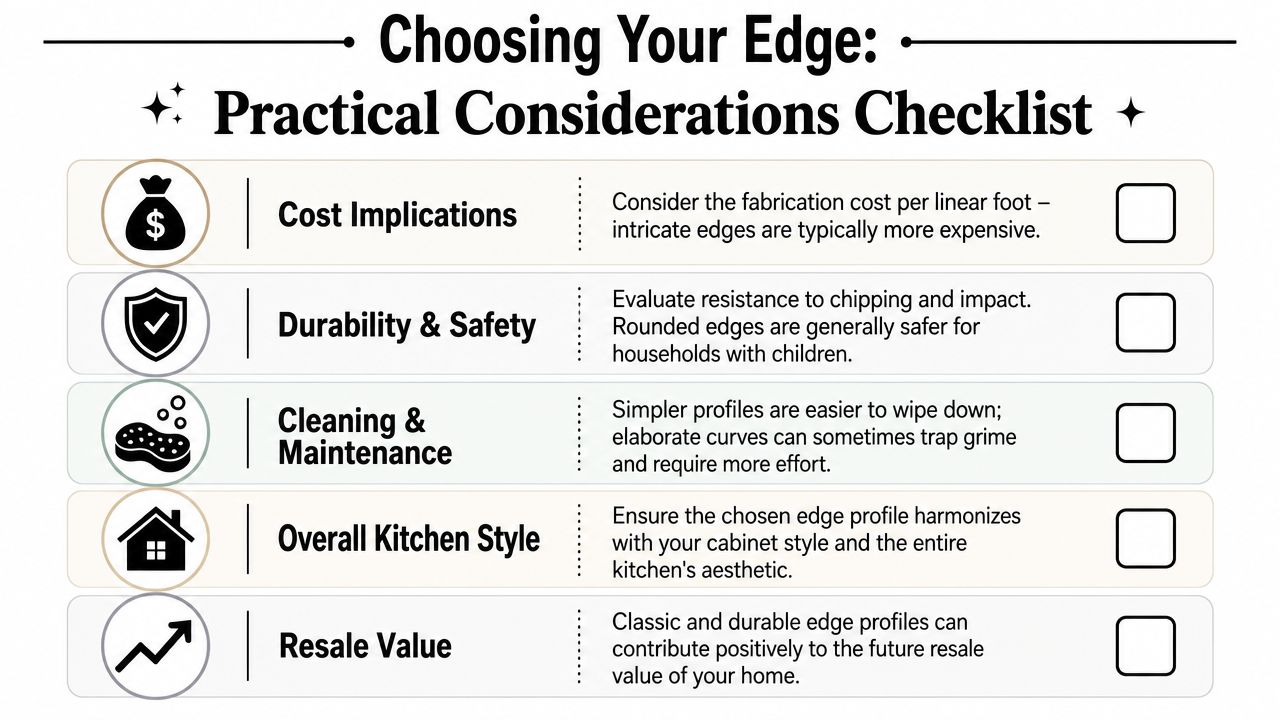
That's why the better question isn't “Which edge is prettiest?” It's “Which edge still makes sense after daily use?” National Design Mart frames the issue well in this overview of countertop edge types, noting that simpler edges are generally easier to clean and more forgiving, rounded profiles are safer for children, and detailed profiles are better suited to stronger materials.
A practical way to think about value
Instead of chasing a specific profile name, sort the options into three broad buckets.
| Practical tier | Typical edge types | Best for |
|---|---|---|
| Standard | Eased, straight-look softened edge, simple round | Most kitchens, easier upkeep, lower fabrication complexity |
| Mid-range upgrade | Bevel, quarter round, half bullnose | Homeowners who want a little shape without a heavy traditional feel |
| Premium custom | Ogee, Dupont, cove, mitered statement edges | Focal points, style-driven kitchens, stronger materials, larger budgets |
If budget is tight, edge complexity is one of the cleanest places to simplify without making the kitchen look cheap. Many high-end kitchens still use a quiet edge because the cabinets, layout, slab, and lighting already carry the design.
For homeowners thinking about broader resale-minded decisions, this outside piece on improvements that add kitchen value is a useful complement to the edge conversation, and this local guide to countertop cost considerations helps frame where edge fabrication fits into the total spend.
The ownership test
Ask these five questions before you finalize the profile:
- Who uses the kitchen most: A household with young children usually benefits from a softer edge.
- How often do you cook: Heavy daily use rewards simple wipeable shapes.
- Where is the edge located: Island overhangs and exposed ends take more abuse than protected wall runs.
- What style is the room aiming for: A formal profile in a minimalist kitchen often feels forced.
- Will you notice the detail later: If the answer is no, keep it simple.
A lot of edge regret comes from choosing for the first week, not for the next decade.
See and Feel the Difference Your South Jersey Consultation
Online photos help, but edge profiles are tactile. You notice the difference when your hand runs across the front corner, when you see how a bevel catches daylight, or when an ogee feels right with one cabinet door and wrong with another. That's hard to judge from a cropped inspiration image.
This matters even more in South Jersey homes, where existing architecture varies so much from Haddonfield to Moorestown to Mount Laurel. The right edge has to suit the slab, the cabinet style, the room's age, and how the household lives. One practical way to evaluate that is seeing samples in context through a mobile showroom model, which you can read about in this overview of in-home kitchen design consultations.
The right answer is usually balanced. Not the flattest edge by default. Not the fanciest edge because it sounds custom. The one that fits your material, your style, your cleaning tolerance, and the people moving through the room every day.
If you're comparing countertop edges options for a kitchen remodel in Cherry Hill, Haddonfield, Moorestown, Voorhees, Mount Laurel, or nearby communities, The Cabinet Coach offers a practical next step. Start with a complimentary video consultation, narrow the material and style direction, then review edge profiles on real samples in the context of your home so the final choice feels clear before fabrication begins.