
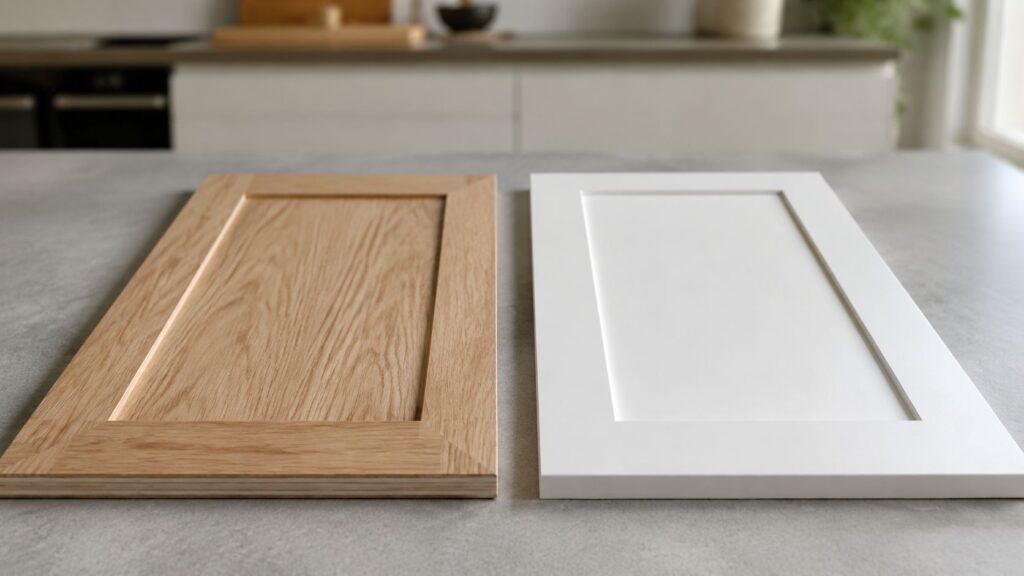
You're probably in the same spot as a lot of South Jersey homeowners. You've picked a cabinet color, saved photos of shaker doors, maybe argued about islands, and now a contractor or cabinet line sheet throws out two materials that sound simple but drive a huge part of the result: plywood and MDF.
This choice matters more than people think. It affects how your cabinets hold up near the sink, how painted doors look after a few seasons, and whether you feel smart about the money you spent five years from now. In older homes around Cherry Hill, Haddonfield, Moorestown, and Collingswood, where floors aren't always perfectly level and kitchens get real daily use, material choice isn't a minor spec. It's a practical decision.
Before you lock in a layout, it helps to sort out workflow and priorities. If you're still refining the room itself, this guide from RBA Home Plans on kitchen design is a useful companion. And if you want a broader planning checklist before choosing materials, review how to plan a kitchen remodel.
Table of Contents
- Starting Your Kitchen Renovation Journey
- Plywood and MDF Cabinets At a Glance
- Structural Integrity and Load Bearing Performance
- Moisture Resistance and Long Term Durability
- Finishing Options Paint Stain and Veneer
- The Right Material for the Right Job in Your Kitchen
- Design Your Perfect South Jersey Cabinets with Expert Help
Starting Your Kitchen Renovation Journey
A kitchen remodel starts out fun. Then the actual decisions show up.
One South Jersey homeowner might want a bright painted kitchen in a Moorestown colonial. Another might be updating a tighter kitchen in Cherry Hill and trying to keep the budget under control without buying cabinets they'll regret. In both cases, the plywood vs MDF cabinets question shows up early because it sits right at the intersection of cost, durability, and appearance.
Most homeowners don't ask for plywood or MDF because they love reading material specs. They ask because they're trying to avoid a bad decision. They don't want sagging shelves, swollen sink bases, or painted doors that look tired too soon. They want cabinets that match how they live. Kids leaning on drawers, steam from the dishwasher, heavy dishes stacked in uppers, wet hands opening the sink cabinet. Real life.
That's why I'm direct about this. If you treat plywood and MDF like interchangeable products, you'll make the wrong call. They are not the same thing, and they don't belong in the same places.
Practical rule: Don't choose cabinet material by showroom appearance alone. Choose it by cabinet part, room conditions, and finish.
South Jersey homes add another layer to the decision. You're dealing with humidity, seasonal swings, and a lot of housing stock where kitchens have been renovated more than once. That means your cabinets need to do more than look good under bright showroom lights. They need to stay square, stay finished well, and tolerate normal household abuse.
If you're overwhelmed, that's normal. But this isn't a mystery. There's a clear way to think about it, and once you see where each material works, the decision gets much easier.
Plywood and MDF Cabinets At a Glance
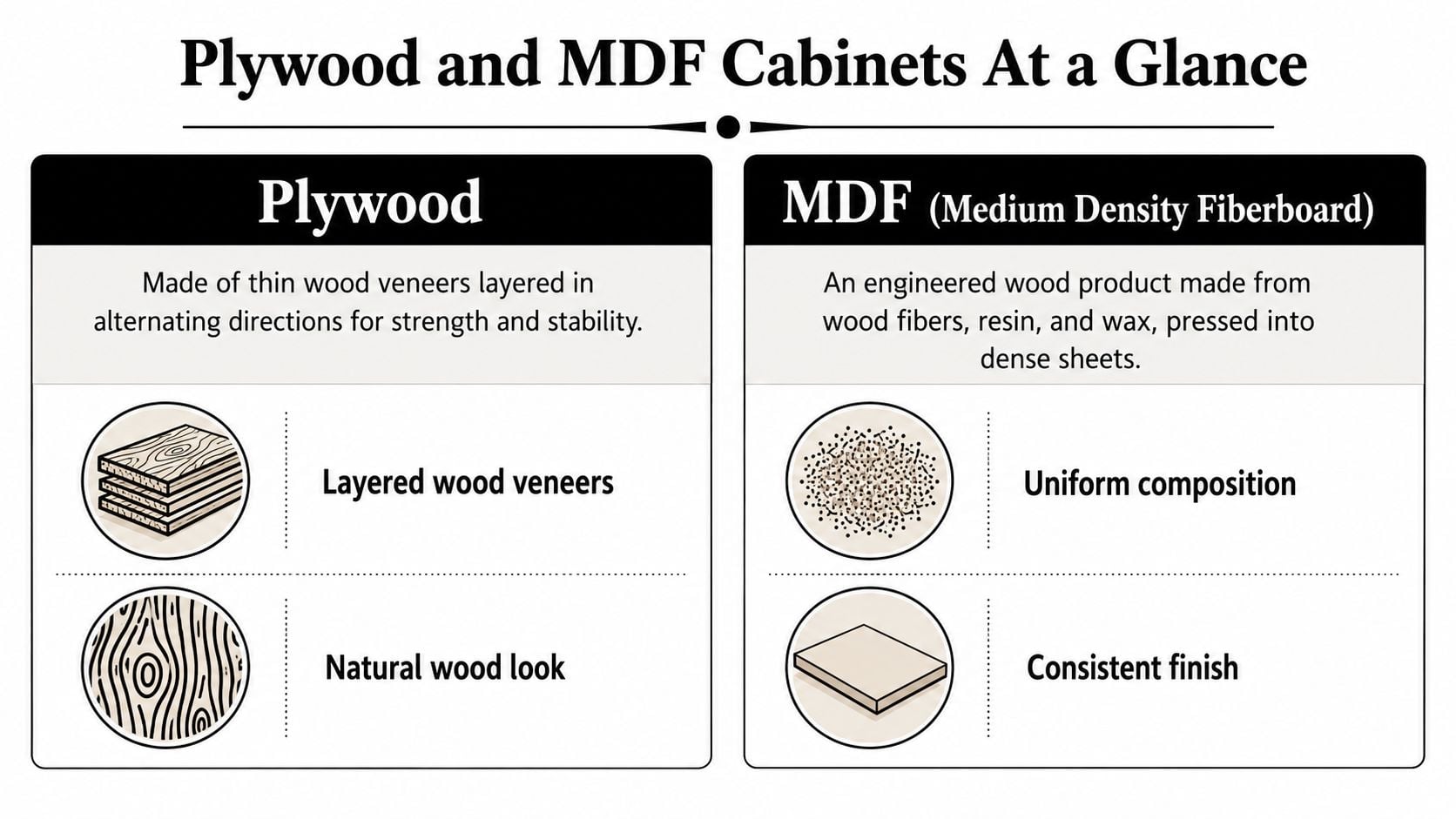
Quick material definitions
Plywood is made from thin wood veneers layered in alternating grain directions. That cross-laminated build is the whole point. It gives the panel more stiffness and makes it a stronger structural choice for cabinet boxes and shelves.
MDF, short for medium-density fiberboard, is a dense engineered panel made from wood fibers and resin pressed into smooth sheets. It has a uniform core, no visible grain pattern, and a very consistent face, which is why painted cabinet components often use it.
If you want the short version, here it is. Plywood is the better structural material. MDF is the better paint substrate.
One cabinet-making source cites MDF at about $35 per sheet, while cabinet-grade plywood often ranges from under $40 to about $65 per sheet, depending on species and grade, which explains why MDF shows up so often in budget-conscious remodels (Cabinet Corp on MDF and plywood cabinet costs).
For a broader cabinet selection framework before you narrow down materials, review how to choose kitchen cabinets.
Plywood vs. MDF Cabinet Materials Quick Comparison
| Feature | Plywood | MDF |
|---|---|---|
| Core composition | Thin wood veneers layered in alternating directions | Compressed wood fibers and resin |
| Typical role in cabinetry | Cabinet boxes, shelving, load-bearing parts | Painted doors, decorative panels, some interior parts |
| Surface quality | Natural wood face, may show grain | Very smooth and uniform |
| Structural performance | Stronger and stiffer | Better for finish than structure |
| Fastener holding | Better screw holding | Less reliable without reinforcement |
| Moisture behavior | More moisture resistant in normal cabinet use | More vulnerable if exposed to moisture |
| Appearance direction | Best when you want real wood character | Best when you want a smooth painted look |
| Cost position | Usually higher | Usually lower |
Here's the opinionated version. If a cabinet part needs to carry weight, hold hardware, or survive around water, I lean plywood. If a cabinet part exists mainly to look smooth under paint, I lean MDF.
That doesn't mean every project should be all one or all the other. In fact, that's usually the wrong approach. The smartest kitchens often use both materials on purpose.
Structural Integrity and Load Bearing Performance
Why cabinet boxes need strength
Cabinet boxes do hard work. They carry stone counters, support drawers packed with pots, stay anchored to walls, and keep doors aligned year after year. That's why structural performance isn't a side issue. It's the foundation.
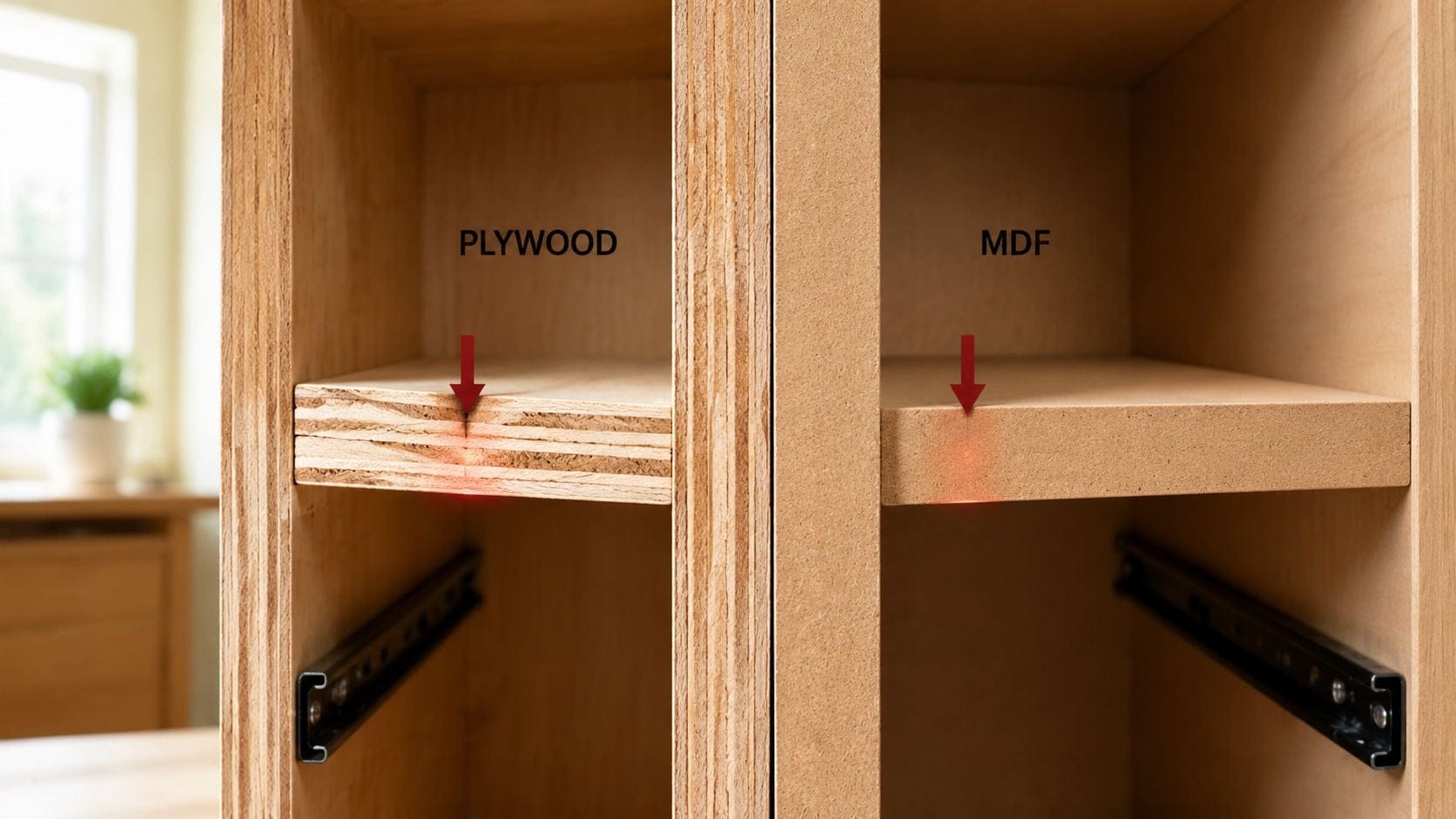
Plywood wins this part of the plywood vs MDF cabinets debate. Its cross-laminated veneer layers improve rigidity, resistance to bending, and screw-holding strength, especially at edges and in high-load boxes or shelving. MDF machines cleanly and paints well, but it's less structurally sound and generally holds screws less reliably without reinforcement, according to Kitchen Cabinet Kings on plywood vs MDF cabinet structure.
That matters most in places homeowners rarely think about until something loosens. Wall cabinet sides. Shelf pin areas. Drawer slide mounting points. Hinge screw locations. Wide pantry shelving. Sink bases carrying a heavy counter and a cluttered cabinet load.
If you want a related benchmark for drawer quality, what dovetail drawers are and why they matter is worth reading because strong cabinet construction and strong drawer construction usually go hand in hand.
Where fasteners become the real test
Most cabinet failures don't begin with a dramatic collapse. They start with hardware getting a little loose. A hinge screw stops biting well. A drawer slide shifts. A shelf edge starts to sag. That's where plywood keeps separating itself.
Think of plywood like a layered roadbed. The grain runs in alternating directions, so stress gets distributed through the panel. MDF is more uniform, which sounds good until repeated load and fastening pressure start concentrating in the same area.
Cabinet boxes should be built for the worst normal day in your kitchen, not the best one.
That worst normal day is ordinary. A teenager yanks open a trash pullout. Someone stores a stack of serving platters on an upper shelf. A contractor adjusts a hinge more than once. Those repeated stresses are exactly why I don't recommend MDF for the main cabinet carcass when durability is the goal.
For a quick visual on how builders talk through these tradeoffs, this walkthrough is helpful:
If you're comparing cabinet lines and one brand uses MDF for boxes while another uses plywood, don't get distracted by a nicer finish sample. Ask what's carrying the load. That's the part you'll live with longest.
Moisture Resistance and Long Term Durability
What happens under real kitchen stress
A lot of cabinet advice gets too simplistic here. People say plywood is better around moisture and stop there. That's incomplete.
Both materials can be damaged in a leak or flood. The more useful question is how they fail, how quickly they fail, and how much warning you get. One cabinet-industry source notes that plywood tends to delaminate and MDF tends to swell, and the severity depends on exposure time and sealing quality, as explained by Berta Store's breakdown of cabinet failure modes.
That distinction matters. Swollen MDF often means the panel has puffed up, softened at the edges, and permanently changed shape. Under a sink, that can turn a small leak into an ugly mess fast. Delaminated plywood isn't good either, but in many everyday cabinet scenarios it tends to be a more gradual and contained failure mode.
How South Jersey conditions change the decision
South Jersey homeowners should pay attention to this more than they think. Summer humidity, dishwasher steam, wet mopping, snow and rain tracked in near mudroom-adjacent kitchens, and older homes with plumbing surprises all push cabinet materials harder than a dry showroom ever will.
That doesn't mean MDF has no place in a South Jersey kitchen. It means you need to keep it out of the danger zones unless there's a very specific reason to use it and the detailing is excellent.
Here's where I'd be strict:
- Under-sink bases: Use plywood. This is the most obvious wet-risk zone in the kitchen.
- Near dishwashers: Steam and repeated moisture exposure make plywood the safer call for adjacent structural parts.
- Bathroom vanities: Same logic. Humidity and splash exposure don't care that the door style looks good.
- Mudroom or laundry cabinetry: If there's any chance of dampness, plywood is the safer default.
And here's where MDF can still make sense:
- Painted doors away from direct water exposure
- Decorative end panels in controlled areas
- Trim details where smooth paint matters most
The better question isn't simply which material is better. It's which one fails more gracefully in your room and how well the cabinet is sealed.
If you want a door-focused version of this decision, MDF vs wood cabinet doors and how to choose helps clarify where finish priorities outweigh structure.
Finishing Options Paint Stain and Veneer
If you want painted cabinets
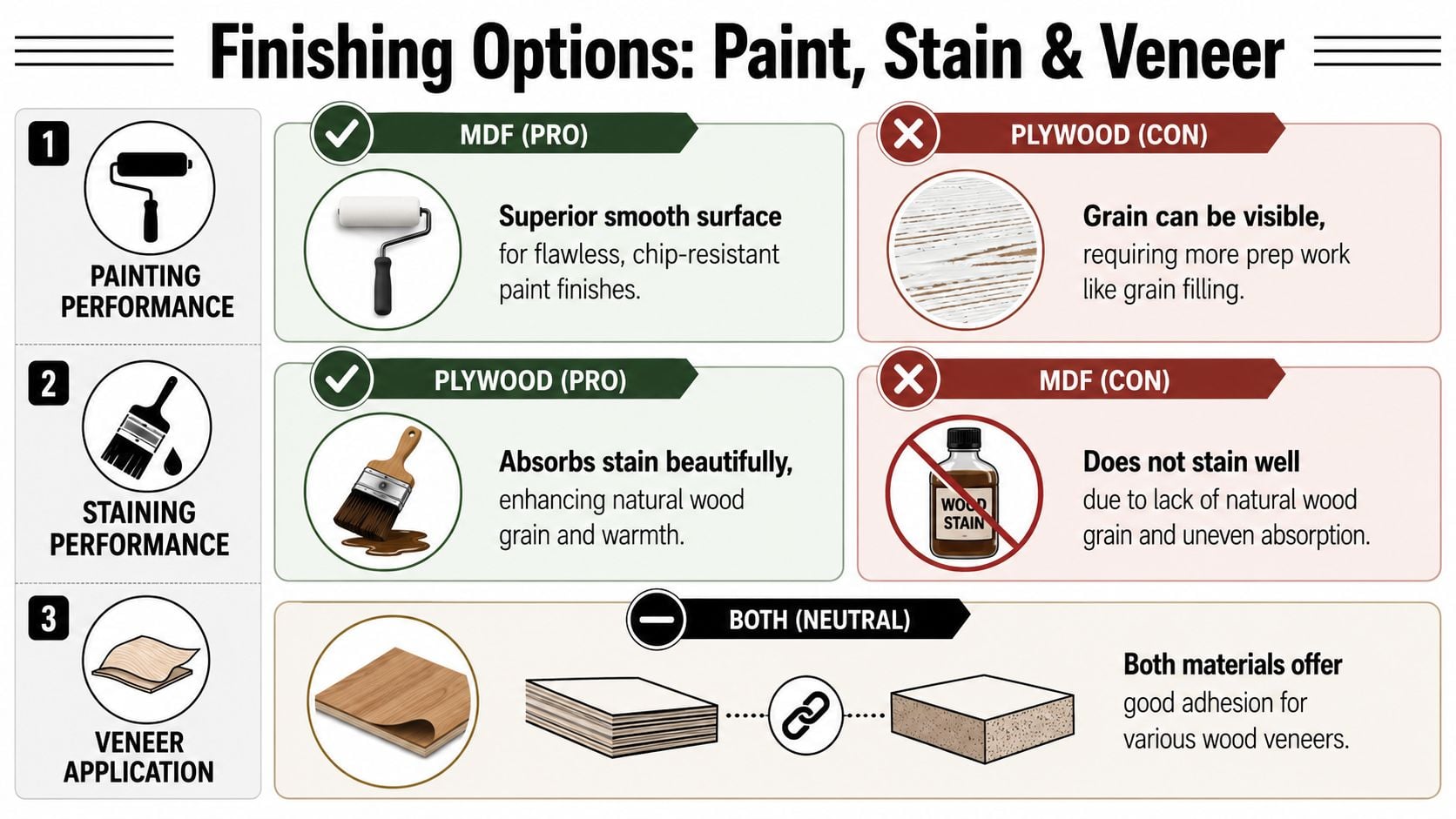
MDF earns its place as usually the better choice for the doors and decorative faces when your goal is a crisp painted shaker, a smooth slab door, or a clean traditional profile with no wood grain telegraphing through.
Its surface is consistent. It machines cleanly. It doesn't bring natural grain variation into a painted finish. That's exactly what you want when the color and surface quality are doing the design work.
If a homeowner tells me they want a bright white, warm greige, deep green, or soft mushroom painted kitchen, I'm immediately thinking about MDF for those painted front-facing components. Not because it's cheaper. Because it usually looks better when paint is the hero.
For a deeper look at finish choices and how they change the final appearance, see painted vs stained cabinets and how to decide.
If you want stained or natural wood
MDF is not the answer if you want real wood character. It doesn't stain like wood because it isn't built like wood. If you want the grain to show, the warmth to come through, and the finish to feel authentic instead of manufactured, plywood or other real wood-based components belong in the conversation.
That's one reason plywood remains commercially relevant. One industry source projects 5% annual CAGR for plywood cabinets through about 2034, signaling sustained demand rather than a fade-out in the cabinetry market (Wurth Louis and Company on projected plywood cabinet demand). I think that tracks with what homeowners actually want. Plenty of people still prefer the look and feel of real wood, especially in higher-end renovations.
Use this simple filter:
- Choose MDF if your top priority is a flawless painted surface.
- Choose plywood if your top priority is visible wood grain and a natural finish.
- Use either as a veneered substrate depending on the construction goal and finish strategy.
If you're trying to force one material to do both jobs, you'll usually end up compromising the look.
The Right Material for the Right Job in Your Kitchen
My recommended cabinet mix
Here's the clear recommendation I give most South Jersey homeowners. Don't treat this as a plywood-or-MDF decision. Treat it as a parts list decision.
For most kitchens, the best build is a hybrid approach.
Use plywood for cabinet boxes, shelves, sink bases, and other structural parts. Use MDF for painted doors, drawer fronts, and decorative painted panels. That mix solves the core issue instead of picking sides for no reason.
Why it works is simple. Plywood handles the job nobody sees but everyone depends on. MDF handles the finish job everyone notices every day.
If your kitchen includes painted perimeter cabinets and a stained island, the split gets even easier. Painted perimeter doors can be MDF. The island, if you want visible grain and a furniture look, should lean wood-based rather than MDF.
When I would not compromise
There are a few situations where I stop being flexible.
Use plywood without debate when the cabinet part is:
- A sink base
- A wide shelf expected to hold heavy kitchen items
- A pantry cabinet with long-term storage load
- A bathroom vanity
- Any cabinet box near recurring moisture or hardware stress
Use MDF confidently when the cabinet part is:
- A painted shaker door
- A painted slab door
- A decorative applied panel in a dry area
- A component where the finish quality matters more than structural muscle
Where homeowners get into trouble is chasing the lowest price across the whole kitchen. MDF is generally the lower-cost panel, which is one reason it appears in budget remodels. But low initial sheet cost doesn't automatically make it the smart whole-kitchen choice. The wrong material in the wrong location creates repair risk, finish disappointment, or both.
Here's my blunt version of the plywood vs MDF cabinets debate for a South Jersey kitchen:
| Cabinet Part | Best Choice | Why |
|---|---|---|
| Cabinet box | Plywood | Better structure and hardware support |
| Sink base | Plywood | Safer around moisture exposure |
| Long shelf | Plywood | Better load-bearing behavior |
| Painted door | MDF | Smoother painted finish |
| Stained panel or door | Plywood | Real wood appearance |
| Decorative painted panel | MDF | Cleaner finish surface |
If you want the best value, stop asking which material is better overall. Ask which one is right for each part of the cabinet.
Design Your Perfect South Jersey Cabinets with Expert Help
A lot of cabinet problems start with homeowners being forced to make material decisions from a sample chip and a price sheet. That's not enough. You need to see the finish, understand where the material is being used, and match the cabinet construction to your house, not a generic sales pitch.

That's especially true in South Jersey, where homes vary a lot. A kitchen in Haddonfield doesn't pose the exact same remodeling questions as one in Mount Laurel, Voorhees, Medford, or Collingswood. Some homes need cabinetry that can handle heavier daily use. Some need careful coordination with older walls and floors. Some are design-driven and paint-finish focused. Others need a practical family-first setup that won't get punished by humidity and spills.
A good cabinet advisor doesn't just ask which door style you like. They ask where you cook, where moisture risk exists, what finish you want, how long you plan to stay, and whether your budget should go toward cabinet structure, countertop material, storage upgrades, or all three in the right balance.
The right cabinet decision isn't made in isolation. It comes from seeing the material, the finish, the room, and the budget together.
That's why local guidance matters. If you can compare plywood and MDF samples in person, in your own light, against your flooring, paint, and countertop options, you'll make a much better decision than you will staring at a tiny showroom corner or an online swatch.
For most homeowners, the answer ends up being straightforward. Plywood for the working structure. MDF for painted beauty where it makes sense. That's the practical, durable path.
If you want help sorting through plywood vs MDF cabinets for your own kitchen, schedule a consultation with The Cabinet Coach. Their mobile showroom brings cabinet samples, finish options, and expert guidance right to your South Jersey home, so you can make a smart decision based on your space, your style, and how your kitchen will be used.