

Your kitchen feels dated, but you don't want a saturated blue, a trendy green, or another stark white renovation. That's where soft grey kitchen cabinets earn their place. The color adds personality without dominating the room, and it can bridge traditional, coastal, modern farmhouse, and contemporary architecture, all common influences in South Jersey homes.
The best result depends on more than the cabinet color. Finish, undertone, countertop, backsplash, hardware, lighting, storage, room scale, maintenance, and budget all change how grey looks and functions. The ideas below treat each kitchen as a set of before-and-after decisions, so you can see what makes a soft grey design feel current rather than merely attractive in a photograph.
A local consultation can make those decisions easier. The Cabinet Coach brings cabinetry, countertops, hardware, and tile selections to homeowners through a mobile showroom and guided consultation process, allowing materials to be reviewed in the actual setting where they'll be used.
Table of Contents
- 1. Soft Grey with White Subway Tile Backsplash
- 2. Soft Grey with Warm Wood Accents and Open Shelving
- 3. Soft Grey Matte Finish with Minimalist Hardware
- 4. Soft Grey Two-Tone Design with a Contrasting Island
- 5. Soft Grey with Integrated Appliances and Hidden Storage
- 6. Soft Grey Shaker Style with Cottage Character
- 7. Soft Grey with Quartz or Waterfall Edge Island
- 8. Soft Grey with Black Accent Hardware and Gold Details
- 8-Style Comparison: Soft Grey Kitchen Cabinets
- Turn Inspiration Into a Kitchen That Fits Your Home
1. Soft Grey with White Subway Tile Backsplash
Soft grey cabinetry and white subway tile create a dependable foundation for a South Jersey kitchen. The grey softens the clinical quality that an all-white room can develop, while the tile introduces a crisp pattern without competing with the cabinets. In a Cherry Hill transitional kitchen, this pairing can support raised-panel details and traditional lighting. In a Voorhees renovation, the same palette can look more contemporary with flat-front doors, slim pulls, and stainless steel appliances.
The important choice is temperature. A blue-leaning grey beside bright white tile can feel chilly, particularly in a kitchen with limited daylight. A warm greige, warm-toned countertop, or natural wood floor keeps the room more inviting. Benjamin Moore's cabinet inspiration guidance places light greys among enduring cabinet colors, but the surrounding finishes determine whether that neutral feels fresh or flat.
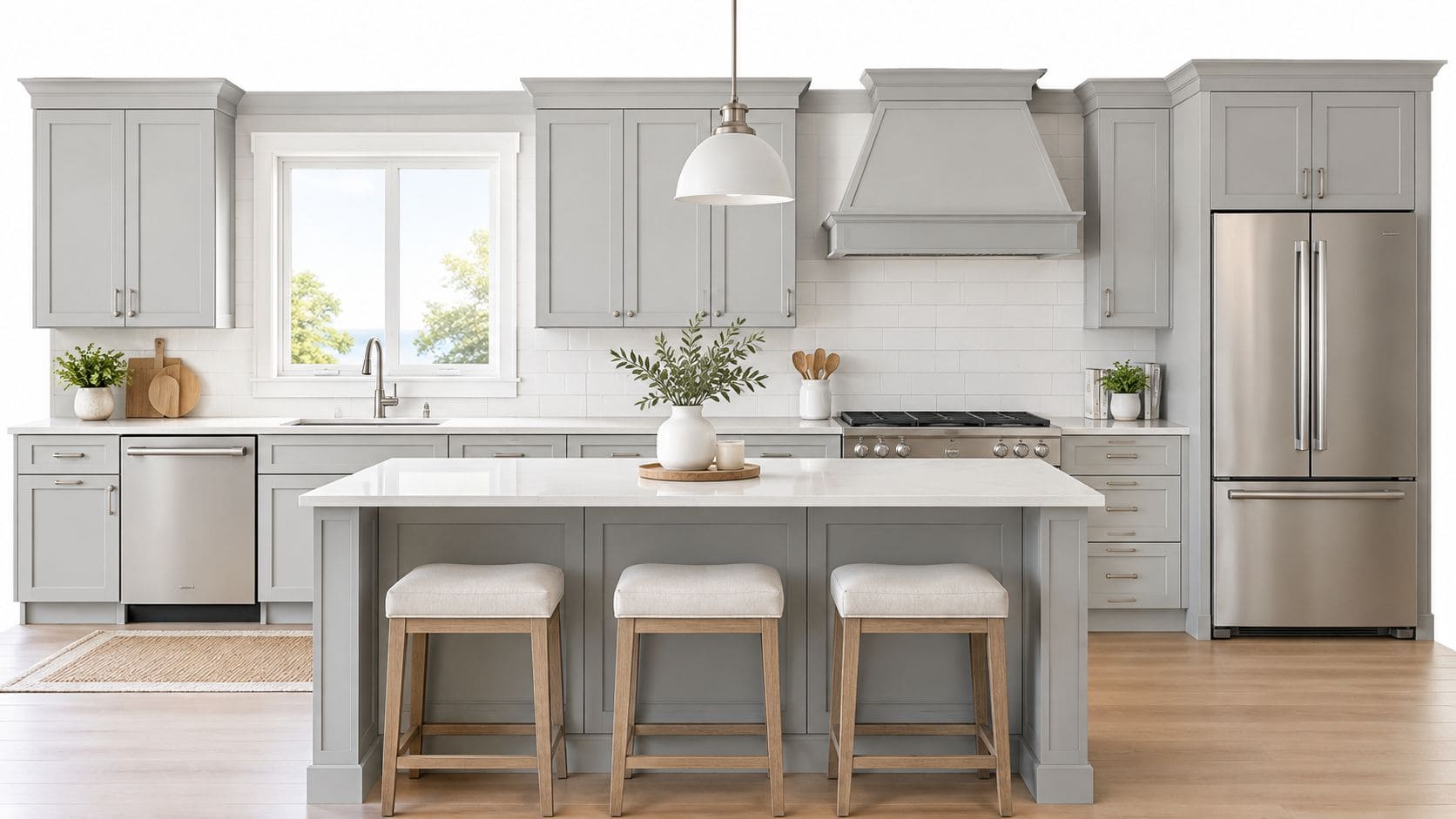
Before and after decisions
If the existing kitchen has dark counters and disconnected wall colors, keep the grey cabinets light and use the backsplash to restore brightness. White marble-look tile adds movement, while light grey grout keeps the installation cohesive rather than outlining every individual tile.
- Countertops: Choose warm quartz or butcher block if the room already has cool flooring or stainless appliances.
- Lighting: Layer pendants, ceiling fixtures, and under-cabinet LEDs so the backsplash remains visible after sunset.
- Hardware: Use black, brass, or satin nickel pulls to define cabinet lines.
- Warmth: Add wood stools, woven window treatments, and restrained open-shelf décor.
Before ordering tile, compare grout and cabinet samples together. The practical advice in these kitchen backsplash trends is especially useful when a simple tile needs to work with both the cabinet finish and the countertop veining.
2. Soft Grey with Warm Wood Accents and Open Shelving
Warm wood changes the entire character of grey cabinetry. Instead of treating grey as the dominant color, use it as the quiet base and let oak, walnut, or natural wood provide texture at eye level. That approach works well in Haddonfield and Mount Laurel homes where homeowners want a polished kitchen that still feels connected to existing floors, beams, or neighboring living spaces.
Open shelving can make the room feel lighter, but it isn't automatically more functional than upper cabinets. Shelves work best where you regularly reach for dishes, mugs, or cookbooks. They work poorly above a heavy-splatter cooking area, where displayed pieces require more frequent cleaning. A sealed, durable wood finish matters because moisture and cooking residue can quickly dull unfinished shelving.
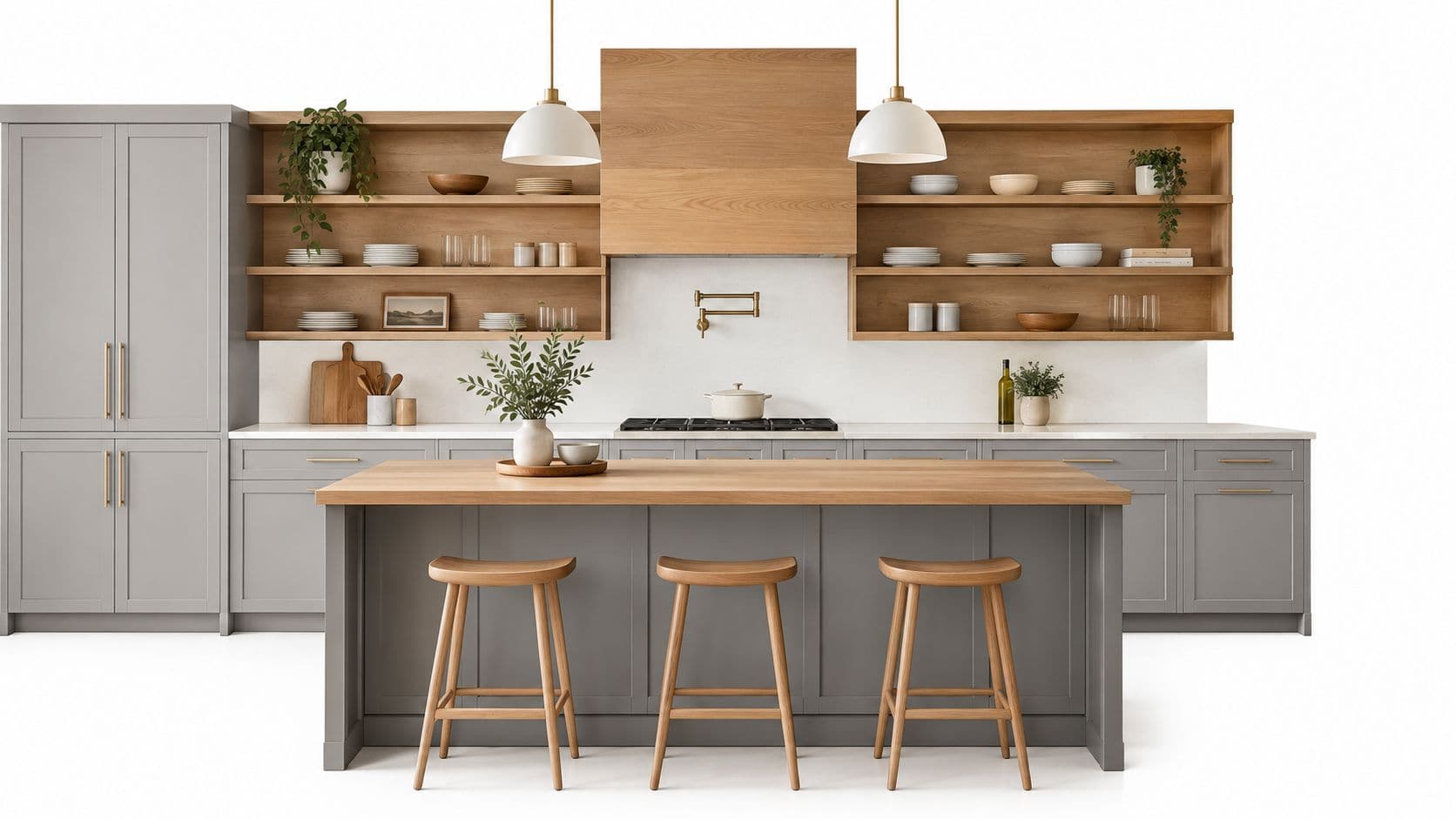
Use wood as an anchor
Coordinate the shelf or island wood with something already present in the home. Matching the floor exactly isn't necessary, but a related undertone prevents the kitchen from looking assembled from unrelated samples. A walnut shelf beside pale grey cabinets creates a richer, more polished effect. Light oak feels more casual and suits coastal or Scandinavian-influenced rooms.
Keep the display practical. Neutral plates, a few cookbooks, and one or two decorative objects usually look more intentional than a shelf packed with small accessories. Under-shelf lighting adds useful evening illumination and gives the wood grain a visible role after daylight fades.
Practical rule: Open shelving should support the way you use the kitchen, not replace storage you already need.
For more ways to balance painted cabinetry with natural materials, compare the guidance on warm wood kitchen cabinets. The same balance can help with making a kitchen feel cozy, particularly when grey cabinets risk feeling too restrained.
3. Soft Grey Matte Finish with Minimalist Hardware
In a compact Collingswood kitchen, soft grey matte cabinets can make the room feel orderly without adding visual glare. The finish absorbs reflections and gives slab or flat-panel doors a more architectural character. In a Medford Township home, pairing matte grey with quartz and discreet hardware creates a contemporary look without committing to a dramatic cabinet color.
Lighting needs more planning because matte surfaces reflect less daylight than satin or gloss. Add task lighting beneath wall cabinets and focused illumination over preparation areas, especially where windows are limited. Check the finish near the sink and range before ordering, too. Dust and touch marks may show, so clean with a soft cloth and the manufacturer's recommended product rather than an abrasive cleaner.
Minimal hardware should still support daily work. Push-to-open doors can suit a clean design, but the mechanism needs to operate reliably through frequent cooking. Full-extension drawers and soft-close runners often offer greater practical value than a fully handle-free layout. A slim edge pull or narrow bar keeps the doors quiet visually while giving wet or flour-covered hands a more dependable grip.
Choose the hardware by drawer width and use, not by showroom appearance:
- Integrated openings: Preserve an uninterrupted, European-inspired front.
- Small pulls: Add grip with little visual weight.
- Larger handles: Make wide drawers easier to open and establish a stronger focal point.
- Metal accents: A faucet, backsplash detail, or light fixture can keep grey cabinetry from looking flat.
For South Jersey homes, this finish works best when the room has enough light and the storage plan does not depend on difficult-to-operate doors. Compare integrated, recessed, and conventional options through these latest kitchen cabinet hardware trends before cabinet specifications fix the layout.
4. Soft Grey Two-Tone Design with a Contrasting Island
A contrasting island gives soft grey cabinets more depth without forcing the entire kitchen into a darker palette. Keep the perimeter grey and use a white, navy, or charcoal island as the focal point. This strategy suits a Cherry Hill kitchen with traditional surrounding cabinetry, but it can also work in a Voorhees space with simple slab doors and a sculptural pendant.
The island color should respond to the room's daylight and scale. Navy or charcoal can look refined in a bright, open kitchen, yet feel heavy in a small room with limited windows. If the kitchen connects directly to a dining or family room, check the island color against nearby furniture and millwork. A strong island should feel intentional from the adjacent room, not like an isolated block.
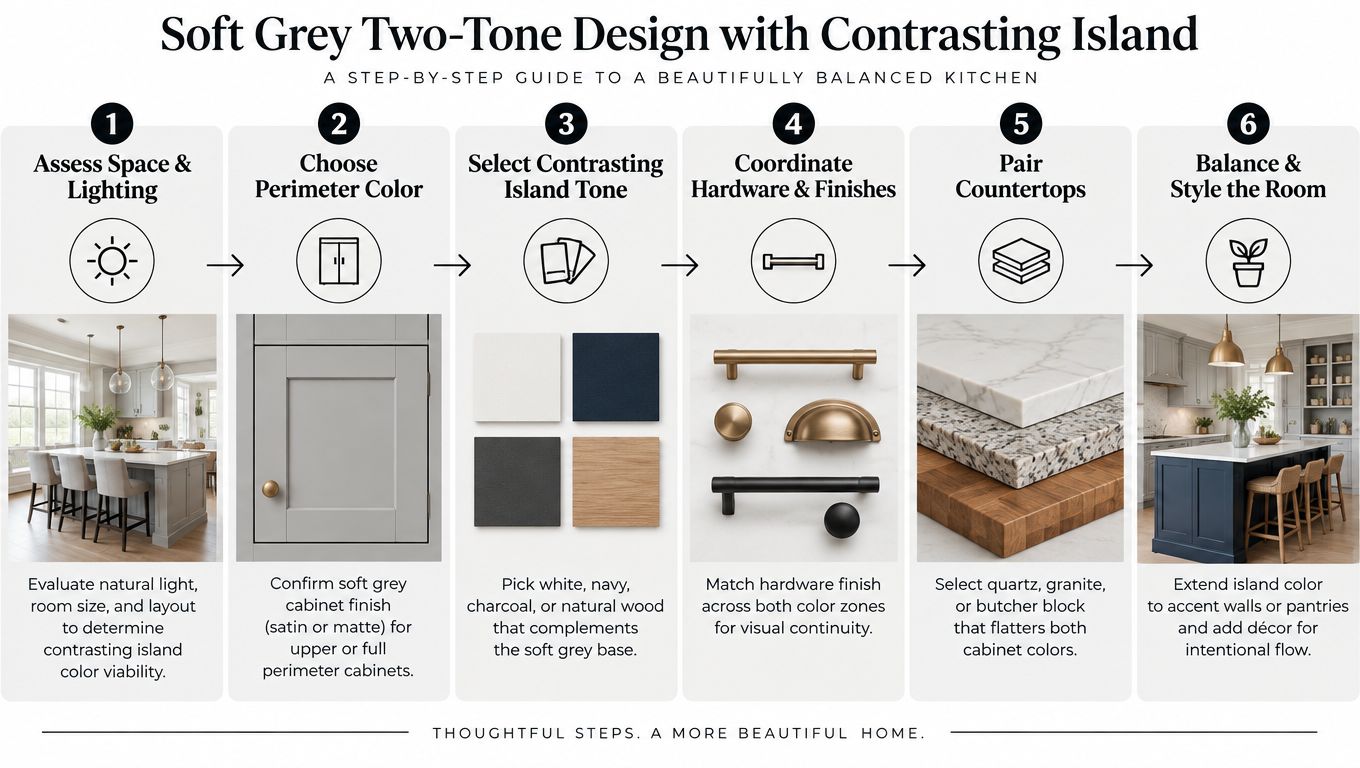
Keep the two colors connected
Use one hardware finish across both cabinet colors. Repeating the same pulls, knobs, or cup pulls creates continuity even when the paint colors contrast. The countertop must also serve both sides. White quartz, restrained veined stone, or a compatible granite can sit comfortably on grey cabinetry and a darker island.
You can repeat the island color in a small, purposeful location, such as a pantry end panel, a built-in hutch, or a nearby accent cabinet. Avoid scattering it across the room without a reason. The strongest two-tone kitchens usually have one dominant cabinet color, one clearly defined contrast, and a countertop that unifies them.
A contrasting island should clarify the kitchen's composition, not compete with the room's architecture.
For layout and proportion guidance, review these two-tone kitchen cabinet ideas before choosing which color belongs on the island and which should remain on the perimeter.
5. Soft Grey with Integrated Appliances and Hidden Storage
A soft grey kitchen feels more orderly when appliances sit behind matching panels. Panel-ready refrigerators and dishwashers preserve the cabinet rhythm, while an appliance garage, pull-out pantry, or vertical tray divider keeps daily tools and ingredients close without crowding the worktops. This approach suits higher-end renovations in Haddonfield and custom kitchens in Cherry Hill or Medford Township, where storage capacity must coexist with a calm view.
Start with the cooking route rather than the finished photograph. Map the path from grocery entry to refrigerator, sink, prep surface, range, and dishwasher. Decide which appliances need daily access, where baking supplies belong, and whether a hidden garage will sit within the main prep zone. A tidy cabinet that forces repeated trips across the room will quickly become frustrating.
Make the cabinet interior earn its space
Integrated appliances depend on precise coordination between the designer, cabinetmaker, and installer. Confirm appliance dimensions, door clearances, ventilation, filler panels, electrical points, and future service access before production. Detailed drawings and 3D views can expose conflicts before panels are ordered, when changes are easier to manage.
Storage choices should match the household's routines:
- Pull-out pantry: Group food by type and bring rear items within reach.
- Vertical dividers: Store baking sheets, cutting boards, and serving trays upright.
- Appliance garage: Conceal a toaster or coffee machine while keeping an outlet nearby.
- Drawer inserts: Give utensils and cooking tools fixed locations.
- Interior lighting: Make deep cabinets and enclosed garages easier to use.
In Camden and Burlington County homes, this planning also helps adapt older layouts to modern storage expectations. A before-and-after review should separate cosmetic changes from functional corrections, including panel sizes, filler placement, appliance locations, and clearance around doors. The hidden-storage concept works only when every cabinet still opens comfortably and every frequently used item has a practical home.
The video below shows how a coordinated cabinet design can move from concept toward a more considered kitchen plan.
6. Soft Grey Shaker Style with Cottage Character
Shaker doors keep soft grey from feeling overly formal. Their simple recessed panels suit older South Jersey homes, cottages, and transitional renovations, while vintage-inspired hardware, open shelving, patterned tile, and farmhouse lighting add the warmth that a cool neutral may lack. In Barrington or Berlin Township, this combination can acknowledge the home's character without reproducing an old-fashioned kitchen.
The cottage effect depends on restraint. Too many distressed accessories, signs, decorative brackets, and competing patterns can make the room feel themed rather than collected. Let the cabinet door provide the clean foundation, then add character through a few materials with genuine utility, such as a wood shelf, an apron-front sink, or a pair of aged-brass pendants.
Build warmth through useful details
Cup pulls on drawers and simple knobs on doors can create a vintage reference without making every cabinet look ornate. A modern bin pull in the same metal family can update the arrangement. Brass, bronze, and aged finishes generally warm grey more effectively than highly polished chrome, but the choice should also relate to the faucet and lighting.
A cottage-inspired backsplash can use subway, hexagonal, or geometric tile. Choose one pattern and allow the grey cabinets to remain visually quiet around it. Natural wood stools, linen shades, potted herbs, and neutral dishware add softness without creating clutter.
The most convincing cottage kitchens look relaxed because the materials are practical, not because every surface has been decorated.
For a Collingswood renovation, consider a grey Shaker perimeter with a lighter countertop, vintage-style pendants, and a small open shelf near the sink. That gives the room character while keeping the primary work zones easy to clean and the storage plan modern.
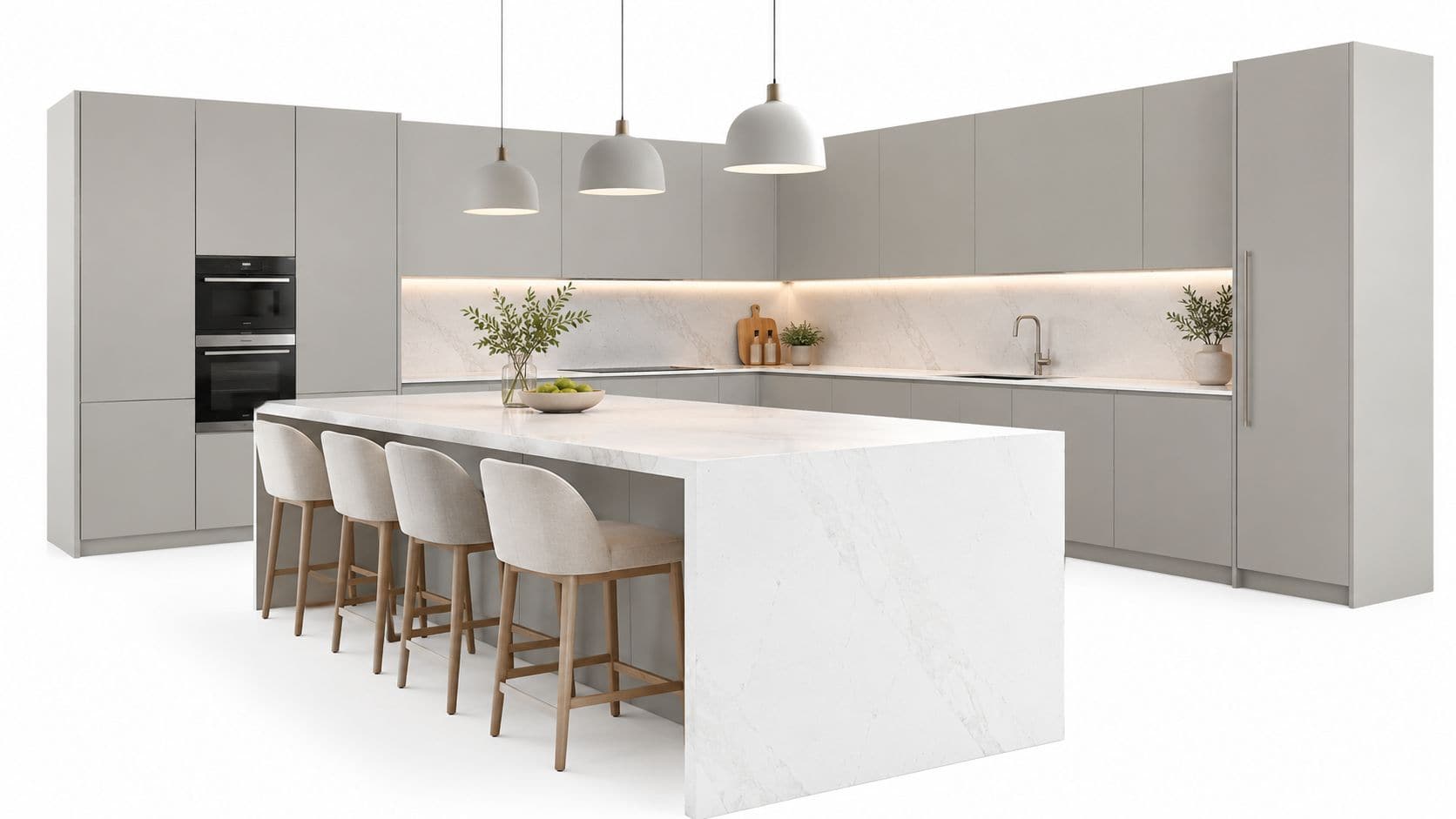
7. Soft Grey with Quartz or Waterfall Edge Island
In an open-plan Mount Laurel kitchen, a waterfall island can make soft grey cabinets feel more architectural without adding a darker cabinet color. The countertop runs down the exposed side panel, creating a continuous surface that faces the entry or adjoining living area. Light quartz keeps the room bright, while a marble-look slab adds movement against restrained cabinetry.
Start with the island's working dimensions, not the edge profile. A waterfall on one visible end may provide enough definition. Covering both ends suits a larger room, but it can crowd a compact kitchen, limit seating flexibility, and make the island feel heavier. Confirm overhang depth and knee clearance before approving the design, particularly if the island will serve as the main dining spot.
Match the slab to the room and the work
Quartz suits a busy island when consistent color and straightforward care matter. Marble and granite offer more natural variation, but they require clearer expectations about maintenance, fabrication, and visible veining. In Cherry Hill or Voorhees, compare the slab with the perimeter counter and backsplash in the actual kitchen light. A surface that looks quiet in a showroom can read busy beside grey cabinetry.
Before fabrication, settle these decisions:
- Vein direction: Confirm how the pattern will continue from the worktop onto the waterfall panel.
- Support: Verify that the island framing can carry the selected stone.
- Seams: Ask where joins will sit and how the fabricator will finish them.
- Seating: Check that the side panel will not obstruct knees, stools, or circulation.
- Coordination: Review the island stone beside the perimeter counter, backsplash, flooring, and cabinet sample.
A soft white or restrained grey pattern usually keeps the island connected to the room rather than making it the only feature. Review countertop edge options with the complete island plan, since the profile affects fabrication, seating, and how the stone meets the cabinetry.
8. Soft Grey with Black Accent Hardware and Gold Details
Black hardware gives pale grey cabinets a clear outline. Gold or brass details then add warmth through the faucet, pendant lights, or a carefully selected accessory. The combination works in a Moorestown transitional kitchen, a Haddonfield renovation with traditional proportions, or a Cherry Hill modern farmhouse where the homeowner wants contrast without committing to a bold cabinet color.
The key is controlling the number of finishes. Matte black pulls, a black faucet, and black lighting can establish a consistent graphic thread. Gold should appear in limited, meaningful locations rather than on every object in the room. A brass faucet and two pendants may be enough. Adding gold shelving, trim, stools, and decorative objects can quickly shift the design from curated to excessive.
Coordinate contrast with care
Choose black hardware with a durable coating and check how it feels in your hand. Fingerprints are less distracting on some matte finishes than on polished surfaces, but every product has different care requirements. Use the same black finish across doors and drawers, and keep the hardware scale consistent even when drawer widths change.
The countertop can either soften or sharpen the scheme. White quartz keeps the room bright, light grey stone creates a quieter tonal effect, and butcher block brings the most natural warmth. Lighting should reveal the metal finishes at night, so install task lighting under wall cabinets and choose pendants that don't cast the island into shadow.
Use a brass or gold detail to connect the kitchen with the adjacent rooms. A nearby mirror frame, cabinet fitting, or light fixture can repeat the warmth without turning the entire floor plan into a matching set. This look succeeds when grey remains the calm background, black supplies definition, and gold provides just enough visual warmth.
8-Style Comparison: Soft Grey Kitchen Cabinets
| Design | 🔄 Complexity | ⚡ Resources & Cost | ⭐ Expected Outcome | 📊 Ideal Use Cases | 💡 Quick Tip |
|---|---|---|---|---|---|
| Soft Grey with White Subway Tile Backsplash | Low, straightforward installs and standard materials | Low–Medium, budget-friendly tile and standard cabinetry | ⭐ High, bright, timeless, broad appeal | Resale-focused, coastal/transitional homes | Pair with warm countertops and layered lighting to avoid coldness |
| Soft Grey with Warm Wood Accents and Open Shelving | Medium, coordinating materials and shelf installation | Medium, quality wood, sealing, occasional refinishing | ⭐ High, warm, characterful, visually dynamic | Farmhouse, transitional, owners wanting personality | Limit open shelving to ~30–40% and style with neutral pieces |
| Soft Grey Matte Finish with Minimalist Hardware | Medium–High, specialty finishes and hardware mechanisms | Medium–High, matte lacquer and push-open/soft-close systems | ⭐ High, sleek, high-end modern appearance | Contemporary/luxury homes and tight spaces | Invest in quality push-to-open mechanisms and good lighting |
| Soft Grey Two-Tone Design with Contrasting Island | Medium, requires careful color coordination and design balance | Medium, extra finishes and island cabinetry | ⭐ High, layered, focalized, resale-friendly | Transitional kitchens and open-plan layouts | Use the same hardware finish across both colors for continuity |
| Soft Grey with Integrated Appliances and Hidden Storage | High, custom panels, complex storage planning | High, integrated appliances and bespoke cabinet work | ⭐ Very High, seamless, highly functional, luxury feel | Luxury homes and organization-focused renovations | Plan storage and appliance specs early; account for future repairs |
| Soft Grey Shaker Style with Cottage Character | Low–Medium, standard cabinetry with vintage details | Low–Medium, Shaker cabinets plus vintage hardware | ⭐ Medium–High, cozy, timeless, approachable aesthetic | Cottages, traditional homes, owners wanting warmth | Mix vintage hardware subtly and layer lighting for charm |
| Soft Grey with Quartz or Waterfall Edge Island | Medium–High, stone fabrication and structural considerations | High, premium stone and professional fabrication | ⭐ Very High, dramatic, modern, architectural focal point | Contemporary luxury and open-concept kitchens | Choose quartz for durability and confirm fabrication/structural specs |
| Soft Grey with Black Accent Hardware and Gold Details | Medium, careful metal finish coordination needed | Medium, quality hardware and fixtures | ⭐ High, sophisticated, curated, upscale look | Transitional and design-conscious homeowners | Limit gold accents, ensure finish consistency, and use quality coatings |
Turn Inspiration Into a Kitchen That Fits Your Home
The best soft grey kitchen isn't the one with the most impressive photograph. It's the one whose finish, layout, storage, and maintenance demands match the way your household uses the room. Start with light. A cool pale grey can feel clean and airy in strong southern exposure, while a warmer greige is often more comfortable in a north-facing room or beside warm flooring. Dura Supreme's cabinet-finish guidance explains why warm and cool greys respond differently to surrounding light and materials.
Room scale matters just as much. Light grey can visually behave like white at a small depth, which helps a compact kitchen stay bright. A medium grey provides more presence on a full perimeter, while a darker charcoal needs enough daylight and a lighter counter to avoid making the room feel compressed. Sherwin-Williams' cabinetry trend guidance continues to describe grey as prevalent while also recognizing the movement toward warmer blonde and neutral finishes.
Recent market evidence supports a measured decision rather than a panic-driven one. Industry coverage of a 2026 Houzz study reported that grey represented 5% of cabinet-color choices among 1,780 renovating homeowners, behind wood at 29%, white at 28%, and green at 6%. The same coverage reported that U.S. search interest for “gray kitchen cabinets” peaked in January 2022 and reached an indexed value of 33 by late August 2026, a decline of roughly two-thirds from that peak. Those figures indicate that grey is no longer the dominant finish, not that every grey kitchen is automatically dated.
Use the eight designs as decision paths:
- Limited daylight: Choose a lighter warm grey, reflective backsplash, layered lighting, and a light counter.
- Open-plan room: Use a two-tone island or waterfall edge to give the kitchen a clear focal point.
- High storage needs: Prioritize full-height cabinets, pull-outs, tray dividers, and integrated appliance planning over open shelves.
- Low maintenance tolerance: Favor durable countertop materials, sealed wood, and cabinet finishes with clear care instructions.
- Traditional architecture: Start with grey Shaker doors, classic tile, and restrained brass or nickel hardware.
- Contemporary architecture: Consider matte doors, integrated appliances, slim hardware, and a simple quartz surface.
- Warm existing finishes: Select greige or mushroom-adjacent grey and repeat the warmth in wood, lighting, or flooring.
- Resale concerns: Avoid a highly personal combination of multiple competing finishes. A flexible neutral palette with replaceable hardware and timeless stone is easier to live with and adapt.
Sample every major finish in your own room. Place the cabinet door beside the floor, countertop, backsplash, and hardware, then view it in morning daylight, afternoon light, and evening LEDs. A color that looks softly neutral in a showroom can reveal a blue, green, or beige undertone once it sits beside your existing materials.
Before-and-after planning should identify more than paint color. Note which drawers are awkward, where countertop appliances collect, whether the dishwasher blocks a walkway, and which cabinets waste vertical space. Then connect the backsplash and island decisions to those functional changes, rather than selecting them as isolated decorative features. Homeowners exploring cabinet painting design ideas should also compare the long-term condition of existing doors, the desired finish quality, and the cost of repainting against replacement cabinetry.
For homeowners in Cherry Hill, Camden County, and Burlington County, seeing materials together is often more useful than saving another inspiration image. The Cabinet Coach offers a complimentary video consultation, mobile showroom process, and guidance across cabinetry, countertops, hardware, and tile, helping you compare a soft grey kitchen against your home's light, architecture, storage needs, timeline, and budget.
The Cabinet Coach brings cabinet, countertop, hardware, and tile selections directly to South Jersey homeowners through its mobile showroom and personalized design consultations. Start with a complimentary video consultation to evaluate your soft grey kitchen ideas, then visit The Cabinet Coach to plan a cohesive, functional renovation for your home.