
You're holding two grey samples that looked the same at the store, and under your kitchen window they don't. One leans blue beside the oak cabinets. The other looks beige next to the white quartz. The name on the chip hasn't changed. The room has.
A grey tile backsplash kitchen is judged by the light, the cabinets, and the countertop it lands against, not by the label on the box. Before you order a full carton, you need the tile body, the layout, the height, and an undertone that still looks right after dinner. That's the sequence below.
Table of Contents
- Grey Tile Backsplash Types Compared at a Glance
- Tile Sizes, Layouts and Backsplash Height
- Choosing a Grey Undertone for Your Kitchen Light
- Grout Colors That Change How Grey Tile Looks
- Pairing Grey Tile with Cabinets, Countertops and Hardware
- Durability, Cleaning and Specs to Check Before Buying
- Budget and Installation Timeline for a Grey Backsplash
- Book a Home Sample Test Before You Order Tile
Grey Tile Backsplash Types Compared at a Glance
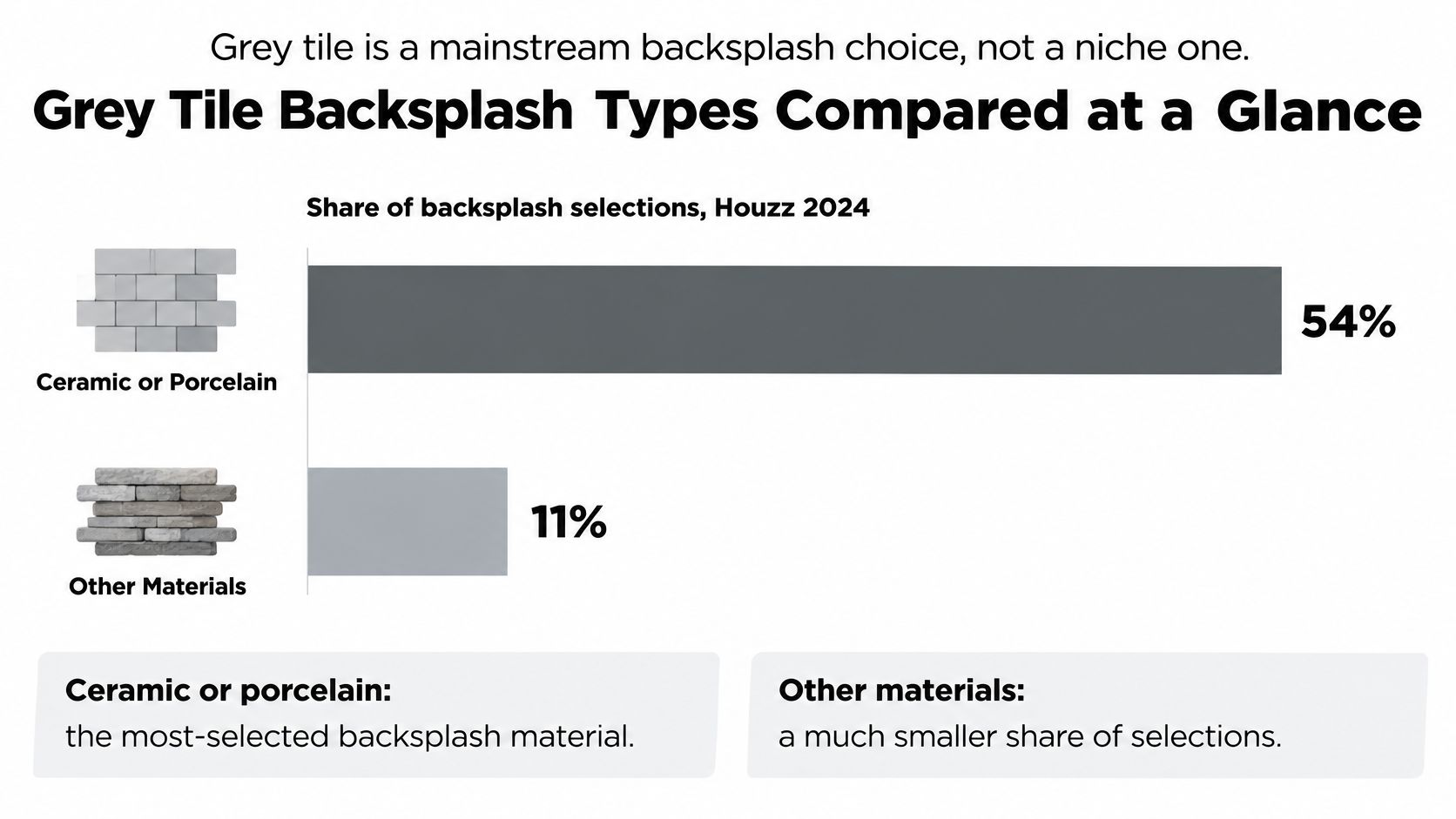
Grey tile is a mainstream backsplash choice, not a niche one. In the 2024 U.S. Houzz Kitchen Trends Study, ceramic or porcelain tile accounted for 54% of backsplash selections, while engineered quartz accounted for 11%. Homeowners already treat tile as the usual finish behind the counter, so a grey field sits in a familiar category.
Five bodies and where water goes
Absorption is the useful split. A low-absorption tile is like a glazed mug: water beads and rolls off. A high-absorption tile is like a sponge: it holds stains until you scrub them out. Colour doesn't tell you which one you bought.
| Tile type | Water absorption | Upkeep | Typical grey look | Best use |
|---|---|---|---|---|
| Glazed ceramic wall tile | Typically above 3% | Moderate | Matte and satin greys | Dry walls and low-splash areas |
| Porcelain | 0.5% or less | Low | Solid-body concrete and stone looks | Behind sinks, dishwashers and ranges |
| Glass mosaic | Near zero | Low, grout lines need attention | Smoky and iridescent greys | Accent strips and feature walls away from heat |
| Handmade zellige | Variable, often moderate to high | Higher, needs sealing and gentle cleaning | Soft mottled greys | Textured, artisan kitchens |
| Natural slate | Porous | High, needs a sealing routine | Honed natural grey | Warm, organic kitchens that accept patina |
Glazed ceramic is the everyday pick on a dry run of wall. The glaze does the stain work, but the clay body can still take on water if a joint stays wet. Porcelain is the body to name when the wall gets soaked, and its concrete or stone looks read solid rather than glassy.
Glass mosaic barely drinks water, yet the grout grid is most of what you clean. Smoky and iridescent greys catch light on a short accent. Layout ideas for that sparkle are collected under glass tile backsplash ideas. Keep glass off the range, where heat can stress the mesh sheet.
Zellige brings a soft mottled grey and an uneven glaze that wants a gentle cleaner. Slate is honed and porous, so it needs a sealing routine or cooking oil will darken the face. For a wider read on how wall finishes sit with paint and cabinets, Premier Builders sets out wall tile styles and colour combinations that behave the same way a backsplash does.
Practical rule: Glazed ceramic is fine on a dry or low-splash wall. Specify porcelain behind a sink, a dishwasher, or a range.
Tile Sizes, Layouts and Backsplash Height
Rectangular tile is the layout people most often install. In the 2025 U.S. Houzz Kitchen Trends Study, 68% of homeowners choosing tile selected rectangular formats, and horizontal brick was the leading pattern at 39%.
What each pattern asks of the wall
Horizontal brick, at 39%, is a 3 by 6 or 4 by 8 rectangle set in a running bond. Contrast grout shows the stagger. A close match hides it. This layout forgives a wall that isn't perfectly flat, which is why it leads.
Horizontal stack followed at 15%. Rectified 3 by 12 or 4 by 12 planks line up in a grid. The joints are the design, so a wavy wall shows every dip. Have the installer check the substrate with a straightedge before the first row goes up.
Herringbone reached 7%. Small rectangles turn on a diagonal, which means more cuts and more waste. In a narrow galley it reads busy unless the grout nearly matches the tile.
Vertical stack also reached 7%. Joints run upward, which lifts the eye and pairs with tile that continues toward the cabinets or a hood. On a short band those lines never get room to travel, so the pattern looks chopped.
Three heights, one wall check
Coverage to the cabinets or range hood was selected by 67% of those homeowners, while 12% extended the backsplash to the ceiling. Walk the wall before you pick one.
- Measure the run. Measure from the countertop to the cabinet bottom or the hood.
- Mark the devices. Mark every outlet and switch so a joint doesn't split a cover plate.
- Find the stops. Note where window trim and open shelves end. Tile that dies mid-trim looks unfinished.
- Choose the stop. Use about 18 inches, cabinet height, or ceiling height based on the wall you want noticed.
A short backsplash keeps material and grout cleaning small. Cabinet height is the common middle. Ceiling height can frame a hood or hide patched plaster. A dark or strongly patterned grey on that full-height wall can compress a small kitchen, and every extra square foot is more grout to wipe. The same three stops are set against cabinet lines in this guide to backsplash height in a kitchen.
A dark patterned grey that looks sharp on a short board can make a narrow kitchen feel shorter once it climbs to the ceiling.
Choosing a Grey Undertone for Your Kitchen Light
Grey isn't a safe neutral you can order by name. CultureMap's report on Houzz's 2025 U.S. Kitchen Trends Study notes that gray accounted for only 7% of backsplash colors, behind the combined 57% share of white and off-white. Generic grey galleries rarely say when grey fits, or which undertone your window will punish.
Undertone is the colour that tips the mix. Grey is never one pigment. Blue tips it cool. Beige tips it toward greige. A chip under store lighting can't tell you which tip your own bulbs will reward.
Match the grey to the room you have
| Room condition | Grey to lean toward | Watch for |
|---|---|---|
| North-facing or dim, few windows | Warm greige or light warm grey | Cool blue-grey can look cold |
| Bright south or west light | Neutral mid-grey | Very pale grey can wash out |
| White cabinets with cool countertops | Neutral grey with no strong blue or beige | Mismatched undertones clash |
| Dark cabinetry | Lighter grey to keep the room open | Dark grey can make the kitchen feel smaller |
A north window gives cool daylight all day. Blue-grey under that light can make the counters feel chilly, the way a white shirt looks bluer in shade. Warm greige holds its balance there. In a bright south or west kitchen, a neutral mid-grey stays steady instead of fading out.
Warm bulbs push a cool grey toward beige by evening. Cooler task lighting shows the undertone you actually bought. Look at the bulb already over the sink before you fall for a showroom board.
White cabinets beside warm greige can look muddy, especially on a cool white counter. A very dark grey in a dim room pulls the walls inward. Rooms that mix those finishes stay open when one surface stays light, which is the point of these black, white, and gray kitchens.
Hold a full-size sample against the cabinets and the countertop in the morning, again in the afternoon, and once after the lights are on. A two-inch chip won't show the shift.
Grout Colors That Change How Grey Tile Looks
Grout turns a field of grey tile into one calm surface or a visible grid. The colour you loved on a single piece can vanish, or get louder, inside a 1/8-inch line.
Grout is the punctuation of the tile. A close match is a comma that softens the sentence. A sharp contrast is an exclamation mark that makes the brick pattern the point.
Five colours and the marks they show
Matching grey, or a tone one step from the tile, gives a quiet surface. Cooking marks show only moderately, because the line isn't a spotlight. Choose it when the cabinets and the stone should lead.
Light warm grey or greige draws a soft grid and sits easily next to wood. On a pale tile it shows tomato splatter faster than a mid tone, so you'll wipe more often behind the range.
Warm taupe blends with greige cabinetry and forgives everyday residue better than white. It suits a kitchen that already has oak or a cream quartz.
Charcoal builds a strong graphic grid and hides residue well. It suits a modern brick or stack layout when you want the rectangles to read as shapes, not as one solid sheet.
White gives a crisp, high-contrast grid that flatters off-white cabinets and a bright room. It shows stains quickly. If you cook most nights, you'll be cleaning lines, not tile faces.
Width, sand, and the bag you buy
Use sanded grout for joints 1/8 inch and wider. Use unsanded grout for narrower joints, including most rectified porcelain. A cementitious grout is enough on a normal backsplash. An epoxy grout earns its cost where the sink or the dishwasher throws water every day. Seal cement-based grout when the bag says to.
Match the grout to the cabinet tone for a quiet kitchen. Contrast it with the tile when the brick layout is the feature you want seen from the doorway.
A shade that looks right on a small grout stick often looks darker once the full wall is set. Ask for a sample laid on a tile board, not a chip in a folder.
Pairing Grey Tile with Cabinets, Countertops and Hardware
Grey tile works as a neutral bridge between cabinets and countertops. Pick the one element that should lead, then let the tile connect the other instead of competing with both.
Pairings that hold together
| Cabinet color | Countertop | Hardware finish | Result with grey tile |
|---|---|---|---|
| White shaker | White quartz with grey veining | Brushed nickel | Clean and classic |
| Warm oak | Dark quartz or honest black granite | Matte black | Strong contrast |
| Navy or deep green | Pale quartz or marble | Brass | Grey acts as a neutral bridge |
| Greige | Light grey quartz | Brushed nickel | Calm, tonal, needs texture |
| Charcoal | Cream or white | Chrome | Tile must be light to avoid heaviness |
White shaker, grey-veined quartz, and brushed nickel stay clean without a loud tile. Warm oak against dark quartz or black granite wants matte black hardware and a lighter grey so the wood still reads warm. Navy or deep green with pale stone needs the grey in the middle, and brass pulls that middle toward the paint. Greige cabinets on light grey quartz go flat unless the tile has texture, a handmade edge, or a visible joint. Charcoal cabinets with a cream counter need a light tile, or three heavy tones stack on top of each other.
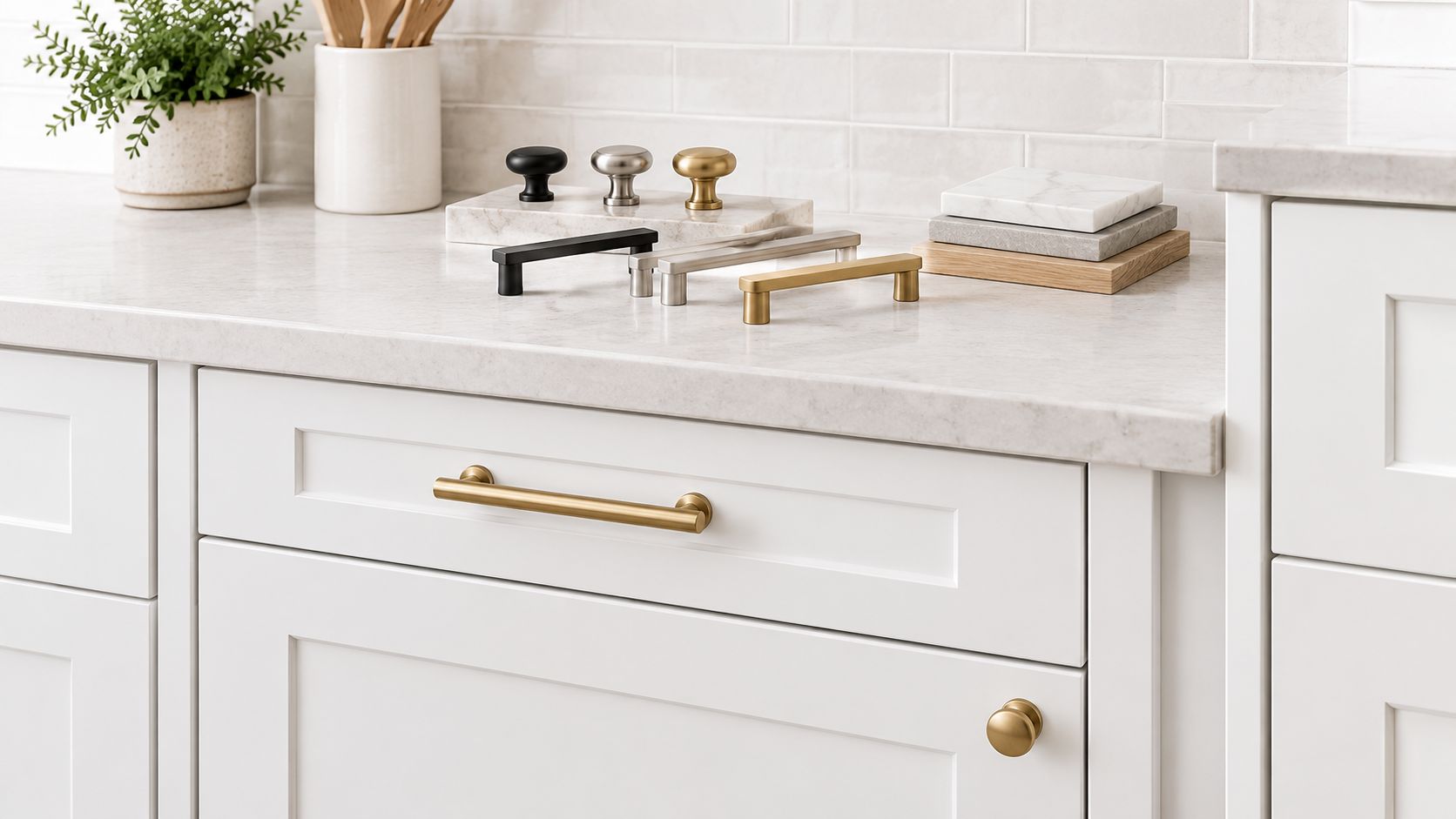
Warm brass and bronze soften grey and suit cream or wood. Cool chrome and nickel sharpen grey and suit white or charcoal.
If the cabinets are being painted before the tile goes up, it helps to compare kitchen cabinet painting costs so the finish budget and the backsplash budget land in the same month. Paint undertone has to be chosen with the tile, not after the cartons arrive.
Joints, heat, and ratings that don't help
The Menards tile and stone buying guide treats PEI ratings as an abrasion class for glazed tile. Lower ratings can suit interior walls, while higher ratings are mainly for floors. Buying grey tile only because it is PEI 4 or PEI 5 adds cost without fixing grease, hot water, or cleaners. Ask instead for wall-use approval, glaze chemical resistance, and a flat enough wall if you want narrow joints on rectified tile.
At changes of plane, and where the backsplash meets the counter or the cabinets, use flexible sealant rather than rigid grout. Those surfaces move differently, and a hard line cracks. Near a range, keep the appliance maker's required clearance and use a tile system rated for that heat. Grout, caulk, and sealants often fail before the tile does. How stone and tile should meet is the check in this note on countertops and backsplash.
Durability, Cleaning and Specs to Check Before Buying
A backsplash is a splash guard, not a floor. It has to shrug off grease and water. It doesn't have to survive shoes.
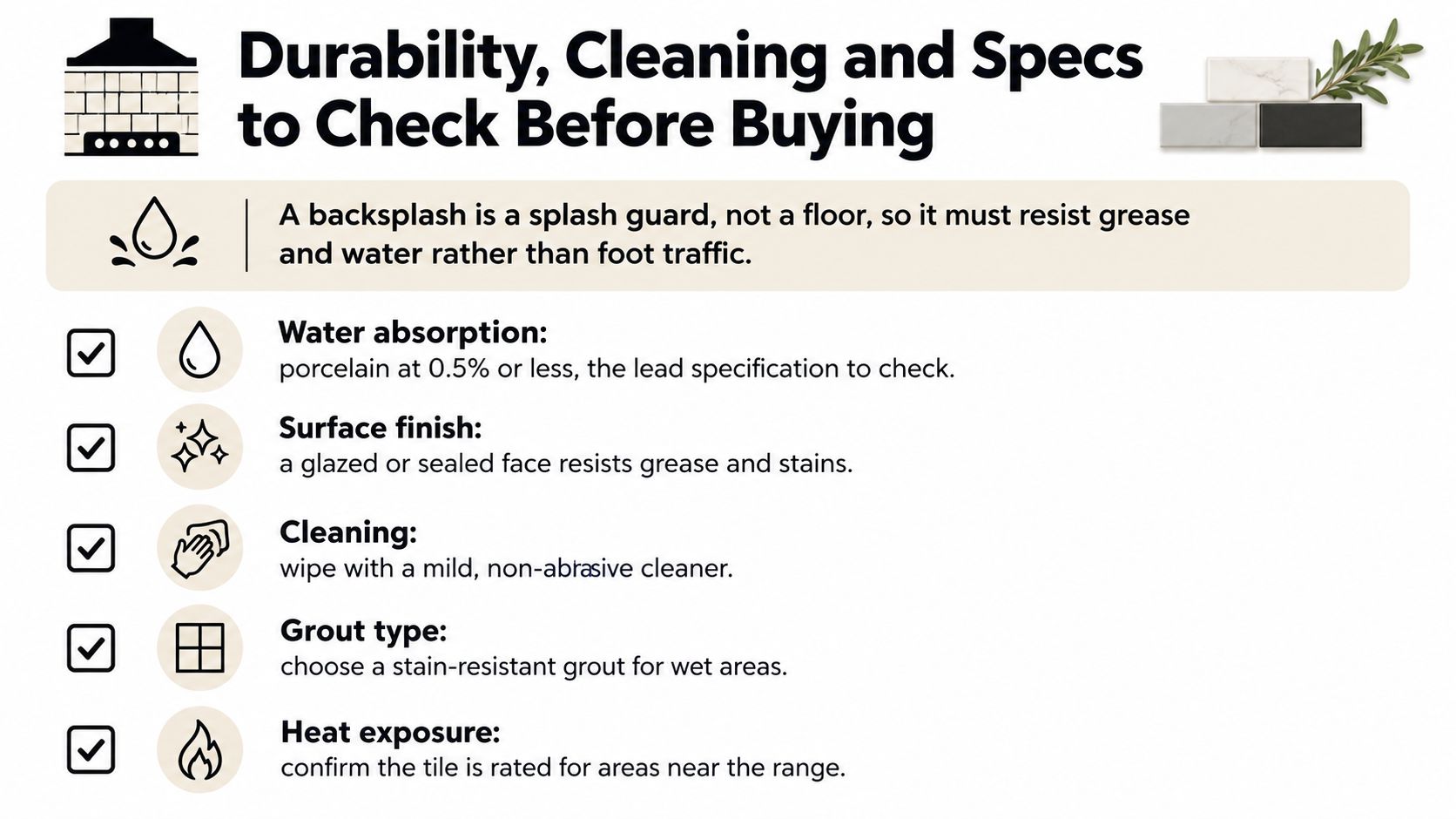
Porcelain is the lead spec on a wet wall. Under ISO 13006 and ASTM C373 testing, porcelain tile has water absorption of 0.5% or less, so the fired body has far fewer pores water can enter. The Tile Council of North America tile initiative is also clear that grout joints are not waterproof. Moisture protection still depends on the substrate, mortar coverage, perimeter treatment, and how the joints are detailed.
Five checks before you pay
- Absorption data. Ask for a published number. The word "ceramic" on a carton isn't a spec.
- Wall approval. Confirm the maker lists the tile for walls. A floor-only piece can be heavier than a backsplash needs.
- Glaze and size. Check chemical resistance, and that tiles in the lot match in size. Mixed lots show up as crooked joints.
- Adhesive. Confirm the thinset is approved for that tile on a vertical set. Glass and large porcelain often need a named mortar.
- Grout for the splash. Match cementitious or epoxy grout to the water, and seal cement-based grout when the maker requires it. Darker grey grout hides residue. It doesn't replace a sound joint.
A high abrasion rating meant for floors won't fix those risks. You'd be paying for foot traffic this wall never sees.
A weekly wipe
Wipe grease with warm water and a pH-neutral cleaner. Skip vinegar mixes and abrasive powders on grout. Treat slate and zellige as sealed faces: renew the sealer on the maker's schedule, and don't flood them.
Budget and Installation Timeline for a Grey Backsplash
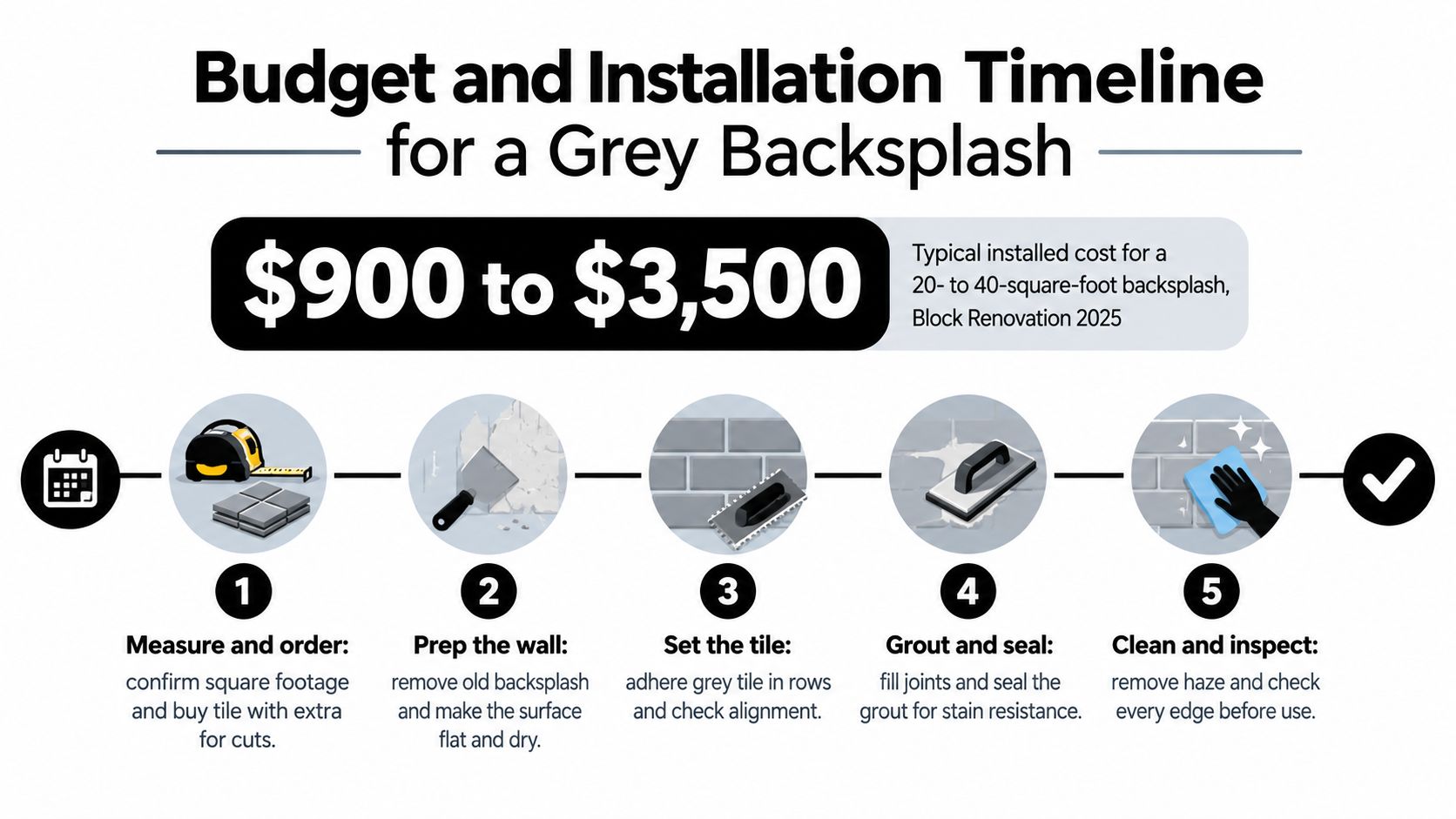
Block Renovation reported in 2025 that installing a kitchen backsplash typically costs USD 900 to USD 3,500 for a 20- to 40-square-foot area.
What moves the figure inside that band
Tile category sits at one end or the other. Glazed ceramic wall tile lands toward the low end. Handmade zellige, glass mosaic, and natural slate land toward the high end, because the material and the slower set both cost more.
Pattern changes labor on the same square footage. A straight brick layout is the faster set. Herringbone adds cuts and waste, so the installer is on the wall longer.
The wall you already have can cost more than the tile. Soft drywall, a bumpy plaster patch, or outlets that must move should be separate lines on the estimate. Ask for them before you compare two quotes.
Phases, in the order they actually happen
| Phase | Typical time | What to confirm |
|---|---|---|
| Sample approval | 1 to 2 weeks | Full-size sample under your light |
| Tile and grout ordering | 1 to 3 weeks | Stock status and lot number match |
| Demo and substrate prep | Half a day to 1 day | Flat, dry, sound wall |
| Setting tile and grout | 1 to 2 days for about 30 square feet | Joint width and pattern alignment |
| Cure and sealant | 24 to 72 hours before heavy use | Manufacturer cure time on the product sheet |
| Final caulk and cleaning | About 1 day | Flexible sealant at counter and cabinet joints |
The days on the wall are the short part. Ordering, lot matching, and the wait for a special-order body usually set the calendar. Don't cook against a fresh joint until the cure printed on the grout and sealant has passed. That's how a clean set stains on day one.
A short install walk-through makes that sequence easier to picture before anyone pulls the old backsplash down.
Book a Home Sample Test Before You Order Tile
Kitchens around Cherry Hill, Haddonfield, Voorhees, Moorestown, and nearby towns often keep older oak or maple next to a newer white or painted shaker front. The grey has to sit with the finish already in the room, not with a catalog photo.

Warm greige tends to suit wood cabinets and warm hardware. A light neutral grey with brushed nickel suits newer white fronts. Keep the backsplash quiet where the range and the sink work hard. Let the hood, the open shelves, or one feature wall carry the pattern.
Three moves, in order. Choose the tile body for the wet zone. Pick the layout and the height from the wall check. Test the grey and the grout against the actual cabinets and countertop across the day.
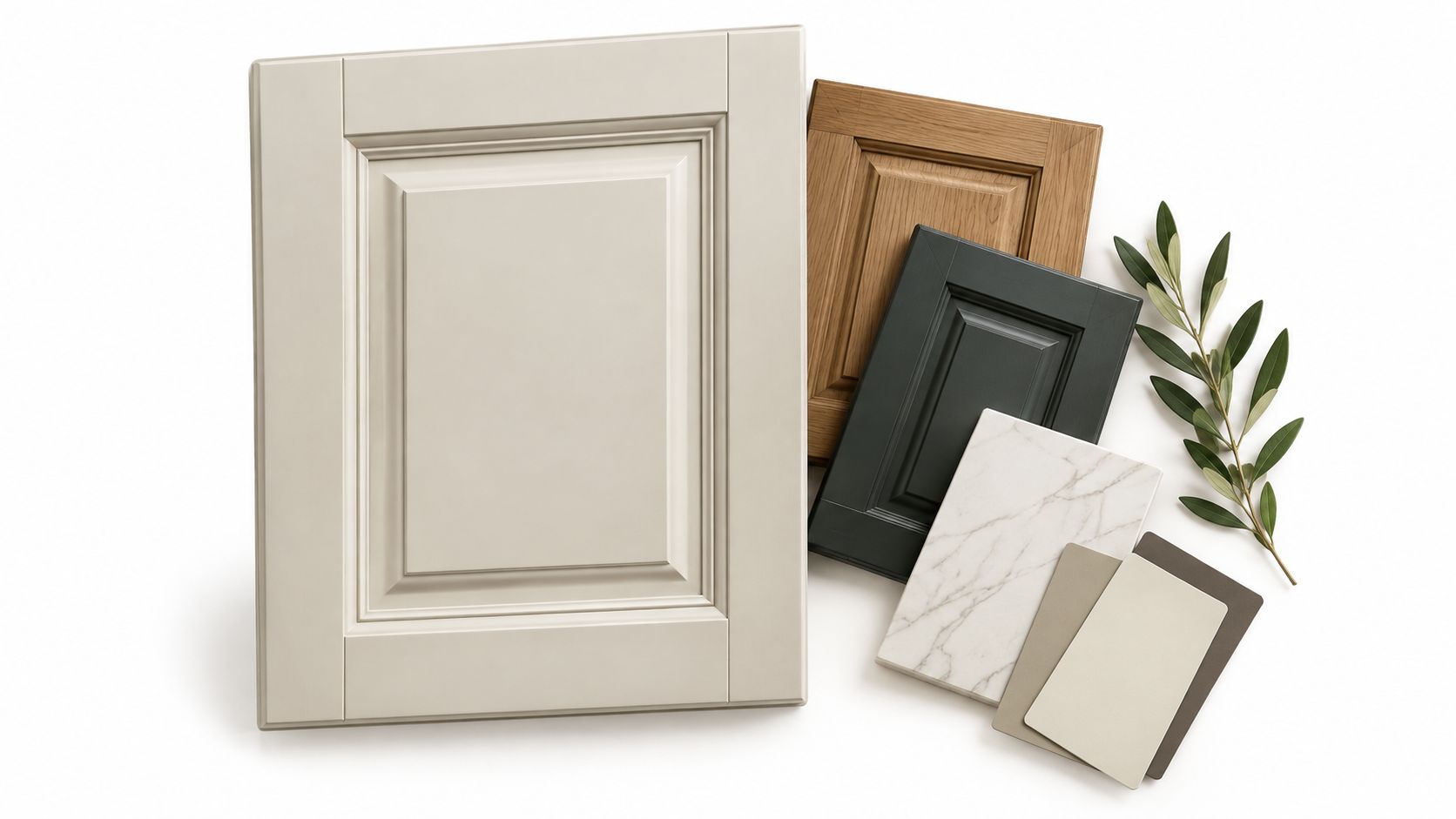
The Cabinet Coach is a South Jersey mobile cabinet showroom that brings tile, grout, and cabinet samples to the house. The path starts with a complimentary video consultation, then discovery, a site visit, concept development, and a transparent preliminary estimate. How that in-home sequence is set up is on the kitchen remodel showroom page. Request the video consultation, bring your wall measurements and a countertop sample, and ask for a grey sample set you can check morning, afternoon, and evening.
The Cabinet Coach brings cabinetry, countertops, hardware, and tile to South Jersey homes so you can judge a grey backsplash under your own light before a carton is ordered. Start with the video consultation, your measurements, and a full-size grey sample beside the counter you already own. Visit The Cabinet Coach to request that consult and pick a time when you can see the sample in morning and evening light.