
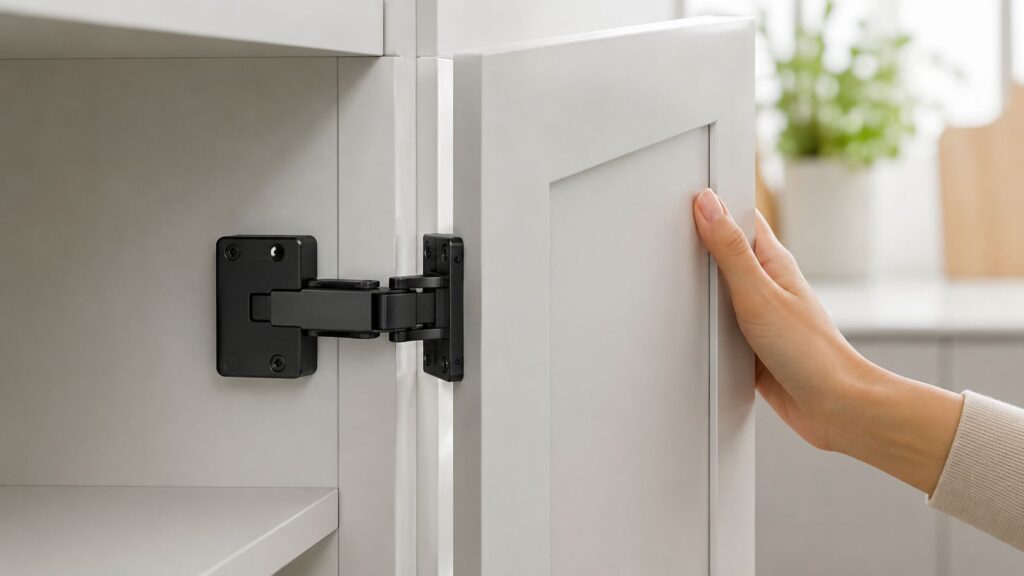
You're standing in a Cherry Hill kitchen with a drawer that yanks shut hard enough to rattle the plates, a cabinet door that slams during dinner cleanup, and a constant little bit of noise you've stopped noticing. That's usually when homeowners decide the house doesn't need a whole new kitchen, it needs the right hardware. Soft close cabinet hardware solves the daily friction without changing the look of the room, and the decision is rarely “should I?” It's which part to replace, what still fits, and whether your cabinets need a full hinge swap or just a damper.
Table of Contents
- Why Soft Close Is the Upgrade Most Homeowners Wish They Had Sooner
- How Soft Close Cabinet Hardware Works
- Benefits That Justify the Upgrade
- Retrofit Dampers Versus Full Hinge Replacement
- Matching Hinge Specs to Your Cabinet Style
- What Installation Actually Looks Like
- Costs, Maintenance, and Sourcing in Cherry Hill
Why Soft Close Is the Upgrade Most Homeowners Wish They Had Sooner
The slam happens at the worst time. Someone's carrying a tray, a kid is reaching for a snack, or you're cleaning up after dinner and the cabinet door snaps shut with that cheap, hollow bang that makes the whole kitchen feel older than it is. In a real house, especially an open kitchen, that sound gets old fast.
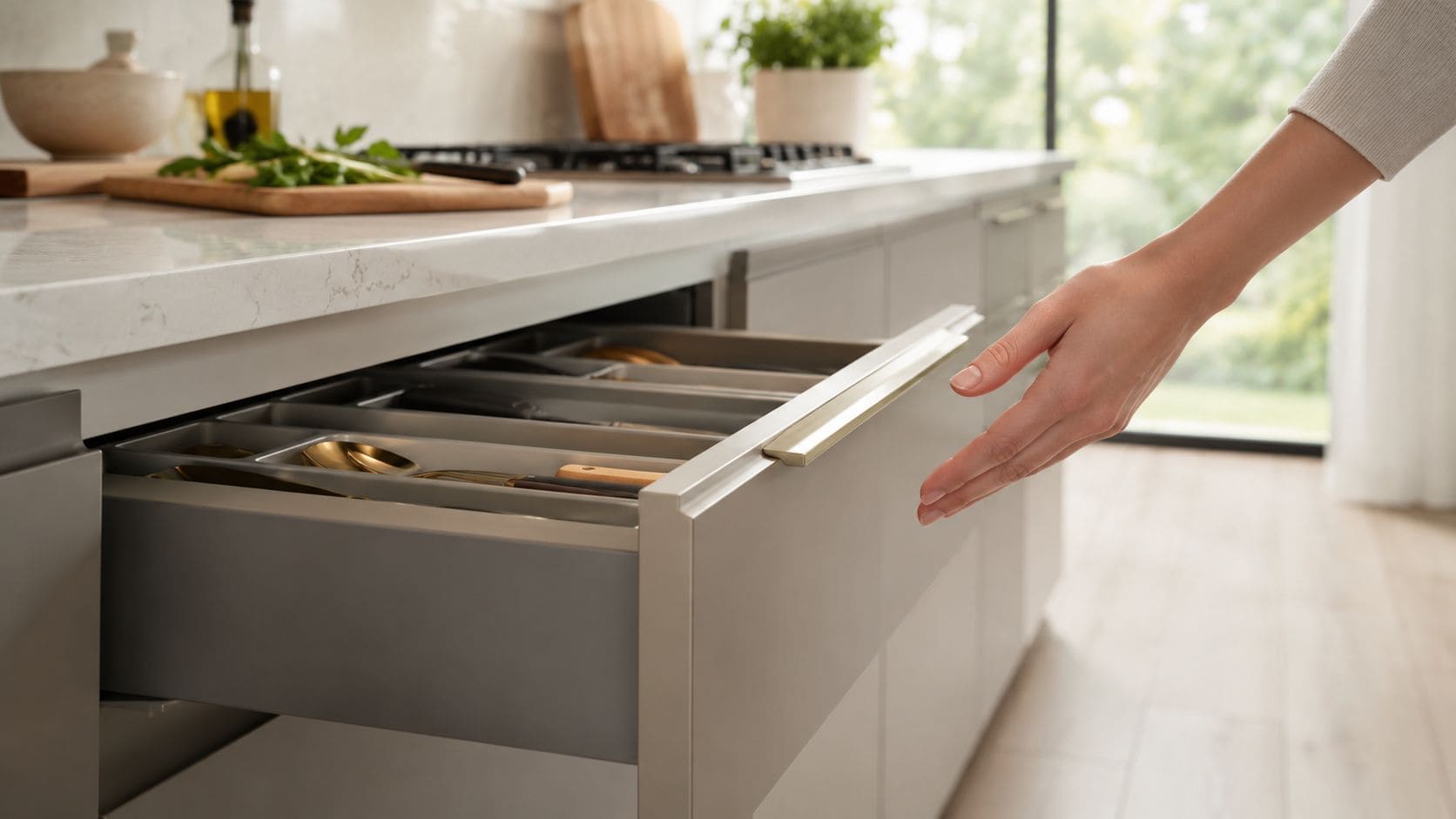
Soft close cabinet hardware fixes that daily annoyance in a way homeowners usually appreciate within the first day. It also changes how people use the kitchen. Doors get shut fully, drawers stop rattling, and the whole room feels calmer.
The four decisions that actually matter
Many begin by inquiring about brands. That's the wrong first question. The useful questions are whether you need a new hinge, whether a retrofit damper is enough, what overlay and opening angle your doors require, and how much you want to spend.
If you're trying to sort through hardware options and finish choices at the same time, find the right cabinet hardware is a helpful place to start because it keeps the decision anchored to fit, not just appearance. I'd also pay attention to current hardware trends on this cabinet hardware trends overview only after you've figured out the functional side.
Practical rule: If the cabinet slams now, the upgrade is probably worth it. If the real problem is that the door is warped or the frame is out of square, new hardware won't magically fix that.
Soft-close became mainstream for a reason. European manufacturers started building dampers into hinges and slides in the early 2000s, and by 2025 the market had grown into a major category, with the global soft-close hinge market described at $2.6 billion and a 6.8% CAGR, while the broader furniture-hinge market was forecast at $8.4 billion in 2025 and $12.9 billion by 2032 at 6.3% CAGR (Strategic Market Research). That doesn't mean every kitchen needs the same hardware, but it does mean this used to be a nice-to-have and is now normal in serious remodels.
How Soft Close Cabinet Hardware Works
Soft-close isn't one product. It is a mechanism family. Homeowners hear the phrase and assume every door and drawer uses the same parts, but kitchens are not built that way.
Three different mechanisms, one quiet result
A concealed hinge with a built-in damper is the most familiar setup. The hinge handles the normal opening and closing, then hydraulic resistance takes over near the end so the door eases shut instead of banging. Separate retrofit dampers do a similar job from the cabinet box side, which is why they can sometimes be added to existing doors without replacing every hinge.
Drawer systems work differently. Soft-close drawer slides use a catch-and-brake action inside the slide hardware, so the drawer is grabbed near the end of travel and pulled in gently. The feel is similar, but the parts are not interchangeable, and that matters when you are ordering replacements for a Cherry Hill kitchen with mixed-overlay doors or a tight galley run.
A screen door closer uses the same basic logic. A spring gets the door moving, and fluid control keeps it from slamming. Cabinet hardware follows that pattern in a much smaller package.

Engagement window is the detail that gets ignored
In concealed hinge systems, the soft-close action typically engages in the last 15 to 25 degrees of door travel, while drawer systems usually trigger about 50 to 80 mm from full closure (Hush Basket). That is why alignment matters so much. If the door is already rubbing, hitting an adjacent wall, or closing out of square, the damper never gets a clean chance to do its job.
The damper only helps at the end of the movement. If the cabinet layout is wrong before that point, the hardware can't rescue it.
That final closing zone is also why spec matching matters more than brand shopping. The best-looking hinge on a catalog page is useless if the geometry does not let the door travel cleanly into the damping range. In older South Jersey kitchens, that is the point where corner cabinets, shallow clearances, and imperfect framing expose the wrong choice fast.
Benefits That Justify the Upgrade
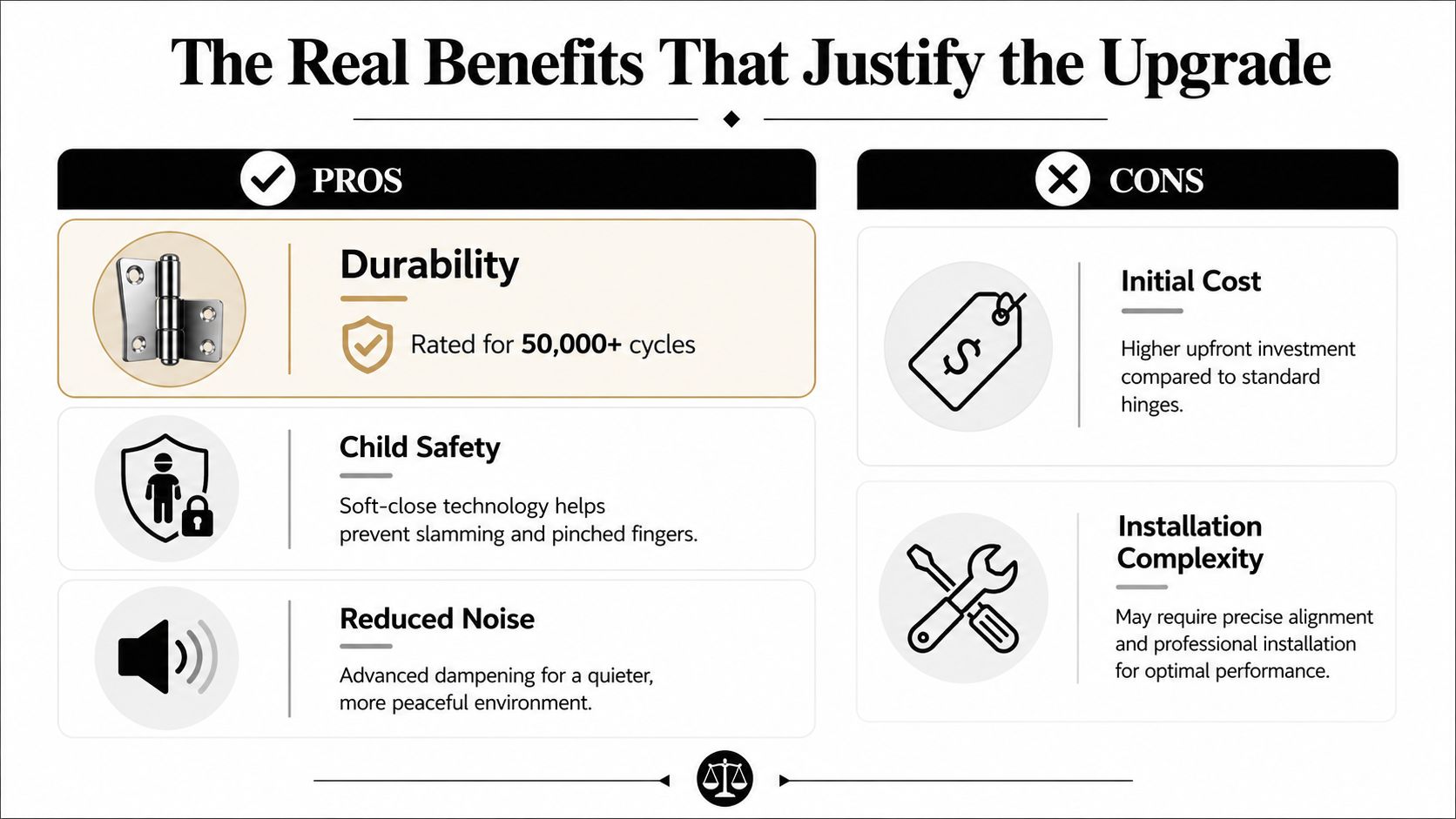
The first thing homeowners notice is the quiet, but the stronger case is wear reduction. Quality soft-close hinges are commonly rated for 75,000 to 100,000 open-close cycles, and some premium systems are documented at 100,000+ cycles. At roughly 20 door cycles per day, that puts a well-made system into many years of ordinary use, which is why soft-close hardware stopped feeling like a luxury and started feeling like standard kitchen hardware.
What the upgrade solves
Open-concept kitchens feel the payoff fastest because sound carries. A loud cabinet in a closed-off kitchen is irritating. The same cabinet in a connected layout can interrupt a conversation, a TV in the next room, or a rushed morning routine. Soft-close hardware also cuts down on the repeated impact that wears on cabinet frames and finish edges.
For families, the safety benefit is plain even if it is modest. A door that eases shut is less likely to catch little fingers or bounce back open. That does not make cabinets childproof, but it does remove one of the more common small hazards in a busy kitchen.
What it won't fix
Soft-close is not a cure for poor cabinet construction. Warped doors stay warped. Loose mounting plates still drift. Cheap boxes still rack, and once that starts, the hardware feels inconsistent no matter how good the mechanism is.
This is the part most sales pages skip. If the cabinet face frame is out of line, if the hinges are mismatched, or if the door swings into a wall, the soft-close feature can only do so much. In those cases, fix the cabinet condition first, then choose the hardware. If you are sorting through replacement options, this hinge replacement guide is a useful place to start.
Bottom line: Soft-close is worth it when the cabinet is fundamentally sound. It is a bandage, not a rebuild.
Retrofit Dampers Versus Full Hinge Replacement
This is the decision homeowners need help with. If your cabinets are structurally fine, you usually have two paths. One is cleaner and more complete, the other is cheaper and easier to live with on older boxes.
| Factor | Retrofit Damper | Full Hinge Replacement |
|---|---|---|
| Best for | Cabinets with usable existing hinges and decent alignment | Cabinets that need a better fit, cleaner feel, or worn-out hinges replaced |
| Upfront spend | Lower | Higher |
| Labor | Faster in many cases | More involved |
| Feel | Helps with the final close, but usually not as refined | Smoother, more integrated soft-close action |
| Compatibility | Works on more existing cabinets, but not all | Must match overlay, cup bore, and opening angle |
| When it fails | Bad alignment, incompatible hinge geometry | If the wrong hinge is ordered, the whole swap becomes a headache |
Quality soft-close hinges typically run about $5 to $15 per hinge, with a 20-door kitchen costing roughly $200 to $600 in hinges alone, and professional installation adding another $200 to $500 (CS Hardware). Some existing hinges can't accept retrofit soft-close and need full replacement instead, which is why no one should promise a universal clip-on fix.
Which path I'd choose
If the cabinets are newer, the doors are square, and the current hinges already sit cleanly, a retrofit damper can make sense. It gets you most of the noise reduction without disturbing the whole setup.
If the doors are tired, the alignment is uneven, or you're already seeing rust, play, or inconsistent closing, replace the hinge system. That's also the better move if you care about the feel of the door at the end of travel, because a full replacement usually gives the more consistent result.
For a deeper look at the replacement side of the work, cabinet hinge replacement guidance is the better place to understand what gets swapped and why.
Simple recommendation
- Choose a retrofit damper when the cabinets are sound, the door geometry is already decent, and you want a quicker fix.
- Choose full hinge replacement when the doors are mismatched, the hinges are worn, or you want the most refined close.
- Avoid forcing a retrofit on a cabinet that already has fit issues, because you'll pay for a feature the cabinet can't use properly.
Matching Hinge Specs to Your Cabinet Style
The wrong hinge will ruin a soft-close upgrade faster than anything else. A door can look fine on the bench, then swing too far, stop short, or slam into a wall because the spec was guessed instead of measured.
Read the three numbers that matter
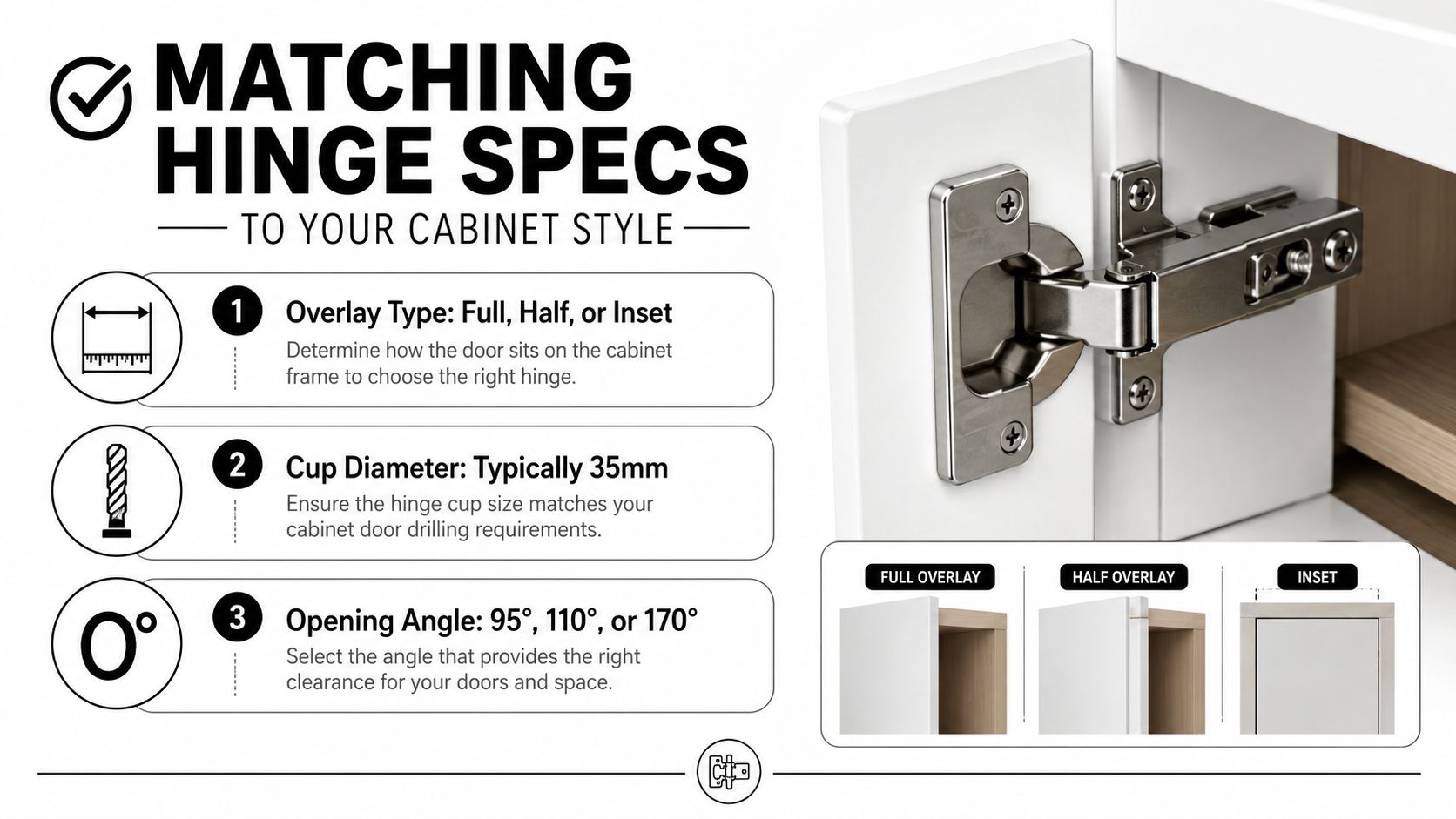
Start with overlay. It tells you how the door sits over the cabinet face, and that is the first spec that has to match the cabinet construction. Then check opening angle. For standard cabinets, soft-close hinges are typically specified around 95 to 110 degrees. Wide-angle and corner applications often call for 165 to 170 degrees (YouTube product demo).
Cup bore size is the other dimension that can sink the job if you ignore it. Many concealed hinge systems use a 35 mm cup, so any hinge swap has to account for that bore even when the hardware looks similar. If the hinge does not seat correctly in the door, the rest of the spec is irrelevant.
Cherry Hill kitchens expose these details fast. Corner cabinets often need wide-angle hinges so the door clears adjacent panels and walls instead of binding halfway open. Tight galley layouts create a different problem, because the aisle and the opposite run of cabinets limit how far the door can swing.
Some hinges need angle-restriction clips when the door must not open past 90 degrees. That matters in compact kitchens, because too much travel can put the door into a wall, appliance, or neighboring cabinet face. If you are sorting through hinge styles and overlay options, expert cabinet hardware selection advice keeps the decision tied to fit instead of showroom language.
Measure the cabinet first, then buy the hinge. Reverse that order, and you end up with a door that looks right in a catalog but fails in the room.
The right hinge is the one that clears the layout and closes cleanly, not the one with the nicest packaging.
What Installation Actually Looks Like
A good retrofit job starts with discipline, not power tools. The installer removes one old hinge at a time so the door stays aligned, dry-fits the replacement, and checks that the door still meets the face frame or cabinet side cleanly before moving on.
The sequence that keeps the door in register
First comes hinge removal on one cabinet door, not the whole room at once. That way the installer can compare the old and new positions, and the door doesn't drift out of alignment while the job is underway.
Next, the new soft-close hinge or adapter gets test-fitted. The mounting plate gets adjusted until the door closes smoothly, the reveal stays even, and the damper engages at the right point instead of too early. If the mechanism is too tight, the door feels sticky. If it's too loose, the closing action gets sloppy.
Then the installer checks for rub points, especially on painted doors and inset-style setups where tiny differences show up fast. A hinge that seems fine on the bench can behave badly once the cabinet is back under real load.
The basics of cabinet hardware installation are simple enough to describe, but they're only simple if the cabinets are already square and the installer respects the adjustment range.
Where DIY usually goes wrong
Over-tightening screws can strip the cup or mounting plate, especially on older cabinets with tired material. Misalignment is the other common mistake, because it changes how the damper engages and can make the door close too early, too late, or not fully at all.
A pro usually handles a straightforward cabinet door much faster than a homeowner who's learning the hardware as they go. The primary value isn't speed alone. It's getting every door to close the same way, which is where the project starts to feel finished instead of patched together.
Costs, Maintenance, and Sourcing in Cherry Hill
The hardware cost is usually less dramatic than people expect. On a full kitchen, the premium for soft-close is often only $150 to $350 for hinges alone, or about $400 to $1,200 total when soft-close drawer slides are included (Alliance Construction). That's why the cost conversation should focus on scope, not sticker shock.
Keep the hardware working
Maintenance is light, but it shouldn't be ignored. Wipe dust off the hinge area, check screw tension once in a while, and don't overload drawers so badly that the slide or damper has to fight the weight every time it closes.
If a door starts drifting or closing unevenly, fix it early. Small alignment issues are easier to correct than worn-out hardware, and most soft-close complaints start as simple adjustment problems. That's especially true in kitchens that get heavy daily use.
Source the project the smart way
The easiest way to buy the wrong hardware is to do it blind. In Cherry Hill and the surrounding South Jersey area, the better approach is to compare finishes, test the close action on real samples, and make sure the hinge match is right before anything gets ordered. That's also where a clear budget breakdown helps, which is why this kitchen remodeling cost guide is useful when you're deciding whether to refresh hardware now or plan it into a larger project.
If you want a cabinet upgrade that feels quiet, precise, and matched to the way your kitchen works, The Cabinet Coach can help you sort out the hinge, damper, and drawer-slide choices without guessing. Visit The Cabinet Coach to book a complimentary video consultation and get a practical plan for your Cherry Hill kitchen, not a generic hardware pitch.