For steamy bathrooms, the safest choice is marine-grade plywood or dense hardwoods such as teak, white oak, and maple. Pair them with a factory-cured conversion varnish, a finish that hardens through a chemical reaction. We cover more options in our post on bathroom cabinets.
Back-to-back hot showers put wood under constant strain, especially without a commercial-grade exhaust fan running. Even moderately moisture-tolerant woods will fail unless the cabinet box and raw edges are completely sealed against vapor penetration.
A weekend spent visiting big-box stores across South Jersey may leave you with plenty of ideas but little useful guidance. Floor displays rarely show how wood handles daily bathroom humidity. The wrong wood or a poorly built box can mean warped frames, swollen doors, and peeling laminate within two to three seasons.
What's Inside This Guide
- Why Steam Destroys Standard Vanities
- Choosing Your Core Material: Solid Hardwood vs. Plywood
- Matching Wood Species to Your Bathroom Ventilation Reality
- Finishes and Hardware for Long-Term Moisture Defense
- Five Essential Steps for Moisture-Resistant Assembly
- Allocating Your Renovation Budget Between Core and Finish
- Questions Camden Homeowners Ask About Steamy Bathrooms
- Planning Your Cabinet Selection and Installation in Camden
Why Steam Destroys Standard Vanities
Steam puts pressure on cabinet materials in an enclosed bathroom. As warm, damp air cools, water collects on cabinet side panels and seeps into unsealed joints. Standard particleboard boxes soak it up, leaving permanent swelling along the bottom kick plates and drawer rails.
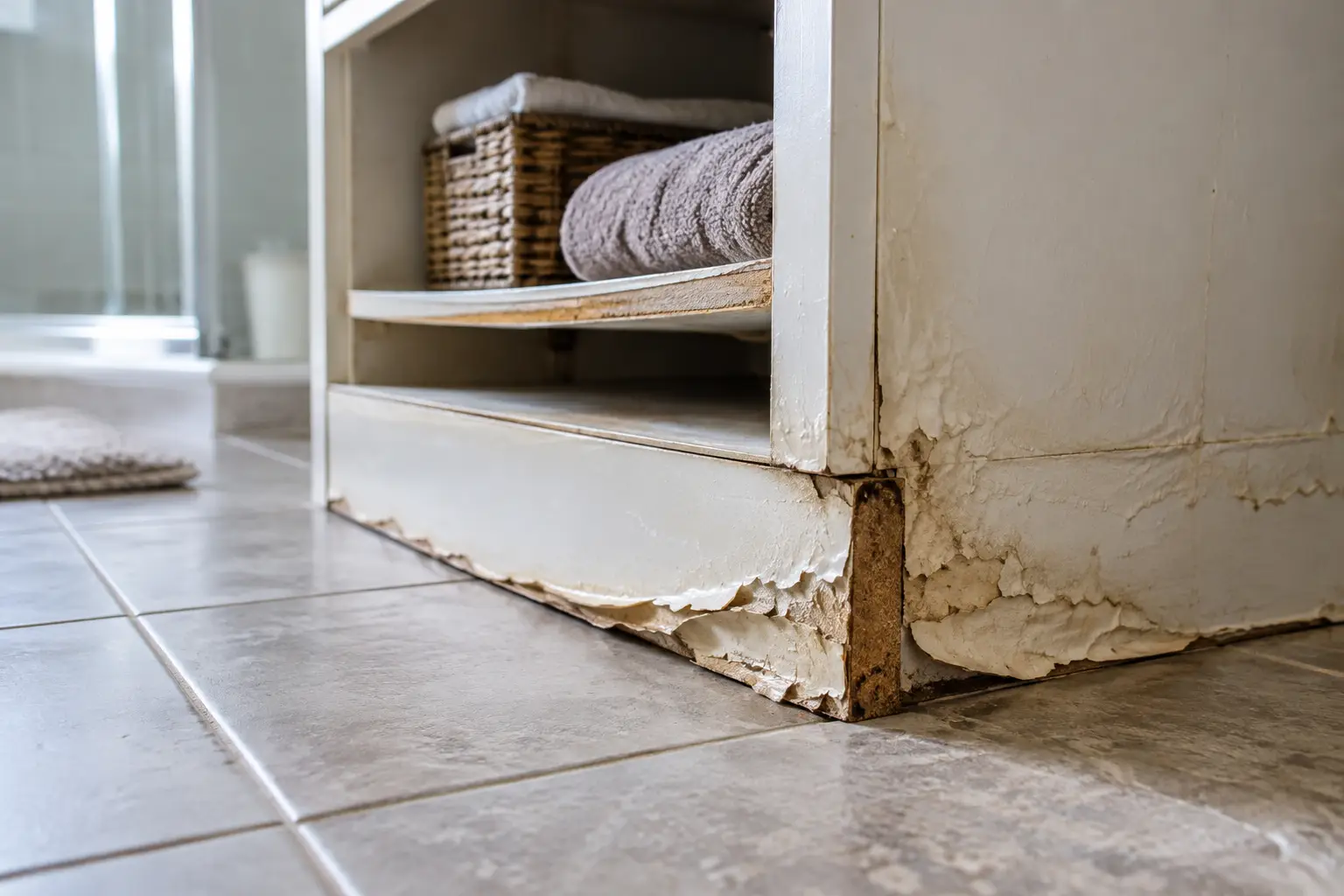
The U.S. Environmental Protection Agency's moisture guidelines explain that unchecked indoor moisture quickly damages porous building materials and harms air quality. In fiberboard, absorbed water breaks down glue and pulls face frames out of square. Drawers start sticking, and soft-close hinges pull out of damaged screw holes.
Practical check: A mirror that still feels damp twenty minutes after a shower calls for cabinet boxes made from exterior-glued plywood or dense hardwoods. Standard medium-density fiberboard is not suitable.
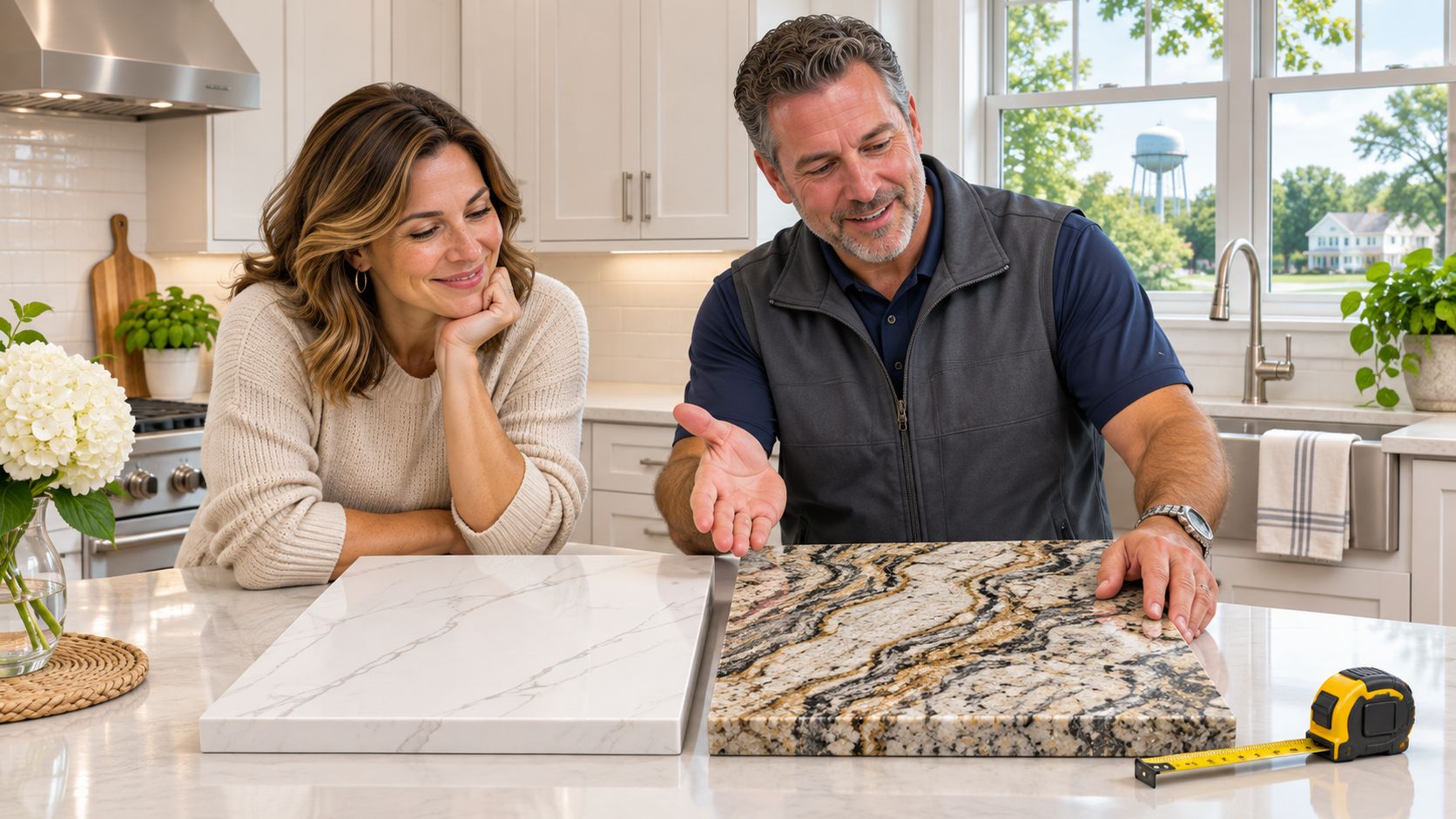
Rather than arrange separate deliveries and work around conflicting trade schedules, you can book an appointment with us. We bring dense wood cross-sections to your driveway in Camden so you can examine the materials at home.
Choosing Your Core Material: Solid Hardwood vs. Plywood
Solid wood is not automatically better than engineered lumber for every cabinet part. Assuming it is can lead to expensive problems in a damp half-bath or a steamy primary suite.
Video: Best Wood for Bathroom Cabinets and Vanities: 8 Species Compared (2026) (USA Cabinet Store Podcast Series)
Evaluating Carcass and Door Stability
Lumber expands across its grain as humidity rises. A solid hardwood face frame gives hinges the strongest hold, but wide solid wood sides can bow. Premium multi-ply birch or marine-grade plywood uses layers with alternating grain directions, which nearly eliminates that movement.
| Cabinet Core Option | Recommended Starting Point | What to Watch |
|---|---|---|
| Marine plywood (A-A grade) | Full cabinet boxes for primary suites with heavy steam | Higher upfront material costs ($$$) |
| Solid white oak / hard maple | Face frames, support rails, and mortise-jointed doors | Door grooves must leave room for expansion ($$) |
| Standard furniture-grade plywood | Guest baths with moderate, occasional shower use | Edge banding needs a polyurethane glue seal ($$) |
| Moisture-resistant MDF (MR-MDF) | Painted flat-panel slab doors only | Never use for base framing or bases exposed to water ($) |
Planning a 10 x 10 kitchen remodel alongside your bathrooms? Choosing coordinated core materials saves time and makes deliveries easier to arrange.
Matching Wood Species to Your Bathroom Ventilation Reality
Density and cell structure determine how quickly wood takes in and releases moisture. Dense domestic hardwoods move predictably, while open-pored woods readily absorb moisture from the air.
USDA Forest Products Laboratory data shows that closed-grain hardwoods shrink and swell substantially less than porous, ring-porous woods such as red oak. In Camden's changing seasons, that difference helps cabinet doors stay flush with their face frames.
| Bathroom Ventilation Situation | Recommended Choice | Avoid |
|---|---|---|
| Enclosed, windowless bath with a standard fan | Teak or white oak with a chemically hardened finish | Red oak, unsealed pine, standard particleboard |
| High-ceiling primary bath with ventilation to the outdoors | Hard maple, birch, or quarter-sawn white oak | Fiberboard with raw edges, unsealed poplar |
| Powder room with a sink and toilet only | Cherry, walnut, or stained hard maple | None; standard cabinet-grade hardwoods hold up reliably |
Installer's rule: Keep red oak out of wet rooms. Its open internal channels draw moisture into the end grain, causing dark patches and mildew beneath clear coats within eighteen months.
To see sample doors under your bathroom's actual lighting, arrange a mobile consultation with us.
Finishes and Hardware for Long-Term Moisture Defense
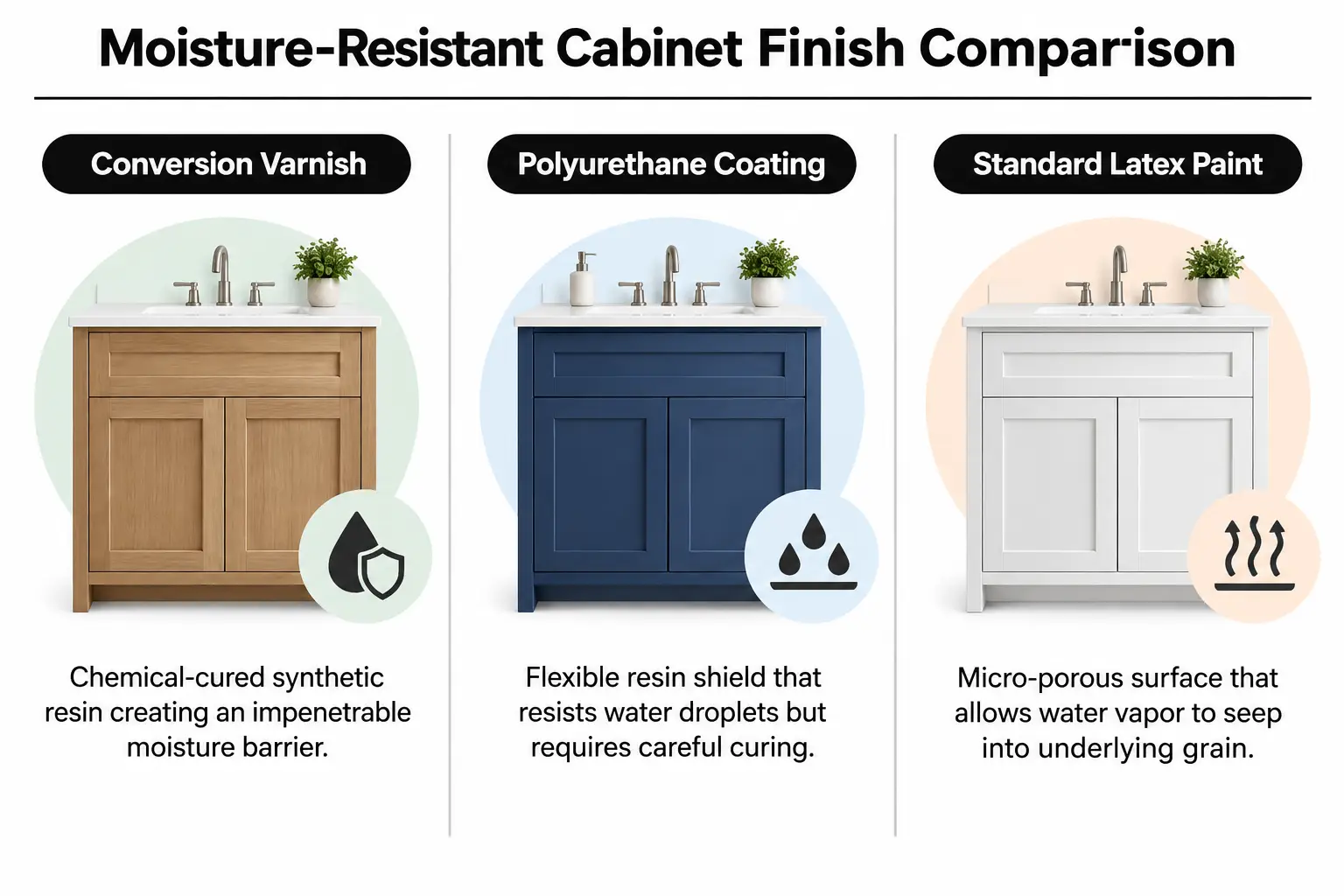
Even water-resistant wood fails if vapor gets through its topcoat. Standard air-dried oil or latex paint has tiny pores that let moisture through. A humid bathroom needs conversion varnish or two-part polyurethane, finishes that cure chemically to form a continuous vapor barrier over every face and edge.
Hardware deserves just as much attention as the finish. Water trapped behind knobs and hinges rusts plain steel screws and stains the surrounding wood. Quality stainless steel or sealed die-cast parts keep doors aligned without spoiling the finish around them.
| Starting Point | Pairing Direction | What to Sample or Test | Intended Effect |
|---|---|---|---|
| Stained white oak | Clear conversion varnish topcoat | Check behind drawer fronts for fully sealed edges | Shows the grain while keeping steam out |
| Painted hard maple | Post-catalyzed enamel hardened with an acid catalyst | Scratch a sample block to test finish flexibility | Resists chips and fine joint cracks, along with soap scum |
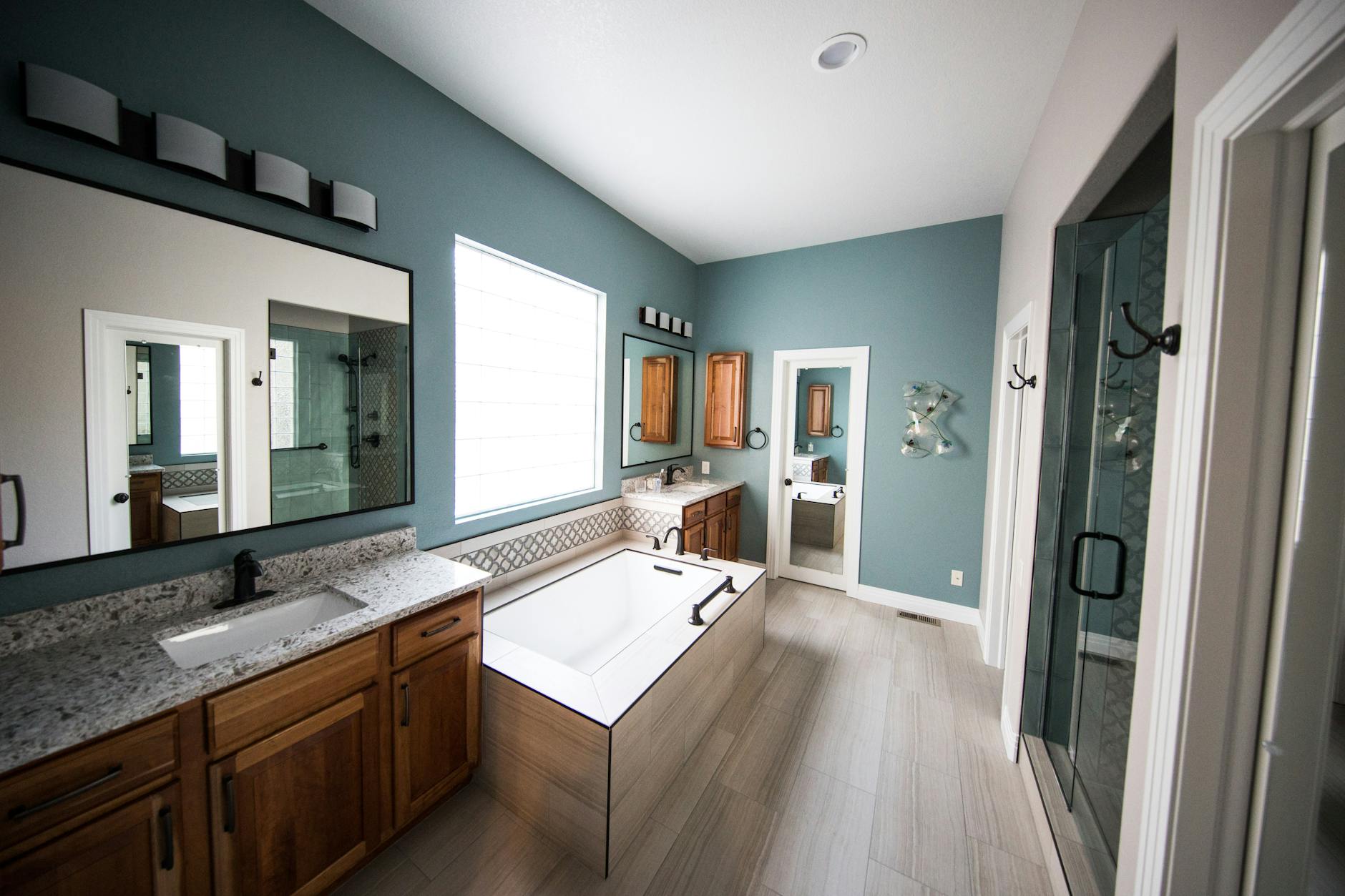
| dark grey bathroom cabinets | Brushed brass or matte black stainless hinges | Confirm the screws' corrosion resistance rating | Adds modern contrast without rust stains |
| a vanity with a makeup area | Integrated quartz top with a splash barrier | Check for a silicone drip edge beneath the counter | Keeps pooled water from running into upper drawers |
Concealed soft-close dampers slow the doors so they close firmly instead of bouncing back. Check these hardware options when reviewing samples to help keep the cabinet interior dry and protected from lingering humidity.
Five Essential Steps for Moisture-Resistant Assembly
Good wood cannot make up for poor assembly or rushed site preparation. The build sequence matters, especially underneath the vanity, where raw edges are easy to miss and moisture can get in unnoticed.
- Seal every raw panel edge: Apply moisture-cured polyurethane adhesive to exposed plywood edges before fastening the face frames together.
- Raise the base off the floor: Fit heavy-duty nylon leveling legs beneath the vanity so wood sides never rest directly on damp tile grout.
- Coat underside cutout openings: Brush two coats of exterior marine spar varnish around plumbing holes drilled through the cabinet's back panel.
- Install water-shedding drip caps: Run a continuous bead of high-grade silicone sealant along the joint between the vanity top and wood box.
- Adjust hinge clearance: Set European hinge depth screws to leave at least a 1/8-inch expansion gap around all four sides of each door.
Before you buy: Look underneath the drawers: unsealed 1/4-inch hardboard bottoms sag in humidity, while 1/2-inch plywood bottoms held in grooves on every side stay flat for decades.
Certification bodies such as the Kitchen Cabinet Manufacturers Association verify these construction standards, including strict twenty-four-hour moisture tests for finishes. Paying for certified construction helps you avoid replacing cabinets before their time.
Allocating Your Renovation Budget Between Core and Finish
As you compare the cost of custom bathroom cabinets, put internal durability ahead of decorative carving. A carved softwood corbel, or support bracket, will rot sooner than a plain shaker cabinet built with an exterior-grade plywood box. The simpler cabinet gives you more for the money where it matters.
| Budget Level | What to Prioritise | What to Question |
|---|---|---|
| Value tier ($) | Plywood boxes with chemically hardened paint | Decorative wood appliques or carved moldings with no practical purpose |
| Mid-range tier ($$) | Quarter-sawn solid frames, dovetail drawers, stainless hinges | Exotic wood veneers on paper-thin backing |
| Premium tier ($$$) | Solid teak or white oak, custom sizing, factory marine seal | Unfinished imported boxes that need messy clear coats applied on-site |
Spending twenty percent more on industrial conversion varnish and a closed-grain hardwood box avoids a second round of removal costs and tile repairs five years later.
Questions Camden Homeowners Ask About Steamy Bathrooms
Can I use solid pine for bathroom cabinets if I seal it well?
Pine is highly porous and moves a great deal as humidity rises and falls. Multiple polyurethane coats still struggle over time. Seasonal movement cracks the finish at frame joints, letting in steam that quickly causes rot.
Is marine plywood better than solid hardwood for vanity boxes?
Yes, marine-grade plywood holds its shape better than solid wood in a cabinet box. Its layers run in alternating grain directions to resist warping. Most high-end custom installations pair a marine plywood box with solid hardwood doors and face frames.
How does bathroom cabinet installation cost compare when using water-resistant wood?
Installation labor costs stay about the same regardless of wood species. Solid white oak or marine plywood typically adds fifteen to thirty percent to the raw cabinet cost. That extra material expense protects against moisture damage that can ruin the subfloor beneath the vanity.
What hinge types work best in high-humidity master bathrooms?
Choose concealed European-style hinges made from nickel-plated die-cast zinc or marine-grade 304 stainless steel for the best performance. Daily shower condensation quickly rusts standard stamped steel hinges, eventually causing them to seize.
Will running an exhaust fan completely protect cheaper fiberboard cabinets?
An exhaust fan sized for the room removes airborne vapor, but wet towels and sink splashes still put water directly on cabinets. Mopping adds moisture at floor level, too. Fiberboard bases eventually absorb that moisture, even with good ceiling ventilation.
Planning Your Cabinet Selection and Installation in Camden
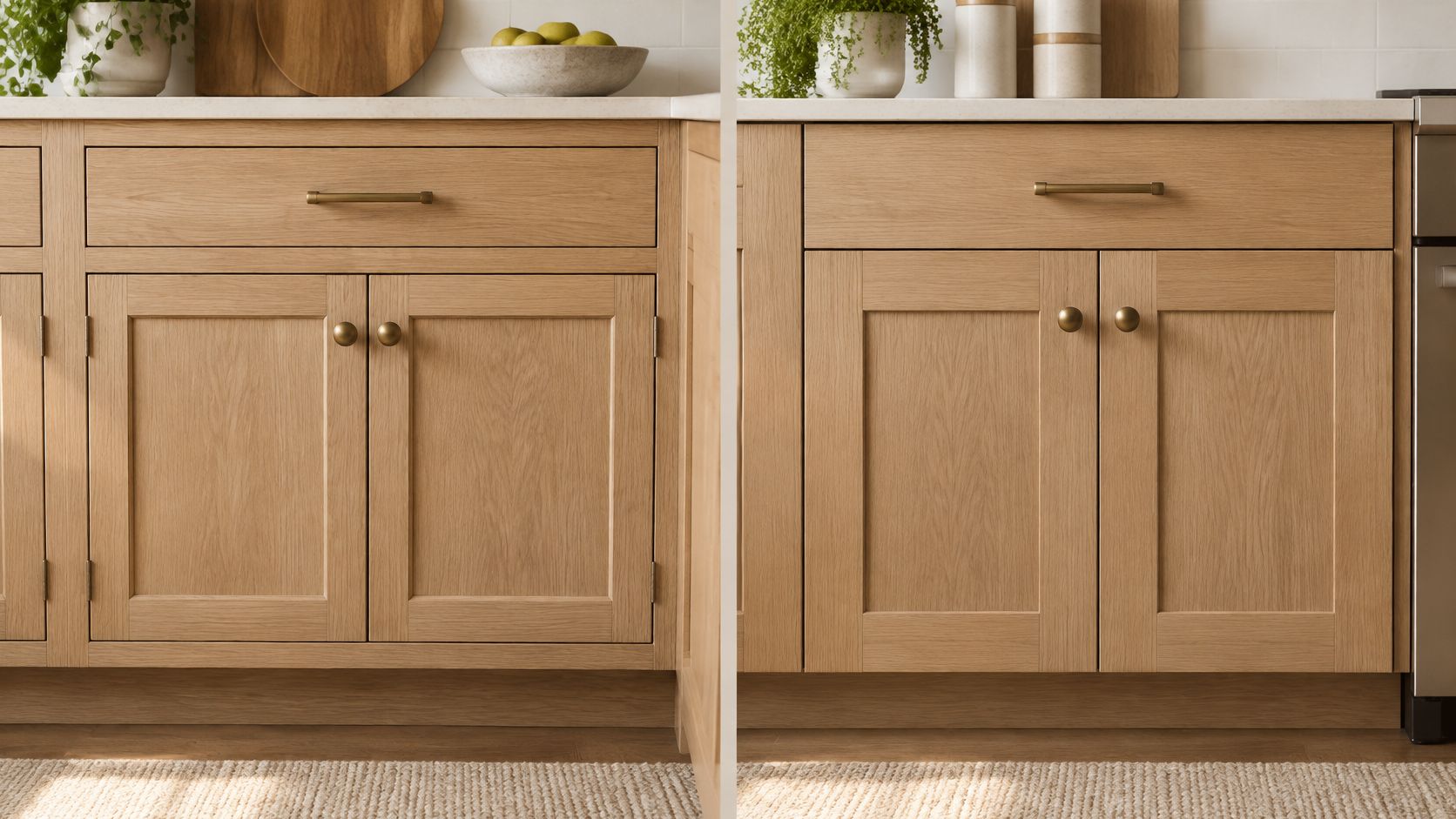
You do not need repeated showroom trips to compare door styles and moisture-resistant materials. At our mobile cabinet design studio in Camden, NJ, we bring door samples and working hardware sets to your home. Our high-resolution layout software lets you review the design there, too.
We measure your space and help you choose materials that suit it. Our team also coordinates the full vanity installation, so you do not have to manage separate subcontractors.
Before you order replacement vanities, check these details with your supplier:
- Confirm box material: Ask for all-plywood or marine-grade boxes, not particleboard.
- Verify finish specifications: Require factory-applied conversion varnish or catalyzed lacquer, which hardens through a chemical reaction.
- Check floor elevation: Make sure leveling legs hold the bottom wood panels above damp bathroom tile.
- Review hardware composition: Specify stainless steel hinges or other corrosion-resistant mechanisms.
- Inspect pipe penetrations: Seal every drilled hole around shut-off valves and drain lines.
For help planning your replacement and comparing samples at home, book your consultation.