
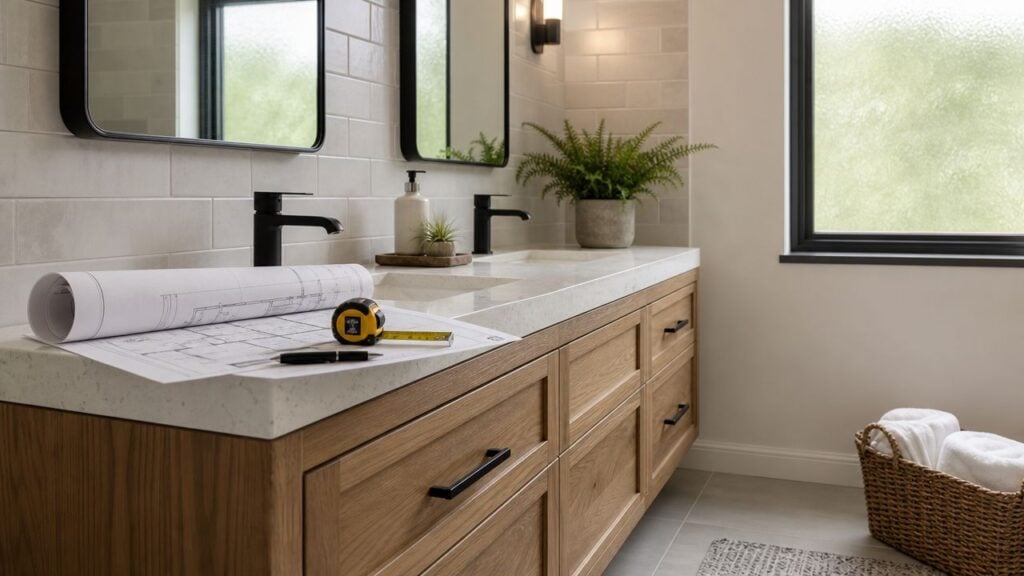
You're probably doing what most South Jersey homeowners do at the start of a bathroom remodel. You've got twelve tabs open, half of them show vanities that look great in a staged photo, and none of them answer the questions that matter in your house. Will it fit between the shower and toilet? Will the drawers clear the door? Will the finish hold up through steamy summers and a family that treats the hall bath like a locker room?
That's where most vanity guides fall apart. They talk style first and function second. I'd flip that completely. The best bathroom vanities aren't the flashiest ones. They're the ones that fit your room, handle moisture, store your daily mess, and still look right five years from now.
If you're remodeling in Cherry Hill, Haddonfield, Moorestown, Collingswood, or anywhere nearby, you also have a few local realities to think about. Older homes often have quirky plumbing locations, tighter layouts, uneven floors, and walls that aren't as straight as the listing photos suggested. Newer homes may give you more room, but they still punish bad planning. A vanity that's too deep or too bulky can make a decent bathroom feel cramped every single morning.
Table of Contents
- The Foundation Sizing and Measuring Your Space
- Choosing Your Vanity Style and Type
- A Guide to Vanity Materials and Countertops
- Maximizing Storage and Functionality
- Budgeting and Installation Realities in South Jersey
- The Cabinet Coach Advantage A Simpler Process
- Your Perfect Bathroom Vanity Awaits
The Foundation Sizing and Measuring Your Space
The first job isn't choosing a finish. It's measuring the room correctly.
A lot of bad vanity decisions happen because someone measures the wall and stops there. That gives you a rough number, not a usable one. In real bathrooms, you have door swings, baseboard trim, toilets, shower glass, heat registers, outlets, and plumbing that all compete for the same few inches.
Start with the footprint
Begin with the full width of the wall where the vanity will sit. Then measure depth from the finished wall out toward whatever sits opposite it, whether that's a toilet, shower edge, or the path you walk through every day.
Common single-sink vanities are typically 24, 30, 36, 48, and 60 inches wide, while double-sink units are usually 60 to 72 inches. Standard depth is often around 21 inches, and height ranges from 31 to 35.5 inches. Those dimensions directly affect fit and plumbing, as outlined in Lowe's bathroom vanity buying guide.

Use this quick measuring routine before you shop:
- Measure wall width: Go baseboard to baseboard, then note any trim, casing, or side wall irregularities.
- Check usable depth: Measure from the wall to the nearest obstruction, not just to the center of the room.
- Record height limits: Window stools, medicine cabinets, and light fixtures can affect what works.
- Mark plumbing locations: Note where the drain exits and where supply lines come through.
- Test door and drawer clearance: Open the bathroom door fully. Then imagine vanity drawers pulled out.
- Look for electrical conflicts: GFCI outlets and switch boxes can land right where a backsplash or side panel wants to be.
Measure the details that cause problems
Plumbing location matters more than people expect. If the drain is offset and you buy a vanity with a bank of drawers in the wrong spot, you've just bought yourself a change order. That's why I always tell homeowners to take photos, write down dimensions, and mark the centerline of the drain before they fall in love with a vanity online.
Practical rule: If a vanity fits on paper but pinches circulation in real life, it doesn't fit.
Depth is the sneaky troublemaker. A vanity can be the right width and still make the room miserable if it sticks out too far. In many South Jersey homes, especially older ones, you don't have the luxury of wasting floor space just because a showroom display looked generous.
If you're considering a double vanity, it helps to look at real sizing expectations before you decide. This guide on standard double vanity sizing is useful because it grounds the decision in fit, not wishful thinking.
My blunt advice is simple. Measure once for the wall. Measure again for how people move through the room. The second number is the one that saves the remodel.
Choosing Your Vanity Style and Type
Style matters. It just needs to serve the room instead of fighting it.
The vanity sets the tone for the whole bathroom. It's usually the largest visual block in the space, so the shape and mounting style do more work than the color. That's why the best bathroom vanities aren't picked from a trend list. They're matched to the layout first, then to the house.
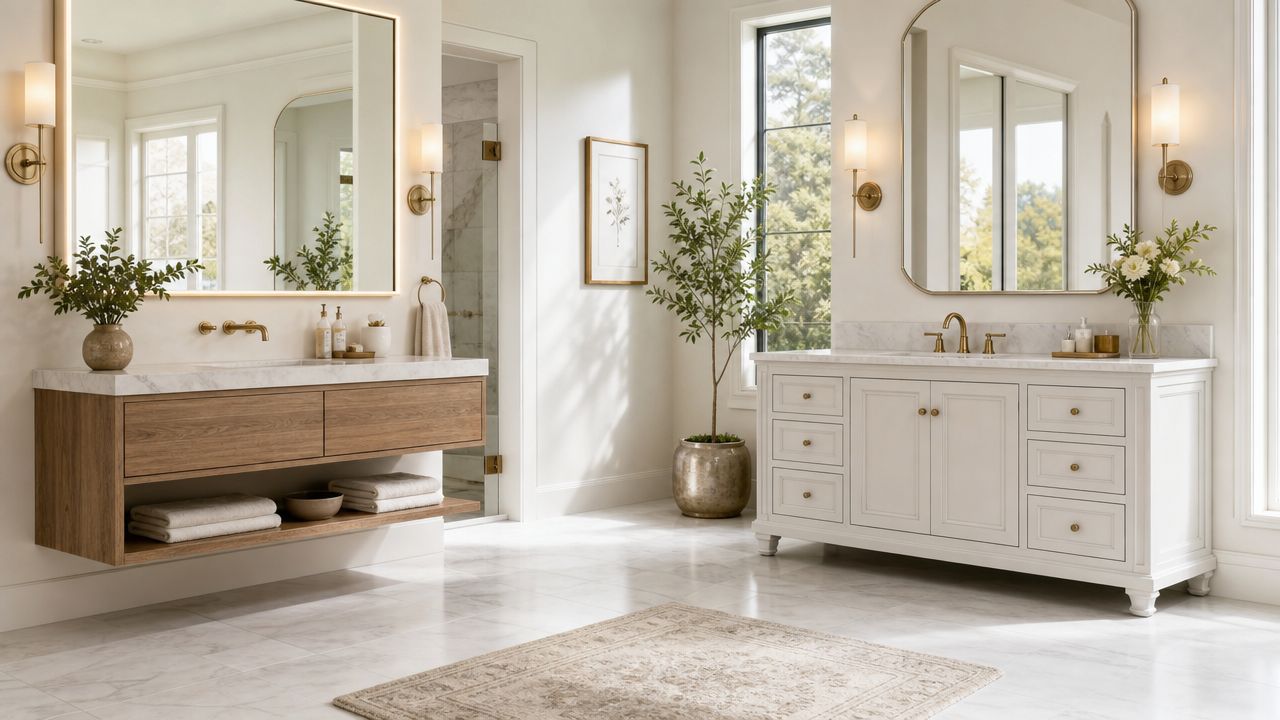
Freestanding vs floating vs corner
A freestanding vanity is the safe choice for most homes. It gives you a furniture-like presence, usually offers straightforward installation, and works well in traditional, transitional, and classic bathrooms. In a Moorestown colonial or a Haddonfield older home, that look often feels right.
A floating vanity works differently. It visually opens the floor, which makes a tight bathroom feel less boxed in. That's one reason comfort-height models and space-saving styles have gained attention. Industry trend guidance notes that 36-inch comfort-height models are replacing older, shorter vanities, and floating vanities are projected to see 15 to 20 percent year-over-year growth in 2026, reflecting demand for visual openness, according to Next Day Cabinets' 2026 vanity trends overview.
A corner vanity is the fix for the bathroom that never made sense to begin with. If the room has an awkward entry, a tight powder room footprint, or a strange wall jog, a corner setup can preserve walking space better than forcing a standard rectangle into the room.
Here's how I size up the main options:
- Freestanding: Best when you want maximum enclosed storage and a grounded look.
- Floating: Best when the room feels narrow, dark, or crowded at floor level.
- Corner: Best when traffic flow is the primary problem, not just cabinet width.
- Open-base furniture style: Best when you want visual lightness and don't need every inch hidden behind doors.
If you want visual inspiration before narrowing the field, these bathroom cabinet ideas are a useful jumping-off point.
Single sink vs double sink
A double vanity sounds like the obvious upgrade in a primary bath. Sometimes it is. Sometimes it's just two smaller work zones pretending to be a luxury.
If two people really use the bathroom at the same time, double sinks help. If one person spreads out makeup, grooming tools, or shaving gear across the counter every morning, one larger sink setup with more landing space can work better.
A double vanity only makes sense if both sink stations are comfortable to use. Two cramped bowls and no counter space is not an upgrade.
Take a look at this video if you want to compare styles and layouts in a more visual way before locking in a direction.
My opinion: choose the vanity type that fixes the room's biggest problem. If the room feels crowded, go floating or corner. If storage is weak, go freestanding with drawers. If the bathroom already works well, then you can afford to make the decision more about character.
A Guide to Vanity Materials and Countertops
Buyers either make a smart investment or buy a future problem.
A vanity can look beautiful online and still be built like a disposable piece of furniture. Bathrooms are wet, humid, and used hard. Steam, splashes, toothpaste drips, wet hands, cleaning products, and minor plumbing leaks all test the cabinet long before style does.
The cabinet box matters more than the door style
If you remember one construction rule, make it this one. Prioritize a plywood cabinet box with moisture-resistant finishes.
That's the strongest expert consensus for humid bathrooms. Industry guidance points to a plywood cabinet box with moisture-resistant finishes as the gold standard because it resists swelling and delamination better than particleboard in wet conditions, as discussed in this professional vanity materials guide.
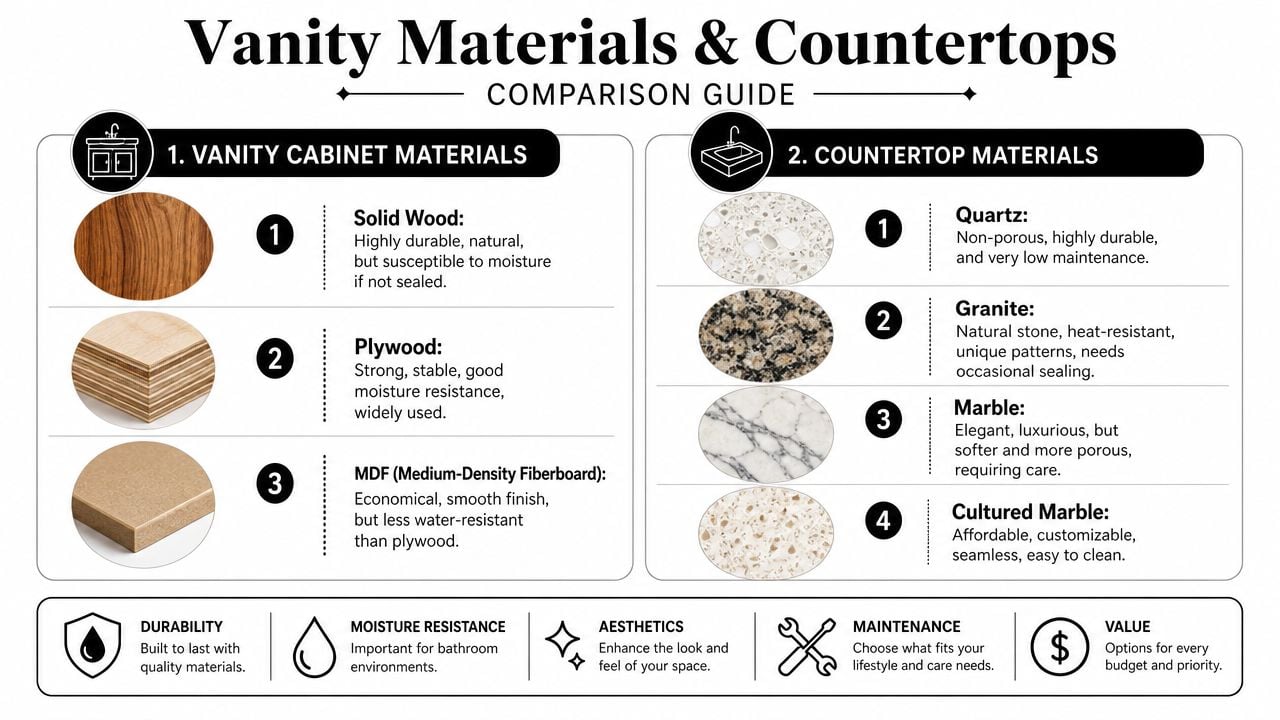
Here's how I'd rank common cabinet materials in a real bathroom:
- Plywood: My first pick for most remodels. Stable, durable, and better suited to humidity.
- Solid wood: Strong and attractive, but it still needs proper sealing and smart construction.
- MDF: Can work in the right application, especially for painted finishes, but it needs protection from water exposure.
- Particleboard: I avoid it for busy bathrooms whenever possible. It's the material most likely to disappoint once moisture gets involved.
Look beyond the brochure. Check the back panels, drawer construction, edge sealing, and hardware. Full-extension slides and soft-close hardware matter because you'll use them every day, not just admire them at install day.
Don't pay premium money for a vanity with weak internals. Fancy paint on a cheap box is still a cheap box.
Countertops that hold up to daily life
Countertops change both maintenance and look. For most households, quartz is the easiest recommendation. It's non-porous, durable, and simple to live with. That matters in a family bathroom where nobody wants a fussy surface.
Granite can work well if you like natural movement and don't mind occasional sealing. Marble looks fantastic, but it asks for more care and a little more forgiveness when etching or wear shows up. Cultured marble can make sense if you want an easy-clean integrated look at a more approachable price point.
If you're comparing smooth solid-surface options, this overview of Corian countertops helps clarify where they fit.
Vanity Material & Countertop Comparison
| Material | Type | Durability | Moisture Resistance | Typical Cost |
|---|---|---|---|---|
| Plywood | Cabinet | High | Good | Mid to high |
| Solid Wood | Cabinet | High | Moderate, depends on sealing | High |
| MDF | Cabinet | Moderate | Lower than plywood | Low to mid |
| Quartz | Countertop | High | High | Mid to high |
| Granite | Countertop | High | Good, with sealing | Mid to high |
| Marble | Countertop | Moderate to high | Lower, needs care | High |
| Cultured Marble | Countertop | Moderate | Good | Low to mid |
A good vanity material decision is boring in the best possible way. Nothing swells. Nothing flakes. Nothing smells musty a year later. That's the standard you want.
Maximizing Storage and Functionality
Storage is where a vanity proves whether it was chosen by a real user or by a Pinterest board.
The core issue isn't more bathroom square footage, but rather a better place for backup soap, hair tools, skincare, medicine, cleaning supplies, and all the small daily clutter that takes over the counter. That's why I care less about raw size and more about interior layout.
Why drawers beat empty cabinet space
Big empty cabinet boxes waste space. You end up crouching down, reaching behind a drain line, and knocking over half a basket to get one thing. Drawers fix that.
A vanity with deep lower drawers, smaller upper drawers, and a sensible sink base will beat a giant two-door cabinet almost every time. Full-extension drawers let you see what you own. Soft-close hardware keeps the piece from feeling cheap six months in.
If you want one small upgrade that pays off every day, add organizers where they matter most:
- Top drawers: Best for toothbrush heads, cosmetics, razors, and smaller daily-use items.
- Deep drawers: Better for hair dryers, extra toilet paper, cleaning products, and backup toiletries.
- Tip-out storage: Handy near the sink for little items that otherwise clutter the top.
- Outlet integration: Useful if you want to charge toothbrushes or hide grooming tools inside the vanity.
A clever example is using tip-out trays for hidden storage at the sink instead of accepting that false-front panel as wasted space.
Smart layouts for tight South Jersey baths
Small bathrooms need smarter planning, not just smaller cabinets. That's why I often push back when someone assumes a narrower vanity is automatically the right move.
For small bathrooms, the best vanity isn't always the smallest. A well-organized 42-inch unit can outperform a cramped 30-inch one, and open-base or wall-hung designs can make a room feel more spacious than a boxy floor-standing cabinet, as noted in this small bathroom vanity guide.
That matches what I see in local homes. In a compact hall bath, a slightly wider vanity with better drawers can solve clutter without making the room feel tight, especially if the design stays visually light. In powder rooms, wall-hung and open-base designs often feel cleaner because you see more floor and less bulk.
My rule is simple. Buy the vanity that improves your morning routine. If it stores more, cleans easier, and keeps the countertop clear, it's doing its job.
Budgeting and Installation Realities in South Jersey
A bathroom vanity budget isn't just the cabinet price. That's the mistake that gets people into trouble.
A complete budget includes the vanity cabinet, countertop, sink, faucet, hardware, demo, disposal, plumbing hookup, finish work, wall repair, paint touch-up, and sometimes electrical changes. If the plumbing needs to move because the new drawer layout conflicts with the old rough-in, the budget changes fast.
What your budget actually needs to cover
The most overlooked spec in budgeting is depth. Cabinet depth affects countertop choice, sink fit, faucet placement, and walking clearance. Robertn notes that a best-practice bathroom vanity often centers around about 21 inches of depth, with common production ranges from 20 to 23 inches and compact options down to 16 to 18 inches, because depth affects both sink compatibility and room clearance in a major way, according to this bathroom vanity depth guide.
That matters in South Jersey because many older homes don't give you extra room to correct a bad assumption. In a narrow bath, a deeper vanity can force toilet clearance issues or make the entry feel awkward. In a primary bath, the wrong depth can limit sink options or crowd the traffic path.
A realistic planning checklist should include:
- Cabinet and top together: Confirm whether the vanity includes the top and sink or not.
- Plumbing compatibility: Existing supply and drain locations can either save money or create extra work.
- Wall and floor condition: Out-of-level floors and out-of-plumb walls are common and affect installation.
- Electrical coordination: New mirrors, sconces, and medicine cabinets often trigger electrical updates. If you're adding or relocating fixture wiring, a licensed lighting installation electrician is the right trade to bring in early.
Why installation is not the place to cut corners
DIY sounds cheaper until the top isn't level, the backsplash gaps at the wall, the trap doesn't line up, or water gets behind the cabinet because sealing was rushed. A vanity install has enough moving parts that mistakes tend to be expensive instead of cosmetic.
In towns like Haddonfield, Moorestown, or Collingswood, older houses can add another layer of unpredictability. You may open the wall and find previous patchwork, outdated shutoffs, or framing that makes a “simple swap” less simple. Even where permits aren't required for a like-for-like change, larger remodel scope can trigger review. Check with your town before work starts, not after.
If multiple trades are involved, someone needs to manage the order of work and keep details from slipping. This guide on managing contractors during a remodel is worth reading because coordination mistakes are where budgets leak.
My advice is firm here. Spend carefully on the vanity. Spend confidently on the install. A well-installed mid-priced vanity will usually outperform a premium vanity installed badly.
The Cabinet Coach Advantage A Simpler Process
Most homeowners don't struggle because they lack taste. They struggle because the decision chain gets too long.
You start with a vanity idea. Then you need cabinet dimensions, finish samples, top options, sink style, hardware, tile coordination, lighting, plumbing alignment, and someone to confirm it all works together in your actual bathroom. That's where the process matters as much as the product.
How the process works in a real home
A simpler route is bringing selections into the house instead of driving from showroom to showroom and trying to remember what “warm white” looked like under different lights. That's the practical appeal of The Cabinet Coach's mobile showroom model. It lets homeowners review cabinetry, countertops, hardware, and related finish options in their own space, where wall color, flooring, and natural light are already part of the decision.

That's especially useful in South Jersey homes where bathrooms vary wildly from one neighborhood to the next. A newer home in Mount Laurel may need a cleaner process for coordinated finishes. An older bathroom in Audubon or Merchantville may need more problem-solving around fit, trim, and existing conditions.
Here's what usually changes once selections happen at home:
- Finishes get clearer: The stain or paint color reads differently under your lighting than it does in a showroom.
- Scale gets more honest: A vanity that seemed modest in a large display area can feel oversized in a compact bath.
- Coordination improves: Hardware, top samples, and tile are easier to judge when they're next to your actual flooring and paint.
- Decision fatigue drops: You stop second-guessing because you're comparing fewer, better-matched options.
Why seeing samples at home changes decisions
I've watched plenty of homeowners walk into a store convinced they want one look, then change direction once they see materials against their own wall color and under evening light. That's not indecision. That's good judgment.
The right vanity often becomes obvious only after you see it in the room it has to serve.
A mobile selection process also helps with practical details people tend to miss in retail settings. Drawer pull projection, side splashes, mirror width, faucet reach, and finish undertones all make more sense when you're standing in the actual bathroom instead of an aisle.
If you're overwhelmed by too many choices, that's usually a sign you need a tighter process, not more browsing.
Your Perfect Bathroom Vanity Awaits
The best bathroom vanities earn their place. They fit the room correctly, use materials that can handle humidity, store the things you use, and make the bathroom easier to live with every morning.
Start with measurements. Be strict about clearances. Choose a style that solves the room's biggest problem instead of chasing a trend. Put your money into solid construction, a practical countertop, and storage that works. Then make sure the installation is handled carefully, because a good vanity still fails if the setup is sloppy.
That's the whole game. Size, durability, function, and fit.
If you get those four right, the finish color and hardware become the enjoyable part instead of a stressful guessing match.
If you want help narrowing the options and seeing real cabinet, countertop, and hardware choices in your own home, The Cabinet Coach offers a mobile showroom process for South Jersey homeowners that makes bathroom vanity decisions a lot easier to sort through.