

A lot of South Jersey bathroom remodels start the same way. Two people are trying to get ready in one space, the counter is crowded, one sink isn't enough, and the room feels smaller every year because the routine keeps exposing the same bottlenecks.
That usually leads to the big question: what is the right double vanity size standard for a real home, not a showroom display? If you're in Cherry Hill, Haddonfield, Moorestown, Voorhees, or one of the older surrounding neighborhoods, that question matters even more because bathroom footprints vary wildly from house to house. A vanity that looks perfect online can feel oversized, undersized, or just awkward once it's inside your actual room.
The good news is that double vanity sizing isn't random. There are established standards for width, depth, and height, and those standards exist for practical reasons. Once you understand how those dimensions affect elbow room, storage, circulation, and plumbing, the choice gets much easier.
Table of Contents
- Starting Your Bathroom Remodel Dream
- The Three Key Numbers for Any Double Vanity
- Planning Your Layout and Essential Clearances
- Special Considerations for Plumbing and Accessibility
- A South Jersey Homeowners Guide to Vanity Selection
- From Standard Sizes to Your Perfect Space
Starting Your Bathroom Remodel Dream
A couple in Cherry Hill usually doesn't begin with a tape measure. They begin with frustration. One person is at the sink, the other is waiting for counter space, and both are tired of storing daily items in drawers across the room because the vanity can't handle the load.
That frustration often turns into a simple wish. Two sinks. More room. Better storage. A cleaner look. Then the uncertainty hits. Will a double vanity actually fit, or will it swallow the room and make the bathroom harder to use?
That's the moment when standards become useful. Not because a standard gives you one answer, but because it gives you a reliable place to start. You stop guessing and begin planning around dimensions that have been proven to work in shared bathrooms.
If you're still at the early stage, it helps to step back and look at the project as a whole before choosing fixtures. A practical guide on how to plan a bathroom remodel can help you organize layout priorities, budget decisions, and finish selections in the right order.
A vanity choice also ties directly to home value, especially in primary baths where buyers notice function as quickly as finishes. That's why many homeowners look at both design and long-term payoff before committing to a layout, and it's worth reviewing how bathroom updates affect value at https://www.thecabinetcoach.com/bathroom-remodel-return-on-investment/.
A double vanity only feels luxurious when the room still works around it.
In South Jersey, that balance matters. A newer home may have the wall length for a larger cabinet and generous mirrors. An older ranch or split-level may need tighter planning, smarter storage, and a stronger focus on circulation. Either way, the right answer isn't the biggest vanity you can force into the room. It's the one that supports the way you live.
The Three Key Numbers for Any Double Vanity
Every double vanity is defined by three measurements: width, depth, and height. If you understand those three numbers, you can sort through almost any vanity listing without getting distracted by styling language or marketing terms.
The core standard is straightforward. The best size for a double vanity notes that the standard width is a minimum of 60 inches, the most popular sizes are 60 to 72 inches, depths average 21 inches, and vanity height has shifted from 30 to 32 inches to a modern 36-inch comfort height.

Width sets the experience
Width is the first number often noticed, and for good reason. It determines whether two sinks will feel shared or cramped.
A 60-inch vanity is the recognized starting line for a standard double vanity. It's the minimum size that allows two sinks to exist without the setup feeling forced. In many bathrooms, that size works well because it gives each person a defined station while keeping the overall footprint manageable.
A 72-inch vanity usually feels calmer in daily use. You gain more landing space for soap, toothbrush holders, cosmetics, and the things people leave out. You also have more flexibility for drawer banks, center storage, and mirror spacing.
An 84-inch vanity can look impressive, but it isn't automatically better. In the wrong room, it steals breathing room and makes door swings, drawer access, and walkway comfort worse.
Depth controls movement
Depth sounds minor until the vanity is installed. Then it's the number that decides whether the room feels easy or tight.
Most double vanities fall within an 18 to 24 inch depth range, with 21 inches being the average. That middle ground works because it supports a standard sink setup without pushing too far into the bathroom.
A shallower vanity can help in tighter rooms, especially if you need to protect walkway space. A deeper vanity adds counter area, but it can make the room feel more crowded fast. That's one reason smaller bathrooms often benefit from studying solutions used in compact layouts, such as the ideas collected at https://www.thecabinetcoach.com/blog-small-bathroom-design-ideas-cherry-hill-nj/.
Height affects comfort every day
Height is the number people underestimate most. They focus on whether the cabinet fits, then live with a height that doesn't feel right for years.
Older vanity standards centered around 30 to 32 inches. Many newer remodels use a 36-inch comfort height, which aligns more closely with kitchen counter expectations and generally feels better for daily grooming.
That doesn't mean every user will love the tallest option. A vanity can be technically standard and still feel wrong for the people using it. That's why height should be treated as an ergonomic decision, not just a catalog spec.
Here is a simple comparison view.
| Dimension | Standard Range | Most Common | Best For |
|---|---|---|---|
| Width | 60 to 72 inches | 60 inches | Shared bathrooms that need two sinks without custom sizing |
| Depth | 18 to 24 inches | 21 inches | Balancing sink space with comfortable room circulation |
| Height | 30 to 36 inches | 36 inches | Modern remodels prioritizing daily comfort |
Practical rule: If you're torn between sizes, decide based on how the vanity will be used at 7 a.m., not how it looks empty in a product photo.
Planning Your Layout and Essential Clearances
A well-sized vanity can still fail if the surrounding layout is off. That's where many remodel regrets come from. The cabinet technically fits, but the room doesn't function well once doors, drawers, people, and daily habits enter the picture.
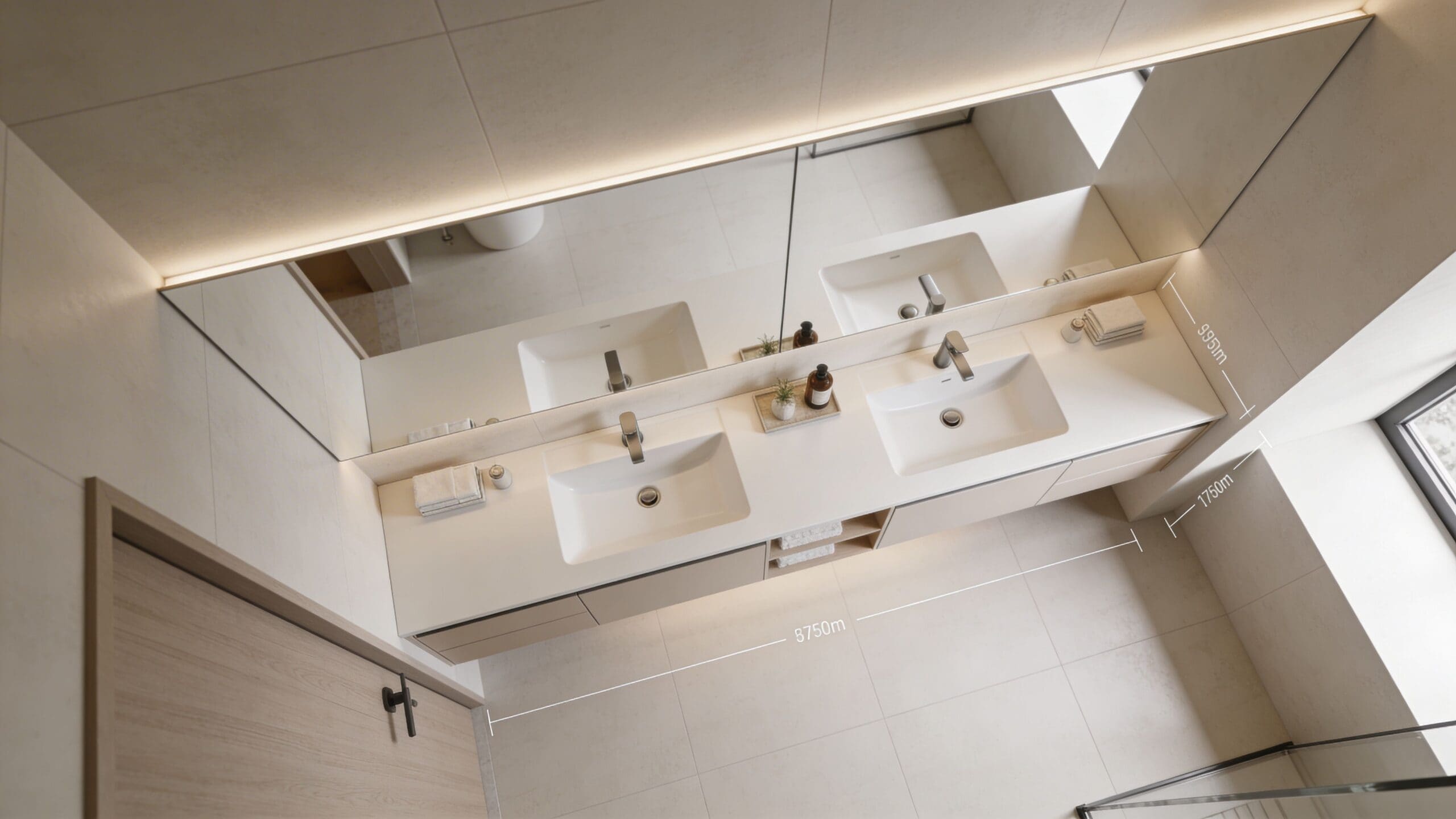
The most useful planning rule comes from the space each person needs, not just the vanity width itself. Wayfair's double vanity size guide recommends at least 30 inches per sink basin plus 12 to 18 inches for central bridging, and it also notes 30 inches of clear floor space in front of the vanity for safe movement.
The sink zone matters more than the cabinet label
This is why a vanity labeled "double" isn't automatically a good double vanity.
A narrow cabinet with two bowls can still feel like one crowded workstation. The sink centers, faucet placement, and shared counter area decide whether two people can use the vanity at the same time without bumping elbows or blocking each other.
When I evaluate a layout, I look at three human actions first:
- Standing room: Each user needs enough side-to-side space to lean in, turn, and reach without colliding.
- Drawer access: Lower drawers and doors must open while someone is standing at the sink.
- Exit path: The bathroom can't trap one person behind another during a busy morning.
A vanity can look balanced on paper and still fail one of those tests.
Map the room before you shop
Before you compare finishes or hardware, map the bathroom on the floor. Painter's tape works. Cardboard works. A full-scale outline tells the truth quickly.
Check these items in order:
Wall length
Measure the actual available wall, not the rough estimate you remember.Front clearance
Confirm that the vanity won't crowd the path between the cabinet and the opposite fixture.Door swing
Entry doors, shower doors, and nearby drawers shouldn't compete for the same space.Fixture relationships
Toilets, tubs, and shower curbs affect the room more than vanity buyers expect.
If your shower and vanity are part of the same remodel, it's smart to understand how both footprints interact. Reviewing common shower sizes at https://www.thecabinetcoach.com/typical-shower-stall-dimensions/ can help you avoid a layout where each fixture fits individually but the room feels jammed once both are installed.
Video can help if you're trying to visualize spacing in a real room:
If the vanity forces you to turn sideways to pass through the room, it's too big for that layout, no matter how nice it looks.
In many South Jersey bathrooms, the smartest move is restraint. A slightly smaller vanity with better clearance often produces a room that feels larger, works better, and ages more gracefully than a bigger cabinet squeezed wall to wall.
Special Considerations for Plumbing and Accessibility
Standard sizing works well until the household has a specific need the standard doesn't fully solve. That often happens with aging-in-place planning, height differences between users, or bathrooms where the existing plumbing doesn't line up neatly with the vanity being considered.
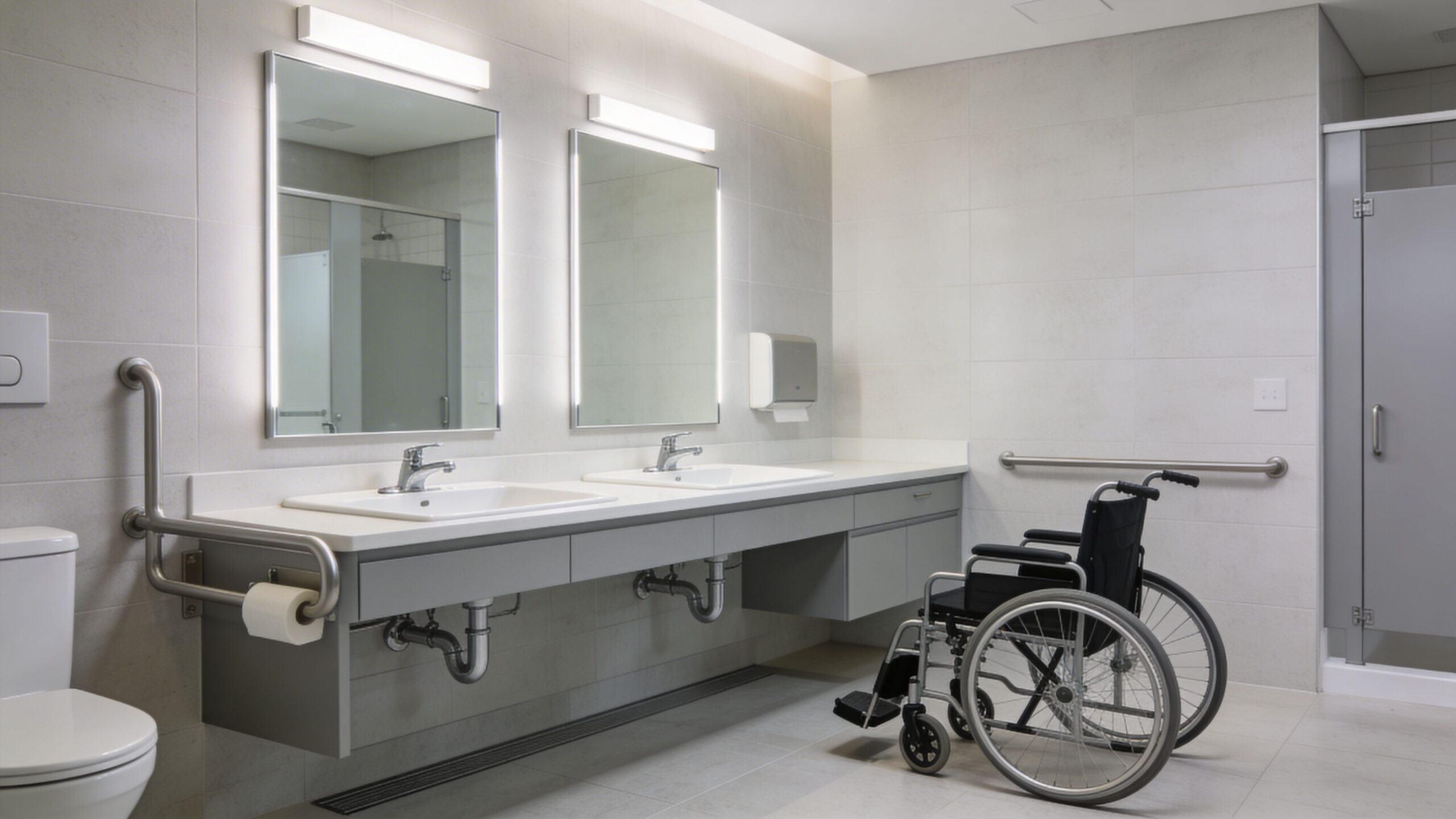
Accessibility changes the starting point
A lot of homeowners hear "accessible vanity" and assume that means a clinical look or a highly specialized installation. In reality, accessibility planning often improves comfort for everyday use, especially in homes where owners want to stay long term.
For aging-in-place and shared-use planning, Edward Martin's standard double vanity size guide notes that post-2025 ADA updates emphasize vanity heights in the 34 to 38 inch range. That creates a more flexible decision window than defaulting to one fixed height.
That range matters because accessibility isn't just about wheelchair use. It can also affect:
- Approach comfort: The user should be able to reach the sink and faucet without overextending.
- Mirror usability: Mirror height and placement need to match the vanity decision.
- Knee and leg space: Some accessible layouts need open space below part of the vanity.
The faucet, sink bowl shape, countertop edge, and surrounding fixtures all matter here too. If you're comparing fixture styles at the same time, https://www.thecabinetcoach.com/a-guide-to-choosing-the-perfect-kitchen-or-bathroom-fixture/ is a useful reference for coordinating appearance with practical use.
Plumbing rough-ins can decide the project
This is the part homeowners don't always see coming. You may find the right vanity size, the right cabinet finish, and the right top, then discover the existing supply and drain locations don't match the plan cleanly.
When accessibility adjustments or nonstandard heights require plumbing changes, the same Edward Martin resource notes that plumbing rerouting in New Jersey can cost $1,200 to $2,500, based on 2025 Angi data cited there. That doesn't mean every project will need it. It means you shouldn't assume a height change is free.
A few trade-offs show up often:
| Issue | What works | What doesn't |
|---|---|---|
| Existing drain locations | Choosing a vanity that aligns closely with current rough-ins | Picking a cabinet with drawers that conflict with drain placement |
| Accessible height planning | Confirming sink, trap, and top details before ordering | Choosing height first and checking plumbing later |
| Countertop overhang | Accounting for side and front projection during measurement | Measuring only the cabinet box and ignoring the finished top |
Countertop details matter more than they seem. Some tops include slight overhangs, so the finished installation can occupy more wall space than the cabinet box alone suggests. That becomes important in alcoves, near side walls, or next to tower cabinets.
Order the vanity only after the cabinet size, countertop edge, sink placement, and plumbing conditions agree with each other.
That's what keeps a standard purchase from becoming a custom problem.
A South Jersey Homeowners Guide to Vanity Selection
National sizing standards are useful. South Jersey houses are what make the final decision complicated.
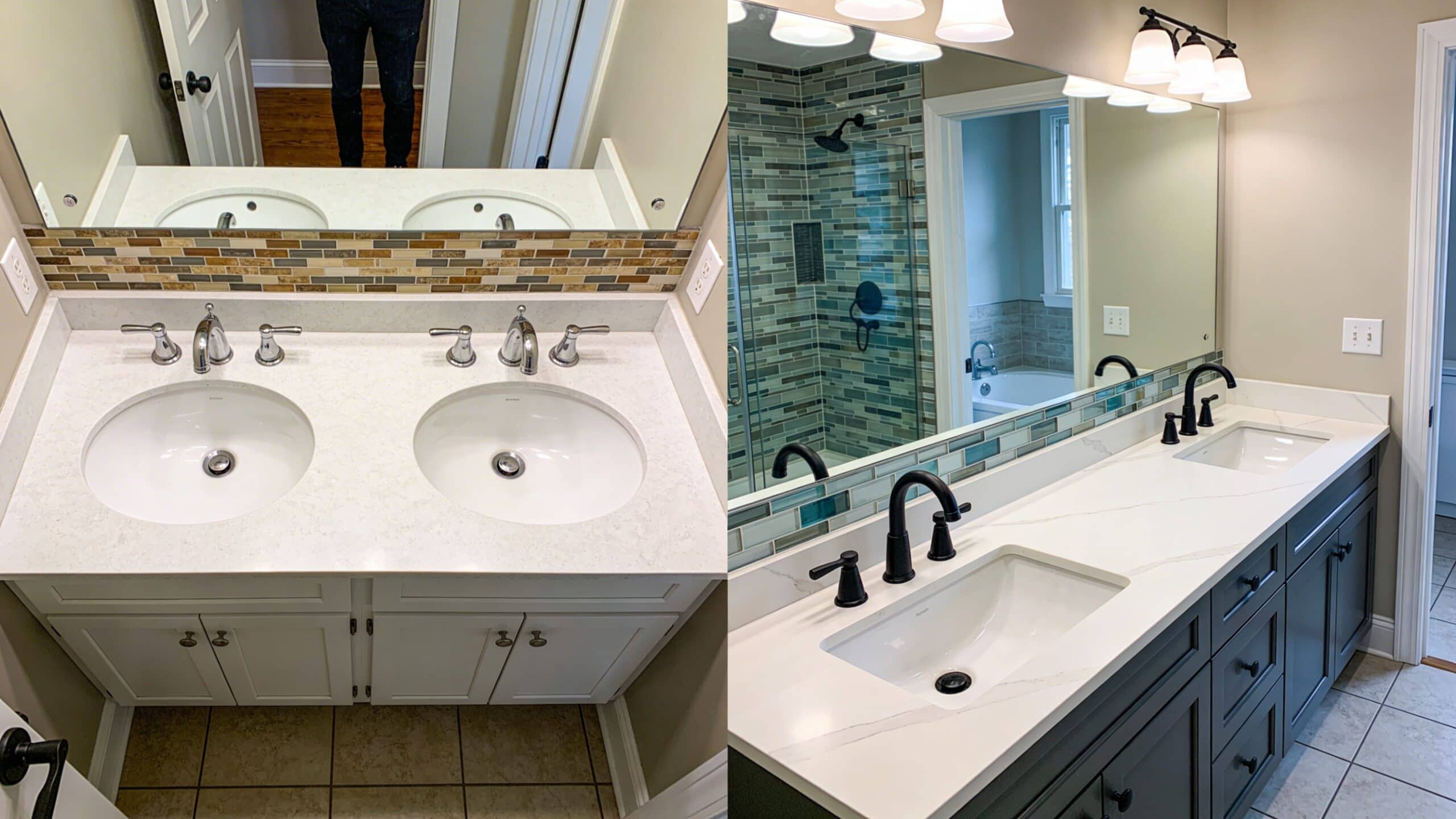
A bathroom in a mid-century ranch near Cherry Hill often has different constraints than a newer primary suite in Moorestown or Medford. One may have tighter wall spans, older plumbing locations, and limited swing clearance. Another may offer enough room for a larger furniture-style vanity, wider mirrors, and expanded storage.
Older homes need a different mindset
In many local remodels, the challenge isn't finding a vanity. It's finding one that respects the room's proportions.
What usually works well:
- A disciplined footprint: The cabinet should leave the room feeling usable, not fully occupied.
- Storage with intention: Drawer banks and divided sink zones often outperform oversized cabinets with weak internal organization.
- Style that matches the house: A sleek slab-front vanity can look excellent in the right setting, but not every home wants that language.
If you're gathering inspiration before making a final style call, Modern Bathroom Vanity Ideas can help you sort through contemporary looks and narrow down what suits your space.
What works in a showroom can fail in a real house
Online shopping makes vanity buying look easy. You filter by width, pick a finish, and assume the rest will fall into place. In practice, the most common problems aren't visual. They're spatial.
A few examples show the pattern:
| Home situation | Better choice | Common mistake |
|---|---|---|
| Narrow primary bath | Prioritize clearance and drawer access | Choosing the deepest vanity available |
| Shared family bath | Focus on separation and easy-clean surfaces | Overloading the top with decorative sink styles |
| Character home | Match the vanity scale to the room's architecture | Installing a bulky unit that dominates the wall |
South Jersey homeowners are also remodeling for reasons beyond appearance. Comfort, storage, and daily function are driving many projects, especially in homes where owners want spaces that work better for the long term. That local shift is reflected in the remodeling motivations discussed at https://www.thecabinetcoach.com/why-south-jersey-homeowners-are-remodeling-kitchens-bathrooms-for-comfort-and-function/.
The smartest vanity selections usually come from seeing materials in the actual room, under the actual lighting, with the actual floor, tile, and wall color in view. That is where a finish that looked perfect online can suddenly feel too yellow, too gray, too glossy, or too heavy.
A good vanity choice should do four jobs at once. It should fit the room, support the routine, suit the house, and still make sense when the plumber and installer arrive.
From Standard Sizes to Your Perfect Space
The best way to think about double vanity sizing is simple. Standard doesn't mean automatic. It means proven.
Start with the established dimensions. Then test them against your bathroom's wall length, traffic flow, sink spacing, storage needs, and user comfort. A well-chosen vanity should make the room easier to use every single day, not just look impressive in photos.
For most homeowners, the decision becomes clearer when you narrow it down in this order:
- First, confirm fit: Check the wall, front clearance, and nearby fixtures.
- Then, confirm function: Decide how much separation, storage, and counter area two users really need.
- Finally, confirm details: Verify height, plumbing alignment, countertop overhang, and fixture compatibility.
That process prevents the most common mistakes. It also keeps the remodel grounded in real use instead of wishful sizing.
If you're at the point where measurements, material choices, and layout questions are starting to overlap, professional guidance saves time and usually prevents expensive rework later.
The Cabinet Coach helps South Jersey homeowners make these decisions with confidence through a mobile showroom and guided design process. If you'd like expert help choosing the right double vanity size standard, materials, and layout for your bathroom, visit The Cabinet Coach to schedule a consultation.