
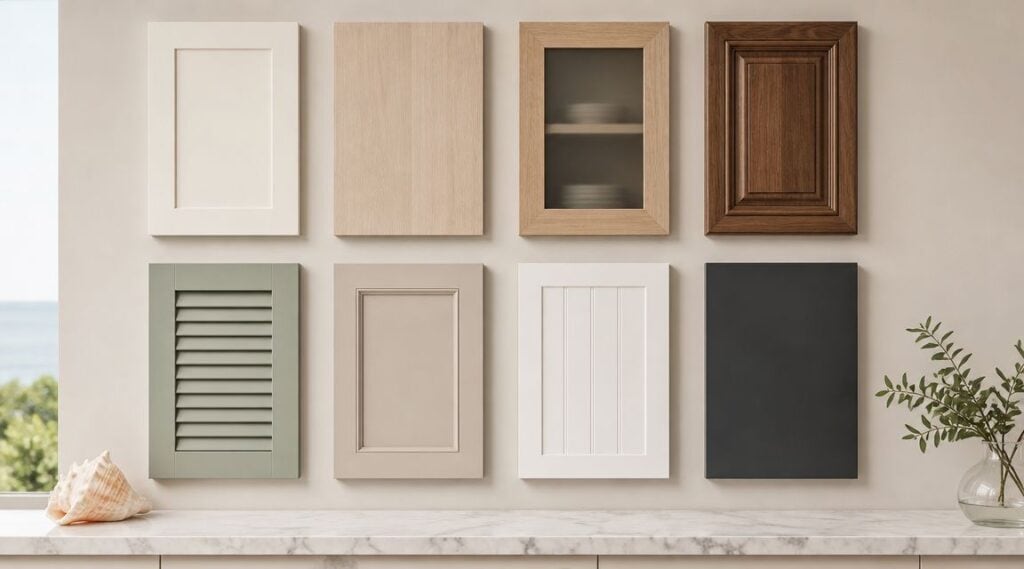
Choosing Your Kitchen's face starts with a question most homeowners don't ask early enough. Do you want your cabinets to impress from across the room, or do you need them to survive school lunches, steam, fingerprints, and years of daily use without driving you crazy?
That gap matters. Most articles about the types of kitchen cupboard doors stop at style names and a few photos. Real kitchen decisions need more than that, especially in South Jersey, where one home might be a Haddonfield Colonial, the next a farmhouse renovation near Moorestown, and the next a newer open-plan build in Cherry Hill. Humidity, sunlight, family traffic, and resale expectations all affect which door style works.
The basics help. Cabinet construction is commonly grouped into partial overlay, full overlay, and inset, with the difference defined by how the door sits on the cabinet frame rather than decoration alone, according to this cabinet style guide explaining overlay, full overlay, and inset. But once you get beyond that framework, the practical details matter more.
This guide gets to the point. You'll see where each door style fits, what it hides badly, what it cleans easily, and what I'd steer toward for different South Jersey homes. If you're also weighing species and finish, this guide to selecting the right cabinet wood is a useful companion before you commit.
Table of Contents
- 1. Shaker Style Doors
- 2. Flat Panel Slab Doors
- 3. Raised Panel Doors
- 4. Glass Front Doors
- 5. Louvered Jalousie Doors
- 6. Beadboard Doors
- 7. Handle-Less Integrated Handle Doors
- 8. Inset Cabinet Doors
- Comparison of 8 Kitchen Cupboard Door Types
- Bringing Your Vision to Life in South Jersey
1. Shaker Style Doors

If you want one safe answer for most South Jersey kitchens, Shaker is it. It has a recessed center panel with a simple frame, so it gives you just enough detail to feel finished without locking you into one design era.
That flexibility is why Shaker continues to dominate. A cabinet market report says Shaker leads the style segment, and the same report cites dealer and preference data showing especially strong demand for white Shaker cabinets, which is one reason so many remodelers treat it as a low-risk choice for resale-minded projects in the suburbs in this cabinet market report on Shaker demand.
Why South Jersey homeowners keep choosing Shaker
Shaker fits older Colonials, updated farmhouses, and most new construction without looking forced. In Cherry Hill and Haddonfield, it's often the easiest bridge between traditional architecture and a cleaner, more current kitchen. Change the hardware and finish, and the whole mood shifts.
A painted Shaker door works especially well in smaller kitchens that need brightness. A stained Shaker door can warm up a space that has a lot of stone, stainless, and hard lines. If you're comparing options, this guide on how to choose kitchen cabinets helps connect style choices to layout and storage decisions.
Practical rule: If you're unsure whether your kitchen should lean traditional or modern, Shaker usually gives you room to decide later with hardware, lighting, and backsplash.
A few practical observations matter more than the trend line:
- Paint shows the shape well: White, cream, greige, and muted green all suit Shaker because the frame catches light without feeling busy.
- Corners need wiping: The inside edge of the recessed panel collects dust and splatter faster than slab doors do.
- Hardware changes the style: Bin pulls and knobs feel more farmhouse or classic. Long bar pulls or tab pulls move it toward transitional.
- Samples matter at home: The same painted Shaker door can read crisp in one kitchen and flat in another depending on window direction.
For busy family kitchens, Shaker is usually a strong middle ground. It isn't the easiest door to clean, and it isn't the most dramatic. It effectively works in more homes than almost any other option.
2. Flat Panel Slab Doors

Slab doors are the opposite of decorative. One flat surface. No frame. No grooves. No visual interruption. If your kitchen is open to the living area and you want the cabinetry to feel calm rather than prominent, slab is often the right move.
They also solve a practical problem. Technical cabinet guidance notes that slab or flat doors are commonly paired with full-overlay construction, which supports clean sightlines and can improve access and storage efficiency compared with more frame-revealing options in this kitchen cabinet door style guide.
Where slab doors work best
In newer South Jersey townhomes and open-plan homes, slab doors often look more intentional than ornate profiles. They pair well with quartz, large-format tile, integrated lighting, and simple backsplashes. If the room already has enough texture from wood flooring, veined counters, or metal accents, a flat door helps the whole composition settle down.
I usually steer homeowners toward matte or softly textured finishes rather than high gloss unless they love a very polished European look. Gloss reflects light well, but it also shows smudges, streaks, and every angle of under-cabinet lighting. This article on how to choose kitchen cabinet colors is useful if you're trying to keep a slab kitchen from feeling cold.
In high-use kitchens, slab doors earn their keep on cleanup day. There are fewer edges to trap grease and flour.
That doesn't mean slab is perfect.
- Fingerprints show differently: Dark matte tends to show oils. Pale matte tends to show less.
- Edges matter: In humid kitchens, lower-quality laminate edges can become the weak point, so ventilation and fabrication quality matter.
- The room needs another source of character: Without panel detail, the interest has to come from color, wood grain, hardware, tile, or lighting.
If your goal is a kitchen that feels uncluttered and easy to maintain, slab deserves serious consideration. Among the many types of kitchen cupboard doors, it's the one I'd call the most visually quiet.
3. Raised Panel Doors
Raised panel doors bring depth right to the cabinet face. The center panel sits proud of the surrounding frame, so light creates more shadow and detail than you get from Shaker or slab. That detail can be handsome, but it needs the right house around it.
Context matters. Raised panel doors still suit plenty of South Jersey homes, especially Colonials, more formal traditional interiors, and renovations where the rest of the trim package already has crown, casing, and layered molding. In a sleek new build, though, they can feel overdressed fast.
When raised panel still makes sense
A raised panel door usually looks best when you commit to its character. Think stained maple, cherry, or another wood species with enough visual richness to support the profile. Painted raised panel can work too, but if the profile is heavy and the kitchen is small, the room can start to feel crowded.
The maintenance side is real. Those routed edges collect dust and cooking residue more quickly than flatter doors. If you cook often and dislike fussy cleanup, raised panel may test your patience long before it stops looking attractive.
A few combinations tend to work better than others:
- Traditional hardware: Cup pulls, round knobs, or more classic shapes usually look balanced.
- Warmer homes: Historic or custom homes in towns like Haddonfield often carry this style more naturally than minimalist interiors do.
- Selective use: A raised panel island paired with simpler perimeter doors can tone down the formality.
For hardware coordination ideas, this look at kitchen cabinet hardware trends can help you avoid pairing an ornate door with hardware that feels too sharp or too industrial.
Raised panel doors usually look better in person than in a tiny online thumbnail. The profile catches natural light differently throughout the day.
If you want cabinetry that feels furniture-like and established, raised panel still has a place. If you want light, simple, and low-maintenance, I'd usually look elsewhere first.
4. Glass Front Doors

Glass-front doors aren't a full-kitchen strategy in most homes. They're an accent move. Used well, they lighten a wall of cabinetry, break up long runs of solid doors, and give a kitchen a more layered look.
Used badly, they turn everyday clutter into display clutter.
The best way to use glass without creating clutter
The most successful installations are usually selective. One bank of upper cabinets near a sink wall, a hutch-style section, or a coffee station works better than putting glass everywhere. In open-concept South Jersey kitchens, that bit of transparency can help a long cabinet wall feel less heavy.
You also need to decide how honest you want the door to be. Clear glass shows everything. Frosted, seeded, or textured glass gives you softness and a little forgiveness. If your mugs and cereal bowls don't live in perfect stacks, textured glass is often the smarter choice.
A few practical notes make a big difference:
- Upper cabinets only: That's usually the safest use because the contents are lighter and more display-friendly.
- Interior lighting helps: Even a modest cabinet light can make glass doors feel intentional instead of accidental.
- Soft-close hinges matter: Less slamming means less stress on the door assembly.
- Condensation awareness: Good ventilation matters in humid kitchens, especially near ranges and dishwashers.
If you already have glass elsewhere in the home, keeping it clean becomes part of the overall maintenance picture. These residential shower door cleaning tips aren't about cabinets, but the same basic truth applies. Glass always asks for more upkeep than opaque surfaces.
I like glass doors most in homes where the homeowner enjoys styling shelves. If you don't want to think about what sits behind the door, choose solid fronts and save yourself the chore.
5. Louvered Jalousie Doors
Louvered doors have horizontal slats, and they bring a lot of personality with them. Depending on the kitchen, they can read coastal, farmhouse, cottage, or even a little tropical. That makes them memorable, but also harder to place.
In South Jersey, I see them make the most sense in selective accent roles rather than as the main cabinet door throughout the kitchen. Beach-influenced homes, beverage areas, mudroom-adjacent built-ins, and a few farmhouse kitchens can carry them well. A standard suburban kitchen with no other architectural cue usually can't.
Where I would actually use louvered doors
If you love the look, keep the application narrow. A coffee bar. A pantry side section. A dry bar. A wine cooler cabinet. Those are the places where louvered doors can feel custom instead of costume-like.
They also come with cleaning trade-offs. Every slat creates another dust shelf, and every angled surface catches kitchen film. That doesn't mean they're wrong. It means you should want them enough to clean them.
Here's where they usually perform best:
- Accent cabinetry: One feature area gives you texture without turning the whole kitchen into a themed space.
- Coastal and cottage settings: They feel more natural in homes that already lean casual.
- Specialty storage: Beverage stations and decorative storage are better candidates than everyday pots-and-pans cabinets.
If a homeowner says, “I love louvered doors,” my next question is always, “Do you love dusting them too?”
I wouldn't put them next to the cooktop if you can avoid it. Grease and slats aren't a great combination. I also wouldn't use them under the sink or in other areas where moisture and wear are already asking a lot from the door.
Among all the types of kitchen cupboard doors, louvered is one of the easiest to overuse. Keep it selective, and it can be charming.
6. Beadboard Doors
Beadboard doors have vertical grooves that add cottage and farmhouse texture without the stronger statement of louvered slats. They feel softer, simpler, and more familiar in many South Jersey homes, especially older houses and renovations with a relaxed, lived-in look.
They're a natural fit for farmhouse kitchens, but they also work in historic homes where plain flat doors might feel too stark. In a beach-house-inspired project, painted beadboard can also bring in the casual character people want without leaning too decorative.
How to keep beadboard from looking too theme-driven
The trick is restraint. Beadboard works best when it plays support rather than trying to dominate the room. Upper cabinets, an island back panel, or a hutch section can carry the detail well. Full kitchens wrapped entirely in beadboard can feel dated faster.
The grooves create the style, and they also create the maintenance issue. Dust, flour, and kitchen residue settle into those lines. That's why I tend to prefer beadboard in painted finishes and in places where cleanup is manageable.
A few combinations usually hold up best:
- Paint over stain: Painted beadboard reads cleaner and is easier to integrate into updated kitchens. For finish direction, this guide on paint and stain cabinets helps frame the decision.
- Use it higher, not lower: Upper cabinets avoid some of the kicks, scuffs, and constant handling that lower cabinets take.
- Mix with simpler doors: Pairing beadboard with Shaker or flat fronts keeps the kitchen from getting too busy.
In local homes with farmhouse or cottage leanings, beadboard still has real appeal. It just needs editing. If every surface in the kitchen already has texture, another grooved profile may be one detail too many.
7. Handle-Less Integrated Handle Doors
Handle-less doors appeal to people who want the kitchen to feel almost architectural. The grip is built into the door or the system around it, so you don't see rows of knobs and pulls breaking up the cabinetry. Done well, the effect is crisp and modern.
This look shows up most often in contemporary South Jersey renovations and new construction where the entire room is designed around simplicity. It usually pairs best with slab doors and full-overlay or frameless-style layouts, not with traditional face-frame details.
What homeowners often miss about handle-less kitchens
The visual calm is obvious. The daily-use reality is less obvious. You still need a comfortable place to grab the door, and you still need hardware systems that let those doors close smoothly and line up properly. Poorly planned handle-less kitchens can feel slick in photos and awkward in use.
That's why I usually tell homeowners to test the grip style before they commit. Recessed channels, routed finger pulls, and push-open systems all feel different in real life. This overview of modern cabinet styles is a good starting point if you're trying to decide whether this cleaner look suits the rest of your home.
A few realities come with the style:
- Best with flat fronts: Shaker or raised profiles usually interrupt the clean effect.
- Touch points move: Instead of grabbing a pull, you're touching the door edge or channel more often.
- Alignment matters: Tight, modern lines make installation errors easier to notice.
- Lighting becomes more important: Clean planes need good lighting to avoid feeling flat.
Clean-lined kitchens are less forgiving of sloppy planning. Every reveal, edge, and shadow line shows.
If you want a minimalist kitchen and you're willing to be precise about design and installation, handle-less doors can look excellent. If your taste is more transitional, visible hardware often adds needed warmth and definition.
8. Inset Cabinet Doors
Inset doors sit flush inside the cabinet frame rather than overlaying it. That one construction change creates a very different look. The cabinetry feels more like built-in furniture, more refined, and more exact.
It also raises the stakes on fit and finish. Industry guides consistently describe inset as the most precise and typically the most expensive of the standard construction categories because the door must fit exactly inside the opening, while overlay doors are generally more common in broader remodeling work in this cabinet door style overview.
Why inset is beautiful and less forgiving
In older South Jersey homes, inset can look especially right. Colonials, historic homes, and renovations with detailed millwork often benefit from that furniture-like appearance. In a plain builder-grade room with minimal trim, though, inset can feel like the cabinetry is speaking a more formal language than the rest of the house.
Humidity matters too. South Jersey summers aren't gentle on wood movement, and inset construction leaves less room for sloppiness. Good fabrication, careful installation, and steady indoor conditions matter more here than they do with many overlay doors.
Before choosing inset, think about these trade-offs:
- Precision is everything: Small alignment issues show quickly.
- Visible hinges may become part of the design: That can be beautiful, but it has to be intentional.
- The style suits period homes well: Especially where you want the kitchen to feel integrated with older architecture.
- The budget needs breathing room: Inset is usually not the place to cut corners.
For a closer look at how inset cabinetry is built and why homeowners choose it, this video is worth a watch.
I love inset in the right home. I don't love it when someone chooses it only because it looks refined online, then gets frustrated by the precision and cost that come with it.
Comparison of 8 Kitchen Cupboard Door Types
| Door Style | 🔄 Implementation Complexity | ⚡ Resource Requirements & Cost | ⭐ Expected Outcomes / Quality | 📊 Ideal Use Cases | 💡 Key Advantages / Tips |
|---|---|---|---|---|---|
| Shaker Style Doors | Moderate, five-piece frame & recessed panel, standard joinery | Moderate, widely available; cost varies by wood species | Timeless, versatile, durable ⭐⭐⭐⭐ | Traditional, transitional, farmhouse, versatile renovations | Easy to paint/stain; pairs with many hardware styles; sample in real lighting |
| Flat Panel (Slab) Doors | Low, single-piece construction, simple installation | Low–Moderate, laminates cheaper; premium finishes raise cost | Clean, minimalist, easy-maintain ⭐⭐⭐⭐ | Contemporary, open-concept, condos, integrated appliances | Use matte/textured finishes to hide fingerprints; ensure quality edge banding |
| Raised Panel Doors | High, routed/molded panel profiles, precise joinery 🔄 | High, solid wood and skilled labor increase cost | Elegant, dimensional, architecturally rich ⭐⭐⭐⭐ | Traditional/transitional kitchens, period homes, formal spaces | Select stable species and quality finishes; expect more cleaning in profiles |
| Glass Front Doors | Moderate, glass glazing and possible interior lighting | Moderate–High, tempered glass, lighting, higher cost | Airy, displays curated items, increases perceived space ⭐⭐⭐ | Upper cabinets, display areas, open-concept homes | Use frosted/seeded glass to hide clutter; plan interior lighting and ventilation |
| Louvered (Jalousie) Doors | High, many slats, detailed assembly 🔄 | High, often custom or specialty, limited manufacturer availability | Distinctive, ventilated, decorative ⭐⭐⭐ | Coastal, farmhouse, wine/beverage cabinets, accent areas | Use selectively; avoid moisture-prone spots; maintain regular dusting |
| Beadboard Doors | Moderate, groove paneling applied to face | Moderate, less common, can be pricier than flat panels | Charming, textured, cottage/coastal feel ⭐⭐⭐ | Farmhouse/cottage kitchens, upper cabinets, accent islands | Best painted for easy cleaning; avoid heavy-use lower cabinets |
| Handle-Less (Integrated) Doors | High, routed grips or push-open hardware, precise alignment 🔄 | High, specialized routing and hardware systems | Ultra-clean, seamless, high-end modern ⭐⭐⭐⭐ | Minimalist/modern kitchens, integrated appliances, luxury projects | Ensure ergonomic routing depth and soft-close; plan with experienced fabricator |
| Inset Cabinet Doors | Very High, ±1mm tolerances, exacting joinery 🔄 | Very High, more material and premium labor; 20–40% cost premium | Refined, built-in furniture appearance, premium quality ⭐⭐⭐⭐⭐ | High-end custom projects, historic renovations, buyers valuing craftsmanship | Control moisture/choose stable woods, hire expert installers, budget longer lead times |
Bringing Your Vision to Life in South Jersey
Cabinet doors do more than finish the cabinets. They set the tone for the whole room, affect how easy the kitchen is to maintain, and shape whether the space still feels right years from now. That's why the best choice usually isn't the flashiest one. It's the one that fits your house, your habits, and the way your kitchen gets used.
A practical way to narrow the field is to match the door to the home first, then to your tolerance for upkeep. Shaker remains the most broadly appealing style and works in almost any South Jersey setting. Slab makes sense when you want a cleaner, more modern kitchen with easier wipe-downs. Raised panel and inset are often strongest in more traditional or architecture-driven homes. Glass, louvered, and beadboard usually work best as selective accents rather than all-over solutions.
That practical lens matters because cabinet choices influence value, not just appearance. Guidance on cabinet door selection points to a broader remodeling reality, and notes that a minor kitchen remodel recouped about 96% of cost nationally in the 2024 Cost vs. Value report, which is a reminder that finish decisions deserve careful thought rather than trend chasing in this cabinet door style guide discussing remodeling value.
South Jersey homeowners also need to think locally. Older homes in Haddonfield, Collingswood, and Moorestown often benefit from doors that respect trim and architectural detail. Newer homes in Cherry Hill, Voorhees, and Mount Laurel often support cleaner full-overlay looks. In humid months, stable finishes, good ventilation, and well-made door construction matter more than a showroom photo suggests.
Design trends are shifting too, but not always in ways that help daily use. Recent industry coverage notes that Shaker remains the most popular style while flat-panel, inset, and fluted looks are gaining traction as a 2025 direction in this review of popular cabinet door styles. My advice is simple. Trend-forward details are fine if you still like them after the novelty wears off and if you understand the cleaning and durability trade-offs.
If you're choosing among the many types of kitchen cupboard doors, seeing samples in your own light is often the turning point. A finish that looks warm in a showroom can go gray in a north-facing kitchen. A profile that seems subtle online can feel much busier once it covers an entire wall. That's where an in-home process becomes useful, and The Cabinet Coach is one local option for South Jersey homeowners who want to compare cabinetry, hardware, countertops, and finishes in context before committing.
If you're ready to compare door styles in your own kitchen instead of guessing from photos, contact The Cabinet Coach to schedule a consultation and see which cabinet doors make sense for your South Jersey home, layout, and budget.