

You're probably looking at your kitchen every day and seeing the same problems. The cabinet doors don't close right. Storage feels cramped. The finish looks tired. And once you start searching for nj kitchen cabinets, every option seems to come with a different promise, price point, and timeline.
That's where most homeowners in Cherry Hill, Voorhees, Moorestown, and nearby South Jersey towns get stuck. They don't need more inspiration photos. They need clear answers on what will hold up, what will fit the house, what will stay on schedule, and what's worth paying for. Cabinets drive all of it. They shape the layout, set the style, affect installation complexity, and influence how the room functions every day.
Table of Contents
- Your South Jersey Kitchen Remodel Starts Here
- Decoding Cabinet Styles and Materials for NJ Homes
- Stock vs Semi-Custom vs Custom A Practical Comparison
- Budgeting and Timelines for Your South Jersey Remodel
- Navigating Installation Permits and Local Codes
- How to Choose the Right South Jersey Cabinet Partner
- Frequently Asked Questions About NJ Kitchen Cabinets
Your South Jersey Kitchen Remodel Starts Here
A lot of kitchen projects start the same way. A homeowner says they want new cabinets, but what they really want is a kitchen that works better. They want deeper storage where it helps, better drawer access, finishes that don't show every fingerprint, and a layout that doesn't create daily friction.
In South Jersey, there's also a practical advantage many homeowners don't realize. New Jersey's Cabinet & Vanity Manufacturing industry has been growing at an average annual rate of 2.1% from 2021 to 2026 and ranks #27 nationally in revenue, according to IBISWorld's New Jersey cabinet and vanity manufacturing industry report. For homeowners, that points to a mature local market with established suppliers, manufacturers, and distribution channels.
That matters because a cabinet project goes more smoothly when you're buying into an established ecosystem instead of treating cabinetry like a one-off retail purchase. You're not just choosing doors and colors. You're coordinating measurements, appliance fit, finishes, installers, and lead times.
Practical rule: Start with function, not color. If the storage plan is wrong, no finish choice will save the kitchen.
A good remodel plan usually begins with a few blunt questions:
- What frustrates you now: Dead corners, poor pantry storage, awkward sink placement, or not enough drawers.
- What stays and what moves: Keeping plumbing and appliances in place is different from reworking the room.
- How much disruption you can tolerate: Some households can live through a phased project. Others need a tighter schedule.
- What level of decision support you want: Some homeowners want to research every hinge and finish. Others want a guided process.
If you haven't mapped those pieces yet, a solid kitchen remodel planning guide is a smart starting point before you look at door styles or paint chips.
Decoding Cabinet Styles and Materials for NJ Homes
Cabinet style gets the attention, but material and construction usually determine whether homeowners stay happy with the choice. A door can look great in a showroom and still be the wrong fit for a busy kitchen with humidity, cooking grease, and heavy daily use.

Door style changes how the whole room reads
Three styles dominate most conversations.
Shaker works because it's flexible. It can look traditional with warm wood tones, transitional with painted finishes, or more current with slimmer rails and simple hardware.
Slab is cleaner and flatter. It fits modern kitchens, smaller spaces, and homes where the goal is visual simplicity. It also tends to make the room feel less busy.
Inset has a furniture-like look because the door sits inside the frame opening. It can be beautiful, but it demands precision and usually belongs in projects where craftsmanship and alignment matter as much as storage volume.
Trend data is shifting in a useful direction for homeowners trying to balance style with resale awareness. According to Houzz's 2026 Kitchen Trends Study as reported by NAR, wood cabinetry was selected by 29% of renovating homeowners, compared with 28% for white cabinets, and medium wood tones led wood finishes at 15%. That doesn't mean white is gone. It means homeowners are moving toward warmer, more natural finishes.
A lot of South Jersey kitchens benefit from that shift. Older homes, especially, often look better with some visual warmth instead of another flat, all-white palette. If you want a cleaner contemporary feel without going cold, reviewing different modern cabinet styles can help narrow the field fast.
Wood is back in a meaningful way, but the best result usually comes from choosing the right wood tone for your light, flooring, and wall color, not from chasing a trend.
Material choice matters more in South Jersey homes
Humidity changes the conversation. In homes near the shore, in older houses with seasonal movement, or in kitchens with limited ventilation, cabinet material matters.
Here's the practical breakdown:
- Solid wood doors: Strong visual appeal and repairable in many cases. They can move with humidity, so species choice, finish quality, and construction all matter.
- Plywood cabinet boxes: A reliable choice when durability is the priority. They tend to be a better fit for homeowners who want a sturdier cabinet structure.
- MDF painted doors: Good for smooth painted finishes because they don't show wood grain the same way. They can be a smart paint-grade option when used in the right application.
- Thermofoil surfaces: Easy to clean and often budget-friendly, but they're not my first choice near heat-heavy zones if a homeowner expects a long service life and easy refinishing later.
What holds up and what tends to disappoint
The biggest mistake isn't choosing the wrong style. It's choosing a construction level that doesn't match the household.
| Priority | Usually works well | Can create problems |
|---|---|---|
| Busy family kitchen | Plywood boxes, durable finish, quality hinges | Thin materials that chip easily |
| Sleek painted look | MDF painted doors in the right build | Low-grade finishes that show wear quickly |
| Natural warmth | Wood doors in medium tones | Very dark finishes that show dust and fingerprints |
| Low-maintenance ownership | Simple profiles, easy-clean surfaces | Deep detailing that traps grease |
In humid conditions, I'd pay close attention to finish consistency, door stability, soft-close hardware quality, and whether the cabinet box feels solid when the door is open. Those details tell you more than the display color ever will.
Stock vs Semi-Custom vs Custom A Practical Comparison
A South Jersey homeowner usually reaches this point after falling in love with a door style online, then getting stuck on a harder question. Which cabinet type fits the house, the budget, and the schedule?

The labels sound simple. The trade-offs are not. In South Jersey, older homes often have walls that are out of square, floors with some slope, and room dimensions that punish standard sizing. Add summer humidity, everyday cooking moisture, and the wear a family kitchen takes, and cabinet selection becomes a practical decision, not just a style decision.
What each cabinet tier really means in practice
Stock cabinets come in fixed sizes and preset finish options. They are usually the fastest path from order to installation, and they can be a smart choice for a simple layout where standard widths will not leave awkward gaps or force too many fillers. The downside shows up quickly in older homes. You can save money on the cabinet line and lose some of it back in compromises.
Semi-custom cabinets start with a manufacturer's system, then allow selective changes such as modified depths, finish choices, storage inserts, molding options, and better fit at problem walls. This is the category I recommend most often in South Jersey because it handles real-house conditions better without putting the whole remodel on a custom-shop timeline.
Custom cabinets are built for the room instead of fitted into it. They make sense when standard and semi-custom sizing still leave functional problems, or when the kitchen has architectural details worth matching carefully. They also make sense for homeowners who care about very specific interior storage, unusual paint or stain requirements, or furniture-style details that catalog lines do not offer.
Custom solves fit problems well. It also adds more decisions, more coordination, and usually more waiting.
Where each option wins and where it tends to cost you
| Cabinet type | Best fit | Main advantage | Common trade-off |
|---|---|---|---|
| Stock | Straight layouts, tighter budgets, faster remodels | Lower upfront cost and quicker ordering | Less flexibility, more fillers, fewer ways to correct odd room conditions |
| Semi-custom | Most South Jersey family kitchens, older homes, remodels that need cleaner fit | Better balance of sizing, finish options, storage, and timeline | Easy to overspend if every upgrade gets added |
| Custom | Unusual room dimensions, detailed design goals, high-priority storage planning | Precise fit and full design control | Higher cost, longer lead time, more schedule exposure |
One mistake I see often is assuming stock means low quality and custom means high quality. Construction quality depends on the specific cabinet line, box material, joinery, finish process, and hardware. A well-built semi-custom cabinet can outperform a poorly built custom cabinet. A carefully selected stock line can work very well in the right room.
Another common mistake is paying for custom work where the room does not need it. If the layout is fairly standard and your goals are durable finish, good storage, and reliable installation, semi-custom often covers the priorities that matter most. Homeowners comparing cabinet levels in more detail can review this guide on how to choose the best cabinets for a kitchen remodel.
How I help homeowners decide
I usually narrow the choice with a few practical questions.
- Choose stock if speed matters, the layout is uncomplicated, and you are comfortable designing around standard cabinet widths and heights.
- Choose semi-custom if the house needs some adjustment for cleaner fit, you want better storage options, or you want more finish control without committing to a full custom build.
- Choose custom if the room has stubborn constraints, you want exact symmetry, or standard sizing will create visible compromises you will notice every day.
For South Jersey homes, humidity and age of the house often push the decision toward semi-custom or custom. Not because they are automatically fancier, but because they give the installer and designer more room to solve real conditions cleanly. That is usually where homeowners get better long-term value.
Budgeting and Timelines for Your South Jersey Remodel
A South Jersey kitchen remodel usually starts to feel expensive before the final invoice shows up. The family is eating off a folding table, the refrigerator is in the dining room, and one late appliance change suddenly pushes the cabinet order back. That is how budgets get stretched. Not from one dramatic mistake, but from a chain of small decisions made out of sequence.
Cabinet budgeting works better when you treat cabinetry as part of the build schedule, not a line item pulled from a showroom quote. The cabinet line matters. So do field measurements, filler allowances, trim details, hardware upgrades, delivery windows, and whether appliance specifications are completely final before the order is released.
Where projects lose time
The biggest schedule problems usually show up before installation day. I see the same pressure points over and over in South Jersey homes. A refrigerator spec changes after design approval. A hood insert gets selected late. Demolition reveals a wall that is farther out of plumb than anyone expected. In older houses near Haddonfield, Collingswood, and Merchantville, that last issue is common, and it affects more than installation. It can change filler sizes, panel widths, and the amount of on-site adjustment the job needs.
Lead times also matter, especially for made-to-order cabinetry. Stock lines usually move faster. Semi-custom often lands in the middle. Full custom gives you the most control, but it can add design time, shop time, and finish time. In a humid New Jersey summer, that trade-off deserves a hard look. If you are trying to keep the project moving and the room has fairly standard dimensions, waiting longer for full custom does not always buy a better daily-use kitchen.
A practical schedule usually follows this order:
- Finalize the layout before ordering. Cabinet orders should go in only after sink location, appliance placement, and traffic flow are settled.
- Confirm every appliance model. Refrigerators, ranges, wall ovens, dishwashers, and hoods all affect cabinet sizing and clearances.
- Build time into specialty selections. Painted finishes, custom colors, and decorative modifications often add production time.
- Expect jobsite surprises. Older South Jersey homes rarely open up perfectly, and smart schedules leave room for that.
How to budget without guessing
A good cabinet budget starts with function. Spend where you touch the kitchen every day. Drawer bases, quality runners, better hinges, stronger box construction, and storage accessories usually return more value than decorative upgrades that only show up in photos.
That is the actual cost-versus-timeline trade-off homeowners need to see clearly. Stock cabinets can reduce wait time and help control labor if the room fits standard sizing without awkward gaps. Semi-custom often gives the best balance for South Jersey remodels because it allows enough adjustment to handle true house conditions without putting the entire project on a custom-shop timeline. Custom cabinetry makes sense when the room has layout problems, tight tolerances, or design priorities that standard sizing cannot solve cleanly.
One delay can also create costs outside the cabinet order itself. Temporary kitchen setups, repeated trade visits, appliance storage, and extra installation days add up fast. A cheaper cabinet line that arrives on time can cost less in practice than a more ambitious plan that keeps the project stalled for weeks.
If you want to compare cabinet spending with countertops, labor, flooring, and the rest of the renovation, this kitchen remodeling cost breakdown for South Jersey projects gives the full picture.
Navigating Installation Permits and Local Codes
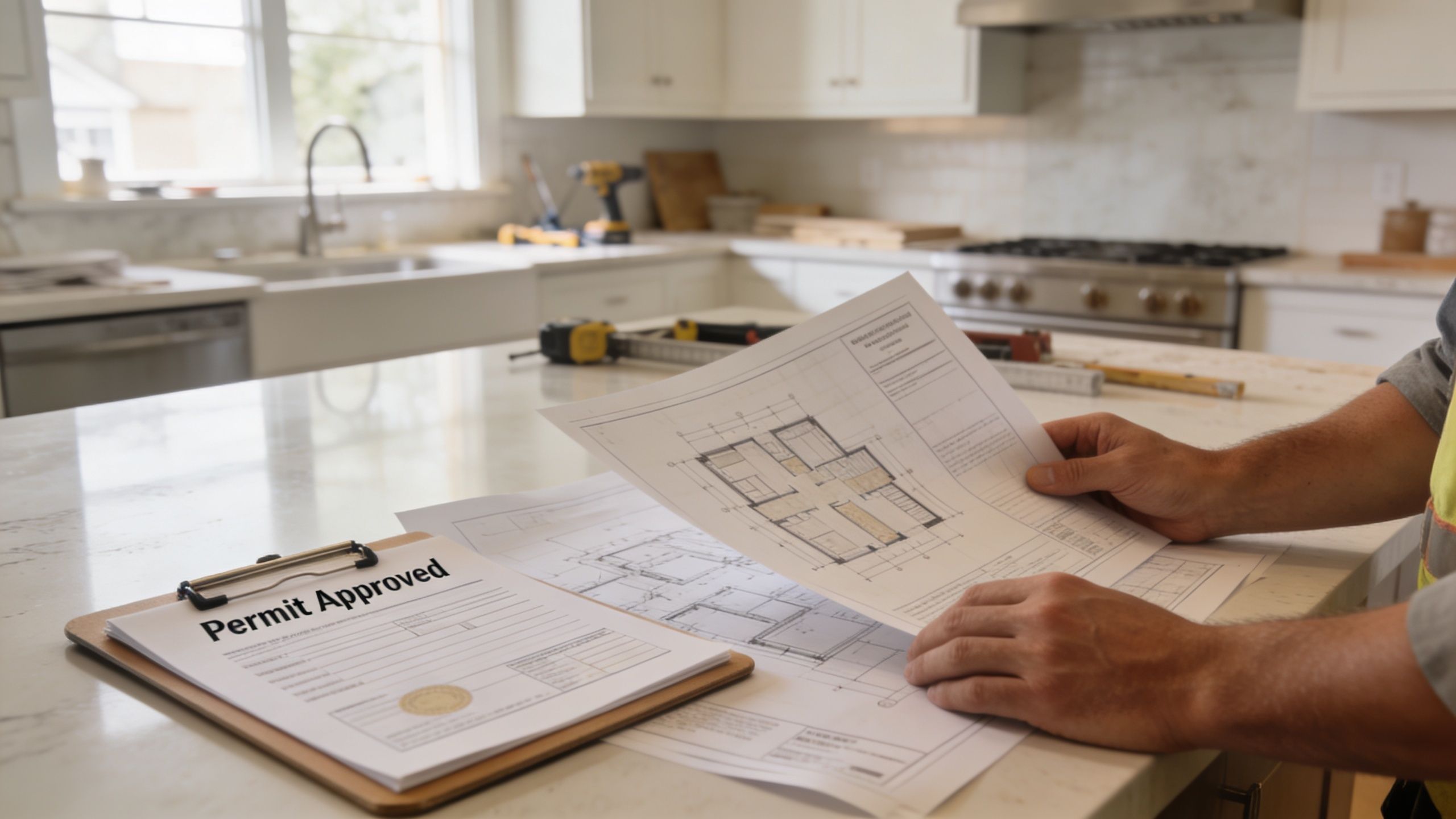
Cabinet installation sounds simple until the project touches plumbing, electrical, ventilation, or wall changes. Replacing cabinets in the same footprint is one thing. Reworking the room is another.
When permits usually come into play
In many South Jersey towns, permits usually become part of the job when the remodel includes moved plumbing lines, added electrical work, new lighting circuits, ventilation changes, gas work, or structural modifications. Homeowners in Cherry Hill, Voorhees, Haddonfield, Moorestown, and similar municipalities should expect permit requirements to vary by scope and local interpretation.
That's why cabinet planning shouldn't happen in isolation. A beautiful design can still fail in execution if the sink shift affects venting, the island changes electrical needs, or the hood selection requires different duct routing.
A few questions are worth asking before final signoff:
- Is the layout changing enough to trigger plumbing or electrical permits
- Are appliance locations staying fixed
- Does the hood require new venting
- Will trim, fillers, or panels affect access to shutoffs or service points
Why standard cabinet dimensions matter
Cabinet dimensions are the quiet part of kitchen design that controls everything else. According to Fabuwood's kitchen cabinet size and dimension guide, standard base cabinets are 34.5 inches high and 24 inches deep, and with a countertop the finished working height is about 36 inches. That baseline drives appliance fit, prep comfort, sink setup, and countertop alignment.
If someone casually changes those dimensions without understanding the consequences, problems show up fast. Dishwashers may not slide in cleanly. Counter heights can feel awkward. Finished surfaces may not align properly across the room.
Precision matters most where cabinets meet appliances, plumbing, and human movement.
For homeowners, the takeaway is simple. Ask who is doing final field measurement, when that happens, and how the team verifies appliance specifications before ordering. Good installation starts long before cabinets arrive on site.
How to Choose the Right South Jersey Cabinet Partner
The difference between a manageable project and a frustrating one usually isn't the door sample. It's the process behind the decisions.

What a good cabinet partner should handle
A cabinet partner should do more than present catalogs. They should help translate daily habits into layout choices, explain material trade-offs clearly, catch issues before ordering, and coordinate decisions so the kitchen doesn't get redesigned three times.
The vetting process should include practical questions:
- How do they measure and re-measure the space
- Do they guide appliance coordination
- Can they explain the difference between style upgrades and functional upgrades
- How do they handle finish samples in your actual lighting
- What happens if site conditions change after demolition
It also helps to look at how a company presents itself locally. Homeowners trying to sort credible local providers can learn something from broader guidance on local SEO for contractors, because strong local visibility often reflects whether a business is built around service areas, real project types, and clear homeowner communication.
Why in home selection changes the process
One practical model is an in-home or mobile showroom approach. Instead of making choices under retail lighting, the designer brings door styles, finishes, countertop options, hardware, and planning tools into the house where the materials will live.
That changes decisions in useful ways. You can compare a warm wood sample against your floor, wall color, natural light, and adjacent rooms. You can also catch issues that don't show up in a showroom, like a finish turning too yellow in afternoon light or a painted door looking too stark against existing trim.
The Cabinet Coach experience is one example of that process in South Jersey, built around mobile showroom consultations, design guidance, and project coordination. That model tends to reduce avoidable confusion because the discussion happens inside the actual room, not in an abstract display setting.
A quick video gives a better sense of how that kind of guided process works in practice.
The right partner won't just ask what style you like. They'll ask how you cook, who uses the kitchen, whether you need more drawers than doors, what level of disruption your household can tolerate, and where your budget needs to stay disciplined.
Frequently Asked Questions About NJ Kitchen Cabinets
Are framed or frameless cabinets better for NJ homes
Neither is universally better. Framed cabinets often suit more traditional, transitional, or classic designs and can feel familiar in older South Jersey homes. Frameless cabinets usually give cleaner interior access and a more contemporary look. The better choice depends on the style you want, the storage goals, and the cabinet line's build quality.
How do I add storage without making a small kitchen feel tighter
Depth is where a lot of homeowners get tripped up. According to Cabinet Joint's cabinet specifications overview, standard wall cabinets are 12 inches deep and base cabinets are typically 24 inches deep. Going deeper can increase storage, but it can also reduce aisle clearance and make a tighter kitchen feel harder to move through.
In smaller or older kitchens, I'd usually focus on smarter internal organization before increasing cabinet depth. Think drawer bases, pull-out trays, better pantry access, and using vertical space more intelligently.
What maintenance helps cabinets last longer
Keep finishes clean with non-abrasive methods, wipe up water around sink bases quickly, and don't let grease build up on door profiles or crown details. Humidity and heat are harder on cabinets than people think, so good ventilation and regular cleaning matter.
Also check hardware once in a while. A loose hinge or slightly misaligned drawer rarely fixes itself. Catching that early helps prevent wear on the door, frame, and finish.
If you're planning a kitchen update and want practical guidance on layout, cabinet selection, finish durability, and the realities of remodeling in South Jersey, The Cabinet Coach is a useful place to start. The process is designed around in-home decision-making, clear design guidance, and coordinated product selection so you can make informed choices without sorting through every option alone.