
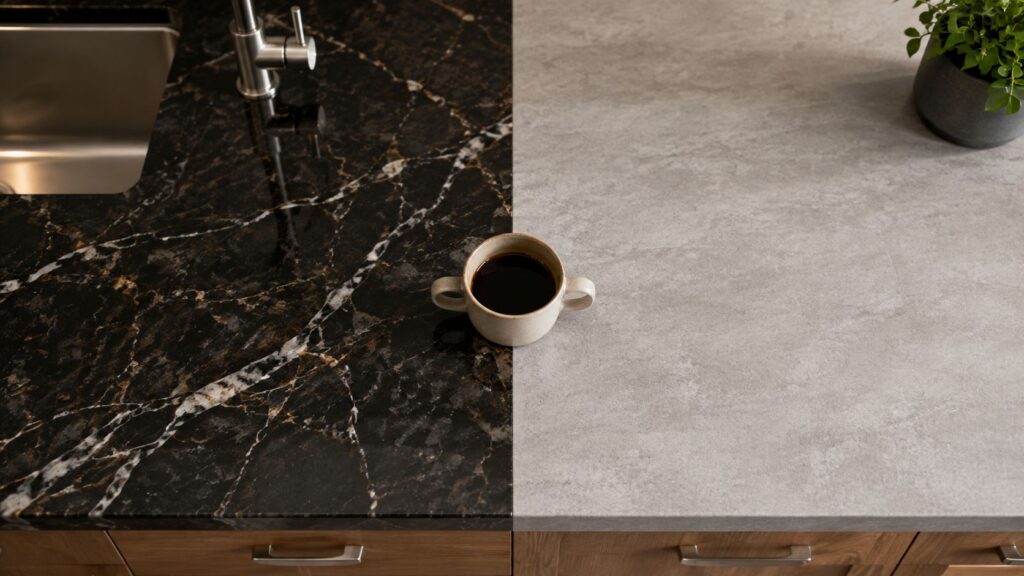
You're standing in a Cherry Hill kitchen with a cabinet quote in one hand and two countertop samples in the other. One is affordable laminate with a convincing stone pattern. The other is granite, heavier, more expensive, and immediately more substantial. Your neighbor chose quartz, your real estate agent keeps mentioning resale, and the old counter is already peeling near the sink. The question isn't which material is better. It's which surface makes sense for your room, your cooking habits, your budget, and your timeline.
For South Jersey homeowners, that distinction matters. A primary kitchen in a high-value colonial has different requirements from a Clementon rental, a basement bar, or a Moorestown laundry room. This guide treats laminate vs granite countertops as a room-by-room decision, with attention to installed cost, heat, wear, maintenance, and the resale expectations buyers bring to local homes.
Table of Contents
- The Decision Every South Jersey Kitchen Faces
- How Laminate and Granite Actually Get Made
- Real Cost Differences for a Cherry Hill Remodel
- Durability, Heat, and Daily Kitchen Abuse
- Maintenance, Sealing, and Long-Term Upkeep
- Where Each Material Wins by Room and Priority
- Choosing the Right Surface for Your Project
- Common Questions Homeowners Ask Before Deciding
The Decision Every South Jersey Kitchen Faces
A couple in their forties recently stood in a 1970s split-level in Cherry Hill's Barclay Farmstead neighborhood, trying to settle the countertop question. Their kitchen had roughly 50 square feet of surface to replace. The original laminate had begun separating near the sink, a neighbor had just installed quartz, and their listing agent had warned them that buyers notice countertops during showings.
They had two competing instincts. Granite looked like the responsible long-term choice, especially if resale mattered. Laminate would leave more money for cabinet repairs, lighting, and the plumbing work the kitchen also needed. Neither instinct was wrong. They were answering different questions.
Laminate became a mainstream residential surface in the 1950s, when postwar homeowners wanted affordable, durable, customizable finishes. Granite reached broader residential use much later, particularly through the 1970s and 1980s, and initially carried a premium, custom-home reputation. Improved quarrying and fabrication eventually made granite more accessible to mainstream remodeling markets, as documented in this history of countertop fabrication in the United States.
My practical rule: Don't spend for granite just because a showroom makes it feel like the “proper” choice. Spend for it when the room and the way you live justify it.
The comparison at a glance
| Decision factor | Laminate | Granite |
|---|---|---|
| Best fit | Rentals, secondary rooms, budget refreshes | Busy primary kitchens and long-term homes |
| Installed cost position | Lower-cost option | Premium natural-stone option |
| Heat tolerance | Requires strict trivet use | Much safer around hot cookware |
| Cutting and scratching | Direct cutting causes permanent damage | Strong resistance in controlled testing |
| Maintenance | Routine cleaning, no sealing | Routine cleaning plus periodic sealing |
| Design character | Printed patterns with broad style choice | Unique natural slabs with real stone depth |
| Resale role | Acceptable when clean and appropriate to the property | Stronger premium signal in an upgraded kitchen |
The couple's real decision came down to four questions:
- How much can the whole remodel absorb? Countertops compete with cabinets, appliances, flooring, electrical work, and plumbing.
- How hard is the kitchen used? A serious home cook creates different demands from a household that mostly reheats meals.
- How long will the owners stay? A temporary solution and a forever-home surface shouldn't be selected the same way.
- What does the room need to communicate? A primary kitchen often carries more resale weight than a laundry room or basement wet bar.
That framework is more useful than a generic winner. In a South Jersey remodel, the right material is the one that solves the room's actual problem without forcing you to compromise elsewhere.
How Laminate and Granite Actually Get Made
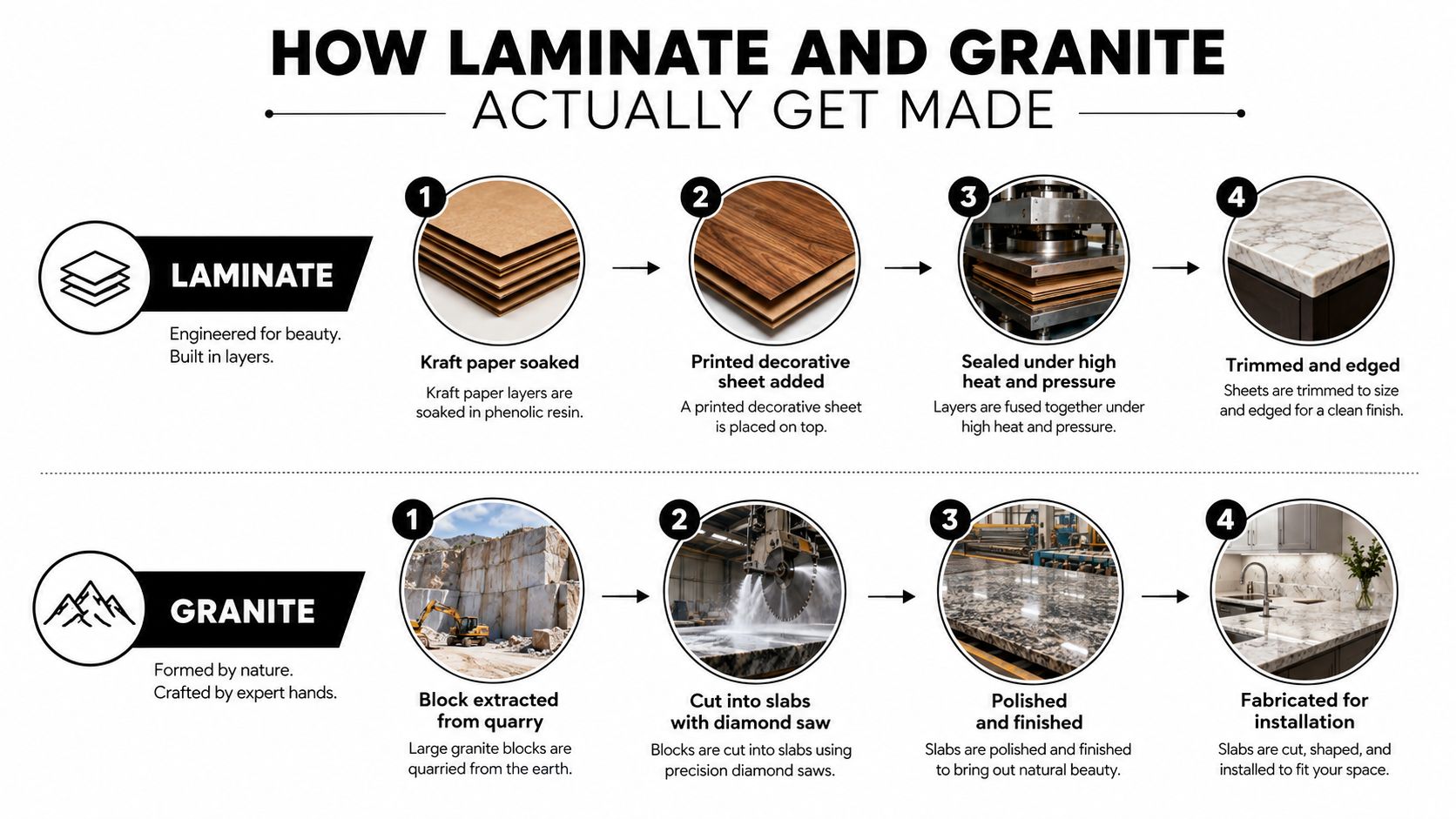
The price gap becomes easier to understand once you follow each material from raw component to finished countertop. Laminate is manufactured in layers. Granite begins as a quarried block and requires considerably more handling before it reaches a kitchen.
Laminate starts as layered sheet material
Manufacturers begin with kraft paper treated with phenolic resin. A printed decorative sheet creates the visible pattern, and a protective surface layer helps the finished material withstand routine cleaning and use. Heat and pressure bond these layers into a rigid sheet, which is then attached to a substrate and trimmed for the cabinet layout.
That construction explains laminate's practical advantages. Fabricators can transport sheets efficiently, cut them with standard shop equipment, and create seams without moving a massive stone slab. A contractor can also adapt the material to straightforward layouts without the same level of slab handling required for granite.
Modern printing has widened the design range. High-resolution patterns can imitate granite, marble, concrete, and other surfaces, while textured finishes add visual and tactile variation. The material is still a printed surface over a core, though, so a damaged edge or wet seam can expose the substrate beneath.
For a useful explanation of the material itself, see this guide to what Formica countertops are.
Granite follows a stone-fabrication route
Granite is extracted as large blocks from quarries, including sources in Brazil, India, and the United States. Fabricators cut those blocks into slabs, polish the faces, shape the edges, and cut openings for sinks, cooktops, and other fixtures. The finished slab then travels to the job site for templating and installation.
Natural variation is part of the appeal. Each slab has its own movement, mineral pattern, and color balance, so homeowners need to select the actual piece rather than rely only on a small sample. Darker granites may receive resin treatment during fabrication, and seams or filled areas can behave differently from the surrounding stone.
This manufacturing history shapes perception as much as cost. Laminate is efficient, adaptable, and design-flexible. Granite is heavy, scarce by comparison, and labor-intensive to extract and fabricate. One is optimized for accessible remodeling. The other is a natural material whose handling and installation remain part of its premium identity.
Real Cost Differences for a Cherry Hill Remodel
For a 50-square-foot Cherry Hill kitchen, the installed price difference is large enough to affect the rest of the renovation. A practical local planning range puts laminate at about $20 to $40 per square foot installed, while granite commonly falls around $40 to $100 per square foot installed, based on the project's layout, slab selection, edge work, and fabrication requirements.
The broader market supports laminate's value position. The global laminate countertops market was valued at US$13,741.8 million in 2024 and is projected to reach US$26,765.4 million by 2033, with a projected 7.7% CAGR from 2025 to 2033, according to Grand View Research's laminate countertop market data. Consumer-facing installed pricing commonly places laminate around $14 to $38 per square foot, which helps explain why it remains relevant in value-driven kitchen and bath projects.
A realistic project comparison
| Line item | Laminate | Granite |
|---|---|---|
| Countertop material and installation | About $20 to $40 per sq. ft. installed | About $40 to $100 per sq. ft. installed |
| 50 sq. ft. planning range | About $1,200 to $2,200 total | About $2,800 to $5,500 total |
| Standard eased edge | Usually included in the basic scope | Often included, with premium edges adding cost |
| One sink cutout | Commonly included in a standard project | Fabrication requirement included in the project scope |
| U-shaped layout seams | Simpler sheet fabrication | May require multiple fabricated seams |
| Templating | Relatively straightforward | Required before fabrication |
| Haul-away | Usually modest | Often higher because of slab weight and handling |
| Potential extras | Plumbing, sink changes, edge upgrades | Plumbing, cooktop openings, seam work, haul-away |
The totals above are planning ranges for a typical project, not a guaranteed quote. A U-shaped granite kitchen can require templating, multiple seam locations, and more fabrication than a simple straight run. Homeowners also forget to ask whether the quote includes disconnecting and reconnecting plumbing, handling a drop-in cooktop, removing the old surface, and hauling away debris.
South Jersey fabricators may also apply a travel charge when the site falls outside their normal service radius. Ask about that before approving the material, especially if the project involves a property farther from the shop or a multi-location installation.
For a broader pricing framework, compare the guidance in this countertop cost per square foot guide. My advice is simple: request a written scope that separates material, templating, fabrication, installation, tear-out, plumbing, cutouts, seams, edge profile, and disposal. The headline square-foot price is only one part of the bill.
Durability, Heat, and Daily Kitchen Abuse
Granite wins the abuse test. Laminate wins only when the household accepts its limits and uses the right habits every day.
Consumer Reports' controlled testing found that heat, cuts, and scratches didn't damage the granite tested, while stains and heat didn't damage the laminates tested. Direct cutting permanently damaged laminate, which makes granite the stronger choice for scratch resistance and rough kitchen use. Those findings are more useful than a showroom sample because they separate surface appearance from actual behavior under stress. See the Consumer Reports countertop testing for the test results.
What the kitchen can throw at each surface
| Test condition | Laminate result | Granite result |
|---|---|---|
| Hot cookware | Needs a trivet and can suffer heat damage from direct contact | Handles short-term direct contact far better, but edges and filled areas still need care |
| Direct knife use | Permanent cutting damage | Strong resistance in controlled testing |
| Scratches | More vulnerable to visible gouges and cuts | Better tolerance in controlled testing |
| Food and drink spills | Surface generally cleans easily, but seams and damaged areas remain vulnerable | Strong stain resistance when properly cared for |
| Heavy impact | Can damage the surface or substrate | Stone resists routine abuse, though edges and seams can chip |
| Sink-area moisture | Water at seams can threaten the underlying substrate | Requires attention to sealing and the surrounding fabrication |
An independent 2026 heat-resistance guide lists granite at about 1,200°F, or 649°C, for short-term direct contact, while laminate is listed at roughly 150°F, or 66°C. The guide warns that laminate can bubble, warp, or melt under hot pans, making a trivet essential for every stove-side landing zone. Read the heat-resistance comparison for countertop materials before choosing laminate for a serious cooking kitchen.
Where homeowners misread granite
Granite isn't indestructible. The broad stone surface may tolerate heat and resist scratches, but a hard impact at a sink opening, outside corner, or seam can chip an edge. Resin-filled areas and darker stone varieties can also behave differently from the main slab.
Laminate has a narrower margin for error, but that doesn't make it a bad material. In a laundry room, rental, basement bar, or light-use bath, the household may never create the conditions that expose its weaknesses. The mistake is installing it in a high-abuse kitchen and expecting stone-like forgiveness.
For a wider side-by-side look at countertop materials, use this countertop material comparison. I recommend granite for cooks who place hot pans down quickly, chop frequently, or don't want to police every surface habit. I recommend laminate when budget control matters more and the users will consistently protect the counter.
Maintenance, Sealing, and Long-Term Upkeep
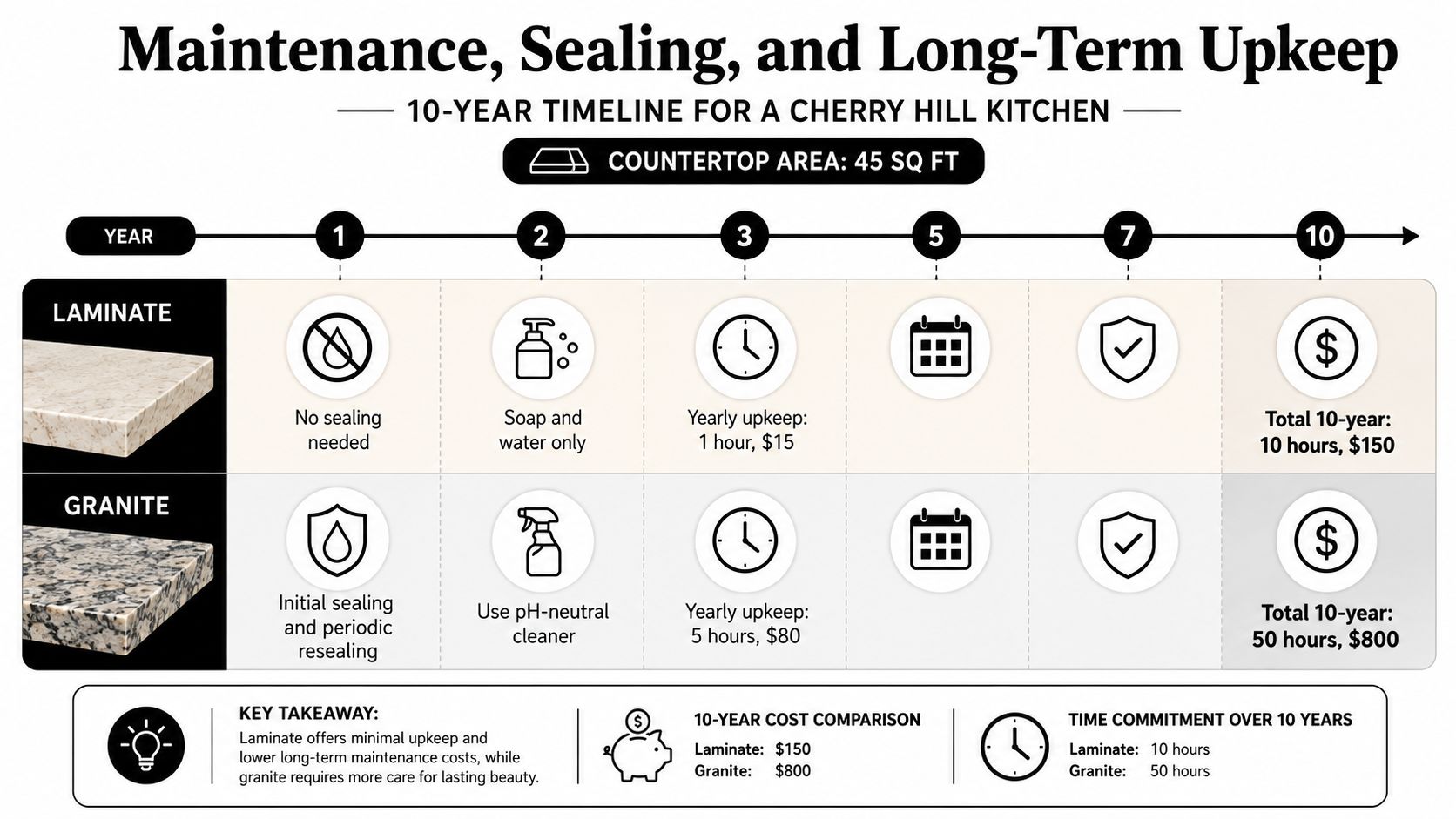
The daily cleaning routine is easy for both surfaces. The difference appears in the maintenance schedule. Laminate asks you to prevent damage at vulnerable seams and edges. Granite asks you to remember periodic sealing and use appropriate cleaners.
Current guidance commonly places granite resealing at roughly every 12 to 18 months, depending on porosity and use, as discussed in current granite countertop trends and care guidance. Sealing isn't a major construction project, but it is a recurring ownership task that busy homeowners often postpone.
Laminate upkeep
Use mild soap and water, wipe spills from seams, and avoid abrasive pads. Laminate doesn't require sealing, and normal cleaning is uncomplicated. The vulnerable locations are the sink joint, exposed edges, cutouts, and any place where the surface layer has been chipped.
That makes laminate low-effort on ordinary weekdays but less forgiving after an accident. A deep scratch, burn, or swollen substrate usually can't be restored invisibly. You may be able to fill a small defect, but a larger failure often means replacing a section.
Granite upkeep
Granite needs a pH-neutral cleaner and periodic inspection. To check a surface, place a few drops of water in an inconspicuous area and watch whether the stone darkens or absorbs the moisture quickly. If absorption is apparent, clean and dry the area, apply a penetrating sealer according to the product directions, allow the required dwell time, remove excess sealer, and let the surface cure before normal use.
An oil-darkened area needs more care than a routine reseal. Clean the spot with a stone-safe product, allow it to dry fully, and ask the fabricator whether a poultice or professional treatment is appropriate before applying additional sealer. Adding product over trapped oil can make the appearance harder to correct.
The maintenance cost isn't only the bottle of sealer. It includes scheduling, preparation, testing, and the consequences of missed care. For cleaning specifics, use this laminate countertop cleaning guide.
The sustainability question also deserves a room-specific answer. Long-lived surfaces can reduce replacement waste, while recycled granite applications and lower-impact sealants are making stone choices more nuanced. Laminate's efficient manufacturing and lower upfront resource commitment may suit a short-term or secondary-space project, but repeated replacement changes the lifecycle picture.
Where Each Material Wins by Room and Priority
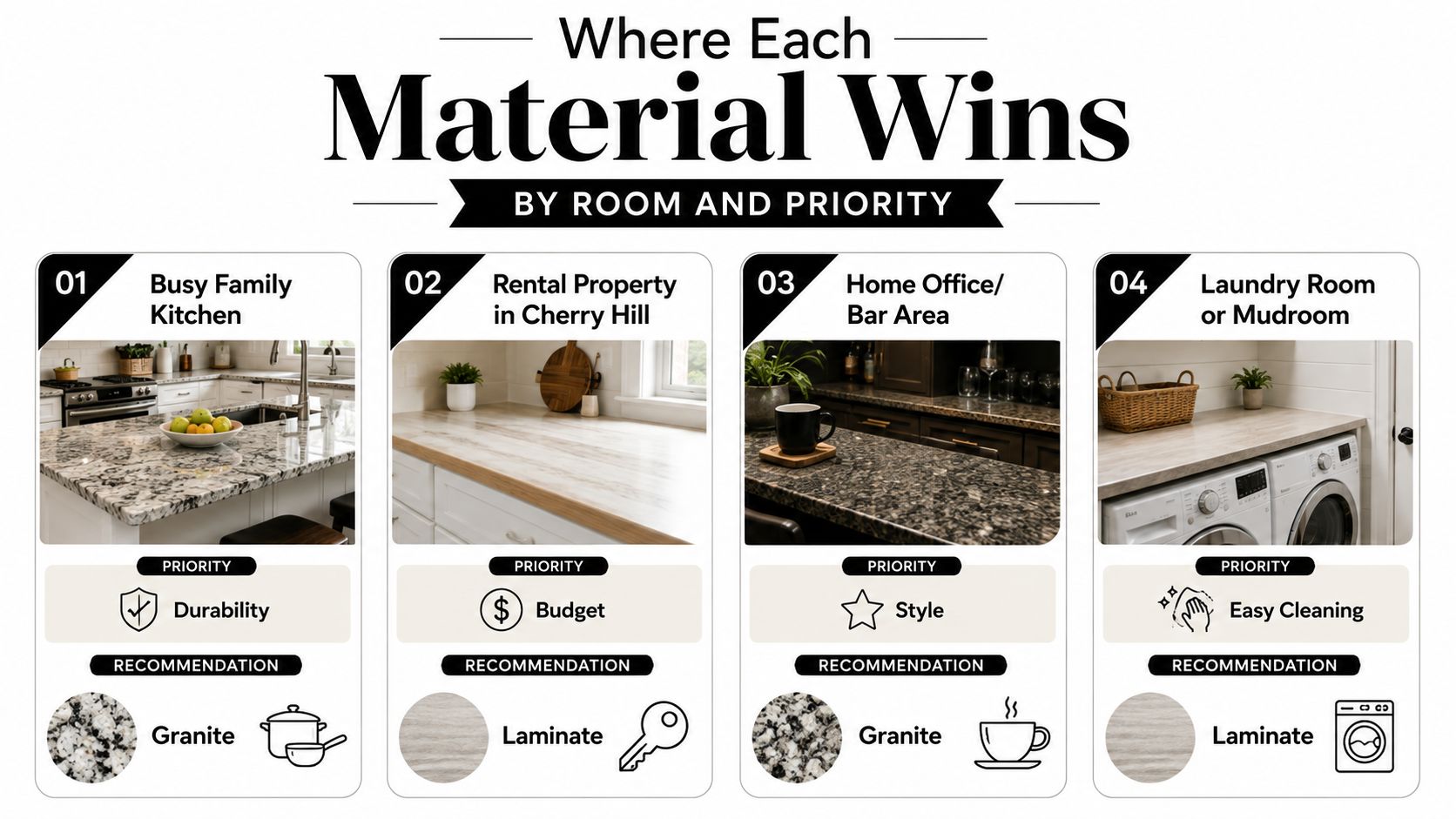
A countertop should serve the room, not the prestige hierarchy of a showroom. Granite is the better answer for some kitchens, but laminate is the smarter investment in spaces where buyers, tenants, or family members won't value premium stone enough to justify the added expense.
Four South Jersey situations
A primary kitchen in a Cherry Hill colonial: Choose granite when the kitchen is a major selling feature and the rest of the renovation already supports a premium finish. Buyers often interpret the countertop as a signal about the quality of the cabinets, appliances, lighting, and installation around it. Granite won't rescue a poor layout, but it can complete a high-end presentation.
A basement wet bar or rental in Clementon: Choose laminate. The room needs a clean, presentable, practical surface, not a costly slab that tenants or occasional guests may never appreciate. Faster installation and lower upfront cost leave room for waterproof flooring, better lighting, or cabinet hardware.
A children's bathroom vanity: Laminate usually makes more sense when the priority is affordable replacement and easy coordination with cabinetry. Toothpaste, standing water, and hurried cleaning can be hard on any vanity, so I'd rather see a homeowner protect the budget in a secondary bath than overspend for a prestige material.
A forever home in Moorestown: Granite earns consideration when the owner expects years of daily use and values natural variation. The decision works only if the homeowner accepts sealing and uses basic stone-safe care. If scheduled upkeep is irritating, select a surface that matches that tolerance rather than buying granite and neglecting it.
The same reasoning applies to laundry rooms, mudrooms, home offices, and guest spaces. Laminate can deliver a coordinated, design-forward finish where the room has lower wear or lower resale weight. Granite belongs where heat, longevity, visual presence, and daily satisfaction matter enough to justify the investment.
Choosing the Right Surface for Your Project
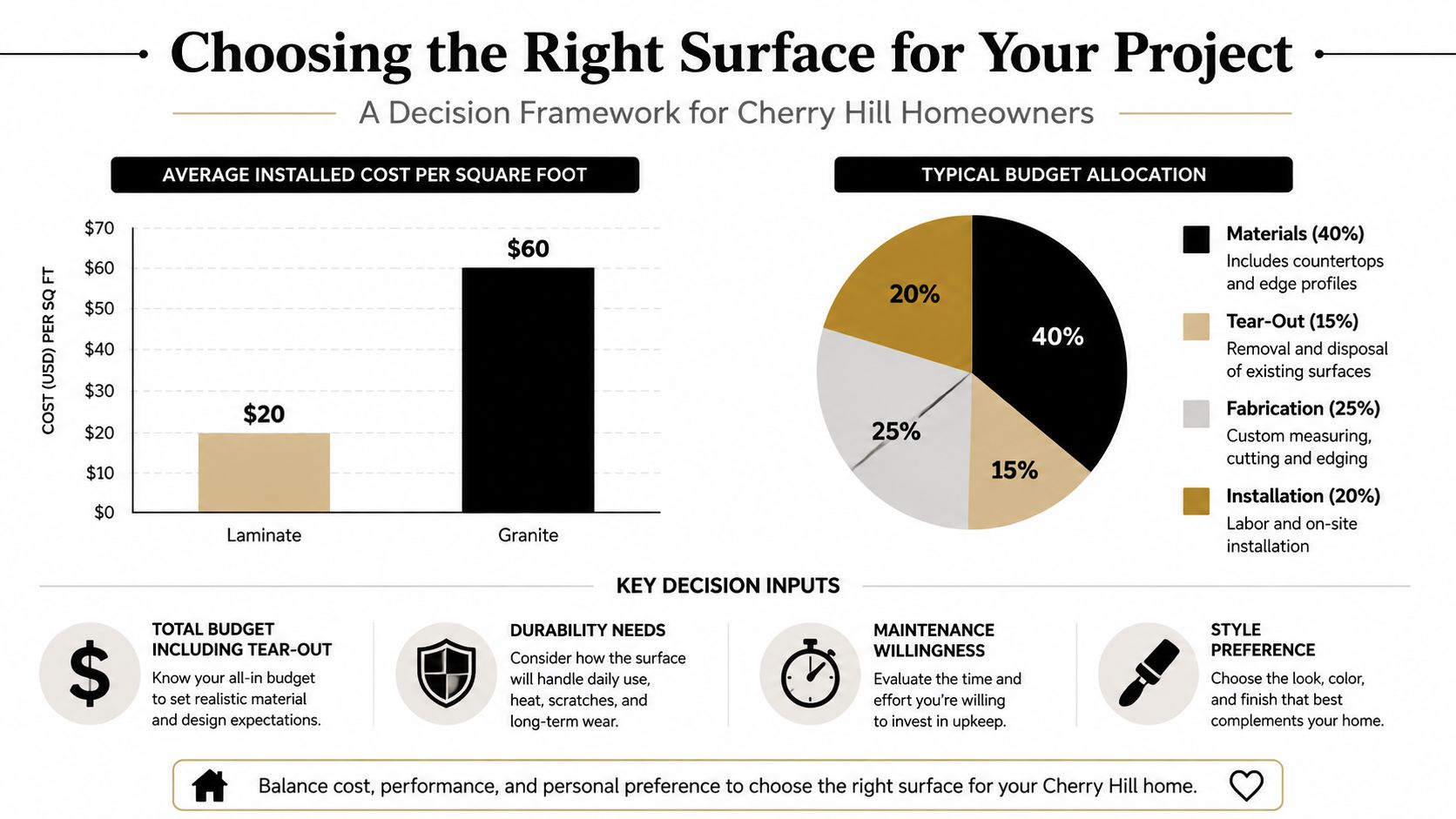
Start with the whole project budget, not the countertop sample. Include tear-out, plumbing, sink changes, cooktop openings, fabrication, installation, disposal, and any cabinet adjustments before deciding what the surface can consume.
Then score the room against four inputs:
- Budget pressure: If choosing granite forces you to postpone cabinet repairs or keep a dysfunctional layout, laminate may create the better kitchen.
- Room importance: A primary kitchen in a competitive South Jersey resale market deserves more attention than a basement utility counter.
- Maintenance tolerance: Granite requires periodic sealing and stone-safe cleaning. Laminate requires careful use around heat, knives, water, and edges.
- Aesthetic target: High-definition laminate can create a convincing coordinated look, while granite delivers authentic stone depth and natural variation.
Three budget situations I'd handle differently
For a first-floor refresh with a tightly controlled budget, laminate is often the responsible call. It can make the kitchen look finished while preserving funds for structural work, cabinet functionality, or appliances. Don't call it a placeholder unless you're planning another replacement, because a second installation creates another round of disruption.
A mid-tier kitchen deserves more investigation before you choose. Ask a granite fabricator about remnants, less common colors, and standard edge options. A smaller slab or a remnant may narrow the perceived gap, but the final quote still needs to include templating, cutouts, seams, installation, and disposal.
At the top end, granite should be judged as part of the entire room. If the cabinets, lighting, appliances, backsplash, and flooring all communicate quality, a budget countertop can become the one element that feels out of place during a buyer walk-through. Use this guide to choosing kitchen countertops to organize the decision before collecting quotes.
Your one-page decision checklist
- Choose laminate if the room is secondary, the budget is tight, installation speed matters, and users will protect it from heat and direct cutting.
- Choose granite if the kitchen is heavily used, the home is a long-term residence, natural stone matters, and you'll maintain the surface.
- Get a second granite quote if remnants or a simpler layout could change the total.
- Reject any quote that doesn't identify cutouts, seams, plumbing, tear-out, edge treatment, and travel charges.
- Prioritize the room's function over what a neighbor installed.
Common Questions Homeowners Ask Before Deciding
How long does installation take?
A straightforward laminate installation can often be completed in a single day, while plumbing changes may extend the work. Granite requires templating, fabrication, and installation coordination, so the calendar is longer even when the on-site installation itself is efficient. Confirm the actual sequence before scheduling your sink, plumber, and appliances.
Can granite handle a pan straight from the oven?
Granite tolerates heat far better than laminate, but I still don't recommend treating it like a trivet. Thermal shock and a hard contact point can damage an edge, seam, or filled area. Use a heat pad, especially near sink cutouts and corners.
Laminate has a much lower heat tolerance, and the independent heat guide cited earlier lists it at roughly 150°F, or 66°C. Put hot cookware on a trivet every time.
Will either surface affect resale in Voorhees or Marlton?
Granite can support the premium presentation buyers expect in an updated primary kitchen. Clean, current laminate doesn't automatically damage a listing, especially when the property and room don't demand a luxury finish, but damaged, swollen, or visibly dated laminate will draw attention.
Does mixing laminate and granite make sense?
Yes, when the room functions are different. Granite can anchor a heavily used main kitchen island, while laminate may work well in a nearby desk area, laundry room, or secondary beverage station. Keep the colors and edge language coordinated so the combination looks intentional.
Can a homeowner install laminate in a small bathroom?
A capable DIY homeowner may handle a simple laminate vanity top, particularly when the layout is straightforward and the sink is a drop-in model. The danger is water management. Measure carefully, seal exposed edges, protect the substrate, and don't attempt the project if the cabinet is out of level or the plumbing connection is uncertain.
If you want help comparing actual samples, cabinet layouts, and installed scopes, The Cabinet Coach brings a mobile showroom experience to South Jersey homeowners and can coordinate cabinetry, countertops, hardware, and tile around the project's budget and timeline. Visit The Cabinet Coach to arrange a consultation before you commit to laminate or granite.