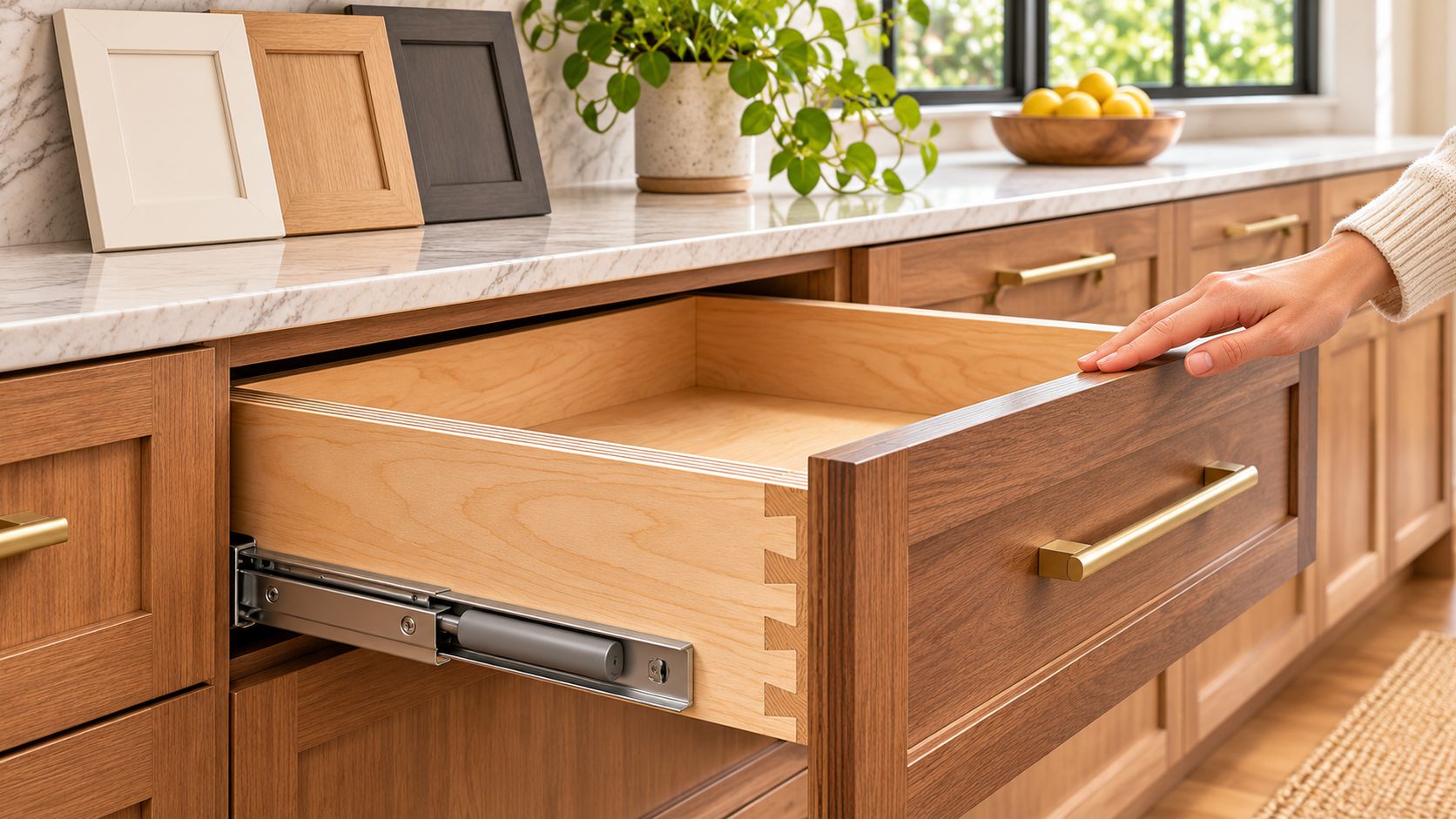
The most repeated piece of cabinet advice is also the least useful: pick a door style you love, decide between painted and stained, then spend whatever your budget allows on solid wood. None of those three choices tells you whether the hinges will still close properly in year twelve, whether the shelf under your cast iron will still be flat, or whether the finish beside the dishwasher will still be intact. Door style is a decorating decision. Cabinet quality is a durability decision.
Cabinets are the one part of a kitchen you touch every day, and they take the largest single share of most remodel budgets. So the showroom test worth running isn't "does this look good," it's "does this system hold up." That question has answers you can check before you sign, and most of them live inside the box, behind the door and under the paperwork.
Table of Contents
- What Kitchen Cabinet Quality Actually Means
- Cabinet Box Construction and Materials That Last
- Formaldehyde Limits and Low-Emission Claims
- Testing Hardware and Finishes Before You Buy
- Installation and Warranty Terms Worth Verifying
- Cost and Lifespan Ranges for Each Budget
- Choose Quality Cabinets with a South Jersey Consultation
What Kitchen Cabinet Quality Actually Means
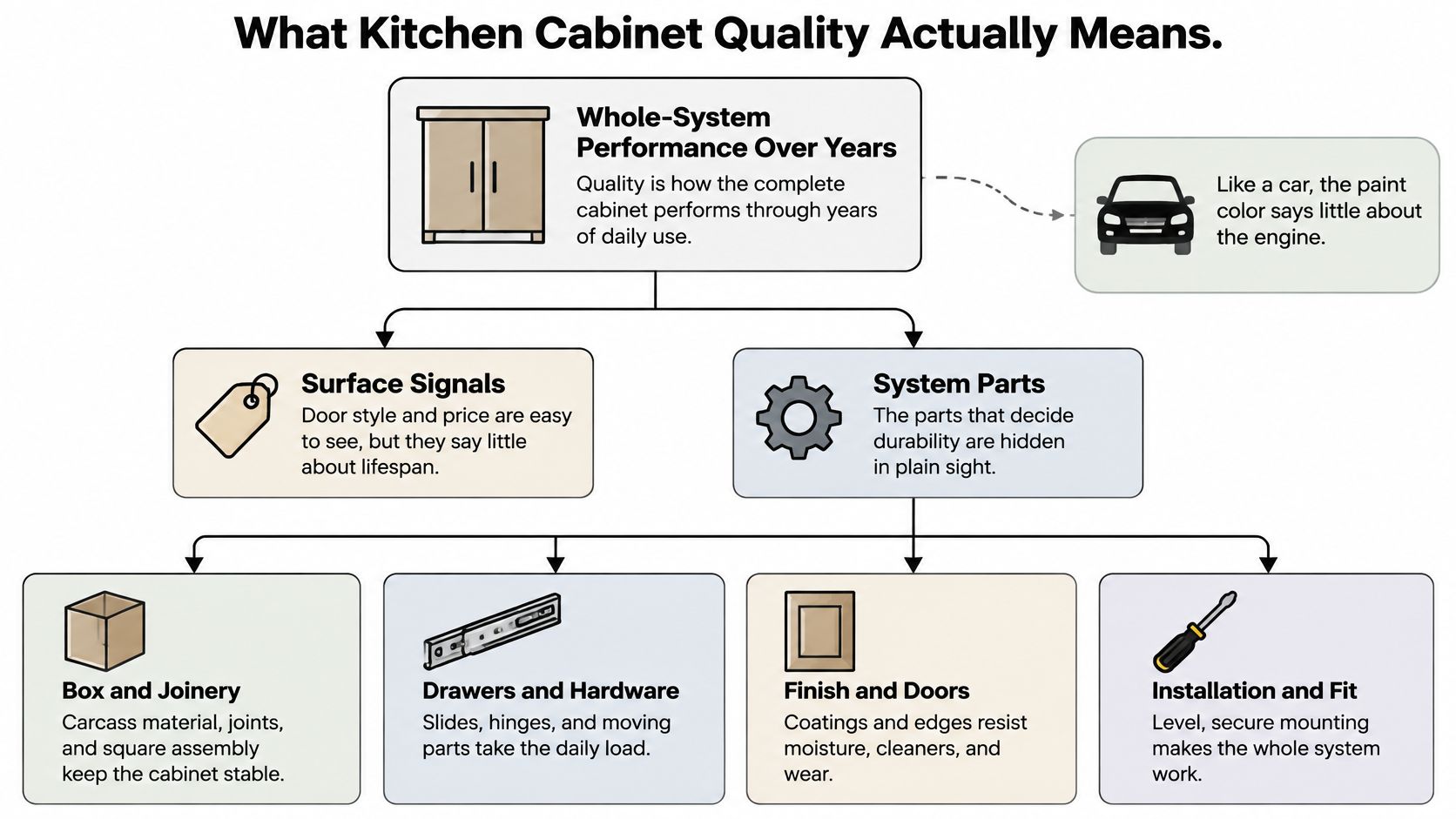
Think about how you judge a used car. The paint shines on every lot, including the ones with worn suspension and a transmission that slips. You buy on the engine, the brakes and the service history, because those decide whether the car is still on the road in year ten. Cabinets work the same way: the door and the color are the paint, and the working parts decide the lifespan.
The frame below shows where the signals sit.
The six factors buyers can actually check
Six things decide whether a cabinet system lasts: the materials in the box, how the box is built, the hardware that moves, the finish that takes the wear, the installation that holds it all level, and the warranty that governs what happens when something fails.
| Quality Factor | What Good Looks Like | Red Flag |
|---|---|---|
| Materials | Plywood or solid wood box with documented emissions compliance | Vague wood claims with no panel type named |
| Construction | Fully enclosed back, joined sides and bottoms, corner bracing | Thin backs, stapled joints, sagging shelves in the showroom |
| Hardware | Named soft-close slides and hinges with cycle and load ratings | Unbranded parts and no rating available |
| Finish | Documented resistance to heat, water, stains and cleaners | No test data, only a glossy sample |
| Installation | Level, plumb, uniform reveals, fastened into framing | Installer unwilling to explain the process or the fasteners used |
| Warranty | Written terms covering box, finish and hardware with clear exclusions | Verbal promises or coverage that ends at installation |
Buyers already say quality matters more than price. In Houzz's 2025 kitchen trends study, quality was the top kitchen-renovation priority for 64% of surveyed homeowners, ahead of cost, as summarized in this review of cabinetry quality benchmarks. That makes the definition worth pinning down, because "quality" is the word everyone uses and almost nobody can test.
There is a standard that turns these questions into measurable checks. ANSI/KCMA A161.1 covers door and drawer operation, shelf loading, finish resistance and impact performance, and it's the reason the benchmarks later in this article exist.
Here is the working definition to carry through the rest of this guide: a quality cabinet performs in a measurable, verifiable way over its service life, and a higher price is not proof of quality on its own. A premium-priced cabinet with unbranded slides and a thin back is a worse buy than a mid-priced line with a certified box and rated hardware.
Cabinet Box Construction and Materials That Last
The box is where most cabinet failures begin. A door can be refinished or replaced. A carcass that has racked out of square, or a shelf that has bowed under a stack of cast iron, usually means a new cabinet. Structural quality is better judged against a recognized performance standard than by panel thickness or appearance alone. ANSI/KCMA A161.1-2022 requires cabinet construction to provide sufficient rigidity for physical performance tests, and it addresses enclosed wall-cabinet construction, component thickness, bracing where needed, dimensional tolerances, hardware requirements and moisture durability such as water holdout for interior surfaces.
The same standard sets a moisture limit most buyers never hear about. Solid-wood and composite-wood materials must be dried to 10% moisture content or less, which limits the dimensional movement that comes from excess moisture. Wood that goes into the box wet will shrink in a dry January and swell in a humid July, and the joints take the strain.
Which material goes where
Four materials show up in cabinet boxes and panels, and each behaves differently under load and moisture. This comparison is worth carrying into a quote meeting.
| Material | Moisture and Load Behavior | Typical Use |
|---|---|---|
| Solid wood | Strong and repairable; moves with humidity if not dried to 10% moisture or less | Doors, face frames, visible trim |
| Hardwood plywood | Stable cross-laminated layers, holds screws well, handles moisture better than particleboard | Cabinet boxes, drawer sides, shelves |
| MDF | Smooth paint-grade surface, consistent density, swells if water-exposed | Painted doors and decorative panels |
| Particleboard | Lowest cost, weakest screw holding, most vulnerable to moisture | Budget shelves and interior components |
If you're weighing the two paint-grade options specifically, this comparison of plywood vs MDF cabinets covers where each one belongs and where it fails.
Take a common case. A 36-inch base cabinet holds a stack of Dutch ovens and a slow cooker. A thin shelf with no front edge band spans that width with nothing but the box sides holding it, and over two or three years it bows in the middle. The same cabinet with a thicker shelf, front and rear rails, and edge banding on the shelf face stays flat, because the load is carried by the frame instead of by a single panel.
What to ask before you sign: does this line carry current KCMA certification, which components does it cover, and how are the drawer boxes joined?
In the showroom, run three physical checks. Open the cabinet and inspect the back. A fully enclosed back stiffens the whole box, while a thin stapled-on panel does almost nothing. Press down hard on the bottom shelf and the shelf above it. Any flex you feel now becomes sag with real weight inside it. Look into the corners. Joined sides and bottoms with corner reinforcement resist the racking that makes doors drift out of alignment later.
Most kitchen failures trace back to box movement, joint weakness, moisture or an overloaded shelf rather than to a visible finish defect. That's why these checks belong ahead of any conversation about door style.
Formaldehyde Limits and Low-Emission Claims
Composite wood used in cabinets can emit formaldehyde, a volatile organic compound released from certain resin systems. Because a single cabinet may use different panels for the box, shelves, end panels and drawer components, the whole specification matters, not just the door you chose. A cabinet is a working system, and emissions are one more place where the parts you never see determine what you live with.
Under Title VI of the U.S. Toxic Substances Control Act, formaldehyde emission limits apply to the composite wood categories used in cabinets. The federal formaldehyde emission standards for composite wood products set these thresholds:
| Panel Type | Formaldehyde Limit (ppm) | Document to Request |
|---|---|---|
| Hardwood plywood | 0.05 | TSCA Title VI compliance certification from a third-party certifier |
| Particleboard | 0.09 | TSCA Title VI compliance certification for each panel supplier |
| MDF | 0.11 | TSCA Title VI compliance certification for the panel line |
| Thin MDF | 0.13 | TSCA Title VI compliance certification for thin panel use |
The Formaldehyde Standards for Composite Wood Products Act of 2010 created this federal framework as Title VI of TSCA. Under EPA implementation, panel producers must use an EPA TSCA Title VI third-party certifier, as explained in the EPA guidance for regulated stakeholders. That third-party piece matters to you as a buyer: the certification is verified by an independent body rather than by the manufacturer grading its own homework.
Three terms marketing blurs together
Regulatory compliance is a formaldehyde limit for regulated composite panels, verified by a certifier. It does not certify every adhesive or finish, and it does not make an entire cabinet "chemical-free." Low emissions is a comparison between compliant panels, not a separate guarantee about indoor air. Nontoxic is usually a marketing word with no defined limit behind it.
Here is the confusion most homeowners run into. A showroom line can meet every emission limit in the table above and still carry a finish that fails in a steamy kitchen, because emissions paperwork and durability paperwork answer two different questions. A low-emission finish still has to resist stains, moisture, abrasion and cleaning products. A line can be excellent on one axis and average on the other, and neither certificate tells you anything about the other.
Interest in healthier materials is widespread among renovating homeowners, yet far fewer projects end up specifying low-emission or sustainably sourced cabinetry. The gap looks like missing information rather than missing interest. Most buyers never learn which document to request, so the decision defaults to whatever the showroom volunteers.
The document worth asking for is a specification sheet, not a badge: substrate for each component, finish type, adhesives, emissions certification and care requirements on one page.
That sheet is also the practical starting point if you're comparing eco-friendly kitchen cabinets across two or three lines, because it forces every quote onto the same basis. Once each line is reduced to the same five entries, the differences stop being a matter of who markets harder and become a matter of what each panel, finish and adhesive is.
Testing Hardware and Finishes Before You Buy
Drawers, doors and finished surfaces take the daily wear: the pull, the slam, the wiped-up sauce, the steaming dishwasher two feet away. ANSI A161.1 testing turns those stresses into repeatable lab checks, including door and drawer operation, static loading, impact resistance for shelves, cabinet bottoms and doors, and resistance of finished surfaces to heat, water and stains. One benchmark used in ANSI/KCMA A161.1 testing is 25,000 automated opening-and-closing cycles for both drawers and cabinet doors.
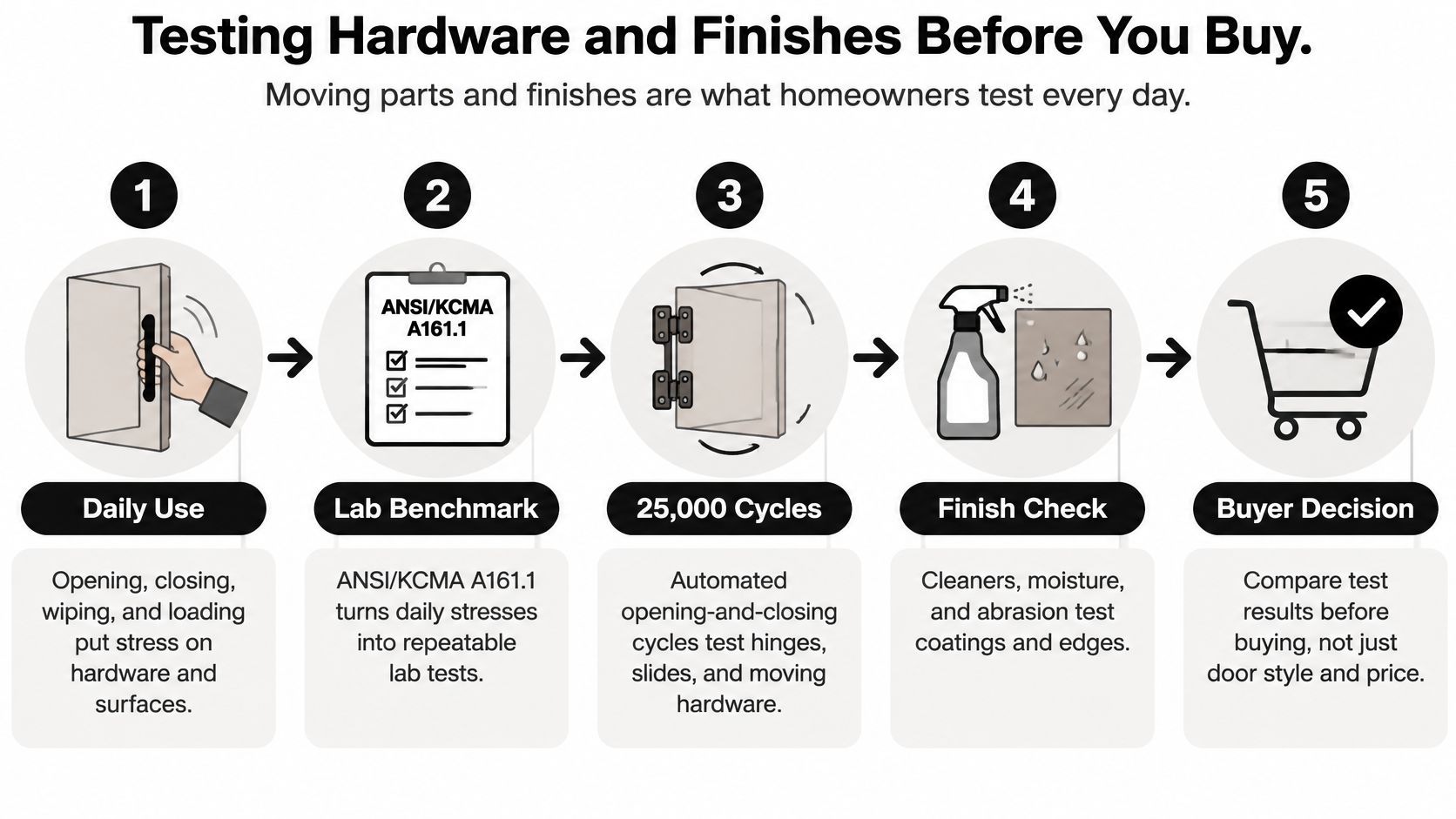
Seven checks to run in a showroom
- Ask for the certification and the ratings. Which hardware cycle and load ratings apply to this line? A cycle rating tells you the slides and hinges were built for daily use rather than for display.
- Pull each drawer fully out and push it back loaded. Put a stack of dinner plates or a couple of cookbooks inside first, then watch for wobble, binding or a slide that fights you near the end of its travel.
- Open and close a door slowly, then briskly. Listen for hinge noise and watch for rebound at the end of the swing, which points to a hinge sized for a lighter door.
- Check alignment at each hinge and along the reveal. Gaps should be even top to bottom and side to side. Uneven gaps mean the box or the door is out of square before it ever reaches your kitchen.
- Inspect exposed edges and corners. Look for seam gaps, chipping and edge banding that stops short or sits proud. Edges are where moisture enters a panel.
- Wipe the finish with a damp cloth and a mild cleaner. Dulling, softening or a chalky residue tells you the coating won't survive your cleaning routine.
- Confirm the slide and hinge brands, then ask about replacement parts. Parts that stay available for years are what turn a repair into a ten-minute job.
Testing also covers loaded drawers, drawer-bottom and closing impacts, door and hinge loading, and door-face impacts in both open and closed positions, so ask whether the certification documents those as well.
For a look at how a sprayed finish is applied and what it has to survive in a working kitchen, the Painters North Shore cabinet spraying guide walks through surface prep and coating behavior in plain terms.
Drawer joinery belongs in the same conversation, since a box that separates at the corner will outlast neither the slide nor the finish; this guide to what dovetail drawers are explains what the joint does under load.
The standard to hold onto is simple: a drawer that still closes smoothly after thousands of pulls is worth more than one that only looks sharp under showroom lighting.
Installation and Warranty Terms Worth Verifying
A well-built cabinet can still fail after it leaves the factory. Installation accuracy and warranty language belong in the quality decision, because they decide whether the box you paid for performs the way it did in the test lab.
Start with what a good install looks like. Cabinets should be level and plumb, with uniform reveals between doors and drawer fronts. Fasteners should be driven into studs or into proper anchors for the substrate, never into drywall alone. Bases and wall junctions get shimmed rather than forced, and uneven walls get scribed filler so the run looks intentional. The sink base deserves extra attention: seal it, protect it from a slow leak, and check the dishwasher placement beside it.
Now the harder question. A written warranty is not evidence of quality. It's evidence of what a company is willing to put in writing. Those are different things, and the terms matter more than the word "lifetime" on the brochure.
Read the exclusions before you compare brands. The length of coverage tells you less than what the document excludes.
Questions worth asking in writing:
- How long does coverage last, and is it prorated? Prorated coverage means you pay a growing share as the cabinet ages.
- Are boxes, finish and hardware covered separately? A finish clause is often shorter than the box clause.
- Who pays labor? Coverage on parts alone leaves the removal and reinstallation to you.
- What voids it? Water exposure, improper cleaning products and installation by an unapproved crew are common exclusions.
Consider a homeowner whose door warped beside the dishwasher within three years. The claim gets denied because the exclusion names water exposure, and the placement decision, plus the sink-base protection, should have been settled before signing rather than after. The kitchen cabinet installation process matters here, because how cabinets are fastened, sealed and sequenced decides which failures ever reach a warranty desk.
Before you sign, request written terms, confirm who handles claims after installation, and ask what a repair involves in year five.
Cost and Lifespan Ranges for Each Budget

Price tiers don't map neatly onto durability, but they do describe what's usually inside the box, how long the line typically serves and how much layout freedom you get.
| Cabinet Tier | Approximate Installed Cost | Typical Service Life | What It Usually Includes |
|---|---|---|---|
| Stock or ready-to-assemble | From about $5,000 for a basic kitchen, materials and labor | About 10 to 15 years | Standard boxes, basic hardware, limited sizes |
| Semi-custom | At least $15,000 for a medium-size kitchen in most cases | About 20 years or more | Enclosed backs, better drawer systems, wider finish options |
| Custom | Roughly $700 or more per linear foot | 30 years or more with proper care | Custom sizing, selected wood species, specialized storage |
Those lifespan figures are planning ranges, not promises. A certified stock box that stays dry and level can outlast a neglected custom one, because service life follows construction, installation and moisture control rather than price.
Why a 20-linear-foot kitchen looks the same in photos
A 20-foot run of stock cabinets and a 20-foot run of semi-custom can photograph identically. The differences hide in the materials list: stock lines typically pair thinner boxes with standard slides and a fixed size grid, while a semi-custom line adds enclosed backs, a better drawer system and sizes that close a gap without a wide filler strip.
Custom money buys exact dimensions, selected wood species, inset doors and storage built to a specific routine. It doesn't automatically buy better joinery, which is why the specification sheet matters as much on a premium quote as on a budget one.
Where to spend, by tier:
- Tight budget: put the money into box construction, hardware and the sink base. Those three fail first and cost the most to fix.
- Middle range: prioritize drawer banks, finish durability and layout. A well-organized drawer stack improves daily life more than an upgraded door profile.
- High end: pay for custom sizing, species and specialized storage rather than surface decoration.
Every range above is approximate and moves with region, labor rates and site conditions. Compare written quotes that itemize materials, hardware and installation line by line, since a per-linear-foot average hides which slides and which back panel you're getting. To price your own layout rather than a national average, start with this breakdown of cabinet cost per linear foot.
Choose Quality Cabinets with a South Jersey Consultation
Running all of these checks takes repetition: the same drawer pulled in three lines, the same door style compared under different lighting, the same quote read again for installation details. Driving between showrooms across Camden and Burlington Counties makes that tedious, and buyers often end up choosing the last door they saw instead of the cabinet system that holds up best.
The Cabinet Coach works as a mobile cabinet showroom, bringing flat panel cabinets, modern cabinets and transitional kitchen cabinets directly to the customer's area. That matters because a finish that looks crisp in a showroom can read differently beside your own countertops, flooring and light. Custom cabinet design with The Cabinet Coach covers cabinet selection, the exact layout and features that fit your space and lifestyle. Material selection also walks clients through complementary elements, from the tile backsplash to the hardware, so the parts feel chosen as one set.
Premium wood species, durable finishes, transitional shaker styles, contemporary designs and traditional raised-panel details can all be compared against the same six factors: materials, construction, hardware, finish, installation and warranty. Use the checklist like a simple scorecard, not a memory test. A shaker door may look familiar in three quotes, but the drawer slides, box construction and finish sample still need separate attention.
The Cabinet Coach serves Cherry Hill and surrounding communities across Camden and Burlington Counties. The practical next step is a complimentary video consultation, followed by transparent preliminary estimates you can compare against those six factors. For builders and remodelers, the process can also produce a decision-ready cabinet package with correct measurements and on-time delivery, without showroom trips.
For a kitchen in South Jersey, visit The Cabinet Coach to compare cabinet systems on how they hold up over time, not just how they look on a display wall.