
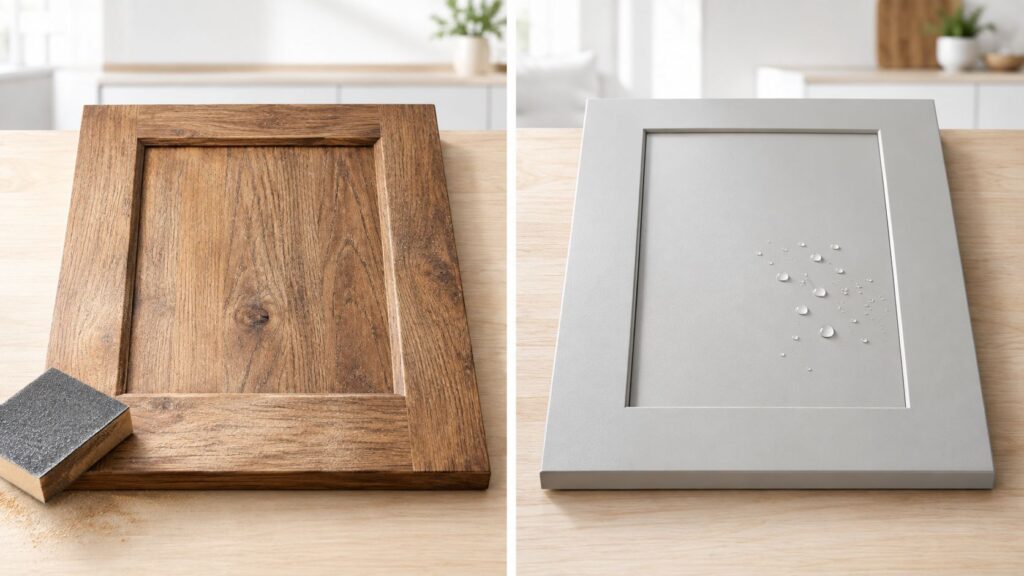
You're sitting at the kitchen table with two door samples in front of you. One has a convincing wood grain and wipes clean after a simulated spill. The other has the warmth and depth you've wanted for years, but you're already wondering what humidity, children, pets, and the occasional leaking dishwasher will do to it.
The laminate vs wood cabinets decision isn't just about the first invoice or which sample looks better under showroom lights. It affects daily cleaning, failure points, future repairs, resale appeal, and whether you can refresh the room later without replacing every door. Wood remains the historical benchmark in major cabinet markets. One 2026 industry report places wood at 60.15% of global kitchen-cabinet revenue in 2025, while another custom-cabinet forecast places wood at 42.3% and laminate at 24.7% of global revenue, with reported values of about $28.95 billion and $16.9 billion respectively (market data on kitchen cabinet materials).
Neither material wins every room. The smart choice depends on how the space gets used, where water and heat collect, how long you'll own the home, and whether you'd rather replace a damaged door or refinish it. The framework below focuses on those practical questions, with particular attention to edge failure, humidity, repair economics, and room-specific use.
Table of Contents
- The Cabinet Choice Every Remodeling Homeowner Faces
- How Laminate and Wood Cabinets Became Today's Options
- Comparing Laminate and Wood Across the Factors That Matter
- Durability in Real Kitchens and Baths
- Cost, Lifespan, and Long-Term Ownership Economics
- Matching the Material to the Room and the Household
- Choosing With Confidence for Your Home
The Cabinet Choice Every Remodeling Homeowner Faces
Most homeowners begin with appearance. They compare a painted shaker door with a wood-grain laminate, hold each sample beside the countertop, and ask which one will make the kitchen feel more expensive. That's a reasonable starting point, but it's not enough to choose responsibly.
The cabinet material sits in the middle of your daily routine. It faces wet hands near the sink, grease near the range, bags and backpacks near the island, and repeated opening around drawers and appliance panels. In a bathroom, it deals with splashes, steam, and the slow effects of moisture at seams. A material that looks excellent on installation day can become frustrating if its most vulnerable edge sits beside a dishwasher.
Begin with three questions:
- Which room is getting the cabinets? A kitchen, bathroom, laundry room, pantry, and dry storage area each create different risks.
- Who uses the room every day? A careful couple has a different wear pattern from a family with children, pets, and constant cooking.
- How long will you stay? A short-term renovation and a long-term home should not receive the same material recommendation.
Practical rule: Choose the material based on its likely failure mode, not its showroom finish.
Laminate usually offers a nonporous surface that handles fingerprints, stains, and routine spills with less fuss than wood (comparison of laminate and wood cabinet surfaces). Wood, however, gives you a much stronger path for future repair. You can often sand, fill, repaint, or refinish damaged wood, while laminate damage frequently means replacing the affected door or panel (repairability comparison for laminate and wood cabinets).
That difference changes the long-term calculation. Laminate can be the better surface for a busy, moisture-prone location, while wood can be the better investment for an owner who expects to live with the cabinets for many years and is willing to maintain them.
Before signing a cabinet contract, ask where the edges are exposed, what material forms the cabinet core, how the doors are finished, and whether damaged parts can be ordered individually. For South Jersey homes, also account for seasonal humidity and temperature changes. The room, the household, and the ownership plan should determine the answer.
For a broader cabinet-selection process, use this guide to choosing kitchen cabinets before you compare door finishes.
How Laminate and Wood Cabinets Became Today's Options
Wood cabinetry has the longer emotional history. Older homes often feature handmade wood doors, face frames, and joinery that were designed to age with the building. Later kitchens expanded the palette to include plywood boxes, painted hardwood doors, softwood frames, MDF components, and selected hardwood faces. Today, “wood cabinets” can describe very different constructions, from a solid wood door to a plywood box with a hardwood veneer.
Lamination itself is hardly a modern shortcut. A historical review traces laminated wood to ancient Egypt, where laminated wood was found in pharaohs' tombs. It also describes Chinese craftsmen gluing shaved wood together roughly 1,000 years ago, followed by English and French furniture makers who used laminate-like constructions in the 17th and 18th centuries for furniture and household pieces (history of laminated materials in furniture and cabinetry).
The modern homeowner's laminate cabinet emerged from that long material tradition, but the look became especially visible in kitchens during the 1970s. Designers and manufacturers offered bold colors, graphic patterns, and easy-clean finishes at a time when homeowners wanted kitchens to reflect personal style rather than imitate formal furniture.
The construction matters more than the label
Modern laminate cabinetry may use high-pressure laminate, melamine-coated panels, or thermally fused laminate surfaces. These products can produce convincing wood looks, solid colors, and contemporary finishes, but their performance depends heavily on how the surface is bonded and what lies beneath it.
A laminate door over a stable, well-sealed panel isn't the same as a thin surface applied to a vulnerable particleboard edge. Likewise, a “wood cabinet” may contain solid hardwood on the visible door, plywood in the box, MDF in a painted center panel, or veneer over an engineered substrate.
That's why the debate persists. Wood remains associated with natural variation, premium positioning, and furniture-like character. Laminate competes through consistency, design range, surface practicality, and scale. Neither option is a single product category. The construction, finish, and installation details decide much of the actual outcome.
When refacing existing boxes, the choice becomes even more specific. This cabinet refacing materials guide helps clarify where laminate, veneer, and other surfaces fit.
Comparing Laminate and Wood Across the Factors That Matter
Start with the table, but don't treat it as a verdict. Laminate categories vary widely, and wood grades, box materials, finishes, and construction methods can change the result substantially.
| Factor | Laminate Cabinets | Wood Cabinets |
|---|---|---|
| Upfront cost | Often the value-oriented choice, with broad pricing depending on surface, core, box construction, and customization | Ranges from accessible stock options to premium custom work, with cost rising for better wood, joinery, finishes, and detailing |
| Durability | Strong resistance to routine scratches, stains, fingerprints, and surface moisture; exposed edges and seams are vulnerable | Handles ordinary wear well when properly finished; dents and scratches can usually be repaired or incorporated into the finish |
| Edge performance | Edge-band delamination can expose the core; standing water and steam increase swelling risk | Finished edges can still require care, but wood can generally be sanded, filled, patched, or refinished |
| Maintenance | Simple daily cleaning with mild products; avoid excessive water and direct heat | Requires more care around moisture and finish wear; cleaning methods should match the finish |
| Appearance | Consistent colors, patterns, and wood looks; strong choice for modern, uniform designs | Natural grain, variation, stains, paint, inset details, and furniture-like character |
| Expected lifespan | Reported estimates commonly fall around 10 to 25 years, depending on construction, use, and exposure (cabinet repair and lifespan overview) | Reported estimates commonly fall around 20 to 50 or more years when construction is sound and the cabinets are maintained (cabinet repair and lifespan overview) |
| Environmental impact | Can use wood fibers efficiently and reduce demand for selected solid lumber, but resins and mixed materials can complicate repair and disposal | Can last longer and support refinishing, but sourcing, species, finish, and replacement frequency all affect the overall impact |
Cost is only meaningful with construction attached
A low-cost laminate door may be a sensible choice for a rental or a laundry room. A poorly sealed laminate edge beside a dishwasher can be a false economy. Wood presents the opposite challenge. A basic wood door with a weak finish may not justify a premium, while a well-built cabinet with repairable components can remain useful through several design changes.
Appearance changes the value equation
Laminate excels when you want repeatable color and a clean contemporary surface. Wood wins when you care about natural grain, visible variation, custom stains, inset doors, or the ability to change the finish later.
Environmental impact also requires more than comparing material names. A cabinet that gets replaced because a wet edge swelled has a different lifecycle from one that receives a repair. Durability, repairability, and responsible sourcing belong in the same conversation.
Durability in Real Kitchens and Baths
The surface is only the first layer of the durability question. In actual kitchens and baths, the edge is often more important than the center of the door.
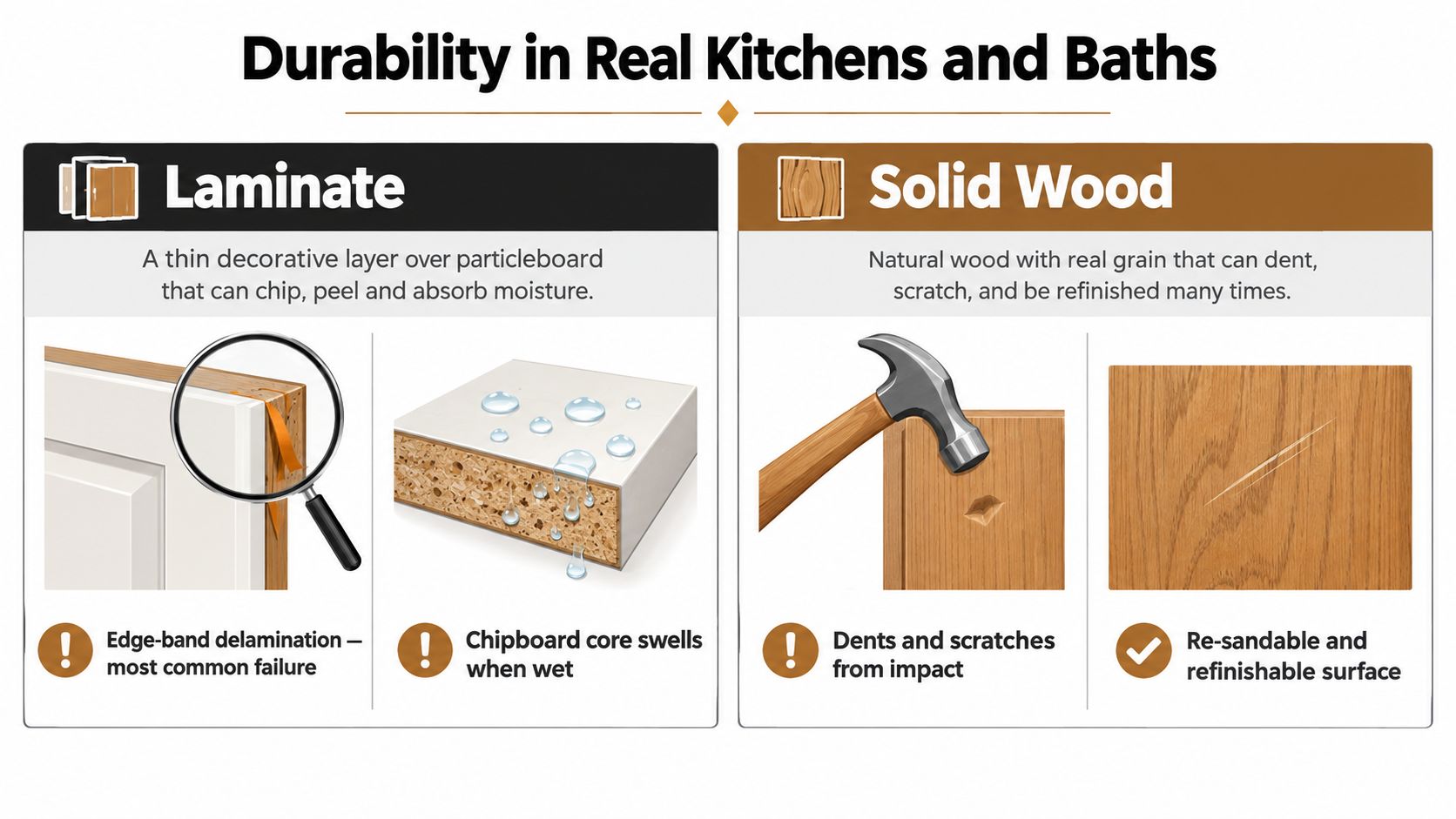
Laminate generally handles daily surface abuse well. Its decorative layer is nonporous, so fingerprints, common spills, and routine cleaning are less demanding than they are on many wood finishes (surface resistance comparison). The problem begins when water or heat reaches a seam, edge band, or exposed substrate.
Where laminate fails
Edge-band delamination is the failure I look for first. Once the edge lifts, water can enter the MDF or particleboard core. The core may swell, the surface can bubble or peel, and the original flat profile may be impossible to restore. A laminate door with a damaged edge often needs replacement rather than an in-place repair.
Heat creates another risk. A door or panel beside an oven, dishwasher, toaster, or steam-producing appliance can experience discoloration, bubbling, or adhesive failure if the construction and clearances aren't appropriate. Laminate is moisture-resistant at the surface, but it isn't invulnerable after a seam opens.
The core changes the consequences. Particleboard can swell substantially after water intrusion, while MDF behaves differently and plywood may retain its shape more effectively, though no engineered panel welcomes prolonged moisture. This is why the cabinet specification matters as much as the decorative finish. Use the plywood versus MDF cabinet guide to compare the substrates before choosing the door.
Where wood earns its keep
Wood can dent, scratch, and show finish wear around pulls and sink bases. Those marks aren't automatically a structural failure. A skilled cabinet finisher can often fill, sand, spot-repair, repaint, or refinish the affected area. Wood also tolerates a broader range of visual repair because grain, stain variation, and painted surfaces can absorb small imperfections.
That doesn't make wood maintenance-free. Humidity can cause wood components to expand and contract, and poorly controlled moisture can damage finishes or joints. But a repairable surface gives you more options than a peeled laminate edge.
For a useful example of how refinishing can refresh cabinet surfaces, see this resource on spray painting cabinets on the North Shore. The technique isn't a substitute for correcting water damage, but it illustrates why a sound wood surface offers a genuine renewal path.
My recommendation: Put laminate where surface abuse is constant, but don't put a vulnerable laminate edge where water will sit every day.
High-humidity rooms shorten the margin for error because moisture remains active at seams and edges. In a South Jersey kitchen or bath, inspect the dishwasher side panel, sink base, vanity ends, and areas beneath plumbing before you decide that a wipeable surface solves the whole problem.
Cost, Lifespan, and Long-Term Ownership Economics
A cabinet decision should be tested over the period you expect to own the home, not just against the initial proposal. The key question is simple: will the material be replaced, repaired, or refinished during your ownership?
Laminate often makes financial sense when the project needs a controlled initial investment, when the room may be renovated again, or when the owner values easy surface maintenance over restoration. Wood costs more in many configurations, but its repairability can change the economics for a long-term owner.
The exact installed price depends on layout, labor, box construction, door style, hardware, countertops, site conditions, and customization. There isn't a responsible universal price table without a measured design and a defined specification. The same applies to lifespan. Reported ranges place laminate around 10 to 25 years and wood around 20 to 50 or more years, but exposure and construction determine where a cabinet lands within those broad ranges (cabinet repair and lifespan overview).
Model the ownership path
Use this worksheet with actual proposals rather than invented averages:
| Cabinet tier | Initial installed cost | Expected service life | Refinishing cycles | 25-year annualized cost |
|---|---|---|---|---|
| Entry-level laminate | Use the contractor's written quote | Use the manufacturer's construction and exposure guidance | Usually limited surface renewal; replacement may be required after edge failure | Divide the total 25-year spend, including replacement or repairs, by 25 |
| Mid-range stock wood | Use the written quote and species specification | Ask what is covered by the warranty and how the finish can be maintained | Confirm whether doors can be sanded, painted, or refinished | Add expected maintenance and refinishing to the ownership total |
| Semi-custom wood | Use the measured design proposal | Confirm box, door, finish, and replacement-part availability | Ask the finisher how many future refreshes the surface can support | Divide the full ownership spend by 25 |
| Custom wood | Use the cabinetmaker's proposal | Evaluate joinery, finish, serviceability, and replacement-part policy | Treat refinishing as a planned future service, not a guarantee | Include design changes, refinishing, and repairs in the total |
South Jersey humidity deserves a line in the calculation. Laminate can resist moisture well on an intact surface, but a failed seam can expose a vulnerable core. Wood may require more finish care, yet its repair path can prevent a complete replacement.
A short-term owner shouldn't automatically buy premium wood. If you expect to move before the material's repairability becomes valuable, laminate may preserve budget for layout, lighting, storage accessories, or better hardware. A long-term owner should look harder at wood, especially if the cabinetmaker can document construction and refinishability.
For planning context, review this cabinet cost per linear foot guide and then request a proposal based on your actual layout.
Matching the Material to the Room and the Household
The right answer changes as soon as the room changes. I wouldn't specify the same material for a family kitchen, a guest powder room, and a rental vanity just because the homeowner likes one door sample.
For a busy family kitchen, laminate is often my first recommendation for the working perimeter, especially around the sink and dishwasher. It handles fingerprints and routine spills with less daily fuss, and a consistent finish can make replacement easier if one door is damaged. Choose a reputable construction, protect exposed edges, and insist on proper appliance clearances.
A rental property has a different objective. The owner needs dependable appearance, controlled replacement, and a material that doesn't turn every tenant mark into a sentimental repair project. Laminate wins here, provided the installer seals vulnerable edges and uses a suitable core.
Match the room first
- Kids' bathroom: Choose laminate when splashes, toothpaste, and quick cleaning matter more than a refinishing plan.
- Powder room: Wood becomes more attractive because the room usually sees less water and less sustained daily abuse.
- Primary-suite bathroom: Choose wood when humidity is controlled and you want a furniture-like vanity that can be maintained over time.
- Laundry room: Laminate is practical around utility use, but keep seams away from plumbing risk and avoid treating moisture resistance as waterproofing.
- Formal pantry or dining storage: Wood is the stronger aesthetic choice when the cabinet rarely encounters standing water.
- Long-term family kitchen: Wood earns the recommendation when you value natural character, custom detailing, and the option to refinish rather than replace.
Don't overlook a hybrid layout
A hybrid can be more intelligent than forcing one material throughout the house. You might use wood uppers and a wood island for the visual focal points, then specify laminate lowers near the sink and dishwasher. Another sensible combination is wood in the kitchen and laminate in the laundry room or children's bath.
The key is to avoid placing the most vulnerable edge at the most aggressive moisture and heat location. A hybrid plan should follow the room's stress pattern, not merely divide materials for decoration.
A homeowner who cooks constantly and wants easy cleanup may prefer laminate even in a high-quality renovation. A homeowner who plans to stay for the long term and wants the kitchen to age like furniture should choose wood where the construction and maintenance plan justify it.
Choosing With Confidence for Your Home
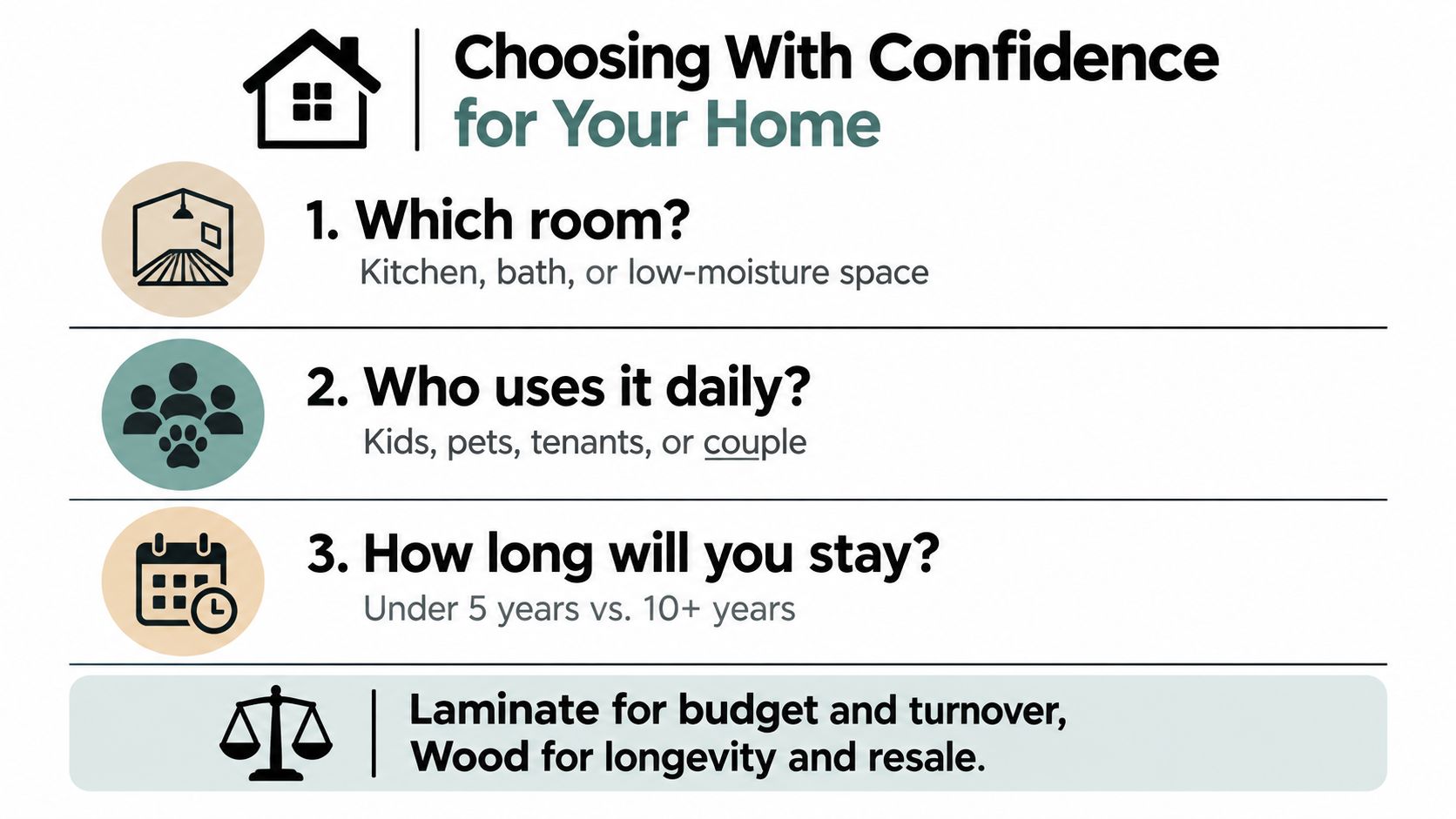
The fastest way to make this decision is to stop asking which material is superior and answer three practical questions.
Which room is it? Identify the sink base, dishwasher side, appliance ends, vanity plumbing, and any location where steam or standing water can reach an edge.
Who uses it every day? Count actual wear, not idealized wear. Children, pets, frequent cooking, renters, and hurried cleanup all favor surfaces that tolerate routine abuse without special handling.
How long will you stay? A short ownership horizon favors controlled cost and easy replacement. A long ownership horizon makes repairability, refinishing, and replacement-part availability more important.
Use this quick decision checklist before you approve the final specification:
- Choose laminate for rental kitchens, children's bathrooms, laundry rooms, and projects where surface cleanup and initial budget matter most.
- Choose wood for a long-term home, a primary suite, formal storage, and any project where you want to sand, repaint, or refinish the cabinets later.
- Choose a hybrid when the room has distinct stress zones. Put the most moisture-resistant construction near daily splash areas and the most repairable, design-focused material where appearance carries more weight.
- Ask about the core before you approve a laminate door. The decorative layer won't protect an exposed, moisture-sensitive substrate after an edge opens.
- Ask about future parts before you approve wood. A repairable material is more useful when the manufacturer or cabinetmaker can supply matching doors, panels, and finish information.
Resale deserves a realistic reading. Buyers respond to a coherent, well-maintained kitchen, but a material label alone doesn't guarantee value. A badly swollen laminate panel is a liability, just as a poorly maintained wood finish can make a premium cabinet look tired. HOA restrictions may affect colors, exterior appearance, or renovation approvals, but they don't remove the need to match the material to the room.
If your existing boxes are sound, refacing may also be worth comparing with full replacement. This guide to cabinet refacing versus replacement can help you frame that decision around the condition of the boxes, the desired door style, and the extent of the renovation.
My advisor's verdict is straightforward. Choose laminate when turnover, surface resistance, and budget control lead the decision. Choose wood when longevity, refinishing, natural character, and long-term ownership matter more. Before you sign, inspect the edges, identify the core, locate the heat and water threats, and ask what happens after the first serious failure. That answer matters more than the sample's appearance across a showroom counter.
The Cabinet Coach brings a mobile cabinet showroom to South Jersey homeowners and helps coordinate cabinetry, countertops, hardware, and tile around the way each room will be used. If you're weighing laminate, wood, refacing, or a hybrid plan, schedule a complimentary video consultation through The Cabinet Coach to discuss your layout, priorities, and preliminary budget.