
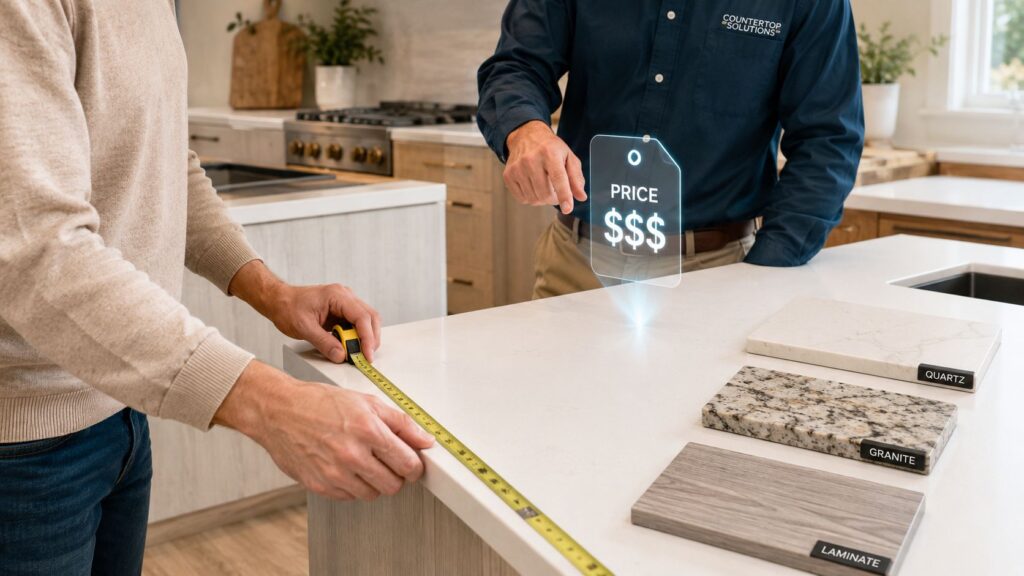
Solid surface countertops usually land around $50 to $150 per square foot installed, and a typical kitchen of 30 to 40 square feet usually comes out around $1,500 to $6,000. If you're standing in a showroom trying to decide whether that number is sane, the short answer is yes, but only if you understand what you're paying for.
Most homeowners don't lose sleep over the slab itself. They get tripped up by the seams, the sink cutouts, the edge detail, and the labor that turns a plain sheet into a finished kitchen surface. That's where solid surface either becomes a smart mid-priced buy or turns into a quote that feels oddly high for something that isn't quartz.
Table of Contents
- What Most Homeowners Expect to Pay in 2026
- What Solid Surface Countertops Actually Are
- Reading the Price Tags Per Square Foot and Per Linear Foot
- The Seven Cost Drivers That Move Your Final Number
- How Solid Surface Stacks Up Against Quartz Granite and Laminate
- Maintenance and Lifetime Cost Over the Life of the Counter
- Five Smart Moves to Lower Your Solid Surface Quote
- South Jersey Considerations and Your Next Step
What Most Homeowners Expect to Pay in 2026
A homeowner usually walks into the kitchen with a design idea and leaves with a budget reality check. That's normal. Solid surface is one of those materials that looks simple until the quote arrives, because the finished price reflects fabrication, fitting, and installation, not just raw material.
The headline number is straightforward. Solid surface countertops are typically priced in the $50 to $150 per square foot installed range, and an average kitchen total of $1,500 to $6,000 covers about 30 to 40 square feet of surface, according to U.S. consumer pricing guides for solid surface countertop costs. That puts solid surface in the mid-range, above laminate and often below premium natural stone options.
Where that range actually lands
A small kitchen can still surprise you. Home improvement pricing sources show a 64 to 99 square foot room may need 20 to 30 square feet of countertop and cost roughly $1,000 to $4,500. A larger kitchen with 40 to 60+ square feet of countertop can run $2,000 to $9,000+. Those totals are why the shape of the kitchen matters almost as much as the material itself.
Practical rule: If your kitchen has a simple layout and modest edge detailing, solid surface usually behaves like a predictable mid-budget choice. If the layout is broken up, the quote climbs fast.
The right way to read the number is not “What does solid surface cost?” It's “What does my kitchen need to become a finished countertop job?” That shift matters, because once you understand the installed price, you can judge whether the material belongs on your shortlist or whether you should move straight to something cheaper or tougher.
What Solid Surface Countertops Actually Are
Solid surface is a manufactured countertop material, not a natural slab pulled from the earth. It's built to look continuous, which is why it shows up so often in kitchens and baths where clean lines matter more than dramatic stone patterning. If you want the short version, think of it as the material category that lives between laminate and stone, but with a much more polished finished result.
What you're really buying
The core appeal is simple. Solid surface can be seamed with color-matched adhesive, shaped into a more continuous look, and finished so the joints don't announce themselves the way they do in many other materials. That's why homeowners who hate visible seams often keep coming back to it.
It also lets fabricators integrate sinks and backsplashes in ways that feel built-in rather than patched on. That's the feature set most shoppers are paying for, not just the sheet goods themselves. For a plain-language primer on the material category, this Corian countertop explainer gives a useful starting point.
Why designers keep putting it in budgets
I like solid surface for one reason above all others, it solves the visual problem of joints. Laminate can't do that cleanly. Stone can, but usually at a higher price and with more maintenance complexity. Solid surface is the option that makes a kitchen look finished without pretending it's a luxury slab project.
A good solid surface quote pays for the fabrication skill as much as the material. If the fabricator is sloppy, the seams show and the whole point disappears.
That's also why this category stays popular in practical remodels. Homeowners want a countertop that looks intentional, cleans easily, and doesn't force them into the maintenance habits of a natural stone surface. Solid surface gives them that, as long as they're willing to accept that it's a performance-and-look compromise, not a heat-proof showpiece.
Reading the Price Tags Per Square Foot and Per Linear Foot
A solid surface quote can look cheap on paper and still land high once the fabricator adds the work. That happens because contractors do not all price the job the same way. Some quote square feet, some quote linear feet, and some bundle in enough extras to make the number look simpler than it is. The unit matters, but the scope behind it matters more.
Square feet give you the cleaner read
Per-square-foot pricing tracks the actual installed surface, so it is the number I trust first. In many residential jobs, solid surface lands in the mid-priced range, and SlabWise's guide to solid surface countertops points to a spread that runs from about $40 to $120 per square foot, with many projects around $55 to $85 per square foot once brand tier, color complexity, fabrication labor, edge detail, and regional labor costs are folded in. That range fits what I see in real kitchens, where the final price moves with the fabricator, the cut list, and how much finishing work the job needs.
A per-linear-foot quote looks easier to read, but it can hide the parts that drive the bill. Sinks, cutouts, finished ends, and seams can all sit outside the headline number. If a fabricator gives you a linear-foot price, ask exactly what it includes before you compare it with a square-foot estimate.
Kitchen size changes the budget fast
| Kitchen Size | Countertop Area | Typical Installed Cost |
|---|---|---|
| Small kitchen | 20 to 30 square feet | $1,000 to $4,500 |
| Typical kitchen | 30 to 40 square feet | $1,500 to $6,000 |
| Large kitchen | 40 to 60+ square feet | $2,000 to $9,000+ |
Use that table as a reality check. A small galley kitchen should not be priced like a large island layout, and a bigger kitchen should never be judged by slab price alone. The installation work, seam count, cutouts, and edge treatment often matter just as much as the surface material itself.
For edge selection guidance, this countertop edges overview is a useful reference before you sign off on a quote. Edge choice sounds cosmetic, but it changes labor and pushes the final number up or down.
The Seven Cost Drivers That Move Your Final Number
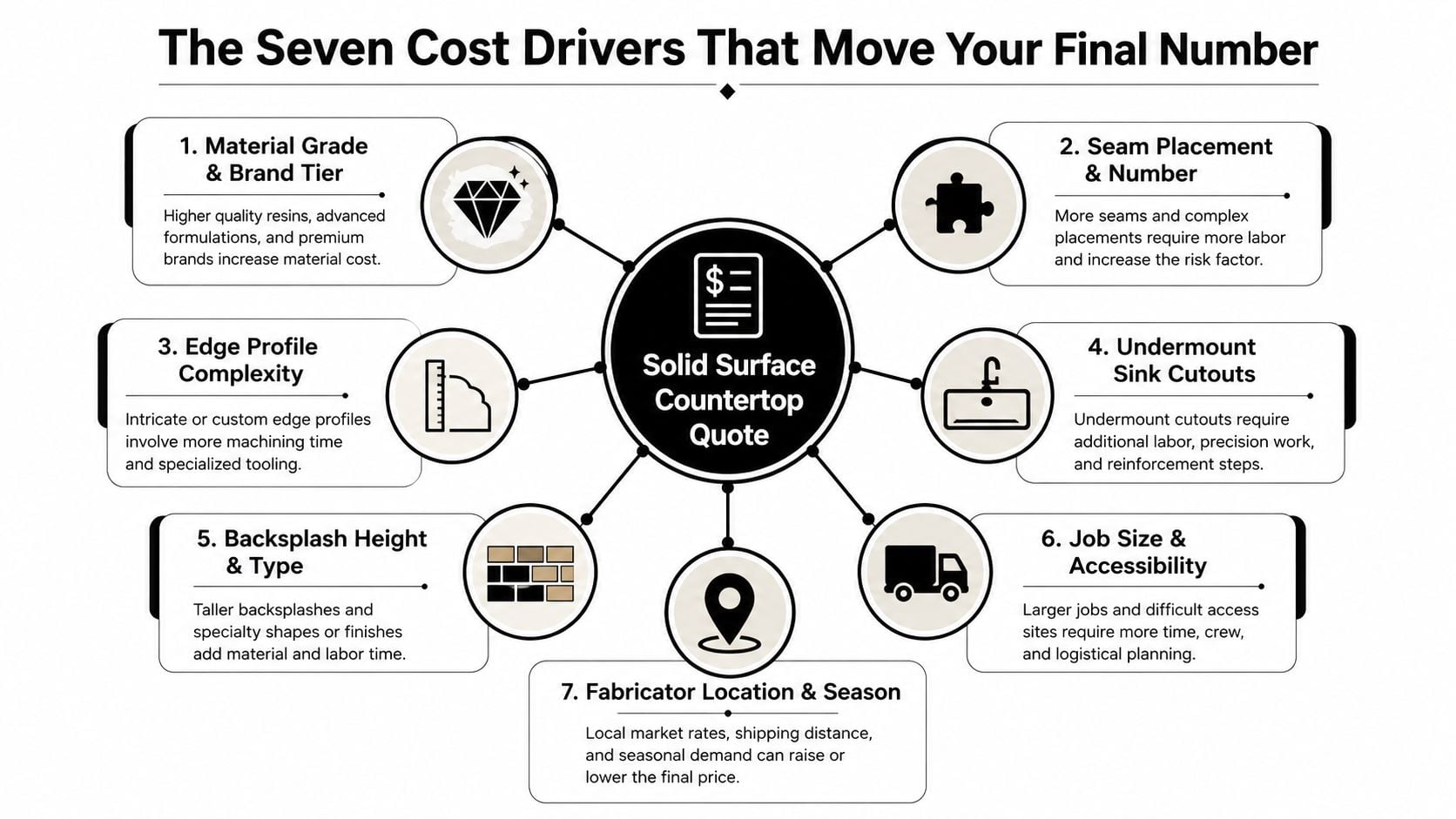
Homeowners get into trouble when they assume solid surface has one clean price. It doesn't. The quote moves because the job moves, and in South Jersey the difference between a straightforward kitchen and a fussy one shows up fast in labor, layout, and finish work.
The drivers that matter
These are the factors that change the number on the final invoice:
- Material grade and brand tier set the starting point before fabrication begins.
- Seam placement and seam count affect both the look and the labor, since fewer seams usually mean cleaner work.
- Edge profile complexity adds fabrication time, especially when you want something more detailed than a basic finished edge.
- Sink and cooktop cutouts require careful measuring and precise shop work.
- Backsplash height and type can turn a simple counter run into a more involved fabrication package.
- Job size and accessibility matter because a cramped kitchen, a tight stairway, or a tricky install route slows the crew down.
- Fabricator location and season shape labor availability and regional pricing.
That is why two kitchens using the same solid surface material can land in very different price bands. The material is only part of the story. The rest is the work required to make it fit the room cleanly.
What should raise your eyebrows
A low bid deserves scrutiny. Check whether removal of the old counters, seam bonding, sink cutouts, and finished edges are included, because those line items are where a quote often grows later. A high bid deserves the same scrutiny, because custom details and awkward access can drive labor up quickly.
South Jersey quotes usually make sense only when you look at the whole job, not just the square footage. A tight suburban kitchen with one sink cutout and a simple edge is a very different labor load from a larger layout with multiple seams, a backsplash wrap, and difficult on-site access. That is where local installers earn their money, and that is also where homeowners get blindsided if they compare only the surface material.
Major U.S. market pricing typically clusters around $40 to $120 per square foot, with many residential projects landing around $55 to $85 per square foot, according to SlabWise's solid surface countertop guide. A project in that range usually makes sense once you break the quote into the seven drivers above.
How Solid Surface Stacks Up Against Quartz Granite and Laminate
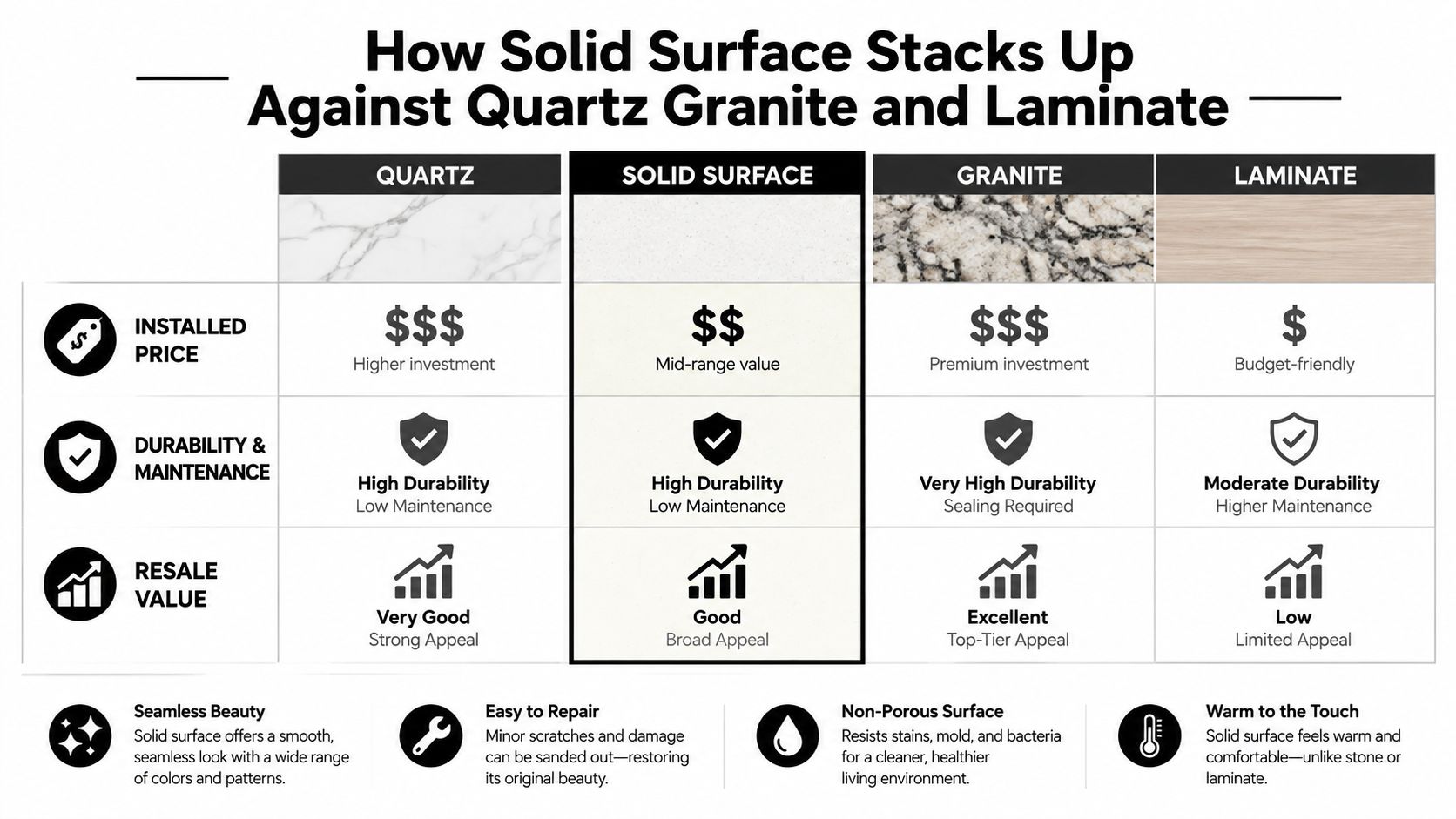
Solid surface earns its keep when you want a cleaner visual finish without jumping to the price and weight profile of stone. It's not the toughest material in the room, and it's not the cheapest either. It sits in the middle, and that's exactly why so many homeowners overlook it.
Price, durability, and upkeep
Quartz and granite usually win on hard-use toughness. Laminate wins on starting price. Solid surface sits between them, which is why it's the sweet spot for homeowners who care more about design and repairability than about bragging rights at the stove. It's also a strong choice when you want integrated sinks and fewer visible joints.
The tradeoff is straightforward. Solid surface is not the best pick if your household cooks hot and hard every day and expects the counter to shrug off abuse. Quartz and granite are more forgiving in that setting. Laminate is cheaper, but it doesn't give you the same look or the same repair story.
Choose solid surface when you want the surface to disappear into the kitchen design. Choose quartz or granite when you want the counter to act like the visual center of the room.
There's a useful visual comparison in this solid surface vs quartz guide, especially if you're deciding between a look with fewer visible joints and a harder, more stone-like surface.
Where the material makes the most sense
A solid surface top works especially well in kitchens where the design needs to stay calm and cohesive. It also makes sense in bathrooms, laundry rooms, and secondary prep areas where repairability and easy cleaning matter more than high-heat performance. If your idea of a good countertop is one that looks built-in rather than bolted on, solid surface is still a very smart shortlist material.
For a quick visual explanation, the video below helps clarify the material tradeoffs.
Maintenance and Lifetime Cost Over the Life of the Counter
The sticker price only tells part of the story. Solid surface matters because it can be maintained and repaired in ways that help stretch its useful life, which is where value shows up for owners who plan to stay put.
Repairability changes the economics
The material is sandable, so small scratches and some surface damage don't automatically mean replacement. That is a real advantage over materials that look great until they chip, crack, or stain in a way that becomes expensive to fix. For a homeowner who hates the idea of replacing a whole counter because of a few ugly marks, that matters.
A 2026 pricing trend report from SlabWise shows installed solid surface pricing moving from $40 to $75 per square foot in 2023 to $45 to $85 per square foot in 2026, a rise of roughly 10% to 13%, according to SlabWise's pricing trend report. That tells you the category hasn't gone away, and it still has enough demand to stay competitive in the market.
What ownership looks like in practice
Routine care is simple. Mild cleaners, non-abrasive pads, and quick attention to wear spots will keep the surface looking good. If a section gets dinged up badly enough, a fabricator can often refinish it rather than replacing the whole run.
For homeowners comparing long-term value, the important point is this, solid surface often behaves like a repairable finished surface rather than a disposable one. That can make it a smarter cost-per-year choice than a cheaper material that needs full replacement sooner. It won't outlast every stone counter in raw toughness, but it can hold its own when a homeowner values recovery over perfection.
What non-porous means in countertop care is worth understanding before you compare materials, because the maintenance conversation gets a lot clearer once you know how surfaces handle spills and cleanup.
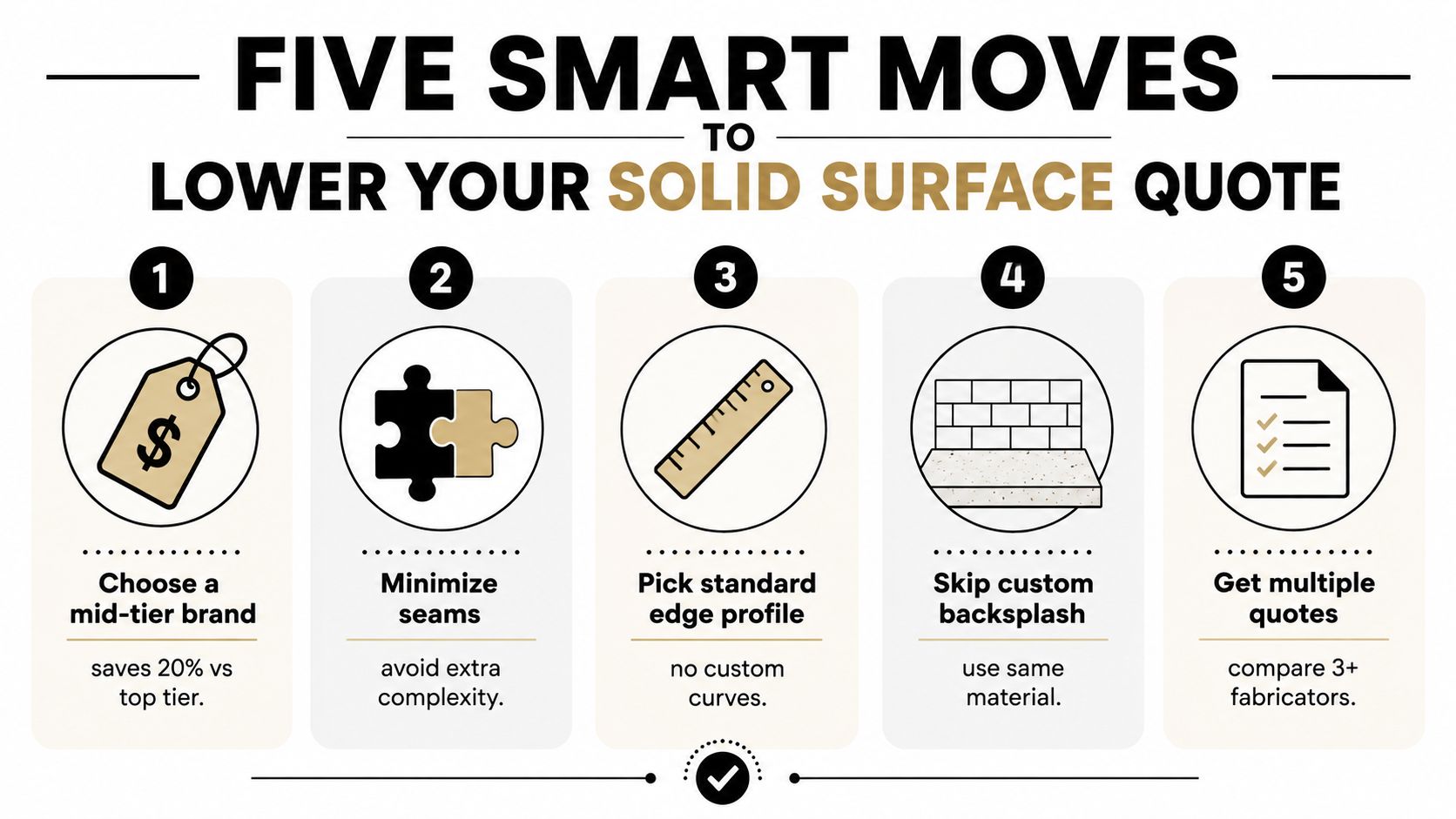
Five Smart Moves to Lower Your Solid Surface Quote
If the budget is tight, don't start by cutting the material entirely. Start by trimming the parts of the job that inflate labor. That's where the savings usually live.
Where to save without wrecking the design
- Choose a mid-tier brand. Fancy brand tiers usually cost more because of color options and supply positioning, not because your kitchen needs them.
- Keep seams to a minimum. Fewer seams means less labor and a cleaner result.
- Use a standard edge profile. Avoid custom curves and ornate detailing unless the kitchen really needs them.
- Skip the custom backsplash. A separate backsplash can add cost without changing the way the counter functions.
- Collect multiple quotes. Fabricators price labor and complexity differently, so comparison shopping matters.
Those moves line up directly with the cost drivers from earlier. If you want the cleanest savings, reduce fabrication complexity before you attack the material itself.
For homeowners also trying to trim maintenance and replacement costs across the house, Pine Country Window Cleaning's maintenance cost reduction guide is a useful reminder that keeping systems simple usually saves more than chasing the lowest upfront number. That's the same mindset that works here.
The point is not to cheap out. The point is to spend on the visible finish and stop paying for detail work you'll barely notice once the kitchen is done.
South Jersey Considerations and Your Next Step
In South Jersey, the quote depends on more than the material tag. Regional labor, older homes with slightly out-of-square walls, and the need for accurate in-home measurements all affect how cleanly the job goes and how much adjustment the fabricator has to do on site. That's why a mobile showroom matters, especially for busy homeowners in Cherry Hill and the surrounding counties.
Why local measurement changes the number
A countertop that looks straightforward on paper can get tricky in a real South Jersey kitchen. Walls aren't always perfectly straight, cabinets can settle, and appliance clearances can be tighter than expected. That's where a preliminary visit beats a phone estimate every time.
If you want a broader price framework for planning, this countertop cost per square foot guide helps you line up material decisions against a realistic budget before you commit. Then you can compare that framework against what your actual room needs.
The Cabinet Coach works as a mobile cabinet showroom and design service, which means you can review countertop samples in your own lighting instead of guessing under store fluorescents. That's a practical advantage, not a sales pitch. It helps you judge whether solid surface looks calm and clean in your kitchen, or whether a different surface better fits the space.
If you're ready to stop estimating and start pricing the actual job, book a free consultation and get a transparent preliminary estimate that reflects your layout, your edge choices, and your local labor reality. See the samples in your kitchen, pressure-test the numbers, and decide whether solid surface is the right mid-priced fit for your remodel.
If you want a straight answer on whether solid surface belongs in your budget, The Cabinet Coach can walk your kitchen, review the layout, and give you a clean starting estimate without the showroom guesswork. Bring your countertop plan, and get numbers that match the room you live in.