
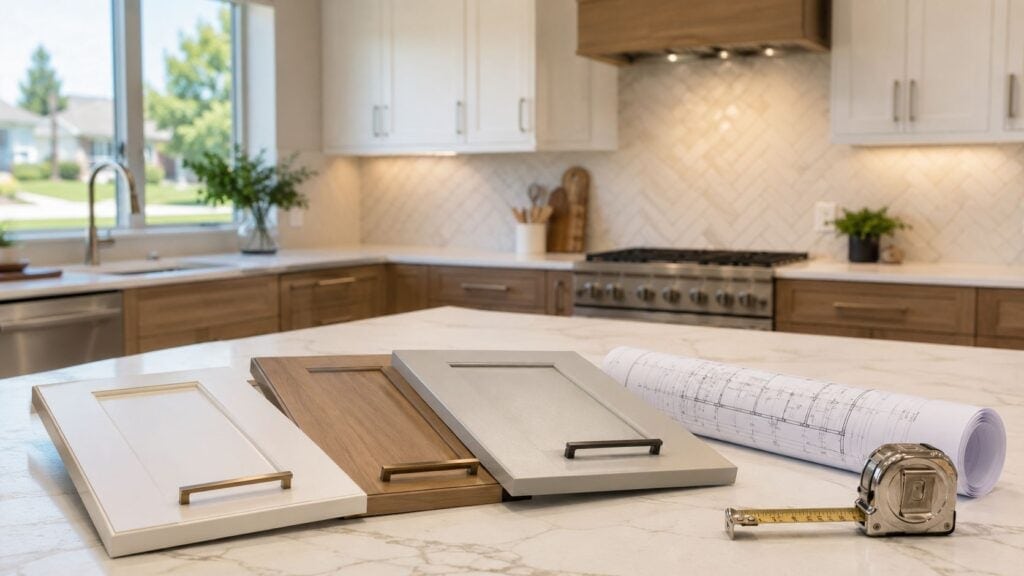
You're standing in a Cherry Hill kitchen with cabinet doors that don't line up, a tape measure in one hand, and a remodel number in your head that keeps getting bigger every time you add a “small” upgrade. That's the moment most homeowners start searching for affordable custom kitchen cabinets, because they want a kitchen that looks custom-fit to the house without turning the project into a luxury build.
The problem is that “affordable custom” gets used loosely. In real life, it means picking the right level of customization for the parts of the kitchen where fit matters, then refusing to pay custom prices for sections where a simpler spec will look identical once the doors are closed and the countertop is on. In South Jersey, that distinction matters more than people think, because older homes in places like Cherry Hill and Haddonfield can punish standard sizing, while newer layouts in Mount Laurel or Voorhees often don't need full custom treatment to get a polished result.
Table of Contents
- What Affordable Custom Cabinets Mean
- Real Costs and How to Estimate Your Cabinet Budget
- Stock, Semi-Custom, and Custom Compared
- Materials and Construction That Save Money Without Looking Cheap
- How a Mobile Showroom Changes the Process
- Financing, Scheduling, and Negotiation Tactics
- Your Action Plan and What to Expect Next
What Affordable Custom Cabinets Mean
A Cherry Hill homeowner with a 1940s colonial usually does not need a lecture about cabinet style. They need cabinets that fit crooked walls, uneven floors, and odd corner conditions without wasting space. Affordable custom cabinets are a budgeting strategy, not a label you slap on the whole kitchen.
The real meaning of custom
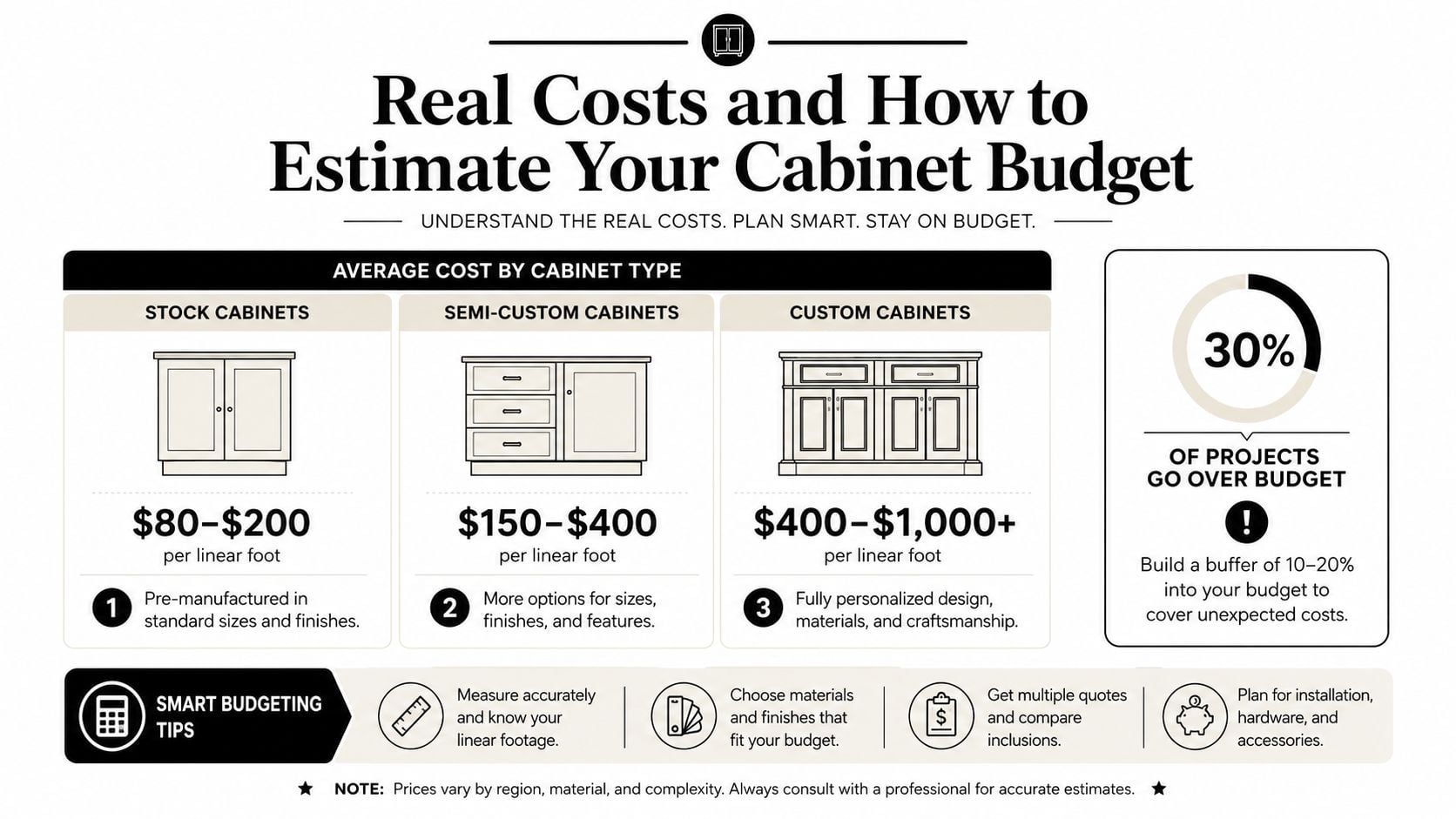
The cabinet trade usually splits into stock, semi-custom, and fully custom. Stock comes in standard sizes, semi-custom gives you some dimensional flexibility, and fully custom is built to the exact specs of the room. The price spread is wide, with stock commonly starting around $100 to $400 per linear foot, semi-custom around $150 to $700, and fully custom at $500 to $1,200 per linear foot or more, depending on complexity and materials. That range is why “affordable” has to describe the specification, not the category. Custom kitchen cabinet pricing benchmarks
Practical rule: Pay for custom where the room forces it. Do not pay for custom where the eye will not notice the difference.
A straight kitchen in a newer South Jersey build can often live comfortably in semi-custom territory. A Cherry Hill colonial with a sink wall that bows, a fridge opening that needs to be corrected, or a corner that steals usable space is a different case. Use custom only where the room demands a precise fit, then keep the rest of the run in a more efficient spec. That is how homeowners get the look and function they want without paying top-tier pricing for every box.
What to decide before you talk to anyone
Start with three questions.
- Do I need a perfect fit everywhere, or only in a few spots? If it is only a few spots, hybrid specification is the smart move.
- Do I care more about price, lead time, or exact dimensions? You rarely get all three at the top level, so choose your priority early.
- Will the kitchen be judged from a few feet away, or lived in every day? That answer tells you where to spend on drawers, hardware, and finish quality.
Then get the rest of the house out of the way. If the kitchen update will force plumbing changes, ask to check plumbing prices before you lock cabinetry around a sink wall or island layout. That keeps cabinet decisions tied to real installation costs instead of guesswork.
A mobile showroom changes this conversation because the cabinets are being judged in your actual kitchen, not under showroom lighting. You can see where a custom filler panel solves a bad wall, where a stock base cabinet is perfectly fine, and where a raised sink run needs a real custom build. The budgeting conversation gets clearer fast. You are no longer paying for a showroom floor, you are paying for the parts of the kitchen that need to work in your house.
If you can answer those questions clearly, you will walk into design conversations with a tighter budget and fewer regrets. That is the difference between buying cabinets and controlling a remodel.
Real Costs and How to Estimate Your Cabinet Budget
Cabinet pricing gets messy fast because one quote might look low until you realize it doesn't include the extras that make the kitchen work. That's why a linear-foot mindset is useful. In the cabinet world, pricing is often discussed per linear foot, and a 20-linear-foot kitchen can move from a modest cabinet bill into luxury territory depending on whether you choose stock, semi-custom, or fully custom products. Kitchen cabinet cost guide
The industry benchmark for fully custom kitchen cabinets is $500 to $1,200 per linear foot, with many sources placing a standard kitchen at roughly $12,000 to $20,000 for cabinets alone. A second useful rule is that cabinets often eat up about 25% to 40% of the total remodel budget, which means a $50,000 renovation can put roughly $12,500 to $20,000 into cabinetry. Those are not abstract numbers, they're the reason cabinet decisions should happen before tile, paint, and accessories start drifting the budget upward. Cabinet pricing and remodel budget rule
What a 20-linear-foot kitchen looks like on paper
Use the linear-foot estimate as your first pass, then force every quote to prove itself against a parts-and-labor breakdown. A rough 20-foot kitchen can sit around these tiers:
- Stock: lower initial outlay, but far less flexibility.
- Semi-custom: a middle ground that often fits standard South Jersey layouts well.
- Fully custom: the most expensive option, but the right answer where the room demands precision.
If you're planning plumbing moves, appliance changes, or a layout shift, get the cabinet number first, then compare it against other project lines instead of guessing. If you need a place to sanity-check related trade work, it can help to check plumbing prices before you assume the cabinet quote is the only number that matters.
Budget rule: If a quote doesn't show boxes, doors, drawer systems, hinges, finish work, and installation separately, it's too vague to trust.
The budget killers nobody wants to discuss
The biggest cost overruns are usually not the base cabinets. They're the add-ons. Pullouts, crown molding, upgraded drawer boxes, hinge upgrades, finish complexity, waste, and labor time all make an “affordable” cabinet plan less affordable if they weren't counted up front. One cabinet-pricing workflow recommends adding roughly 20% extra for materials and 50% more time as a safeguard against underbidding, while also warning that overhead and profit need to be explicit rather than assumed. Cabinet pricing workflow and safeguards
If you want a second reference point for line-item thinking, this cabinet cost per linear foot guide helps frame the quote in the way cabinet shops build pricing. That's the right way to shop in South Jersey. Not by sticker shock, by structure.
Stock, Semi-Custom, and Custom Compared
A narrow pantry wall, a crooked soffit, or a refrigerator opening that never quite measured cleanly, those are the jobs that separate cabinet tiers in a South Jersey kitchen. The right choice is the one that fits the room without paying custom prices for spaces that do not need them.
Fit, lead time, and upgrade flexibility
Stock cabinets are the cheapest route, but they come in fixed sizes and standard configurations. In a newer tract home with straight walls and predictable openings, that can work well enough. In older South Jersey houses, those same boxes can turn into filler strips, awkward spacing, and extra labor. Semi-custom cabinets usually land in the middle, with installed pricing often around $150 to $650 per linear foot and enough size options to handle modest corrections without jumping to a full custom build. Affordable cabinet comparison
Fully custom sits at the top of the market, commonly around $500 to $1,200+ per linear foot, and it usually comes with longer lead times. Semi-custom tends to run about $400 to $900 per linear foot with 4 to 8 weeks of lead time, while stock is the fastest and least flexible option. Custom versus semi-custom timing and pricing That tradeoff is the core decision. Straight kitchens with standard walls rarely need fully custom everywhere. Rooms with odd angles, uneven walls, or tricky appliance spacing often punish a stock-only approach with extra field work and wasted material.
Cabinet Tier Comparison for South Jersey Homeowners
| Tier | Price per Linear Foot | Lead Time | Best Use |
|---|---|---|---|
| Stock | Lower installed cost | Fastest | Simple layouts, standard wall runs |
| Semi-custom | Midrange | 4 to 8 weeks | Straightforward kitchens with some sizing flexibility |
| Fully custom | $500 to $1,200+ | 8 to 16+ weeks | Tight fits, odd angles, precise design goals |
The hybrid move that saves money
The smartest budget move is to stop treating the entire kitchen as one cabinet decision. Use custom where the room forces it, then use semi-custom on the long, visible runs where standard sizing still looks intentional once the room is finished. That means custom around the sink wall, the range hood, the pantry niche, or the problem corner, and semi-custom everywhere else. In South Jersey, that hybrid spec usually beats a full custom package because you pay for precision only where precision pays back.
For homeowners comparing those two middle-ground choices, the custom versus semi-custom cabinet guide helps clarify where the extra flexibility is worth paying for and where it is just expensive padding. Keep the custom work targeted. Let the rest of the kitchen stay efficient.
A mobile showroom changes the budget conversation too. Once the cabinet pro is measuring in your home, you are not paying to support a big showroom and a stack of displays you never chose. You are making decisions against the actual walls, the actual appliances, and the actual layout, which is where the significant savings show up.
If you need to deal with ventilation gaps inside cabinet runs, Ring Hot Water air vents are a practical add-on to discuss during planning, especially where cabinet placement affects airflow and appliance performance.
Materials and Construction That Save Money Without Looking Cheap
South Jersey homeowners get burned by cabinet choices in the same predictable way, they pay extra for parts nobody sees, then try to save on the parts they touch every day. That is backwards. The right move is to spend where moisture, hardware wear, and daily use punish weak materials, then keep the decorative side simple enough that the kitchen still looks intentional after install.
Spend on feel, save on decoration
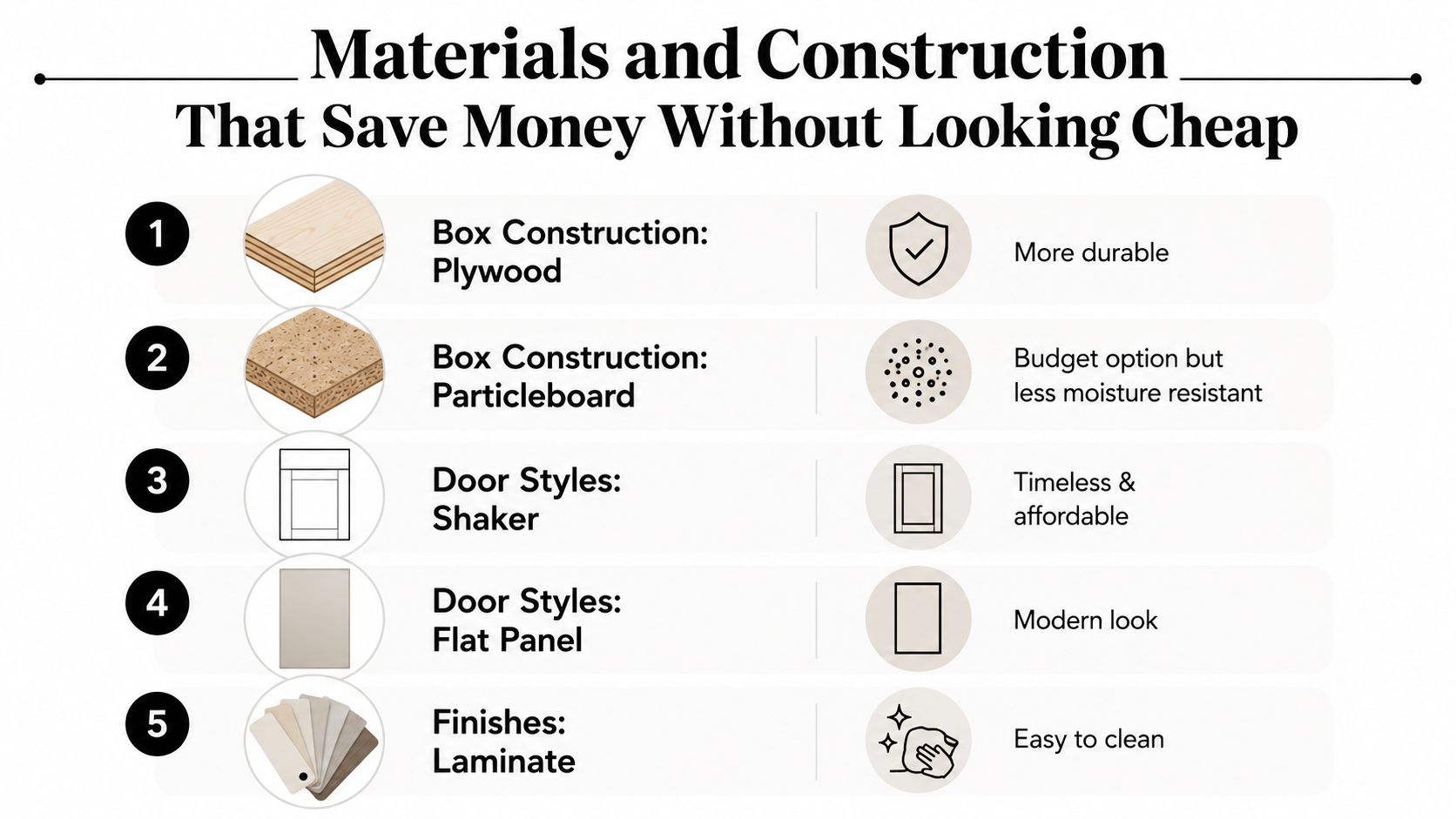
Cabinet boxes matter, but not every cabinet run needs the same build if the finished kitchen still looks sharp and holds up. In humid South Jersey basements and first-floor kitchens that take on summer moisture, plywood boxes resist swelling and edge damage better than MDF, which is why the decision is less about bragging rights and more about repair costs later. For a clear side-by-side look at the trade-off, this plywood versus MDF cabinet guide is worth reading before you approve a spec.
A Shaker door or a flat-panel door usually looks cleaner and more expensive than a busy profile, especially once the room has new counters, backsplash, and lighting. That is why so many budget-aware South Jersey remodels still end up looking custom without paying for a fully ornate cabinet package. The door face does most of the visual work, while the box and the joinery do the part that has to last.
The features worth paying for
Pay for plywood boxes wherever moisture, spills, or heavy use are likely. In real kitchens, that is the difference between a cabinet that stays square and one that starts looking tired early.
Pay for soft-close hinges because they change daily use in a way you notice immediately. Slamming doors and rattling hardware make a new kitchen feel cheap fast.
Pay for full-extension drawer glides in base cabinets, utensil storage, and pantry pull-outs. If a drawer only opens partway, you are wasting cabinet depth you already paid for.
Pay for simple, durable finishes that clean up without drama. Laminate and straightforward painted finishes usually do the job better than elaborate finish systems that cost more and age faster in a busy kitchen. If cabinet ventilation is part of the plan, add Ring Hot Water air vents during layout instead of trying to fix airflow after the boxes are already in.
The features I'd cut first
Skip decorative corbels unless they are doing real visual work in a larger, more traditional room. They add cost, collect dust, and rarely improve the way the kitchen functions.
Stacked crown is another place where budgets get padded without improving daily use. It can look finished in the right room, but it is easy to overspend there while neglecting better drawer hardware or stronger cabinet carcasses.
Highly complex finish treatments are usually a bad trade in a South Jersey remodel. They take money away from the parts that matter, and they do not make a kitchen more livable just because they look fancier in a sample door.
Straight answer: Buy durability where hands touch the kitchen every day. Keep the decorative choices simple enough that the room still feels deliberate, not overworked.
The practical rule is simple. Put your money into the cabinet body, the hinges, the drawer movement, and moisture-resistant construction. Use fewer decorative extras, cleaner door lines, and straightforward finishes so the kitchen looks finished without looking overbuilt.
How a Mobile Showroom Changes the Process
Most cabinet shopping wastes time because homeowners are asked to make expensive decisions in a showroom that isn't theirs. The floors are different, the light is different, and the paint on the wall isn't the paint in the house. A mobile showroom fixes that by bringing cabinet samples, countertop options, hardware, and tile into the actual room where they'll live.
Why in-home selection changes the budget conversation
The Cabinet Coach's mobile showroom model is built around a complimentary video consultation, an in-home discovery visit, concept development with samples in your lighting, preliminary estimates, refined designs, product finalization, and coordination with other trades. That process matters because cabinet choices get made in context, not under fluorescent store lighting. The result is usually fewer changes later, which is where a lot of remodeling budgets leak. Why a mobile cabinet showroom changes remodeling
The mobile model also strips out a lot of showroom overhead. You're not paying for a big retail footprint and then trying to interpret the price in your own house. You're making decisions where the kitchen lives, which is a cleaner way to budget like a homeowner instead of a showroom visitor.
What the workflow should feel like
A good process is calm and specific. You should get a clear sense of what's being designed, what can be changed, and what each material choice does to the estimate. If the numbers are fuzzy, the process is weak.
The Cabinet Coach is one South Jersey example of that approach, and it's a relevant one for homeowners who want cabinet selection tied to project coordination instead of disconnected shopping. The value isn't hype. It's that the designer sees the room, the light, and the adjacent finishes before the cabinet order gets locked.
The actual sequence should feel like this:
- Consultation: Quick alignment on goals and budget.
- Discovery visit: Measurements, layout review, and problem-spot identification.
- Design development: Samples and concepts evaluated in the home.
- Estimate refinement: Changes happen before orders go out.
- Install coordination: Cabinetry, countertop, and trade scheduling stay aligned.
If you want to see how that type of process is presented in practice, this mobile showroom overview is a sensible place to start.
Financing, Scheduling, and Negotiation Tactics
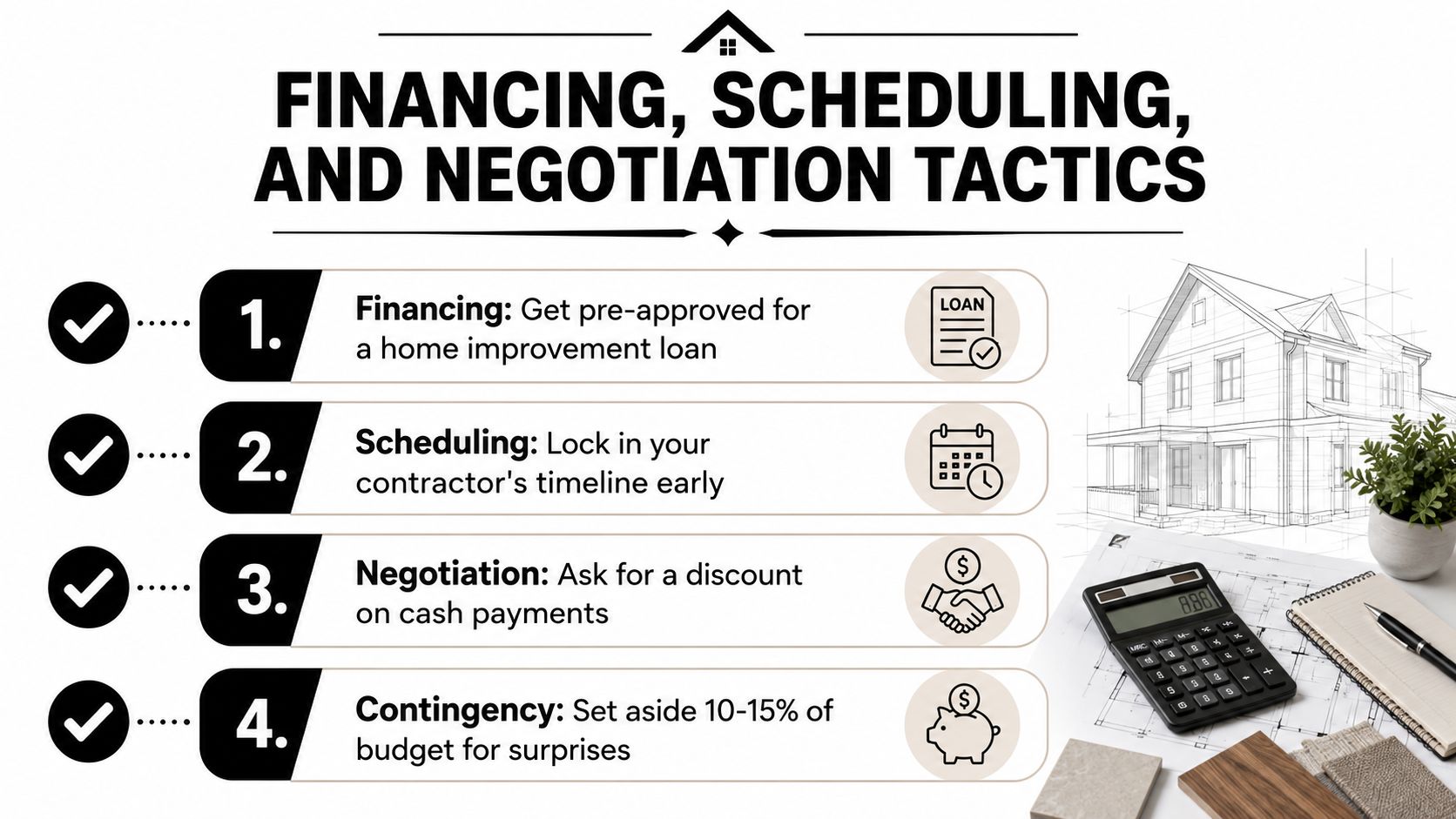
Cabinet budgets get damaged by bad planning more often than by bad taste. The homeowners who stay on track usually do three things early, they line up financing, they protect the schedule, and they make the quote itemized instead of letting it stay vague.
How to keep cash flow under control
Some homeowners use home equity lines, some use contractor financing, and some split the remodel across two budget years. Each choice affects timing and total cash pressure. A phased approach can make a remodel more manageable, but it only works if the scope stays disciplined and the cabinet spec doesn't creep upward just because the project is being stretched out.
For homeowners comparing financing structures against broader remodel cost, the finance kitchen renovation guide is a useful planning reference. If you're also trying to understand broader lending math for renovation work, this Charlotte NC construction loan calculator can help frame how financing tools affect the monthly picture.
The schedule that avoids chaos
Custom and hybrid cabinet projects need buffer. Lead times, countertop templating, and appliance coordination can all shift a timeline if nobody is watching the sequence. The cabinet order should be locked only after measurements and design details are right, not after someone gets impatient and tries to save a week.
South Jersey homeowners usually get better responsiveness when they schedule thoughtfully. Late fall through early spring is often a better time to ask for attention from trades because the calendar is less frantic than peak remodel season. That doesn't mean every contractor discounts work, but it does mean you're less likely to be squeezed by a packed queue.
The negotiation habits that save real money
- Ask for an itemized quote. A bundled number hides where the money is going.
- Compare like for like. A lower price on weaker construction is not a real savings.
- Push back on upgrades you don't need. If the hardware or finish doesn't move the look or function, cut it.
- Confirm what counts as extras. Waste, trim, fillers, and special pulls should not surprise you later.
- Set aside a contingency. A realistic buffer keeps small surprises from becoming project-stopping problems.
Your Action Plan and What to Expect Next
Start with three moves this week. Book a design consultation, measure and photograph the kitchen, and write down a realistic total remodel budget that already assigns cabinets their share. Since cabinets often take 25% to 40% of the whole remodel budget, the cabinet number should not be an afterthought. It should be one of the first decisions you make. Kitchen cabinet budget share benchmark
What a solid project should look like
A well-run cabinet project feels clear from the first call. The designer should ask about the room's problems, the schedule, and the level of customization you need. The preliminary estimate should show where the money goes, not hide everything in one lump sum.
From order to install, a custom or hybrid cabinet spec usually lives in the 8 to 16+ week zone, depending on the specification and production path. That's normal. What's not normal is letting the project drift because the plan was never specific enough to begin with.
The biggest mistake homeowners make is paying custom prices for the whole kitchen when only a few areas need custom treatment. That's how “affordable” becomes expensive. The better move is to protect the fit where it matters, simplify the rest, and keep the spec clean enough that the final quote matches the actual room.
If you're ready to stop guessing, The Cabinet Coach can walk you through cabinet planning, in-home selection, and project coordination in one process. Visit The Cabinet Coach to start with a consultation and get a cabinet plan that fits your South Jersey kitchen, not just a showroom brochure.
If you're weighing affordable custom kitchen cabinets for a South Jersey remodel, don't shop for the lowest cabinet price alone. Choose the specification that fits your room, your timeline, and your budget, then let the design follow that decision.