

If you're standing in a South Jersey kitchen with paint samples in one hand and cabinet quotes in the other, the decision can feel bigger than the room itself. A maple door sample looks calm and clean on the showroom board, but in your actual house, under your light, next to your floors and backsplash, it can read completely differently. That's why contemporary maple cabinets deserve a practical look, not just a style one.
They're a common choice for a reason. In a major annual cabinet-trends survey, maple accounted for 36% of cabinet doors, ahead of cherry, birch, and oak, which shows it's firmly part of the mainstream cabinet mix in North American kitchens, not a niche pick for design magazines alone. Woodworking Network's cabinet-trends survey backs up what many remodelers already see in the field, maple gives homeowners a dependable base for a modern kitchen that still feels warm.
For homeowners coordinating plumbing, electrical, and finish selections at the same time, a reliable trade partner matters just as much as the cabinet species. If you're comparing remodel resources, Stultz Plumbing for quality work is the kind of service link people often keep handy when project timing gets tight.
Table of Contents
- Starting Your Kitchen Remodel Journey
- What Defines Contemporary Maple Cabinets
- Designing Your Kitchen with Maple Cabinets
- Maple vs Other Cabinet Materials A Clear Comparison
- Durability Maintenance and Long-Term Value
- Customization Hardware and Modern Touches
- Your Selection Checklist for a South Jersey Remodel
Starting Your Kitchen Remodel Journey
A Cherry Hill homeowner usually doesn't begin with a bold design statement. They start with pressure, the kitchen is dated, the doors are worn, the budget has limits, and every cabinet sample looks good until it has to live in the house for years. In that moment, contemporary maple cabinets make sense because they give you a calm visual starting point without locking the room into one style.
Why maple keeps showing up in real remodels
Maple works because it doesn't fight the rest of the room. Its lighter tone and restrained grain let countertops, floors, lighting, and hardware do more of the visual work, which helps when you are balancing taste with resale value and day-to-day use. Homeowners and remodelers keep choosing it because it fits both modern and transitional spaces without making the kitchen feel overly styled.
Practical rule: If the rest of your kitchen already has personality, use maple to quiet the field instead of competing with it.
A guided in-home process can save time as well. The Cabinet Coach's kitchen remodel planning guide is useful because cabinet selection stops being theoretical once samples are seen in your own light, against your own flooring, in your actual traffic pattern. A mobile showroom approach fits busy South Jersey households that do not want to make repeated trips to compare nearly identical white doors.
Project timing also matters once work begins. Coordinating with reliable trade partners is part of a smooth remodel, and homeowners often keep contacts like Stultz Plumbing for quality work handy when plumbing changes can affect cabinet installs, sink placement, or inspection timing.
Maple is not a magic answer, and it should not be sold that way. It is a strong, reliable foundation for people who want the kitchen to look current now and still feel sensible later. That kind of choice helps limit regret, especially when you are thinking about finish upkeep, long-term wear, and where the wood comes from.
What Defines Contemporary Maple Cabinets
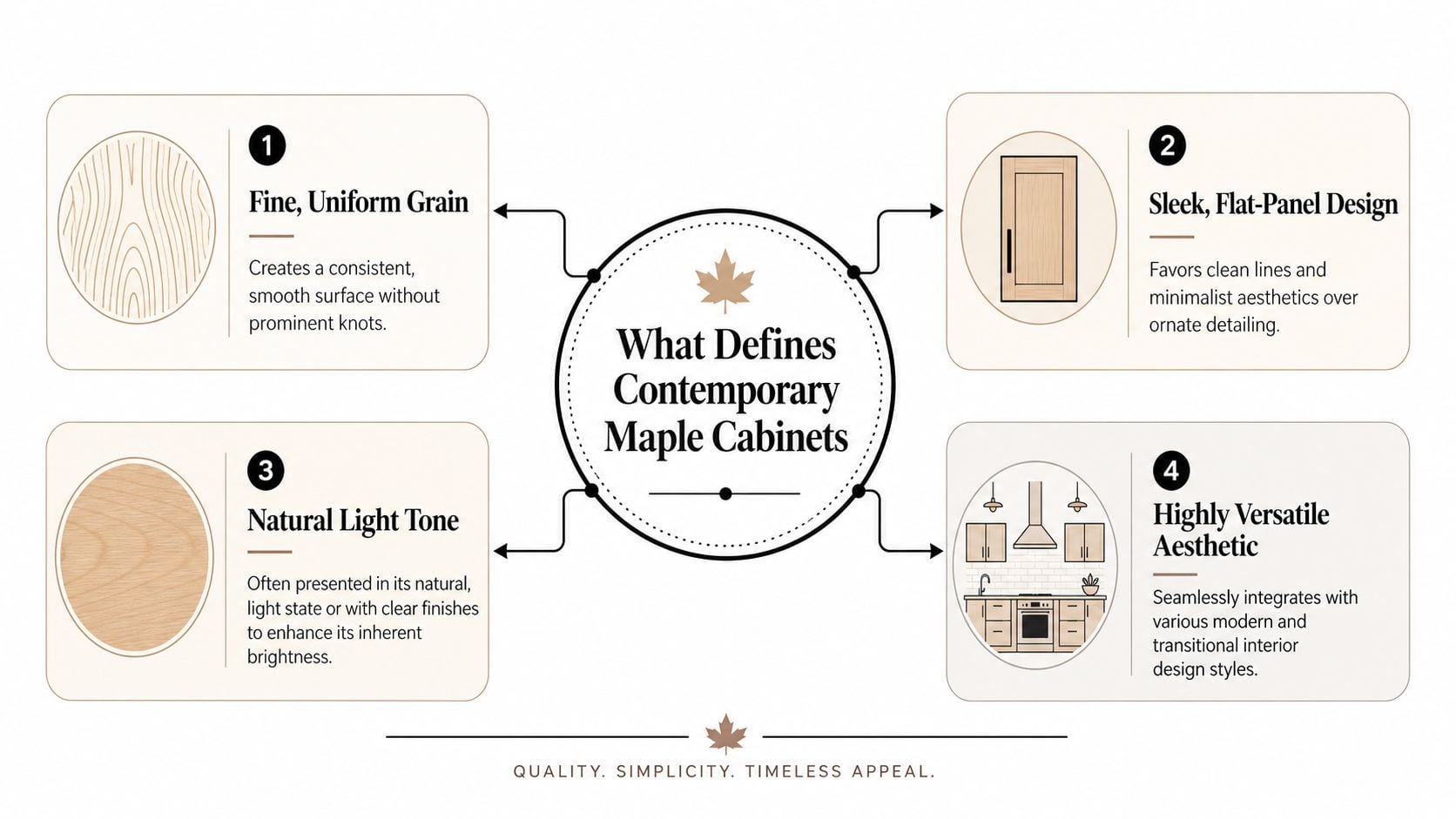
Contemporary maple cabinets are defined by restraint more than decoration. The wood itself does much of the visual work, because maple's fine, closed grain creates a smoother field than woods with stronger grain movement, so the cabinet face reads clean and modern. A plain maple door can feel composed before the hardware or countertop are chosen. George One Stop's maple cabinet guide notes that maple accepts stains, glazes, and painted finishes more uniformly than many hardwoods, which helps reduce blotching and supports the flat, low-contrast look tied to modern design.
The look starts with the grain
Maple behaves like a smooth sheet of paper rather than textured cardstock. Both can be attractive, but the smoother surface lets the rest of the room stand out more clearly. That is why slab doors and simple Shaker profiles pair so well with maple, they preserve the visual calm contemporary kitchens need while still giving the room shape.
Finish choices matter as much as the species
Maple's natural color sits in a light, creamy range, which makes it flexible in real kitchens. Left natural, it can feel soft and airy. Painted, it can blend into the architecture or create an unbroken run of cabinetry. Stained, it can still stay modern if the color stays controlled and the door style remains clean.
For more design examples, The Cabinet Coach's page on modern kitchen with maple cabinets is worth reviewing because it shows how door style, finish, hardware, and surrounding materials work together rather than in isolation.
Designer insight: Contemporary does not mean cold. With maple, it usually means the visual noise is stripped out so the room feels intentional.
That is what defines them. Contemporary maple cabinets do not rely on ornament to look current, they rely on proportion, finish, and restraint. If the door is overly fussy, the effect breaks down. If the finish is too glossy, the wood can start to look more reflective than refined. The best result is usually simple, balanced, and quiet.
Designing Your Kitchen with Maple Cabinets
A well-designed maple kitchen isn't built around the cabinets alone. It's built around contrast, texture, and the way each surface supports the others. In South Jersey homes, that often means pairing contemporary maple cabinets with materials that either sharpen the look or warm it up, depending on the rest of the house.
Pair maple with materials that clarify the line
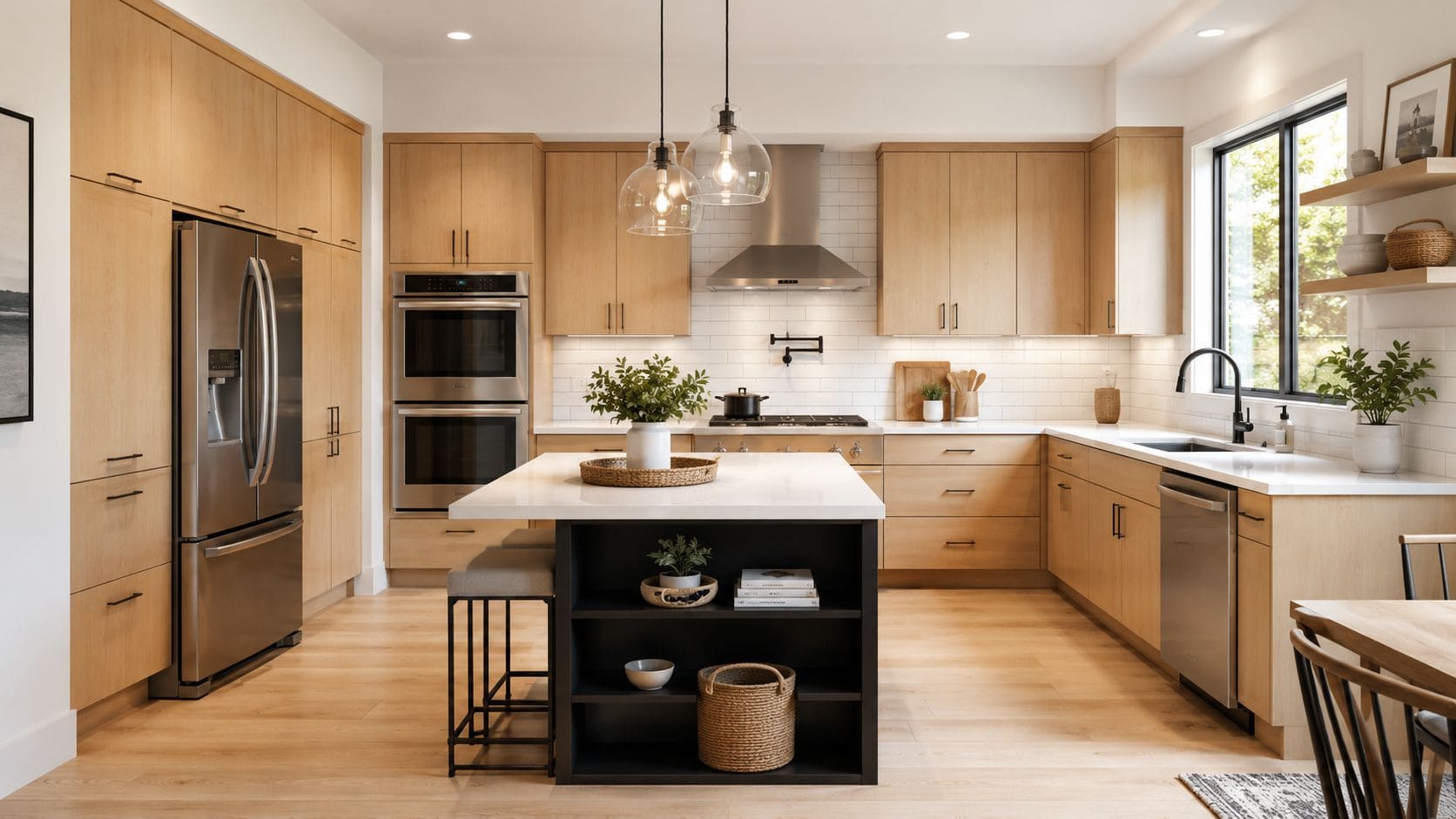
A clean white quartz countertop usually pushes maple toward a brighter, more architectural look. It works especially well when the cabinet finish is natural or lightly toned, because the room reads as open without becoming sterile. If you want more depth, soapstone or another darker surface can ground the cabinets and make the grain feel richer without turning the kitchen traditional.
The same logic applies to the backsplash. A simple ceramic subway tile keeps the composition calm, while a geometric tile can add movement if the cabinets themselves are very restrained. When the maple door is flat and the counter is simple, the backsplash becomes the place to add pattern without cluttering the room.
The Cabinet Coach's countertop and cabinet combinations guide is useful for homeowners who want to compare these pairings before making a purchase decision. Seeing the combination in advance matters because maple can swing modern, warm, or softly transitional depending on the adjacent finish.
Use contrast deliberately, not everywhere
A black island, matte faucet, or darker accent hardware can sharpen the look without overwhelming the room. But too many contrasts can make a maple kitchen feel segmented. One or two strong decisions usually work better than five competing ones.
Here's a simple way to think about it.
- For Scandinavian minimalism: use pale maple, white quartz, and a restrained tile pattern.
- For a warmer contemporary feel: add a softer stone tone, brushed metal hardware, and a backsplash with subtle texture.
- For a bolder modern layout: keep the perimeter cabinets light and use a darker island or hood surround for emphasis.
The key is consistency. Maple gives you enough flexibility to move between styles, but it looks strongest when the room has a clear point of view. If every finish shouts, the cabinets lose the calm quality that makes them work in the first place.
Maple vs Other Cabinet Materials A Clear Comparison
Maple makes a strong case for itself, but homeowners should still compare it with the other common options before signing off on a cabinet package. Oak, cherry, and engineered cabinet materials each solve different problems, and the right answer depends on what matters most in your kitchen, appearance, durability, or finish flexibility. For a deeper construction comparison, The Cabinet Coach's plywood vs MDF cabinets guide can help you separate door material choices from box construction choices.
| Feature | Maple | Oak, Red/White | Cherry |
|---|---|---|---|
| Grain and appearance | Fine, uniform, low-contrast | More visible grain, more movement | Smooth, richer character, more pronounced color shift over time |
| Contemporary suitability | Very strong | Better when you want visible texture | Works better in warmer or more traditional looks |
| Finish flexibility | Accepts stain and paint evenly | Grain often remains visually active under finish | Takes finish well, but the tone pushes the look warmer |
| Durability | High hardness cabinet species | Durable, depending on species and use | Durable, but not as hard as maple |
| Best use case | Clean, adaptable kitchens | Kitchens where grain is part of the design | Kitchens that benefit from deeper warmth |
What the comparison really means
Maple sits in the middle of the decision tree in a good way. It gives you more refinement than grain-heavy woods when you want a contemporary look, and more natural character than painted engineered surfaces when you still want to see wood in the room. Oak can be a stronger fit if the homeowner wants visible texture as a feature. Cherry often appeals when warmth and richness matter more than a neutral backdrop.
Bottom line: choose maple when you want the cabinet to support the design instead of dominating it.
Engineered options can make sense in certain budgets and applications, but they change the tactile and visual feel of the kitchen. That's why many remodelers still start with maple when the goal is a lasting contemporary design that can adapt to changes in flooring, lighting, or wall color later on. Maple gives you room to evolve the rest of the kitchen without replacing the cabinetry.
Durability Maintenance and Long-Term Value
A kitchen can look perfect on install day and still fail you if the finish can't handle real use. Maple earns its place partly because it's physically tough. It has a Janka rating of about 1,450, which is higher than white oak and red oak, and that higher hardness helps resist dents and scratches in a high-use kitchen. Oppein Home's maple cabinet guide also cites a service life of 20-30+ years when properly maintained, which is the kind of ownership horizon most homeowners desire.
Hardness helps, but finish care still matters
Hardness is only part of the story. Maple's smooth, uniform surface means wear can show differently than it does on a heavily textured wood. A nick on a flat finish is easier to notice, and light-colored finishes can make touch-ups more obvious if the repair doesn't match perfectly. That's the trade-off, maple protects well, but its clean surface also asks for more careful finishing and maintenance.
Sunlight matters too. On lighter maple, gradual yellowing or tone shift can become noticeable over time, especially in kitchens with strong natural light. That doesn't make maple a bad choice, it just means homeowners should ask about finish chemistry and placement before they decide where the brightest surfaces belong.
Practical rule: the more uniform the surface, the more important the finish quality becomes.
What keeps maple cabinets looking good longer
Routine cleaning should stay gentle. Use a soft cloth, mild cleaner, and dry the surface instead of letting water sit on the finish. Avoid harsh abrasives, because they can cloud a smooth maple surface faster than a more textured cabinet material.
Long-term value comes from the combination of hardness, repairability, and sensible styling. If you choose a finish that's too trendy or too delicate, the cabinet may still be structurally sound while the surface looks tired. If you choose a quieter maple finish and protect it from the start, the cabinet can keep its visual clarity for years.
That's the ownership advantage of maple in a real kitchen. It doesn't ask for constant attention, but it does reward thoughtful specification. For homeowners who want a cabinet that can age with the house instead of against it, that balance matters.
Customization Hardware and Modern Touches
Hardware can change maple faster than almost anything else. The same cabinet door can look crisp and architectural with a slim bar pull, quieter with a small knob, or nearly uninterrupted with an integrated handle. In a contemporary kitchen, the point is control, not ornament.

Hardware choices set the tone
Matte black pulls tend to sharpen the look and create contrast against a pale maple door. Brushed brass adds warmth without feeling ornate, especially if the rest of the kitchen stays simple. Polished nickel works when the goal is a cleaner, more reflective finish, but it can read colder if the room lacks warmth elsewhere.
The Cabinet Coach's hardware trends guide is a practical reference if you want to narrow down a finish family before a final order. The right choice usually depends less on the cabinet itself than on the room's lighting, faucet finish, and the visual weight of the appliances. On a real project, I look at how the hardware will read from the sink, the entry, and the cooking zone, because those are the angles homeowners notice every day.
Modern touches go beyond style
Sourcing and finish specs now matter as much as visual details. A cabinet can look current and still be a poor long-term fit if the materials are unclear or the finish chemistry does not suit the household. Homeowners who care about contemporary maple cabinets usually want a cleaner appearance, better documentation, and a finish that holds up without demanding constant attention.
That shift shows up in the questions people ask before they order. They still care about looks, but they also want to know what the cabinet is made from, how it is finished, and whether the product fits their routine. The Cabinet Coach's maple kitchen discussion at The Cabinet Coach's maple kitchen discussion reflects that practical mindset. A cohesive design also extends beyond the cabinets. Even details like window treatments can complete the look, and expert tips for elegant valances can help unify the space without adding clutter.
Designer note: contemporary style gets stronger when every choice, from pull finish to finish chemistry, points in the same direction.
The result is a cabinet that feels personal rather than generic. Maple provides the neutral base, hardware supplies the rhythm, and the finish specification gives the project its long-term credibility.
Your Selection Checklist for a South Jersey Remodel
A cabinet choice has to perform in the room, not just look good under showroom lights. Before you commit to contemporary maple cabinets, walk the kitchen as it exists now and note where sunlight lands, where people gather, and which surfaces will take the hardest use. That is the difference between a sample that looks right and a cabinet plan that holds up in daily life.
Questions worth asking before you order
- Assess kitchen layout: Does the cabinet plan support cooking, cleanup, and traffic flow without crowding the room?
- Choose maple finish: What is the finish's VOC level, and how well is it rated for long-term wear in a busy kitchen?
- Confirm maple sourcing: Is the maple sourced from a certified sustainable forest, or from a supply chain that is not clearly documented?
- Select hardware style: Do the pulls or knobs support the look, or are they fighting the door design?
- Set your budget: Have you accounted for materials, labor, and the small changes that always come up mid-project?
- Check timeline and installers: Is the schedule realistic, and is the installation team clear on the product details?
- Confirm local requirements: Have permits, code, and any South Jersey-specific coordination needs been addressed?
Industry forecasts show semi-custom cabinets hold nearly 38% of the market, while specialty showrooms capture over 41% of sales. Mordor Intelligence's kitchen cabinet market forecast points to a clear pattern, homeowners want guided expertise when they are tailoring a material like maple to a specific design and budget. That matches what I see in real remodels. People are more confident when the cabinet choices are made with the kitchen itself in view, especially when finish durability, maintenance demands, and sourcing details are part of the conversation.
Answering those questions is easier in your own space. The Cabinet Coach's mobile showroom model fits that approach because samples can be reviewed at home instead of guessed at under retail lighting. For South Jersey homeowners in Cherry Hill, Voorhees, Haddonfield, and nearby towns, that kind of consultation is usually the cleanest next step when the goal is a kitchen that feels contemporary now and still makes sense years from now.