
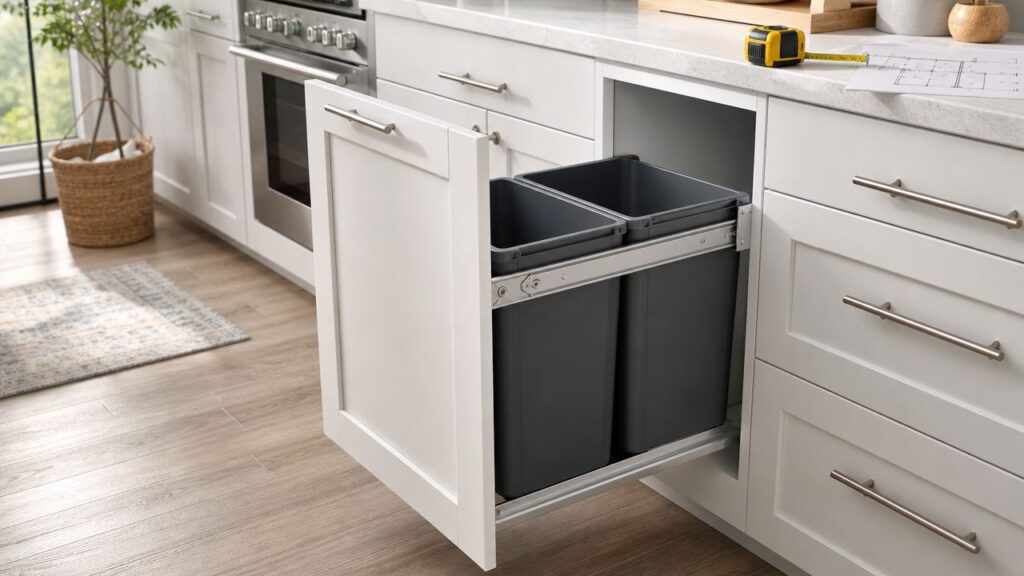
You're probably here because your current trash setup is doing at least one annoying thing every single day. It's sitting out in the open, breaking up the look of the kitchen, blocking a walkway, or forcing you to drip from sink to bin with peels, packaging, and coffee grounds in hand.
That's exactly why a hidden kitchen trash bin has become one of the smartest details in a remodel. It's not flashy, but it changes how the kitchen feels and functions. The category itself reflects that demand. The global trash bin market reached $22.18 billion in 2025, and residential applications accounted for 40.07% of revenue, according to Grand View Research's trash bin market report. In South Jersey kitchens, that often shows up as one clear priority: keep the room clean-looking without sacrificing convenience.
For homeowners in Cherry Hill, Haddonfield, Moorestown, Voorhees, and nearby communities, the best results come from treating the trash cabinet as part of the kitchen plan, not an accessory picked at the end. Cabinet width, sink location, traffic flow, recycling habits, and hardware quality all matter more than the product photo on the box.
Table of Contents
- Choosing Your Perfect Hidden Trash System
- Planning the Perfect Spot for Measurement and Placement
- Integrating Seamlessly with Cabinetry and Hardware
- Beyond Installation with Odor Control and Long-Term Care
- Deciding Your Path DIY vs Professional Installation
- Your South Jersey Remodel A Checklist for Success with The Cabinet Coach
Choosing Your Perfect Hidden Trash System
Most homeowners start with one assumption: a pull-out trash bin is the answer. Often, that's right. But not always. The best hidden kitchen trash bin is the one that matches the way your kitchen works on a Tuesday night, not the one that looks best in a showroom.
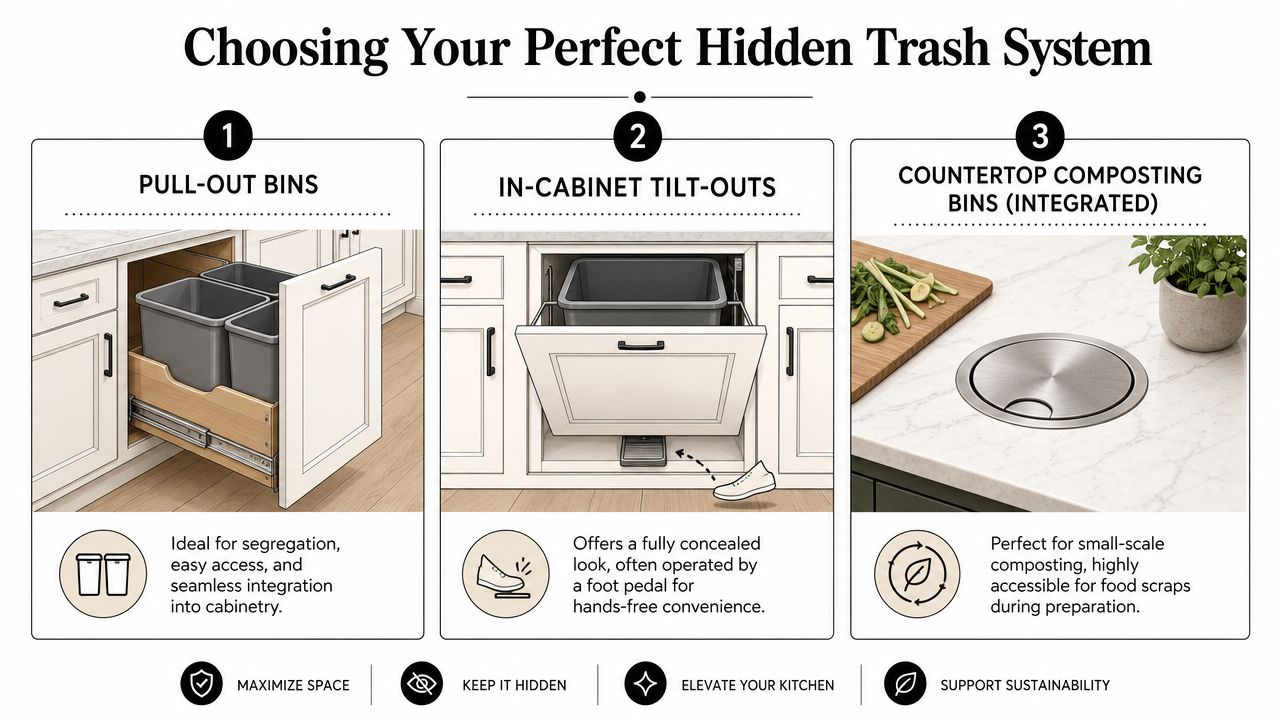
The three systems homeowners ask about most
Pull-out bins are the workhorse. They slide out from a base cabinet, usually on a metal frame, and they're the easiest to live with in a busy family kitchen. If you cook often, recycle regularly, or want one simple motion between prep and cleanup, this is the strongest option.
Best for: main kitchens, island cabinets, sink-adjacent cabinets, high-use households.
Watch for: cabinet width, door swing conflicts, and whether the frame clears plumbing or nearby appliance handles.
Tilt-outs look tidy from the outside and can work well in a secondary zone. They're less ideal for full household trash because capacity is usually more limited and the motion is less efficient for heavier loads.
Best for: small prep stations, a baking area, or lightweight waste.
Watch for: reduced capacity and less flexibility if your family generates a lot of daily trash.
Integrated countertop composting bins serve a different purpose. They're not a replacement for your main trash pull-out. They're a support tool for cooks who want a dedicated spot for food scraps during prep.
Best for: homeowners who cook from scratch and want peels and scraps off the counter fast.
Watch for: making sure it complements, rather than complicates, the main waste setup.
Practical rule: If your trash cabinet will be opened many times a day, a pull-out system usually beats a clever-looking alternative.
A lot of South Jersey kitchens also need the trash system to solve an organization problem, not just a visual one. If your lower cabinets already feel overworked, it helps to think about the trash cabinet alongside other storage upgrades like these deep kitchen cabinet organization ideas.
Single bin or dual bin
This decision changes daily use more than people expect.
| System | Works well when | Main drawback |
|---|---|---|
| Single bin | Space is tight or recycling lives elsewhere | Trash and recycling compete for room |
| Dual bin | You want one cabinet to handle both streams | Needs more interior width |
| Bin plus small bag storage | You want liners, gloves, or filters close by | Reduces room for larger containers |
Material matters too. Polymer bins are practical, lighter, and easy to rinse. Stainless steel components tend to feel more premium and are often chosen when homeowners want the inside hardware to match the quality of the rest of the kitchen.
The best-looking hidden kitchen trash bin doesn't call attention to itself. It opens smoothly, closes gently, and fits the rhythm of the room.
Planning the Perfect Spot for Measurement and Placement
Placement is where good ideas either become effortless or annoying. A hidden trash bin should support prep, cleanup, and movement through the room. If you have to cross the kitchen every time you scrape a plate or trim vegetables, the cabinet is in the wrong spot.
Where the bin should live
In most remodels, the strongest location is near the sink and primary prep area. That keeps the mess path short. You rinse, scrape, toss, and move on. In an island kitchen, a trash pull-out near the sink side of the island often performs better than one buried on a perimeter run.
A few placement patterns work especially well:
- Beside the sink base: Easy cleanup, short reach, natural for food prep.
- On the end of an island prep zone: Great for multiple cooks, especially when one person is at the sink and another is chopping.
- Near the dishwasher path: Helpful for plate scraping before loading.
- Away from tight corners: Prevents collisions with open doors, appliance handles, or another person trying to pass behind you.
For South Jersey families planning around real daily volume, capacity deserves honest attention. The average American generates 4.9 pounds of waste daily, and for a family of four in Voorhees or Mount Laurel, that means nearly 20 pounds of waste every day, making dual-bin systems for trash and recycling a practical choice in many remodels, according to Market.us data on the U.S. trash cans and wastebasket market.
Put the bin where the mess happens, not where there happened to be an empty cabinet.
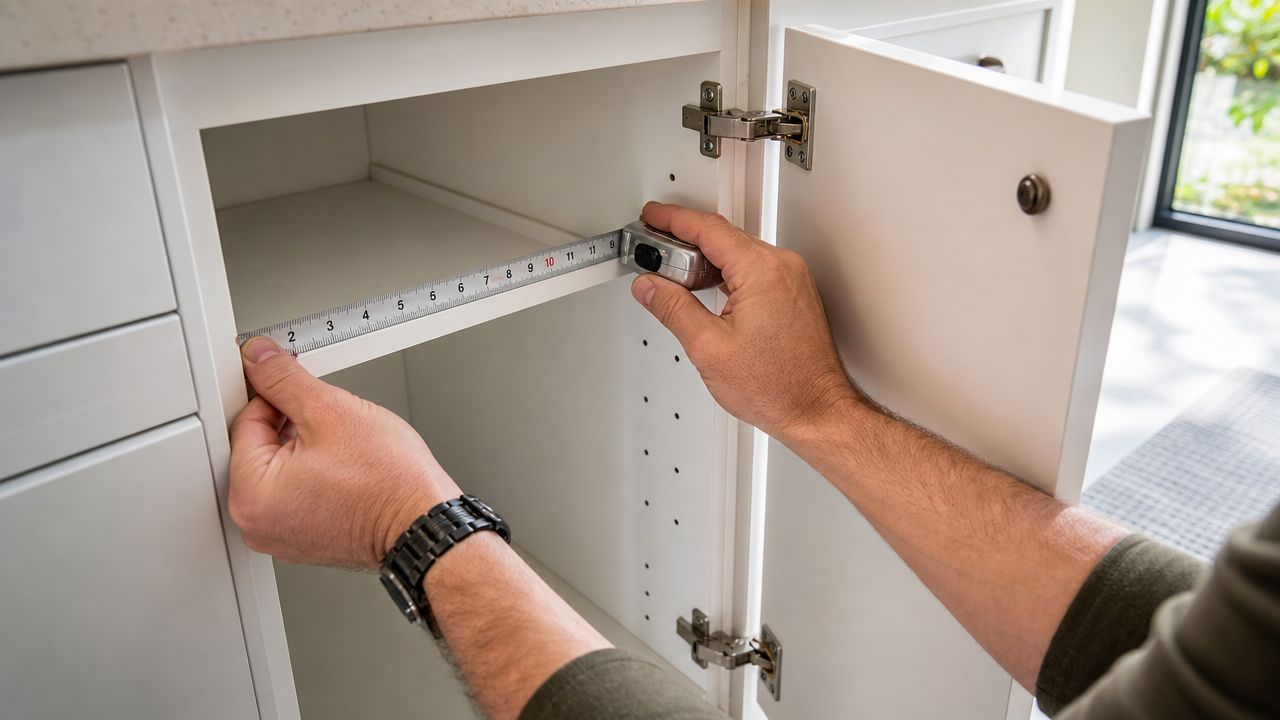
How to measure without surprises
Product listings often make installation look simple. The cabinet itself is usually what causes trouble. What matters is the clear interior opening, not the outside cabinet size.
Check these points before choosing a unit:
Interior width
Measure the usable inside width at the narrowest point. Face frames, hinges, and side hardware can steal room.Interior depth
Measure from the inside front to the back panel. Watch for pipes, outlets, and any rear supports.Interior height
Make sure the bin can clear the opening and still lift out for cleaning.Door and drawer conflicts
A trash pull-out beside a dishwasher or near a corner can work beautifully, or badly, depending on swing clearance.Obstructions inside the cabinet
Water lines, sink plumbing, and uneven flooring inside the base can all affect fit.
If you want a more detailed measuring process before shopping hardware, this kitchen cabinet measurement guide is worth reviewing.
The mistake I see most often is homeowners measuring the cabinet box once, ordering a system, and assuming all slide kits use space the same way. They don't. Some frames are forgiving. Others need very specific clearance.
Integrating Seamlessly with Cabinetry and Hardware
A hidden kitchen trash bin should feel like part of the cabinetry package. If the reveal lines are off, the door sits proud, or the glide feels rough, the whole thing reads as an add-on. In a well-designed kitchen, even the trash cabinet should open with the same confidence as the utensil drawers and pantry pull-outs.
What makes a trash cabinet feel built in
The first choice is whether the trash system sits behind its own cabinet door or attaches directly to a door-mounted pull-out. A door-mounted system usually gives the cleaner experience. You pull once, the door and bins move together, and the motion feels intentional.
A separate cabinet door in front of an interior pull-out can still work, but it adds a second step. That may not sound like much until you're carrying scraps in one hand and trying not to touch too many surfaces with the other.
Here's the quick comparison:
| Option | What it feels like | Best use |
|---|---|---|
| Door-mounted pull-out | One-motion access, more custom feel | Main trash cabinet in a remodel |
| Behind-door pull-out | More economical, a little less fluid | Utility spaces or simpler upgrades |
Cabinet style matters too. In a Shaker kitchen, the trash cabinet should maintain the same reveal and panel proportions as neighboring bases. In a flat-panel kitchen, alignment gets even more noticeable because the clean lines leave less room for visual forgiveness.
The hardware choices that matter daily
The slide hardware is where cheap systems reveal themselves. Homeowners usually notice three things right away: whether the unit opens fully, whether it racks side to side under load, and whether it slams shut.
Full-extension slides are worth it because they bring the bins all the way out where you can use them and remove them easily. Soft-close hardware is one of those upgrades people stop thinking about after a week because it feels natural from then on.
A few practical takeaways:
- Bottom-mount setups often work well for pull-out trash frames because they support weight from below and simplify installation in many cabinet boxes.
- Side-mount systems can be effective, but they demand cleaner side clearance and can be less forgiving in retrofit situations.
- Ball-bearing slides generally feel more substantial in daily use than lighter-duty alternatives.
A trash cabinet gets handled hard. If there's one place not to cut corners on hardware, this is it.
Door-mount alignment is another point where good cabinetry work shows. The door has to sit square, clear adjacent fronts, and stay consistent with the rest of the run. If you're comparing hardware approaches for integrated cabinetry details, this overview on installing cabinet hardware helps frame what separates a polished result from a frustrating one.
Beyond Installation with Odor Control and Long-Term Care
The hesitation I hear most is simple: “Won't it smell worse if the trash is inside a cabinet?” Not if the system is planned well and maintained with a little discipline. A hidden trash bin doesn't create odor. Neglected food waste does.
Why odor problems usually come from habits not the cabinet
A cabinet helps in some kitchens because it keeps the bin covered, contained, and out of direct room exposure. An effective fix is pairing the cabinet with habits that match what you throw away.
These strategies work:
- Use fitted bags consistently: Loose liners slump, leak, and let residue collect in the bottom.
- Separate wet scraps early: If you cook a lot, food waste is usually the source of odor, not packaging.
- Choose a lid where appropriate: Some systems include integrated lids or work well with them, especially if the cabinet is used heavily for food scraps.
- Add passive odor control: If the surrounding cabinet tends to hold stale smells, many homeowners shop eco-friendly charcoal bags as a simple, low-maintenance way to help freshen enclosed spaces.
One thing that doesn't work well is trying to solve a cleaning problem with fragrance products alone. Sprays and deodorizers cover odors for a while. They don't remove the residue causing them.
Simple maintenance that keeps it working smoothly
Long-term performance comes down to keeping three areas clean: the bin, the slide frame, and the cabinet floor.
I recommend a routine like this:
- Empty before overpacking: Overstuffed bags drag against the frame and can tear on the way out.
- Wipe the bin rim and interior cabinet floor: That's where drips and sticky buildup usually collect first.
- Clean the slide area carefully: Use a cloth, not a soaking spray, around moving hardware.
- Check the door-mount screws occasionally: If the cabinet gets heavy use, hardware can loosen over time.
If a trash pull-out starts feeling rough, check for grime before assuming the hardware failed.
The payoff is that the cabinet keeps its premium feel. It still opens cleanly. It still looks intentional. And it doesn't become the one detail in the remodel people regret using every day.
Deciding Your Path DIY vs Professional Installation
Some hidden kitchen trash bin projects are straightforward. Others look straightforward until the door doesn't line up, the screws bottom out, or the frame rubs the face frame. This is one of those upgrades where a standard cabinet can make you feel like a hero and a slightly nonstandard one can eat your whole Saturday.
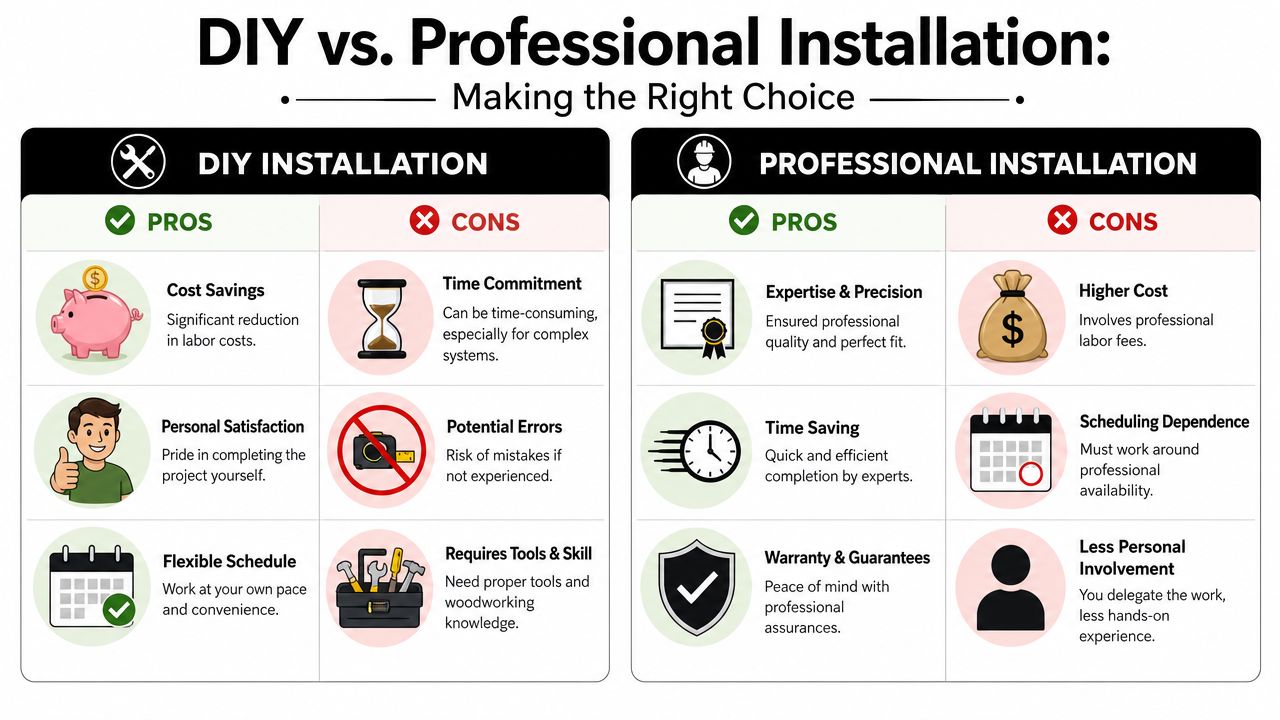
When DIY makes sense
For a standard door-mounted pull-out, installation typically follows a very specific sequence: remove the cabinet door, position the frame, mount it to the cabinet bottom with four corner screws, secure the base with two additional screws, attach the wireframe basket, unfold the frame to snap on the pull bar, test the bin and bag, and then reattach the door. When the cabinet dimensions match the required 14.5-inch width, the process can take less than 10 minutes with a DIY success rate exceeding 95%, based on the installation walkthrough on YouTube.
That sounds easy because, under ideal conditions, it often is.
This is the path that usually suits you if:
- Your cabinet is standard: The opening matches the product requirements cleanly.
- You're comfortable with basic tools: Drill, screwdriver, measuring tape, and minor adjustments don't bother you.
- You're doing a focused upgrade: You're not also reworking doors, fillers, adjacent panels, or countertop overhangs.
A useful homeowner mindset for this kind of project is the same one used for larger renovation coordination. This guide on managing contractors during a remodel is a good reminder that even small cabinet upgrades benefit from clear sequencing and realistic expectations.
A quick look at the installation process helps show the appeal:
When professional installation earns its keep
The trouble starts when the cabinet is close to standard, but not quite. The same installation guidance notes common snags such as needing to shim the front face with washers if it exceeds standard size and changing screw length to 1.5 inches so they sink properly into 3/4-inch plywood cabinet walls, as described in that same earlier installation source.
That's where professional experience becomes less about speed and more about judgment.
Professional installation usually makes sense when:
- The cabinet opening is tight or irregular
- You want the door reveal to match surrounding cabinetry exactly
- The trash pull-out is part of a broader kitchen remodel
- There are nearby plumbing, electrical, or appliance conflicts
- You want the result to feel original to the kitchen, not retrofit
A good installer also sees issues before the hardware goes in. They'll check whether the adjacent drawer front will clip the handle, whether the panel profile leaves enough room for a door-mount bracket, and whether the cabinet floor needs reinforcement.
DIY can absolutely work. It's a good option for the right setup. But if the kitchen is being renovated as a finished, design-driven space, professional installation usually protects the details people care about most.
Your South Jersey Remodel A Checklist for Success with The Cabinet Coach
The hidden trash cabinet is rarely the only decision in a remodel. Once homeowners in Cherry Hill, Haddonfield, Moorestown, Collingswood, Mount Laurel, or Medford start planning, they're also weighing cabinet style, countertop edge, storage upgrades, hardware finish, lighting, and construction timing. The easiest projects are the ones that turn those moving parts into a sequence.
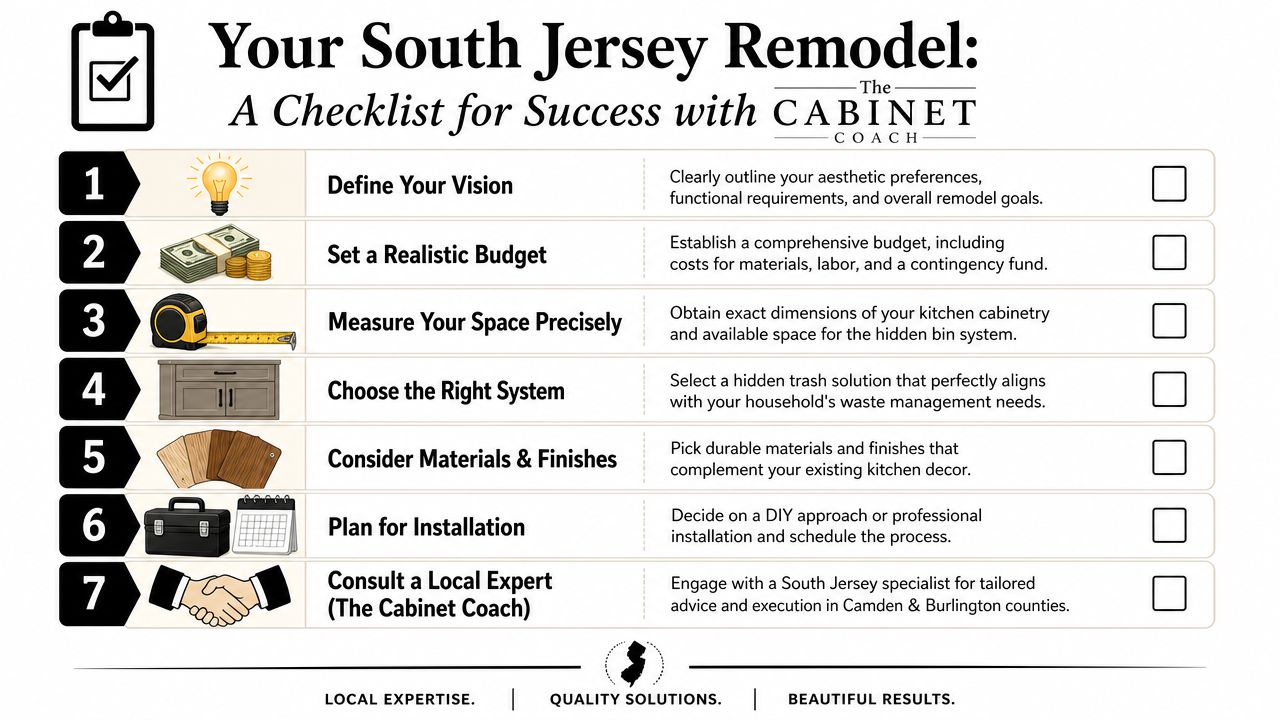
A practical project path for local homeowners
A smooth remodel usually starts with clarity, not products. Before you choose a pull-out model, decide what the kitchen needs to do better.
Use this checklist:
Define how you use the kitchen
If the island is the prep hub, the trash belongs near it. If the cleanup zone is the bottleneck, solve that first.Set the budget before comparing upgrades
Hidden trash systems feel small, but they connect to cabinetry choices, hardware quality, and installation method. For homeowners trying to map spending realistically, DreamKitchen.ai's budgeting guide is a useful planning resource.Measure the candidate cabinet carefully
Get the interior opening, depth, height, and any obstructions on paper. Assumptions create reorders.Choose the system based on lifestyle
A family handling steady trash and recycling usually benefits from a dual pull-out. A lighter-use secondary zone may not need that footprint.Coordinate finishes and function together
The trash cabinet should match the kitchen visually and mechanically. That means the right door style, glide quality, and handle placement.
The best remodel decisions usually aren't dramatic. They remove friction you were tired of living with.
What a smooth remodel usually looks like
For many South Jersey homeowners, the process becomes manageable once there's a clear roadmap. That often looks something like this:
Start with a planning conversation
Clarify priorities, problem spots, and must-haves.Review the room in person
Existing conditions matter. Floor level, plumbing location, and cabinet construction all affect what's realistic.Develop the cabinet and storage plan
The hidden trash bin is properly placed as part of this plan, rather than squeezed in late.Finalize materials and hardware
Cabinetry, countertops, pulls, slides, and interior accessories should support one another.Coordinate installation in the right order
That includes cabinetry work, related trades, and final fit adjustments.
If you're preparing for a full renovation rather than a one-off cabinet accessory, this kitchen remodel planning guide helps organize the bigger picture.
What homeowners usually want isn't just a prettier trash solution. They want a kitchen that feels calmer, moves better, and looks finished. A hidden kitchen trash bin is one of those details that delivers all three when it's designed into the room from the start.
If you're planning a kitchen update in Cherry Hill or anywhere in Camden and Burlington counties, The Cabinet Coach can help you turn details like a hidden trash cabinet into a fully resolved design. The mobile showroom, guided planning process, and end-to-end project support make it easier to choose the right cabinetry, hardware, and layout without guessing your way through the remodel.