
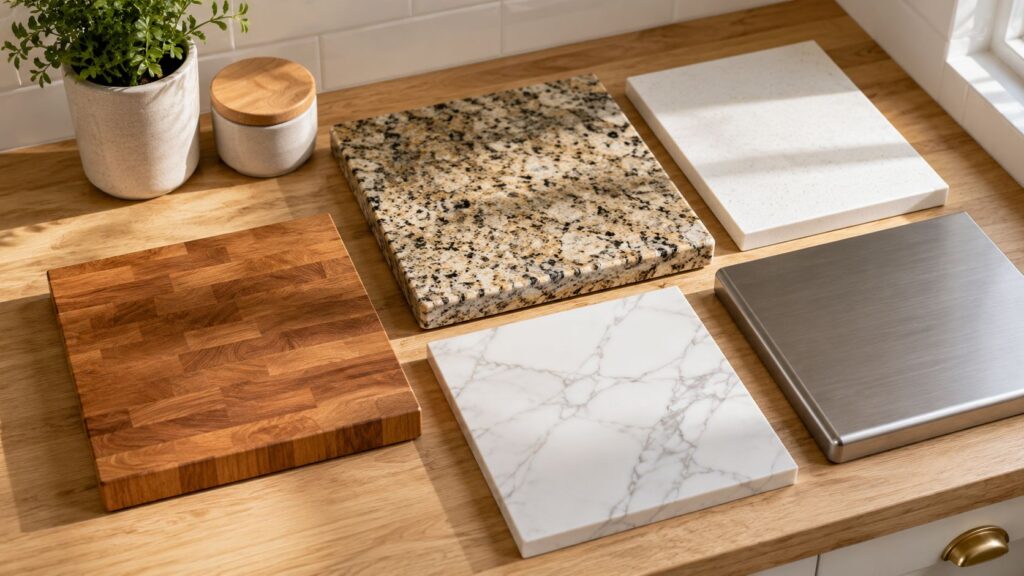
You're probably standing in your kitchen right now, looking at counters that have seen too many school lunches, coffee rings, and hurried weeknight dinners. You know the room needs an update, but once you start looking at the types of countertops available, the choices get confusing fast. Granite, quartz, marble, butcher block, solid surface, laminate. They all look good in photos. They do not all perform the same way in a real South Jersey home.
That's where most homeowners get stuck. The right countertop isn't just about color or trend. It has to fit how you cook, how much maintenance you'll keep up with, what your budget can support, and, if resale matters, what buyers in towns like Cherry Hill, Moorestown, Voorhees, and Haddonfield tend to value when they walk into a kitchen.
Table of Contents
- Choosing Your Perfect Countertop Starts Here
- At a Glance Countertop Material Comparison
- The Natural Stone Collection Granite Marble Soapstone and Quartzite
- The Engineered Collection Quartz Solid Surface Porcelain and Recycled Glass
- The Specialty Collection Laminate Butcher Block Concrete and Stainless Steel
- A Decision Checklist for Your South Jersey Home
- Begin Your Countertop Journey with Confidence
Choosing Your Perfect Countertop Starts Here
A lot of remodel decisions feel cosmetic until you get to the countertop. Then the decision becomes practical very quickly. This is the surface where groceries land, kids do homework, hot pans get set down for “just a second,” and spilled red sauce tests every promise made in a showroom sample.
That's also why this category matters so much in the remodeling world. The residential construction segment commanded 61.80% of the global countertops market in 2025, and kitchen countertops captured 69.55% of that market, according to Grand View Research's countertop market analysis. Homeowners are putting real thought and real money into this choice because it affects daily life more than almost any finish in the room.
In practice, rather than a technical explanation of every countertop type, individuals often need guidance to narrow the field. A family in Medford with three young kids usually needs a different answer than an empty nester in Moorestown creating a quiet, high-design kitchen for entertaining. A rental update in Camden County has different priorities than a forever-home renovation in Burlington County.
Practical rule: Start with performance, then choose the prettiest option within that performance tier.
If you're still in the early stage of collecting ideas, a kitchen design consultation can help organize your priorities before you fall in love with the wrong slab. The smartest countertop decision usually feels less like chasing a trend and more like matching a material to the way your home works.
At a Glance Countertop Material Comparison
The fastest way to sort through the main types of countertops is to compare them side by side. Some materials look similar at first glance and behave very differently once they're installed. Others come with trade-offs that are easy to accept if you know about them upfront.
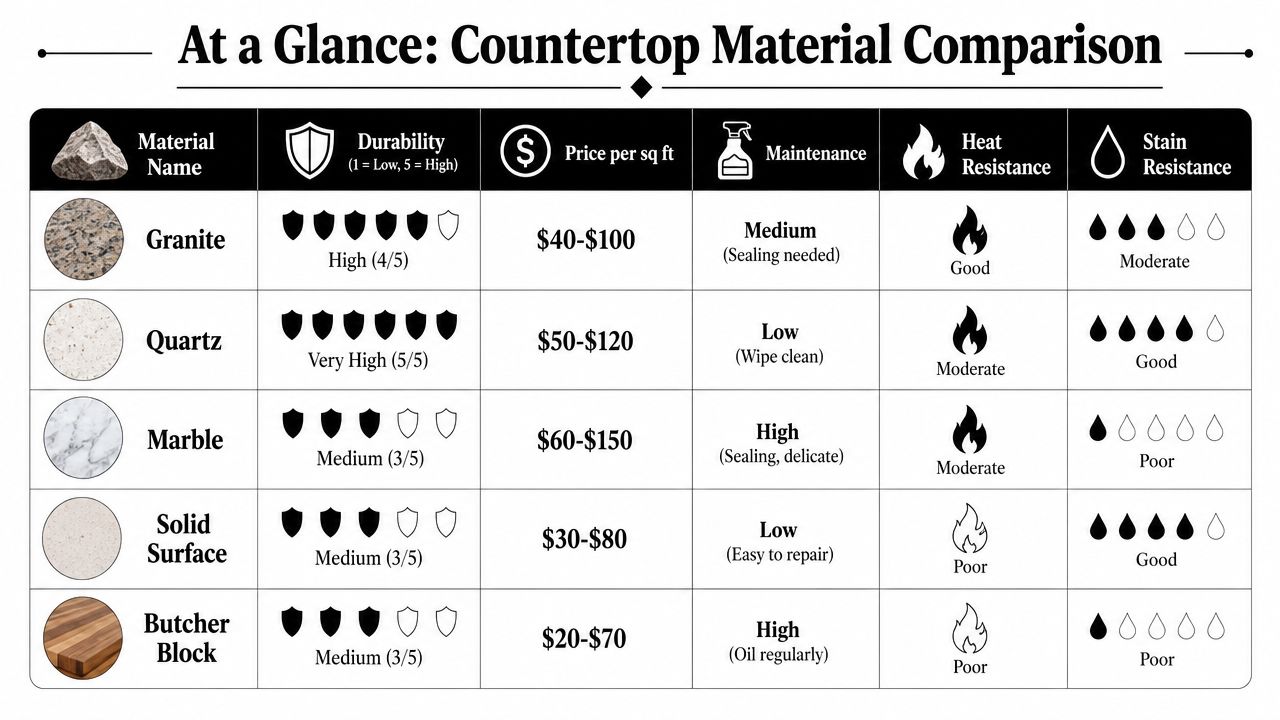
Price is usually the first filter. Based on Mordor Intelligence's countertops market report, laminate countertops range from $20 to $50 per square foot, granite from $40 to $200, quartz from $100 to $150, and marble from $40 to $140. Those ranges don't tell the whole story, but they do show why homeowners often compare materials that aren't true equals in maintenance or resale appeal.
How to read the comparison
Durability isn't just about whether a surface is “hard.” It includes how well the material handles scratching, chipping, impact, and real household wear. Heat resistance matters if you cook often. Stain resistance matters if you don't want a countertop that punishes every spill. Maintenance is the category homeowners tend to underestimate.
Here's a helpful visual before the table:
Countertop Material Quick-Reference Guide
| Material | Cost/Sq. Ft. | Durability (Scratch/Chip) | Stain Resistance | Heat Resistance | Maintenance |
|---|---|---|---|---|---|
| Laminate | $20 to $50 | Lower than stone options | Fair to good, depends on seam and wear | Lower | Low daily care, but damage is harder to reverse |
| Granite | $40 to $200 | Strong overall | Good when properly sealed | Good | Moderate |
| Quartz | $100 to $150 | Strong for daily use | Excellent because it's nonporous | Moderate | Low |
| Marble | $40 to $140 | Softer than harder stones | Lower than quartz | Moderate | Higher |
| Solid Surface | Qualitative only | Moderate | Good | Lower | Low to moderate |
| Butcher Block | Qualitative only | Moderate, can mark with use | Lower without diligent care | Lower | Higher |
A few quick takeaways tend to help homeowners immediately:
- If low maintenance is the priority: Quartz and solid surface usually stay on the shortlist.
- If natural variation is the goal: Granite, marble, and quartzite are the conversation.
- If budget leads the project: Laminate often enters early, but it needs to be weighed against long-term value, not just upfront cost.
- If warmth matters more than perfection: Butcher block gives a softer look that stone can't replicate.
For homeowners comparing installation budgets in more detail, this guide to the cost of countertops per square foot is a useful next step.
The Natural Stone Collection Granite Marble Soapstone and Quartzite
A Cherry Hill or Moorestown homeowner can fall in love with a slab in under a minute. The harder part is deciding whether that slab will still feel like a smart purchase five or ten years from now. Natural stone often helps resale because buyers recognize it, but the return depends on choosing the right stone for the house, the price point, and the way your family uses the kitchen.
Granite
Granite remains one of the safest natural stone choices for South Jersey resale. Buyers know the name, appraisers and agents see it as an established upgrade, and it works across a wide range of kitchen styles without boxing the next owner into a very specific look.
Its appeal is practical as much as visual. Granite handles regular kitchen use well, offers true slab-to-slab variation, and pairs comfortably with painted shaker cabinets, stained wood, and more transitional layouts. In many homes, that balance matters more than chasing the newest material trend.
The trade-off is upkeep. Granite needs sealing and a little respect. Homeowners who ignore that side of ownership can end up with staining or dull areas that undercut the value they thought they were buying.
For budgeting, fabrication, and installed pricing, this guide on how much it is to install granite countertops gives a clearer picture than a slab price alone.
Granite also exposes a common resale myth. A lower-cost, DIY-friendly top may save money at install, but in many South Jersey neighborhoods it does not create the same buyer confidence that professionally fabricated natural stone does. In a market where kitchens help sell homes, that difference shows up.
Marble
Marble sells a feeling fast. It brightens a room, softens a kitchen with simple cabinetry, and gives a home a higher-end look that buyers notice during showings.
It also asks for tolerance.
Marble is softer than quartzite and more likely to show etching, wear, and small signs of use. Homeowners who want a polished, untouched surface usually struggle with it over time. Homeowners who appreciate patina often stay happy with it much longer.
Marble makes the most sense when the design goal is clear and the owner accepts the maintenance. It can work beautifully in baking zones, lower-stress kitchens, and homes where character matters more than perfection. For a busy family kitchen built around low maintenance, it is usually the wrong investment, even if the first impression is strong.
Soapstone
Soapstone appeals to a narrower group of homeowners, but the right homeowner tends to love it. It brings a quieter, older look that fits historic homes, farmhouse kitchens, and spaces with painted cabinetry, warm metals, and handmade details.
From a resale standpoint, soapstone is more style-specific than granite. That can be a strength in the right Moorestown colonial or Haddonfield historic home, but it is less universal if broad buyer appeal is the goal. It also marks and softens with use, which some homeowners read as charm and others read as damage.
A practical way to judge soapstone:
- Best for: Homeowners who enjoy visible character over time
- Less ideal for: Buyers who want a crisp, unchanged finish
- Strongest fit: Historic, rustic, and collected interiors
Soapstone is not a budget shortcut to a luxury look. It is a deliberate style choice.
Quartzite
Quartzite earns attention from homeowners who want natural stone without marble's level of vulnerability. It is a natural metamorphic stone, not engineered quartz, and that distinction matters when you are comparing maintenance, appearance, and resale positioning.
According to Style by Emily Henderson's countertop guide, quartzite has a Mohs hardness of 7, while marble is 3, which helps explain why quartzite generally resists scratching and chipping better than softer natural stones. In an active kitchen, that added durability can make the investment easier to justify.
Quartzite usually fits homeowners who want:
- A true natural slab
- Better scratch resistance than marble
- A refined, high-end look with stronger day-to-day performance
The caution is not the headline durability. It is the selection and fabrication process. Some quartzites perform beautifully. Some are sold under confusing labels, and slab quality can vary. The exact piece matters, along with the finish, edge profile, seam placement, and fabricator's skill.
What matters most with natural stone
Natural stone should never be chosen from a small sample alone. The full slab determines how the kitchen will read once the island is cut, the sink opening is placed, and the seams are laid out.
All American Granite's guide to questions to ask when shopping for countertops reinforces the same lesson professionals see every day. Stone quality varies, and homeowners often do not spot the difference until after installation problems show up.
For South Jersey homeowners, the smartest approach is simple:
- View the actual slab whenever possible
- Ask where seams will go before you sign off
- Check edge profiles for durability, not just appearance
- Compare stones by performance and grade, not color alone
- Treat fabrication as part of the investment, not a separate afterthought
That last point matters for ROI. In this market, buyers respond to kitchens that feel well planned and professionally finished. A cheap top, a poorly chosen slab, or a DIY-looking installation can cancel out the money saved upfront. Natural stone can add lasting value, but only when the material choice and the craftsmanship match the home.
The Engineered Collection Quartz Solid Surface Porcelain and Recycled Glass
Engineered materials attract homeowners who want fewer surprises. The patterns are more controlled, the performance is often more predictable, and the maintenance burden is usually easier to live with year after year. In busy homes, that matters more than people expect at the start of a remodel.
Quartz
Quartz is one of the most practical countertop choices available today, especially for family kitchens and high-use entertaining spaces. It gives homeowners the clean look many want without the ongoing upkeep that comes with some natural stones.
According to Cabinet Corp's guide to kitchen countertop types, engineered quartz is made of about 90 to 94% natural quartz mineral and 6 to 10% polymer resin, has a Mohs hardness rating of 7, and creates a nonporous surface that resists staining and bacterial penetration without requiring periodic sealing. That composition explains why quartz has become such a dependable answer for kitchens that need to function hard every day.
What quartz does well:
- Consistent appearance: Helpful when you want a clean, controlled design.
- Low maintenance: No sealing schedule to remember.
- Good stain resistance: Strong fit for families, frequent cooks, and entertainers.
What quartz doesn't do as well is mimic the one-of-a-kind character of a true natural slab. It can be beautiful, but it's a different type of beauty. Some homeowners prefer that consistency. Others miss the organic variation.
Solid surface
Solid surface counters, including well-known products like Corian, occupy a useful middle ground. They aren't trying to be dramatic statement slabs. They're trying to be practical, clean, repairable, and visually quiet.
That's why solid surface often works well in secondary spaces, minimalist kitchens, laundry rooms, mudrooms, and some bathrooms. It can also be a smart answer for homeowners who dislike visible grime-catching joints and want a more continuous feel.
A few reasons solid surface keeps earning consideration:
- It's nonporous in everyday use
- It can be easier to repair than many harder materials
- Integrated sinks and clean lines suit modern design
For homeowners comparing this option in more depth, this overview of what Corian countertops are is worth reading.
Porcelain
Porcelain has gained attention because it offers a crisp, contemporary aesthetic and can work beautifully in kitchens aiming for a more architectural feel. Thin profiles, large-format looks, and restrained patterning appeal to homeowners who don't want bulky counters or traditional stone visuals.
Porcelain also fits well in homes where the design team is aiming for continuity between countertops, backsplashes, and sometimes even wall surfaces. It can create a sharp, refined finish that feels current without being flashy.
That said, porcelain isn't always the easiest material for every fabrication scenario. Edge details, installer experience, and project specifics matter. Homeowners should be sure the fabricator is comfortable with the product and the intended profile.
Recycled glass
Recycled glass isn't a mainstream answer for every kitchen, but it can be compelling in the right project. It often appeals to homeowners who want a surface with more personality, more reflectivity, or a sustainability-minded story behind the design.
Design-wise, recycled glass can go in two different directions. Some versions read playful and expressive. Others are subdued and polished enough for a contemporary kitchen. Because the look varies so much by product, this is one category where in-person viewing matters a lot.
The right engineered surface usually wins because it matches your habits, not because it has the strongest sales pitch.
Where engineered materials usually win
Engineered materials tend to outperform natural stone when the homeowner's top priorities are predictability, easier care, and a controlled finished look. That's especially true in households where countertop use is constant and maintenance routines are aspirational at best.
They're often a strong fit for:
- Young families: Less worry over spills and messes
- Busy professionals: Easy upkeep after long workdays
- Rental or investment properties: Cleaner visual consistency
- Modern kitchens: Better control over color and pattern repetition
The only time engineered surfaces disappoint is when a homeowner is craving the variation and authenticity of quarried stone but chooses a manufactured surface for convenience. Functionally, the decision may be right. Emotionally, it can still feel off if the aesthetic goal wasn't honest from the start.
The Specialty Collection Laminate Butcher Block Concrete and Stainless Steel
Some countertop materials earn their place because they solve a specific problem. Others get chosen because they create a look no stone or engineered slab can quite match. This group includes some of the most budget-friendly options and some of the most style-driven ones.
Where these materials make sense
Laminate has improved visually over the years. It can imitate stone, wood, and solid colors far better than many homeowners expect. For a fast refresh, a secondary space, or a tightly controlled renovation budget, laminate can be a reasonable option. If appearance is the main goal and the kitchen won't be heavily stressed, it can do the job.
Butcher block brings warmth in a way cool-toned stone never will. It softens painted kitchens, works beautifully in cottages and transitional homes, and can be especially appealing on islands where homeowners want furniture-like character. Many people love the approachable, lived-in feeling it creates.
Concrete is usually chosen for design intent. It suits industrial, modern, and custom spaces where homeowners want something sculptural and less conventional. It can feel bespoke in the best sense when the rest of the room supports that direction.
Stainless steel is the most utilitarian option in the group. Serious home cooks often appreciate its hygienic, commercial-kitchen feel. In certain modern homes, it also looks sharp and intentional rather than purely functional.
For laminate specifically, this overview of what Formica countertops are gives useful context on where the category fits today.
Where homeowners get surprised
The downside of laminate is that it still doesn't behave like stone. It's a value material, not a premium one. It can look good at first and still feel less substantial in daily use, especially around seams and edges.
The downside of butcher block is upkeep. Homeowners love it in inspiration photos. They like it less when they realize water, staining, and surface wear need attention if they want it to stay looking fresh. It's a material that asks for participation.
Concrete often surprises people because they assume “industrial” means carefree. It doesn't. It can require sealing, and its handcrafted nature means variation is part of the package. Homeowners who want strict consistency usually don't enjoy concrete for long.
Stainless steel is honest about what it is. It scratches. It can dent. Fingerprints show. For some people, that's a deal-breaker. For others, it's exactly the point. They want a surface that performs like a work table and don't mind seeing use reflected back.
A useful way to evaluate this category is to ask one direct question: are you choosing the material for performance, for style, or because the upfront number feels easier to swallow? If the answer is only budget, it's worth pausing before you commit.
A Decision Checklist for Your South Jersey Home
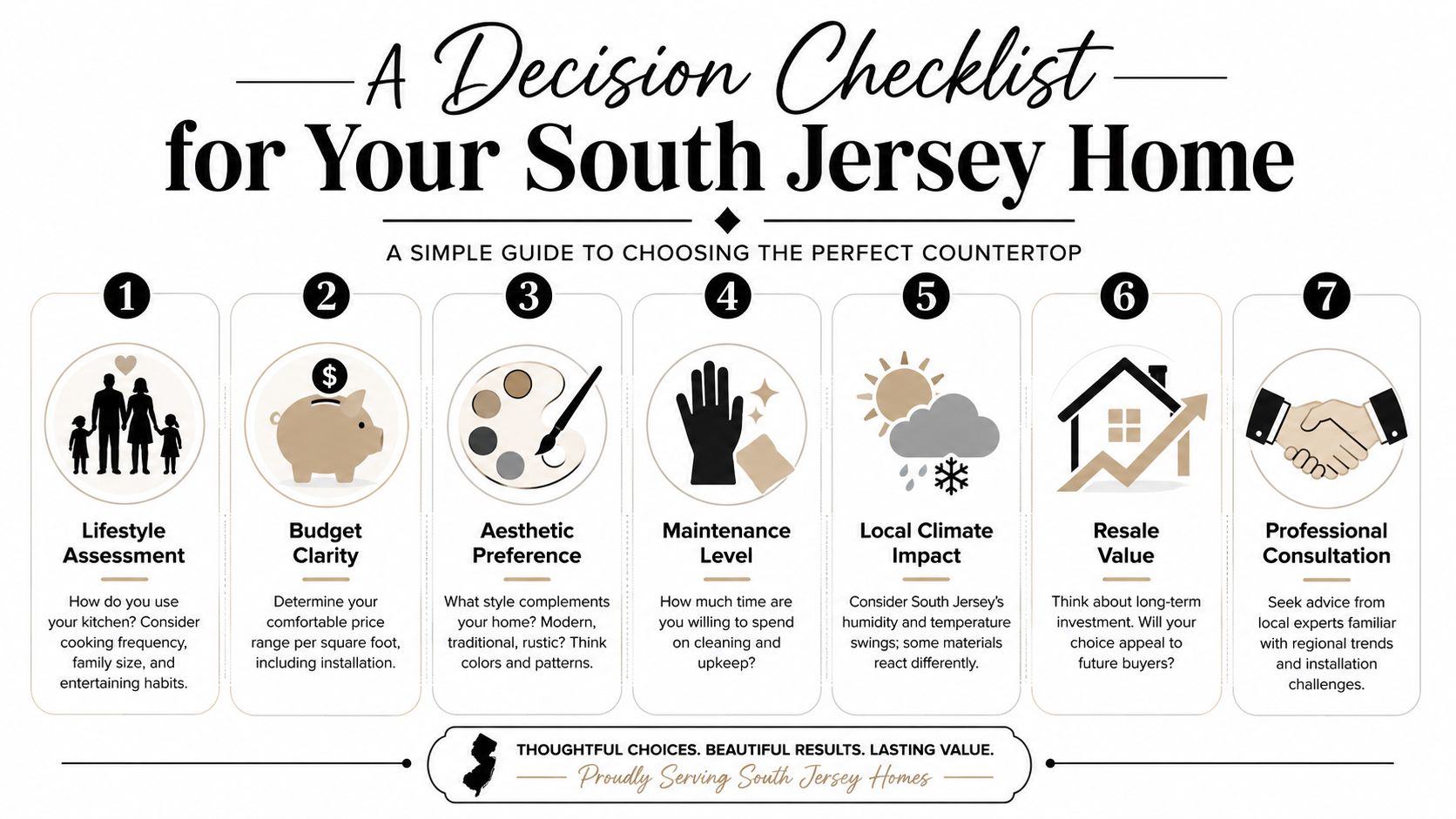
A countertop that looks good on a sample rack can still be the wrong choice for your house, your routine, and your resale plans. I see that often with South Jersey homeowners comparing a Moorestown family kitchen to a smaller Collingswood remodel or a rental property near Camden. The right decision gets clearer once you filter for use, upkeep, and how buyers in this market tend to read the finished space.
Start with how you live
Use these questions to narrow the field fast:
- How hard does your kitchen work: If the counters handle daily cooking, lunch prep, homework, and holiday traffic, durability and stain resistance deserve top billing.
- What maintenance will happen in real life: If sealing, oiling, and careful cleanup are unlikely to become routine, cross off materials that depend on regular attention.
- What fits the house itself: Crisp quartz can suit a newer Voorhees kitchen beautifully. In an older Haddonfield home, natural stone or a warmer surface may feel more believable with the architecture.
- How long do you plan to stay: A long-term home gives you room to prioritize personal taste. A kitchen tied to a sale in the next few years should keep buyer expectations closer to the center of the decision.
Buyers react quickly to countertops that look durable, current, and easy to maintain.
Homeowners who are weighing return on investment should also keep the full remodel in view. This guide to profitable kitchen upgrades is useful because countertop choices rarely deliver their best return in isolation.
The resale value myth in South Jersey
One mistake shows up again and again. Homeowners assume a DIY-friendly countertop is a safe investment because it gives the kitchen a fresher look for less money upfront.
That shortcut does not hold up well in many South Jersey resale situations, especially in towns like Cherry Hill and Moorestown where buyers often compare your kitchen against homes with quartz or granite already in place. A laminate, butcher block, or basic concrete install may photograph fine, but buyers can still read it as a future project. Once that happens, the savings you enjoyed during the remodel do not always translate into stronger offers.
The lesson for South Jersey homeowners is simple. Lower installation cost and better return are not the same thing.
That does not mean every house needs the most expensive slab in the showroom. It means the smartest investment is usually the material that matches the price point of the home and meets buyer expectations without overspending.
A shortlist that works
For many South Jersey homes, this is a practical starting filter:
- Choose quartz if you want broad resale appeal, low maintenance, and a clean, consistent look.
- Choose granite if you want natural variation and solid day-to-day durability.
- Choose quartzite if you want the character of stone and are comfortable paying more for it.
- Choose marble if appearance is the priority and you accept etching, wear, and extra caution.
- Choose solid surface if repairability and an integrated look matter more than stone status.
- Choose laminate or butcher block only if their trade-offs support a clear plan for the home, not just a lower starting number.
A strong countertop choice usually balances three things:
- Daily usability
- Fit with the style and value of the house
- Buyer response if you sell in the South Jersey market
Miss one of those, and the countertop often becomes the part of the remodel that feels dated, fussy, or underpowered sooner than expected.
Begin Your Countertop Journey with Confidence
The best types of countertops aren't the ones getting the most attention online. They're the ones that still make sense after a full year of cooking, cleaning, entertaining, and living in the space. That's why countertop selection works best when it's grounded in real habits, real budgets, and real expectations about upkeep and resale.

For South Jersey homeowners, the decision often comes down to a few honest questions. Do you want natural variation or pattern consistency? Do you want a countertop that ages with character or one that stays predictable? Are you designing for your own long-term use, or do future buyers need to be part of the conversation? Once those answers are clear, the material list gets much shorter.
A strong remodel doesn't come from picking the most expensive slab in the building. It comes from matching the surface to the home. When that match is right, the countertop supports everything else in the room, from cabinet color and backsplash selection to how comfortable the kitchen feels on an ordinary Tuesday night.
If you'd like help narrowing down the right countertop for your kitchen or bath, The Cabinet Coach brings a mobile showroom experience directly to South Jersey homeowners, making it easier to compare materials, align choices with your budget, and move from ideas to a finished plan with less stress.