
Most granite countertop installations land between $2,000 and $4,000, and granite itself commonly falls in a broad $43 to $140 per square foot range. That wide spread is the whole story. Granite isn't one price, and homeowners in South Jersey feel that fast when they start comparing quotes.
I'll give you the straight answer I give new clients. If you're asking how much is it to install granite countertops, the honest answer is that the stone is only part of the bill. Fabrication, sink cutouts, edge details, demolition, and how your kitchen is laid out matter just as much. A simple kitchen in Collingswood won't price like a larger, detail-heavy kitchen in Cherry Hill or Moorestown, even if both homeowners say they want “granite.”
That's why national averages are useful, but they're not enough. You need to know what pushes your project toward the lower end, what sends it upward, and which choices are worth paying for.
Table of Contents
- Granite Countertop Cost Averages for 2026
- Deconstructing the Price What Drives Your Granite Cost
- Sample Budgets For Common South Jersey Kitchens
- Smart Ways to Save on Your Granite Countertops
- How to Measure for an Accurate Granite Countertop Estimate
- The Installation Process What to Expect
- Get a Precise Granite Quote with The Cabinet Coach
Granite Countertop Cost Averages for 2026
If you want a baseline before you start shopping, use installed price per square foot and total project cost together. Looking at only one number gives you a distorted picture.
Homeowners often see a low material price and assume that's the kitchen price. It isn't. Installed granite includes stone, fabrication, labor, and job-specific details that show up after measuring.
The national ranges worth knowing
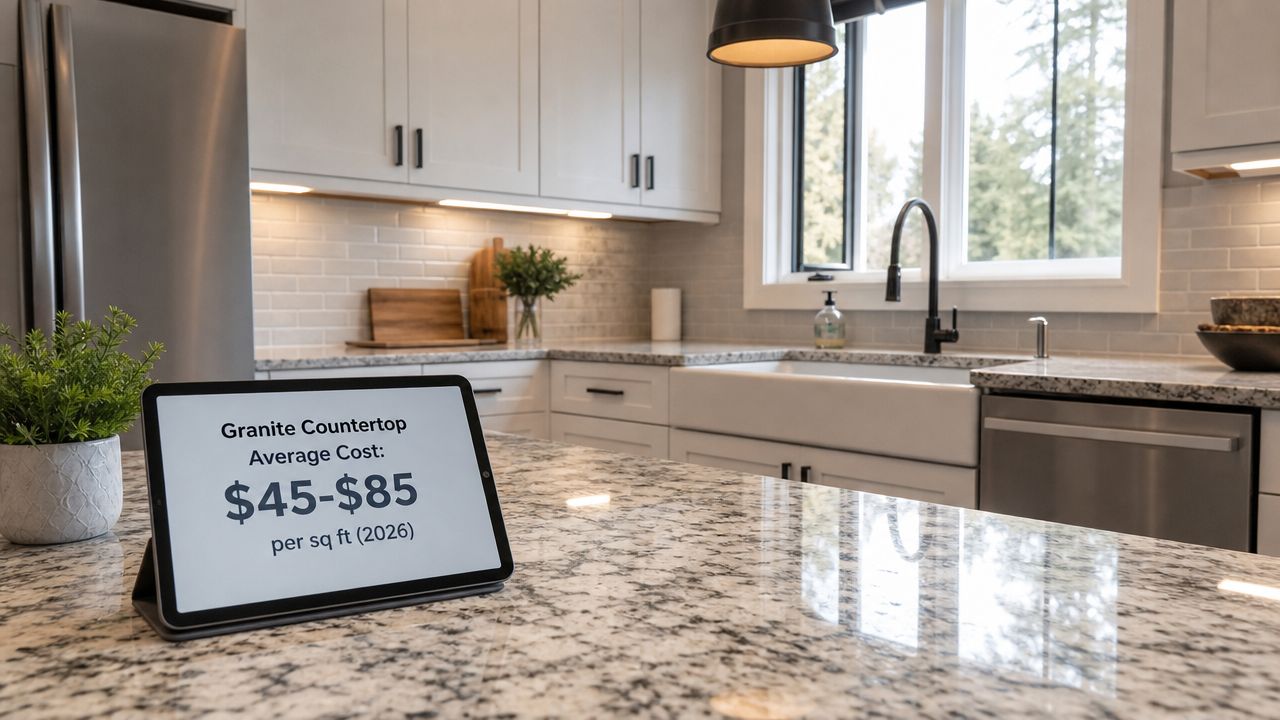
A useful benchmark is this: Homewyse's May 2026 installed granite countertop pricing starts at $96.58 to $141 per square foot, while The Home Depot lists granite at $43 to $140 per square foot with an average of $70 per square foot. That tells you the market spans basic to premium jobs, not one neat middle number.
For planning, I'd treat that as a reality check. If one quote looks far lower than the rest, something may be missing. If one quote is much higher, the kitchen may include details you haven't accounted for yet.
Practical rule: Don't ask only, “What's your price per square foot?” Ask what that price includes.
Why the range is so wide
Granite pricing swings because each kitchen is a custom fabrication job. A builder-grade color with straight runs is one thing. An exotic slab, a shaped island, multiple cutouts, and upgraded edges are something else entirely.
In South Jersey, that difference shows up in ordinary neighborhoods. A compact ranch kitchen in Cherry Hill might need a straightforward layout. A larger Moorestown kitchen may call for longer runs, more seams, or an island that demands cleaner slab matching. Same material category, different workload.
A lot of homeowners also underestimate how much finish choices matter. Better edges, more visible seam planning, and tighter fitting around walls all take additional shop and install time. If you want a broader look at how different surfaces compare before you settle on granite, this guide on countertop costs per square foot is a useful planning reference.
Deconstructing the Price What Drives Your Granite Cost
Granite quotes confuse people because they mix material, labor, and customization into one final number. That's why one kitchen can sit near the low end while another jumps well beyond it.
Angi's granite countertop cost guide reports that most installations fall between $2,000 and $4,000, with an average total of $3,250. It also breaks out major cost components: slabs commonly run $40 to $60 per square foot, labor is typically $35 to $85 per hour, upgraded edges add $10 to $40 per square foot, and old countertop disposal adds $4 to $7 per square foot.
Start with the slab, but don't stop there
People get hung up on the stone label. I understand why. The slab is visible, emotional, and easy to compare. But the slab doesn't tell you how hard the job is to fabricate and install.
That's also why granite performs so well in demanding settings. If you're curious how granite's toughness translates outside the kitchen, this breakdown of the advantages of granite paving is a good example of why the material has such lasting appeal.
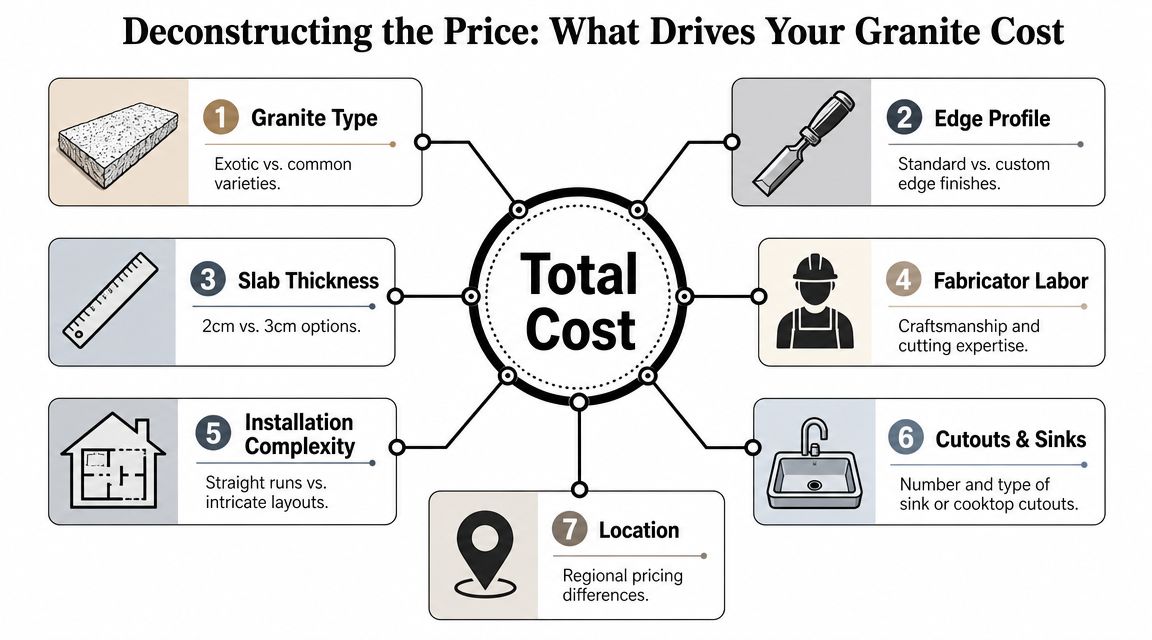
The seven cost drivers I see on real quotes
Granite type and slab selection
Common colors usually price more predictably. Rare movement, unusual coloration, and stronger pattern variation tend to push jobs upward because slab selection becomes more restrictive.Edge profile
Homeowners often add cost here. A standard eased edge is simpler. A decorative edge takes more fabrication time and more finishing skill.Slab thickness
Thicker-looking tops can change fabrication requirements and overall handling. More weight and a different visual profile can affect both shop work and installation planning.Layout complexity
Straight runs are cheaper to template and install than kitchens with angled corners, tight turns, peninsulas, or islands that need careful seam placement.Cutouts and sink details
Every sink, faucet area, cooktop opening, and specialty cut has to be planned and executed. One undermount sink is straightforward. Multiple cutouts make the job more involved.Labor and fabrication quality
Cheap granite work looks cheap. Weak seam placement, rough polishing, and sloppy wall scribing show up immediately. Good shops charge for craftsmanship because they should.Removal and disposal
Old countertop tear-out isn't glamorous, but it affects the bill. Disposal costs are real, and some existing tops come out cleanly while others fight you the entire way.
A granite quote should explain the kitchen, not just the stone. If it doesn't, you're buying blind.
Here's my recommendation. Compare quotes line by line, not by total alone. If you're still deciding between materials and want a better framework for evaluating durability, appearance, and maintenance, use this guide on how to choose kitchen countertops.
Sample Budgets For Common South Jersey Kitchens
A 30 square foot granite install is often used as the national baseline. In South Jersey, that baseline only gets you so far. A compact condo kitchen in Collingswood does not price out like a larger Cherry Hill family kitchen, and it definitely does not price out like a Moorestown kitchen with a big island and more visible stone.
Here's the practical way to look at it. Use national averages as a reference point, then adjust for the kind of kitchen you have. At The Cabinet Coach, that local adjustment is usually where homeowners either get clarity or get surprised.
Three local-style examples
A small galley kitchen in Collingswood is usually the cleanest budget. Fewer square feet, fewer interruptions, and a simple layout keep fabrication and install more predictable. If you choose a common granite color and a standard edge, this is often the most cost-controlled type of project.
A mid-size family kitchen in Cherry Hill is where granite pricing starts to spread out. You may have longer runs, an undermount sink, a dishwasher span, and one area where seam placement matters. This is the kitchen size where a quote can look reasonable at first, then rise once the exact layout gets measured.
A larger Moorestown kitchen usually brings the biggest jump in cost. Islands, wider spans, more exposed edges, and a premium slab choice all add up fast. Homeowners notice the slab first, but the labor and fabrication detail are usually what push the total higher.
Sample Granite Countertop Budgets for South Jersey Kitchens
| Kitchen Type (Location Example) | Approx. Sq. Ft. | Granite Level | Estimated Total Cost |
|---|---|---|---|
| Small galley kitchen (Collingswood) | About 30 sq. ft. | Common granite, standard edge | Often aligns with the typical installed range cited earlier for a simple 30 sq. ft. job |
| Family kitchen (Cherry Hill) | More than a small galley layout | Mid-range granite, standard to upgraded details | Usually lands above entry-level pricing once the full layout, sink area, and seam plan are included |
| Large kitchen (Moorestown) | Larger footprint with island or added complexity | Premium granite, upgraded fabrication details | Often moves well beyond baseline pricing because size, slab selection, and finish work stack together |
If your kitchen looks bigger, busier, or more custom than a basic 30 square foot example, expect a higher number. That is normal. It is not a pricing trick.
One good reality check is to compare your layout to a standard planning model before you ask for estimates. Our guide to a 10×10 kitchen cost framework helps you judge whether your kitchen is compact, average, or clearly outside the standard showroom template.
My advice is simple. If you live in South Jersey, ask for a quote built around your actual kitchen, not a national average and not a vague per-square-foot promise. That is how you avoid sticker shock and make a smart decision the first time.
Smart Ways to Save on Your Granite Countertops
Saving money on granite is mostly about discipline. Homeowners overspend when they chase upgrades that don't change the overall look much, or when they approve a layout without thinking about fabrication.
Where to cut cost without hurting the result
- Choose a more common granite color. Exotic patterns get attention in the slab yard, but many kitchens look just as strong with a quieter stone that coordinates with the cabinets and backsplash.
- Keep the edge simple. Fancy edges sound impressive. Most of the time, they don't improve the kitchen enough to justify the extra spend.
- Simplify the layout where you can. Long uninterrupted runs, fewer awkward corners, and fewer custom transitions make fabrication easier.
- Use remnants for smaller spaces. If you're doing a vanity, laundry room, or bar area, remnant stone can be a smart move.
- Think through demolition before the crew arrives. Removal affects labor and disposal. Sometimes preparation helps. Sometimes DIY demo creates damage and slows the job down.
Where I wouldn't cut corners
Don't cheap out on measurement. Don't cheap out on fabrication quality. Don't cheap out on installation.
Those are the three places where “saving money” often turns into visible regret. A poor seam, chipped cutout, or crooked overhang will annoy you every day.
If the budget is tight, reduce the number of upgrades before you reduce the quality of the people doing the work. And if you need to stage the broader remodel instead of forcing every expense into one month, this guide on financing a kitchen renovation can help you think through the timing.
How to Measure for an Accurate Granite Countertop Estimate
If you want a useful first quote, bring a basic sketch with real measurements. It doesn't need to be pretty. It needs to be clear.
A rough cabinet-store guess wastes time. A simple, measured drawing gives a fabricator enough context to tell whether you're discussing a modest job or something more complex.
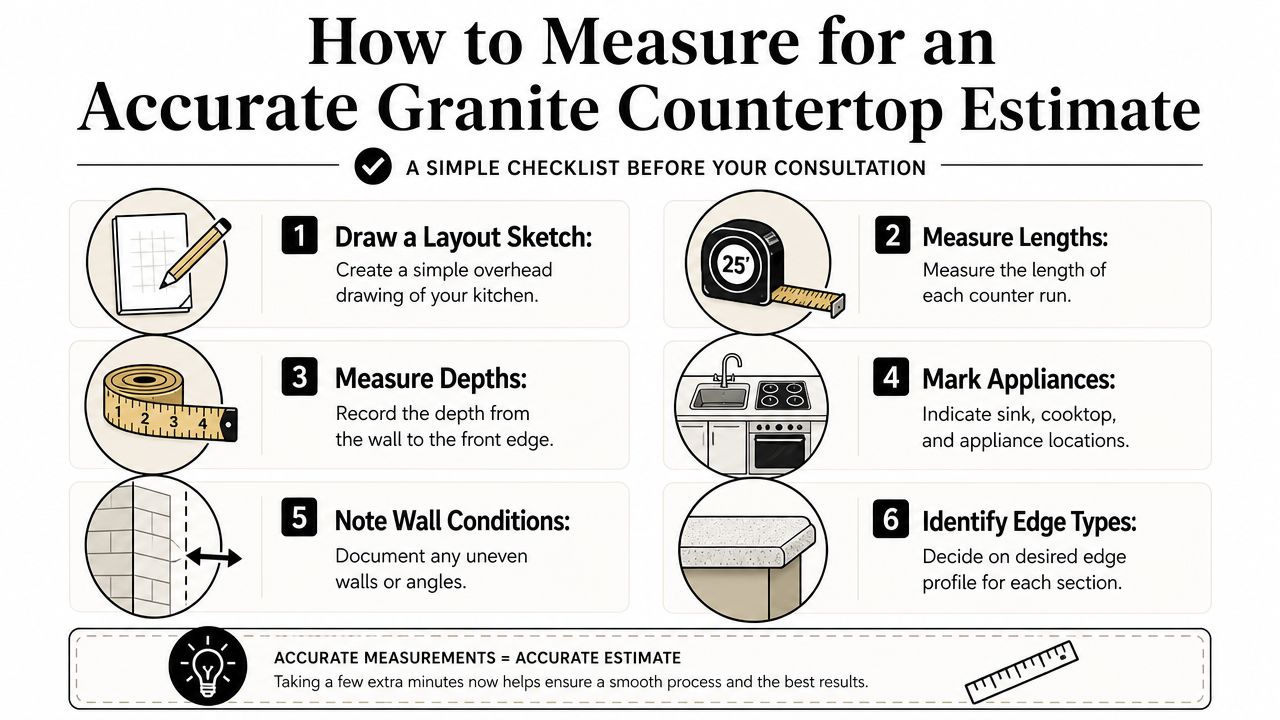
What to put on your sketch
Use a tape measure and draw the kitchen from above. Then include:
- Each counter run length. Measure wall to wall, or end to end, for every section.
- Counter depth. Measure from the wall to the front edge of the cabinet or planned countertop line.
- Sink and cooktop locations. Mark where cutouts will go.
- Peninsulas and islands. Show these separately so they don't get lost in the main perimeter drawing.
- Overhang areas. Breakfast bars and seating areas matter because they affect the final shape and support planning.
What homeowners usually miss
Walls aren't always straight. Corners aren't always square. Existing kitchens in South Jersey homes, especially older homes, can be full of small surprises.
Note any odd angles, bump-outs, window trim conflicts, or cabinet areas that look out of parallel. Also write down what kind of sink you want if you know it. Undermount and other sink configurations affect fabrication details.
Bring measurements for budgeting. Expect templating for precision.
If you're replacing an existing top and want a realistic sense of what comes next, this article on how to replace kitchen countertops is a solid companion read.
The Installation Process What to Expect
Most homeowners are less worried about the granite than they are about the disruption. That part is fair. Good installation should feel organized, not chaotic.
Here's the process in plain English. You choose the slab, the team templates the counters, the shop fabricates the pieces, and installation day handles removal, placement, seaming, sealing, cleanup, and a final walkthrough.
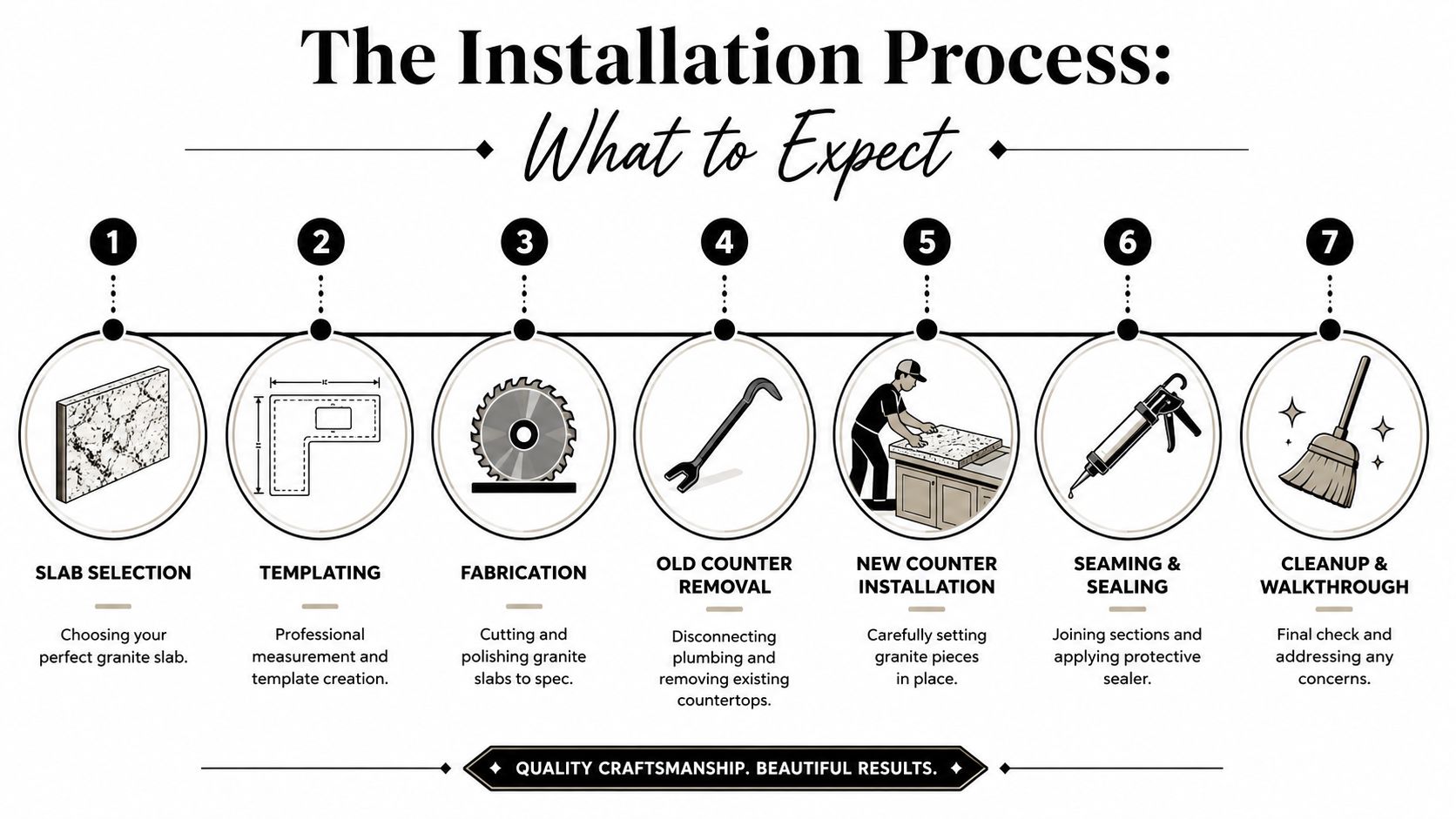
From slab choice to final walkthrough
Templating is where the job gets real. That's the point where actual field conditions replace assumptions, and the shop can finalize cutouts, seam placement, and finished dimensions.
On installation day, crews usually start with protecting nearby surfaces and removing the old tops if that's part of the scope. Then they dry-fit the granite, make sure sections sit correctly, join seams, and complete the finish work.
This walkthrough video gives a helpful visual sense of the process in motion.
The key is preparation. Clear the counters, empty nearby cabinets if requested, and assume your sink area may be temporarily out of service while plumbing gets reconnected.
Get a Precise Granite Quote with The Cabinet Coach
South Jersey granite quotes can swing fast when the details are vague. The difference between a rough ballpark and a usable number usually comes down to one thing. How well the kitchen has been defined before pricing starts.
At this stage, stop asking, “What's granite per square foot?” Ask for a quote built around your actual kitchen in Cherry Hill, Moorestown, Voorhees, or the next town over. That means cabinet layout, sink and cooktop locations, overhangs, edge profile, backsplash plan, demolition, and plumbing reconnects need to be part of the conversation from day one.
The Cabinet Coach handles that process in a way many homeowners prefer. Instead of choosing materials under showroom lighting and hoping they work at home, you review cabinets, countertops, hardware, and finishes in your own space. That makes the granite decision easier because you can see whether the slab works with your cabinet color, wall paint, floor tone, and natural light before you commit.
That local context matters.
A precise quote should break out the material, fabrication, edge treatment, cutouts, removal, and installation as separate line items. If those costs are lumped together, you cannot compare bids properly. If seam locations, sink type, or backsplash scope are missing, the quote is incomplete and the final invoice is more likely to climb.
My advice is simple. Get measured. Get specific. Then compare quotes line by line, not just by the bottom number.
If you're planning a kitchen remodel in South Jersey and want a granite quote that matches your actual layout, style, and budget, start with The Cabinet Coach. A clear consultation and measured estimate will tell you more than any generic square-foot number ever will.