
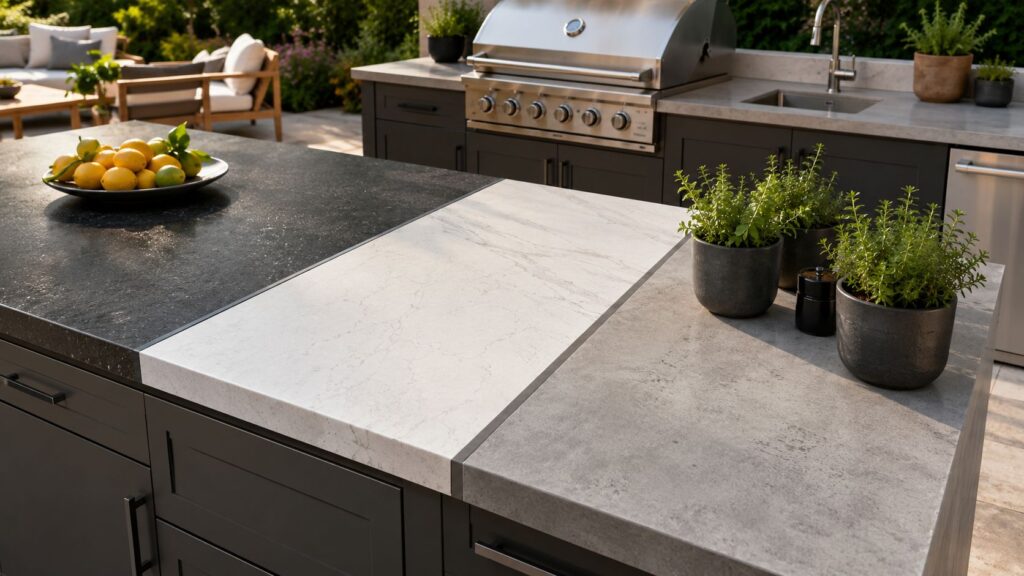
You're standing in the backyard, sketching out the space where the grill, sink, and prep zone will go, and the countertop is the part that decides whether the whole setup feels finished or feels temporary. In South Jersey, that choice matters even more because the surface has to handle humidity, freeze-thaw swings, and summer sun without becoming a maintenance headache. The best outdoor kitchen countertop ideas aren't just about looks, they're about picking a material that fits how you cook, how much you want to clean, and how exposed the space really is.
For homeowners comparing options now, the market leans hard toward stone and stone-like surfaces. One industry survey found natural stone used by 57% of homeowners, while quartz followed at 23%; it also showed that 66% of outdoor kitchens fall between 100 and 400 square feet, 22% exceed 400 square feet, and only 12% are under 100 square feet in size outdoor kitchens by the numbers. That scale matters because most real projects need long, continuous work surfaces, appliance cutouts, and outdoor detailing that won't fail when the weather turns.
The backlog of regrets tells the same story. That same survey found 12% of homeowners wished they had invested more in shelter or shade, 10% wanted a larger space, and 9% wished for better countertops outdoor kitchens by the numbers. If you're planning for a Cherry Hill, Haddonfield, or Moorestown backyard, the smartest move is choosing a countertop that looks great on day one and still makes sense after a few wet springs and hot summers. For a visual starting point, this ai generated backyard design can help you think through layout and finish combinations before you commit.
Table of Contents
- 1. Granite with Polished Finish – Traditional Elegance for High-Traffic Kitchen Islands
- 2. Quartzite with Leathered Finish – Modern Durability for Contemporary Outdoor Kitchens
- 3. Engineered Quartz with Brushed Metal Finish – Low-Maintenance Option for Busy Homeowners
- 4. Bluestone with Natural Cleft Finish – Rustic Charm for Mediterranean-Inspired Outdoor Kitchens
- 5. Soapstone with Honed Finish – Warm Vintage Character for Transitional Outdoor Kitchens
- 6. Stainless Steel with Brushed Finish – Commercial-Grade Durability for Chef-Inspired Kitchens
- 7. Recycled Glass with Resin Binder – Eco-Friendly Statement Surface for Sustainable Outdoor Kitchens
- 8. Concrete with Integral Color and Sealed Finish – Custom Design for Modern Industrial Kitchens
- 9. Porcelain Slab with Textured Matte Finish – Lightweight Alternative to Stone for Modern Outdoor Kitchens
- 10. Travertine with Tumbled Finish – Mediterranean Warmth for Resort-Style Outdoor Entertaining
- 10 Outdoor Kitchen Countertops Compared
- Ready to Design Your Outdoor Oasis?
1. Granite with Polished Finish – Traditional Elegance for High-Traffic Kitchen Islands
Granite is still the safest first call for a lot of outdoor kitchens because it balances classic style, real durability, and a wide range of slab looks. For South Jersey homeowners who want a surface that feels substantial on a larger island, polished granite works especially well on Cherry Hill and Haddonfield projects where the outdoor kitchen is meant to look like part of the house, not an afterthought.
Practical rule: if your countertop will sit in direct weather, the fabrication details matter as much as the stone itself.
That means paying attention to slope, edge profile, and sealing. A properly sloped top helps water move off the surface instead of sitting around seams or access panels, and a food-grade sealer helps the stone resist moisture during humid spells. In this climate, I also like lighter granite colors because they absorb less heat in direct sun, which makes the cook zone more comfortable in July and August.
A polished finish gives granite a reflective quality that can brighten a covered patio or a shaded yard. It also pairs easily with stainless appliances, brick veneer, and painted cabinet bases, which is why you see it so often in premium backyard installs across Cherry Hill estates and Moorestown renovations. The main trade-off is that polished stone can show water rings more readily than a honed or leathered surface, so coasters aren't just for indoor entertaining.
- Seal annually: South Jersey humidity can wear down protection faster than homeowners expect.
- Use coasters: bottled drinks and sweating glasses can leave marks on a polished finish.
- Avoid acidic spills: lemon juice and vinegar are better wiped up quickly.
- Choose light-to-mid tones: they usually feel cooler under strong afternoon sun.
Granite also connects well to the practical side of budgeting. If you want to understand how material choice affects install scope, the cabinet and countertop planning around granite countertop installation costs can be a useful reference point while you're comparing finishes and island sizes.
2. Quartzite with Leathered Finish – Modern Durability for Contemporary Outdoor Kitchens
Quartzite is the material I steer people toward when they want a more refined, current look without sacrificing toughness. The leathered finish softens the surface visually, cuts the glare, and gives the countertop a tactile quality that works well with minimalist outdoor cabinetry and modern stainless appliances in places like Mount Laurel and Voorhees.
What makes quartzite stand out outdoors is that it behaves like a serious natural stone, not a decorative compromise. It's a strong choice for homeowners who want the veining and depth of stone but need better outdoor performance than softer materials can offer. In a place like South Jersey, where summer sun and shoulder-season dampness both show up regularly, that kind of balance matters.
Quartzite tends to fit the homeowner who wants a “finished” look without constant babysitting.
That said, quartzite still deserves routine care. I'd still choose a lighter shade when the counter will sit in direct sun, and I'd still ask for samples to be viewed outside, not under showroom lighting. Contractors also need to know how to cut and seal quartzite correctly, because the stone's beauty depends on clean fabrication, not just the slab selection.
- Check samples outdoors: the finish reads differently in real sun than it does inside.
- Ask about sealing intervals: even durable natural stone benefits from ongoing maintenance.
- Use it with restraint near heat: leave enough distance from grills and smokers.
- Pair with clean-lined materials: quartzite looks strongest next to simple cabinet fronts.
A lot of homeowners compare quartzite with granite before making a decision, and that comparison is worth doing carefully. The material choice isn't only about price, it's about the look you want, the exposure your kitchen will get, and how much maintenance you're willing to own. A practical comparison like quartz versus granite countertops helps keep those trade-offs grounded.
3. Engineered Quartz with Brushed Metal Finish – Low-Maintenance Option for Busy Homeowners
Engineered quartz looks tempting because it delivers consistency. For busy families in Pennsauken, Delran, or Medford Township, that uniform color and pattern can feel like a relief when the rest of the backyard already has plenty of visual activity.
The brushed metal finish adds another layer of practicality. It softens the gloss, hides fingerprints better than a high-shine surface, and gives the island a contemporary feel that works in transitional homes. If your outdoor kitchen is covered, partially sheltered, or tucked under a pergola, quartz can be part of the conversation, but it should never be treated like a free pass for full weather exposure.
Keep quartz out of the hottest zone near the grill, and don't assume every product is meant for uncovered outdoor use.
That's the main trade-off. Quartz is valued for being easy to live with, but the resin in engineered products means heat and sun exposure have to be considered carefully. For South Jersey homeowners, that means asking very direct questions about where the kitchen sits, how much direct sunlight it gets, and whether the manufacturer allows outdoor installation in that exact condition.
A brushed quartz surface works best when the rest of the design is disciplined. Think weather-resistant cabinetry, simple hardware, and fewer visible seams. Darker brushed tones are also helpful because they tend to disguise dust and the small marks that show up after a long season of barbecues and casual entertaining.
If you're still sorting through broad countertop categories, the best starting point is usually the planning stage, not the finish choice. A practical guide like how to choose kitchen countertops can help clarify where quartz fits, and where a different surface is the safer long-term call.
4. Bluestone with Natural Cleft Finish – Rustic Charm for Mediterranean-Inspired Outdoor Kitchens
Bluestone is one of the most regionally fitting outdoor kitchen countertop ideas for South Jersey because it already feels at home here. It's a natural fit for Haddonfield courtyards, Cherry Hill patios, and transitional outdoor rooms where the owner wants something grounded, regional, and a little less expected than imported stone.
The natural cleft finish preserves the quarried texture, so the surface reads as authentic rather than overly refined. That matters if you're trying to create a Mediterranean or cottage-inspired space where the countertop should blend into the hardscape instead of looking showroom-perfect. Bluestone also pairs beautifully with clay pavers, textured stucco, and planted edges, which can make the whole yard feel more settled and cohesive.
This is also where local sourcing becomes part of the appeal. Bluestone carries a regional identity that homeowners often like when they want materials with a sense of place. It feels less generic than a standard catalog stone, and it can connect visually to walkways, wall caps, and seating areas around the rest of the property.
The weak point isn't style, it's maintenance discipline.
Bluestone needs thoughtful sealing and good drainage, especially in humid weather. If water sits on a porous surface or around poorly detailed seams, the finish can start to age faster than the rest of the kitchen. I also prefer thicker pieces for outdoor installations because they feel more substantial and handle the everyday wear of plates, trays, and casual prep more gracefully.
When used well, bluestone doesn't shout. It settles the space. That's exactly why it works in South Jersey yards that need one material to tie together the kitchen, patio, and landscaping without making the outdoor room feel overdesigned.
5. Soapstone with Honed Finish – Warm Vintage Character for Transitional Outdoor Kitchens
Soapstone brings a softer mood to the outdoor kitchen, which is why it works so well in transitional projects. In Haddonfield and Collingswood, I see it make sense for homeowners who want warmth and character, but don't want a countertop that feels formal or fussy.
The honed finish keeps the look matte and approachable. Soapstone also develops a patina over time, and that aging process is part of its appeal rather than a flaw to be corrected. If you're the kind of homeowner who prefers surfaces that evolve naturally instead of staying frozen in showroom condition, soapstone can be very satisfying.
Its strength is emotional as much as visual. Soapstone feels calm, and it pairs especially well with warm woods, vintage-inspired lighting, and cabinetry that doesn't need a lot of shine to make the kitchen feel finished. That makes it a good match for artisan-style outdoor entertaining spaces in Cherry Hill where the goal is comfort, not flash.
A few practical points matter here. Soapstone is softer than granite or quartzite, so I wouldn't place it too close to an active grill zone where heat and rough use can take a toll. Some homeowners like to oil it periodically for a deeper tone, while others prefer to let the patina happen naturally. Both approaches are valid, but the key is to accept that soapstone lives differently than harder stone.
- Expect character changes: small scratches and subtle wear are part of the material.
- Use it in gentler zones: prep, serving, or bar seating areas are often the best fit.
- Pair it with soft textures: wood and matte cabinetry suit it better than high gloss.
- Treat the finish as living: the surface improves visually as it settles into the space.
Soapstone isn't for everyone, but for the right homeowner it delivers warmth that polished stone can't match. That's especially valuable in outdoor rooms where the kitchen should feel like a place you want to linger, not just cook.
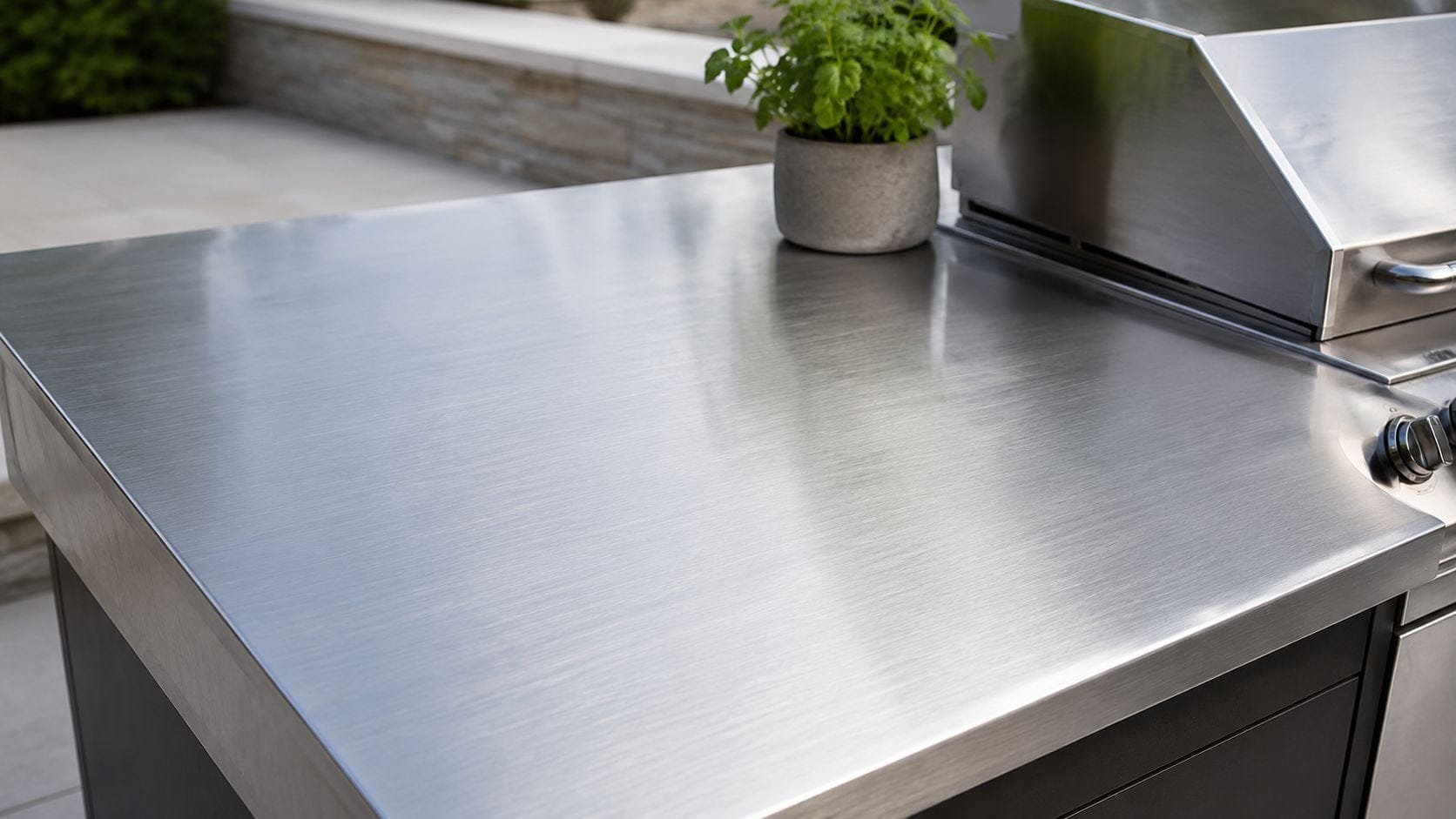
6. Stainless Steel with Brushed Finish – Commercial-Grade Durability for Chef-Inspired Kitchens
Stainless steel is the most direct way to give an outdoor kitchen a professional, chef-inspired feel. In Moorestown, Mount Laurel, and other South Jersey neighborhoods where homeowners want the prep area to work hard, a brushed stainless countertop can make the whole space feel serious without being overly ornate.
The biggest advantage is obvious. Stainless is built for activity, so it suits grilling stations, heavy prep zones, and outdoor layouts where food handling happens constantly. The brushed finish is especially helpful because it softens reflections and hides the small marks that come with daily use.
For a humid, coastal-influenced region, material grade matters. I'd want a contractor to specify Grade 316 stainless in this climate because the surface is better aligned with long-term outdoor exposure than a generic indoor-grade product. Welded seams and professional finishing are also critical, because this is one of those materials where sloppy fabrication shows up quickly.
Stainless feels strongest in shaded or covered areas, where the surface can stay more comfortable to use.
That heat issue matters more than people expect. A bare stainless top in direct sun can become uncomfortably warm, so I usually prefer it under a roof extension, pergola, or another partially covered condition. It also helps to treat the counter like a real cooking surface, not a cutting board. Use boards, keep up with cleaning, and don't expect it to hide abuse.
This material fits best when the rest of the kitchen stays crisp and simple. Modern appliances, flat-front cabinetry, and a restrained palette keep the look intentional. If you want utility first, with a strong visual payoff, stainless does that better than most materials.
7. Recycled Glass with Resin Binder – Eco-Friendly Statement Surface for Sustainable Outdoor Kitchens
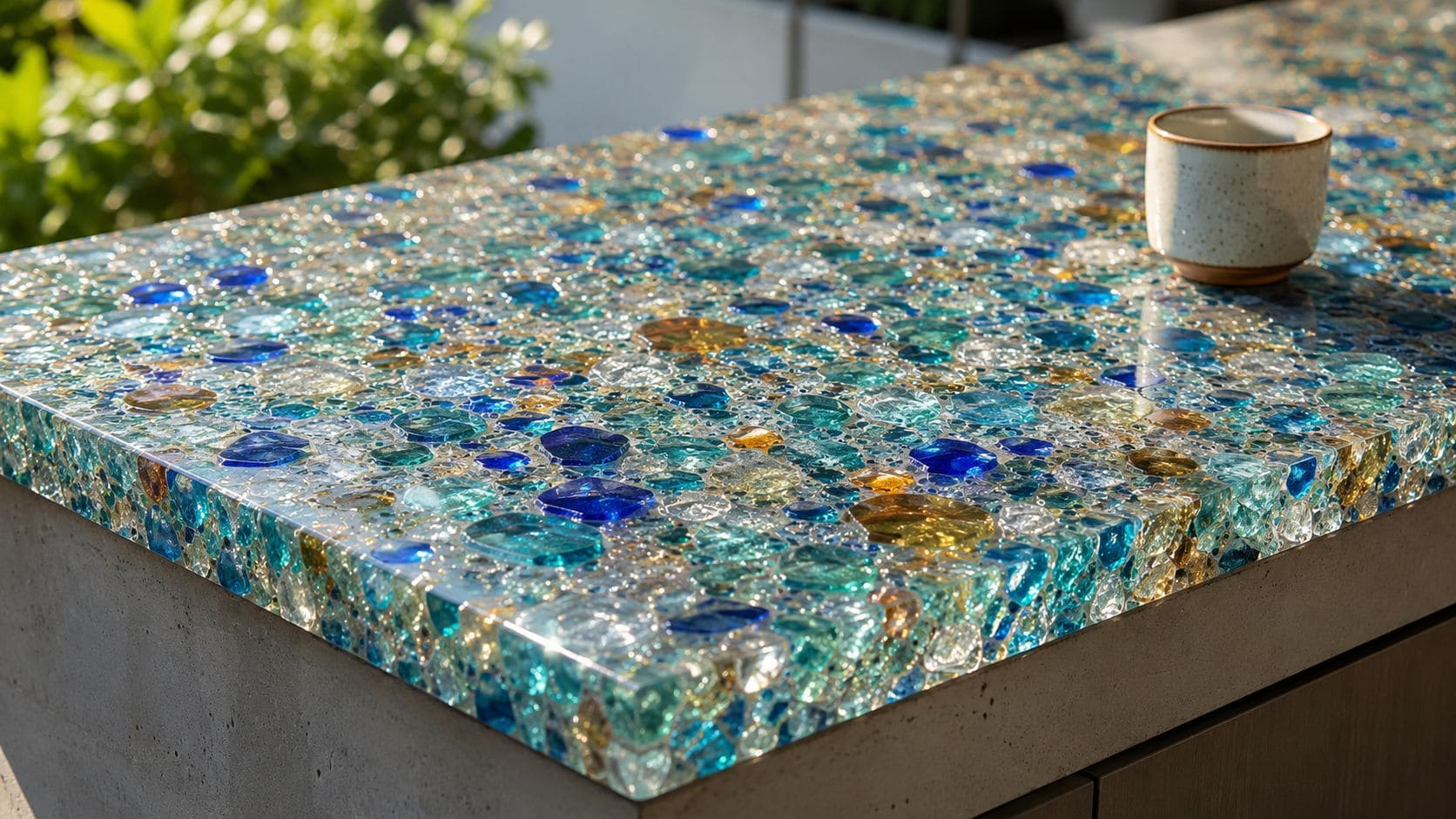
Recycled glass countertops are for homeowners who want the surface to say something. The color fragments, the movement in the slab, and the way the glass catches light all give the kitchen a more custom feel than a standard stone selection. In Burlington County and other parts of South Jersey where sustainability is part of the conversation, that can be a compelling reason to consider it.
This isn't the quietest option, and that's the point. Recycled glass works best when the outdoor kitchen is meant to feel distinctive, maybe even a little artistic. It pairs well with reclaimed wood, recycled materials, and simple cabinet forms that let the surface do the talking.
The caution is exposure. Resin-based products need smart placement, so I'd keep the counter away from the most intense direct sun when possible. Darker glass blends usually wear more gracefully outdoors, and a UV-aware protective finish helps the surface hold up better over time.
A practical installation approach makes a big difference here.
- Choose placement carefully: covered or partial-shade zones are friendlier to resin-based surfaces.
- Prefer darker mixes: they can disguise aging more easily than pale, high-contrast blends.
- Clean gently: abrasive pads can dull the finish and reduce clarity.
- Coordinate the palette: the rest of the kitchen should support the statement surface, not compete with it.
This is a good choice for homeowners who care about design narrative. If the rest of the backyard already uses reclaimed or low-waste materials, a recycled glass top reinforces that intention in a way guests can see immediately. It's not the most conservative pick, but it can be one of the most memorable.
8. Concrete with Integral Color and Sealed Finish – Custom Design for Modern Industrial Kitchens
Concrete is the most flexible option on this list for homeowners who want something custom. In Collingswood and Cherry Hill, it fits well in modern industrial outdoor kitchens where the finish needs to feel made for the house rather than selected from a standard slab catalog.
The appeal of concrete is obvious. You can shape it, color it, texture it, and detail it in ways that make the countertop feel personal. For design-forward homeowners, that opens the door to embedded patterns or a finish that matches the patio and hardscape more closely than stone ever could.
The trade-off is upkeep and discipline. Outdoor concrete needs proper sealing, careful slope, and an experienced fabricator who understands how the material behaves outside. In a humid South Jersey climate, that means planning for maintenance rather than hoping the surface will take care of itself.
Concrete is strongest when the owner accepts patina instead of fighting it.
That's the mindset shift. Concrete can develop character over time, and some homeowners love that while others find it frustrating. If you want a surface that looks pristine forever, this probably isn't your best match. If you want a one-of-a-kind outdoor top that can handle a strong design concept, it's worth serious consideration.
For budget planning, it helps to understand that custom concrete varies a lot based on detailing and finish work. A useful starting point is concrete countertop installation cost, especially if you're comparing concrete against stone or porcelain for a large outdoor island.
9. Porcelain Slab with Textured Matte Finish – Lightweight Alternative to Stone for Modern Outdoor Kitchens
Porcelain slab is one of the strongest answers to the modern outdoor kitchen question because it combines a clean look with low-maintenance performance. It's also a good fit for South Jersey homeowners who want the appearance of stone without the same level of upkeep.
The textured matte finish helps in two ways. It softens glare in bright sunlight, and it adds grip that feels more practical around food prep and serving zones. Large-format porcelain also reduces visible grout lines, which is a major advantage if you want the countertop to read as one continuous surface instead of a patchwork of joints.
Practicality and design line up here. Porcelain suits contemporary homes in Mount Laurel, Voorhees, and luxury Cherry Hill properties because it delivers a sleek look without asking much back from the homeowner. If you want a material that handles outdoor use with less worry, porcelain is one of the most convincing choices on the market.
The critical part is installation. Porcelain needs contractors who know how to handle large slabs, support them correctly, and keep the detailing clean. The surface itself can be very forgiving, but the fabrication has to be precise or the end result will look underwhelming.
If you're still narrowing the field, a broader overview of different types of countertops can help you compare porcelain with the rest of the category before you settle on a final direction.
10. Travertine with Tumbled Finish – Mediterranean Warmth for Resort-Style Outdoor Entertaining
Travertine brings warmth in a way few other materials can. The tumbled finish softens the edges and gives the surface a lived-in, resort-like feel that works beautifully in Mediterranean-inspired yards throughout South Jersey.
This is the countertop choice for a homeowner who wants the outdoor kitchen to feel relaxed. In Cherry Hill and Haddonfield estates, travertine can make the patio read more like a vacation setting than a hardscape project, especially when it's paired with clay pavers, warm wood cabinetry, and casual seating.
The trade-off is porosity. Travertine needs more attention than denser stone, especially in a humid climate where moisture can get into the surface more easily. Coasters, prompt spill cleanup, and regular sealing are part of the deal, not optional extras.
If you want travertine outdoors, plan for maintenance the way you'd plan for furniture covers or grill care.
That's the honest version. The material is beautiful, but it rewards owners who don't mind staying ahead of wear. You can also fill the natural holes for a more uniform look, though some homeowners prefer to leave the stone untouched because the texture is part of the charm.
Travertine works best when the whole space leans warm and casual. It's not the most technical option, and it's not the lowest-maintenance one, but it can be the most inviting. For South Jersey homeowners building a backyard that feels like a retreat, that counts for a lot.
10 Outdoor Kitchen Countertops Compared
| Item (Material · Finish) | Implementation Complexity 🔄 | Resource Requirements 💡 | Expected Outcomes 📊 | Ideal Use Cases | Key Advantages ⭐⚡ |
|---|---|---|---|---|---|
| Granite, Polished (Natural Granite) | High: heavy slabs, professional install, occasional structural reinforcement | $$ ($40–$100+/ft²); reseal every 1–3 yrs | Very durable (25+ yrs); elegant appearance; potential staining if unsealed | Outdoor islands, main cooking surfaces, high-traffic prep | Timeless aesthetic; heat & scratch resistant; adds resale value ⭐⭐⭐⭐ |
| Quartzite, Leathered (Natural Quartzite) | High: specialist fabrication; difficult repairs | $$ ($50–$120+/ft²); minimal sealing (2–3 yrs) | Superior durability (30+ yrs); UV-stable; low visible wear | Weather-exposed prep surfaces, contemporary outdoor kitchens | Exceptional durability; hides spots; modern matte look ⭐⭐⭐⭐⭐ |
| Engineered Quartz, Brushed Metal (Quartz composite) | Moderate: easier templating, needs experienced installer | $ ($30–$70/ft²); factory sealed, no routine sealing | Durable (20–25 yrs); consistent appearance; less heat tolerant | Busy homeowners, bar areas, low-maintenance counters | Virtually maintenance-free; wide color palette; hygienic ⚡⭐⭐⭐ |
| Bluestone, Natural Cleft (Sedimentary flagstone) | Moderate–High: variable thickness, skilled install for even surface | $ ($30–$60/ft²); annual sealing recommended | Moderate durability; rustic, slip-resistant surface | Mediterranean/cottage-style outdoor kitchens, wet zones | Locally sourced; strong slip resistance; distinctive character ⭐⭐⭐ |
| Soapstone, Honed (Metamorphic) | Moderate: specialty installers; embraces patina and repairability | $$ ($70–$150+/ft²); no chemical sealing required (optional oiling) | Develops patina over 12–18 months; repairable but softer | Pastry/prep surfaces, vintage/transitional settings | Natural stain resistance (no sealants); resurfacing possible; warm look ⭐⭐⭐ |
| Stainless Steel, Brushed (Grade 304/316) | High: precision welding for seams; pro installation critical | $$ ($50–$100+/ft²); minimal consumables (cleaners) | Very durable & hygienic (25+ yrs); conductive to heat | Chef-inspired active cooking zones, coastal/humid climates | Truly maintenance-free (no sealing); hygienic; heat resistant ⭐⭐⭐⭐⚡ |
| Recycled Glass, Resin Binder (Polished/Semi-polished) | Moderate: specialized fab; UV protection needed for outdoors | $$ ($50–$150+/ft²); reseal 1–2 yrs; UV sealer advisable | Distinctive, durable (15–20 yrs); potential resin yellowing with sun | Bar accents, statement countertops, sustainable builds | Highly sustainable; visually striking; customizable patterns ⭐⭐⭐ |
| Concrete, Integral Color (Sealed) | High: artisan craftsmanship; risk of cracking; precise sealing | $–$$ ($40–$80/ft²); frequent sealing (quarterly recommended outdoors) | Custom, one-of-a-kind surfaces (15–20 yrs when well maintained) | Industrial/modern custom designs, artistic installations | Unlimited customization; can embed elements; modern aesthetic ⭐⭐⭐ |
| Porcelain Slab, Textured Matte (Engineered porcelain) | Moderate–High: large-format handling; specialized installers | $$ ($60–$100+/ft²); no sealing required ever | Extremely durable (50+ yrs); non-porous; UV-stable; zero maintenance | Contemporary, low-maintenance outdoor kitchens, seamless installs | True zero maintenance; lightweight vs. stone; long lifespan ⭐⭐⭐⭐⭐⚡ |
| Travertine, Tumbled (Natural Travertine) | Moderate: careful installation, hole-filling optional | $–$ ($25–$50/ft²); sealing 2–3×/yr; frequent upkeep | Warm, resort-like aesthetic; moderate durability | Resort-style entertaining, warm Mediterranean outdoor spaces | Inviting warmth and texture; slip-resistant tumbled finish ⭐⭐⭐ |
Ready to Design Your Outdoor Oasis?
Selecting the right outdoor kitchen countertop is a balance of aesthetics, budget, and performance. In South Jersey, that balance gets sharper because humidity, freeze-thaw cycles, and strong summer sun all put stress on the finish, the seams, and the details around the slab. A material that looks perfect in a showroom can behave very differently once it's living outside in Cherry Hill, Haddonfield, or anywhere across Camden and Burlington counties.
If you want the most traditional route, granite still offers broad appeal and reliable outdoor performance. If you want a cleaner, more modern look, quartzite and porcelain are compelling for homeowners who care about long-term practicality. For a more regional or custom feel, Bluestone, concrete, and travertine each bring a strong design point of view, while stainless steel and recycled glass can push the kitchen toward chef-driven or sustainability-minded territory.
The smartest decision usually comes down to three questions. How exposed is the space, how much maintenance are you willing to own, and what kind of atmosphere do you want the backyard to create? If those answers are clear, the right countertop choice gets much easier.
Feeling inspired but still unsure where to start? Book a complimentary consultation with The Cabinet Coach, and our mobile showroom can visit you in Cherry Hill, Haddonfield, or anywhere in Camden and Burlington counties to help you narrow down materials, finishes, and layout details that fit your outdoor kitchen goals. For more layout inspiration, this guide to outdoor kitchen layout ideas for 2026 can help you think through how the counter should work with the rest of the space.
The Cabinet Coach helps South Jersey homeowners compare outdoor kitchen countertop materials, cabinetry, and finish details in a way that fits both the house and the climate. If you're planning a backyard project and want design guidance that comes to you, visit The Cabinet Coach to start your consultation and see how the right surface can shape the whole outdoor kitchen.