
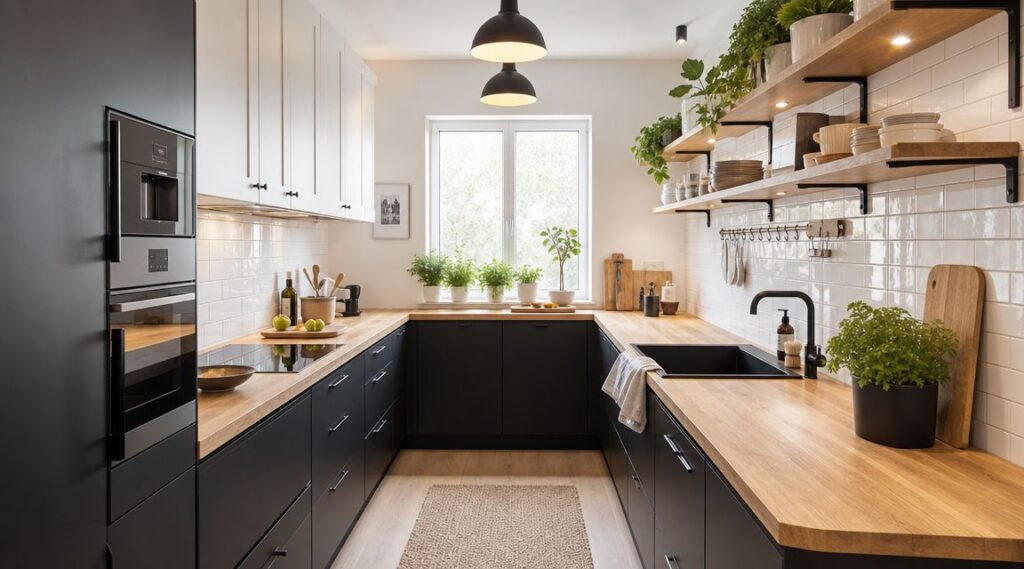
You're probably staring at saved photos of dramatic black kitchens and thinking the same thing most South Jersey homeowners think at this point: I love the look, but my kitchen is too small to pull it off.
That concern is reasonable. In a tight galley, a condo kitchen, or an older home with limited daylight, black cabinets can either look polished and intentional or feel heavy fast. The difference usually isn't the color itself. It's the way the room handles light, contrast, storage, and daily wear.
The other question people ask a little later is the one that matters just as much: Will I be wiping these cabinets down all the time? That's where many inspiration posts stop short. A black kitchen that looks good on day one still has to survive fingerprints, cooking film, dust, and rushed weekday mornings.
Table of Contents
- Embracing the Bold Why Black Cabinets Work in Small Kitchens
- Mastering Light and Contrast to Maximize Space
- Smart Layouts and Storage for a Clutter-Free Look
- Choosing the Right Cabinet Finishes and Hardware
- Inspiration From Real Small Kitchen Transformations
- Start Your South Jersey Kitchen Project with Confidence
Embracing the Bold Why Black Cabinets Work in Small Kitchens
A lot of homeowners come in with a split decision already forming. They want the richness of black cabinetry, but they're afraid their kitchen will feel boxed in. In practice, that fear usually comes from seeing dark kitchens done without balance, not from the color black itself.
Black cabinets can make a small kitchen feel focused, well-composed, and more deliberate. Instead of trying to make every compact kitchen look bigger at all costs, a well-designed dark kitchen can lean into a more refined, jewel-box feel. That's often a better outcome than a bright kitchen that still feels visually chaotic.
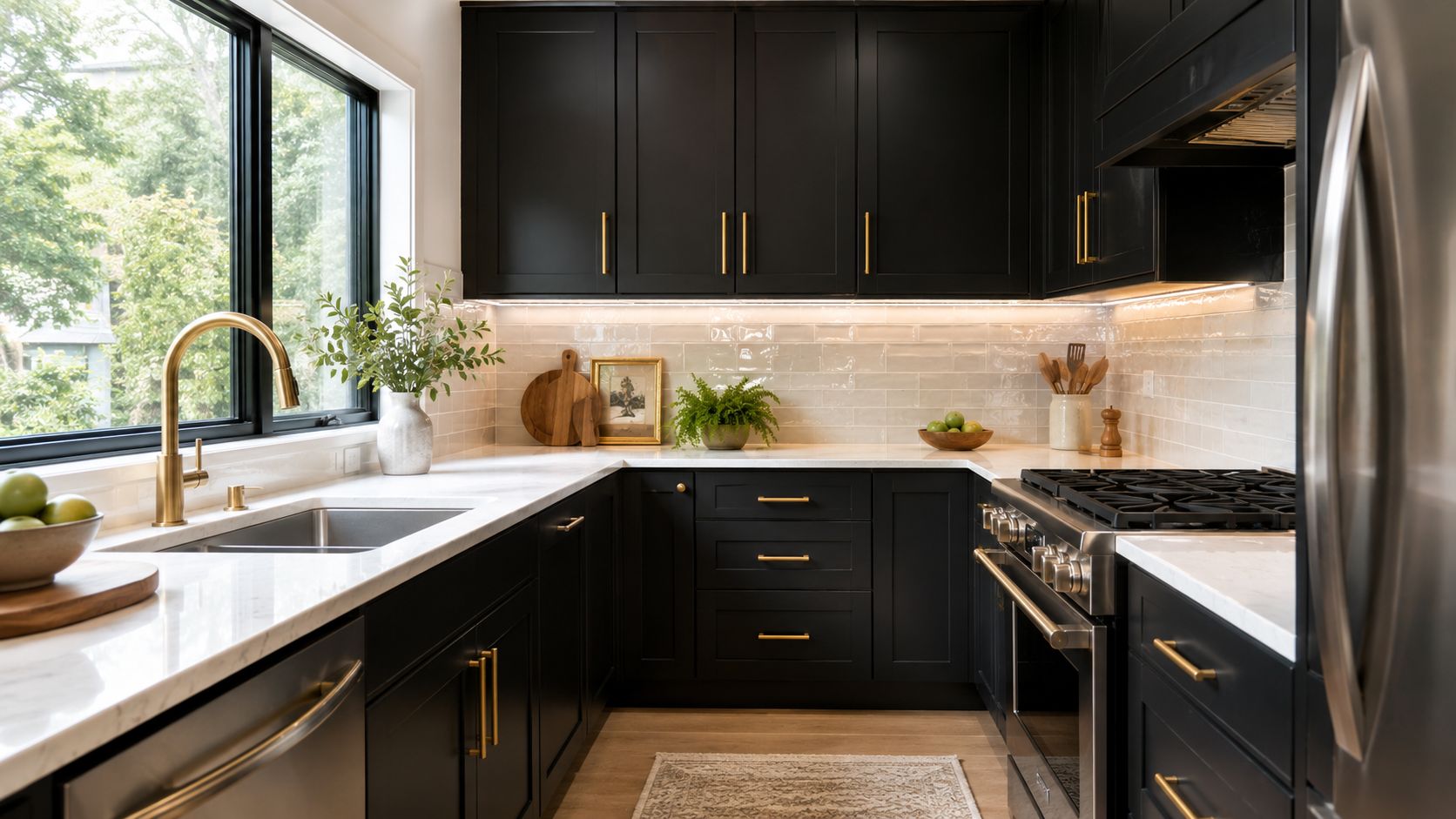
Where black works best first
The smartest first move in a small kitchen usually isn't going all black from floor to ceiling. Design guidance tied to the modern-kitchen trend that accelerated in the 2010s increasingly recommends using black on lower cabinets only or on an island while keeping upper cabinets lighter, because that preserves openness while still giving you the black-cabinet look, as noted by Demetra Cabinetry's discussion of why black kitchen cabinets are in style.
That approach works especially well in South Jersey homes where kitchens often connect directly to dining spaces, mudrooms, or family rooms. The dark base grounds the room. The lighter upper half keeps the sightline from feeling top-heavy.
A few combinations tend to feel more natural than others:
- Black base cabinets with white uppers: Clean, familiar, and easy to live with.
- Black perimeter lowers with a wood or painted island: Strong contrast without too much visual weight.
- Black island only: Good for homeowners who want the look but aren't ready to commit across the full room.
Practical rule: If you're nervous about black, start where the eye expects visual weight to sit anyway, below the countertop.
Why the look feels current
Black cabinetry didn't appear out of nowhere. It rose with the broader move toward modern kitchens, sharper contrast, and more intentional material pairings. That's why black still feels current when it's handled well. It reads less like a trend gimmick and more like a design choice with structure behind it.
The details around it matter. A black cabinet kitchen almost always looks stronger when the surrounding finishes help carry the contrast. If you're sorting through backsplash ideas, these white tile and black grout ideas are worth reviewing because they show how pattern and definition can support the cabinet color without making the room feel busy.
If you want a clearer sense of how this palette can come together, it also helps to look at black white and gray kitchen combinations that use contrast in a controlled way.
Mastering Light and Contrast to Maximize Space
Dark cabinets don't automatically shrink a room. Poorly managed light does. Black absorbs more light, so the kitchen has to be designed to put that light back into the space with intention. When that happens, black kitchen cabinets in a small kitchen can feel crisp and dimensional instead of dim.
Independent remodeling guidance recommends black cabinets in small kitchens when the design balances the dark finish with light-colored walls, light countertops, and strong light. The same guidance notes that glossy black finishes can bounce light back into the room, especially when paired with reflective surfaces and bright task lighting, as explained in Kitchen Magic's article on whether a small kitchen can look good with black cabinets.
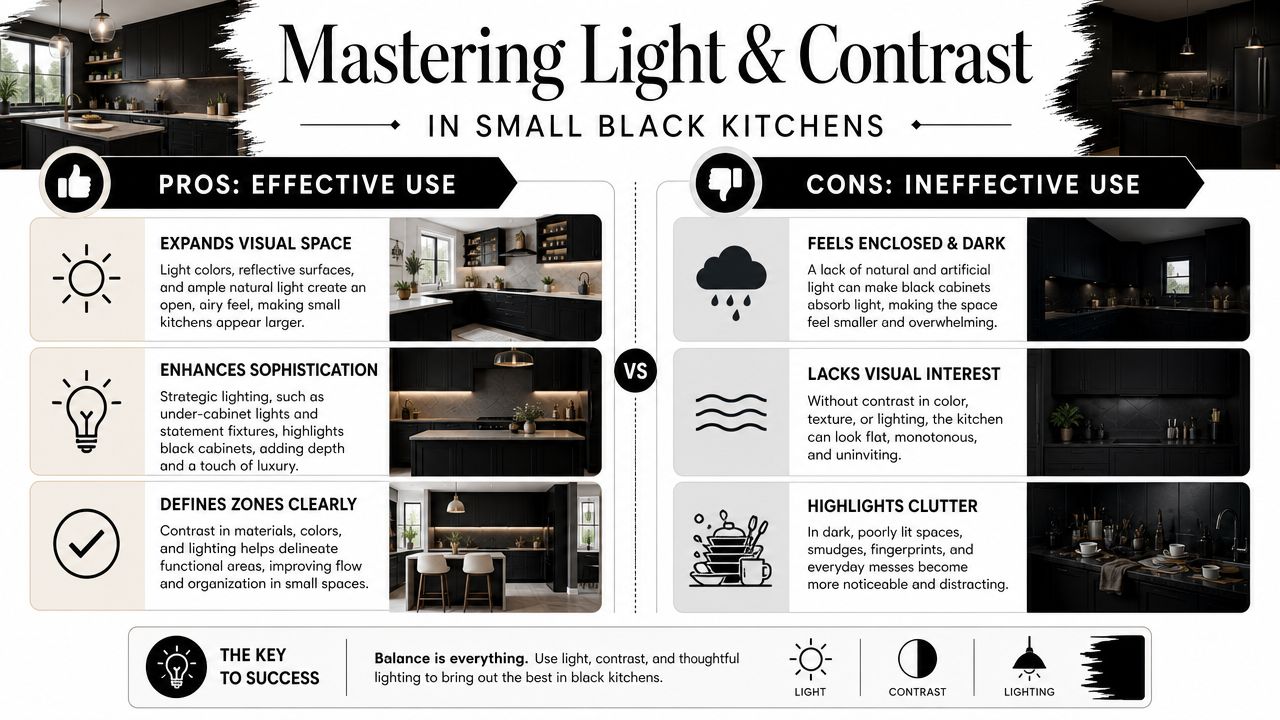
Use three layers of light
Most small kitchens with black cabinets need more than one ceiling fixture and hope. Light needs to come from different heights and directions.
Ambient light
This is your overall room lighting. Recessed cans, a flush mount, or a well-placed surface fixture should give even coverage so corners don't disappear.Task light
Under-cabinet lighting does a lot of heavy lifting in black kitchens. It brightens the countertop, sharpens the backsplash, and keeps the lower half of the room from feeling like one dark block.Accent light
Pendants over a peninsula or island, cabinet interior lighting behind glass, or a focused sconce can add depth. In a compact room, these touches help the kitchen feel designed rather than merely illuminated.
A practical trick is to wash light across the backsplash and wall surface, not just down onto the floor. That keeps the perimeter visually active and helps the walls recede.
Keep contrast clean, not choppy
The second part of the equation is contrast control. The room needs enough light material to balance the black, but not so many competing finishes that the kitchen starts to feel restless.
A compact black kitchen tends to work better when you keep these choices tight:
| Element | Usually works well | Usually creates problems |
|---|---|---|
| Countertops | White quartz, soft off-white stone look, light wood tone | Very dark counters that disappear into black cabinets |
| Backsplash | Glossy white tile, light reflective surface, simple pattern | Busy multicolor tile with strong contrast shifts |
| Wall color | Light neutrals that hold brightness | Mid-tone muddy paint that dulls the room |
| Visual flow | Repeating a few finishes consistently | Too many breaks between cabinet, counter, tile, and paint |
Black cabinets need a supporting cast. If every surrounding finish also asks for attention, the room gets smaller visually.
Window treatments matter more than homeowners expect. If the kitchen gets decent daylight, heavy fabric can undo the effect quickly. Looking at blinds and shades for kitchens can help you choose a treatment that preserves light while still giving privacy.
For homeowners trying to decide whether black is the right cabinet color at all, a broader review of how to choose kitchen cabinet colors is useful before you commit to samples.
What usually goes wrong
The failed version of this look is pretty consistent. It usually includes dark cabinets, dark counters, limited under-cabinet lighting, and a backsplash that introduces another strong pattern or color break. None of those choices is fatal on its own. Together, they compress the room.
The successful version is simpler. Light surfaces where light matters most. Reflective finishes where they help. A clear plan for how the eye moves through the room.
Smart Layouts and Storage for a Clutter-Free Look
Even the best cabinet color can't rescue a cramped kitchen that's full of visual noise. In small spaces, clutter reads before color does. With black cabinets, that matters even more because the room looks strongest when the lines stay clean.
Design guidance for compact kitchens advises that black cabinets work best when the layout preserves brightness and contrast control, and it specifically recommends pairing them with light countertops and minimal color breaks to keep sightlines continuous and avoid the busy effect that makes small rooms feel tighter, as discussed in Kitchen Cabinet Depot's guidance on whether black kitchen cabinets are a good idea.
Layout choices that help black cabinets breathe
In a galley kitchen, the biggest mistake is overloading both walls with upper cabinets. If storage allows, one side can sometimes shift to open wall space, a shorter run of uppers, or a focal point like a vent hood wall. That gives the eye a place to rest.
In an L-shaped kitchen, the corner usually determines whether the room feels usable or frustrating. Better corner access and uninterrupted countertop runs do more for daily function than adding one more small cabinet box.
A few layout moves usually pay off:
- Run cabinetry higher: Taller cabinetry uses vertical space better and cuts down on dust-catching dead zones above cabinets.
- Choose drawers for lowers: Deep drawers make pots, mixing bowls, and pantry items easier to reach than standard base cabinets with one shelf.
- Protect walkway width: If an island or peninsula makes movement awkward, it's not worth forcing into a small footprint.
- Simplify the finish palette: Repeating the same countertop and backsplash materials helps the room feel longer and calmer.
Storage that improves the look and the function
Good storage isn't just about capacity. It protects the visual effect of black cabinetry by keeping counters open and reducing random objects in view.
Consider prioritizing:
- Full-height pantry storage: One organized pantry cabinet often works harder than several scattered upper cabinets.
- Drawer organizers: Cutlery, utensils, wraps, and cooking tools stay contained instead of migrating to the counter.
- Tray dividers: Baking sheets and cutting boards store vertically and stop creating pileups.
- Corner solutions: Pull-out or rotating inserts make hard-to-reach corners more usable.
- Appliance planning: If the toaster, coffee setup, and blender all need permanent landing spots, account for that before finalizing the cabinet plan.
If you're gathering ideas before a remodel, these clever small kitchen storage concepts are a useful starting point because they connect storage decisions to actual space limits.
A lot of homeowners also underestimate how important lower-cabinet organization becomes once they choose darker cabinetry. Clean interiors make the exterior design easier to maintain. If you want practical options, this guide on how to organize deep kitchen cabinets is a helpful reference.
A black kitchen usually looks more expensive when there's less on display.
Choosing the Right Cabinet Finishes and Hardware
This is where the pretty photo and the lived-in kitchen start to separate. Black is not one finish. Matte black, satin black, textured black, and glossy black all behave differently once the kitchen is in use.
That difference matters in a small kitchen because the cabinet surface does two jobs at once. It shapes the style of the room, and it determines how much everyday evidence of life shows up on the doors and drawers.
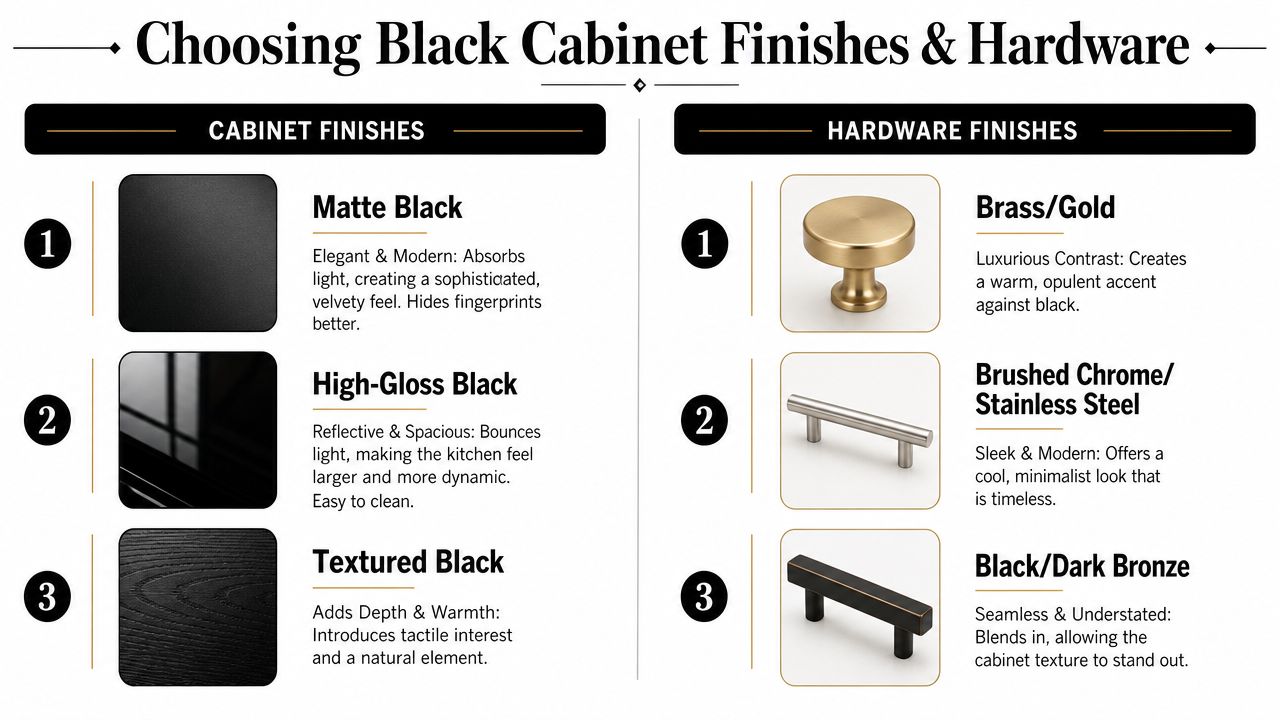
Matte versus glossy in real life
Independent coverage notes that black cabinets can show fingerprints, smudges, and dust more readily, especially on glossy finishes. The same guidance highlights the key trade-off homeowners need to understand: matte black may hide fingerprints better, while glossy black bounces more light and can make a small room feel more open, as covered in Kitchen Cabinet Depot's look at the pros and cons of black kitchen cabinets.
That's the decision point. You're not choosing the “right” black. You're choosing the black that suits your kitchen and your household.
| Finish | Visual effect | Daily livability | Best fit |
|---|---|---|---|
| Matte black | Soft, grounded, velvety | More forgiving with touch marks | Busy households, family kitchens, lower-maintenance goals |
| Satin black | Balanced, understated sheen | Easier to wipe than flat finishes | Transitional kitchens, mixed lighting conditions |
| Glossy black | Reflective, sharp, modern | Shows smudges more readily | Small kitchens that need help bouncing light |
Match the finish to how you live
A couple with a calmer household and a strong cleaning routine may love a glossy slab-front black cabinet. A family kitchen with constant traffic often benefits from a matte or lightly textured finish that doesn't advertise every touch.
Ask yourself these questions before finalizing samples:
- Who uses the kitchen most often: Adults only, kids, guests, tenants, or everyone.
- How much daylight you get: Limited natural light pushes more homeowners toward finishes that help with reflection.
- How often you cook: Heavy daily use means more contact, steam, oil film, and cleanup.
- How design-forward you want the room to feel: Gloss pushes modern harder. Matte tends to feel quieter and more architectural.
Don't choose a cabinet finish from a mood photo alone. Choose it from your cleaning tolerance.
Hardware changes the whole read
Hardware is where black cabinets can shift from stark to warm, from modern to classic, or from dramatic to subtle.
Here's the quick read:
- Brass or warm gold: Adds contrast and softens black immediately.
- Brushed nickel or stainless: Keeps the kitchen crisp and straightforward.
- Black hardware: Creates a low-contrast, more integrated look, especially on flat-panel doors.
- Dark bronze: Warmer and a little richer than standard black hardware.
In small kitchens, oversized pulls can overpower the cabinet face. Slim bar pulls, modest knobs, or integrated pulls often look cleaner. The right choice depends on door style, appliance finish, and how much visual punctuation you want.
If you're comparing options, this roundup of kitchen cabinet hardware trends can help narrow down what fits your cabinet style without overcomplicating the mix.
Inspiration From Real Small Kitchen Transformations
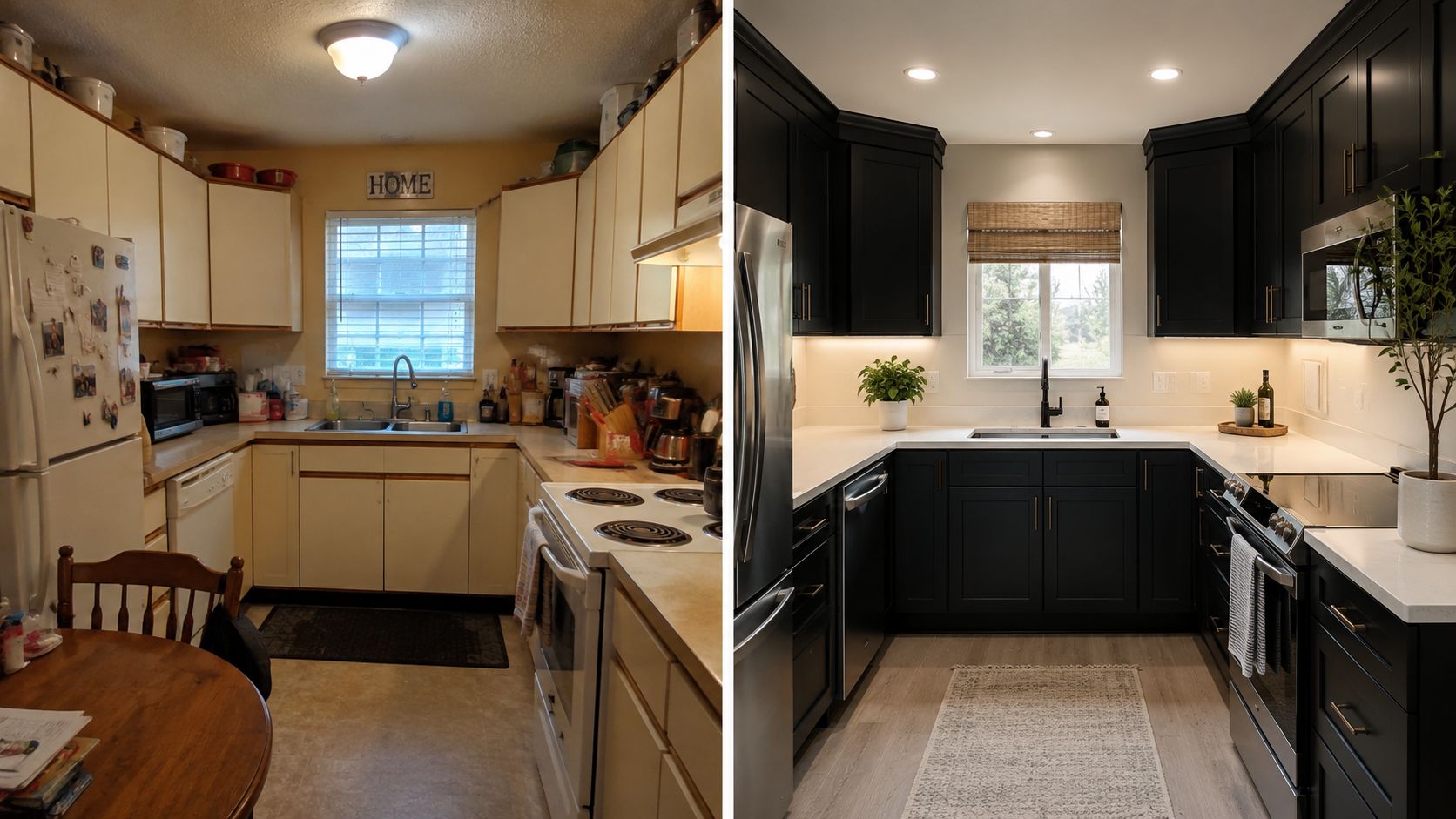
The easiest way to judge black kitchen cabinets in a small kitchen is to stop thinking about the color in isolation and look at how it behaves in specific room types.
The narrow rowhome galley
One common setup in older South Jersey homes is a long, narrow galley with one modest window and too many upper cabinets. In that layout, full black cabinetry usually feels heavy if it climbs both walls.
A stronger solution is black lower cabinets, lighter uppers, a bright counter surface, and under-cabinet lighting that keeps the work zone active. The dark base adds structure. The light upper half keeps the room from feeling compressed.
The compact condo kitchen
Condo kitchens often have a different problem. They aren't always dark, but they can feel flat and builder-basic. In those spaces, black can add definition quickly, especially on the lower cabinets or the island face.
The better choice usually depends on lifestyle. If the homeowner wants less visible wear from daily traffic, matte black tends to make more sense. If the room needs every bit of reflected light it can get, glossy black can be worth the extra upkeep.
A short visual walk-through can help if you're trying to compare how these choices land in real kitchens.
The small family kitchen that needs to function hard
This is often the toughest one. The homeowner wants a bold look, but the kitchen has to handle backpacks, rushed breakfasts, meal prep, and constant opening and closing of base cabinets.
In that situation, black still works. The design just has to favor livability over drama. That usually means a forgiving finish, practical hardware, easier-access storage, and fewer decorative interruptions on the backsplash and countertop. The result isn't less stylish. It's more durable.
If you want to compare more completed spaces and get a feel for what different cabinet treatments look like in real homes, browsing a kitchen remodeling gallery is a useful next step.
Start Your South Jersey Kitchen Project with Confidence
A small kitchen doesn't need to avoid black cabinets. It needs a sharper plan.
In Cherry Hill, Haddonfield, Voorhees, and nearby towns, a lot of kitchens come with the same mix of constraints. Older footprints. Uneven natural light. Tight walkways. Storage that doesn't match how people cook now. Black cabinetry can work beautifully in those homes, but only if the decisions around it are practical.
What homeowners usually need help deciding
The big questions tend to be straightforward:
- How much black is too much: Full room, lower cabinets only, or island only.
- Which finish is realistic: Matte for a more forgiving surface, or glossy for more reflected light.
- What keeps the room bright: Countertop, backsplash, wall color, and lighting choices that support the cabinet color.
- How to keep it livable: Storage planning, hardware selection, and layout edits that prevent the room from feeling crowded.
Those choices are easier to make when you're looking at real materials in your own home, under your own lighting, instead of trying to guess from tiny samples or showroom memory.
A local, practical next step
For South Jersey homeowners who want help sorting through cabinet styles, finishes, hardware, tile, and countertop pairings in one process, The Cabinet Coach offers a mobile showroom model that brings selections and design guidance into the home. That kind of process is especially useful in small kitchens, where a black finish can look very different depending on the room's daylight, surrounding paint, and adjacent flooring.
A compact kitchen in Haddon Township might need a softer matte black on the lowers and a simple light backsplash to stay calm. A condo kitchen in Voorhees might benefit from a glossier finish and cleaner hardware to increase reflection and sharpen the look. A narrow kitchen in Collingswood may need layout changes before color ever becomes the main issue.
The smartest black kitchen isn't the darkest one. It's the one that still works on a Tuesday morning.
The decision should feel clear, not stressful
If you're in the early stage, don't force a final answer from inspiration images alone. Narrow the decision with three things: your light, your maintenance tolerance, and your actual storage needs. Those are the factors that tell you whether black cabinets will feel elevated or exhausting.
Once those are clear, the rest gets easier. Cabinet style, hardware finish, backsplash selection, and countertop contrast start to line up because the room has a direction.
If you're planning a kitchen update in South Jersey and want help deciding whether black cabinetry makes sense in your space, The Cabinet Coach is a practical place to start. A complimentary video consultation lets you talk through your layout, lighting, finish preferences, and day-to-day needs before you commit to materials.