
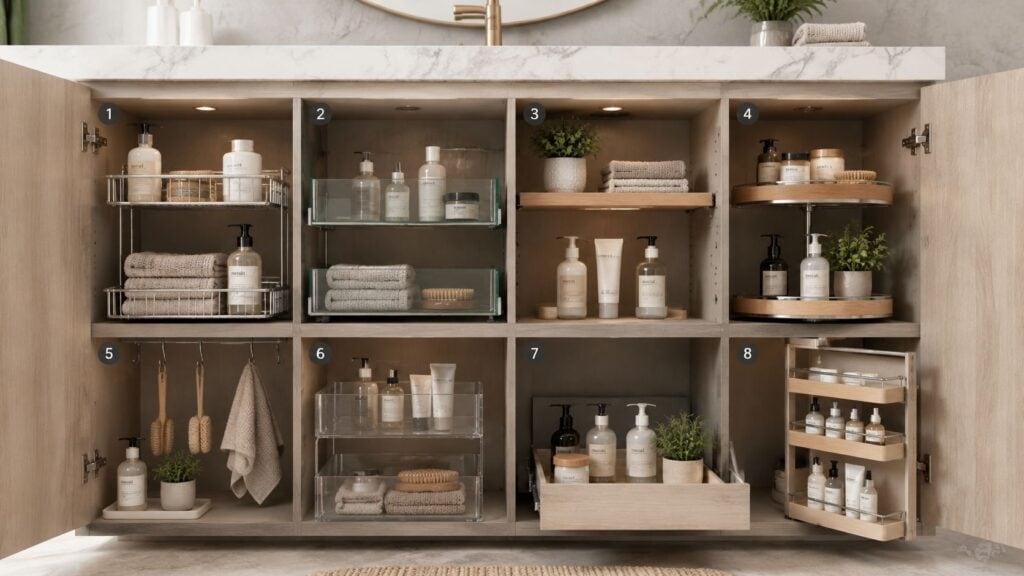
You open the vanity door to grab one item, and three others tip forward. A deep cabinet with a single shelf does that. Bottles slide to the back, hot tools fight for space with cleaning supplies, and the area under the sink becomes harder to use than it should be.
Better shelving fixes the cabinet, not just the mess.
The first step is practical: measure the cabinet you have. Under-sink plumbing, face frames, hinge clearance, drawer hardware, and door swing all change what will fit and what will be annoying to use every day. Lowe's bathroom shelving guide makes the same point. Width, depth, and height matter, but so does reach. A shelf that fits on paper can still be a poor choice if you have to remove half the cabinet contents to get to one item.
Material and hardware choices matter just as much. Glass keeps a small bath feeling lighter, but it shows dust and toothpaste fast. Wood looks warmer, but in a humid room it needs the right finish and decent ventilation. Metal brackets and shelf pins hold up well, though the wrong finish can clash with your faucet and mirror. If you are coordinating visible parts, this guide to choosing cabinet hardware finishes and styles helps you keep the shelving details consistent with the rest of the bathroom.
That is the difference between a gallery of ideas and a plan you can build. Some shelving upgrades are realistic DIY projects if the cabinet box is square and the walls are sound. Others, especially custom inserts around plumbing or lighting built into open shelves, usually go better with measured design and installation. For South Jersey homeowners, The Cabinet Coach is part of that conversation because good storage design depends on exact fit, not generic dimensions.
If you also want the open shelves to look finished instead of crowded, this guide on styling your wooden bathroom shelves offers useful visual ideas.
Table of Contents
- 1. Floating Glass Shelves with Chrome Hardware
- 2. Pull-Out Sliding Drawer Shelves
- 3. Adjustable Wood Shelving with Metal Supports
- 4. Corner Carousel or Lazy Susan Shelving
- 5. Wall-Mounted Open Shelving with Integrated Lighting
- 6. Tiered Basket and Bin Storage Shelving
- 7. Double-Stacked or High-Capacity Shelving Systems
- 8. Custom-Built Cabinet Insert Shelving and Dividers
- Bathroom Cabinet Shelving: 8-Item Comparison
- Design Your Perfect Bathroom with a Local Expert
1. Floating Glass Shelves with Chrome Hardware
Floating glass shelves work best when you want storage to feel lighter instead of heavier. In a small hall bath or powder room, solid shelving can make the wall look crowded fast. Tempered glass, especially with slim chrome brackets or concealed supports, keeps the room visually open and lets tile, paint, or mirror details stay visible.
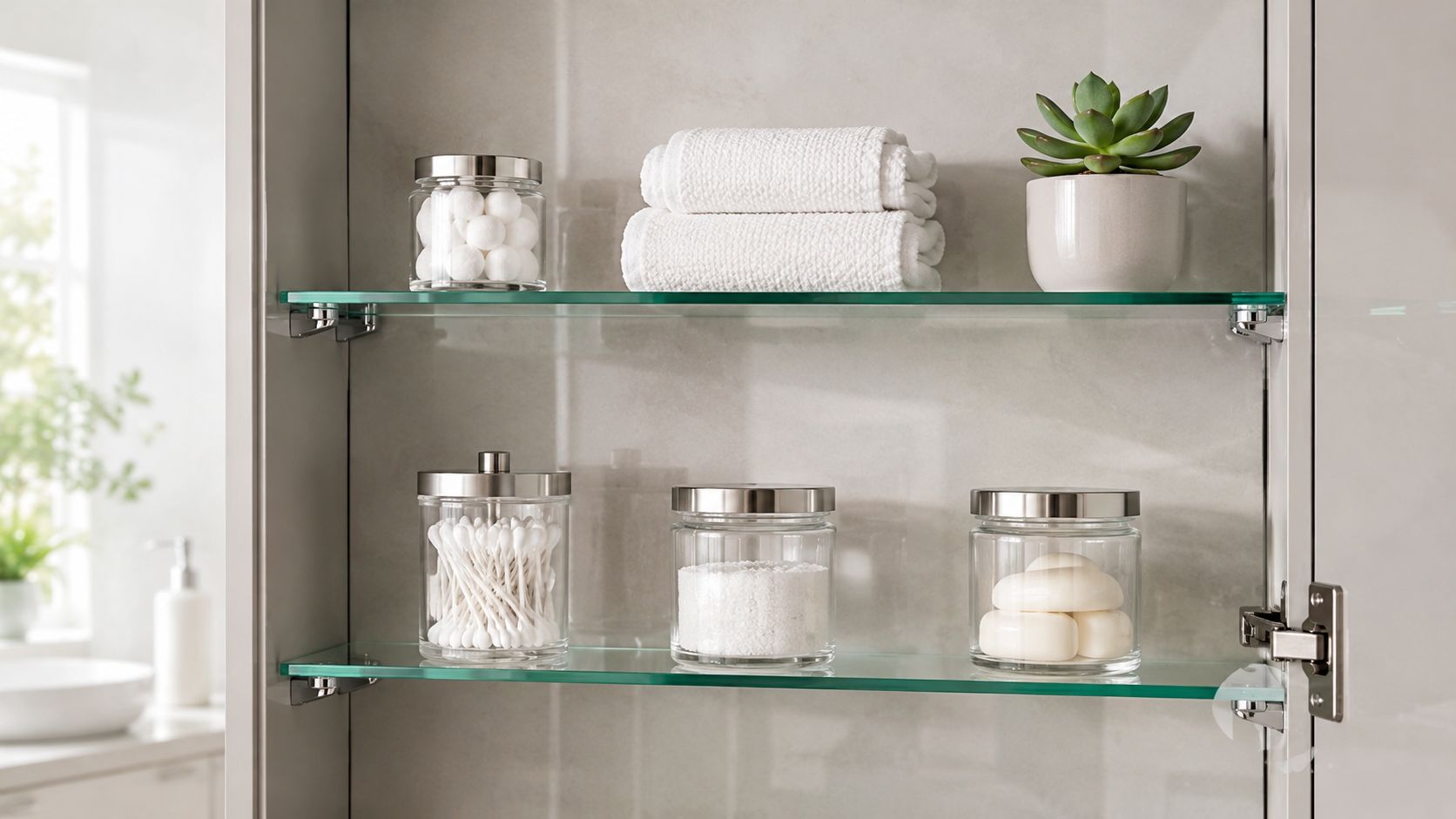
I like this option most in guest bathrooms, narrow vanity side walls, and recessed areas near a medicine cabinet. It's less forgiving in a messy family bath, because everything stays visible. If your daily routine involves a lot of products, pair the shelves with a few clean-lined bins so the look stays intentional instead of chaotic.
Where glass shelves work best
Glass shelves shine when the bathroom already has polished fixtures. Kohler and Moen collections often use that clean metal-and-glass language well, and budget-minded homeowners often look to IKEA-style glass shelving when they want a similar feel without going fully custom.
A few practical rules matter more than the style:
- Use tempered glass: Standard glass doesn't belong in a bathroom storage application.
- Match the metal finish: Coordinate the brackets with faucets, mirror trim, and even your cabinet hardware choices.
- Clean for practical use: Microfiber cloths help reduce visible water spots and fingerprints.
- Anchor correctly: Stud mounting is best. If studs don't line up, use hardware rated for the wall type.
Open shelving only looks calm when the items on it are edited. Too many mismatched bottles will make expensive shelves look cheap.
The biggest trade-off is maintenance. Glass looks excellent right after cleaning, but it shows dust, dried drips, and toothpaste mist quickly. If you love a crisp modern look and don't mind regular wipe-downs, it's a strong choice. If you want low-maintenance storage, closed shelving usually wins.
2. Pull-Out Sliding Drawer Shelves
Deep vanity cabinets waste space because the back half becomes invisible. Pull-out sliding shelves fix that problem immediately. Instead of crouching and reaching around plumbing, you bring the contents to you.
That's why I recommend this idea more than almost any other for under-sink storage. It's practical, not decorative. And in a bathroom you use every day, practical tends to age better than trendy.
Why pull-outs outperform fixed shelves
Contemporary storage design has shifted from simple enclosed cabinets to more layered, concealed, and modular solutions. Guidance from Good Housekeeping's small bathroom storage ideas reflects that shift with built-ins, hidden storage moves, and other ways to use space that would otherwise sit idle. Pull-out trays fit that same logic. They turn dead space into accessible storage.
For homeowners, the key advantage is visibility. A fixed shelf may technically hold the same products, but if you can't see or reach what's in the back, that capacity doesn't help much.
A quick look at the mechanism helps:
DIY fit versus custom fit
This idea can be DIY-friendly if your cabinet opening is square and the plumbing leaves enough clearance. It becomes a pro job fast when drain lines, shutoff valves, and uneven cabinet interiors get involved.
- Measure the interior, not the exterior: Cabinet listings can be misleading. Use the actual inside width, depth, and clear height.
- Check door clearance: Some vanities need special slide placement so the shelf can extend cleanly.
- Choose soft-close hardware: It reduces wear and feels better in daily use.
- Use categories: One pull-out for hair care, one for oral care, one for cleaning supplies works better than a random mix.
If you want a good mental model for making deep storage usable, the same principles used in organizing deep kitchen cabinets carry over well to bathroom vanities too. The hardware concept is also similar to improving kitchen functionality with runners, where easy extension matters more than raw shelf depth.
Practical rule: If you have to kneel and reach blindly, the cabinet needs pull-outs.
3. Adjustable Wood Shelving with Metal Supports
Adjustable wood shelving is the most balanced option on this list. It looks warmer than glass, costs less than full custom inserts, and adapts well as your storage needs change. That flexibility matters more than people expect. A shelf layout that works for a couple may not work once kids, extra products, or backup linens enter the picture.
This is also one of the easiest bathroom cabinet shelving ideas to make feel built-in without rebuilding the whole vanity. A good shelf board, decent support pins or standards, and a moisture-aware finish can go a long way.
Best materials and finish choices
Bathrooms are hard on wood. Steam, splashes, and condensation will find every raw edge. If you're adding or replacing wood shelving, seal the shelf edges well and don't assume a furniture-grade finish is enough for a wet room.
Material choice matters here because durability often gets overlooked in bathroom organization advice. Guidance summarized in Extra Space Storage's hidden bathroom storage ideas pushes useful hidden storage moves, but homeowners still need to think through moisture performance. In humid bathrooms, sealed plywood, thermally fused laminate, solid wood, powder-coated metal, and ventilated shelf layouts all have different maintenance and longevity trade-offs.
A few combinations work well in practice:
- Sealed plywood shelves: Stable and dependable for painted or stained applications.
- Thermally fused laminate shelves: Lower maintenance, especially in busy kids' baths.
- Solid wood shelves: Attractive, but they need proper sealing and ongoing care.
- Metal supports or standards: Better for adjustability than fixed cleats.
Where this style fits
This approach suits transitional bathrooms, farmhouse-inspired spaces, and vanities where you want warmth without giving up function. It's also helpful when cabinet interiors need to evolve. You can raise a shelf for tall bottles, lower one for stacked hand towels, or create a tighter section for cosmetics trays.
The trade-off is visual weight. Wood shelves feel more substantial than glass and less precise than custom inserts. Done well, that's a plus. Done poorly, it can look like an afterthought.
4. Corner Carousel or Lazy Susan Shelving
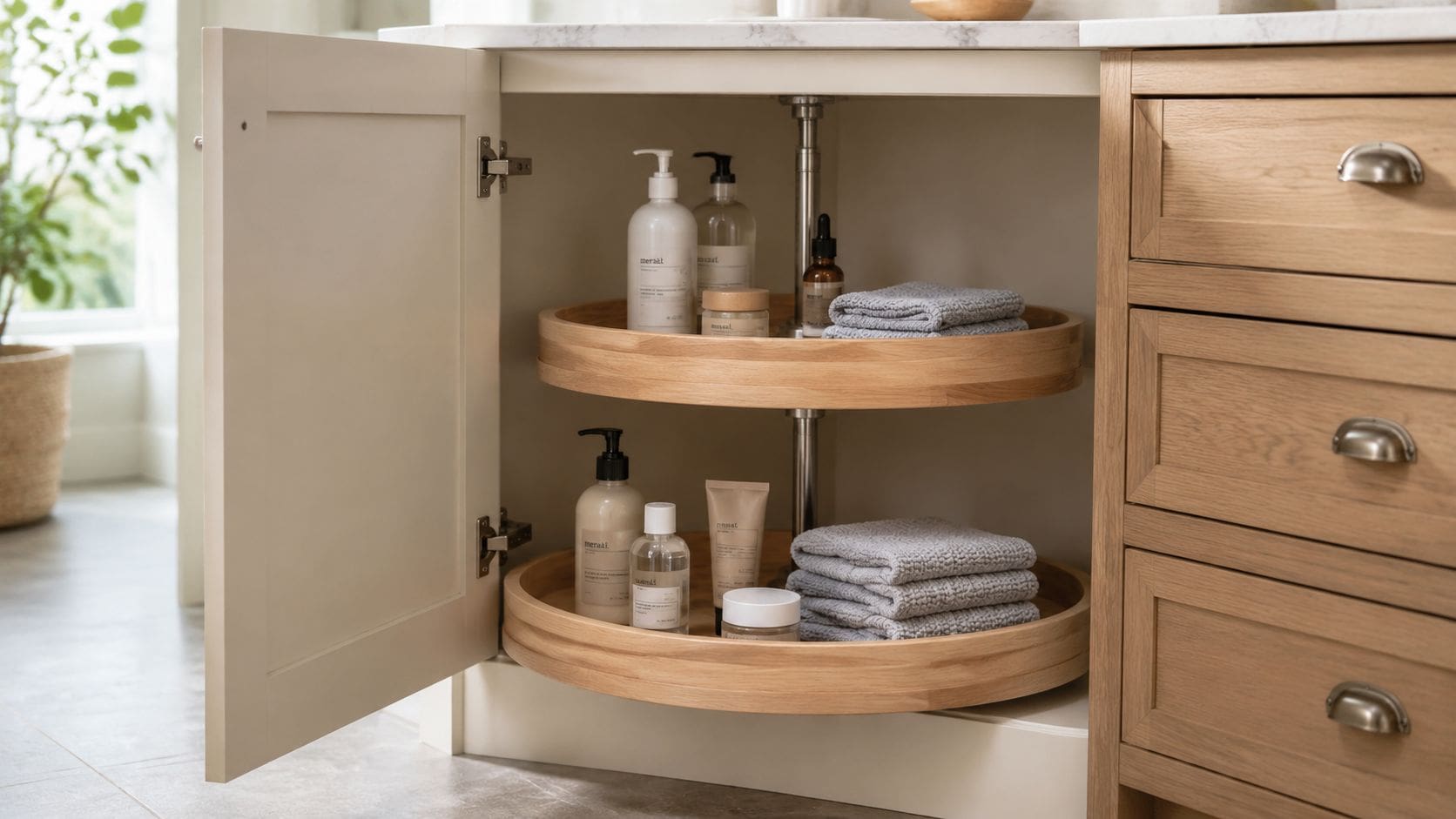
Corner storage is often the most frustrating storage in the room. You can technically put things there, but you won't want to retrieve them. That's why a carousel or Lazy Susan-style shelf can make sense in a corner vanity or side cabinet. It transforms awkward reach space into rotating access.
This isn't a universal solution. In some bathrooms, a simple fixed shelf is better because the corner isn't deep enough to justify the mechanism. But when the cabinet footprint is wide and the corner would otherwise become a black hole, rotating storage earns its keep.
What belongs on a rotating shelf
Keep the load light and the shapes predictable. Toiletries, backup soap, hair products, washcloths, and compact baskets all work well. Tall unstable bottles, loose powders, and heavy bulk items usually don't.
A few placement tips make the system far more usable:
- Use shelf liners: They keep bottles from sliding during rotation.
- Reserve it for medium-use items: Daily essentials should stay in a more direct-access zone.
- Check door swing carefully: A well-built carousel still fails if the door opening blocks access.
- Avoid overcrowding: Rotation gets annoying when products bump each other.
Rotating storage solves access problems, not sorting problems. If the contents are disorganized, the spin won't save you.
I've found this style works better in adult bathrooms than in children's baths, where items tend to get put back carelessly. If your household is disciplined enough to keep categories intact, a corner carousel can rescue a difficult cabinet. If not, it may become another moving part nobody enjoys using.
5. Wall-Mounted Open Shelving with Integrated Lighting
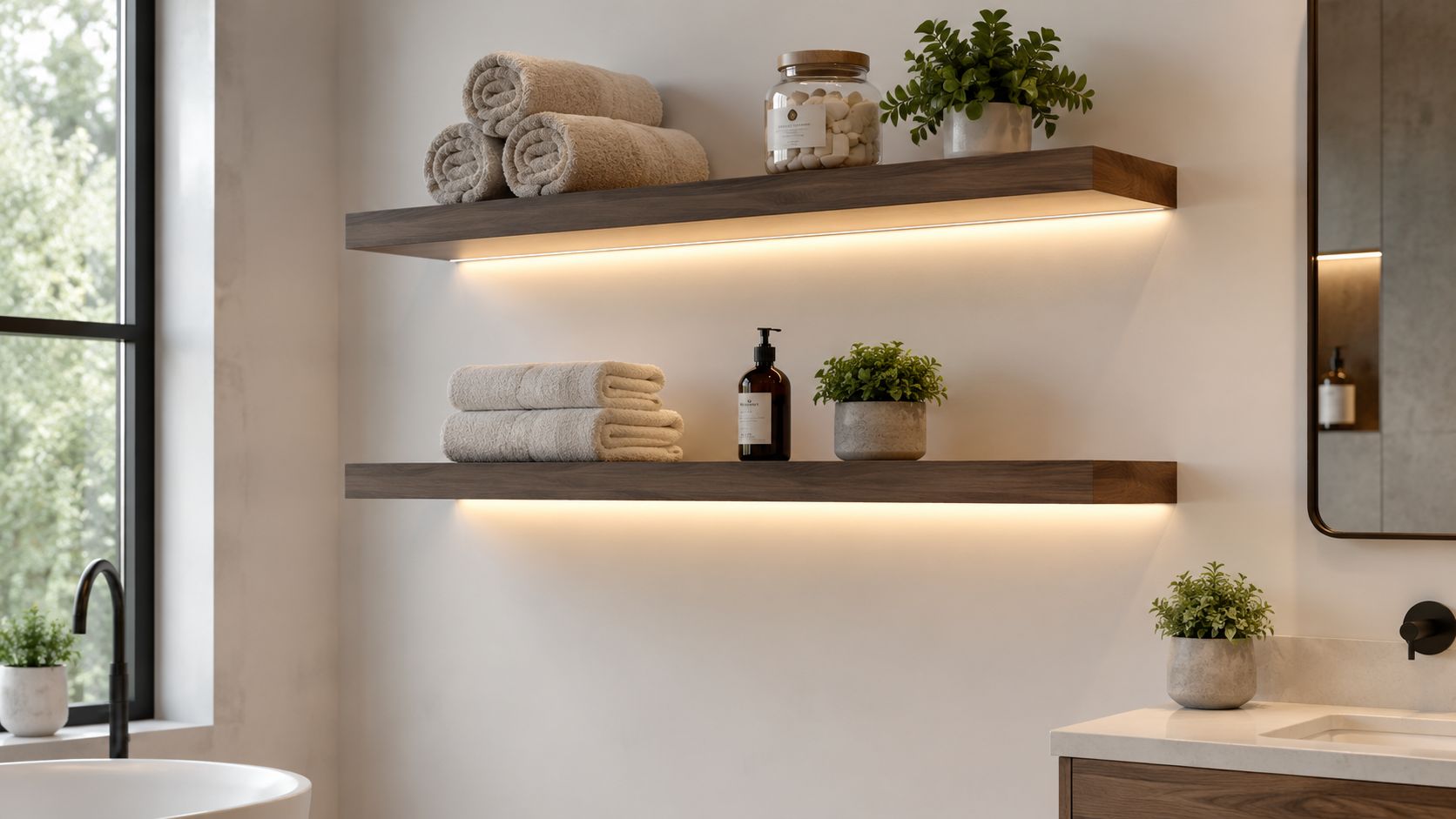
Integrated lighting changes the role of shelving. It stops being just a storage surface and starts acting like part of the bathroom's lighting plan. That can make a basic wall niche, side shelf, or vanity-adjacent display area feel much more intentional.
The look is strongest in modern bathrooms where the shelves are edited carefully. Rolled towels, a tray for skincare, and one or two decorative accents can look polished. Ten products and a charging cord won't.
Design choices that matter
Planning the electrical work early is the difference between a clean install and a workaround. If the lighting is being added after tile, paint, and cabinetry are complete, the project gets harder and usually less elegant.
For most bathrooms, these guidelines work well:
- Use warm white lighting: Around 2700K gives a softer, spa-like effect.
- Hide the diode strip: Recess it or shield it so you see the glow, not the source.
- Think in layers: Shelf lighting should support mirror and ceiling lighting, not replace them.
- Use moisture-appropriate components: Especially near sinks and shower-adjacent walls.
For homeowners considering this route, coordinated under-cabinet lighting installation can help the bathroom feel cohesive instead of pieced together over time.
DIY or pro
Stick-on LED kits can work for a temporary update or a low-risk decorative shelf. Hardwired lighting belongs in the pro category. It's cleaner, longer-lasting, and easier to integrate with dimmers and other bathroom lighting controls.
This is one of those ideas that photographs beautifully but can disappoint if the shelf proportions are wrong. Narrow shelves with well-planned lighting usually look custom. Thick shelves with visible cords usually don't.
6. Tiered Basket and Bin Storage Shelving
If your bathroom has to serve real life, baskets and bins are often the fastest way to impose order. They're not glamorous, but they solve a common problem. Most bathroom products are small, visually noisy, and easy to lose. Shelves alone don't fix that. Containers do.
This method works especially well inside linen towers, open side shelving, medicine cabinets, and under-sink shelves where categories need boundaries. It also gives shared bathrooms a fighting chance. One basket for each person, or one for each routine, keeps products from spreading everywhere.
How to keep basket storage from looking sloppy
The basket-and-bin approach succeeds when the containers are consistent. Random leftover bins create more visual clutter than no bins at all. Matching materials and predictable labels make the system easier to maintain.
The broader market supports this kind of organization. One estimate values the global bathroom cabinets market at USD 74.80 billion in 2025, with a projection to reach USD 174.41 billion by 2036 at an 8.0% CAGR and a USD 93.62 billion incremental opportunity. That kind of growth points to sustained demand for more usable cabinet interiors, including the kind of modular shelving and categorized storage that baskets support.
Use bins with a purpose:
- Daily-use bins: Toothpaste, moisturizer, hair ties, deodorant.
- Backstock bins: Extra soap, replacement toothbrush heads, refills.
- Task bins: First aid, shaving, travel items, guest supplies.
- Cleaning bins: Bathroom-specific sprays, cloths, gloves.
For smaller compartments, ideas from medicine cabinet organization translate well here because the same principle applies. Group by use, not by product shape alone.
The best baskets are boring. If they stack, wipe clean easily, and fit the shelf exactly, they'll outperform more decorative options over time.
Fabric-lined wire baskets can work, but in high-moisture bathrooms I usually prefer wipeable bins or baskets with a surface that won't trap dust and humidity.
7. Double-Stacked or High-Capacity Shelving Systems
A shared bathroom gets overloaded fast. Extra toilet paper, backup shampoo, cleaning products, towels, kids' bath items, and first-aid supplies all compete for the same cabinet space. In that situation, high-capacity shelving usually works better than a styled display shelf because it increases usable storage without expanding the cabinet footprint.
Double-stacked shelving adds more levels inside the same cabinet or linen niche, but the layout only works if each level has a job. I usually recommend this approach for family bathrooms, hall baths, and utility-heavy spaces where storage volume matters more than a clean showroom look. The goal is simple. Fit more, keep it reachable, and prevent the cabinet from turning into one deep pile.
Where this system works best
As noted earlier, homeowners continue to prioritize bathroom storage that supports daily use. High-capacity shelving addresses that need directly, especially in homes where one cabinet has to carry too many categories at once.
A practical layout usually breaks down like this:
- Top shelves: Refills, backstock, and rarely used items
- Eye-level shelves: Daily toiletries, medication organizers, grooming products
- Lower shelves: Towels, tissue packs, cleaning caddies, larger containers
- Shelf inserts or bins: Small-item control inside wider shelf spans
This is one of the few shelving ideas where vertical spacing matters as much as shelf count. If every opening is too short, tall bottles get laid on their side and the whole system starts fighting the user.
The trade-offs homeowners should know
More shelves do not automatically mean better storage. Add too many, and access gets worse. Leave spans too wide, and shelves start to bow under weight. Use the wrong material in a humid bathroom, and the edges swell or delaminate.
For DIY installs, melamine and plywood both have a place. Melamine is easy to wipe clean and works well for enclosed cabinets, but exposed cut edges need proper banding. Plywood handles fasteners better and usually lasts longer in moisture-prone rooms, especially when sealed well. Thin particleboard shelves are the option I avoid for heavy bathroom loads.
Shelf thickness and support spacing matter here. Long runs benefit from center support, metal pins rated for real weight, or fixed cleats rather than basic shelf pegs alone. If the cabinet has to hold bulk items every day, this is usually where a pro install earns its keep.
Common failure points
The first problem is sagging. The second is bad zoning.
Homeowners often place heavy stock on the longest shelf, then reserve the strongest area for lighter items. I set the cabinet up the other way around. Put dense items where support is best, and reserve upper shelves for lighter backups. Medication storage also needs more thought than simple stacking, especially in homes with children or in bathrooms that run hot and humid.
If you want the extra capacity without an exposed utility look, enclosing the system helps. Designs borrowed from bathroom cabinet ideas over the toilet can hide dense storage behind doors while still using the full height of the wall.
For South Jersey homeowners planning a larger bathroom update, this is also the point where custom sizing matters. The Cabinet Coach can help map shelf heights around real product sizes, plumbing clearances, and the weight the cabinet needs to carry. That kind of planning makes a high-capacity system feel intentional instead of overpacked.
A high-capacity shelving system is rarely the most decorative choice. It is often the one that works longest with the fewest daily frustrations.
8. Custom-Built Cabinet Insert Shelving and Dividers
Custom inserts are what I recommend when homeowners are tired of compromise. Off-the-shelf organizers can improve a cabinet, but they still ask you to adapt to standard sizes. Custom inserts reverse that. The storage is built around your cabinet, your plumbing, and the products you use.
Bathroom cabinet shelving ideas are now incorporated into the cabinet architecture, transforming them beyond mere accessories. That larger shift has become standard in modern bathroom planning. Storage now gets integrated into vanities, wall cavities, false drawers, and door interiors because homeowners expect more from every inch of space.
What custom inserts do better
Custom dividers, drawer-within-drawer systems, tip-out trays, tray dividers, and shaped inserts around plumbing all solve very specific problems. They're especially helpful in primary bathrooms where the cabinet has to support grooming routines, cosmetics, electrical tools, and shared storage without feeling overstuffed.
For homeowners in South Jersey, this is also the point where local design support matters. A team like The Cabinet Coach can plan cabinetry, interior accessories, hardware, and installation together so the inserts feel intentional rather than added later.
A strong custom plan usually includes:
- Item-based planning: Design shelf heights around real products, not guesses.
- Material matching: Interior inserts should coordinate with the cabinet construction.
- Future flexibility: Adjustable elements help when routines change.
- Soft-close hardware: Better feel, less wear, fewer slammed drawers.
When to skip custom
Don't invest in custom inserts if the cabinet box itself is failing, swelling, or poorly laid out. Fix the structure first. Custom organization inside a low-quality cabinet won't deliver the result people expect.
If the plumbing, door swing, and storage needs are all unusual, custom inserts stop being a luxury and start being the cleanest solution.
This is the premium option because it solves the most variables at once. It's rarely the cheapest path, but it's often the one that makes the bathroom easiest to live with every day.
Bathroom Cabinet Shelving: 8-Item Comparison
| Option | 🔄 Implementation Complexity | ⚡ Resource Requirements | 📊 Expected Outcomes | 💡 Ideal Use Cases | ⭐ Key Advantages |
|---|---|---|---|---|---|
| Floating Glass Shelves with Chrome Hardware | Moderate–High: precise mounting and professional install recommended | Medium–High: tempered glass, chrome brackets, labor | High visual impact and perceived space; limited weight capacity | Small modern bathrooms, vanity displays, light-enhancing installs | Sleek modern aesthetic; light distribution; easy to clean |
| Pull-Out Sliding Drawer Shelves | High: custom measurement and professional installation | Medium–High: quality ball-bearing slides, fittings, install labor | Excellent accessibility and full-depth use; durable operation | Deep or under-sink cabinets, accessibility-focused kitchens/baths | Maximizes usable depth; reduces reach/strain; smooth operation |
| Adjustable Wood Shelving with Metal Supports | Low–Medium: DIY possible; requires level, stud anchoring | Low–Medium: wood shelves, metal standards, basic tools | Flexible storage and warm aesthetic; moderate load capacity | Traditional, transitional, or farmhouse bathrooms; display areas | Highly customizable; affordable; easily reconfigured |
| Corner Carousel / Lazy Susan Shelving | Medium: carpentry for fit and rotating mechanism install | Low–Medium: carousel hardware, shelves, some carpentry | Transforms corner dead space into accessible storage; limited tall-item fit | Corner cabinets (upper/lower), frequently used toiletries | Efficient corner use; good visibility; cost-effective solution |
| Wall-Mounted Open Shelving with Integrated Lighting | High: requires electrical wiring and coordinated installation | High: LED strips, drivers, electrician, finishes | Strong design and task lighting impact; increases ambiance and value | Vanity areas, luxury or design-forward bathrooms | Combines storage with lighting; energy-efficient; designer look |
| Tiered Basket & Bin Storage Shelving | Low: simple installation and setup; largely DIY | Low: shelving plus baskets/bins, labels, minimal tools | Neat, hidden storage with curated appearance; needs upkeep | Families, renters, staging, flexible storage needs | Hides clutter while keeping items accessible; cost-effective |
| Double-Stacked / High-Capacity Shelving Systems | Medium: secure mounting and assembly required | Medium: heavy-duty metal or reinforced wood, anchors | Maximizes bulk storage and durability; industrial look | Utility bathrooms, large-family storage, stockpiles | High weight capacity; durable and configurable |
| Custom-Built Cabinet Insert Shelving & Dividers | Very High: professional design, measurement, and fabrication | High: bespoke materials, custom hardware, longer lead time | Optimal organization and seamless integration; premium finish | High-end remodels, maximizing existing cabinetry, long-term owners | Perfect fit; tailored functionality; increases property value |
Design Your Perfect Bathroom with a Local Expert
The best shelving choice depends less on trends and more on how your bathroom is used. A guest bath can carry open glass shelves without much stress. A primary bath may need custom inserts, lighting, and layered storage. A family bath usually benefits from closed shelving, pull-outs, bins, and materials that handle humidity without constant maintenance.
That practical mindset matters because bathroom storage has moved far beyond the old single-shelf vanity. Homeowners now expect concealed storage, modular interiors, and better use of wall and under-sink space. In real remodeling work, that means every decision connects to another one. Shelf depth affects what bins fit. Lighting affects how shelves look. Hardware affects how comfortable the cabinet feels to use. Material choice affects how well the bathroom holds up to moisture over time.
For homeowners in Cherry Hill, Haddonfield, Moorestown, and nearby Camden and Burlington County communities, working with a local cabinet design specialist can simplify those trade-offs. The Cabinet Coach offers a mobile showroom approach, which means you can review cabinetry, finishes, hardware, and bathroom storage options in the context of your own home rather than trying to piece everything together under store lighting. That's especially useful when you're coordinating shelving with vanities, countertops, tile, and fixture finishes.
A good bathroom plan also looks ahead. It doesn't just solve where the toothpaste goes today. It accounts for backup storage, easier cleaning, future household changes, and the way a bathroom should feel when everything is put away. That's where customized design beats a stack of random organizers.
If you're still deciding between layouts, it can help to create 3D bathroom plans before finalizing cabinetry and shelving locations. Seeing shelf depth, door swing, lighting placement, and traffic flow together often makes the right choice much clearer.
The right storage should make your mornings easier, your counters calmer, and your cabinets simpler to maintain. If that's the result you want, it makes sense to approach shelving as part of the remodel, not as a last-minute add-on.
If you're planning a bathroom remodel in South Jersey and want help choosing shelving, cabinetry, hardware, and layout details that fit your space, contact The Cabinet Coach to start the conversation. Their mobile showroom and guided design process can help you turn a cluttered bathroom into a more functional, better-organized room.