
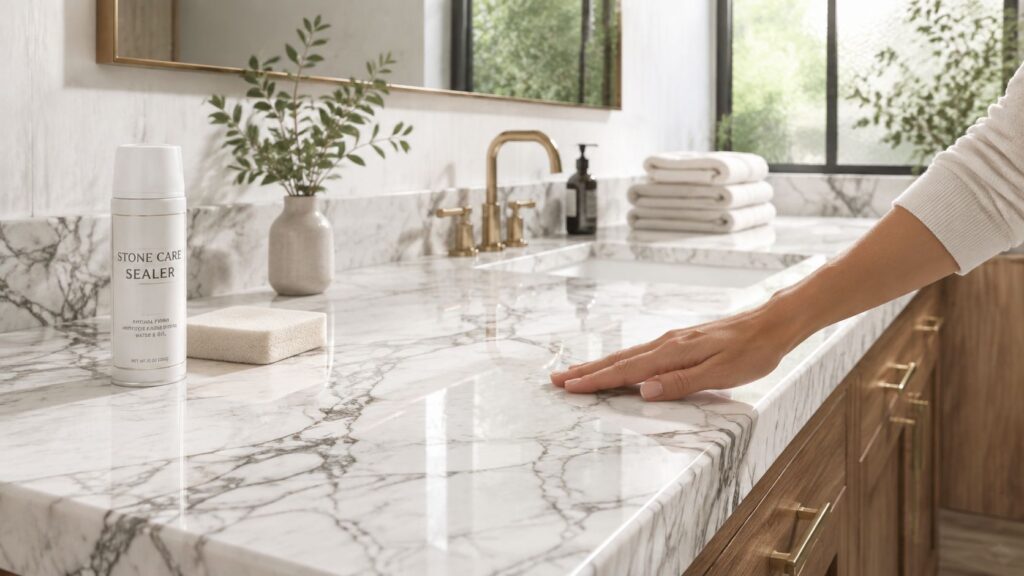
You're standing in a Cherry Hill stone yard with your hand on a Calacatta slab. The veining is exactly what you wanted, but your cousin's warning is still in your head: his marble vanity looked dull and spotted within a year. Both reactions are reasonable. Marble countertops for a bathroom can be breathtaking, but they aren't maintenance-free, and the right choice depends more on how the room is used than on how the slab photographs.
A lightly used powder room and a busy family bathroom demand different materials. South Jersey homeowners also need to account for hard-water spotting, daily toothpaste and skincare residue, humidity, and the simple fact that many homeowners don't want another demanding household surface. Marble can work beautifully, but only when you choose the stone, finish, care routine, and bathroom location with open eyes.
Table of Contents
- Why Marble Keeps Showing Up in Bathroom Designs
- Types and Grades of Marble Used on Bathroom Vanities
- What Marble Does Well and Where It Struggles
- How Porosity, Sealing, and Etching Really Work
- Marble Compared to Quartz, Quartzite, and Marble-Look Alternatives
- Daily Care, Resealing, and Long-Term Maintenance
- Installation, Fabrication, and What to Ask Your Countertop Team
- Deciding If Marble Is Right for Your Bathroom
Why Marble Keeps Showing Up in Bathroom Designs
Marble has the kind of visual depth that manufactured patterns still struggle to reproduce. Its veining shifts across the slab, disappears at the edge, and changes character under morning and evening lighting. A printed surface can imitate the image of marble, but real stone gives the vanity a sense of movement and permanence.
That appeal has a long history. Marble was prized in ancient Greece and Rome, later featured prominently during the Renaissance, and remained associated with important architectural work as processing and transportation improved. Historical accounts describe marble countertops becoming popular in high-end homes in the early 1900s, before cheaper laminate became dominant in the 1950s and 1960s. That history helps explain why homeowners still read marble as a luxury material today. The history of marble and its countertop use provides useful context for that shift.
In a Cherry Hill primary suite, a marble vanity can anchor the entire design. It works with painted cabinetry, warm oak, brass, polished nickel, black fixtures, and traditional tile. In a powder room, a more dramatic slab can act almost like artwork, especially when the cabinet footprint is small enough that the stone remains the focal point.
The design advantage is real: marble makes an ordinary vanity feel custom before you add hardware, lighting, or decorative accessories.
The romantic part holds up. The maintenance warnings do too. A bathroom vanity isn't exposed to the same foods and cooking acids as a kitchen counter, but toothpaste, mouthwash, skincare products, perfume, soap film, and standing water still create daily wear. The question isn't whether marble will remain untouched. The question is whether you'll appreciate its natural aging or resent every mark.
For a broader look at how local homeowners are creating spa-like primary suites, see this Cherry Hill bathroom design guide. The strongest designs treat the vanity as part of a complete room, not as an isolated slab purchase.
Types and Grades of Marble Used on Bathroom Vanities
In a busy Cherry Hill family bathroom, the right marble depends less on the name of the stone than on how much daily upkeep you will accept. Start with the actual slab. Names such as Carrara, Calacatta, and Statuario identify recognizable marble families, but quarry blocks still vary in background, movement, and veining. Ask the supplier to show you the slab proposed for your vanity, not only a small sample.
Carrara is the practical everyday choice. Its softer white or gray field and restrained movement coordinate easily with tile, cabinetry, and hardware. Statuario and Calacatta are more dramatic, with brighter backgrounds and stronger veins. Choose them when the vanity should command attention, especially in a powder room or a primary bath with quieter surrounding finishes.
Dolomitic marbles, including Danby and Vermont varieties, deserve attention for a heavily used wet room. They are denser and harder than many other marble options, but they still need proper care and can still etch. For South Jersey bathrooms with daily family use, that extra density can make them a more sensible marble choice, although it does not make the surface maintenance-free.
Hard-water deposits are common in Cherry Hill and surrounding Camden County neighborhoods, where mineral content in the water can leave persistent rings on vanity surfaces. That makes slab color and finish a practical decision. A busy family bath benefits from a surface whose natural movement and texture will not make every deposit or dull mark look prominent.
How grades affect the purchase
Commercial grades generally describe structural soundness, filled fissures, color consistency, and visible variation. They do not rank beauty from good to bad. A lower grade may show more movement or repairs, while a higher grade may offer a cleaner, more predictable field.
A bathroom vanity usually has a shorter span and lighter structural demands than a kitchen island. Therefore, a B or C grade may be perfectly reasonable when the slab is sound and its variation fits the design. Do not pay for a highly uniform slab if you specifically want strong natural movement. Inspect filled areas, edges, and the planned sink cutout before approving the stone.
| Marble Type | Typical Appearance | Relative Hardness | Best Bathroom Fit |
|---|---|---|---|
| Carrara | Soft white or gray field with moderate veining | Moderate | Everyday primary or guest vanity |
| Calacatta | Bright field with bold, expressive veining | Moderate | Statement primary bath or powder room |
| Statuario | Bright background with prominent gray movement | Moderate | High-visibility luxury vanity |
| Danby or Vermont marble | Denser appearance with restrained to moderate movement | Relatively harder among marble options | Busy wet room where marble is still desired |
Choose the finish with your habits in mind
Polished marble reflects light and intensifies color, but it also makes dull etch marks easier to see. Honed marble has a matte surface that disguises small changes more effectively. Leathered finishes add texture and variation, though their surface profile requires attentive cleaning around residue and hard-water deposits.
Before placing a deposit, request the slab's quarry origin, exact grade, finish sample, and expected veining variation. Confirm how the fabricator will orient the sink cutout and where the strongest vein will fall. A beautiful slab can produce a disappointing vanity when the layout ignores its best movement.
What Marble Does Well and Where It Struggles
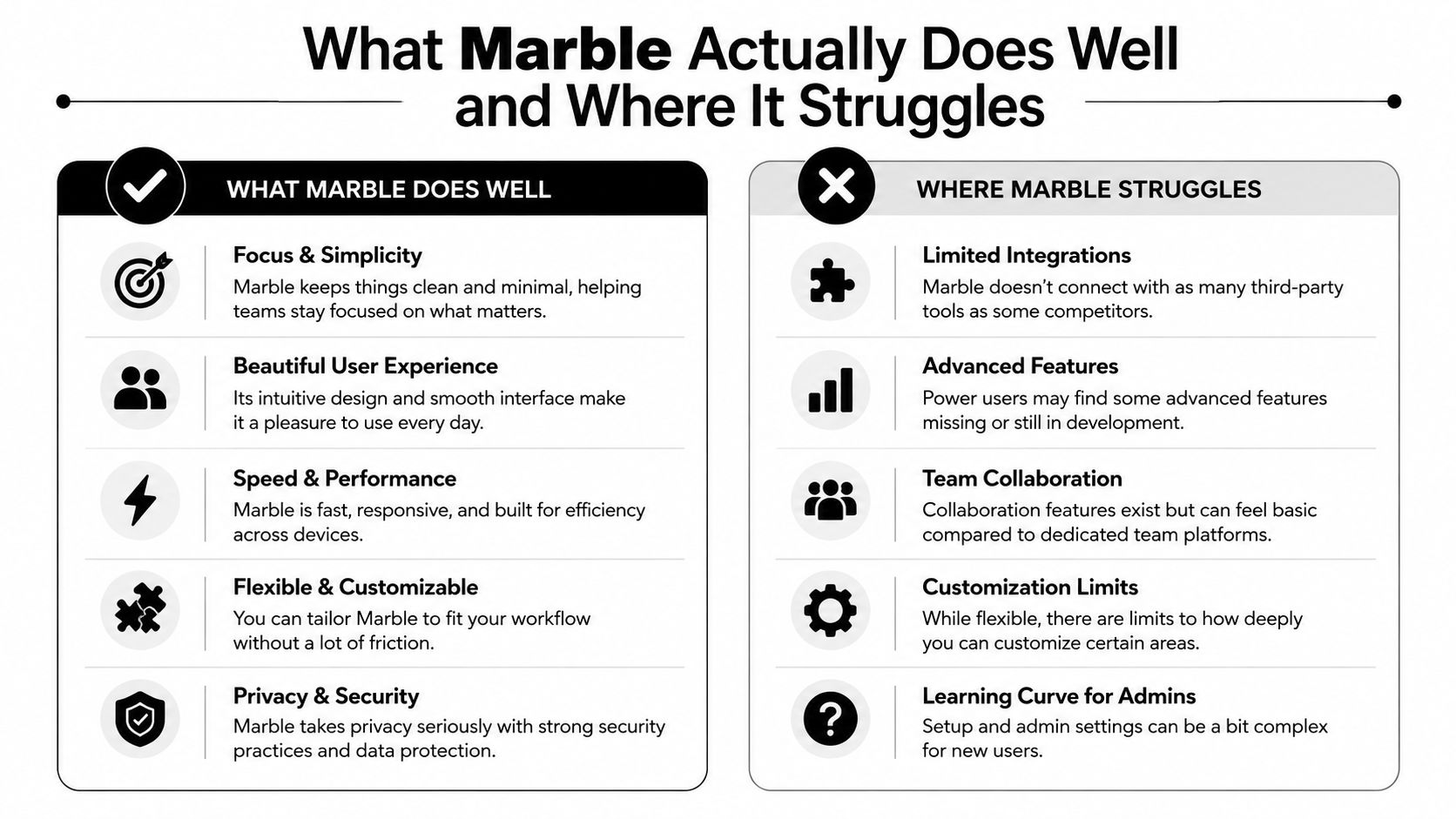
A marble vanity can look outstanding in a Cherry Hill bathroom, but its success depends less on style than on how the room is used. In a quiet powder room, the stone's natural movement and depth can be easy to appreciate. In a busy family bath with hard water, daily grooming, and bottles beside the faucet, the same surface demands consistent care.
Marble handles normal bathroom heat well. A curling iron or warm towel should not create the same concern associated with some synthetic surfaces, although no countertop should serve as a heat-storage station. Over time, marble can develop a patina that suits homeowners who prefer a lived-in surface to a factory-perfect finish.
Its weaknesses are more practical. Marble is softer than quartz, so a dropped bottle or hard object can chip an exposed edge. Strong movement can also overwhelm a small powder room, particularly beside busy tile. Review the comparison of marble countertop strengths and weaknesses before committing to a pattern that may dominate the room.
Chemical wear deserves more attention than structural wear
Marble's calcite chemistry creates the main maintenance problem. Acidic products can react with calcium carbonate at the surface and leave a dull mark. Some skincare formulas, cleaners, and grooming residue can etch the finish even without creating a dark stain. A vanity may remain structurally sound while its surface begins to look tired.
Independent product EPD data reports liquid water absorption for marble countertops between 0.1% and 1.0% by dry weight, with density around 2,699 kg/m³ and flexural strength of about 6.89 MPa. Those figures describe a material suitable for normal vanity loads, but they also confirm that marble has micro-porosity. The marble sealer guide and technical data explains why surface damage, rather than collapse, is the practical concern.
Separate manageable annoyances from deal-breakers
Mineral rings, a small edge nick, or professional honing after years of use are manageable problems. The deal-breaker is expecting the vanity to remain unchanged without changing daily habits.
If toothpaste sits beside the faucet, bottles leak onto the same area, and nobody wipes the counter, marble will record that use. For a busy family bathroom, choose marble only if regular wiping and periodic maintenance fit your routine. For a lightly used powder room, that upkeep is easier to justify.
How Porosity, Sealing, and Etching Really Work
Marble is a fine-pored natural stone. Unlike glass or engineered surfaces, it contains tiny channels that allow moisture and bathroom products to penetrate over time. Absorption varies by slab. In a Cherry Hill bathroom, hard-water droplets, soap residue, cosmetics, and standing water make that porosity a daily maintenance concern. For a plain-language explanation of the distinction, review what non-porous means.
A penetrating sealer fills space within those channels and slows capillary uptake, giving you more time to wipe away water or a spill. It does not make marble permanently waterproof or convert it into a non-porous surface. Sealing reduces the chance of a stain setting quickly, but it does not eliminate the cleaning habits that family bathrooms require.
Three bathroom scenarios make the difference clear
A hard-water droplet beneath the faucet can evaporate into a mineral ring. Perfume or another liquid may move into micro-pores when the surface lacks adequate protection. Toothpaste, skincare residue, and acidic grooming products can dull the exposed calcite surface through etching.
Sealing mainly addresses absorption. Etching occurs at the exposed surface, so a sealer cannot prevent every dull mark caused by product chemistry. The practical rule is simple: Treat sealer as a delay mechanism, not permission to leave spills sitting.
Test the countertop with a few drops of water in an inconspicuous area. If the stone darkens quickly instead of holding a bead, the protective barrier needs attention. For a busy family bath, schedule this check alongside routine cleaning. A lightly used powder room gives marble more breathing room, while a heavily used vanity demands faster wiping and periodic resealing.
The embedded video below demonstrates how water absorption, staining, and acid etching interact on sealed marble. It offers a useful visual reference for homeowners deciding whether their cleaning routine can support marble.
Marble Compared to Quartz, Quartzite, and Marble-Look Alternatives
A Cherry Hill family bathroom puts a countertop through a different test than a lightly used powder room. Hard-water spots, wet hands, cosmetics, and rushed morning routines make maintenance tolerance more important than a showroom sample. Marble brings natural variation and a graceful patina. Quartz favors consistency and easier upkeep, quartzite keeps genuine stone character with stronger performance, and marble-look porcelain or engineered surfaces offer tighter visual control.
Quartz is the practical recommendation for a busy family bath where no one wants to monitor every bottle. Its pattern stays consistent, it avoids the same sealing demands as porous natural stone, and it is widely available in marble-inspired designs. The tradeoff is a more regular appearance, plus the need to protect the surface from excessive heat.
Quartzite suits homeowners who want real veining with a harder-working natural stone. Ask the supplier to verify the slab's classification. Labels such as “soft quartzite” can create confusion, and the stone's performance depends on what was selected. Marble-look porcelain can handle common bathroom use with little routine attention, but its edge fabrication, sink cutouts, and repair options differ from those of natural stone.
| Material | Water Absorption | Acid Resistance | Maintenance | Heat Tolerance | Typical Cost (per sq ft installed) | Best Fit Bathroom |
|---|---|---|---|---|---|---|
| Marble | Porous to varying degrees | Vulnerable to etching | Regular care and sealing | Strong for normal vanity use | Varies by slab and fabrication | Statement vanity, powder room, lower-intensity primary bath |
| Quartz | Low-maintenance engineered surface | Generally strong against routine bathroom products | Minimal routine care | Use reasonable caution with high heat | Varies by brand and installation | Busy family bathroom |
| Quartzite | Natural stone performance varies by slab | Generally stronger than marble, but verify material | Sealing and routine care may apply | Strong for normal vanity use | Varies by slab and fabrication | High-use bath where natural stone is desired |
| Marble-look porcelain or engineered surface | Low-maintenance options available | Usually strong, product-specific | Low routine maintenance | Product-specific | Varies by product and fabrication | High-use bath prioritizing consistency |
Use this countertop material comparison to compare materials by cleaning habits, room intensity, and tolerance for surface changes. That approach is more useful than choosing from a showroom sample alone.
Marble is the stronger choice for homeowners who value patina, natural depth, and one-of-a-kind movement. Its beauty comes with a surface that demands attention, especially in a South Jersey primary bath shared by several family members. Quartz is usually the better fit for that workload, while carefully selected quartzite serves homeowners who want natural stone and can accept ongoing care. In a powder room, marble's visual payoff can justify the extra responsibility.
Daily Care, Resealing, and Long-Term Maintenance
In a busy Cherry Hill family bath, marble holds up only when moisture and products get managed every day. Use a pH-neutral stone cleaner or a small amount of mild soap, wipe with microfiber, and blot standing water instead of letting it evaporate around the faucet.
Keep perfume, retinol, hair treatments, and cosmetics on a tray. This contains spills and keeps leaking bottles off the slab. Vinegar, abrasive powders, bleach, and acidic bathroom cleaners can etch or dull marble, so keep them away from the vanity.
A workable care rhythm
Daily: Wipe toothpaste, water, soap residue, and product spills as soon as you see them. A dry microfiber cloth works well after morning routines and showers.
Weekly: Clean the entire surface with a marble-safe product, polish metal hardware separately, and inspect the caulk where the backsplash meets the wall. White rings on dark marble are often mineral residue from hard water. Use a stone-safe cleaner rather than vinegar.
Every six months: Run a water-drop test in a discreet area. The wet-area marble maintenance guidance recommends spot testing bathroom marble every six months. If water absorbs within about three minutes instead of remaining beaded, the surface may need resealing.
About every twelve months: A marble-care recommendation places wet-area resealing at about every twelve months, but the slab, sealer, and bathroom workload determine the actual interval. Honed marble may need resealing every three to six months, while polished marble may need it every six to twelve months, according to The Grit and Polish bathroom marble care guide. The Grit and Polish bathroom marble care guide supports checking the finish more often in a heavily used family bath.
A realistic standard: Aim for stone that stays clean, functional, and attractive. Marble does not need to remain untouched, but it does require consistent control of moisture and bathroom products.
Over a 20-year period, one 2026 estimate places professional resealing and specialty-cleaner maintenance for a natural marble bathroom countertop at roughly $4,000 to $8,000. The long-term maintenance discussion in The Grit and Polish bathroom marble care guide makes that commitment visible when you compare marble with lower-maintenance materials. For broader material-planning principles, Interiors by DeX's low-maintenance advice offers useful guidance.
Installation, Fabrication, and What to Ask Your Countertop Team
The countertop process starts after the vanity cabinet is installed and secured. A fabricator templates the actual base, checks the walls, confirms the sink and faucet locations, and records the conditions that a drawing can't reliably predict. Don't template against an unfinished cabinet layout if you want accurate overhangs and plumbing coordination.
Seam placement deserves a design conversation. A seam near the sink may be practical, but it can interrupt a strong vein. Ask the fabricator to lay the template over the slab and show you where the cutouts will land. If the vanity requires a seam, discuss whether the team can align or visually balance the movement rather than treating the joint as an afterthought.
Questions to bring to the fabrication meeting
- Show the actual slab: Ask to review the full piece, not only a sample, and identify the area that will become the most visible counter run.
- Confirm the sink method: An undermount sink creates a clean, easy-to-wipe transition, while a vessel sink changes the visual height and plumbing requirements.
- Coordinate faucet drilling: Confirm the faucet model, hole spacing, handle locations, and whether the rough plumbing matches the selected configuration.
- Review the edge: A small eased edge is practical for a family bath. More decorative profiles can suit traditional cabinetry but may emphasize chips or corners.
- Discuss backsplash details: Decide whether the backsplash comes from the same slab, how it meets the wall, and how the top edge will be finished.
- Request care and warranty paperwork: Keep the stone identification, sealer information, fabrication scope, and installation terms with your remodel records.
The sequence usually includes cutting, polishing the exposed edges and sink opening, transporting the piece, dry-fitting it, setting it, connecting the plumbing, and applying the final caulk bead. Your bathroom may be out of service during the installation window, so confirm the schedule before demolition begins.
Reviewing countertop edge options before the fabrication appointment will help you make the edge profile part of the design rather than a last-minute selection. The countertop team should collaborate with your designer, cabinet installer, plumber, and tile contractor. Good coordination prevents the common problems, including a faucet that misses the sink, a backsplash that conflicts with tile, or a dramatic vein hidden by the basin.
Deciding If Marble Is Right for Your Bathroom
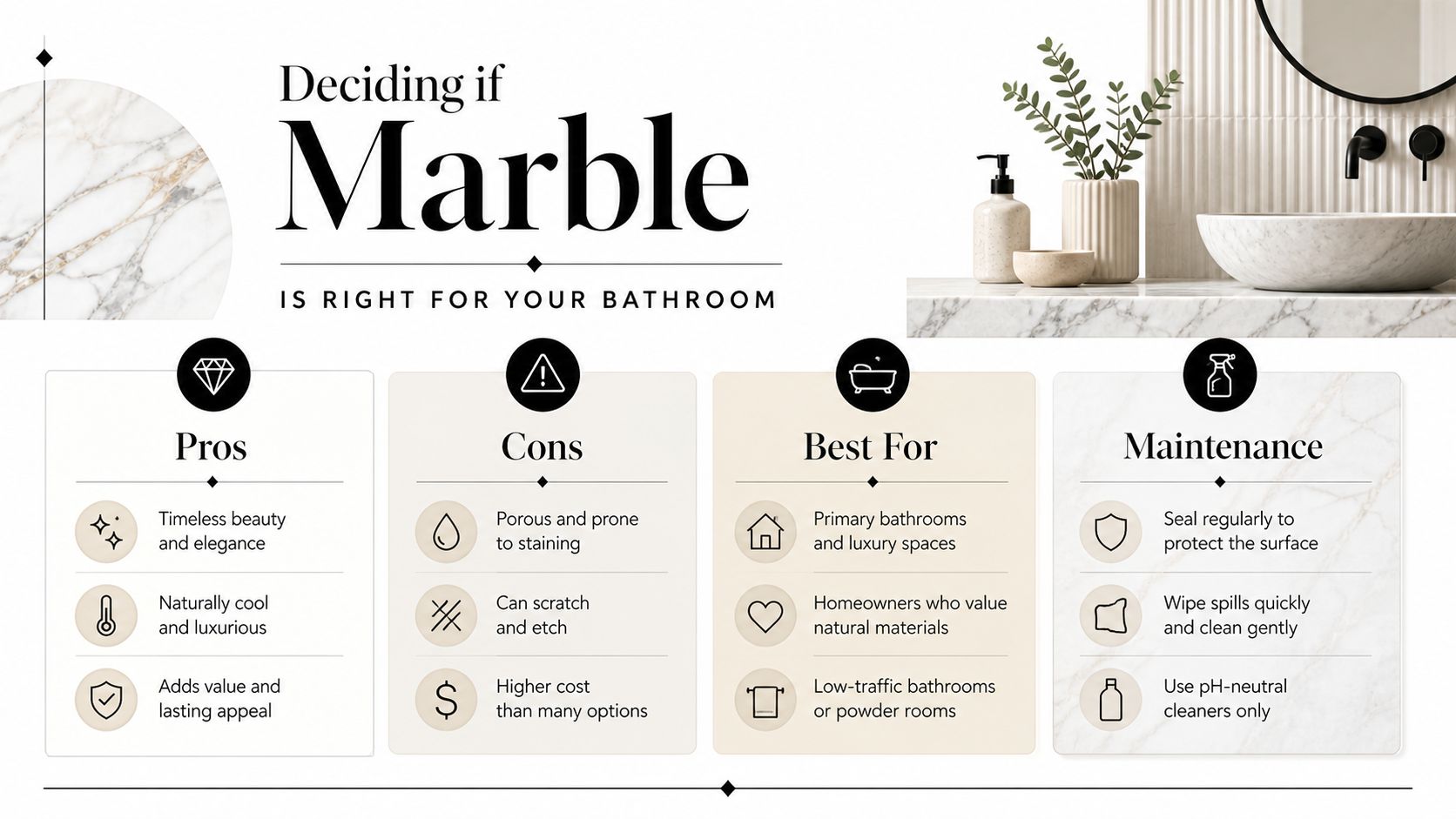
A marble vanity can look perfect in a showroom and frustrate you at home. In a Cherry Hill bathroom, hard-water droplets, toothpaste, hair products, wet hands, and rushed family mornings reveal whether your maintenance tolerance matches the stone.
A powder room is the easiest setting for marble. Guest use is lighter, and a dramatic polished slab can make a small space feel intentional without facing constant daily traffic. A primary bathroom also works when the adults using it will wipe spills, keep products on trays, and accept periodic sealing.
A busy family bathroom demands a stricter decision. If nobody will manage the surface and you expect it to look unchanged after years of hard use, choose quartz or another low-maintenance option. Marble earns its place when natural variation and an evolving surface matter enough to justify careful cleaning and upkeep.
Use this quick filter
Choose marble when:
- The visual payoff matters: Natural veining and genuine variation are priorities.
- The room has manageable traffic: The space is a powder room, guest bath, or controlled primary suite.
- You accept maintenance: Sealing, suitable cleaners, and quick wiping fit your routine.
- Patina doesn't scare you: Small changes will read as character rather than failure.
Choose another material when:
- Zero upkeep is the priority: You do not want testing, resealing, or product restrictions.
- The bathroom is high intensity: Several people use it daily, with no dependable care routine.
- Consistency matters: You want predictable appearance across slabs and little natural variation.
Choose marble when natural veining and genuine variation matter more than a zero-maintenance surface. Choose another material when heavy daily traffic makes consistent upkeep unrealistic.
Marble may support resale appeal because buyers often connect it with a premium bathroom, but resale should not override your household's daily experience. The counter must work for the people using it now before it can improve listing photographs. For renovation-planning context, review this guide to bathroom remodel return on investment.
Bring room photos, vanity dimensions, household-use notes, cleaning preferences, and a shortlist of marble varieties to your consultation. Accurate information about the bathroom's workload makes it easier to choose a slab and finish you will still appreciate after the showroom excitement fades.
The Cabinet Coach provides in-home and mobile showroom consultations for bathroom remodeling, helping Cherry Hill homeowners compare marble, quartz, quartzite, cabinetry, hardware, and tile in the actual room. Visit The Cabinet Coach to schedule a complimentary video consultation and begin vanity selection with guidance on maintenance, layout, and budget.