
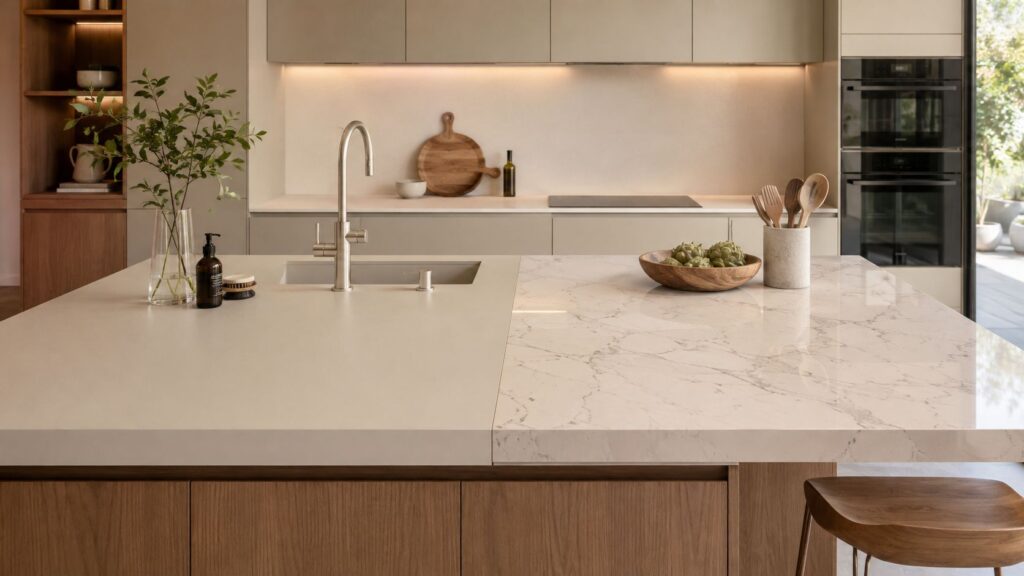
You're standing at the kitchen table with two samples in your hands, one sleek and stone-like, the other smooth and joint-free, and the question isn't which one looks nicer under showroom lights. It's which one will still make sense after years of coffee spills, sheet-pan dinners, kids' backpacks, and a bathroom that gets used before school every morning. In a Cherry Hill home, that choice changes how the room feels, how it cleans up, and how forgiving it is when life gets rough around the edges.
| Criterion | Solid Surface | Quartz |
|---|---|---|
| Best fit | Seamless, formed, easy-to-repair spaces | Busy kitchens, islands, hard-use surfaces |
| Look | Uniform, continuous, soft edge details | Stone-like, crisp, premium visual |
| Heat resistance | Lower, but still fine with care | Higher, but still needs trivets |
| Scratch resistance | Softer surface, easier to renew | Harder surface, better for daily abuse |
| Repairability | Can be sanded, buffed, and refinished | Less forgiving, often not repaired the same way |
| Seam visibility | Nearly invisible seams | Visible seams, though usually well matched |
| Typical use | Bathrooms, laundry rooms, rentals | Family kitchens, resale-focused remodels |
Table of Contents
- Two Slabs, One Kitchen Decision
- What Solid Surface and Quartz Are
- Durability, Heat, and Daily Wear Compared
- Real Cost Ranges for a Cherry Hill Kitchen
- Where Each Material Shines in Your Home
- Maintenance, Repairs, and a 15-Year Outlook
- A Five-Minute Decision Checklist and Sample Budgets
- Book Your In-Home Design Consultation
Two Slabs, One Kitchen Decision
The couple in Cherry Hill has already picked the cabinet color, and now they're leaning over two countertop samples that look close enough to confuse the issue. One is solid surface, the other is quartz, and the slab they choose will ripple through cabinet detailing, backsplash choices, sink selection, and how the room gets used over the next decade.
That's why this isn't a simple “which one is tougher” question. It's a function-first versus finish-first decision, and the right answer depends on whether the room needs practical, low-maintenance performance or a more stone-like, high-impact finish. If you're thinking through the same kind of remodel, it helps to look at the full list of kitchen features homeowners want and ask which surface supports them without getting in the way.
The part homeowners usually miss
A countertop doesn't live alone. It has to work with cabinet reveals, appliance placement, lighting, and the way a family enters and exits the kitchen every day. That's why a mobile showroom visit matters, especially when you're trying to pressure-test the fit before anything gets ordered.
Practical rule: If the room needs to look continuous and custom, solid surface deserves serious attention. If the room needs to absorb real kitchen abuse without fuss, quartz is usually the safer bet.
The quickest way to avoid regret is to put the samples in your own light and talk through the layout before you commit. That's exactly the point of a guided consultation, and it's the same reason homeowners use The Cabinet Coach countertop selection process before locking in a finish.
A lot of showroom decisions sound good until they meet a narrow galley kitchen, a busy island, or a bath vanity with a sink cutout that needs to disappear visually. The best choice is the one that matches the room's job, not the one with the loudest sales pitch.
What Solid Surface and Quartz Are
Solid surface in plain English
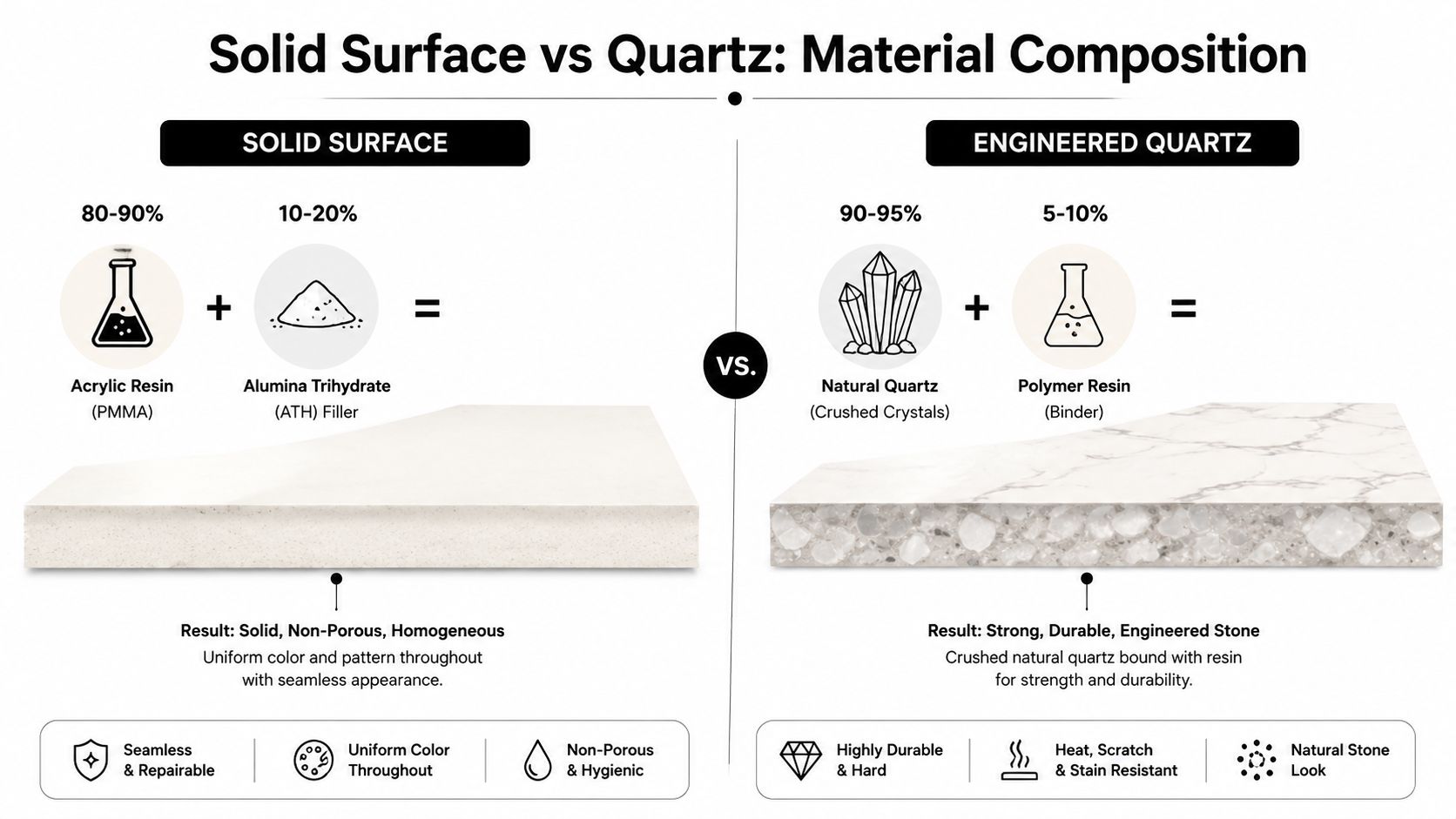
Solid surface is a man-made sheet material built from acrylic or polyester resin mixed with mineral filler. In practice, it's usually about 66% mineral filler and 33% acrylic or polyester resin source. That makeup lets fabricators join pieces smoothly, shape curves, and blend sinks into the top with very few visual breaks.
If you want a plain explanation of the category, see what Corian countertops are. Corian helped make the material familiar to homeowners, but the key point is how it behaves in a room. It stays visually consistent, can be fabricated into continuous runs, and works especially well for coved backsplashes and integrated basins, which is why it shows up so often in bathrooms and utility spaces.
Quartz is engineered, not natural stone
Engineered quartz is not the same thing as granite or marble. It's typically made from about 90–95% natural quartz crystals bound with 5–10% resin and pigments source. That composition gives it the dense, hard feel homeowners usually want in a busy kitchen, while still letting manufacturers control color and pattern more consistently than natural stone.
The key difference is how it is built and how it performs on the counter. Quartz is engineered for appearance and everyday use together. It looks like a slab, but it is manufactured in a factory, not quarried as a single stone block. That is why the finish tends to feel more premium and more predictable from one piece to the next.
Why the composition matters
The composition gap is the whole story. Quartz is generally denser and harder, while solid surface is more workable and easier to reshape. That is why one material usually wins in a kitchen that needs a tougher work surface, and the other wins in a room where fabrication flexibility matters more.
For a Cherry Hill homeowner, the choice gets practical. In a compact South Jersey kitchen, quartz gives you a harder, more finished surface that takes abuse better and keeps a crisp look. In a primary bath remodel, solid surface makes more sense if you want an integrated sink, fewer visual seams, and a cleaner custom look around a smaller footprint. The decision comes down to function-first or finish-first, not a generic materials contest.
If you want the showroom-level shortcut, keep it simple. Quartz behaves like a harder work surface with a stone-like look, while solid surface behaves like a design material that can disappear into the room. Choose the one that matches how the space will be used.
Durability, Heat, and Daily Wear Compared
The surface you'll notice every day
The biggest technical difference is hardness. Quartz is typically around Mohs hardness 7, while solid surface is roughly 2.5 to 3 source. That's a meaningful gap when a kid drags a pan, a cutting board slips, or someone sets a heavy bag down right on the island.
| Solid Surface vs Quartz at a Glance | Solid Surface | Quartz |
|---|---|---|
| Hardness | About 2.5 to 3 Mohs | About 7 Mohs |
| Heat tolerance | About 250 to 320°F | About 680°F |
| Repairability | Sanded, buffed, refinished | Harder to repair the same way |
| Seam visibility | Nearly invisible | Visible, though usually well matched |
| Best daily-use story | Restore, refresh, rework | Resist, protect, hold up |
Quartz also has the edge in scratch resistance. Solid surface can absolutely handle everyday life, but it's softer, so it shows abuse sooner. That's not a flaw if you value repairability, but it is a real trade-off if your kitchen gets hammered all day.
A countertop that gets used hard should be judged by what happens after the third year, not just the first week.
Heat, chips, and seam appearance
In heat terms, independent industry sources commonly place solid surface around 250–320°F, while quartz is often cited around 680°F source. Even so, neither one should be treated like a trivet replacement. Direct contact with very hot cookware can still damage both, so the practical rule is simple. Use hot pads.
For chip and impact behavior, quartz generally feels tougher and more chip-resistant, but it's less forgiving when something does go wrong. Solid surface is easier to sand, buff, and blend back into shape. If you're comparing quartz kitchen work surfaces, this is the part that usually separates “nice to have” from “worth paying for.”
Seams are the final visual difference. Solid surface can be joined so cleanly that the seam nearly disappears. Quartz seams are usually tighter and more color-matched than natural stone seams, but they're still detectable if you know where to look. In a compact Cherry Hill kitchen, that can matter more than people expect, especially around corners, sinks, and small islands.
Real Cost Ranges for a Cherry Hill Kitchen
What the square-foot price really means
Installed quartz countertops can run about $50 to $200 per square foot, with many mid-tier projects landing in the $70 to $100 range and premium brands reaching $100 to $150 per square foot how much quartz countertops cost per square foot. For a 50-square-foot kitchen, that works out to roughly $3,500 to $7,500 total installed cost. Solid surface is often slightly less expensive upfront source.
Start with the installed number, then ask what sits inside it. Edge profile, sink cutouts, cooktop cutouts, backsplash height, and demolition of the old top can shift the final figure more than most homeowners expect. If you are comparing against the upfront price of quartz, make sure you are comparing installed work, not just slab pricing.
Weight, labor, and the little line items
Quartz can weigh about 33% more than solid surface at the same thickness source. That affects handling, transport, and installation logistics, which is why labor can shift even when the materials look close in budget. The slab is only part of the bill. The cost also includes the team moving it, cutting it, fitting it, and making sure the seams and supports are right.
That is also where homeowners sometimes overlook the value of affordable cabinet updates. If the cabinets are structurally fine, spending the whole budget on new counters can be the wrong move. A tighter remodel often pairs a cabinet refresh with the surface that fits the room.
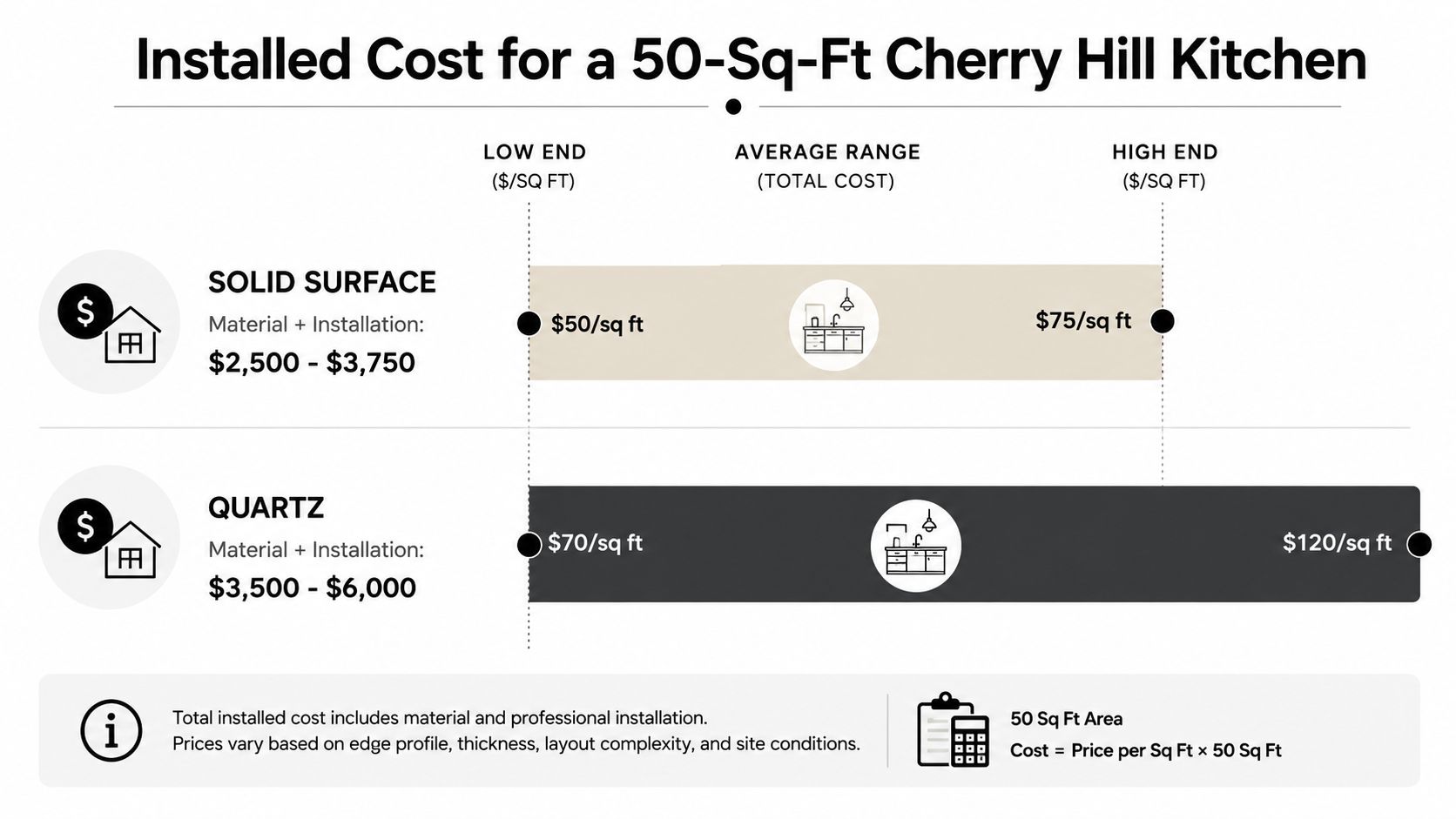
A sample starting point for a Cherry Hill kitchen looks like this. Solid surface, lower installed cost, fewer premium edge add-ons, simpler fabrication. Quartz, higher installed cost, more structural handling, better fit when the room is expected to take real abuse. The right budget is the one that leaves enough room for the parts of the remodel people live with.
Where Each Material Shines in Your Home
Quartz belongs in the rooms that get hit hardest
If I'm standing at a kitchen table with a family that cooks every night, entertains often, and uses the island as a landing zone, I steer them toward quartz. That's the room where scratch resistance, stain resistance, and a harder everyday surface matter most. It's also the better visual if the homeowner wants a stone-like finish that helps the kitchen feel more finished and resales better in the eyes of buyers.
Quartz is the straightforward choice for busy family kitchens, large islands, and prep zones where hot pans, grocery bags, and constant wiping are part of the routine. It suits homeowners who want the counter to disappear into the background as a reliable work surface.
Solid surface is stronger where design details matter
Now for the contrarian take. Solid surface is the smarter material in primary bathrooms, laundry rooms, kids' baths, and many rentals. Those spaces get moisture, routine wear, and a lot of cleaning, but they don't always need the visual weight or hardness of quartz. What they do need is easy repair, custom shaping, and fewer grime-catching seams.
Solid surface also wins when the design calls for a continuous backsplash, a coved transition, or an integrated sink. That's where thermoformed fabrication comes into play, because quartz can't match that same level of curve and continuity. In a compact South Jersey bath, that clean look can make a small room feel calmer and easier to maintain.
My direct recommendation
If the room is a primary kitchen and the countertop has to take daily abuse, choose quartz. If the room is a bath or utility space and the design benefits from surfaces without visible joints or an integrated basin, choose solid surface. That's the cleanest way to think about it, and it usually leads to a better outcome than chasing the material with the loudest reputation.
Maintenance, Repairs, and a 15-Year Outlook
Daily care is easy, but repairability is not equal
For routine cleaning, both materials behave alike. Mild soap and water handle normal messes well, and both should be protected from harsh treatment and direct hot cookware. If you want a practical maintenance mindset, start with the same rule you'd use for any polished surface. Clean it gently, and don't test it unnecessarily.
The difference shows up when the surface ages. Solid surface can be sanded, buffed, and refinished, so scratches and minor wear don't have to become permanent. Quartz is harder to damage in the first place, but when it chips or takes heat damage, it doesn't usually get the same kind of on-site renewal.
What long-term ownership feels like
That's the core ownership trade-off. Solid surface asks you to accept a softer material in exchange for a surface you can restore. Quartz asks you to pay more attention up front in exchange for less day-to-day concern later. If you want a deeper definition of why that matters, see what non-porous means in countertops, because porosity affects how surfaces behave over time.
Ownership truth: Solid surface rewards homeowners who'd rather renew a top than replace it. Quartz rewards homeowners who'd rather leave it alone and let it take the beating.
For stain and water behavior, both are widely treated as low-maintenance surfaces. If you're already frustrated by mineral buildup in other parts of the house, it helps to understand how people approach remove water spots from granite, because the same habit applies here. Wipe spills promptly, avoid abrasive pads, and don't treat the counter like an unlimited heat shield.
The 15-year question comes down to wear tolerance. If you'll notice every scratch and want the top to stay crisp-looking with minimal effort, quartz makes sense. If you'd rather have a surface that can be renewed instead of replaced, solid surface is the more forgiving long-view choice.
A Five-Minute Decision Checklist and Sample Budgets
Run this before you order samples
- Do you cook daily? If yes, quartz fits better.
- Do you use hot pans directly on the counter? If yes, quartz still wins, though you should use trivets either way.
- Do you want an integrated sink or continuous curves? If yes, solid surface is the stronger fit.
- Is resale value a top priority? If yes, quartz usually makes more sense in the main kitchen.
- Is your primary budget under $3,500 for 50 square feet? If yes, solid surface is the safer starting point.
Sample 50-square-foot budget shapes
Quartz-forward kitchen. Higher material spend, stronger fabrication and handling needs, more budget pressure on edge profiles and cutouts. That's the right shape when the kitchen is the centerpiece of the home and the counter needs to be both durable and visually polished.
Solid-surface-forward kitchen. Lower starting cost, more flexibility for custom fabrication, easier integration with a sink or backsplash detail. That's the right shape when the room needs smooth function and the homeowner values repairability over a premium stone look.
A good budget doesn't just ask what the slab costs. It asks what the room needs, what the household will do to it, and which details deserve the money. In Cherry Hill homes, that simple question usually leads to a clearer answer than a generic material ranking ever will.
Book Your In-Home Design Consultation
Bring a rough measurement, a few inspiration photos, a realistic budget range, and a short list of how the kitchen or bath needs to perform. That gives the first conversation enough substance to separate a pretty sample from a surface that fits the room. A mobile showroom visit is especially useful here, because you can compare solid surface and quartz in your own lighting with cabinetry, hardware, and tile samples sitting right beside them.
The Cabinet Coach starts with a complimentary video consultation, then moves into discovery, a site visit, concept development, and a transparent preliminary estimate. That process is useful when you're trying to decide between a bathroom top and a harder-working kitchen slab, because the choices get tested against the actual space instead of a showroom assumption.
If you're weighing solid surface vs quartz for a Cherry Hill kitchen or bath, The Cabinet Coach can walk the room with you, compare the samples in place, and turn the decision into a clear plan. Visit The Cabinet Coach to start a consultation and get a countertop recommendation that fits how your home gets used.