
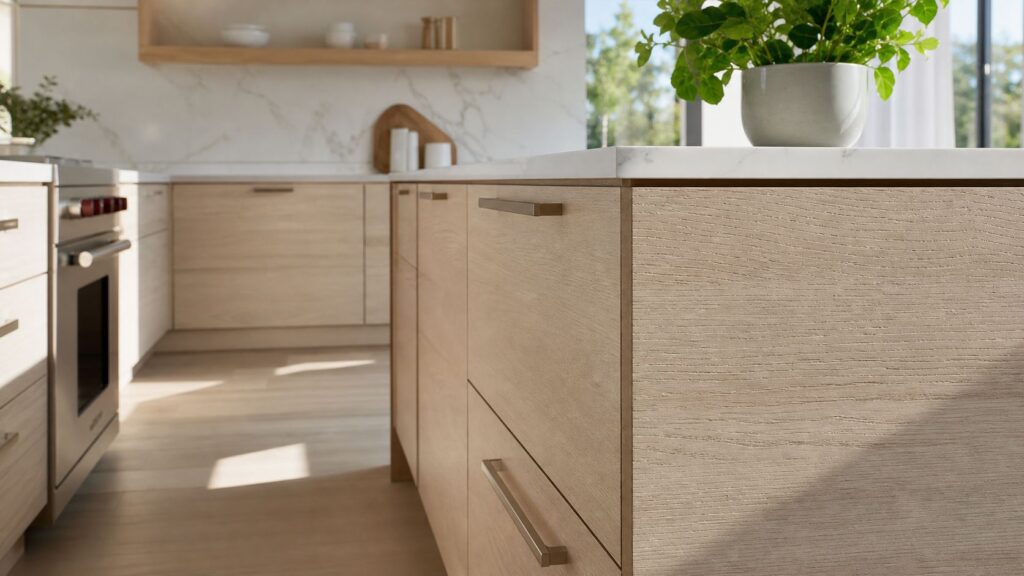
You're standing in a South Jersey kitchen that feels tired, but not broken. The oak is still solid, the layout mostly works, and the room gets used hard every day. The problem is the look. The wood reads warm in a way that feels dated, the room feels heavier than it should, and every catalog photo you save seems to prove that modern oak cabinets can look better than what's in your house now.
That's the decision point. You're not choosing whether oak is “in” or “out.” You're deciding how much oak belongs in the room, what cut of wood keeps it clean, and what needs to change around it so the kitchen feels current instead of nostalgic. In practice, that means balancing species, grain, finish, and layout, then making sure the install holds up when the house starts moving, the humidity changes, and the drawers get used every day.
Table of Contents
- Why Modern Oak Is Back on the Shortlist
- What Modern Oak Cabinets Actually Are
- Finishes, Stains, and How Cabinets Are Built
- The Case for Less Oak, Not More
- Budgets, Timelines, and Layout Traps
- Pairing Oak With Countertops, Hardware, and Color
- How The Cabinet Coach Simplifies the Whole Process
Why Modern Oak Is Back on the Shortlist
A lot of South Jersey homeowners are in the same spot. The kitchen is still functional, but it's carrying too much visual weight, and the old honey-oak look makes the whole house feel more dated than it should. At that point, oak stops being a throwback and starts becoming a design choice again, especially when the goal is warmth without clutter.
That shift isn't just anecdotal. A 2026 industry summary reported that oak cabinetry had regained a 12% market share after years of decline, and it also identified white oak at 51% as a leading professional specification, which tells you where the category is headed, toward lighter, cleaner kitchens rather than the orange-toned oak remembered from the 1980s and 1990s industry summary. The same source also shows how cabinet demand has grown over the long run, with domestic wood furniture shipments overtaken by cabinet shipments over time, which helps explain why cabinetry has become such a major design and construction category industry summary.
The modern version is about restraint
That's why I don't treat modern oak cabinets as a trend piece. I treat them as a balancing problem. The wood should read calm, not busy. The room should feel brighter, not wood-heavy. And the cabinet profile should support that clean read instead of fighting it.
You can see the same direction in broader market data. One industry source placed the global kitchen cabinet market at USD 91.07 billion in 2025 and projected growth to USD 124.42 billion by 2031 at a 5.36% CAGR market report. The same report also noted that wood finishes were at 29% of kitchens in the 2026 Houzz Kitchen Trends Study, up six points year over year, while the NKBA 2026 Kitchen Trends Report found 59% of design professionals saw wood grain as a growing trend and 51% said white oak was their preferred species market report.
Practical rule: if the room already feels dark or heavy, don't add more oak by default. Start by deciding where the wood belongs, then strip out whatever makes the kitchen feel visually crowded.
That's the mindset I use when I'm talking through a remodel with a homeowner in Cherry Hill, Haddonfield, or anywhere else in the area. The question isn't whether oak can look modern. It can. The essential question is whether the room can carry it without losing light, breathing room, or a clean sightline. South Jersey kitchen trend guidance
What Modern Oak Cabinets Actually Are
Modern oak starts with the wood itself, but it doesn't end there. You're really dealing with species, grain architecture, and door profile, and those three choices decide whether the cabinets read contemporary or stuck in another decade. If you only look at the finish color, you'll miss the part that controls the visual result.
Species and grain do the heavy lifting
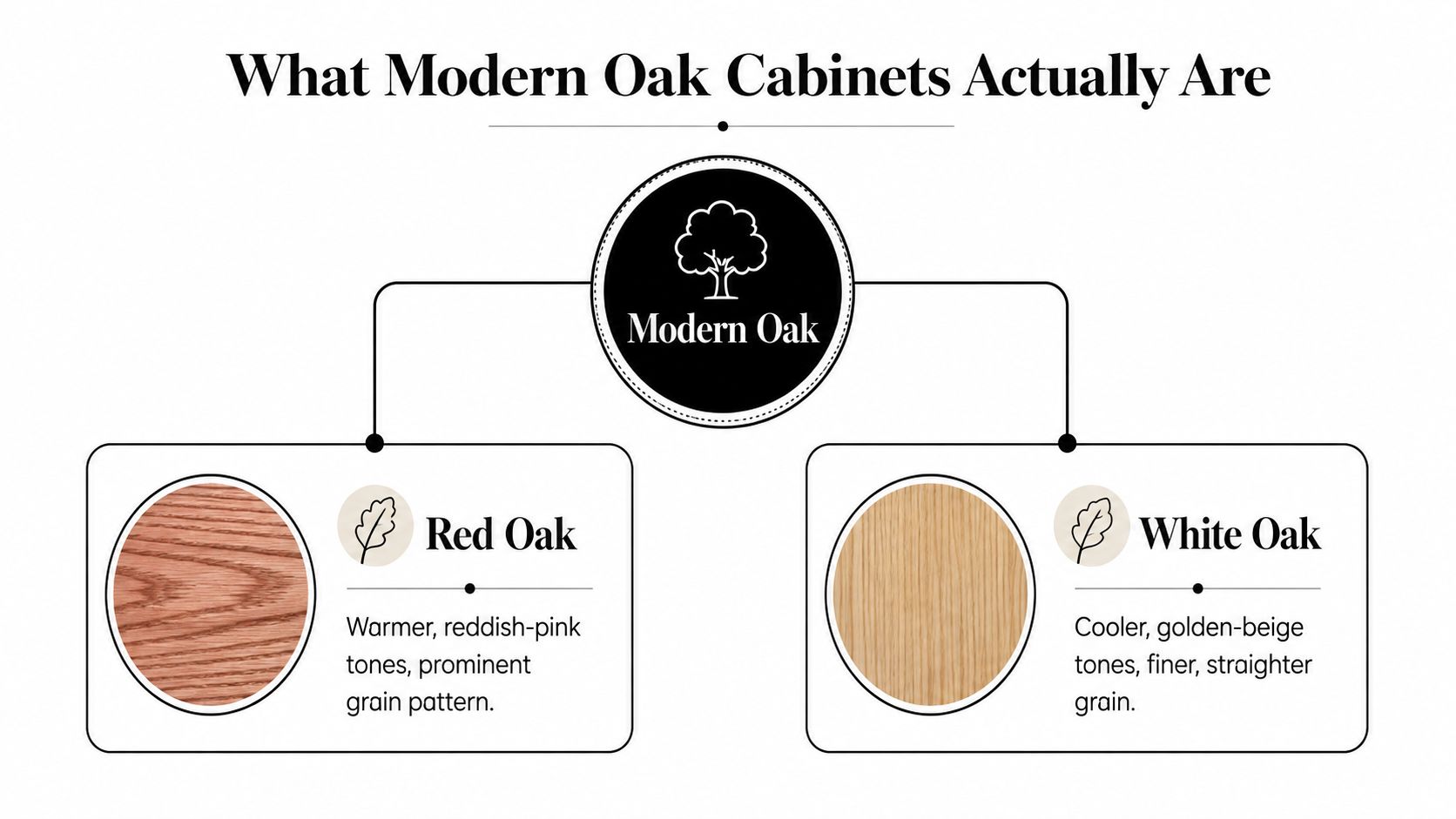
In plain English, white oak usually reads lighter and cleaner than red oak. That's why it dominates modern specs, especially when designers want a calmer surface with less visual noise. The tighter, straighter grain also helps the wood feel more architectural, which is why it's the safer choice for a modern kitchen.
Think of rift-sawn oak like a freshly combed field, the lines run more parallel and the surface looks disciplined. Flat-sawn oak is more dramatic, with cathedral arches that can be beautiful but often feel older and busier in a kitchen. If you want a contemporary read, rift-sawn white oak is the move.
If you want a useful comparison outside cabinetry, the same grain logic shows up when people compare white oak flooring options, because the cut and grain are what make the surface feel calm or active.
The door style has to match the grain
The best modern profiles are simple. A slab front gives you the cleanest read, a tight Shaker can still work if the rails and stiles stay restrained, and handleless fronts push the look even further into contemporary territory. The more visible the grain, the more important it is that the door shape stays quiet.
Oak looks modern when the surface reads like a plane, not a pattern.
That's why white oak shows up so often in handleless kitchens and slim Shaker designs. The wood is doing enough work on its own, so the profile shouldn't compete. If you need a visual starting point, the key is to think about whether you want the grain to disappear into the room or become the room's main feature.
A practical way to shop is to speak in those three knobs, species, cut, and door profile. If a cabinet line can't tell you what kind of oak it uses, how it's cut, and what the face detail looks like, keep moving. For a broader look at warm wood styling, this guide on warm wood kitchen cabinets is useful because it shows how oak can sit inside a larger palette instead of carrying the whole room alone.
Finishes, Stains, and How Cabinets Are Built
The finish system matters as much as the species. I've seen beautiful oak ruined by a heavy color and average oak rescued by a restrained finish. If you want a modern result, your first filter should be simple, avoid anything that makes the grain look orange, muddy, or overworked.
Finish choices that support a modern look
Natural and light oak finishes are the easiest wins because they keep the grain visible without turning it loud. Medium stains can work in the right house, but they need more discipline in the rest of the room. Fumed oak can look rich, but it pushes the kitchen toward moodier territory fast, so I only reach for it when the rest of the palette is very light.
Painted finishes and cerused oak can both be good in the right design, but they solve different problems. Painted uppers or perimeter cabinets reduce the wood load, while cerused treatments bring out the grain and can read more decorative than minimal. If your goal is a modern, airy kitchen, I'd rather see a lighter oak face paired with simpler surrounding materials than a heavily processed oak treatment trying too hard to look current.
| Finish | Look | Best Door Profile | Pairs Well With |
|---|---|---|---|
| Light natural oak | Clean, airy, warm | Slab or tight Shaker | White quartz, brushed nickel |
| Medium stain | Fuller tone, more classic | Tight Shaker | Honed stone, matte black |
| Fumed oak | Deep, moody, architectural | Slab | Pale walls, minimal hardware |
| Cerused oak | Open grain, textured, decorative | Slab or refined Shaker | Simple counters, restrained tile |
Build quality decides whether the look lasts
Construction is where a lot of quote sheets get vague, and that's a mistake. Independent cabinet specs commonly use 3/4-inch solid wood face frames, 1/2-inch plywood sides, 3/4-inch plywood shelves, and 6 mm to 3/8-inch back panels, with adjustable shelves often set in 32 mm increments for hardware compatibility and load tuning cabinet specifications. That hybrid approach matters because the face frame carries a lot of the alignment load, while the plywood carcass gives you better dimensional stability than all-solid-wood construction cabinet specifications.
For South Jersey, that stability matters. Humidity and seasonal swings can turn a sloppy build into a maintenance problem fast. I want factory finishes, sealed interiors, and compliance-minded materials like CARB P2 / EPA TSCA Title VI construction, because the finish system and the carcass both have to resist moisture and movement white oak cabinet guide.
| What to ask for | Why it matters |
|---|---|
| Factory-applied finish | More consistent protection than site-applied work |
| Plywood carcass | Better stability than all-solid builds |
| Sealed interior surfaces | Better moisture resistance and easier cleanup |
| CARB P2 / EPA TSCA Title VI compliance | Helps control emissions in the home |
| Soft-close concealed hinges | Easier field adjustment and cleaner reveals |
For cabinet color and stain decisions, this paint-and-stain cabinet guide is helpful because it shows how the finish decision changes the whole room, not just the box.
The Case for Less Oak, Not More
The mistake I see most is simple. A homeowner thinks the answer to dated oak is more oak, more matching wood, and more visual continuity. That usually makes the kitchen feel heavier, not newer.
Wood load is the real issue
Wood load is the total amount of wood your eye has to process when you walk into the room. If the cabinets, island, trim, and open shelving all land in the same tone, the kitchen stops breathing. That's when oak starts to feel stubborn instead of intentional.
The better move is usually subtraction. Remove some upper cabinets. Switch the island to a lighter finish. Break up a long wall of oak with stone, paint, or open space. The point isn't to hide the wood, it's to let the wood look deliberate instead of overwhelming.
A modern kitchen usually looks better when the oak is edited, not multiplied.
That's especially true in older kitchens where the original honey oak dominates everything. I've seen those spaces come alive when the design team pulled back on the wood and gave the room cleaner contrast. The cabinets didn't need to disappear, they needed room to breathe.
Contrast beats sameness
If you want oak to read current, pair it with a contrast that's quiet, not loud. Think lighter countertops, simpler door profiles, and a palette that lets the grain stay visible without becoming the whole story. Generic advice often says to “warm it up,” but that's the wrong instinct if the room already feels wood-heavy.
The broader industry also supports restraint. Modern oak spaces tend to work best when they're mixed with lighter materials, not when every surface is matched for the sake of unity. That's why I'd rather remove visual mass than keep stacking wood on wood.
For a practical budget angle on refinishing versus replacing, the Melbourne cabinet refinishing cost guide is a useful reference point if you're trying to decide whether your current oak should stay and be reworked or get replaced outright. Locally, the same principle applies. Don't rebuild around a finish problem if the layout and the existing boxes are already worth keeping.
If you want a style reference that leans modern without overdoing the wood, the roundup on top modern cabinet styles for South Jersey homes is a good place to calibrate your eye before you start ordering materials.
Budgets, Timelines, and Layout Traps
Oak looks simple in a mood board and complicated in a quote. That's because pricing depends on how much of the kitchen you're changing, how much is custom, and how many layout problems need to be solved before the cabinets even hit the truck. If you're trying to plan responsibly, start with the tier of build you need, not the one that sounds nicest.
What the money usually follows
Stock cabinets are the fastest path, but they give you the least control over grain, sizing, and finish. Semi-custom gives you more flexibility on widths, heights, and species choices, which is where a lot of modern oak projects land. Fully custom is what you choose when the room has odd corners, tricky appliance spacing, or a strong design vision that can't be forced into standard boxes.
Because labor, selections, and site conditions vary, I won't pretend there's a clean universal number for every remodel. The takeaway is this, the more you care about grain quality, corner efficiency, and a modern look, the more likely you are to move beyond stock. That's also where the market scale matters, since kitchen cabinets sit inside a very large category and even style shifts influence real budget decisions market report.
Here's the timeline I'd plan around for a kitchen with modern oak cabinetry.
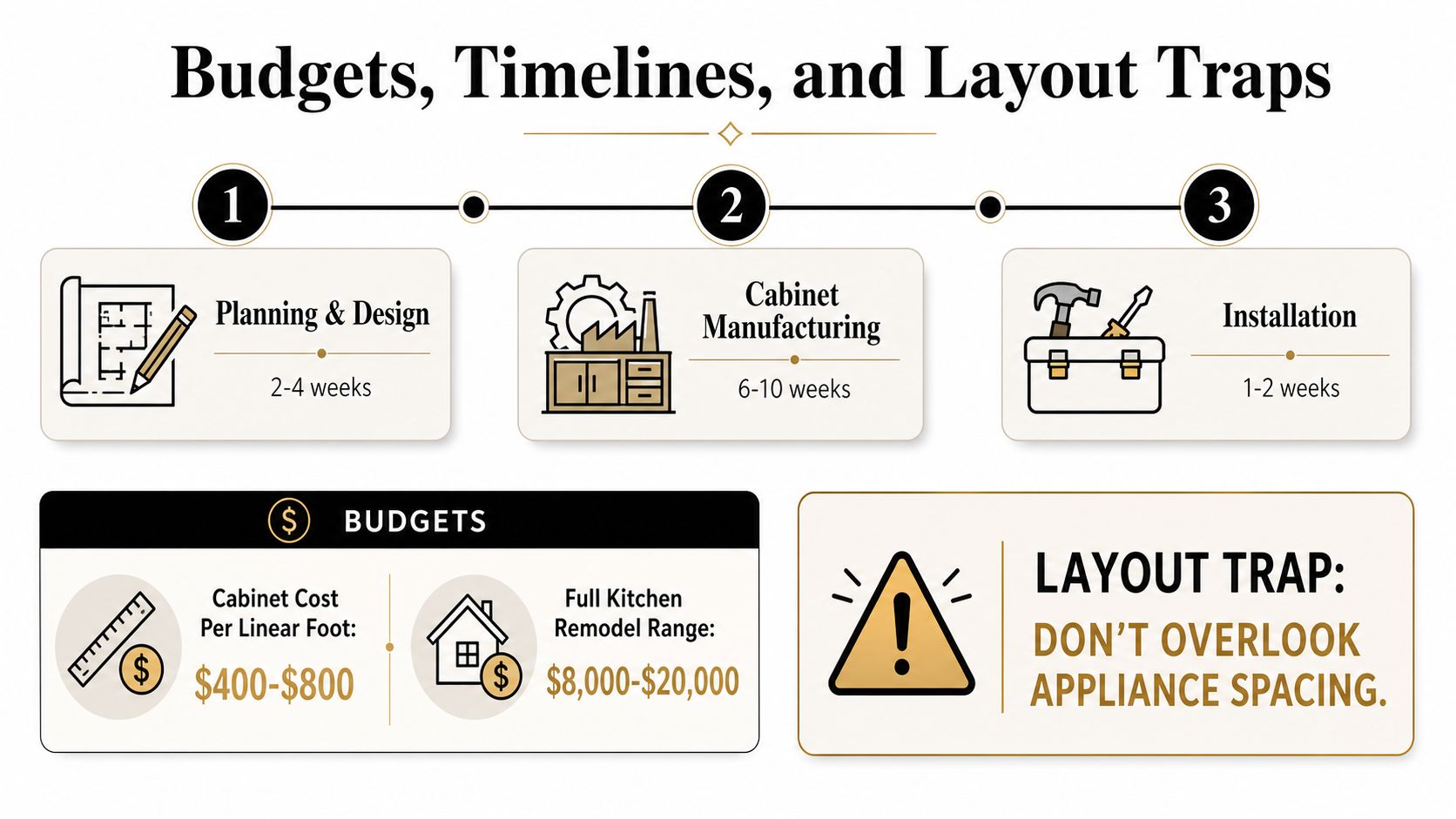
- Planning and design. Two to four weeks is normal for measuring, refining the layout, and locking in the finish direction.
- Cabinet manufacturing. Six to ten weeks is a realistic window once the order is finalized.
- Installation. One to two weeks is typical for cabinets, adjustments, and the final fit-out.
Budget rule: the cleaner the plan, the fewer expensive surprises you get once walls are opened and trades start working in sequence.
The layout traps that waste space
Corners are where good kitchens go to die if nobody checks them early. Blind corners create dead zones that swallow usable depth, and lazy Susans give you access but trade away capacity. Frameless construction can recover several inches of interior access compared with face-frame cabinets at the same exterior size, so construction type matters when the room is tight corner cabinet guidance.
That's why appliance spacing matters too. If the refrigerator, range, or dishwasher openings are off by even a little, the whole run starts feeling cramped, and the pretty oak face won't fix it. For South Jersey homes, I want the cabinet layout settled before anyone gets sentimental about finishes.
If you're coordinating a full project, the service model behind kitchen and bathroom remodeling is useful because the cabinetry has to be designed in step with the rest of the trades, not after them.
Pairing Oak With Countertops, Hardware, and Color
Oak works when every other choice supports it. If the counter fights the grain, the hardware disappears, or the wall color darkens the room, the cabinets lose the clean, modern read you were paying for. I want the rest of the palette to make the wood look calmer, not busier.
Countertops should quiet the grain
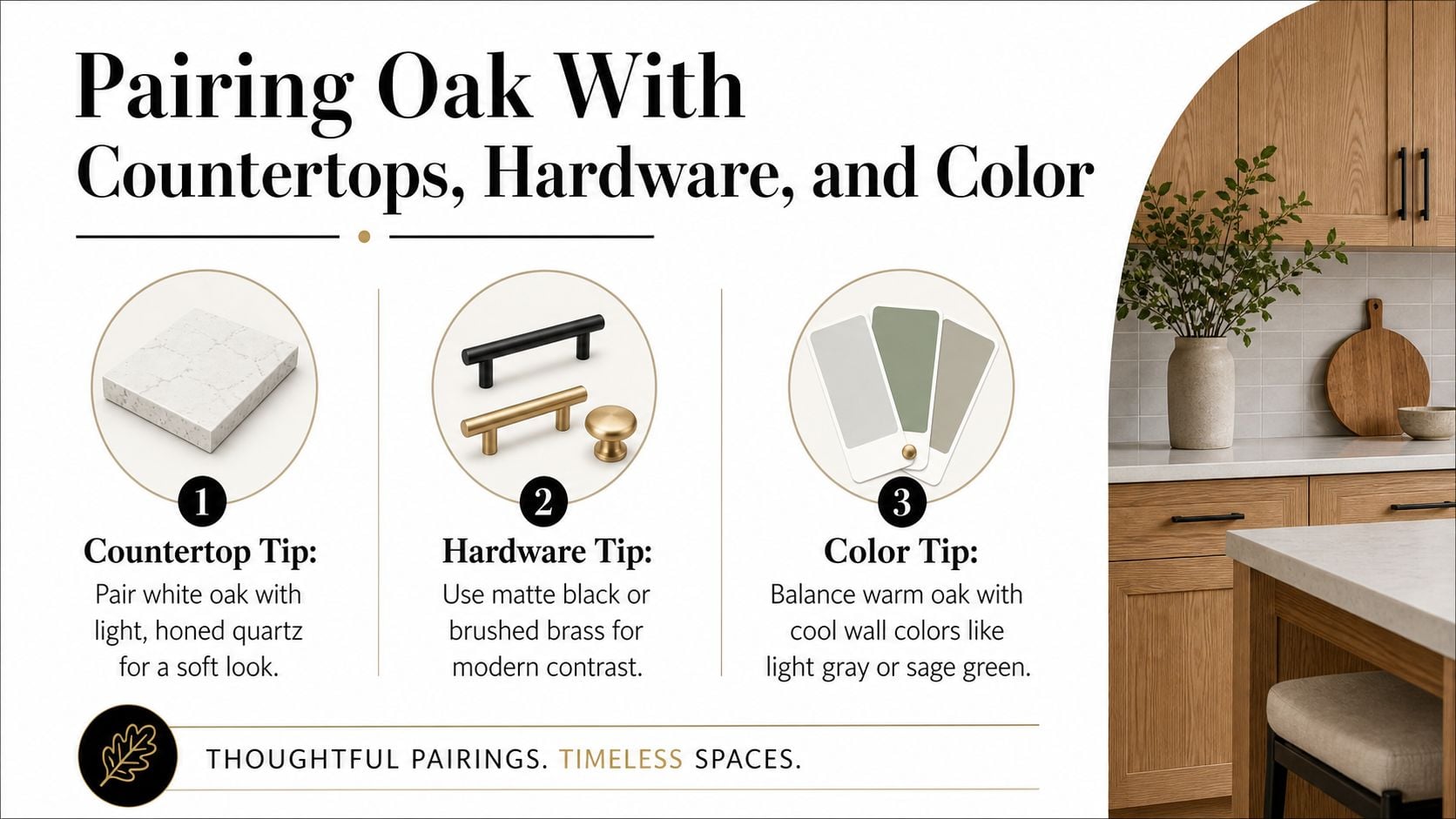
The safest matches are quartz with subtle veining, honed marble, and warm quartzite. Those surfaces give you movement without chaos, which matters because oak already brings texture. Busy high-contrast stone tends to compete with the cabinet face, especially when the grain is active.
Hardware needs the same restraint. Long bar pulls work well on drawers, integrated pulls can clean up the look even more, and brushed nickel or matte black usually gives the most reliable modern result. I don't want shiny hardware calling attention to itself if the oak is already doing visual work.
For lighting coordination, the guide on designing your dream kitchen lighting is useful because light placement changes how the grain reads after dark, which matters more than most homeowners expect.
Color should keep the room open
Walls and backsplashes should protect brightness. That usually means softer, cooler support colors rather than earthy tones that double down on the wood. If the oak is warm, let the room around it be lighter and quieter so the cabinets stay grounded without making the kitchen feel closed in.
If the countertop has a lot of movement, the oak should stay calmer. If the oak grain is the star, the rest of the room should know its place.
That's the whole coordination problem in one sentence. The best modern kitchens don't try to make every material equally important. They assign jobs, and oak gets the right amount of attention without letting the whole room become wood-on-wood theater.
How The Cabinet Coach Simplifies the Whole Process
A lot of homeowners get stuck because they're trying to choose cabinets, counters, and layout from separate tabs on a laptop. The smarter route is to bring the samples and the plan into the same conversation. That's where a mobile showroom process earns its keep, because it lets the design happen in the context of your actual space.

The Cabinet Coach process starts with a complimentary video consultation, then moves to a discovery and site visit, concept development, a transparent preliminary estimate, and design refinement. After that, product choices get finalized, architects and trades get coordinated, and the project is managed through completion. That sequence matters because it addresses the same risks covered above, budget uncertainty, corner planning, finish selection, and trade coordination.
A modern oak cabinets project goes wrong when the homeowner approves a pretty finish before the layout is solved. This process flips that problem around. The space gets measured, the cabinet samples get seen in the home, and the final product choices are made after the constraints are clear.
The first call goes smoother if you have your rough dimensions, a few inspiration images, a working budget target, and notes about what already drives you crazy in the kitchen. Bring the pain points, not just the pretty screenshots, because the layout decisions will be stronger when the designer knows what has to change.
Here's the bottom line. If you want oak to feel modern in a South Jersey kitchen, make it lighter, cleaner, and more deliberate than the old versions you're trying to leave behind. The Cabinet Coach can help you sort the layout, the finish, and the construction details in one process, so you're not guessing at the parts that matter most once the remodel is underway.