
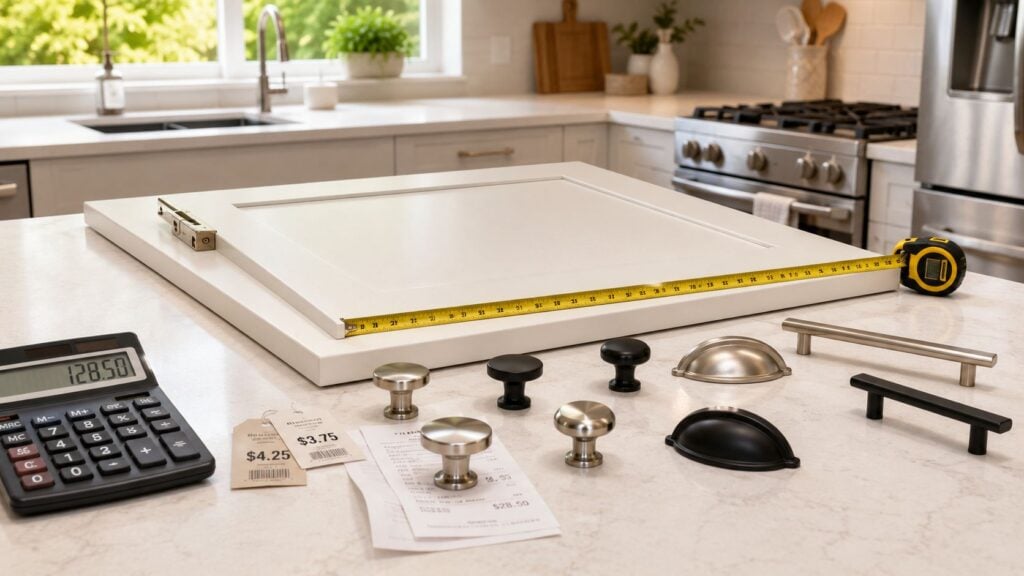
Most Cherry Hill homeowners should expect $120 to $2,400 for a typical 25- to 35-piece hardware swap, with the national average around $300 for a full cabinet-hardware project. If your quote is drifting toward the high end, that usually means the job has moved beyond a simple swap and into alignment, drilling, or retrofit work.
That's the part many homeowners miss when they stand in a half-finished kitchen with a box of pulls on the counter. One pull looks cheap. A full kitchen of them, especially when you mix builder-grade pieces with one or two statement handles, can turn into a real line item fast.
Table of Contents
- What Cabinet Hardware Installation Really Costs in 2026
- Breaking Down the Numbers Per Knob, Handle, and Drawer
- Materials vs Labor Where Your Money Actually Goes
- What Drives the Price Higher and Lower
- DIY vs Hiring a Pro in South Jersey
- Sample Estimates for Cherry Hill and Surrounding Counties
- Smart Questions to Ask Before You Sign a Quote
- Budgeting With Confidence and Getting a Real Number
What Cabinet Hardware Installation Really Costs in 2026
A Cherry Hill homeowner can fall in love with a $40 builder-grade pull or a $140 designer pull and still miss the cost. The hardware itself is only half the story. The labor to measure, drill, align, and keep every reveal line consistent is what turns a small refresh into a meaningful budget item.
Professional installation is usually priced as a per-piece labor job, not a full-project cabinet expense. Major cost guides put labor at $5 to $30 per piece and show a typical full project around $300 overall, with a wide repeatable project range of $100 to $10,000 depending on scope and complexity. For a kitchen with 20 to 40 handles, the installed total often lands between $120 and $2,400 Angi's cabinet hardware installation cost guide.
The kitchen that makes the price make sense
A lot of South Jersey quotes get clearer once you stop thinking in terms of “hardware” and start thinking in terms of openings. One drawer front, one door, one pull location, that's one decision point and one labor action. If the installer has to template, mark, drill, and correct for a mismatch, that piece starts behaving like a mini task instead of a quick add-on.
That's why a small kitchen can still surprise you. The quote climbs when the work includes more doors, more drawers, and more chances for the installer to correct old hole patterns or uneven fronts. A kitchen that looks modest on paper can become a $1,500 or $4,000 line item once the work touches more surfaces and requires more precision.
If you're mapping the bigger renovation, it helps to keep cabinet hardware in the same mental bucket as other finish decisions. A useful budgeting companion is sample kitchen remodel budgets from Task Masters Inc., because hardware rarely lives alone once you start comparing cabinet, finish, and trim costs.
Practical rule: if the quote sounds cheap, check whether it includes drilling, removal of old pieces, and fixing mismatched hole patterns.
Breaking Down the Numbers Per Knob, Handle, and Drawer
What an opening really means
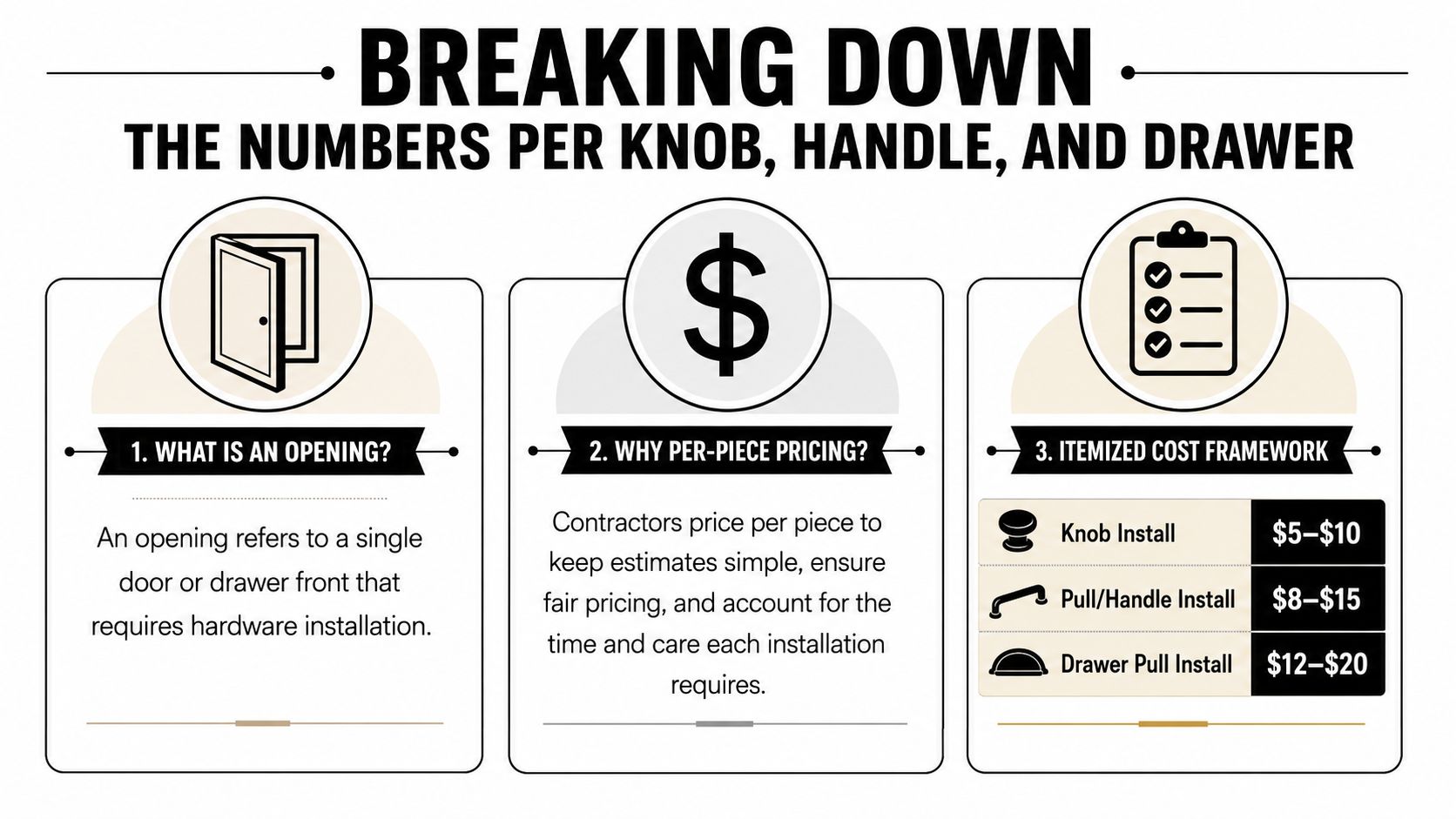
An opening is one door or one drawer front. Installers price by opening because each one needs its own measurement, mark, drilling, and alignment check. That keeps the quote tied to real labor instead of a vague room total.
That matters the moment you compare bids. One contractor may say per knob, another may say per handle, and a third may say per cabinet. In a hardware-only job, those phrases can point to the same thing, but they can also hide different labor assumptions and different levels of prep.
The placement rules matter too, especially if you are laying out pulls and knobs yourself. Use The Cabinet Coach cabinet hardware placement guide as a reference, because where each piece lands affects both the look and the consistency of the install.
How different pieces change the bill
A basic knob swap is the least disruptive job. A standard 3-inch pull is still straightforward, but it usually demands tighter template control than a single knob because the holes need to land clean and level. An 8-inch appliance pull on a tall pantry is a different job, since the larger piece requires more precise drilling and usually more care in handling.
Larger pulls do not just cost more to buy, they slow the install down.
Installer pricing often follows that reality. Independent guides break labor into roughly $2.50 to $4.75 per piece for basic knobs and standard 3-inch pulls, and $8 to $12 per piece for large appliance pulls or specialty hardware CountBricks cost guide. If your kitchen mixes small upper-cabinet knobs with oversized island pulls, the average can hide the true total.
Here is the cleanest way to read a quote. If you see a number per knob, per handle, or per drawer, ask what work is included in that unit. If you see a per-cabinet price, confirm whether that means one front, one pair of doors, or one full opening. The unit matters more than the label.
Materials vs Labor Where Your Money Actually Goes
A kitchen quote can look inflated because the homeowner is staring at the hardware price tag instead of the actual split. The parts are easy to shop. The labor is where the installer makes or loses money, and that is what decides whether a quote is fair.
A 2026 cabinet-cost guide puts hardware at $4 to $12 per piece for builder-grade, $15 to $40 for midrange, and $40 to $150+ for designer hardware. In a typical 25-linear-foot kitchen, that often means 25 to 45 pieces, so the hardware budget can run from about $100 to $5,000+ depending on finish and tier FinHome Contracting's 2026 cabinet cost guide.
Shopping the hardware separately
You can save real money by choosing simpler finishes and standard sizes. You cannot save your way out of labor if the job still needs precise drilling and clean alignment. A quote that looks high on product can still be fair overall if the install is clean and the hardware is consistent.
The same guide notes 2026 labor rates of roughly $50 to $90 per linear foot for straightforward replacement and $80 to $150 per linear foot for renovation work that involves layout changes or plumbing relocations FinHome Contracting's 2026 cabinet cost guide. That is cabinet-project language, but the point carries over. Once the installer is working around other trades, the hardware line stops being an isolated task and starts behaving like part of a bigger remodel.
The Cabinet Coach also offers how to choose cabinet hardware, and that matters because the finish tier you pick affects both materials and handling time. Simpler hardware is easier to source, easier to match, and easier to replace if one piece arrives damaged.
Why labor quotes still swing
| Materials vs Labor by Hardware Tier | Per-Piece Hardware | Total Hardware (30 pcs) | Labor Estimate | Combined Total |
|---|---|---|---|---|
| Builder-grade | $4 to $12 | $120 to $360 | $150 to $900 | $270 to $1,260 |
| Midrange | $15 to $40 | $450 to $1,200 | $150 to $900 | $600 to $2,100 |
| Designer | $40 to $150+ | $1,200 to $4,500+ | $150 to $900 | $1,350 to $5,400+ |
This table is more useful than a single quote range because it shows where the money is going. If hardware cost climbs and labor stays steady, you are paying for finish and style. If labor climbs too, the job has probably moved beyond a basic swap and into a more involved install. That is the part South Jersey homeowners miss when they budget by piece alone.
What Drives the Price Higher and Lower
The hidden costs most homeowners miss
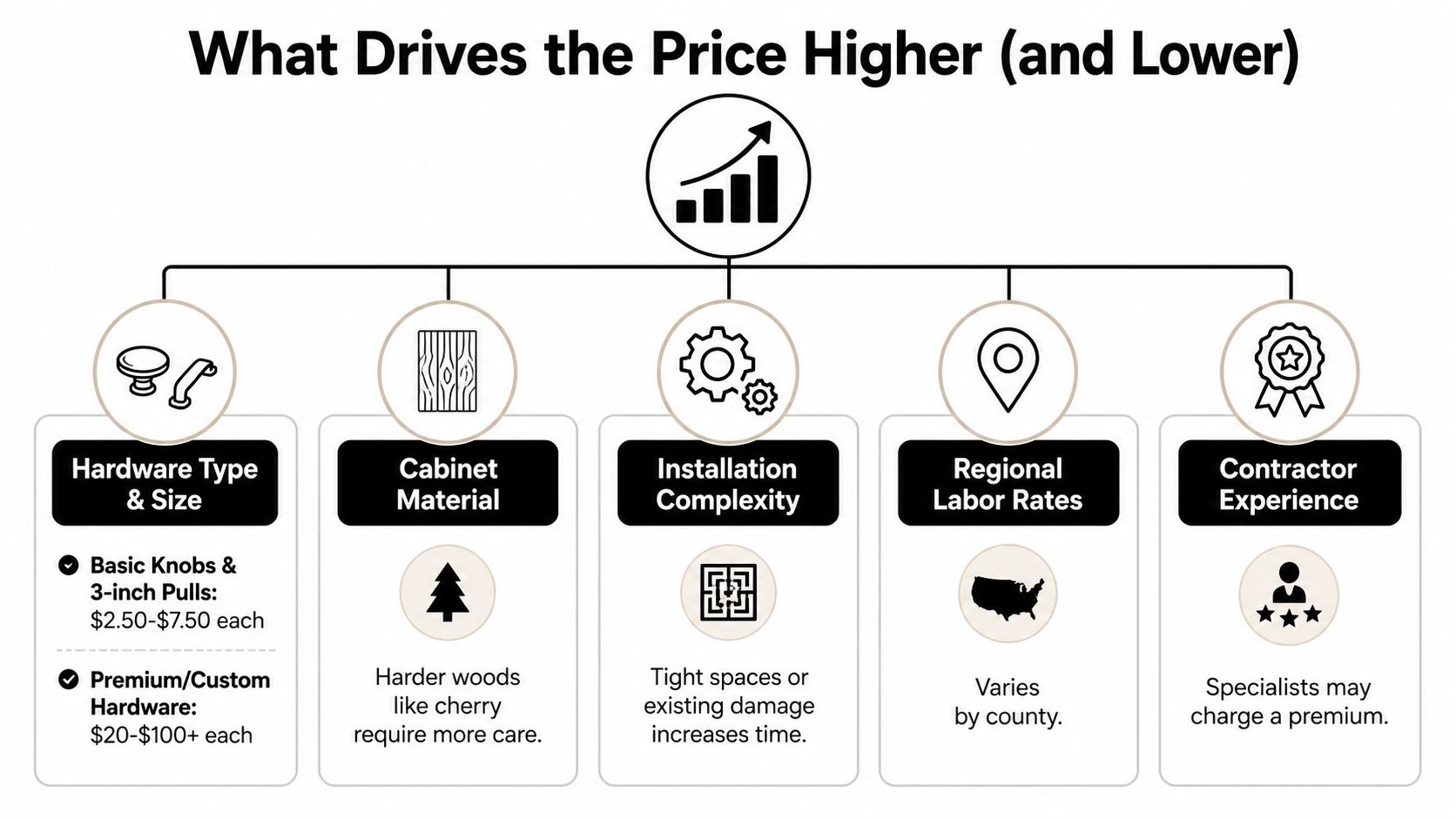
Walk into a South Jersey kitchen with mismatched pulls, tired doors, and a few extra surprises under the finish, and the hardware quote stops looking simple. Hardware type and size are the first price lever. Basic knobs and 3-inch pulls usually stay in the lower labor band, while large appliance pulls and specialty pieces push the price up because the installer has to control the template more carefully and drill with more caution. That is the difference between a quick swap and a job that demands patience.
Cabinet condition comes next. A clean, newer kitchen is easier to work on than a 1990s layout with worn doors, crooked hole patterns, and old repairs hidden under paint. Harder woods and damaged surfaces demand more care, and that care shows up in the bill.
A quote gets expensive fast when the installer has to fix the cabinet, not just hang the hardware.
Removal and retrofit work also change the number. If old hardware has to come off, if the existing hole pattern does not match the new piece, or if the doors need patching before drilling, the job stops being a fast swap. Backplates add another alignment step, and soft-close adapters turn a hardware job into a hinge-and-drawer-slide conversation. If you are weighing that kind of upgrade, review soft-close cabinet hardware before you sign anything. Once soft-close enters the scope, you are deciding how much of the cabinet movement system gets touched.
You can also watch this short explainer if you want a visual sense of why some installs take longer than others.
Regional labor rates and contractor experience round out the list. In South Jersey, the same hardware can cost more or less depending on the installer's workflow, how many trips the job requires, and whether the quote assumes clean replacement or a partial retrofit. The smartest move is to treat mixed kitchens as tiered jobs, not as one averaged piece count.
DIY vs Hiring a Pro in South Jersey
A DIY hardware install looks cheap until you buy the tools. You'll want a template, a drill guide, a self-centering bit, and a marking gauge if you care about consistent placement. If you've never done a full kitchen before, a 30-piece kitchen can eat a full weekend easily.
The failure modes are predictable. Misaligned reveals make the kitchen look sloppy. Thermofoil doors can splinter if you push the drill too hard. A cracked drawer front wipes out the savings fast because replacement parts aren't cheap and the fix usually takes longer than the original job.
When the weekend project stops being cheap
A professional installer brings on-site templates, finish-safe bits, and a repeatable process for keeping handles level across different cabinet styles. That consistency is what homeowners are paying for, not just the act of putting metal on wood. A pro also gives you a cleaner path if a hole pattern needs correction mid-job.
The Cabinet Coach's how to install cabinet hardware resource fits this decision point well, because it shows how much precision the work demands. Once you see the steps in order, it's easier to tell whether you're equipped to do it yourself.
If you're the kind of homeowner who already owns the right tools and has a steady hand, DIY can make sense. If you're trying to match pulls across a full kitchen while worrying about finish damage, hiring out is usually the smarter spend. The price of a mistake is often higher than the labor you were trying to avoid.
My rule: if the cabinet doors are expensive, painted, or already patched once, let a pro drill them.
Sample Estimates for Cherry Hill and Surrounding Counties
Pattern matching your own kitchen
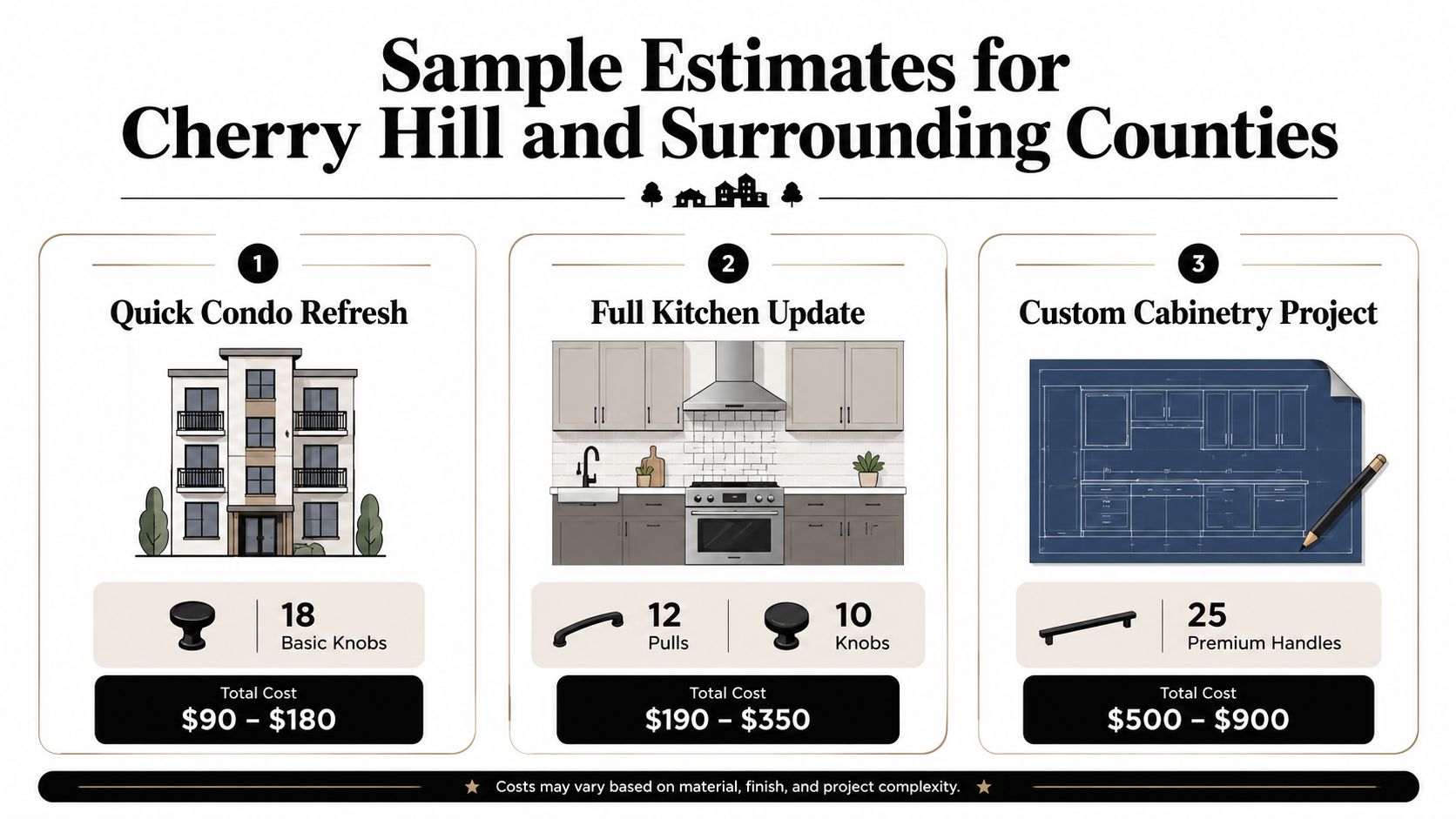
A quick refresh in a Cherry Hill condo is the easiest case to read. With 18 basic knobs, builder-grade zinc pulls, and no drilling changes, the installed number usually stays in the modest range because the labor is simple and the hardware is basic. That's the kind of job where the quote should feel controlled, not mysterious.
A midrange Evesham or Mount Laurel kitchen tells a different story. Once you mix knobs and 3-inch pulls across 32 pieces and work on freshly refinished doors, the installer has more surfaces to protect and more alignment to maintain. The price climbs because the job needs more care, not because the hardware is exotic.
A designer retrofit in Moorestown or Haddonfield is where homeowners get the biggest surprise. Oversized appliance pulls, backplates, and soft-close adapters all add handling and setup time, so the quote can move quickly from “looks manageable” to a true renovation number. That's where finish coordination starts to matter as much as the pull itself.
For a broader remodel context, kitchen remodeling cost breakdown helps you see how hardware fits into the rest of the cabinet budget. And if the project also involves new task lighting over the island or under the uppers, a lighting installation electrician is the kind of trade you'd want lined up before the final hardware pass.
Sample pricing infographics like this can be misleading if you read them too casually, because they flatten different levels of finish into one neat row. Use them as pattern matches, not promises. The final number depends on how much the installer has to correct, protect, and coordinate.
Smart Questions to Ask Before You Sign a Quote
The quote traps that blow up budgets
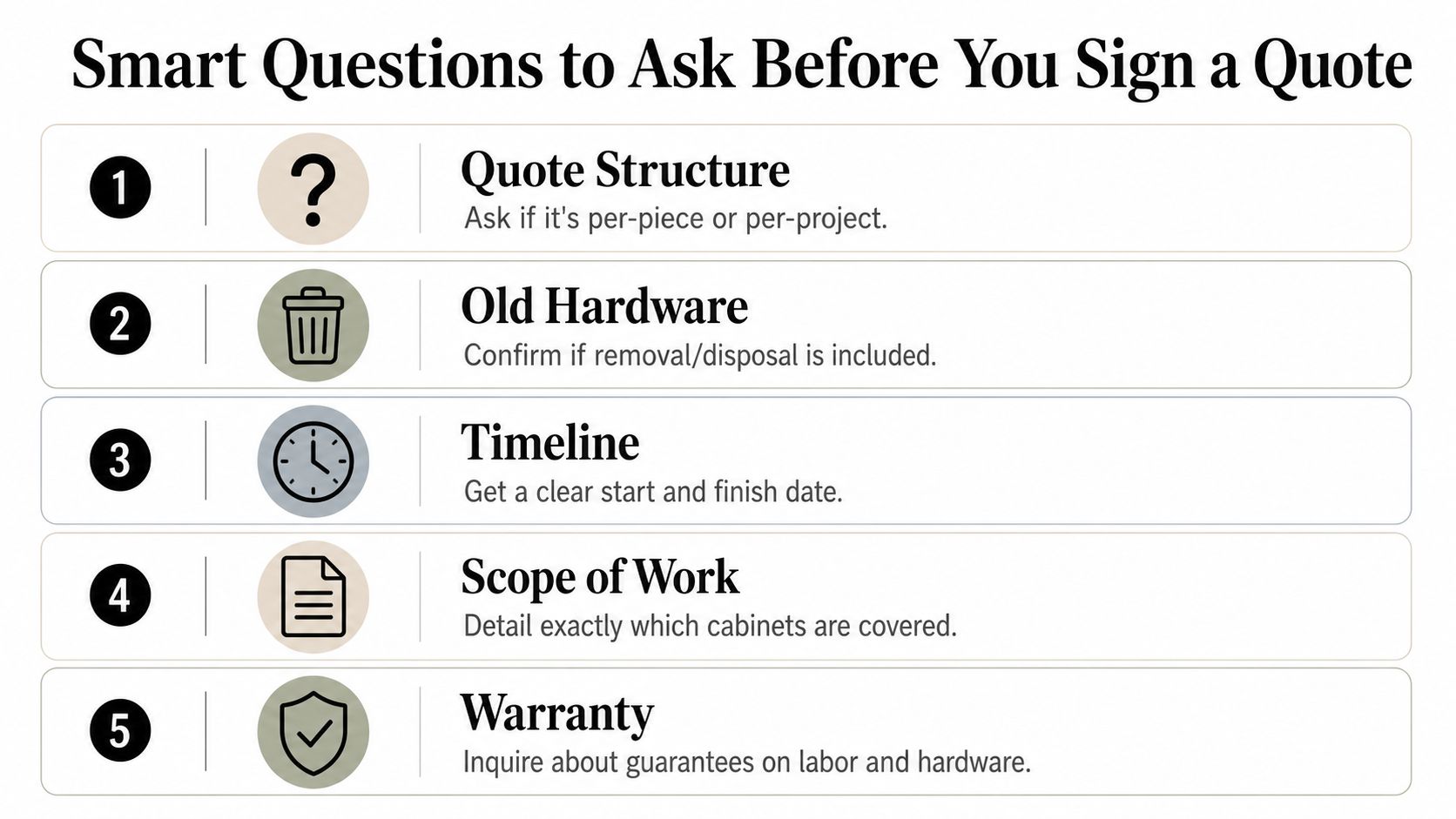
Start with the structure of the quote. Ask whether it's per-piece or per-project. A per-piece quote is easier to audit and usually safer for the homeowner because you can see how the total was built.
Then ask about old hardware. Removal and disposal are often omitted from a clean-looking bid, and that omission can add friction once the work starts. If the installer says old pieces are “included,” make sure that covers taking them down, patching visible damage if needed, and hauling them away.
A good quote tells you what happens when the new pull doesn't match the old holes.
Ask who supplies the drill template and whether the quote covers touch-up if the finish chips during drilling. That's not a picky question, it's a cost-control question. A missing template or an unplanned patch can add time, and time is what pushes a labor quote out of range.
You should also ask about soft-close adapters if you're considering them. These can change the quote from a straightforward hardware swap into a more involved cabinet adjustment job, so the installer needs to spell out exactly what's included.
In South Jersey, ask one more thing that homeowners outside the region often skip, whether the installer is registered and insured in New Jersey. That matters for liability and warranty coverage, and it tells you whether the contractor is set up to work cleanly in this market. The cheapest quote on paper isn't useful if the contractor can't stand behind the work.
Budgeting With Confidence and Getting a Real Number
The fastest way to budget cabinet hardware is simple. Count the openings, choose the hardware tier, and add a cushion for surprises. Then decide where you want the nice pieces, usually the island or the range pull, and where you can save, usually the uppers and pantry.
That split works because not every opening deserves the same hardware spend. The eye lands on the island first, then the main prep wall, then the less visible cabinets. Spend where you'll notice it every day, and keep the rest clean and consistent.
The Cabinet Coach uses a mobile showroom model, so homeowners can compare cabinet finishes, hardware, and related materials in their own lighting instead of guessing from a display wall. That's a useful way to avoid overbuying pieces that look right in a store but wrong in a real kitchen. The process starts with a complimentary video consultation, then moves into a preliminary estimate built around the actual scope.
If you're in Cherry Hill or anywhere in South Jersey, that's the right next step. Get the kitchen measured, get the hardware tier matched to the cabinet condition, and stop treating this as a tiny accessory decision. The line item is small only if you keep the scope small.
If you want a clear, local number for your own kitchen, start with The Cabinet Coach and book a complimentary video consultation. They work through cabinetry, hardware, and finish choices in one place, which makes it easier to see where your cabinet hardware installation cost is really headed before you sign anything.