

In South Jersey, installed quartz countertops usually land between $70 and $150 per square foot, and broad national pricing for quartz runs from $50 to $200 per square foot installed, with most homeowners spending $70 to $100 per square foot for typical projects. Quality tier, fabrication complexity, and who installs it are the biggest reasons that number moves.
If you're searching for how much are quartz countertops per square foot, you're probably doing what most homeowners do at the start of a kitchen remodel. You open five tabs, see five different answers, and none of them help you build a real budget for Cherry Hill, Haddonfield, Moorestown, or anywhere else in South Jersey.
That confusion is normal. Online pricing mixes material-only quotes with installed pricing, leaves out cutouts and removal, and rarely reflects what Northeast labor costs. The result is a number that sounds useful but falls apart the second you ask for a real estimate.
A better way to look at quartz is simple. Start with the installed square-foot range. Then look at the grade of quartz, the edge detail, the number of cutouts, and whether your fabricator is giving you a clean, realistic quote or a teaser price that grows later.
Table of Contents
- Starting Your Kitchen Project The Search for a Real Price
- The True Cost of Quartz Per Square Foot Installed
- Key Factors That Drive Your Final Countertop Cost
- Example Quartz Countertop Estimates for South Jersey Kitchens
- Smart Ways to Manage Your Quartz Countertop Budget
- Get a Precise Quote The Cabinet Coach Process
Starting Your Kitchen Project The Search for a Real Price
A South Jersey homeowner starts with a practical question. “How much are quartz countertops per square foot?” That sounds straightforward until the search results start throwing out low teaser numbers, premium showroom numbers, material-only numbers, and vague “starting at” pricing with no context.
One homeowner in Cherry Hill might be budgeting for a standard L-shaped kitchen and expecting a clean white quartz with a simple eased edge. Another in Collingswood might be trying to fit a smaller condo kitchen into a tighter renovation budget. Both type in the same question, and both get answers that are too broad to trust.
That's the problem. The internet gives ranges. Your kitchen needs a quote.
Practical rule: If a price doesn't clearly say installed, it's not useful for budgeting a real kitchen remodel.
The smarter approach is to build the budget in layers:
- Start with installed pricing: Material-only numbers don't tell you what the project will cost.
- Match price to quality tier: Builder-grade and premium quartz aren't the same product, even when photos make them look close.
- Account for job conditions: A simple run with one sink opening costs less to fabricate than a kitchen with multiple corners, cutouts, and detailed edges.
- Get local planning help early: A realistic remodeling budget gets easier when your cabinet layout, countertop choices, and finish decisions are coordinated from the start.
If you're still shaping the full renovation budget, this guide on how to plan a kitchen remodel is a useful place to tighten the numbers before you choose materials.
Why South Jersey homeowners get stuck
The sticker shock usually isn't from quartz itself. It comes from discovering that the advertised square-foot number didn't include fabrication details, labor conditions, old top removal, or backsplash work.
That's why homeowners feel like prices are all over the map. In reality, the market is fairly understandable once you separate slab quality from fabrication and installation. Do that, and quartz pricing stops feeling mysterious.
The True Cost of Quartz Per Square Foot Installed
A South Jersey homeowner usually starts in the same spot. One website says quartz is affordable, another says it is luxury, and neither number looks anything like the quote that shows up after measurements. For a real kitchen budget, use installed pricing.
Quartz countertops typically run $50 to $200 per square foot installed, with many projects landing around $70 to $100 per square foot, according to American Quartz & Granite's quartz countertop cost guide. That same source places builder-grade quartz at $50 to $60 installed, commercial grade at $60 to $80 installed, and premium quartz at $80 to $100+ installed. It also notes that labor often accounts for $20 to $40 per square foot, or roughly 30 to 40% of the total, while material makes up the rest.
Those national numbers are useful. They are not specific enough to plan a South Jersey remodel without help from someone who knows the local fabricators, lead times, and labor conditions.
What the installed number actually means
Installed quartz is the only number that matters because countertops are custom work. You are paying for the slab, field measurements, shop fabrication, cutouts, edge finishing, delivery, and installation. A cheap material number without that work attached is just a teaser.
Quality tier matters too. Builder-grade quartz usually gives you simpler colors and more repetitive patterning. Mid-range selections are the sweet spot for many South Jersey kitchens because they balance appearance and price. Premium quartz costs more for a reason. The visuals are cleaner, the patterns look more natural, and the finished kitchen usually reads more custom.
If you want quartz that makes the whole kitchen look better, skip the cheapest slab on the rack. Mid-range or better is usually the right call.
Quartz Countertop Cost in South Jersey Per Square Foot Installed
| Quartz Tier | Description | Estimated Cost Per Sq. Ft. |
|---|---|---|
| Builder's Grade | Basic colors and more budget-driven selections | $50 to $60 installed |
| Commercial Grade | The middle of the market and the most practical choice for many kitchens | $60 to $80 installed |
| Premium | Cleaner visuals, stronger aesthetics, and high-end selections | $80 to $100+ installed |
| Complex or highly customized projects | Premium material plus design complexity, upgrades, and labor-heavy fabrication | Can move toward the upper end of the $50 to $200 installed range |
For many South Jersey kitchens, the practical target sits in the middle of that table. Costs climb fast when the job includes a large island, multiple seams, waterfall sides, full-height backsplash work, or fussy cutouts around sinks and cooktops.
A standard 30-square-foot kitchen installation averages about $3,000 to $4,500, though full project totals can range from $1,000 to $12,000 depending on kitchen size and fabrication complexity, based on the same source cited above.
If you want to compare quartz against other materials before you commit, this guide to countertop costs per square foot by material and installation level gives you a clearer apples-to-apples view.
In South Jersey, the best way to avoid guesswork is to tie the quartz choice to the cabinet layout early. That is exactly why The Cabinet Coach brings the mobile showroom to you. You can look at samples in your own light, match them to your cabinet finish, and get pricing that reflects your kitchen instead of a generic internet range.
Key Factors That Drive Your Final Countertop Cost
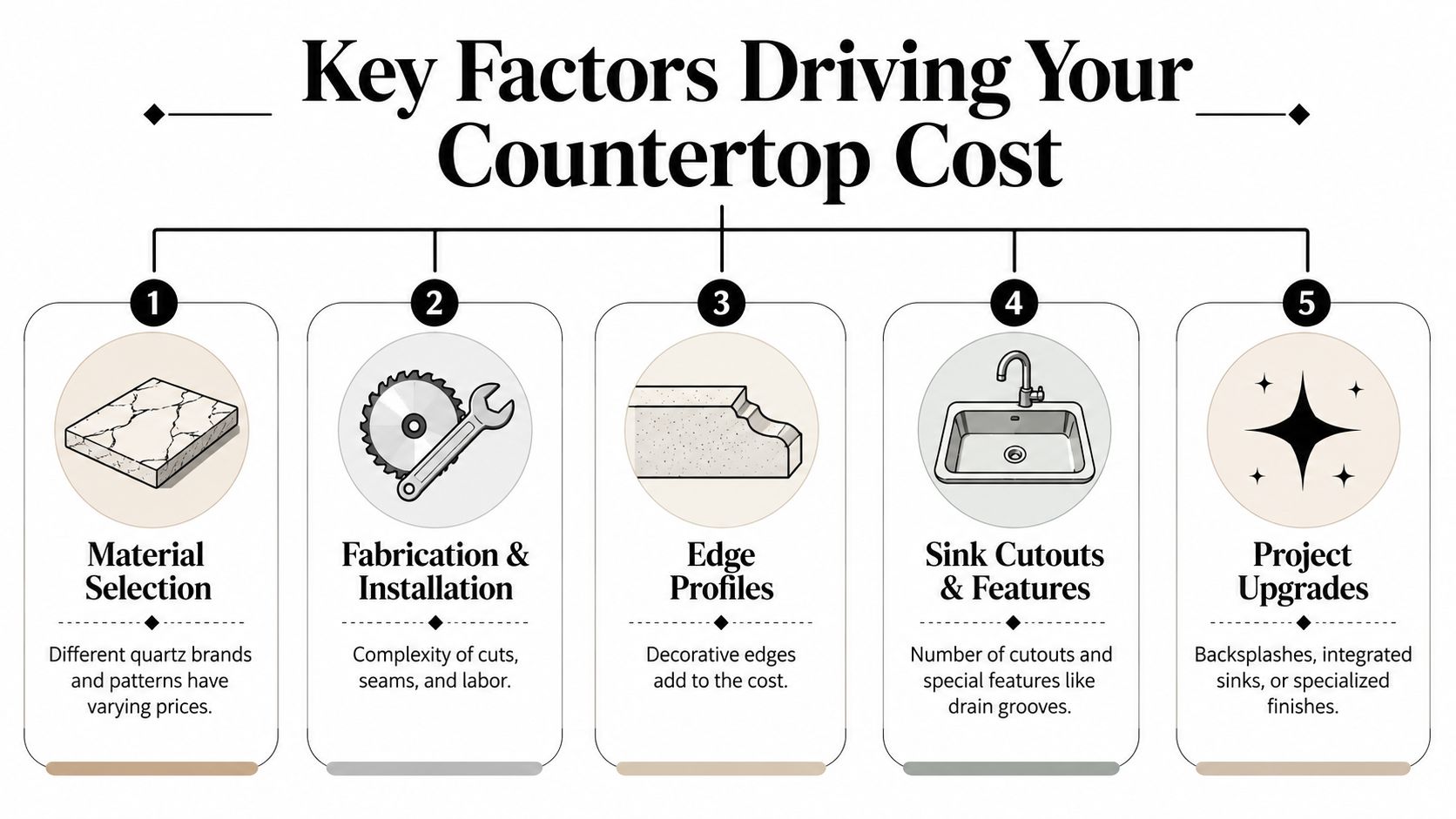
The fastest way to blow a South Jersey kitchen budget is to price quartz by square footage alone and assume the rest will sort itself out. It won't. The final figure depends on the layout, the fabrication work, the install conditions, and the add-ons that never show up in a basic online calculator.
Why online square-foot calculators miss the mark
A homeowner in Moorestown and a homeowner in Texas can both type in the same kitchen size and get the same internet estimate. They will not get the same real quote. South Jersey pricing reflects Northeast labor rates, fabrication schedules, delivery logistics, and the fact that many homes here have older walls, tighter entries, and less forgiving conditions than a brand-new suburban build.
That is why two kitchens with similar square footage can end up far apart on price. One may have a straight run with one sink cutout. The other may need an island slab, a cooktop opening, extra seam planning, and careful fitting against imperfect walls.
The biggest cost drivers are usually practical, not mysterious:
- Layout complexity: Corners, long spans, narrow sections, and large islands increase fabrication time.
- Cutouts and drilling: Undermount sinks, cooktops, faucets, soap dispensers, and accessory holes add labor.
- Edge profile: A simple eased edge keeps the project on budget. More detailed shapes cost more to fabricate. If you want to compare styles before you decide, review these countertop edge profile options for quartz kitchens.
- Material selection: Brand, color consistency, veining, and slab availability all affect the final number.
- Installation conditions: Older homes, tight stairways, small door openings, and out-of-level surfaces can add time and handling.
South Jersey homeowners should pay close attention to the last point. A quote that looks cheap on paper can get expensive fast if the fabricator did not account for access, leveling issues, or awkward field conditions.
The upgrades that change the quote fast
The extras are where many countertop budgets get off track. Old top removal, plumbing disconnects, backsplash work, specialty cutouts, and upgraded edges often sit outside the headline square-foot price. Caesarstone notes that tear-out commonly adds cost, and quartz backsplashes are typically priced separately from the main countertop slab, not rolled into one flat installed number, as noted earlier.
Ask for a line-item quote. That is the simplest way to see whether you are comparing real proposals or just comparing slab prices.
A trustworthy quote shows included work, optional upgrades, and any item that can change after field measure.
My advice for South Jersey kitchens is simple. Choose the quartz color first, keep the edge profile restrained, and get the layout measured before you make assumptions about total cost. Better yet, use a local process that brings samples to your home and prices the job around your actual cabinets, lighting, and floor plan. That is how you avoid the guesswork that wastes time and money.
Example Quartz Countertop Estimates for South Jersey Kitchens
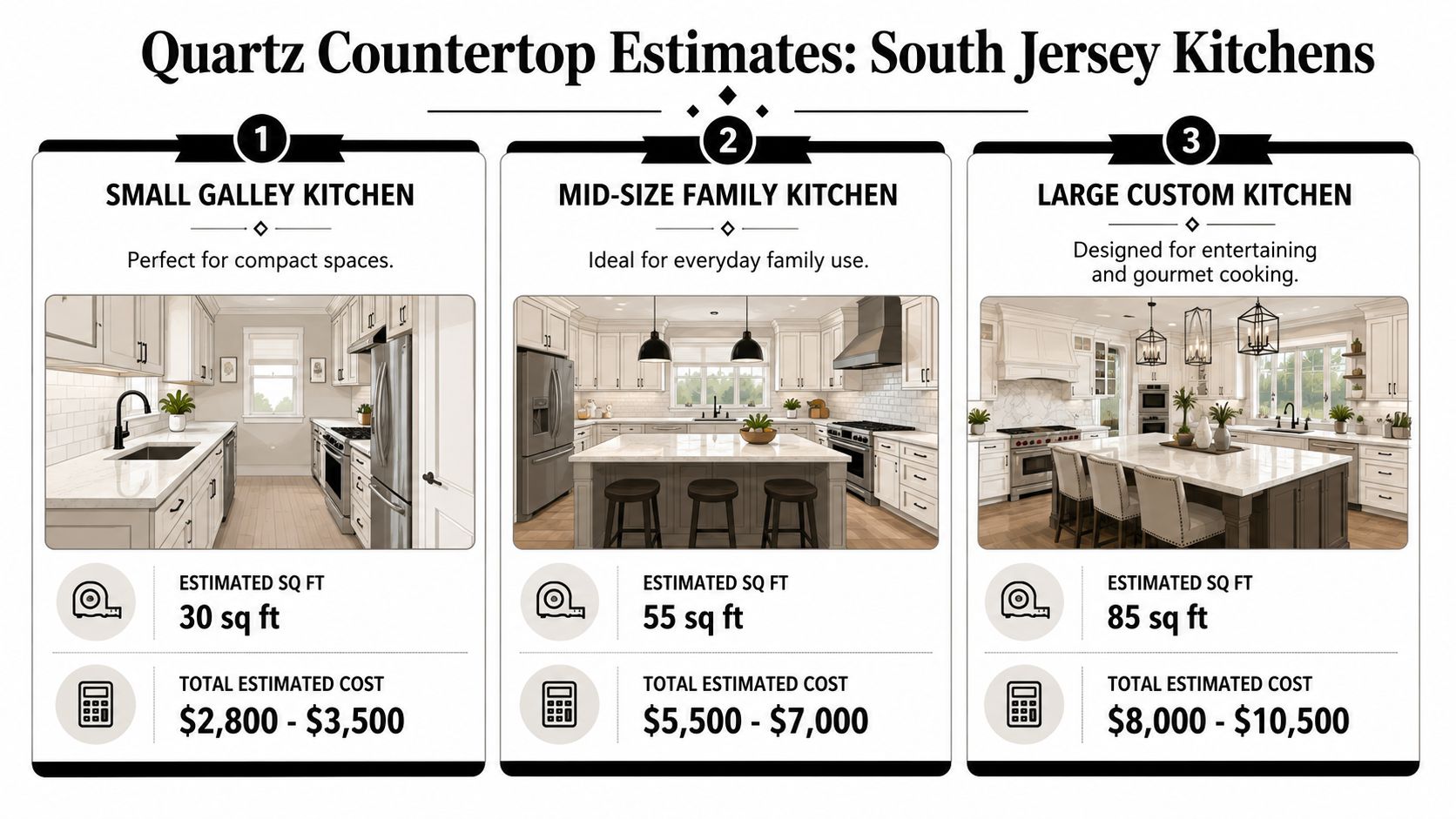
You are standing in your kitchen in Marlton or Medford, looking at old laminate tops, and every online article keeps throwing out a national average that does not help you make a decision. What you need is a realistic South Jersey range tied to kitchen size and layout.
Use these examples for budgeting. Then get the kitchen measured in person. That is the point where guessing stops, especially when a mobile showroom can bring samples to your house and price the job around your actual cabinets, lighting, and floor plan.
Small galley kitchen
A small galley kitchen usually gives you the best shot at keeping quartz affordable. In many South Jersey condos, townhomes, and older row-style homes, the footprint is compact enough that you can choose a good-looking quartz color without letting the total run wild.
If the layout is straight, the edge is simple, and you are not adding a full-height splash or special cutouts, this type of kitchen usually stays toward the lower end of the installed range discussed earlier. The catch is access. In older homes, tight hallways, narrow stairs, and uneven walls can eat into the savings fast.
The right move here is simple. Pick an in-stock color, keep the edge profile clean, and avoid paying premium money for a pattern that barely has room to show.
Mid-size family kitchen
This is the kitchen most South Jersey homeowners call about. Think Cherry Hill, Voorhees, Haddonfield, Washington Township. A main sink run, an L-shape or U-shape, maybe a small overhang for seating. Big enough for material choice to matter. Small enough that smart decisions still control the quote.
This size kitchen usually lands in the middle of the quartz budget range if you stay disciplined. A standard thickness, standard edge, and a popular color keep the project grounded. Costs rise when homeowners start stacking upgrades that sound minor on their own, such as a large single-bowl sink cutout, a mitered edge, a full quartz backsplash, or a pattern that requires better slab matching.
My advice is blunt. For a family kitchen, spend money where you see it every day. Put it into the color and overall look, not fancy edge work which often ceases to be noticed after a week.
Large kitchen with island
Large kitchens create the biggest pricing swings. The square footage matters, but the cost jump usually comes from design choices. A big island, waterfall panels, dramatic veining, extra overhang support, and multiple seam decisions can push a quartz quote up quickly.
Homeowners who stay on budget usually make one clear call early. They choose the feature that deserves the splurge. In most South Jersey homes, that is the island. Then they keep the perimeter counters more practical.
A smart plan looks like this:
- Use a solid mid-range quartz on the main perimeter runs.
- Reserve the premium pattern for the island if that is the visual focal point.
- Skip decorative edge upgrades unless they match the style of the whole kitchen.
- Review the full slab layout before approving waterfall ends or wraparound splash details.
If you are still deciding between materials, this guide on how much it is to install granite countertops is a useful side-by-side comparison for South Jersey homeowners who want to weigh price, appearance, and maintenance.
Smart Ways to Manage Your Quartz Countertop Budget
The best budget strategy isn't “buy the cheapest quartz.” That usually leads to disappointment. The right strategy is choosing where the money is evident.
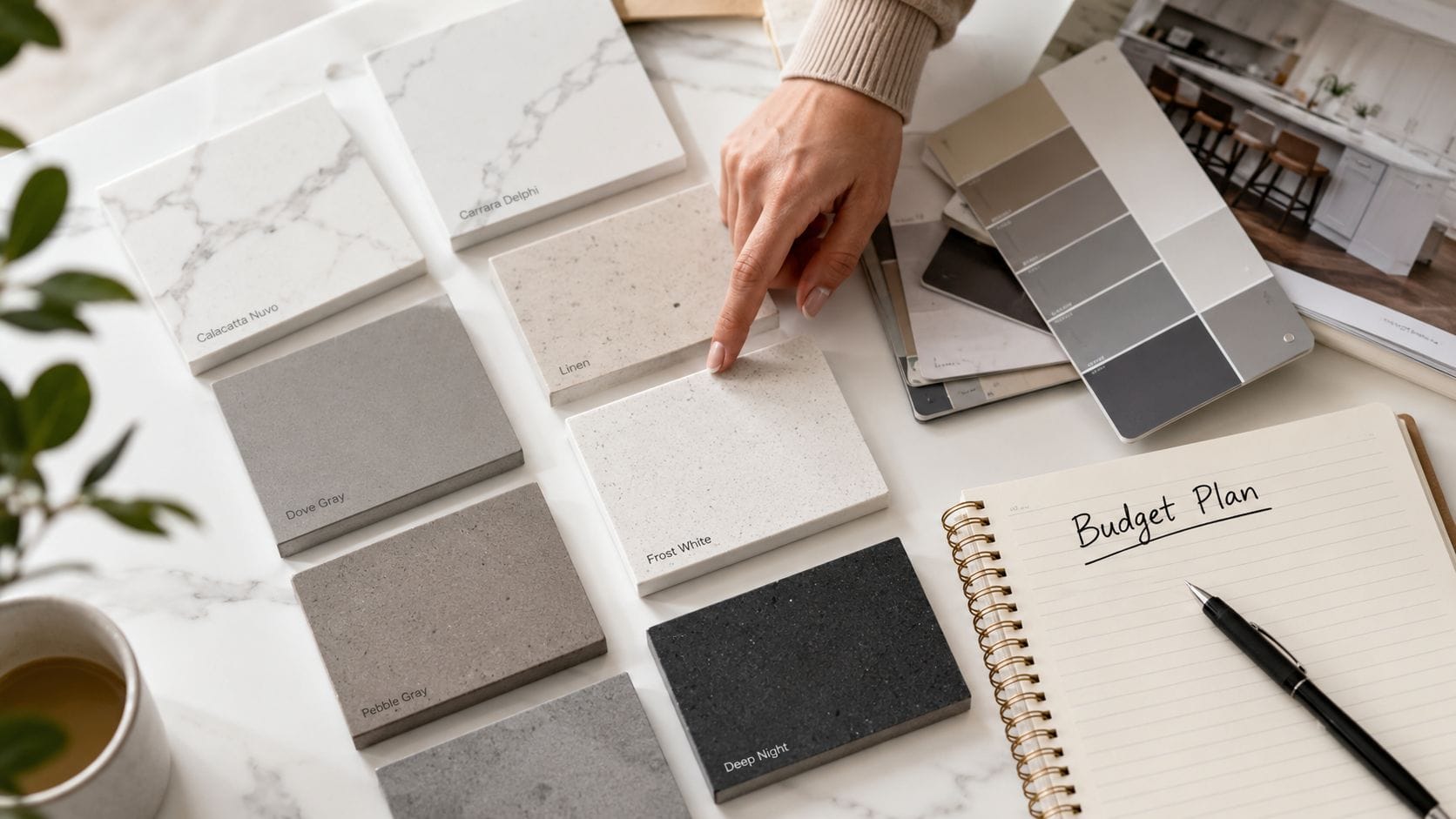
A kitchen can look high-end without loading every possible upgrade into the quote. Most homeowners get better results by staying disciplined on the fabrication side and selective on the visual side.
Where to save without making the kitchen look cheap
Start with the easy wins.
- Choose in-stock colors: Standard whites, soft grays, and popular marble-look patterns are usually easier to source and easier to price.
- Use a simple edge: An eased edge looks clean, current, and intentional.
- Keep the layout efficient: Better planning reduces awkward seams and wasted slab area.
- Skip unnecessary matching surfaces: Not every kitchen needs a full quartz backsplash.
- Ask about remnants for smaller areas: Bars, laundry spaces, and vanities may not need a full slab commitment.
If financing is part of the project, review your options before you lock in materials. This guide to kitchen remodel financing can help you match your countertop decisions to the larger renovation budget.
Don't chase the lowest advertised quartz price. Chase the best-looking finished kitchen within the number you can live with.
Where it pays to be selective instead of cheap
There are also places where cutting cost too hard backfires.
Cheap-looking quartz usually shows itself in the pattern repeat, the lack of depth, or the way the slab reads under natural light. If your kitchen gets a lot of daylight, spend more attention on the actual sample and less on the marketing photo.
Fabrication quality matters too. A beautiful slab can still look mediocre if the seams are poorly placed or the edge finish feels rough. If you want a better sense of what good decision-making looks like during a remodel, this video is worth a few minutes.
A few practical priorities usually produce the strongest result:
- Spend on the surface you see first. The island or main run often deserves the better pattern.
- Protect the install quality. This isn't the place to gamble on the cheapest labor.
- Coordinate with cabinets and lighting. Quartz never exists in isolation. It looks different next to warm white cabinets than it does next to a cooler painted finish.
Get a Precise Quote The Cabinet Coach Process
The reason homeowners keep searching how much are quartz countertops per square foot is simple. They want one reliable number they can trust before the remodel starts.
They usually don't get it from broad online ranges. They get it from a process that measures the room, looks at the layout, narrows the material choices, and tests samples in the actual home. That's especially important in South Jersey, where older homes, mixed lighting conditions, and unique kitchen footprints can change both design decisions and pricing.

A better quote process does a few things well:
It narrows choices in the real room
Quartz samples look different under showroom lights than they do in your kitchen. Seeing options next to your floor, paint, cabinet finish, and hardware cuts out a lot of bad guesses.
It prices the actual scope
A useful estimate reflects the actual project. That includes the countertop layout, edge decisions, sink and appliance locations, and any extra work tied to removal or backsplash plans.
It reduces expensive indecision
Most budget drift happens when homeowners make late material changes or approve upgrades one at a time without seeing the total effect. A transparent preliminary estimate fixes that.
The right quote doesn't just tell you the price. It shows you why the price is what it is.
If you want clarity instead of guesswork, The Cabinet Coach offers South Jersey homeowners a mobile showroom experience, guided design help, and an efficient consultation process that makes countertop decisions easier to price and easier to trust. Start with a complimentary video consultation and get a quote built around your kitchen, not a generic national average.