
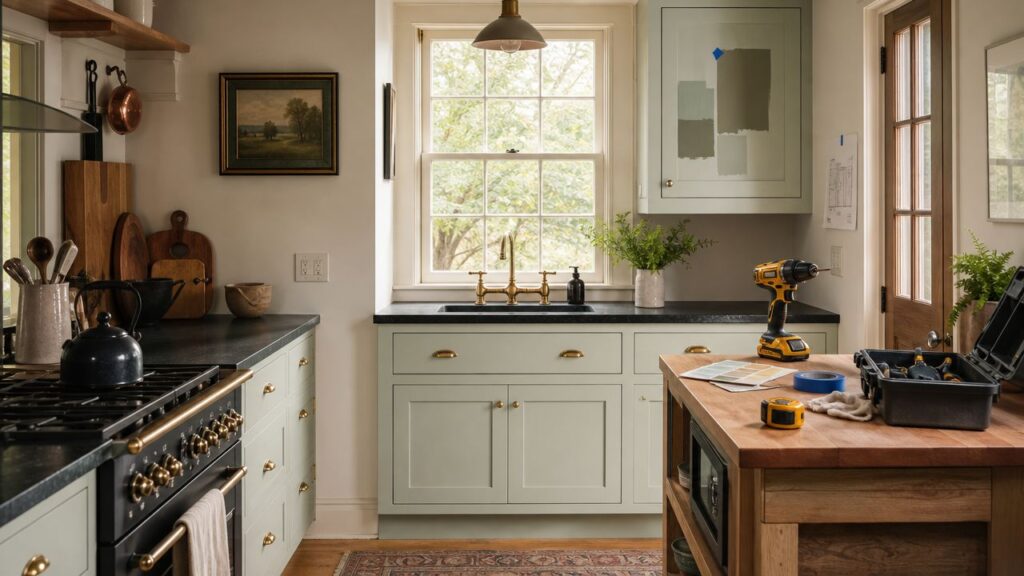
You're probably standing in a kitchen that still has good bones and bad habits. Maybe the cabinets stop short in odd places, the fridge door fights the back door, the light is flat and dim, and every “small kitchen idea” you save online looks like it belongs in a new build in Texas, not a foursquare in Haddonfield or a Cape in Moorestown.
That's the primary challenge with an old house small kitchen remodel in South Jersey. You're not just trying to make a tiny room prettier. You're trying to make it work for the way your family cooks now, while keeping the room believable in the house it belongs to. Done right, the kitchen feels brighter, calmer, and more useful without looking like it was dropped in from another zip code.
Table of Contents
- The Pre-Remodel Assessment Your Old House Needs
- Smart Layouts for Small Historic Kitchens
- Choosing Materials That Enhance Period Character
- Modern Lighting and Appliances Without Compromise
- Your South Jersey Remodel Roadmap Budget Timeline and Permits
- Bringing Your Vision to Life
The Pre-Remodel Assessment Your Old House Needs
The first mistake I see is treating an old kitchen like a decorating project. In an older South Jersey house, the early phase is discovery, not demolition. Before you choose a door style or debate paint colors, you need to figure out what the room is hiding.
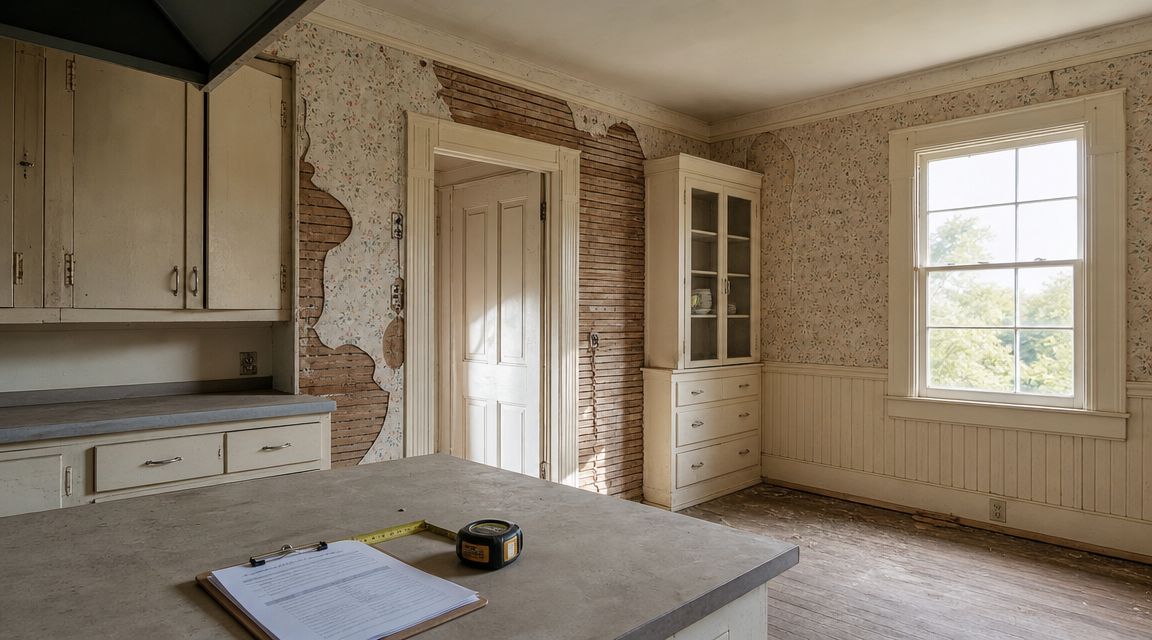
Start with x-ray vision, not finishes
In older homes, small kitchens often reveal problems that have nothing to do with style. A renovation guide focused on older homes advises homeowners to hold back 15% to 20% of the budget for contingency, and to lean toward 20% because walls and floors may hide knob-and-tube wiring, galvanized plumbing, and subfloor rot. The same guide notes that many old-house kitchens were built with only one overhead light fixture, which is why current plans typically need at least two layers of light for the room to work well (older-home kitchen renovation guidance).
That advice matches what happens on real jobs. In a tight kitchen, one hidden issue can force a chain reaction. A bad section of subfloor changes cabinet heights. An electrical correction changes where task lighting can go. Old plumbing can push the sink location from “ideal” to “smart enough.”
Practical rule: If the house is old enough to surprise you, the budget should be built to absorb a surprise.
What to inspect before design is finalized
You don't need to open every wall to get useful answers. You do need to look carefully and ask the right questions.
Use this short pre-remodel checklist:
- Electrical clues: Look for two-prong receptacles, oddly placed switches, patchwork cover plates, and a panel that already seems maxed out.
- Plumbing clues: Check for slow drains, inconsistent water pressure, signs of past leaks under the sink, and pipes that suggest mixed generations of repairs.
- Floor clues: Walk the room in soft shoes. If the floor dips near the sink run or feels springy at the dishwasher location, note it.
- Wall and ceiling clues: Hairline cracks aren't always serious, but repaired plaster, uneven surfaces, and old soffits often hint at earlier work that needs to be understood.
- Ventilation clues: If the range area has no obvious vent path, plan for a realistic discussion early. That's easier before cabinet drawings are locked.
A measured site visit matters more in an old house than in a newer one. Nothing is perfectly square. Window trim projects farther than you expect. Baseboards aren't standard. Door casings can steal the clearance that looked fine on paper. This is why I usually tell homeowners to read through a practical planning guide like how to plan a kitchen remodel before they start pinning inspiration photos.
How to protect the house while work is underway
Small kitchens get crowded fast during construction. If the project affects nearby dining rooms, mudrooms, or first-floor circulation, it helps to pack deliberately instead of shuffling boxes from corner to corner. For overflow pieces, seasonal cookware, and dining furniture you don't want damaged, some homeowners look at off-site storage such as TLC Moving & Storage Medford units so the work area stays cleaner and safer.
That sounds minor until demo starts. Old houses punish clutter. If trades are stepping around stacked chairs and boxed dishware, the room gets slower, dustier, and harder to protect.
Smart Layouts for Small Historic Kitchens
A lot of old kitchens fail in the same way. They have too many interruptions, not enough landing space, and one or two decisions from a past remodel that looked sensible but killed the room's flow. The fix usually isn't “make it open concept.” The fix is making the footprint behave.
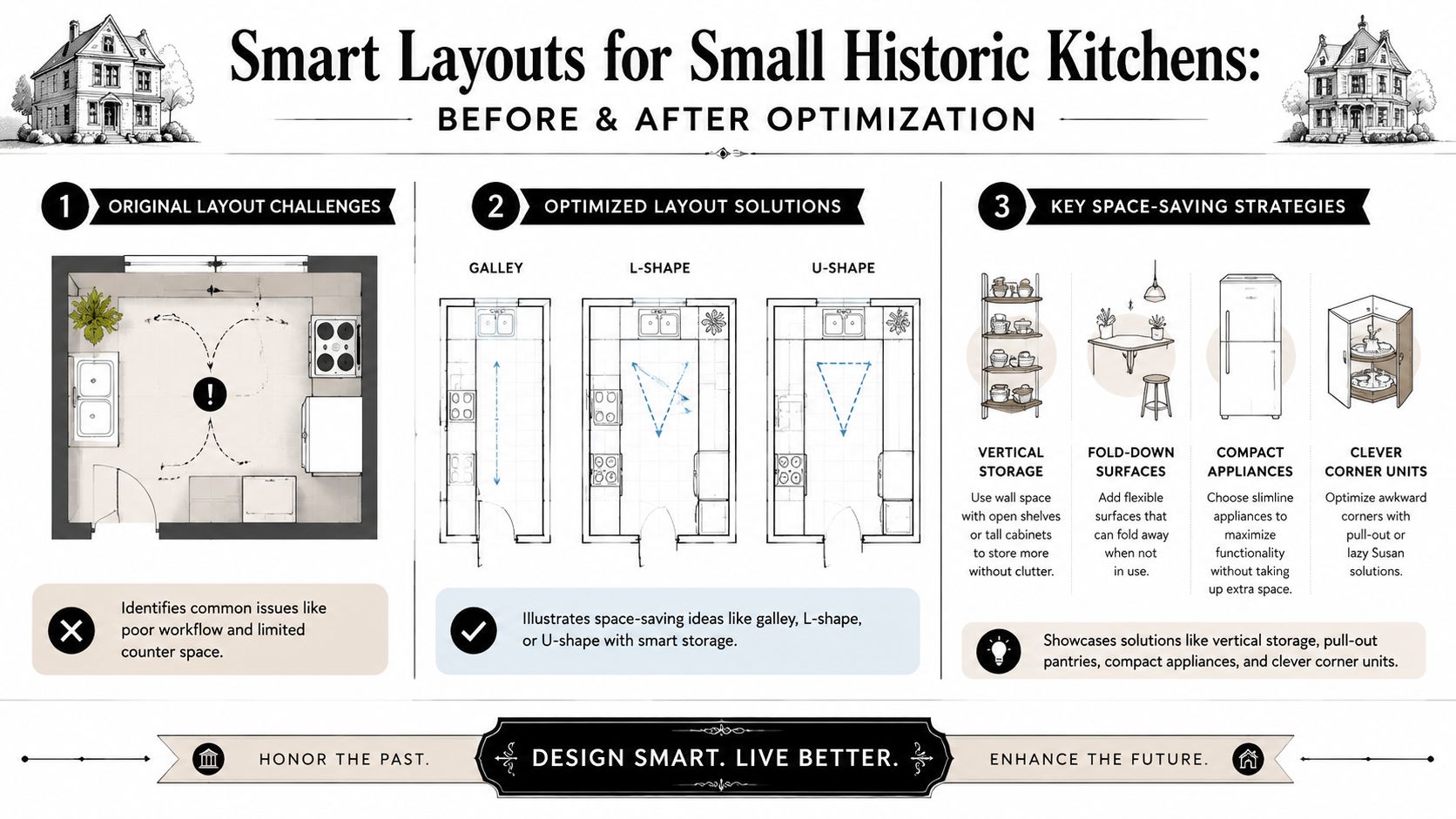
When a galley is the right answer
Homeowners often assume a galley kitchen is something to escape. In older homes, I often do the opposite. If both walls can work hard and circulation doesn't cut through the cooking zone, a galley can be the cleanest layout in the house.
What doesn't work is a fake galley with shallow storage on one side, full-depth obstacles on the other, and appliances that interrupt every task. What does work is a galley with a clear prep run, practical storage where you reach for it, and fewer competing door swings.
A simple comparison helps:
| Layout problem | Better move |
|---|---|
| Sink, range, and fridge all broken up by doors or windows | Consolidate key tasks into tighter working runs |
| Corner cabinetry that traps storage | Reduce awkward corners or use specialized corner storage |
| Too many small cabinets | Fewer, better-sized storage zones with purposeful interiors |
| Open shelves everywhere | A controlled mix of closed storage and display |
The kitchen doesn't need to look larger. It needs to work larger.
Why a peninsula often beats an island
In small historic kitchens, an island is frequently the wrong ambition. It eats aisle space, blocks movement, and can make an old room feel like it's trying too hard to be contemporary. A peninsula, by contrast, often earns its keep. It can define the kitchen edge, add storage, create seating, and preserve a more natural path through adjacent rooms.
A peninsula belongs in many old houses because it behaves like architecture. A small island often behaves like furniture that wandered into the way.
That distinction matters in South Jersey homes where kitchens often connect awkwardly to breakfast rooms, side entries, or narrow back halls. If a peninsula can absorb the microwave, dish storage, or a prep surface, it usually does more for daily function than a center island squeezed in for resale optics.
For homeowners sorting through workflow questions, the classic kitchen work triangle is still useful, but only if you adapt it to the house instead of forcing it.
Corners, tall storage, and appliance scale
Historic kitchens waste space in sneaky places. Blind corners become black holes. Short uppers stop at odd points. Refrigerators loom. One oversized range can make the entire room feel undersized.
I compare solutions side by side with clients because the trade-offs are easier to see that way:
Blind corner cabinet vs. rethinking the base run
A blind corner can work, but only if what's stored there deserves that level of effort. Sometimes the better answer is shortening one cabinet run and giving that space back to movement.Open shelf vs. shallow pantry cabinet
Open shelving lightens the room visually, but a shallow pantry often gives you more honest storage without making the wall feel bulky.Standard full-depth fridge at the room edge vs. integrated or better-positioned refrigeration
If the refrigerator is the first thing you see from the dining room, it tends to dominate the entire space. Better placement, panels, or a less visually heavy unit can calm the room immediately.One tall cabinet vs. several chopped-up uppers
In many old kitchens, one well-placed tall storage piece is more useful than a line of tiny compartments.
The best old house small kitchen remodels don't pretend every inch should be cabinetry. They decide which inches should stay open so the room can breathe.
Choosing Materials That Enhance Period Character
The fastest way to ruin an old kitchen is to make it look too new, too coordinated, and too perfect. Older houses usually read better when the kitchen feels assembled over time. That means restraint, variation, and materials that don't shout over the architecture.

Avoid the kitchen-in-a-box look
One historic renovation guide makes this point clearly. It argues against long runs of matching modern cabinets and recommends mixed finishes, concealed appliances, and furniture-like pieces so the room feels believable in a 100-year-old house rather than built around today's continuous cabinet-wall model (historic kitchen character guidance).
I agree with that approach because it solves two problems at once. It preserves character, and it softens the visual weight of cabinetry in a small room. If every box matches, every line aligns, and every appliance announces itself, the kitchen can feel more like a showroom display than part of the house.
Materials that feel settled into the house
A period-sensitive kitchen doesn't require museum accuracy. It requires judgment.
Here's what usually works better than the generic all-in-one package:
- Painted cabinetry mixed with wood accents: A wood hutch piece, a painted perimeter, or an island-style furniture element can break up monotony.
- Hardware with age and shape: Bin pulls, latches, knobs with a little depth, and finishes that don't look overly lacquered tend to sit more comfortably in older homes.
- Countertops with softness: The room usually benefits from surfaces that don't feel overly glossy or aggressively patterned.
- Backsplashes that support, not dominate: Small-format tile, simple field tile, or a restrained slab treatment often lasts longer visually than a loud feature wall.
- Flooring with context: In many old houses, the floor should connect to adjacent rooms instead of turning the kitchen into a separate design universe.
Don't ask whether a finish is “on trend.” Ask whether it would look strange if the rest of the house had never been updated.
If you're thinking broadly about preserving heritage home charm, that same principle carries through every kitchen choice. The room should feel edited, not manufactured.
Use a mobile showroom to judge finishes in your actual light
Homeowners make better decisions when they stop shopping only from phone screens. The same painted door sample can look calm in a Moorestown kitchen with north light and completely different in a Collingswood house with warm afternoon sun. A mobile selection process helps because you're comparing materials against your floor, your trim, your wall color, and your house's age in real time.
One option for that kind of selection process is guidance on how to choose kitchen cabinets, especially if you're trying to decide between a cleaner inset-inspired look, a more transitional painted door, or a wood finish that won't fight original millwork.
Modern Lighting and Appliances Without Compromise
Old kitchens usually suffer from one predictable problem. They were lit for a different era. A single ceiling fixture might have been acceptable when the room had fewer tasks, fewer appliances, and lower expectations. Today, that setup leaves counters in shadow and makes a small room feel smaller.
Build light in layers
I start with a simple rule. Each layer should do a job.
Ambient light gives the room its base level of brightness. In an old house, that might come from a low-profile ceiling fixture, small recessed fixtures used carefully, or a period-friendly semi-flush mount that doesn't hang too low.
Task light is what keeps the room functional. Under-cabinet lighting matters more than homeowners think because it lights the work surface instead of just the room. If there's a sink wall with no upper cabinets, a well-placed sconce or pendant can pick up that duty.
Accent light adds depth. Glass-front cabinets, a small lamp on a shelf, or lighting that highlights a hutch-like piece can make the room feel warmer and less clinical.
A practical reference point for South Jersey homeowners curious about newer controls and integrated features is smart kitchen technology in Cherry Hill. The point isn't to turn an old kitchen into a gadget lab. It's to use modern lighting and controls quietly.
Choose appliances that support the room instead of dominating it
Appliances can either preserve scale or destroy it. In a compact historic kitchen, oversized stainless units often become the first thing your eye lands on. That's rarely what you want.
The better approach is usually one of these:
- Panel-ready refrigeration or dishwashing when the kitchen opens to other living spaces
- A range with visual restraint rather than a bulky professional-style statement piece
- A microwave tucked into lower cabinetry or a pantry zone instead of parked at eye level
- A ventilation plan designed early, so the hood looks intentional instead of improvised
The goal isn't to hide every modern convenience. It's to keep the room's character in charge.
Your South Jersey Remodel Roadmap Budget Timeline and Permits
This is the part homeowners worry about most, and for good reason. A small kitchen looks manageable until permits, lead times, municipal reviews, and old-house surprises all converge. In South Jersey, the right roadmap is less about speed and more about sequence.
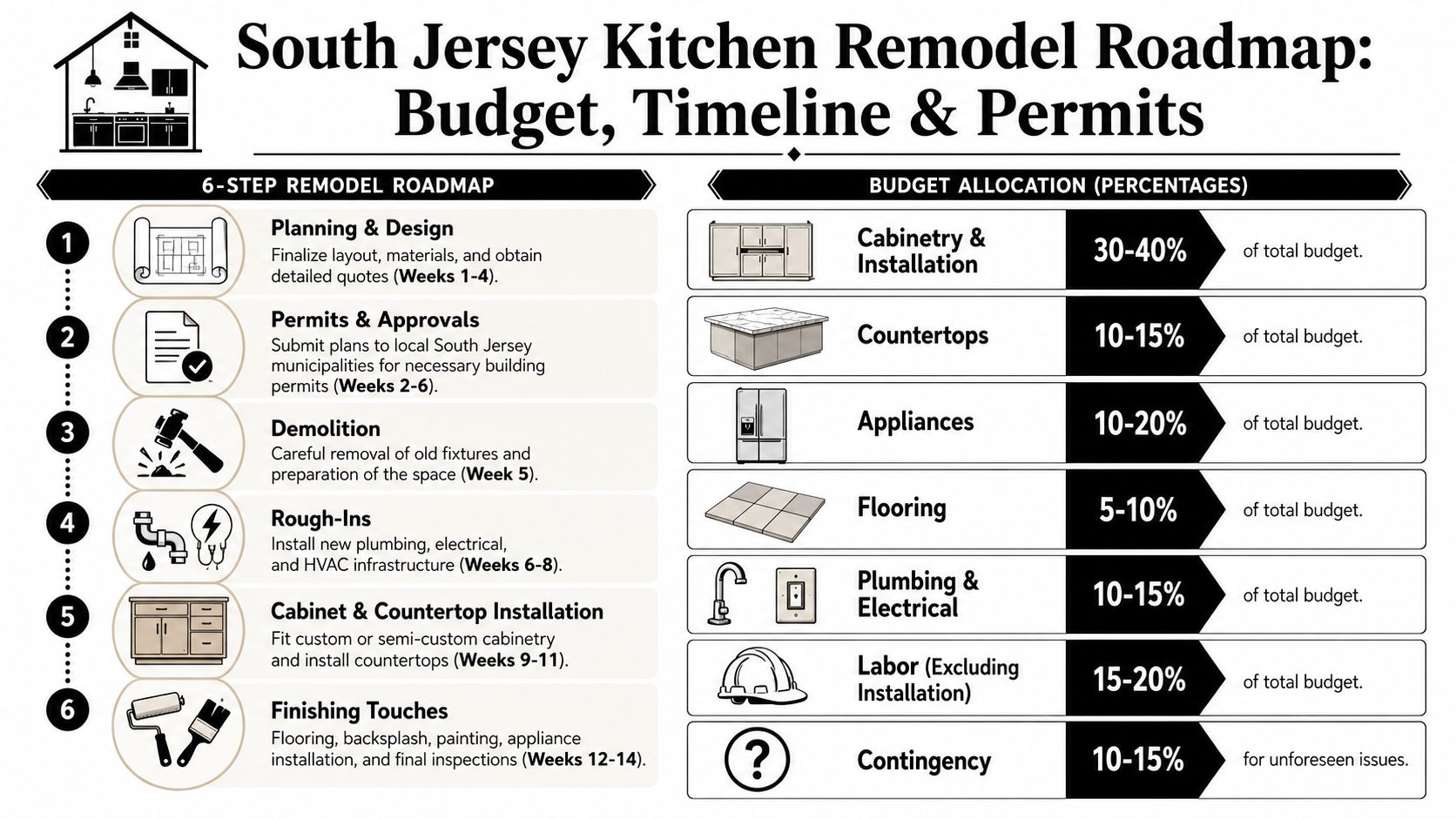
Budget for the real project, not the dream version
Kitchen remodeling is a serious investment category now. The 2025 Houzz Kitchen Trends Study reported a median spend of $60,000 based on a survey of more than 1,600 renovating homeowners, and industry resale studies cited by the National Association of Realtors indicate homeowners can recover about 75% of the cost of a kitchen overhaul at resale (NAR summary of kitchen renovation spending and value).
That doesn't mean every old house small kitchen remodel should aim for a full overhaul. In many Camden and Burlington County homes, the smartest move is selective investment. Keep the footprint if it works. Put money into layout corrections, storage, lighting, cabinet quality, and the details that make the room fit the house.
What fails is budgeting for finishes while ignoring infrastructure. In older homes, the invisible work often decides whether the visible work feels polished.
How the schedule actually unfolds
A published remodeling timeline shows how even a smaller kitchen still moves through several phases. Demolition and clean-out can take 1 to 2 weeks, contractor work 1 to 3 weeks, flooring 2 to 3 days, cabinets 3 to 5 days, countertops and appliances 3 to 5 weeks, and final painting and cleaning 2 to 4 weeks. The same guidance recommends getting at least three contractor estimates with timelines and finalizing appliance specs before cabinet orders because countertop lead time often becomes the critical path (kitchen remodel timeline planning).
That sequence is exactly why old kitchens can feel “almost done” for longer than homeowners expect. Cabinet install is not the finish line. After cabinets, the project still depends on templating, fabrication, appliance coordination, finishing work, punch details, and inspections.
A few habits keep the schedule steadier:
- Lock appliance decisions early: Cabinet and utility planning depend on real specs, not placeholders.
- Confirm who owns each handoff: Homeowners get in trouble when no one is clearly tracking template dates, delivery windows, or inspection sequencing.
- Expect municipal timing to vary: One town may turn comments quickly. Another may ask for revisions or supporting details before moving forward.
The kitchen doesn't go off schedule because one thing was late. It goes off schedule because five small decisions were left open too long.
South Jersey permit realities
In South Jersey, permit expectations can shift by municipality, even when the scope looks similar on paper. Haddonfield, Moorestown, Cherry Hill, and surrounding towns can all have their own review habits, documentation preferences, and inspection rhythms. If you're moving plumbing, changing electrical service, altering ventilation, or touching structure, assume the permit conversation needs to happen early.
For older homes, I also encourage homeowners to think beyond the kitchen walls. If floor framing has to be corrected, if an old rear entry needs work, or if exterior conditions complicate access, adjacent site work may matter more than expected. For that broader context, some homeowners find resources like Firm Foundations' excavation guide useful when they're trying to understand what supporting work around the house can affect a renovation schedule.
The local advantage in South Jersey is straightforward. When selections can be reviewed at home, permit questions are anticipated early, and the design respects the house's quirks instead of fighting them, the whole project gets less stressful. That matters just as much as the final cabinet color.
Bringing Your Vision to Life
A good old house small kitchen remodel doesn't erase the house's age. It edits the room so daily life works better inside that history. The right plan respects crooked walls, awkward windows, original trim, and the rhythm of older homes while still giving you better storage, better light, and a kitchen you want to spend time in.
That balance is what makes these projects rewarding. The finished room shouldn't feel trendy or overworked. It should feel like your house finally got the kitchen it was always supposed to have. If you want to see what that can look like in a compact space, small kitchen makeovers can help you compare approaches that improve function without flattening character.
If you're planning a kitchen update in Cherry Hill, Haddonfield, Moorestown, Collingswood, Medford, or nearby South Jersey communities, The Cabinet Coach offers a mobile showroom approach that lets you review cabinetry, countertops, hardware, and tile in your own home, with guidance that fits older houses and the realities of local remodeling.