
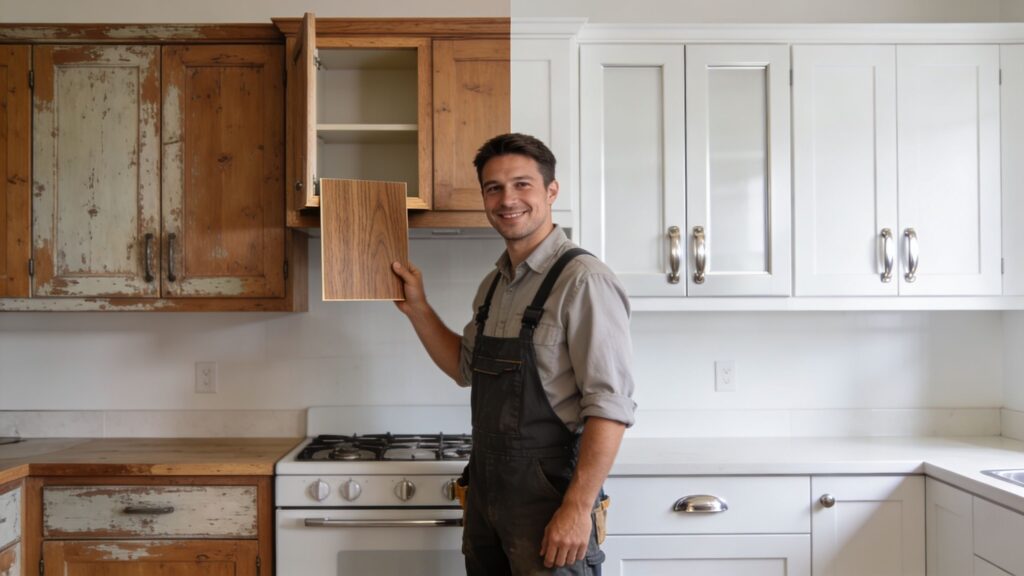
You're probably looking at a kitchen that still works, but doesn't feel like you anymore. The cabinet boxes are solid. The drawers still open. The layout fits your routine in Cherry Hill, Moorestown, Haddonfield, or Mount Laurel. But every time you walk in, the dated doors, worn finish, and old hardware make the whole room feel tired.
That's where kitchen cabinet refacing services come in. For many South Jersey homeowners, refacing hits the sweet spot between “do nothing” and “tear out the whole kitchen.” It updates the look of the room without the full demolition, long disruption, and bigger budget that come with total replacement. If you've also had any past leaks under the sink or around the dishwasher, it's smart to think about moisture issues early. Hidden water problems can affect cabinet condition, and this guide on preventing mold growth in your home is a helpful place to start before you commit to cosmetic work.
A lot of homeowners also get stuck on one basic question. Should you paint the cabinets, reface them, or replace them? If you want to compare a finish-only approach with a more complete surface upgrade, this look at painted and stained cabinet options helps clarify where each path makes sense.
Table of Contents
- Is Cabinet Refacing the Right Choice for Your Kitchen
- Understanding the Cabinet Refacing Process
- Refacing vs Full Replacement A Cost and Benefit Analysis
- The Professional Refacing Project from Start to Finish
- Hiring a Top Cabinet Refacing Contractor in South Jersey
- The Cabinet Coach Advantage A Mobile Showroom at Your Door
- Common Questions About Cabinet Refacing
Is Cabinet Refacing the Right Choice for Your Kitchen
A homeowner in Voorhees or Medford often starts in the same place. They don't hate their kitchen. They hate that it looks old. The cabinet frames are still doing their job, but the style belongs to another decade, and a full remodel feels like too much.
That's why refacing has become such a common conversation. It gives homeowners a way to keep the parts of the kitchen that still work while updating the parts they see and touch every day. And it isn't some niche idea. The global cabinet refacing services market was valued at approximately USD 36.5 billion in 2023 and is projected to reach USD 59.2 billion by 2031, according to this cabinet refacing services market report. That growth points to a clear shift toward affordable and sustainable kitchen updates.
When refacing makes sense
Refacing is usually a strong fit when your kitchen has a layout you already like. Maybe the sink, range, and refrigerator are in sensible spots. Maybe your pantry storage works fine. Maybe the problem is just that the doors are worn, the finish is dated, and the room needs a fresh face.
It's especially appealing in South Jersey homes where homeowners want improvement without turning the house upside down. If you work long hours in Camden County or Burlington County, you may not want weeks of demolition dust, missing appliances, and daily jobsite noise.
Practical rule: If your cabinet boxes are in good condition and your layout still works for your family, refacing deserves a serious look.
When refacing is not the best fit
Refacing won't solve every kitchen problem. It won't fix a bad floor plan. It won't add major new storage by itself. It also won't rescue cabinets that are badly damaged by water, sagging, or out of alignment.
That's the first honest checkpoint. If the structure is good, refacing can be a smart update. If the structure is failing, replacement may be the better long-term decision.
Understanding the Cabinet Refacing Process
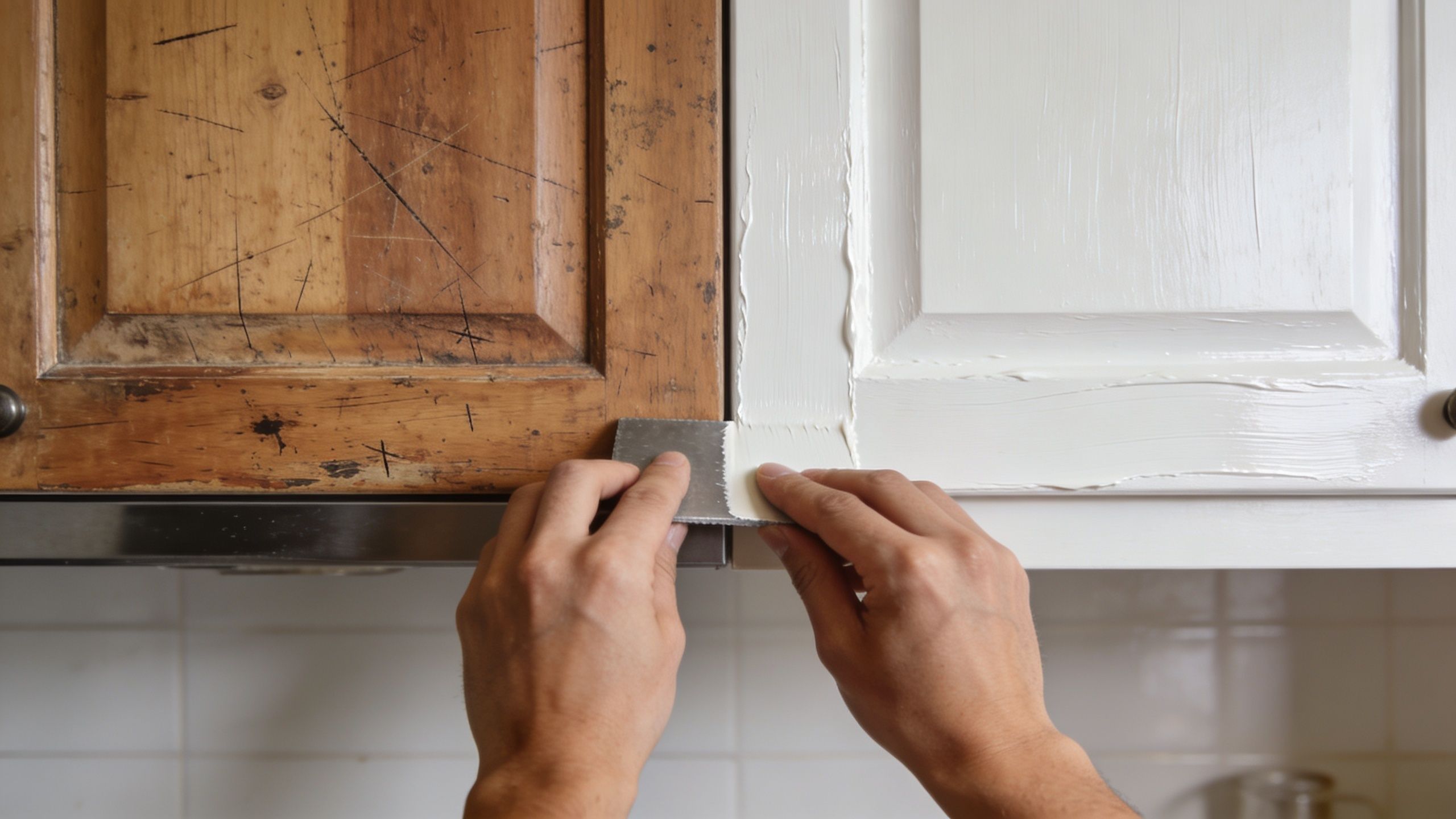
Think of cabinet refacing as giving your kitchen cabinets a new outer shell while keeping the original cabinet boxes in place. You're not just painting over the old surfaces and hoping for the best. A professional crew replaces the visible moving parts and covers the exposed cabinet framework with a new finish material designed to look clean and consistent.
What gets replaced and what stays
In a typical refacing job, the installer removes the old doors, drawer fronts, hinges, pulls, and knobs. Those pieces are replaced with brand-new ones in the style and finish you choose.
The existing cabinet boxes stay. The exposed faces of those boxes are then covered so everything matches the new doors and drawers. When the work is done well, the kitchen looks far closer to a new cabinet installation than to a paint refresh.
Here's the simple breakdown:
- Removed and replaced: doors, drawer fronts, hardware
- Kept in place: cabinet boxes that are still structurally sound
- Updated on site: visible cabinet faces and end panels
What professionals actually do
The technical side matters more than most homeowners realize. The process involves applying 0.5-1.0 mm thick veneer or high-pressure laminate to cabinet faces after abrading them to an 180-grit finish. That prep helps create an adhesive bond strength of greater than 300 PSI, which is what helps prevent peeling and supports a durable finish, as described in this cabinet refacing process guide.
That sounds technical, so here's the plain-English version. The cabinet surface has to be cleaned, smoothed, and prepared properly or the new skin won't hold. Good refacing is a precision job, not a shortcut.
A clean-looking kitchen isn't the same as a durable kitchen. The prep work is what separates a finish that lasts from one that starts peeling at the edges.
How refacing differs from painting
People often get confused. Painting changes the color of what you already have. Refacing changes the visible surfaces themselves.
Painting can work in the right situation, but it still leaves you with the same old doors, the same wear marks, and the same profile. Refacing gives you new door styles, new drawer fronts, and a more factory-finished appearance. If your goal is a bigger visual transformation without full replacement, refacing usually lands in a different category than paint.
Refacing vs Full Replacement A Cost and Benefit Analysis
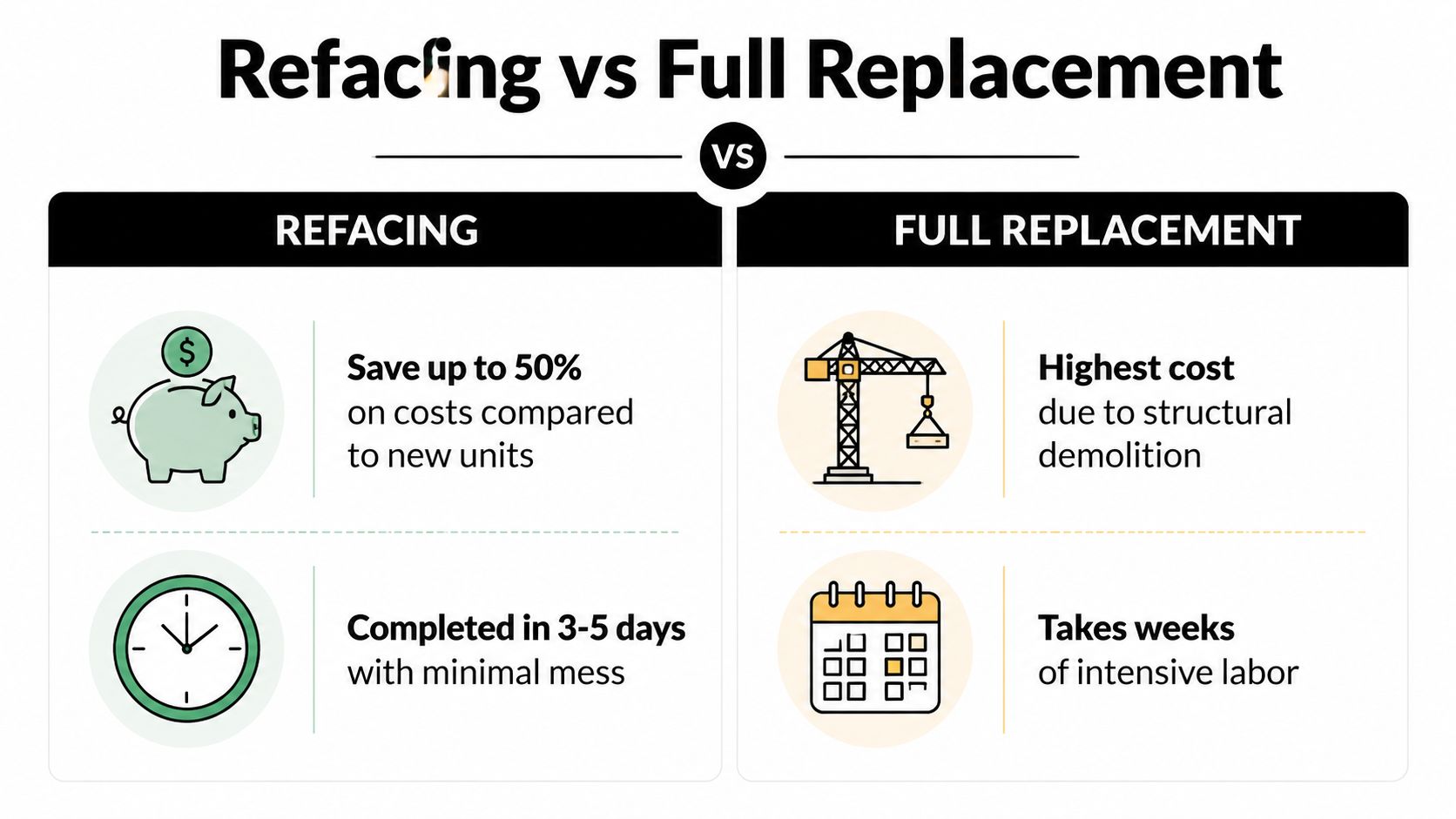
Most South Jersey homeowners aren't deciding between a good option and a bad option. They're choosing between two valid renovation paths. The right answer depends on your kitchen's condition, your budget, and how much disruption you're willing to live with.
The financial side homeowners care about
Refacing gets attention because it can create a noticeable visual upgrade without requiring a full cabinet tear-out. The resale math is also compelling. According to the 2026 Cost vs. Value data summarized in this kitchen ROI report, a minor kitchen remodel centered on updates like keeping existing cabinet boxes and replacing fronts can recoup 112.9% of cost nationally. The same source notes that a project costing $28,458 could add $32,141 in resale value, while major upscale remodels costing $82,000 to $164,000 return only 36% to 51%.
That doesn't mean every refacing project beats every replacement project. It means homeowners should be cautious about assuming that the bigger renovation automatically makes better financial sense.
If you're trying to think through the whole kitchen and not just the cabinets, this guide to a smooth kitchen renovation is useful for mapping the larger project in a realistic way.
The day-to-day trade-offs
Refacing is often the better fit when the kitchen layout already functions well. Replacement becomes more attractive when you want to change cabinet locations, add a new island configuration, or correct a poor floor plan.
Here's the side-by-side view.
| Factor | Cabinet Refacing | Full Cabinet Replacement |
|---|---|---|
| Cabinet boxes | Existing boxes stay if they're in good shape | Old cabinets are removed and replaced |
| Visual impact | Major style update with new doors, drawer fronts, and finished faces | Full reset with all-new cabinetry |
| Layout changes | Limited. Best when the current layout works | Best option if you want a different footprint |
| Disruption | Lower demolition and less mess | More demolition, more trades, more interruption |
| Timeline | Often a faster path for an in-place update | Usually takes longer because removal and rebuild are involved |
| Budget direction | Usually more cost-conscious than replacing everything | Usually the more expensive path |
| Waste | Reuses existing cabinet structure | Sends more material out of the kitchen |
| Best fit | Solid boxes, dated look, good layout | Damaged cabinets, poor layout, major redesign |
A useful rule for South Jersey homes
In neighborhoods with solid, well-built older homes, the cabinet boxes are often the deciding factor. If those boxes are square, dry, and stable, refacing can deliver the look most homeowners want without pushing them into a much larger renovation.
For a quick pricing reality check before you call contractors, this page on the cost of kitchen cabinet refacing helps frame what influences the estimate.
The Professional Refacing Project from Start to Finish
A professional refacing project should feel organized, not mysterious. Homeowners usually feel most comfortable when they know what happens in the house, in what order, and why each step matters.
First visit and cabinet inspection
The project begins with an in-home consultation. The contractor measures the kitchen, reviews your door style and finish choices, and checks whether the cabinet boxes are suitable for refacing. This is also when you talk through details that affect the final look, such as exposed cabinet ends, crown trim, fillers, and hardware style.
A good contractor also asks practical questions. Do your drawers need better function? Do you want soft-close hinges? Are you keeping the counters, or coordinating the cabinet update with other surfaces?
Removal, prep, and surface work
After materials are ordered, the crew removes the old doors, drawer fronts, and hardware. Then comes the part homeowners don't always see coming. Prep is slow, careful work.
Installers clean the cabinet faces thoroughly, address minor imperfections, and prepare exposed surfaces so the new veneer or laminate can bond properly. If the prep is rushed, the finished kitchen may look fine on day one and fail later.
The quiet part of the project is often the most important part. Surface prep is where the long-term quality gets decided.
Fitting the new look together
Once the cabinet faces are wrapped or covered, the crew installs the new doors and drawer fronts. Then they align reveals, adjust hinges, and fine-tune every opening so the kitchen looks consistent from one run of cabinets to the next.
Many homeowners use this moment to coordinate nearby updates too. If you're comparing backsplash materials, this guide to choosing cement and zellige kitchen tiles can help you think about color, texture, and how handmade tile plays with new cabinet finishes.
Final walkthrough
The last stage is cleanup and punch-list review. Open every door. Pull every drawer. Stand in different corners of the room and look down the lines of the cabinetry. Small alignment details matter because your eye will catch them every day.
A contractor who welcomes that walkthrough is usually a contractor who expects the work to hold up.
Hiring a Top Cabinet Refacing Contractor in South Jersey
This is the point where homeowners can save themselves a lot of regret. Two companies may both say they offer kitchen cabinet refacing services, but the difference in inspection standards, installation skill, and communication can be huge.

Ask how they decide whether your cabinets qualify
This is the question many homeowners never ask. A real professional doesn't try to sell refacing for every kitchen. They inspect for warping, water damage, and structural soundness, and they know some kitchens should be rejected. According to this cabinet refacing guide from Kitchen Magic, failing to reject 20-30% of unsuitable candidates due to moisture-related swelling or frame misalignment is a major reason refacing jobs later develop peeling and binding problems.
That's valuable because it tells you what a good contractor is willing to say. Sometimes the best answer is, “Your cabinets aren't a good candidate.”
What to verify before signing anything
A South Jersey homeowner in Collingswood, Cinnaminson, or Evesham should treat this like hiring any serious home improvement pro.
- Registration and insurance: Ask whether the contractor is properly registered in New Jersey and carries insurance.
- Local project history: Request photos of jobs in towns like Cherry Hill, Haddonfield, Moorestown, Mount Laurel, or nearby communities with homes similar to yours.
- Written scope: Make sure the estimate spells out what is being replaced, what is being covered, what hardware is included, and how exposed ends or trim are handled.
- Material clarity: Ask whether the visible cabinet faces will get veneer, laminate, or another finish system, and how the contractor matches those materials to the new doors.
- Problem policy: Find out what happens if the crew finds hidden damage after doors come off.
Questions worth asking in the kitchen
You don't need contractor jargon. You need useful answers. Try questions like these:
- How do you inspect for moisture damage around the sink base and dishwasher?
- What would make you tell me refacing is the wrong choice?
- How do you make sure doors line up evenly after installation?
- What does the estimate exclude?
- Who handles adjustments if something needs fine-tuning after install?
A contractor's willingness to talk you out of refacing is often a sign that you're talking to the right person.
If you want a broader framework for evaluating renovation pros and keeping communication clean, this resource on how to manage contractors is worth reading before you start collecting bids.
The Cabinet Coach Advantage A Mobile Showroom at Your Door
South Jersey homeowners often run into the same problem before the project even begins. They don't have time to drive from one showroom to another, compare tiny finish chips under fluorescent lights, and then try to imagine how everything will look in their own kitchen.
That's where a mobile-showroom model feels different in a practical way.

Why in-home selection works better
For a homeowner in Cherry Hill, Haddon Township, Medford, or Moorestown, seeing cabinet door samples, hardware, countertop options, and finish combinations inside the actual home removes a lot of guesswork. Natural light changes color. Existing flooring changes how painted and wood-look finishes read. Wall color matters more than people expect.
A mobile showroom also helps busy families make decisions faster because everyone can look at the same samples in the same space at the same time. That tends to create fewer surprises later.
There's also a convenience factor that shouldn't be dismissed. If your weekdays are full and your weekends are already spoken for, bringing the design process to the house is easier.
A smoother path from consultation to decisions
The model usually starts with an initial conversation, then moves into an at-home review of samples, measurements, and design direction. Instead of asking homeowners to mentally assemble the project from scattered showroom visits, the process stays tied to the kitchen itself.
If you're curious why more homeowners are leaning toward that approach, this article on why a mobile cabinet showroom is the future of kitchen remodeling in South Jersey lays out the practical advantages.
A quick look at the experience helps make it tangible:
For homeowners who value efficiency, clear guidance, and decisions made in context, that approach can make the renovation feel less like a scavenger hunt and more like a managed project.
Common Questions About Cabinet Refacing
Homeowners usually reach the same final questions once they understand the basics. How long will it last? Is DIY worth trying? What are the limits?
Does refacing last
It can, if the cabinet boxes are solid and the installation is done correctly. The long-term result depends on cabinet condition, moisture exposure, material quality, and prep work. Refacing is not magic. It's a surface and component upgrade built on the condition of what stays behind.
Maintenance is usually straightforward. Keep surfaces clean, wipe up water around the sink base, and don't assume every finish should be treated the same way. Ask your installer what cleaners are safe for the specific veneer, laminate, or door finish used in your kitchen.
Is DIY refacing a smart money saver
Sometimes homeowners think it will be. Many change their mind once they see how exact the process is.
According to this DIY cabinet refacing discussion, professional installers have failure rates under 1% over 10 years, while estimated DIY failure rates are 15% or more because of common mistakes in surface prep, adhesive application, and seam finishing. That doesn't mean no homeowner can do it. It means the margin for error is a lot smaller than online tutorials make it seem.
What refacing cannot do
Refacing won't rework a cramped layout. It won't move plumbing. It won't solve structural cabinet failure. If your kitchen needs a new footprint, replacement or a broader remodel may be the right move.
A simple way to think about it:
- Use refacing when: the layout works and the boxes are sound
- Use replacement when: the boxes are damaged or the kitchen needs a new configuration
- Use a pro when: you want the finished result to look consistent and hold up over time
If you're ready to compare local options, this page on kitchen cabinet refacing near you is a practical next step.
A smart refacing project feels boring in the best way. The decisions are clear, the expectations are realistic, and the finished kitchen looks like it should have looked all along.
If you want expert guidance from a local team that brings the design experience to your home, The Cabinet Coach offers South Jersey homeowners a convenient way to plan cabinetry, finishes, hardware, and related remodeling details without the usual showroom hassle. It's a strong fit for busy households that want clear advice, a polished process, and a kitchen update that makes sense for the home they already have.