
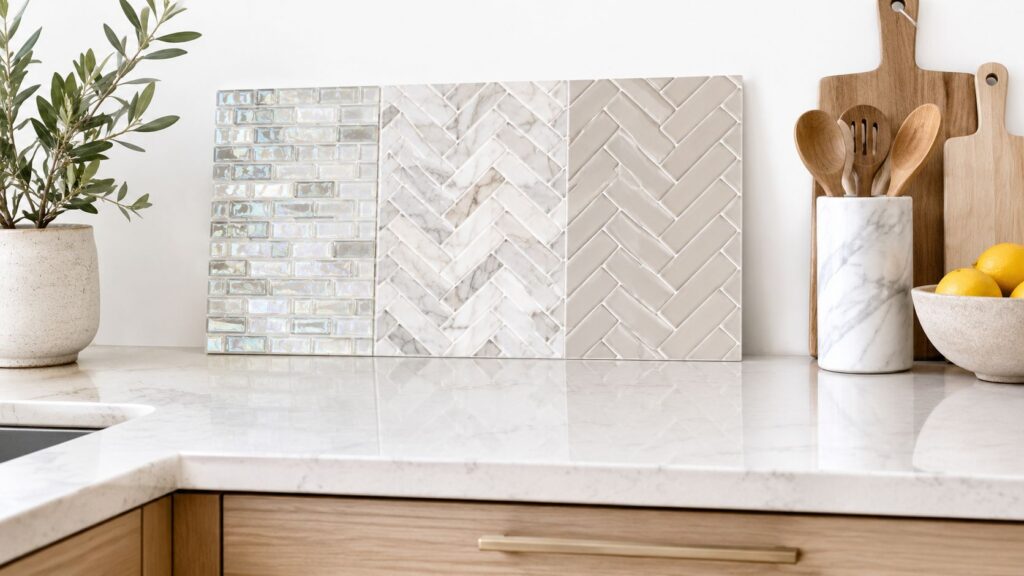
You're probably looking at a wall behind your counters and trying to answer a simple question that gets oddly complicated fast. Should the whole backsplash be mosaic, or should mosaic tile stay in a smaller area where it adds texture without turning daily cleanup into a chore?
That's the decision most homeowners miss. A mosaics kitchen backsplash can look excellent, but full-wall mosaic isn't automatically the smartest move. In a busy kitchen, the better answer is often a hybrid mosaic strategy: put the detailed tile where your eye wants interest, then use a simpler surface where grease, splatter, and constant wiping make grout lines a liability.
Mosaic tile has staying power for a reason. Decorative mosaics go back to roughly 3000 BC, and backsplash history also shows that early modern kitchen backsplashes were small, utility-first surfaces rather than major design features, as noted in this backsplash progression overview. That's why mosaic still works today. It can protect the wall and make the room feel finished. The trick is using it in the right amount, in the right material, and in the right location.
Table of Contents
- Choosing Your Mosaic Kitchen Backsplash Material
- Popular Styles and Patterns for Mosaic Backsplashes
- Navigating Cost Ranges and Value of Mosaic Tile
- Installation Standards and Practical Considerations
- Matching Mosaics with Cabinetry and Countertops
- Maintenance Tips for Long-Lasting Mosaic Beauty
- The Mobile Showroom Experience with The Cabinet Coach
Choosing Your Mosaic Kitchen Backsplash Material
In real kitchens, material choice usually decides whether people love their backsplash six months later. Not the color. Not the pattern. The material.
A family that cooks every night lives with backsplash tile differently than someone who mostly reheats takeout. In one kitchen, a glossy glass mosaic can be a smart, easy-wipe surface. In another, a tumbled stone mosaic behind a range can start collecting grease in every pit and edge. That's where the hybrid approach earns its keep.
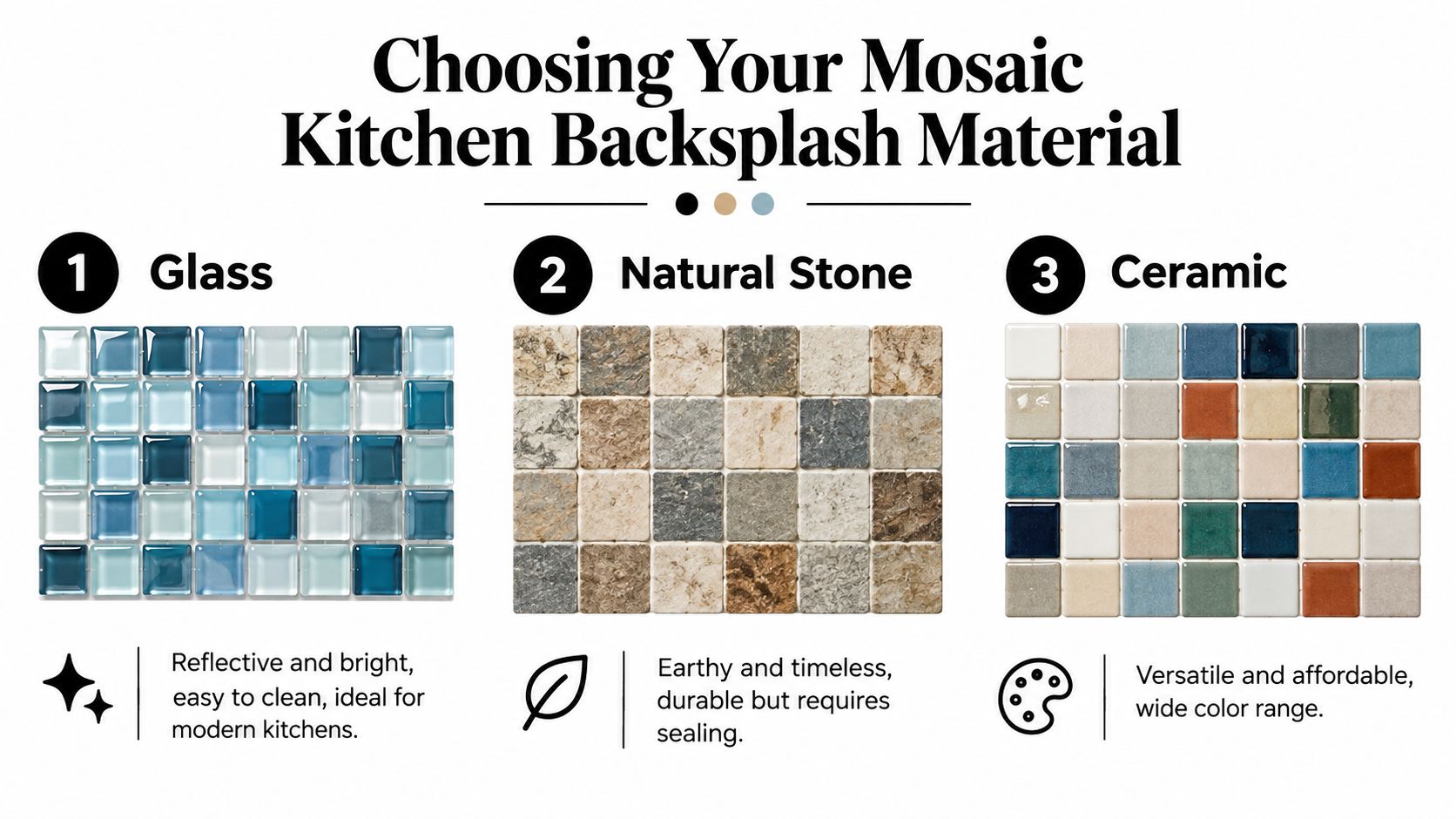
Glass for light and easy wipe-downs
Glass mosaics suit homeowners who want a crisp, reflective finish and don't want to baby the tile face. They bounce light well, especially in smaller kitchens or rooms with one weak window. They also tend to wipe clean more easily than textured stone.
Glass does come with installer demands. It shows trowel lines, voids, and sloppy setting more than ceramic does. Installation guidance for glass mosaics calls for white modified thinset, back-buttering, and full coverage rather than spot bonding, with ANSI-based guidance commonly targeting at least 80% mortar coverage for dry areas and 95% where superior support is needed, according to this tile backsplash installation guide.
Practical rule: If you want glass mosaic, spend less time chasing the perfect color blend and more time making sure the installer knows how to set translucent tile cleanly.
Natural stone for warmth and character
Stone mosaic has depth that factory-made products often can't fake. Marble, travertine, and similar materials can soften a kitchen and make painted cabinetry look more grounded. In traditional or transitional spaces, stone often feels more expensive because variation is built in.
It also asks more from the homeowner. Stone usually needs sealing, and textured or honed finishes can hold onto cooking residue more than smoother surfaces. On a side wall or coffee station, that trade-off can be fine. Directly behind a high-use cooktop, it's often where I'd switch to slab or large-format tile instead.
Ceramic and porcelain for flexibility
Ceramic and porcelain mosaics are often the safest middle ground. They can mimic handmade tile, stone, or cleaner contemporary looks without bringing the same maintenance burden as porous natural materials.
A simple way to narrow the field is to start with the room's use pattern, then compare options against your tolerance for upkeep. This tile backsplash selection guide is useful if you're trying to line up style with real-world use.
- If you cook heavily: lean toward smoother glass or porcelain.
- If texture matters most: reserve stone mosaic for lower-splatter zones.
- If budget discipline matters: ceramic often gives the widest design range with fewer surprises.
Popular Styles and Patterns for Mosaic Backsplashes
Style is where many backsplash decisions go sideways. People fall in love with a sample board, then install that same level of visual activity across the entire kitchen.
That can work, but it doesn't always.
Mosaic isn't a niche finish. A market report cited by USA Cabinet Store values the global mosaic tiles market at $12.4 billion in 2025 and projects $19.7 billion by 2034, with 6.2% CAGR. In that same report, residential applications account for 42.3% of revenue, while backsplash uses represent 19.4% of market share and are expanding at 7.2% CAGR, as summarized in this review of kitchen backsplash trends. So yes, mosaic backsplashes are popular. The mistake is assuming popularity means every pattern belongs on every wall.
Patterns that age well
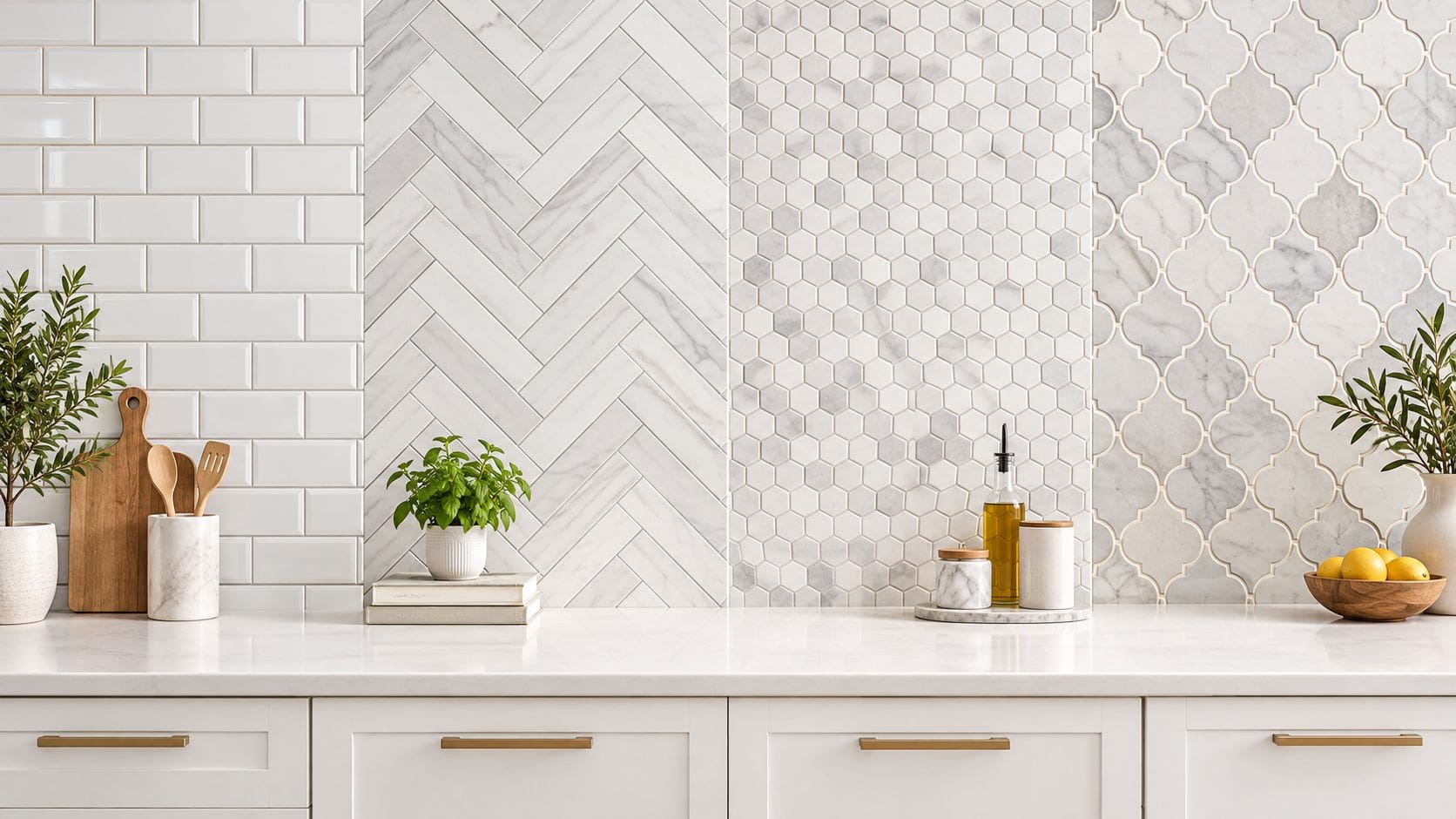
The safer long-term patterns usually rely on shape and texture more than loud contrast. Good examples include sheeted brick mosaics, restrained hex, small stacked formats, and soft herringbone in muted tones.
Those layouts still give you movement, but they don't demand all the attention in the room. If you're leaning glass, these glass tile backsplash ideas show where reflective mosaics can add detail without overwhelming cabinetry.
A few styles tend to hold up better over time:
- Tonal mosaics: color variation within one family keeps the surface interesting without looking busy.
- Geometric patterns in quiet palettes: hex and linear mosaics feel current when the color story stays controlled.
- Handmade-look finishes: slight variation reads warmer than flat uniform shine.
Where trend and practicality meet
Current trend coverage points in two directions at once. Some homeowners want expressive texture and geometric mosaic looks. Others want quieter, slab-like simplicity. Recent commentary also notes warm neutrals, handmade textures, geometric mosaics, statement color, and slab backsplashes among key looks for 2025 to 2026, while overly busy patterns are losing favor, according to this mosaic tile trends overview.
That split is exactly why hybrid design works.
Use mosaic where you want texture to register up close. Use simpler surfaces where you need the wall to disappear and clean up fast.
Here's a useful visual reference before you commit to a layout:
A full-wall penny round can be charming in photos. In a hard-working kitchen, a narrower field of mosaic often gives you the same personality with fewer regrets.
Navigating Cost Ranges and Value of Mosaic Tile
Cost conversations around mosaic usually get oversimplified. People compare tile prices and forget that backsplash value comes from three separate buckets: material, labor, and long-term upkeep.
Material choice drives the first bucket. Glass, stone, ceramic, and porcelain don't land in the same pricing tier. But labor is where mosaic often catches homeowners off guard. A sheeted mosaic still takes time to align, flatten, cut around outlets, and grout cleanly. Small tile forgives very little when the wall is out of plane or the corners aren't square.
The side-by-side reality
A simple comparison helps.
| Material | Up-front budget pressure | Labor sensitivity | Daily ownership |
|---|---|---|---|
| Glass mosaic | Often higher | High, because flaws show | Easy tile-face cleaning, but grout still needs attention |
| Natural stone mosaic | Varies by stone | High, especially with irregular texture | More upkeep, often sealing, more residue capture |
| Ceramic or porcelain mosaic | Usually easier to control | Moderate to high | Often the best balance of look and maintenance |
That's why I don't treat full mosaic as the default recommendation. If you only need visual interest in one focal area, using mosaic selectively can redirect budget toward better cabinetry details, cleaner countertop edges, or a larger uninterrupted surface behind the range.
Value isn't just style
The value question is less about whether mosaic is “worth it” and more about whether you're buying the right amount of it.
Recent backsplash trend coverage suggests designers are increasingly mixing materials, such as using a slab panel behind the cooktop and mosaics on adjacent walls, while larger tiles and subtle grout are gaining popularity over busier patterns, according to this 2026 kitchen backsplash trends article. That lines up with what works in the field. Hybrid layouts often feel more deliberate and less forced.
If you're weighing backsplash spending against the rest of the room, this kitchen remodeling cost breakdown helps put tile decisions in context.
- Best place to spend on mosaic: bar wall, sink wall, coffee station, or a framed accent panel.
- Best place to simplify: the high-splatter area behind the range.
- Best value move: put detail where people notice it first, not where you'll scrub it most.
Installation Standards and Practical Considerations
Most backsplash failures don't start with ugly tile. They start with decent tile installed carelessly.
Mosaic makes that more obvious because there are so many joints, edges, and transitions packed into a small area. If the wall prep is poor, if the sheets wander, or if the setting bed has voids, you'll see it.
Joint width is not a guess
For mosaics, the grout joint has to be tight, but it can't be imaginary. ANSI A108.02 requires the actual grout joint to be at least 3 times the tile's facial-dimension variation and never less than 1/16 inch. For running-bond layouts with tiles larger than 15 inches on a side, the minimum increases to 1/8 inch for rectified tile and 3/16 inch for calibrated tile, according to the ANSI A108 standards preview.
In practice, backsplash mosaics often land around that narrow-joint range, especially with small glass and similar formats. That tight spacing gives the surface a cleaner field, but only when the sheet alignment is controlled.
If you can spot the sheet seams before grout goes in, the installer needs to slow down.
Mortar, grout, and coverage choices
There's also a chemistry side to backsplash work that homeowners should ask about. Narrow joints often point to unsanded grout, and glass tile generally benefits from that choice because it reduces scratching. Where stain resistance and lower porosity matter more, epoxy or modified epoxy grout can make sense, but only if the installer is comfortable working with it.
A good contractor should walk you through these decisions in plain language:
- Wall condition: flatness matters more with mosaic because lippage telegraphs quickly.
- Tile transparency: translucent glass needs a clean, consistent bond coat.
- Joint size: the tile's actual variation should drive grout spacing, not wishful thinking.
- Grout chemistry: match it to the material and the maintenance goal.
Match the layout to the room
Installation details also affect design choices. If your cabinets have strong grain, your counters have movement, and your backsplash pattern is intricate, the room can tip into visual static. A quieter layout often solves what people think is a color problem.
For help tying tile selection back to the rest of the kitchen, start with cabinet door style, countertop movement, and lighting direction, then compare layout options against them. That's the practical side of planning a mosaics kitchen backsplash that looks intentional instead of overbuilt.
Matching Mosaics with Cabinetry and Countertops
A backsplash doesn't live on its own. It sits between the two biggest visual masses in the room, cabinetry and countertops, and it either calms the transition or makes it fight.
That's why the hybrid mosaic approach works so well. It treats mosaic as a connector, not just a decoration.
Pair busy with quiet
If your countertop has heavy veining or granular movement, the backsplash usually needs restraint. A mosaic can still work, but the pieces should read as texture from across the room, not a second competing pattern.
Likewise, if your cabinetry already has strong personality, think inset doors, rich stain, or ornate hardware, a simpler mosaic often performs better than a high-contrast geometric blend.
A few pairings tend to stay balanced:
- Dark wood cabinets plus pale marble-look mosaic: good contrast, but keep the tile pattern small and the palette quiet.
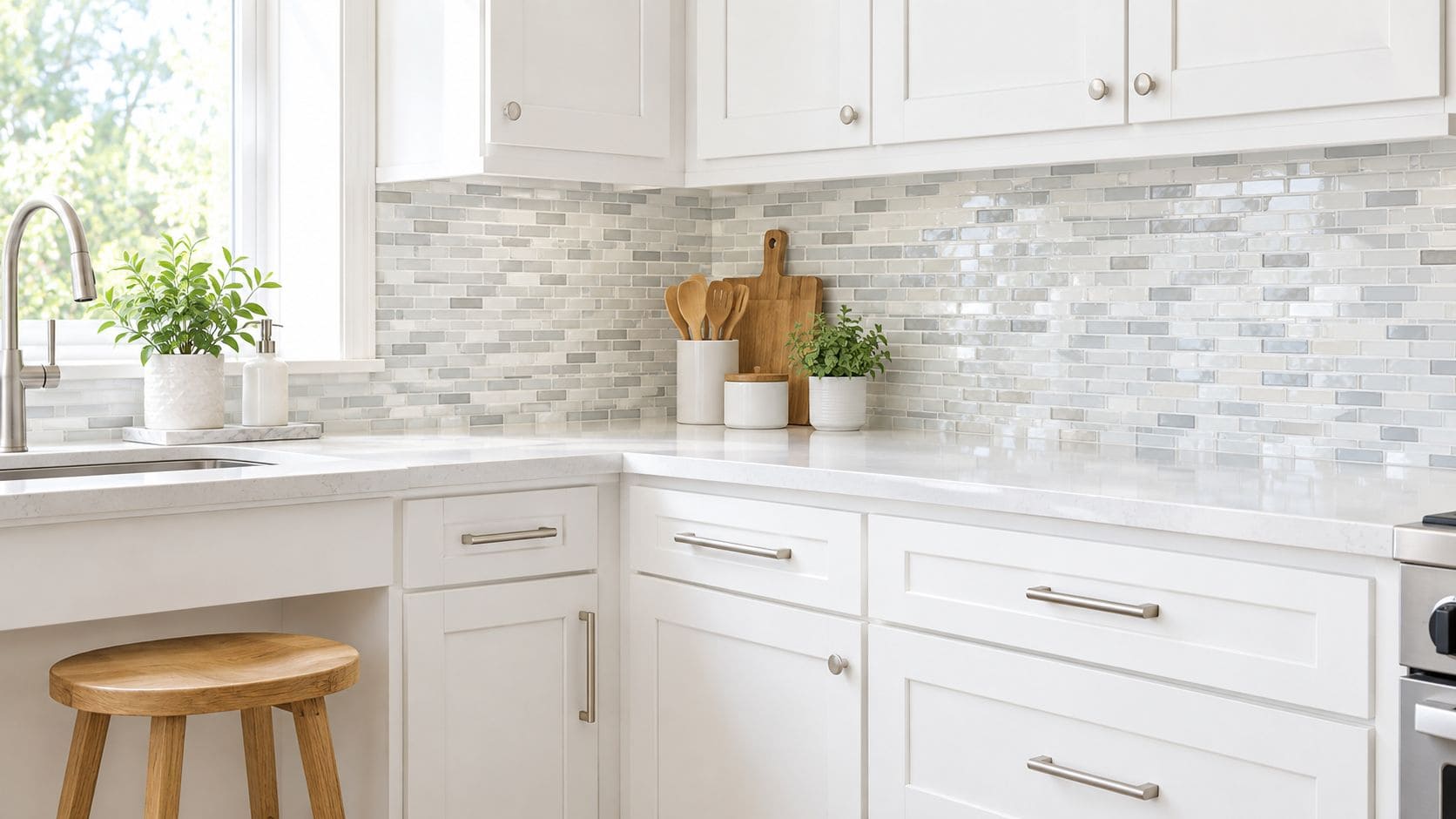
- Painted shaker cabinets plus glossy glass mosaic: works well when the counter is subtle and the grout color stays close to the tile.
- Bold stone countertops plus neutral ceramic mosaic: lets the backsplash bridge colors without starting a visual argument.
The myth that small tile is easy to clean
Small tile gets sold as manageable because the pieces are small. The opposite is often true. More pieces mean more grout joints, more edges, and more places for residue to settle.
That doesn't make mosaic a bad choice. It means placement matters. A mosaic accent on the sink run, open shelf wall, or beverage station gives you the texture people like without making the most abused wall in the room the hardest one to maintain.
Field note: The prettiest mosaic samples often belong on the easiest wall to wipe, not the hardest one to cook against.
This is also where coordinated sample review helps. Looking at tile in isolation is risky. Comparing it beside actual cabinet finishes and countertop samples tells you quickly whether the backsplash is acting as glue or noise. A useful starting point is this guide to countertop and cabinet combinations.
Use mosaic as punctuation
The smartest mosaic layouts often do one of three things well:
| Kitchen condition | Better backsplash move |
|---|---|
| Strong counters, strong cabinets | Quiet mosaic or non-mosaic field |
| Plain counters, simple cabinets | Mosaic can take a larger visual role |
| High-splatter cooking zone | Simpler, lower-maintenance surface |
Think of mosaic as punctuation. A little in the right place sharpens the whole sentence. Too much of it and the room starts shouting.
Maintenance Tips for Long-Lasting Mosaic Beauty
The maintenance side of mosaic is where hybrid design stops being theory and starts saving effort. If you reduce the amount of grout in the hardest-working parts of the kitchen, you reduce the amount of cleaning you have to care about later.
That matters for daily life and for resale. Buyers may admire an intricate backsplash, but they also notice whether the kitchen feels easy to maintain. A selective mosaic installation usually reads thoughtful, while a wall packed with tiny joints can read high-maintenance.
Clean by material, not by habit
Different mosaic materials need different handling.
- Glass mosaic: usually the easiest to wipe clean. Use non-abrasive cleaners and soft cloths so you don't haze the finish.
- Natural stone mosaic: needs more caution. Avoid harsh cleaners that can dull or etch the surface, and keep up with sealing when the product calls for it.
- Ceramic and porcelain mosaic: generally forgiving, but grout still needs attention.
If your backsplash includes ceramic tile and the grout is starting to darken, this practical guide can help you find ceramic tile cleaning advice before you reach for the wrong product.
Why the hybrid approach lowers maintenance drag
Here's the simple case for it. Full-wall mosaic expands the number of grout joints you need to wipe, inspect, and eventually refresh. A hybrid layout limits that detail to the areas where it delivers the most design payoff.
That gives you several advantages:
- Less grout near heavy grease output, especially behind a range.
- Easier weekly cleanup on the larger, simpler sections.
- Better long-term appearance, because the most visible focal tile isn't also taking the worst abuse.
What actually keeps mosaic looking good
Good maintenance is usually boring. That's a compliment.
Wipe splatter early, avoid abrasive pads, and don't let textured stone collect months of cooking film before you address it.
If you want a mosaics kitchen backsplash to age well, choose a material you'll maintain, not one you admire only in a showroom sample. The homeowners happiest with mosaic tend to be the ones who used it strategically instead of coating every wall in it.
The Mobile Showroom Experience with The Cabinet Coach
Backsplash decisions get easier when you stop judging tile under showroom lighting and start looking at it in your actual kitchen. Wall color, cabinet finish, countertop movement, under-cabinet lighting, and even window direction change how mosaic reads.
That's why an in-home sample process is useful for this category. You can put a glass sheet next to your counters, compare grout tones against cabinet paint, and see quickly whether the mosaic should cover a full wall or just one section.

How the process works in practice
A practical sample review usually follows a straightforward path.
- Start with photos and priorities. Before anyone talks tile shape, define how you cook, how much maintenance you'll tolerate, and whether the backsplash should be quiet or focal.
- Compare materials in the room. Glass, stone, and ceramic can look completely different once they're beside your cabinets and counters.
- Test placement options. The hybrid strategy gets real. Full wall, range accent, sink wall, or mixed surfaces all read differently in person.
- Refine grout and edge details. These small decisions affect the finished look more than most homeowners expect.
For South Jersey homeowners who want that kind of in-home evaluation, The Cabinet Coach offers a mobile showroom process that brings cabinetry, countertop, hardware, and tile selections into the house rather than sending clients from store to store. If you want to understand why that format suits remodeling decisions like backsplash selection, this article on why a mobile cabinet showroom is the future of kitchen remodeling in South Jersey lays out the approach.
Why this matters for mosaic specifically
Mosaic is unusually sensitive to context. A tile that looks elegant on a sample board can look too busy once it's framed by veined quartz, painted cabinets, and stainless appliances. The opposite happens too. A tile that seems plain in isolation can become exactly right when everything is viewed together.
That's also why homeowners should mock up the hybrid option before committing. Hold the mosaic only in the accent zone first. Then look at a simpler field option behind the range. In many kitchens, that split gives you a cleaner result and a more livable one.
If you're sorting through mosaic, slab, or mixed backsplash ideas, The Cabinet Coach can help you compare tile, cabinetry, and countertop samples in your own kitchen so the decision matches your lighting, layout, and maintenance priorities. It's a practical way to decide where mosaic belongs, where it doesn't, and how to make the whole kitchen read as one finished design.