
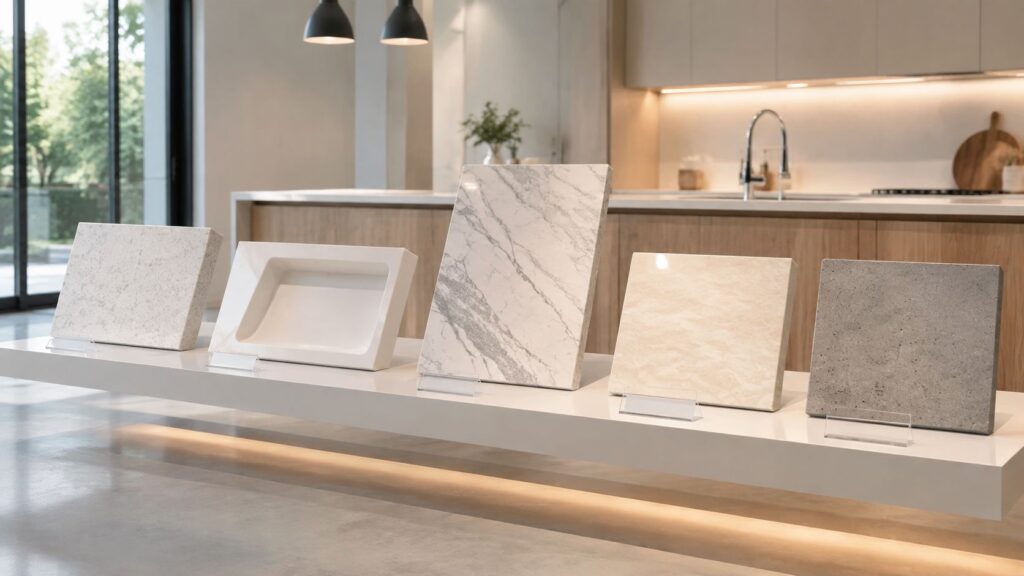
You're probably standing in a kitchen right now, holding a sample board, and wondering why every slab starts to sound the same after ten minutes. One seller says quartz is low maintenance, another says porcelain is indestructible, and a third pushes a solid surface that “solves everything.” It doesn't. Man made countertops materials are not interchangeable, and if you're remodeling in South Jersey, the wrong pick shows up fast in heat marks, chipped corners, scratched sink surrounds, and a surface that looks great on day one but annoys you by year two.
Table of Contents
- Why Man Made Countertops Took Over South Jersey Kitchens
- What Counts as a Man Made Countertop Material
- Durability, Maintenance, and Real Cost Ranges
- The Failure Modes Nobody Warns You About
- Edges, Seams, Cutouts, and What Fabricators Actually Need
- Matching the Material to Your Household
- Selecting Your Slab with The Cabinet Coach
Why Man Made Countertops Took Over South Jersey Kitchens
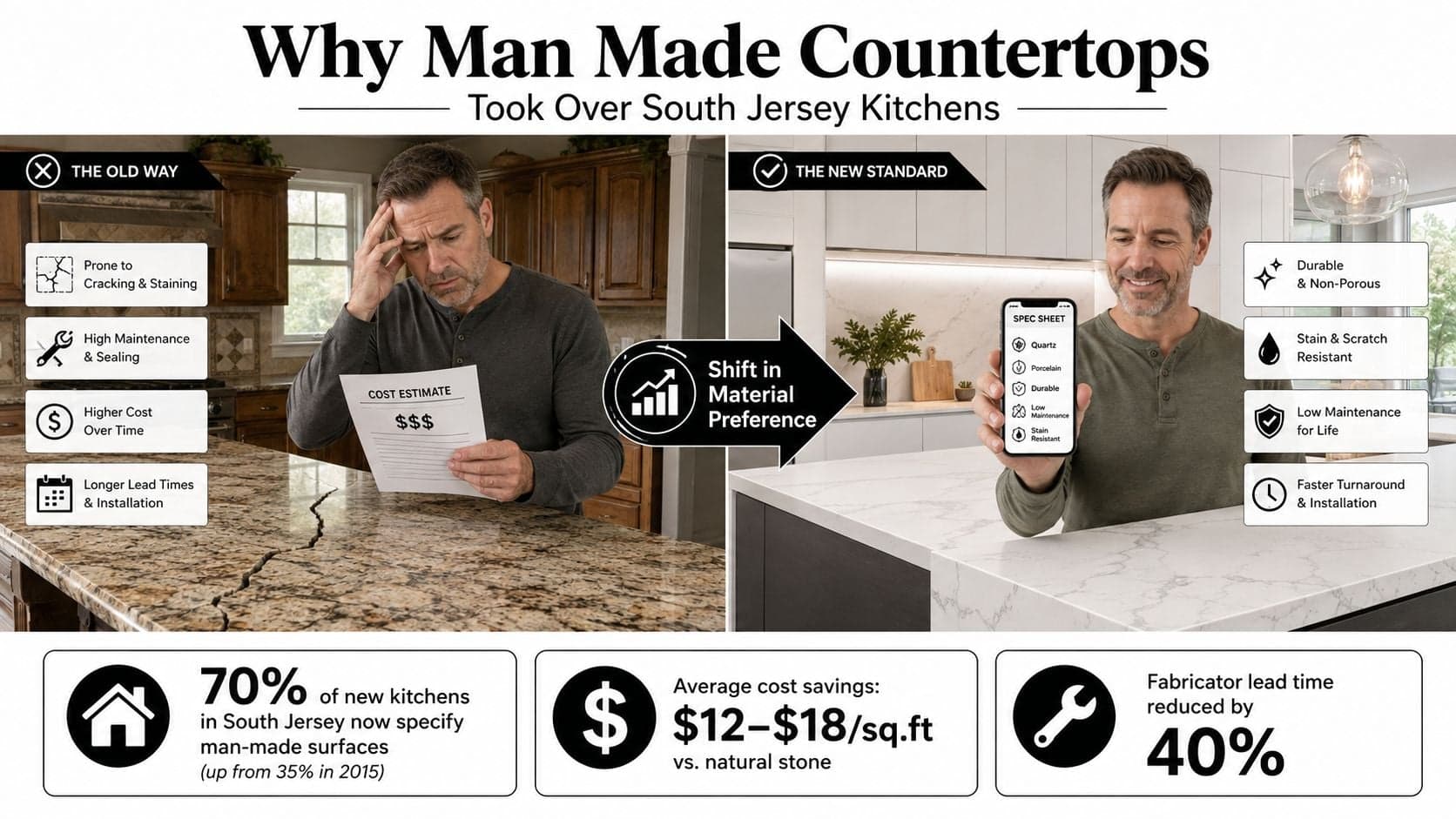
A Cherry Hill homeowner walks into a mobile showroom, stares at three white slabs, and asks the same thing I hear in nearly every remodel, “Which one won't turn into a headache after install?” That question is exactly why fabricated surfaces keep winning the spec sheet. They're predictable, easier to coordinate with cabinets and appliances, and they give you a cleaner design conversation than trying to gamble on the personality of a one-off natural stone slab.
The market shift is real
One industry estimate puts engineered quartz at 51% of the U.S. countertop market, ahead of granite at about 24%, and says quartz overtook granite around 2018 to 2019. The same source places the U.S. countertop industry at $22.1 billion and estimates 8,000 to 10,000 fabrication shops nationwide, which tells you how central factory-made surfaces have become in remodeling and residential work alike. Read the countertop industry snapshot.
That matters in South Jersey because homeowners aren't shopping for a theory, they're shopping for a surface that can survive a family kitchen, a bath vanity, or a resale update without forcing a lot of extra care. The rise of fabricated materials also changed the buying process. Instead of picking a slab first and figuring the rest out later, more owners now compare finish, edge profile, maintenance, and installation risk before they ever sign off.
Practical rule: if your kitchen gets used every day, start with failure modes, not color chips.
The Cabinet Coach's quartz vs granite comparison fits that mindset well because it treats material choice as part of the remodel plan, not an afterthought. That's the right order. A countertop isn't a decoration you swap later, it's a working surface that has to fit the layout, the cabinets, and the way your household cooks.
What Counts as a Man Made Countertop Material
Homeowners often use “man made” as if it means one product. It doesn't. In the real world, you're usually choosing among engineered quartz, solid surface, porcelain slab, cultured marble, and, in some projects, concrete composite. Those aren't stylistic aliases. They're different factory processes, different resins, different failure points, and very different install behaviors. The right choice starts with understanding what's in the slab.
Five categories, five different builds
Engineered quartz is the familiar one. It's typically made from about 90% ground natural quartz and 10% polyester or polymer resin, which is why it behaves like a dense, non-porous surface that doesn't need sealing. That material breakdown is spelled out here, and it's the reason quartz dominates so many kitchen remodels.
Solid surface is a different animal. It's a homogeneous composite of roughly 33% acrylic resin and 66% aluminum trihydrate, usually cast into sheets around 1/2 inch or 3/4 inch thick. Because it's thermoformable at about 300 to 340°F, fabricators can bend it into integrated sinks and curved details. The solid-surface construction details are laid out here.
Porcelain slab is the newer showroom favorite. It's pressed and fired at high temperature, then printed or finished to mimic stone, concrete, or a clean modern monolith. It's not the same thing as a porcelain tile counter, and it's not just a thin skin. It's a different fabrication category altogether. For a helpful scan of current options, the 2026 kitchen countertop options guide is worth a look if you're comparing engineered looks and surface systems.
Cultured marble is a molded, resin-based material that shows up a lot in baths and vanity work. It usually isn't the first choice for a hard-use kitchen, but it still comes up in South Jersey quotes because it solves a specific need, quick bathroom refreshes, integrated bowls, and a controlled budget.
Concrete composite is the most custom of the group. It can be cast for a custom look and a heavier architectural feel, but it asks more of the installer and the structure below it. It's not the casual pick, and it's not the safest choice for a homeowner who wants low fuss.
The Cabinet Coach countertop types guide is useful because it keeps these categories separate instead of lumping everything “non-natural” together, which is exactly where most shopping mistakes start.
| Material | Core Composition | Typical Thickness | Signature Property |
|---|---|---|---|
| Engineered Quartz | Ground quartz with resin binder | Slab format | Non-porous, consistent pattern |
| Solid Surface | Acrylic resin with ATH filler | Sheet format | Seamless fabrication and repair |
| Porcelain Slab | Fired mineral body | Large-format slab | Thin profile with strong visual realism |
| Cultured Marble | Resin-based molded composite | Vanity and bath forms | Integrated bowls and molded detail |
| Concrete Composite | Cementitious or composite cast material | Custom-cast | Heavy, architectural appearance |
If you can't tell me whether the surface is cast, pressed, or bonded, you're not far enough into the decision.
The point isn't to memorize chemistry. The point is to stop treating all man made countertops materials as one bucket. Quartz, solid surface, porcelain, cultured marble, and concrete composite each solve a different remodeling problem. If your kitchen, bath, or laundry room has a real use pattern, the material has to match that pattern.
Durability, Maintenance, and Real Cost Ranges
Most homeowners don't need a laboratory comparison. They need a straight answer. Which material stays clean, which one scratches, which one handles heat, and which one eats into the budget once install details get real? That's the decision point, and it's where the glossy showroom story often breaks down.
The materials do not age the same way
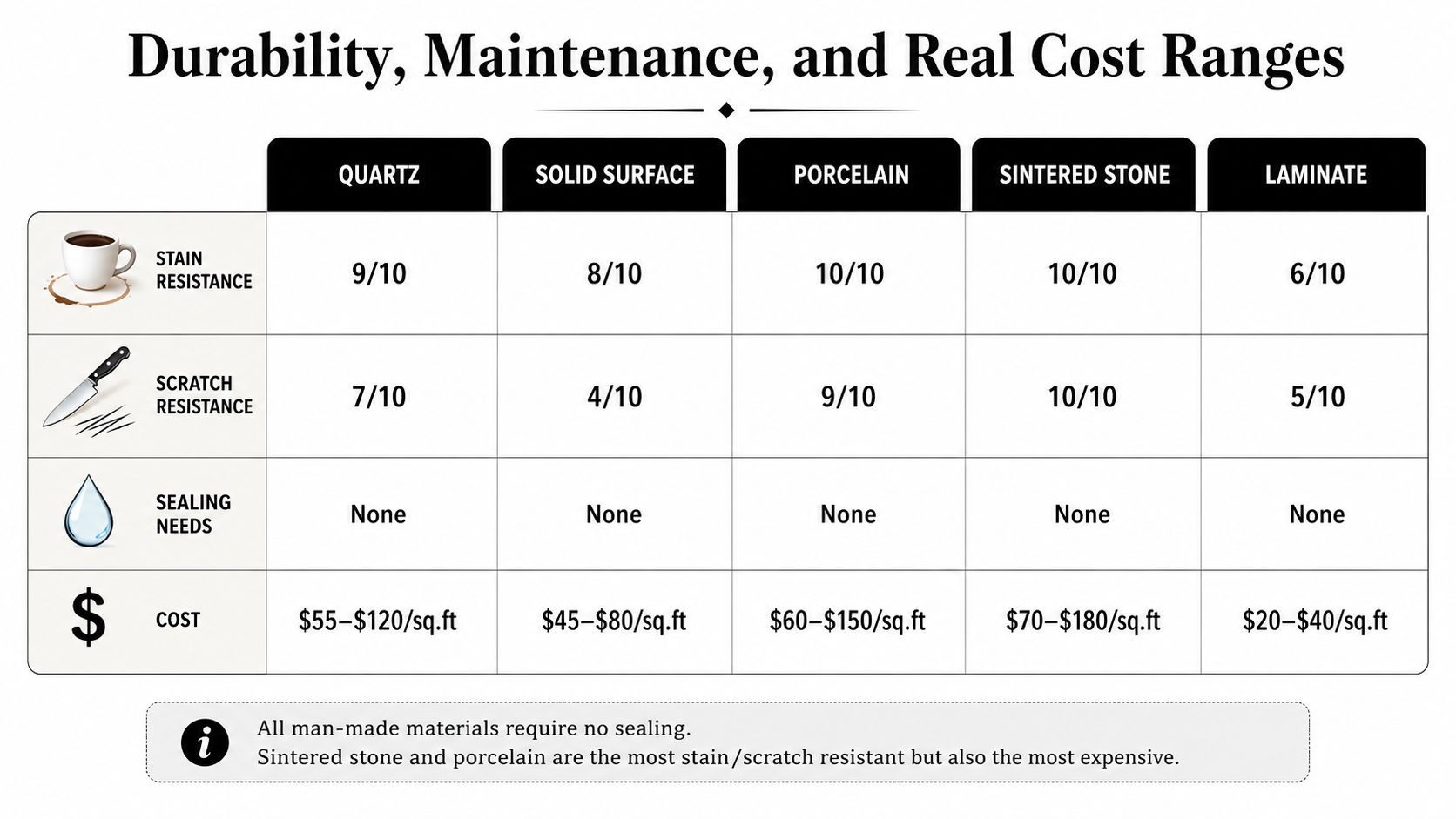
Quartz is the easy-care crowd favorite because the resin binder makes it non-porous and stain resistant. It doesn't need sealing, but it still has a weakness under heat, because the binder is heat-sensitive. The slab can look premium for years, but hot cookware is still a problem.
Solid surface is easy to live with day to day, but it's softer than quartz and much more prone to scratching. It wins in repairability and fabrication, then gives some of that back in visible wear if the household is rough on surfaces.
Porcelain is the hard-use choice in a lot of modern kitchens. It's strong, stain resistant, and doesn't need sealing. The tradeoff is that edge detailing and installation quality matter a lot more than they do with more forgiving surfaces.
The market projection for man-made solid surface countertops is from USD 4.92 billion in 2024 to USD 7.78 billion by 2033, with a 5.4% CAGR from 2026 to 2033. Another forecast puts the broader countertops market at USD 161.23 billion in 2026, rising to USD 195.41 billion by 2031 at a 3.92% CAGR. That projection is here, and it shows that the category keeps expanding even as buyers split into more specialized material preferences.
The same forecast says U.S. countertop demand is projected to reach 935 million square feet in 2028, valued at $8.6 billion, and that porcelain slab has grown rapidly since its U.S. introduction in 2013, making it the fastest-growing material through the forecast period. That lines up with what I see on remodel sites, more homeowners want the porcelain look, especially when they're trying to reduce maintenance and keep a clean, contemporary finish.
Budget and upkeep should be judged together
Here's the decision rule I use. If the household cooks hard and often, pay attention to heat and impact, not just stain resistance. If the project is for a bath, laundry room, or a low-traffic resale update, you can prioritize cost and visual uniformity more aggressively.
Short version: cheap up front is only cheap if it still looks right after the install dust settles.
A solid place to cross-check pricing is the countertop materials cost guide from Aureli Construction, because it reminds homeowners that fabricated surfaces carry both material and install variables. The Cabinet Coach countertop pricing by material page is also worth using when you want to compare options against actual cabinet plans instead of abstract square footage.
| Material | Maintenance | Heat Resistance | Scratch Behavior | Realistic Budget Read |
|---|---|---|---|---|
| Quartz | Low routine care, no sealing | Sensitive to hot pans | Good for daily use, not bulletproof | Mid to upper midrange |
| Solid Surface | Low care, easy to clean | Not a heat-first material | Scratches more easily | Usually friendlier to budget |
| Porcelain | Low care, no sealing | Strong under heat | Very hard wearing | Higher cost, more install-sensitive |
| Cultured Marble | Low care in baths, not rugged | Not ideal for hot cookware | Softer, more cosmetic wear | Often budget oriented |
| Concrete Composite | Variable care, project-specific | Depends on finish and seal strategy | Can show wear and movement | Highly custom, quote-driven |
The chart tells the story better than any showroom pitch. If you want the least maintenance with a polished, upscale look, quartz and porcelain do the heavy lifting. If you want a softer budget and a simpler bath or vanity project, solid surface and cultured marble still have a place. If you're shopping for a busy family kitchen, don't start with the prettiest board. Start with the surface that won't make you regret dinner prep.
The Failure Modes Nobody Warns You About
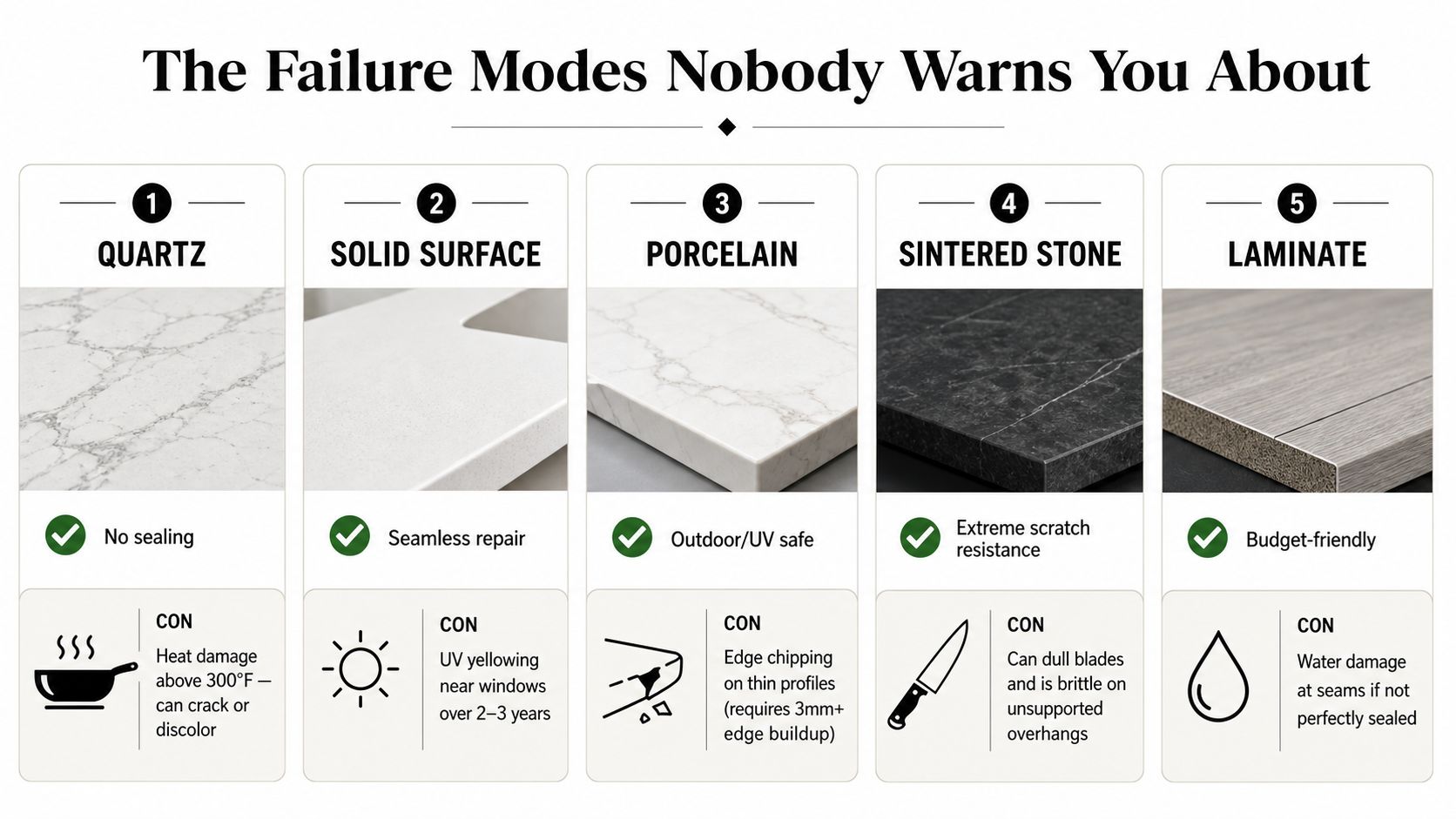
Showroom talk loves the words “durable” and “low maintenance.” Those words hide the story. Every man made countertop material has a weak spot, and the weak spot usually shows up after install, when the counters are being used for real cooking, cleaning, and daily traffic.
Heat, sun, and surface wear show up differently
Quartz is the classic example. It's stain resistant and doesn't need sealing, but the resin binder is heat-sensitive. That's why I treat hot pans as a design issue, not just a housekeeping issue. If the cooktop is tight to the work zone, you need a household that uses trivets.
Solid surface solves one problem and creates another. It can be repaired and reshaped, but it scratches far more easily than quartz or natural stone. That matters around sinks, breakfast stations, and kids who treat the counter like a landing strip.
Porcelain handles UV and heat well, which is why it's so strong in modern kitchen and bath design. The catch is edge behavior. Thin profiles look clean, but they need proper edge buildup and careful fabrication so the first chip doesn't become the first complaint.
The Compac design and fabrication manual is blunt about the install side of this. It calls for rounded inside corners, beveled outer edges, and fully supported, level cabinets before installation. That's not overkill. It's how you keep a good slab from turning into a warranty call.
The small details are where the damage starts
Here's the part most homeowners miss. A countertop doesn't fail because the brochure was wrong. It fails because the edge was too sharp, the cabinet run wasn't level, the cutout was too close to the edge, or the sink area didn't get the right reinforcement. A lot of “mystery cracks” are really prep mistakes that showed up late.
Practical rule: if a material looks fragile in the details phase, it'll be fragile in daily use too.
That's why I don't buy the idea that any one surface is universally “best.” Quartz is great for a lot of kitchens, but not for every heat-heavy cook. Solid surface is useful in baths and easy-care spaces, but it's not my first pick for a rough kitchen. Porcelain is excellent for durability and clean visuals, but only if your fabricator knows how to handle the thin edge details.
A busy family should care less about the label and more about the abuse pattern. Hot skillet, sunlit window, kids leaning on the edge, cookie sheets pulled across the prep area, those are the tests. If the material can't survive those moments, it doesn't matter how elegant it looked in the showroom.
Edges, Seams, Cutouts, and What Fabricators Actually Need
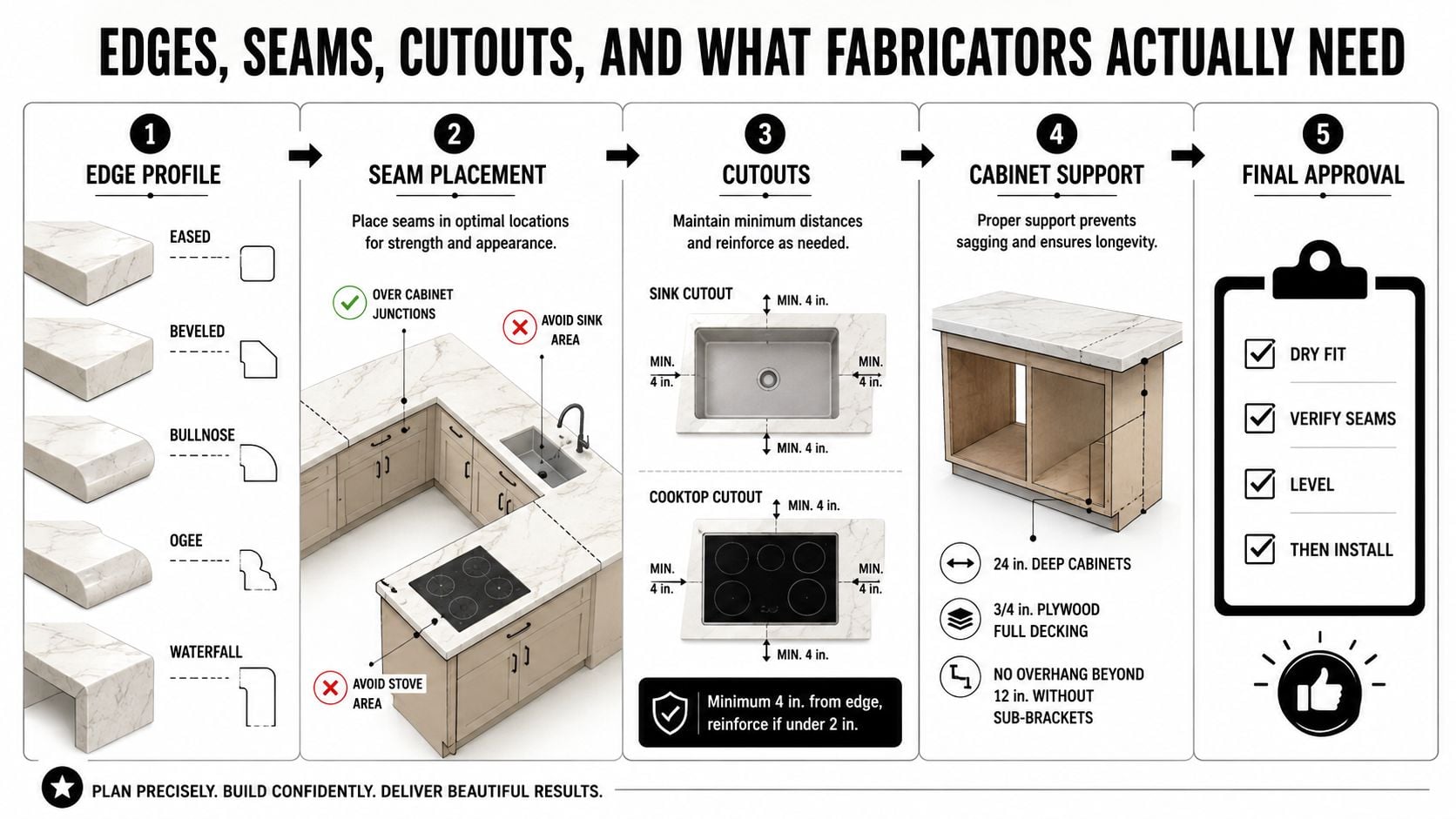
The best slab in the world can still look wrong if the fabrication is sloppy. Edges, seams, cutouts, and cabinet support are not minor details. They're the difference between a clean install and a countertop that telegraphs problems every time the light hits it.
Choose the edge for the use, not just the style
An eased edge is the cleanest default. It keeps the line simple and is usually the safest choice in hard-working kitchens because it doesn't invite unnecessary breakage.
A beveled edge gives a sharper architectural look, which can suit a modern kitchen or a more classic bath vanity. A bullnose softens the profile and is easier on hands, knees, and kids' elbows. Ogee reads traditional and decorative, while a waterfall edge turns the countertop into a design statement by dropping the material down the side of the cabinet run.
The countertop edges options guide is helpful here because edge choice should be part of the design conversation, not an afterthought once the slab is already selected.
Seams and cutouts should serve the slab
Fabricators try to place seams over cabinet junctions and away from obvious sightlines. That's the cleanest strategy because seams are least noticeable where the base cabinets already break the visual field. Sink and cooktop cutouts need more care than a casual buyer expects, especially when the work zone is tight or the run is narrow.
A slab also needs proper cabinet support. Fully level cabinets, good substrate, and the right overhang support are what keep the surface from flexing and turning stress into damage later. If the cabinet box is wrong, the countertop has to compensate, and that's where cracks and fit issues start creeping in.
Use a simple install checklist
- Confirm the edge profile first: Decide whether the room needs eased, beveled, bullnose, ogee, or waterfall before fabrication starts.
- Place seams where they disappear: Push them over cabinet breaks and away from sinks, cooktops, and high-contrast sightlines.
- Respect cutout spacing: Sink and cooktop openings should be planned with the slab's strength in mind, not forced into the final week.
- Check cabinet support early: Level, solid, and fully supported cabinets make the install cleaner and the surface safer.
- Do a dry fit before final approval: Once the slab is cut, there's no easy way to undo a bad layout.
When a homeowner sees the install plan this clearly, the “which material is best” question gets a lot easier. Some materials are more forgiving, but none of them excuse bad planning. If the fabricator is guessing at the site, the countertop is already in trouble.
Matching the Material to Your Household
The right choice depends on how your house lives, not how the sample board looks under showroom lighting. A busy family kitchen, a resale-focused condo, and a primary bath need different materials because they're not asking the slab to do the same job. That's where a lot of remodels go sideways, buyers choose for aesthetics first and then get annoyed by the surface they have to live with.
Busy kitchens need forgiveness, not fuss
For a Voorhees family cooking nightly, quartz is usually the first call if the cooking habits include a lot of prep, easy cleanup, and a desire for a polished look without sealing. Go with a clean edge, not an fussy one. A simple eased or beveled profile keeps the kitchen looking finished without making the top feel fragile.
A family that sets hot pans down everywhere should think harder about porcelain. It handles abuse differently and gives you more confidence around heat and UV exposure. It's the smarter pick if the layout puts the kitchen in bright daylight and the homeowners want a crisp modern finish.
Resale and baths want controlled risk
For a Collingswood condo flip, solid surface can make sense in secondary spaces where you need a clean, unified look and don't want to overbuild the budget. It's also practical when the project includes a bath vanity and integrated sink detail. That's where the material's fabrication flexibility earns its keep.
For a Moorestown primary-suite bath, I'd still lean toward porcelain or a neat solid-surface spec depending on the design. If the room gets plenty of natural light and the client wants a refined, low-fuss finish, porcelain is the stronger long-term play. If the goal is a softer look with easier fabrication and a more controlled spend, solid surface still holds up.
Short advice: match the slab to the room's abuse level, not the client's favorite Pinterest image.
One more thing. If you're comparing countertop performance in the context of a broader remodel, the CP Painting Company performance guide can be a useful reference point for thinking about finish quality and how the final room should hold up visually over time. That mindset matters here too, because countertops are part of the overall performance of the space, not a standalone purchase.
Selecting Your Slab with The Cabinet Coach
A good countertop choice gets easier when you stop shopping in isolation. The Cabinet Coach's mobile-showroom workflow is built for that. A complimentary video consultation starts the process, then the team moves into an in-home review where you can compare cabinet finishes, countertop options, hardware, and tile in the actual room, not under a warehouse spotlight. That matters because quartz, porcelain, and solid surface look very different once they're beside your floors, windows, and cabinet colors.
The free in-home kitchen design consultation is the right entry point if you want to move from research to a real plan. The value isn't just seeing samples. It's getting the material conversation tied to layout, budget, and install realities before you commit.
Better choices happen when the estimate is transparent
Preliminary estimates should surface the tradeoffs early. If quartz fits the project but porcelain pushes the budget higher, you need to see that before the order is locked. If a fabricator needs different support or edge treatment for a slab choice, that should be clear during the selection phase, not after demo day.
The Cabinet Coach also coordinates architects, fabricators, and trades so the chosen material lands correctly in the finished room. That coordination is what keeps a good product from being undermined by a sloppy install sequence. In a market like Cherry Hill and the surrounding counties, where homeowners want a smooth process and real accountability, that workflow is often the difference between a calm remodel and a stressful one.
If you're ready to compare man made countertops materials with someone who can factor in your cabinets, cooking habits, and room layout, start with a consultation and bring the decision into the room where it belongs.
If you're planning a kitchen or bath remodel in South Jersey, The Cabinet Coach can walk you through countertop options in a mobile showroom, tie the slab choice to your cabinets and layout, and help you avoid the usual install mistakes. Visit The Cabinet Coach to book a consultation and get a real countertop plan for your home.