
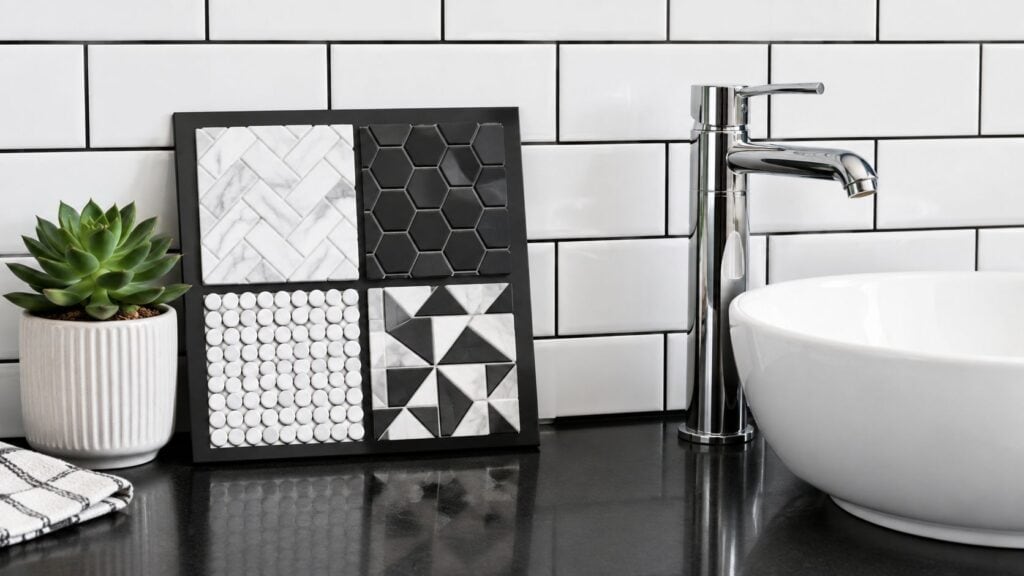
A black-and-white kitchen already has a strong point of view. The backsplash can calm that contrast with quiet lines, amplify it through geometry, add warmth with masonry texture, or introduce a controlled metallic or stone accent. The right answer depends on more than the tile itself. Cabinet door style, countertop movement, available wall area, lighting, cooking-zone heat, cleaning habits, and the permanence you want from the remodel all affect the decision.
The best backsplash ideas for black and white kitchen designs also solve practical problems. A busy countertop may need a restrained wall, while flat-panel cabinets can support a more graphic pattern. A cooktop wall needs materials and installation methods suited to heat and grease, while a rental kitchen may call for a reversible surface instead of mortar and grout. The options below compare visual impact, scale, grout, maintenance, installation demands, and cabinet coordination. For homeowners in Cherry Hill and throughout South Jersey, The Cabinet Coach can help coordinate tile with cabinetry, countertops, hardware, and the broader remodel.
Table of Contents
- 1. Classic Black and White Subway Tile
- 2. Geometric Black and White Patterned Tile
- 3. Checkerboard Pattern Tile
- 4. Hexagonal Black and White Tile
- 5. Herringbone Black and White Tile Layout
- 6. Black and White Marble or Natural Stone Tile
- 7. Brushed Metal or Stainless Steel Accents With Black and White Tile
- 8. Mix-and-Match Textured and Smooth Black and White Tiles
- 9. Thin Brick or Stacked Stone Black and White Backsplash
- 10. Waterproof Wallpaper or Peel-and-Stick Black and White Pattern
- 10 Black & White Backsplash Ideas Compared
- Turn a Favorite Pattern Into a Coordinated Remodel
1. Classic Black and White Subway Tile
Traditional subway tile creates the most familiar experience in a black-and-white kitchen. The classic format was first used in New York City's City Hall subway station in 1904, where its glazed white rectangular surface helped provide brightness, easy cleaning, stain resistance, and light reflection, as documented in this history of subway tile design (historical background on subway tile). That practical origin still suits kitchens because white tile brightens the wall while black details give the installation definition.
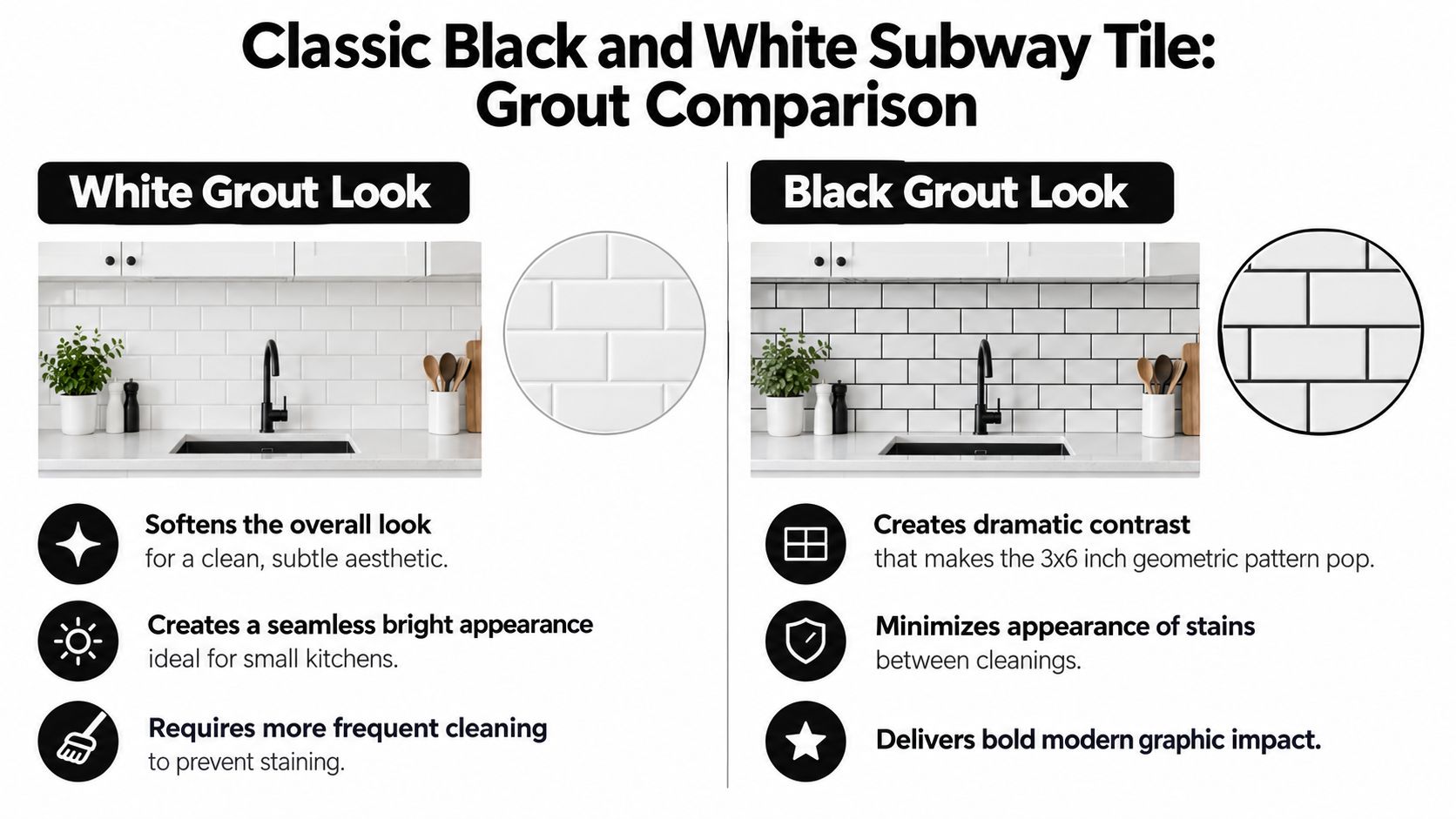
Use white subway tile with white grout for a softer, quieter effect. Choose black grout when you want every horizontal and vertical line to read as part of the design. Black-and-white alternating tiles create a stronger graphic statement, but they can compete with a veined countertop or ornate cabinet door.
Grout changes the entire mood
Black grout is useful in a busy cooking area because discoloration is less visually obvious between cleanings. It also makes installation quality more important. Uneven joints, inconsistent spacing, or poorly aligned outlets will stand out. White grout is more forgiving visually, but it demands more attention around the sink and cooktop.
A matte tile reduces glare and gives black cabinetry a softer partner. Glossy white tile reflects more light, which can help a dim kitchen, but it may look sharper beside polished counters and stainless appliances. Extend the pattern toward the ceiling or range hood when the wall has height and the cabinet layout supports a finished vertical composition. Before selecting the tile, compare finishes and cabinet relationships in this kitchen backsplash trends guide.
2. Geometric Black and White Patterned Tile
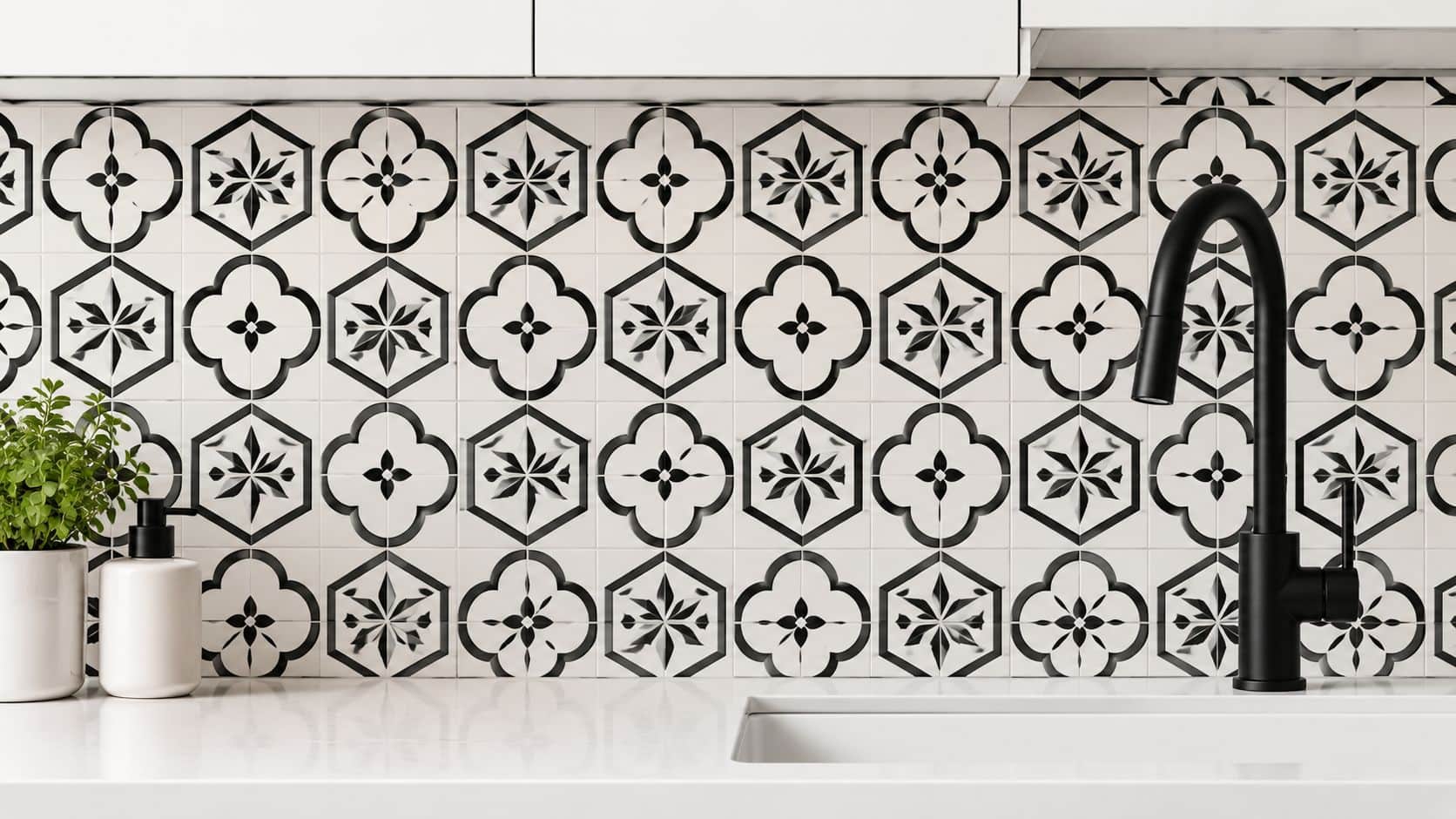
Patterned tile turns the backsplash into the kitchen's focal point. Quatrefoils, Moroccan-inspired motifs, diamonds, and bold printed ceramics can add personality without introducing another color. This approach works particularly well with simple Shaker or flat-panel cabinetry, where the wall can provide the decorative detail the doors deliberately avoid.
The trade-off is visual competition. A patterned backsplash doesn't need help from a heavily veined countertop, ornate pendant lights, and elaborate hardware all at once. If the counters already carry strong movement, use the pattern on a range wall or a limited section rather than across every backsplash surface.
Keep the field controlled
A practical way to make graphic tile livable is to combine it with a quieter field tile. A patterned panel behind the range can sit beside white subway tile or a plain porcelain surface. That creates a focal point without forcing the eye to process a motif at every turn.
- Use restrained grout: White or light gray grout usually lets the pattern lead instead of adding another grid.
- Match the cabinet simplicity: Plain slab or Shaker doors give decorative tile room to breathe.
- Sample the full repeat: A small sample may hide how quickly a pattern becomes dominant across a long wall.
- Check the surface: Matte or lightly textured finishes often feel more architectural than a highly reflective printed tile.
Hand-painted tile brings variation and character, but variation can make repairs and replacement matching harder. Printed ceramic gives a more consistent repeat and may be easier to coordinate across multiple walls. For a busy kitchen, select a surface that can be wiped without deep embossing that traps grease.
3. Checkerboard Pattern Tile
Checkerboard tile delivers immediate rhythm. Alternating black and white squares create a retro-modern mood that fits cottage, farmhouse, vintage, and eclectic kitchens, but the effect can also look crisp in a contemporary room with slab doors and restrained hardware. The pattern is straightforward to understand, which makes it a strong choice when you want impact without a complicated decorative motif.
Square tile creates the cleanest checkerboard. Larger squares make the pattern feel calmer and more architectural, while small squares create a busier, nostalgic surface. Rectangular pieces can produce a stretched interpretation, although the alternating grid becomes less traditional and requires careful layout planning around outlets, corners, and cabinet ends.
Let the pattern be the feature
A checkerboard backsplash works best when surrounding elements support it. Pair it with a simple countertop, limited open shelving, and hardware that reinforces the chosen period. Matte black pulls and a bridge-style faucet can lean vintage, while nickel hardware can keep the composition transitional.
Epoxy or urethane grout can be considered where stain resistance is a priority, but grout selection should be reviewed with the installer because product handling and application differ from standard cement grout. The pattern also needs a level substrate. Small deviations become obvious when the squares must align across a long wall.
Don't force checkerboard into a narrow strip where only partial squares will show. It needs enough uninterrupted wall to establish its rhythm. If the kitchen has a generous range wall, extending the pattern vertically can create a deliberate feature. If the wall is broken by several windows, cabinets, and outlets, a quieter subway or slab surface may look more composed.
4. Hexagonal Black and White Tile
Hexagons sit between the familiarity of subway tile and the intensity of a full graphic pattern. Their angled edges create movement, but a solid white field with pale grout can remain remarkably calm. In a black-and-white kitchen, hexagons can be used as a white background with black accents, a mixed monochrome field, or a black tile zone framed by white.
Scale controls the experience. Small mosaics produce more grout and a stronger texture, while larger hexagons create a cleaner, contemporary surface. In a compact kitchen, a larger format can prevent the wall from feeling overly fragmented. Around a cooktop or sink, though, the number of joints still matters because every joint requires cleaning.
Coordinate shape with cabinet geometry
Hexagonal tile pairs naturally with modern flat-panel or handleless cabinetry. Its geometry echoes the clean lines without copying the rectangular door shape. With traditional raised-panel cabinets, the result can work, but the room needs a clear transitional strategy so the tile doesn't look disconnected from the furniture-like cabinetry.
The guide to selecting a tile backsplash is useful when comparing tile size, finish, and the surrounding countertop. Bring actual samples into the kitchen. A warm white cabinet can make a blue-white tile look disconnected, while a charcoal cabinet may need a softer white to avoid an overly severe contrast.
- Choose grout with purpose: White or light gray reduces the visible network of joints.
- Use finish contrast carefully: Matte black beside glossy white creates depth without adding color.
- Plan outlet cuts early: Hexagonal edges need precise cuts at receptacles and corners.
- Keep the counter quieter: The tile already supplies directional movement.
Professional installation matters more than it may appear. The eye catches drifting rows and irregular joints quickly, especially when black pieces form a repeated pattern.
5. Herringbone Black and White Tile Layout
Herringbone changes the direction of an ordinary rectangular tile. Instead of running in a straight bond, the pieces create a V-shaped zigzag that adds movement and a high-design feel. White subway tile with dark grout gives the most dramatic version, while white tile with light grout produces a quieter pattern that works well with transitional cabinetry.
This layout is attractive because it adds sophistication without requiring a second tile shape. It is also less forgiving than a standard running bond. The installer must account for centerlines, end cuts, cabinet transitions, outlets, and the visual point where the pattern begins. Poorly planned edges can leave awkward slivers or make the zigzag appear off-center.
Treat installation as part of the design
Herringbone isn't the best place to cut installation quality to the lowest bid. A skilled tile setter will plan the layout before spreading mortar and will protect the pattern at corners and changes in wall width. The grout should support the pattern rather than create unnecessary noise. White or light gray grout keeps the field refined, while black grout makes every angle more assertive.
Practical rule: If the countertop has prominent veining, choose a restrained herringbone tile and grout. The wall already has enough directional energy.
Use herringbone from the counter to the underside of the upper cabinets for a contained statement. Extending it to the ceiling or range hood can look dramatic, but the surrounding wall must be cleanly resolved. It pairs especially well with Shaker cabinetry, simple hardware, and a countertop with limited movement.
A quality porcelain or ceramic tile can handle normal backsplash conditions, but the cooktop area still needs the correct substrate, mortar, and clearances. The pattern creates visual value, so budget for the labor required to execute it accurately.
6. Black and White Marble or Natural Stone Tile
Natural stone creates a more luxurious experience because the contrast comes from the material's own veining, variation, and surface depth. Carrara marble can provide a luminous white ground with gray movement, while Nero Marquina brings a black field with pale veining. Black granite with light veins offers a harder, more dramatic look, and limestone can soften the palette with a quieter texture.
Stone doesn't behave like glazed porcelain. It may need sealing, and its finish affects how easily water marks, grease, and fingerprints show. Honed or leathered surfaces generally feel more practical than a highly polished finish in a working kitchen, but the exact care requirements depend on the stone and product recommendations.
Let the stone coordinate with the counter
A marble backsplash can match a marble countertop for a continuous luxury composition, but matching slabs or tiles isn't always simple. If the countertop already has prominent movement, a calmer stone wall may prevent the kitchen from feeling visually crowded. Conversely, a quiet solid counter can support a more expressive black-and-white stone.
Use grout that complements the dominant stone color rather than creating an unrelated outline. Waterproofing behind the tile and proper sealing before use are essential parts of the installation plan. The wall behind the range also needs effective ventilation because natural texture can collect residue.
For homeowners who want the appearance of stone with less routine care, porcelain or a manufactured slab can be a more practical direction. Black backsplash tile coordination ideas can help clarify how dark stone works beside white cabinetry, black islands, and hardware. Natural stone is worth choosing when its variation is part of the appeal, not when you're hoping it will behave like a maintenance-free surface.
7. Brushed Metal or Stainless Steel Accents With Black and White Tile
Metal accents add an industrial edge and a controlled reflective note. Stainless steel, brushed aluminum, or muted chrome can appear as a narrow border, corner detail, trim piece, or occasional accent tile inside an otherwise black-and-white installation. The result works particularly well with stainless appliances, black cabinetry, exposed shelving, and contemporary lighting.
The strongest versions use metal sparingly. A full wall of polished metal can feel commercial and can reveal fingerprints, streaks, and reflected clutter. Brushed or matte finishes usually provide the industrial character with less visual glare and easier daily upkeep.
Connect the metal to real kitchen hardware
Coordinate the metal with the faucet, appliance panels, lighting, and cabinet pulls, but don't assume every silver finish matches automatically. Brushed stainless and polished chrome reflect light differently. A thin metal strip can bridge two finishes, while too many competing metals make the backsplash appear like an afterthought.
- Use an intentional location: A horizontal border can emphasize the cabinet line, while a vertical accent can frame a range or window.
- Choose durable material: Stainless steel or aluminum is generally better suited to wet kitchen conditions than a delicate decorative trim.
- Plan the fastening: Metal pieces need accurate alignment and appropriate setting materials.
- Keep cleaning simple: Microfiber cloths and a cleaner approved for the specific metal help protect the finish.
A black-and-white ceramic field keeps the metal from dominating. White tile reflects the accent and brightens the wall, while black tile makes the metal look sharper and more prominent. This option suits homeowners who want texture and shine but don't want the visual expense or maintenance demands of full natural stone.
8. Mix-and-Match Textured and Smooth Black and White Tiles
Texture adds depth without changing the color palette. Pair glossy white subway tile with matte black tile, or combine a smooth porcelain field with an embossed linear accent. Handmade surfaces can introduce subtle irregularity, while a structured relief pattern gives the backsplash a more deliberate architectural character.
This strategy works best when one surface acts as the background and the other serves as punctuation. Covering the entire wall in multiple textures can make cleaning difficult and can compete with countertop movement. A narrow accent band, range-wall panel, or framed section gives the tactile tile a clear role.
Balance reflectivity and maintenance
Glossy white tile can bounce light around a darker kitchen, while matte black tile absorbs some of that intensity. That contrast is more controlled than adding another color. However, textured tile has more places for grease and dust to settle, especially near the cooktop. Use soft sponges and pH-neutral cleaners, and ask the tile manufacturer how the relief should be maintained.
A backsplash can be monochromatic without being flat. Varying sheen and relief often creates enough interest without adding a third color.
Grout needs to work across both surfaces. A contrasting grout may define smooth tile but visually overwhelm embossed pieces. Before installation, place samples beside the actual cabinet door, countertop, and hardware. The glass tile backsplash ideas from The Cabinet Coach can also help when you're comparing reflective surfaces with matte cabinetry.
Textured tile is particularly effective with simple white Shaker doors or black slab cabinetry. If the cabinets already have heavy grain, molding, or decorative profiles, keep the backsplash texture restrained.
9. Thin Brick or Stacked Stone Black and White Backsplash
Thin brick and stacked stone bring masonry character to a black-and-white kitchen. Instead of relying on a printed pattern, these materials create depth through joints, edges, and uneven surfaces. A white brick veneer can warm a black island and white cabinets, while dark brick can ground a bright wall and reinforce an industrial or farmhouse direction.
This is a strong choice for homeowners who feel a conventional tile backsplash looks too polished. It suits rustic cabinetry, painted Shaker doors, reclaimed wood accents, and cottage architecture. In a modern kitchen, the contrast can work too, but the rest of the room should stay disciplined so the masonry doesn't look accidental.
Respect the surface's working conditions
Brick and stacked stone have more texture than smooth ceramic, which means grease can collect in recessed areas. The cooktop zone needs especially careful consideration. Strong ventilation, appropriate sealing, and a cleaning method that won't damage the material should be planned before installation.
Use a pH-neutral cleaner and a soft brush for routine care. Avoid assuming that every masonry product can be installed directly behind a range. The substrate, mortar, waterproofing, clearances, and sealant must suit the specific product and location.
A large uninterrupted wall gives the material room to read as architecture. On a short strip broken by cabinets and receptacles, the texture may look busy rather than intentional. Running bond creates a familiar brick rhythm, stacked installation feels more contemporary, and herringbone adds a decorative layer but increases layout demands.
Choose this option for warmth and tactile depth, not convenience. If low maintenance is the top priority, a porcelain surface that imitates brick or stone may better fit the kitchen's daily workload.
10. Waterproof Wallpaper or Peel-and-Stick Black and White Pattern
Removable backsplash products create the most flexible experience. Waterproof kitchen wallpaper and peel-and-stick panels can imitate subway tile, geometric patterns, or custom black-and-white artwork without committing to mortar, grout, or a permanent wall installation. They're useful for renters, temporary updates, and homeowners who want to test a pattern before investing in tile.
Preparation determines the result. The wall should be clean, smooth, dry, and free of loose paint or texture. Apply the material from the center outward, smoothing each section with a squeegee or firm card to reduce bubbles and wrinkles. Misaligned repeats are especially noticeable in geometric designs, so dry-fitting the first pieces is worthwhile.
Know where the temporary option stops
Peel-and-stick products are not a universal substitute for tile. Direct heat, steam, standing water, and heavy grease can shorten their useful life or compromise the adhesive. Keep them away from the most intense cooktop exposure unless the product specifically permits that installation and the manufacturer's requirements are followed.
This approach works well behind a coffee station, on a low-splash wall, or in a rental where permanent changes aren't allowed. A simple black-and-white pattern can also help you evaluate whether the room needs more contrast before selecting a permanent material.
Best use: Treat peel-and-stick as a controlled update or a design test, not as a shortcut around cooktop protection and proper installation.
Plan the eventual permanent backsplash at the same time if a full remodel is coming. Backsplash height affects outlets, hood surrounds, open shelving, and cabinet proportions. Review those relationships in this kitchen backsplash height guide before applying a temporary product.
10 Black & White Backsplash Ideas Compared
| Backsplash Style | Implementation Complexity 🔄 | Resources & Cost ⚡ | Expected Outcome 📊⭐ | Ideal Use Cases 💡 | Key Advantages ⭐ |
|---|---|---|---|---|---|
| Classic Black and White Subway Tile | Medium, straightforward layouts but requires alignment 🔄🔄 | Low–Medium, common materials; budget-friendly ⚡⚡ | Clean, timeless aesthetic; versatile and broadly appealing ⭐⭐⭐⭐ 📊 | Modern, transitional, small or large kitchens | Easy to clean, widely available, cost-effective ⭐ |
| Geometric Black and White Patterned Tile | High, intricate layouts and precise placement 🔄🔄🔄 | High, specialty or hand‑painted tiles; skilled labor ⚡ | Strong artistic focal point; high visual complexity ⭐⭐⭐⭐ 📊 | Eclectic, bohemian, accent backsplash applications | Unique personality and strong visual interest ⭐ |
| Checkerboard Pattern Tile | Medium, regular grid but needs precise alignment 🔄🔄 | Low–Medium, standard tiles, moderate cost ⚡⚡ | Bold retro-modern statement; high-contrast graphic effect ⭐⭐⭐ 📊 | Farmhouse, cottage, vintage, or diner-inspired kitchens | Immediately recognizable statement; relatively simple install ⭐ |
| Hexagonal Black and White Tile | Medium–High, geometry requires careful installation 🔄🔄 | Medium–High, specialty shapes, varied sizes ⚡⚡ | Contemporary geometric interest; flexible scale and pattern ⭐⭐⭐⭐ 📊 | Contemporary and transitional kitchens seeking modern detail | Modern appeal, flexible layouts and sizes ⭐ |
| Herringbone Black and White Tile Layout | High, precise V-pattern, many cuts and alignment 🔄🔄🔄 | High, greater labor and waste; premium installation ⚡ | Sophisticated, high-design appearance; premium finish ⭐⭐⭐⭐⭐ 📊 | Luxury, transitional, statement backsplashes | Elegant movement and timeless sophistication ⭐ |
| Black and White Marble/Natural Stone Tile | High, heavy material handling, sealing, precise install 🔄🔄🔄 | Very High, premium materials and ongoing maintenance ⚡ | Luxurious, one‑of‑a‑kind veining; high perceived value ⭐⭐⭐⭐⭐ 📊 | High-end, luxury kitchen renovations | Timeless luxury, unique veining, durable with care ⭐ |
| Brushed Metal or Stainless Steel Accents | Medium, metal trim requires special installation 🔄🔄 | Medium, added material cost; specialty pieces ⚡⚡ | Contemporary industrial accent; ties appliances and hardware ⭐⭐⭐ 📊 | Contemporary, industrial, appliance-focused kitchens | Material contrast, reflective highlights, cohesive with appliances ⭐ |
| Mix-and-Match Textured & Smooth Tiles | Medium–High, sourcing and balancing multiple finishes 🔄🔄 | Medium–High, varied tile types and careful coordination ⚡⚡ | Textural depth and tactile interest without added color ⭐⭐⭐⭐ 📊 | Bespoke, modern/transitional, high-end kitchens | Sophisticated depth; hides fingerprints; artisanal quality ⭐ |
| Thin Brick or Stacked Stone Backsplash | High, masonry techniques, mortar, three‑dimensional install 🔄🔄🔄 | High, expensive materials and installation; maintenance ⚡ | Dramatic architectural texture and depth; rustic character ⭐⭐⭐⭐ 📊 | Farmhouse, rustic, industrial, feature walls | 3D texture and strong architectural focal point ⭐ |
| Waterproof Wallpaper / Peel‑and‑Stick Pattern | Low, DIY-friendly, quick application 🔄 | Low, budget-friendly, removable, fast update ⚡⚡⚡ | Temporary, affordable style update; lower long-term durability ⭐⭐ 📊 | Renters, short-term updates, budget projects | Removable, fast install, no grout maintenance ⭐ |
Turn a Favorite Pattern Into a Coordinated Remodel
Start by choosing the visual role you want the backsplash to play. Subway tile and a quiet slab calm a high-contrast kitchen. Herringbone and hexagons add movement without introducing another color. Marble or natural stone supplies luxury and variation. Brick and stacked stone bring warmth and architecture. Metal adds an industrial note, while peel-and-stick products provide a reversible test.
Then place real samples beside the actual cabinet door, countertop, hardware, flooring, and paint. A white tile that looks clean in a showroom can feel cold beside a warm cabinet finish. Black grout may sharpen a white subway wall, but it can also compete with a heavily veined counter. Glossy tile can help a dim room feel brighter, while matte surfaces often create a quieter, softer appearance.
Evaluate the working conditions before choosing the finish. The area behind a cooktop experiences more heat, grease, and cleaning than a wall beside a pantry. Porcelain is a particularly strong technical choice because it is non-porous, has water absorption of 0.5% or less, resists heat and scratches, and doesn't require sealing, according to this technical overview of black-and-white kitchen applications (porcelain backsplash performance details). Properly installed glazed porcelain or ceramic backsplashes can last 75 years or more, so installation quality matters as much as the pattern.
Use the current kitchen to identify the missing quality
Stand in the room and ask what the present backsplash lacks:
- Light: Consider glossy white subway, glass, or a pale slab.
- Movement: Look at herringbone, hexagon, or a restrained geometric pattern.
- Texture: Compare handmade tile, embossed surfaces, brick, or stacked stone.
- Warmth: A natural stone, limestone-like surface, or white masonry finish may soften the contrast.
- A focal point: Reserve patterned tile or expressive marble for the range wall.
Recent design coverage reports that slab backsplashes represent about 28% of backsplashes in renovated American kitchens, while 96% of homeowners and designers identify neutrals as their main palette. Those figures appear in this 2026 kitchen trend summary, which also describes neutrals as including warm whites, off-whites, charcoal, and muted tones. The practical lesson is that black and white can remain current whether you choose traditional tile or a slab.
For busy homeowners, combining materials can be smarter than covering every wall with one demanding surface. A grout-light slab or large-format porcelain behind the cooktop can reduce cleaning demands, while a patterned or textured tile on a lower-traffic wall supplies personality. Current trend coverage also identifies large-format slabs, porcelain, and wall panels as popular partly because they minimize grout lines, while decorative tiles are being used more selectively (kitchen backsplash trend guidance for 2026).
Homeowners in Cherry Hill, Camden County, and Burlington County can use The Cabinet Coach's complimentary video consultation and mobile showroom experience to review cabinetry, countertops, hardware, and tile together. Seeing those materials as one composition makes it easier to budget for layout complexity, sealing, substrate preparation, and the finish details that determine whether the backsplash feels integrated.
The Cabinet Coach brings a mobile cabinet showroom to South Jersey homeowners and helps coordinate cabinetry, countertops, hardware, and tile for kitchen remodels. Visit The Cabinet Coach to schedule a complimentary video consultation and review your black-and-white backsplash direction before you commit to materials.