
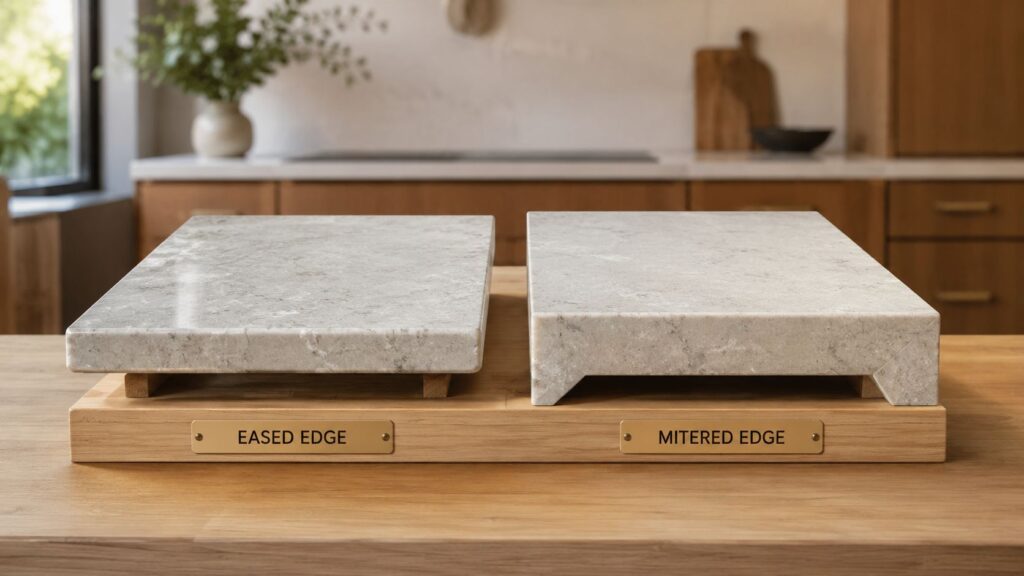
You've chosen the cabinets, settled on the layout, and started comparing quartz, granite, or quartzite slabs. Then the fabricator asks a deceptively simple question: “Which edge profile would you like?” For many South Jersey homeowners, that small decision arrives after the major design choices feel finished, yet it can change the island's presence, the countertop's comfort, and the final fabrication bill.
The central choice is often mitered edge vs eased edge. An eased edge keeps the slab's actual thickness and softly relieves the sharp corner. A mitered edge joins two angled pieces to make a thinner slab look substantially thicker. Neither is universally right. The better option depends on your kitchen's architecture, how your family uses the space, the stone pattern you selected, and how much visual weight you want at the counter.
Table of Contents
- Choosing the Right Countertop Edge for Your Kitchen
- Understanding Mitered and Eased Edge Fabrication
- Mitered vs Eased Edge A Detailed Comparison
- Matching Countertop Edges to Your Kitchen Style
- Practical Guidance for South Jersey Homeowners
- How The Cabinet Coach Helps You Decide
Choosing the Right Countertop Edge for Your Kitchen
A homeowner in Haddonfield might begin with a period-appropriate colonial kitchen, detailed cabinetry, and a natural stone selected for subtle movement. A homeowner in Cherry Hill might be planning a kitchen with flat-panel doors and a large island intended to anchor the entire room. Both may be looking at the same two edge choices, but they probably shouldn't make the same decision.
The eased edge is a restrained treatment. It softens the sharp corner of a standard countertop without changing the slab's honest thickness. The result is clean, comfortable, and visually quiet. The mitered edge is a built construction, not merely a decorative rounding. It creates a deeper-looking front by joining pieces at angled cuts, giving an island a stronger architectural presence.
Design rule: Choose the edge as part of the room's composition, not as an isolated countertop upgrade.
That distinction matters in South Jersey homes, where a kitchen may connect a traditional dining room to a newly renovated work area, or combine a historic exterior with contemporary cabinetry. A thick-looking mitered island can look intentional in a modern Moorestown addition, but it may overpower a compact kitchen with ornate door details. An eased edge can provide the visual calm needed when the backsplash, hardware, cabinetry, and slab already compete for attention.
If you're still evaluating material, color, and finish alongside the edge, this practical guide on how to choose kitchen countertops in Houston offers useful broader selection criteria, even though your project is closer to Cherry Hill than Houston. The goal is the same: make the countertop work with the whole kitchen before fabrication begins.
Understanding Mitered and Eased Edge Fabrication
The easiest way to understand the difference is to separate profile treatment from construction technique.
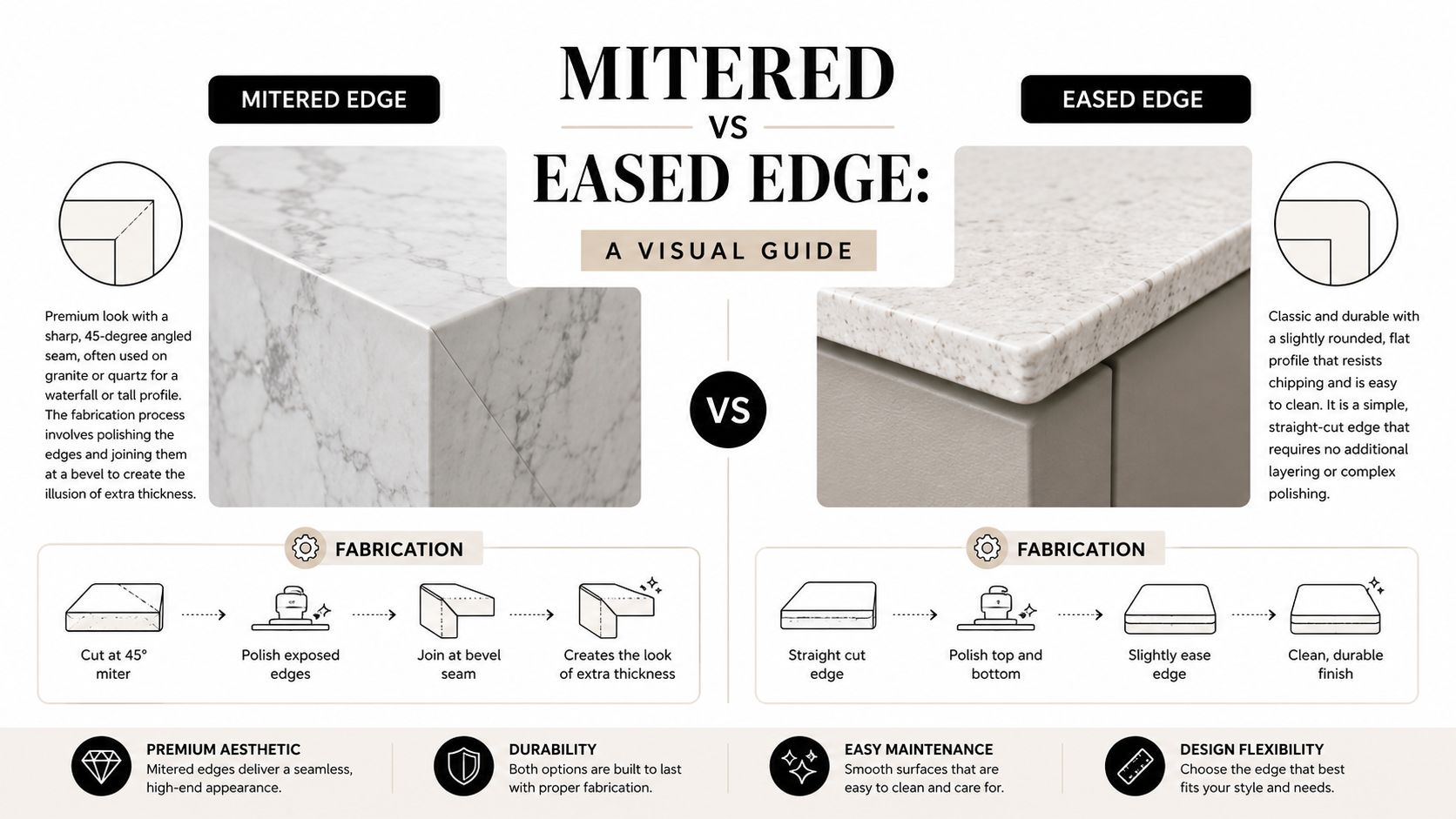
An eased edge begins with the slab itself. The fabricator cuts the countertop to its required shape, then slightly softens the top corner that would otherwise meet at a sharp 90-degree angle. That small adjustment makes the edge more comfortable to touch and helps reduce the vulnerability associated with a perfectly sharp corner. The slab still looks like the thickness you purchased.
A mitered edge follows a different sequence:
- The fabricator cuts the primary slab edge at a 45-degree angle.
- A second piece is prepared with a matching angled cut.
- The two pieces are bonded together.
- The joint is finished and polished so the front reads as one substantial edge.
This is similar to joining two picture-frame pieces at their angled corners rather than sanding one square board. The miter hides the construction line at the corner and creates a thicker visual mass without requiring the entire countertop slab to be manufactured at that thickness.
What the eased edge preserves
An eased edge preserves the slab's natural proportions. It works particularly well when you want the stone's surface pattern, cabinet design, or backsplash to remain the visual focus. There's no added apron piece and no miter joint running through the edge, so the fabrication is comparatively straightforward.
That simplicity also makes the profile versatile. It suits a compact galley kitchen in Collingswood, a traditional kitchen in Burlington County, or a contemporary perimeter counter where the cabinetry already provides plenty of visual structure.
What the mitered edge creates
A mitered build gives a 2 cm or 3 cm slab the appearance of roughly 4 cm to 6 cm thickness, according to the fabrication guidance from Granite Guy's countertop edge profile guide. The exact visual effect depends on the build, material, and design, but the principle remains consistent: the edge looks deeper than the original slab.
That added construction requires more planning. Veining, color, seam placement, support, and the quality of the angled cuts all matter. A mitered edge can look exceptional when the fabricator controls those details. It won't compensate for poor layout or a visible, uneven joint.
For a wider overview of the profiles available before your slab is cut, review The Cabinet Coach's guide to countertop edge options. Seeing the choices together helps clarify whether you want a simple finishing detail or a more substantial built edge.
Mitered vs Eased Edge A Detailed Comparison
The practical decision usually comes down to three questions: What should the kitchen look like, how will the edge perform during daily use, and where does the added fabrication cost make sense?
| Feature | Mitered Edge | Eased Edge |
|---|---|---|
| Construction | Two pieces joined at 45-degree cuts | One slab with a softened top corner |
| Visual effect | Creates a thicker, more substantial appearance | Preserves the slab's actual thickness |
| Best use | Statement islands, waterfall ends, premium focal areas | Perimeter counters, compact kitchens, restrained designs |
| Maintenance consideration | Requires attention to the finished seam | Simple surface transition, easy to wipe clean |
| Fabrication cost | Commonly adds about $30 to $60 per linear foot | Often available at a $0 upcharge |
| Design character | Bold, architectural, luxurious | Clean, timeless, understated |
Aesthetics
A mitered edge gives an island a monolithic, furniture-like appearance. The deeper face can make a large island feel more grounded, especially when the countertop is intended to be the room's centerpiece. It's particularly effective when the slab has movement that can be carried over the edge, or when a waterfall end needs a visually continuous transition.
For a focal island, a mitered edge adds presence. For a quiet work surface, an eased edge often looks more deliberate.
The eased edge takes a less assertive approach. It doesn't pretend the slab is thicker than it is, and that honesty can be its strength. With dramatic quartzite, strongly veined marble, or patterned quartz, a simple edge lets the surface remain the star instead of adding another line for the eye to follow.
Durability and maintenance
An eased edge has a straightforward advantage in construction. There's no additional miter seam at the front, and the softened corner is comfortable to use and simple to clean. The profile doesn't introduce grooves or ornamental transitions that collect residue.
A mitered edge can also serve a busy kitchen well when it's fabricated and installed carefully. However, its joined construction means the seam deserves attention during selection. Ask to see a finished sample, not only a rendering, and discuss how the fabricator will align the edge, handle the slab pattern, and finish the joint.
Daily habits matter, too. Children, pets, stools, cookware, and tight walkways all increase the chance of contact at an island corner. If your household treats the kitchen as a high-traffic work zone, the simpler profile may provide more peace of mind.
Cost
The cost difference comes from the work behind the appearance. Eased edges are often the standard option at a $0 upcharge, while mitered edges commonly add about $30 to $60 per linear foot in fabrication costs, as outlined by SlabWise's mitered edge pricing guide. The final estimate still depends on the design, material, layout, and the sections being fabricated.
That premium doesn't automatically make a mitered edge a poor value. On a large island, the front edge may be the feature that makes the entire design feel finished. On a smaller perimeter run, the same investment may provide little visible benefit.
For a broader understanding of how material selection affects the overall countertop decision, compare the options in this guide to types of countertops. The edge should be priced and judged alongside the slab, not as a disconnected add-on.
Matching Countertop Edges to Your Kitchen Style
The strongest edge choice usually supports the architecture already present in the room. South Jersey kitchens cover a wide range, from historic homes in Haddonfield to newer construction in Voorhees, Mount Laurel, and surrounding communities. The same profile can feel elegant in one setting and unnecessarily heavy in another.
Modern and contemporary kitchens
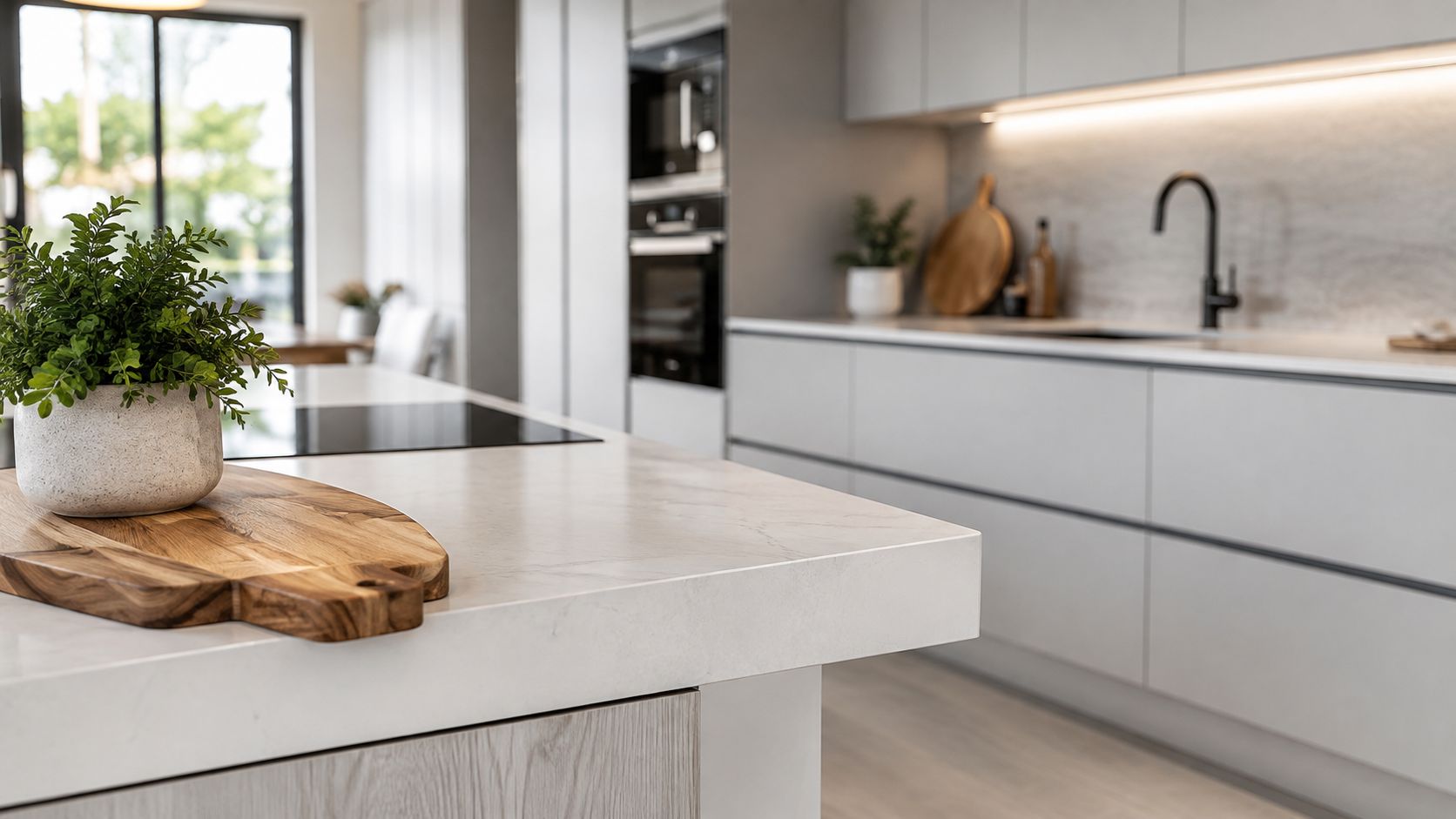
Modern kitchens often benefit from the crisp geometry of a mitered island edge. Flat-panel cabinets, integrated appliances, minimal hardware, and a quiet backsplash can give the thicker countertop face room to make a statement. In a newer Voorhees kitchen, a mitered edge can make the island feel more like a designed architectural object than a work surface.
An eased edge also works in modern rooms, particularly when the cabinets are extremely minimal. If the design goal is lightness and visual restraint, the slab's actual thickness may be the better match.
Traditional and farmhouse kitchens
Traditional kitchens typically have more visual detail. Shaker doors, furniture-style legs, crown molding, paneled appliances, and warm hardware already create layers across the room. An eased edge keeps the countertop from competing with those features.
In a Burlington County farmhouse renovation, the eased profile can support a welcoming, practical character. It looks finished without appearing overly formal, and it works well when the stone has a soft pattern rather than a dramatic waterfall presentation.
Transitional and coastal rooms
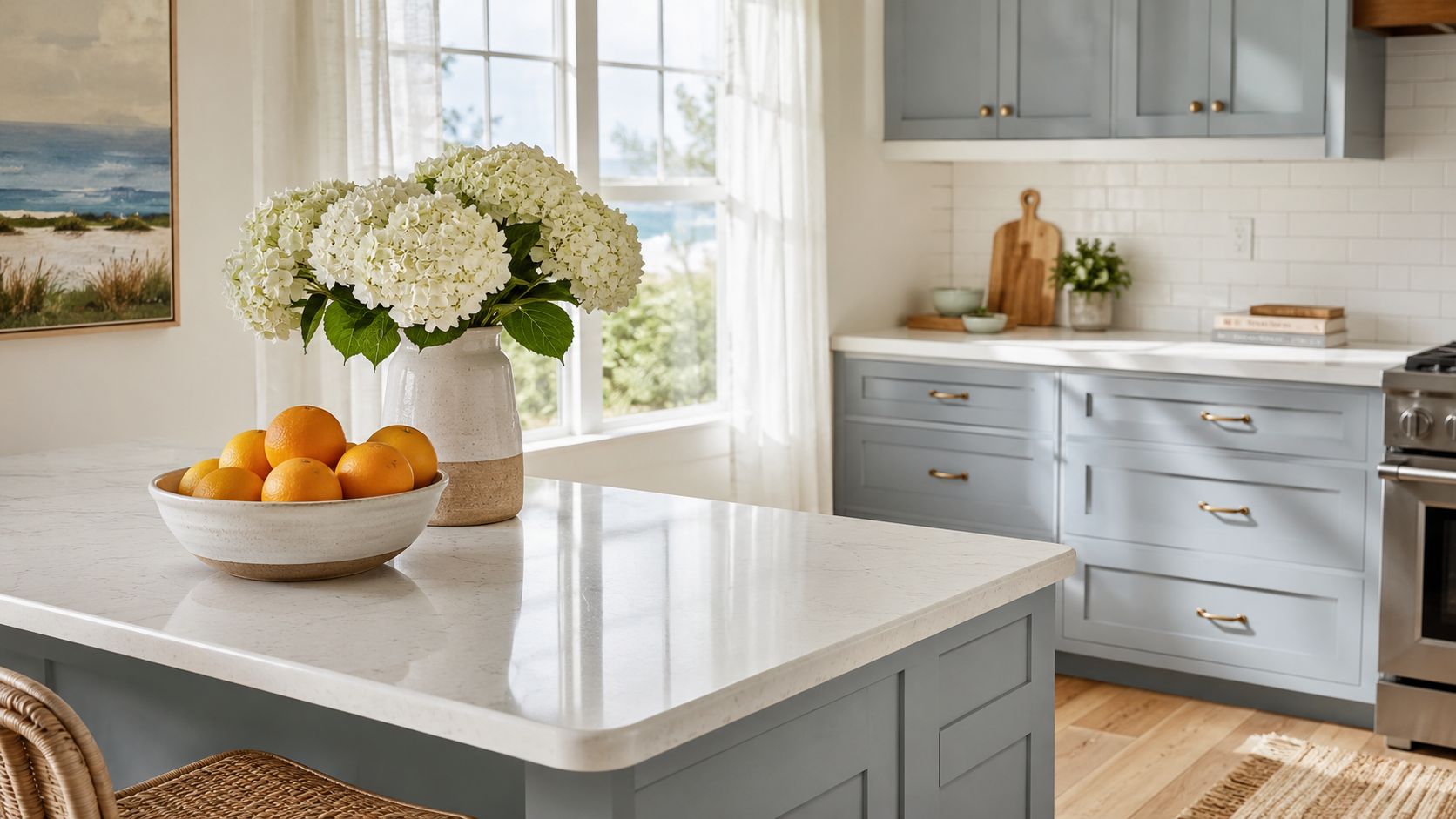
Transitional kitchens can go either direction. Use an eased edge when you want the cabinets and lighting to carry the design, or choose a mitered edge on the island while keeping surrounding counters simple. That combination can introduce contrast without turning every surface into a focal point.
Coastal kitchens near the shore often use pale cabinetry, natural textures, and relaxed finishes. A mitered edge can add modern luxury to that lighter palette, while an eased edge preserves the casual feeling. The right answer depends on whether the island should feel sculptural or approachable.
Before finalizing the profile, evaluate the full relationship between cabinets, slab, backsplash, and hardware through coordinated countertop and cabinet combinations. A sample that looks striking by itself may feel too heavy once it sits beside your cabinet doors.
A short visual reference can also help you compare how edge thickness changes the island's presence:
Practical Guidance for South Jersey Homeowners
Material selection should come before the final edge decision because the surface pattern changes how the edge reads. A quiet quartz may benefit from the architectural weight of a mitered build, while a heavily veined natural stone may need a simpler edge so the pattern remains uninterrupted. With patterned engineered quartz, review the actual slab or a large sample rather than relying only on a small showroom chip.
A large island in Mount Laurel or another newer South Jersey home can be a strong candidate for a mitered edge. The island often has enough visual and physical space to justify the deeper face. A small galley kitchen in Collingswood may not. There, an eased edge keeps circulation clear and avoids adding emphasis to a counter that already has limited room.
Questions for your fabricator
Bring specific questions to the fabrication meeting instead of choosing from a profile name alone:
- Seam placement: Ask where the miter joint will fall and how visible it may be from normal standing positions.
- Pattern alignment: Confirm how the quartz, granite, quartzite, or porcelain pattern will move across the front.
- Corner treatment: Discuss whether exposed corners need a softened transition for your household and room layout.
- Support requirements: Ask what support the chosen build needs from the cabinet layout and island framing.
- Sample quality: Request a physical edge sample or a finished shop sample when the profile is central to the design.
A good fabricator should explain what the material can support, how the joint will be finished, and where the construction lines will appear. If the answers stay vague, get clarification before approving the template.
Budget conversations should include both the slab and fabrication. The guidance on countertop cost per square foot can help frame the material portion, but an edge upgrade may be calculated separately. Decide where you want the visual investment to go. Many homeowners prefer a more distinctive island and a quieter perimeter, while others value consistency throughout the kitchen.
How The Cabinet Coach Helps You Decide
Countertop edges are easier to judge at home than on a screen. The room's natural light, cabinet color, backsplash, floor tone, and sightlines all affect whether a mitered edge feels refined or oversized. A sample viewed beside your actual cabinet finish can answer questions that a product photograph can't.
The Cabinet Coach brings a mobile showroom experience to South Jersey homeowners, including clients in Cherry Hill, Haddonfield, Moorestown, and nearby communities. During a design consultation, the team can review your layout, budget, lifestyle, and overall material direction, then help compare the practical impact of an eased edge with the stronger visual presence of a mitered build.

That guidance is valuable when the answer isn't “premium” or “standard.” A mitered edge may be the right choice for a prominent island, while an eased edge may better serve the perimeter or a high-traffic family kitchen. The design team can also coordinate the edge decision with cabinetry, hardware, tile, and the selected countertop material so the finished room feels cohesive.
If you're weighing these options during an active renovation, schedule a free in-home kitchen design consultation and bring the decision into the context of your actual space.
The Cabinet Coach offers in-home design guidance and a mobile showroom experience for South Jersey kitchen and bath renovations, including help selecting cabinetry, countertops, hardware, tile, and the right countertop edge. Visit The Cabinet Coach to begin a consultation and compare mitered and eased edge options for your home.