
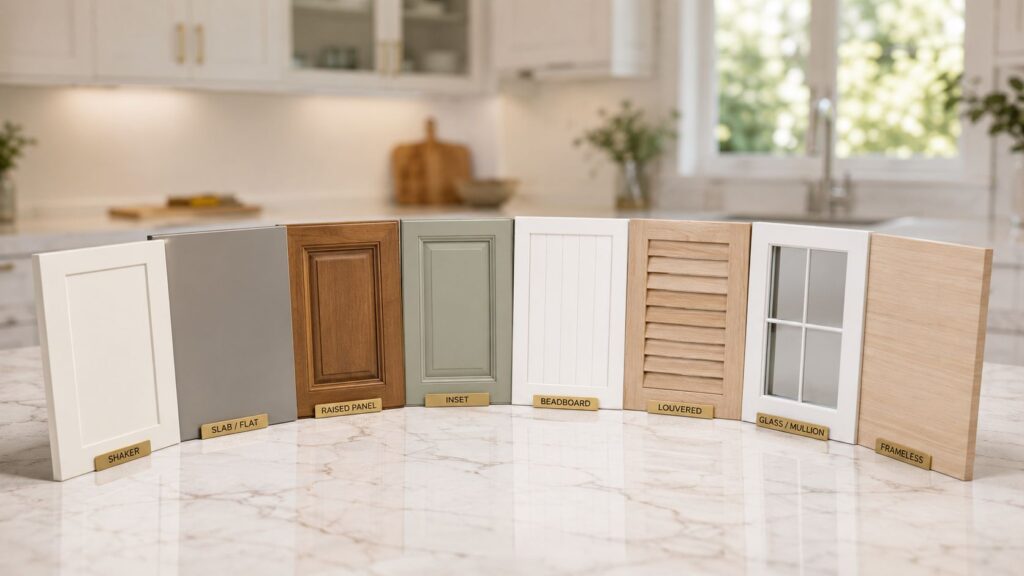
You're standing in a Cherry Hill kitchen with two door samples on the island, one Shaker, one slab, and the room already feels like it's asking you a question you can't quite answer. One door looks calm and familiar, the other looks sleek and edited, and the problem isn't color or countertop, it's that you haven't named what each one does to the whole house. That's the cabinet decision, and it's why South Jersey remodels go off the rails when homeowners shop by finish before they settle the cabinet door styles.
If you're comparing ideas, the most useful starting point is a solid visual reference, like the kitchen cabinet ideas gallery from Groen's Fine Furniture. But don't get distracted by paint chips yet. The door profile is the skeleton, not the outfit.
Table of Contents
- Why the Door Style Sets the Whole Kitchen Tone
- The Six Foundational Cabinet Door Styles Explained
- Framed vs Frameless Construction and What It Changes
- How Overlay and Frame Width Define the Look
- Pros, Cons, and Cost Range for Each Door Style
- Finishes, Hardware, and the Style Pairings That Age Well
- Installation Timeline and How a Mobile Showroom Changes It
- Choosing the Right Cabinet Door Style for Your Home
Why the Door Style Sets the Whole Kitchen Tone
A homeowner in Cherry Hill once held up two sample doors and said, “I like both, but one feels more expensive.” She wasn't wrong, she just didn't have the vocabulary yet. The door profile was doing most of the work, not the color, not the hardware, and definitely not the backsplash that hadn't been picked yet.
Cabinet door styles set the tone because they control the first read of the room. A five-piece frame with a recessed center panel feels different from a flat slab before you even choose a paint color. That's why Shaker, which traces back to the 1800s and still sits near the center of the market, remains such a default choice in real remodels, not because it's boring, but because it bridges traditional and contemporary interiors cleanly enough to let the rest of the room move either way. Industry sources cited in the brief put Shaker at about 60% of U.S. cabinet sales, 57% of the cabinet market, and say 61% of homeowners prefer white Shaker cabinets source referenced in the verified data.
The practical effect shows up fast in South Jersey homes. A taller-looking room usually benefits from slimmer visual framing, while a darker, heavier kitchen can handle more structure in the door face. That's why a slab door can make a narrow townhouse in Cherry Hill feel cleaner, while a Shaker or raised-panel choice can keep a colonial in Haddonfield from feeling stripped bare.
Practical rule: Pick the door style before you pick the decorative layers. Hardware, paint, and tile all sit on top of that decision.
A lot of people think the kitchen is choosing a “look.” I think the kitchen is choosing a structure for everything else to hang on. Once you see it that way, the whole conversation gets easier, and the resale angle gets clearer too, because buyers often react to the door family before they notice anything else.
The Six Foundational Cabinet Door Styles Explained
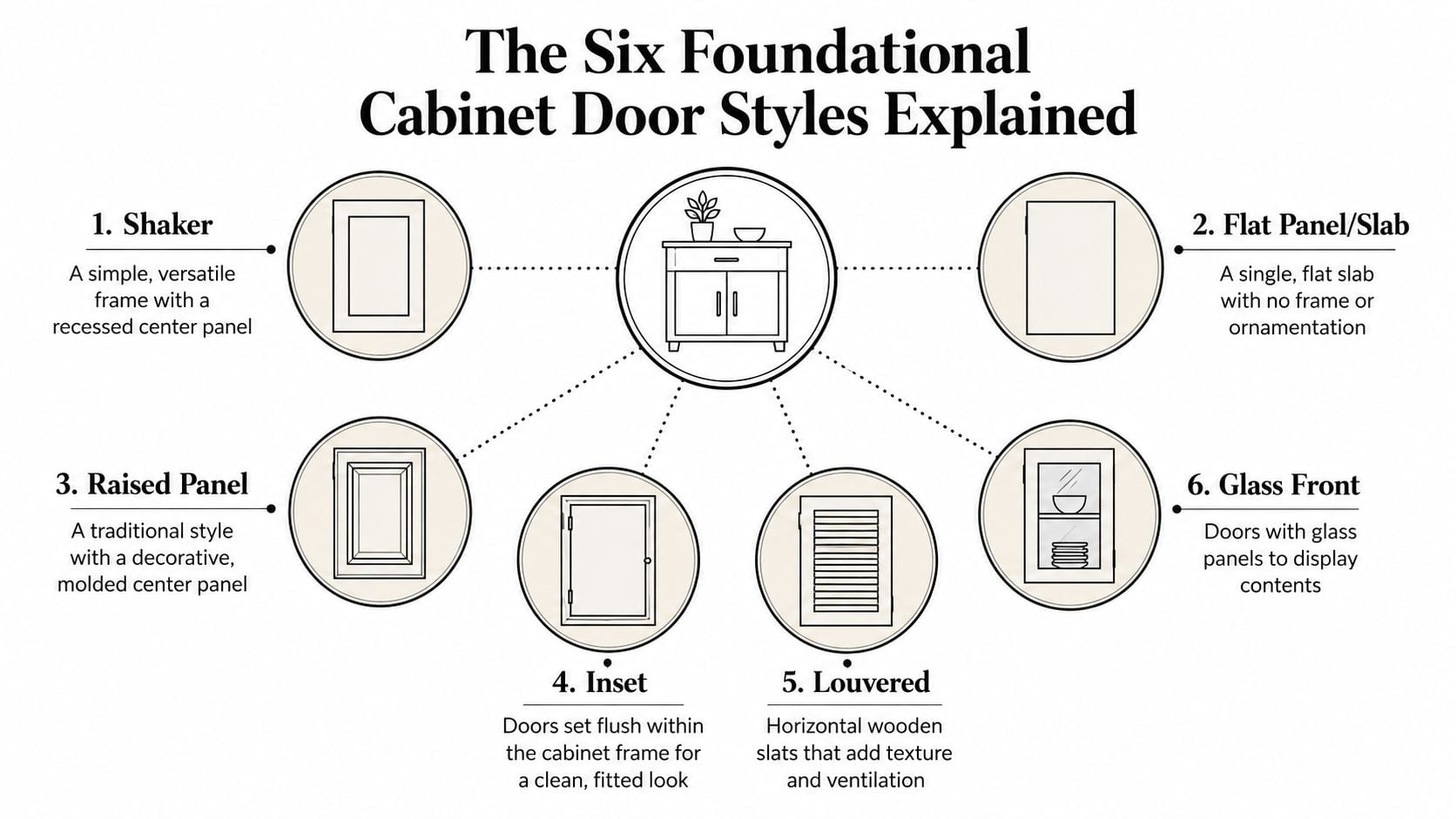
The six door families you'll see in a showroom are Shaker, slab or flat-panel, raised panel, inset, beadboard, and louvered. Glass-front and mullion fronts show up as accent pieces, not usually as the primary style throughout the kitchen. If you can name those categories correctly, you can stop guessing and start directing the conversation.
Start with the workhorse styles
Shaker is the five-piece frame-and-panel door with a recessed center. It's the most versatile option in the group because it fits traditional, transitional, and clean-lined kitchens without forcing the room into one decade. For South Jersey remodels, that flexibility matters because many homes mix old architecture with newer additions, and Shaker can sit comfortably in both.
Flat-panel, also called slab, is one uninterrupted surface with no frame ornamentation. It gives you the calmest, most modern reading, and it's the style I'd choose when the kitchen needs to disappear into the architecture instead of announcing itself.
Raised panel is the classic decorative option, with a center panel that sits proud of the surrounding frame. It brings depth and a more formal furniture feel, which is exactly why it still belongs in homes that want a traditional or premium look.
The specialty and display doors
Inset doors sit flush within the cabinet frame. That close fit gives the whole kitchen a furniture-grade look, and it's the right call when precision matters more than casual ease.
Beadboard adds vertical grooves and a more relaxed, textural feel. It works best in coastal, cottage, or utility-adjacent spaces where charm is part of the brief.
Louvered fronts use horizontal slats, which gives them a distinct texture and a functional airflow angle. I like them in pantry zones or specialty spots, not as an all-over kitchen move.
For a deeper look at modern options with a South Jersey lens, the 8 top modern cabinet styles for South Jersey homes guide is useful once you've narrowed the field.
Framed vs Frameless Construction and What It Changes
The box matters as much as the door. I've walked into plenty of kitchens where the homeowner chose the “same” Shaker sample as a friend, then wondered why the finished room looked completely different. The answer was usually the cabinet construction, not the profile itself.
Face-frame cabinets
Traditional face-frame cabinetry leaves a visible frame on the front of the box. That frame works naturally with inset doors and with overlay styles that don't try to hide the structure completely. It's the build commonly recognized in older South Jersey neighborhoods, because it feels familiar and sturdy.
Frameless European cabinets
Frameless or European-style cabinets skip the face frame and let doors mount directly to the cabinet box. After World War II, that approach spread widely because it supported a cleaner, simpler look, and it's still the build that makes slab and slim Shaker designs feel crisp rather than bulky. The visual result is more open access and a cleaner reveal at the front edge.
The hardware choice follows the construction choice. A concealed hinge setup makes more sense on a frameless or full-overlay installation, while face-frame cabinetry has more variation in hinge and reveal behavior. That's why two kitchens can share the same door face but feel unrelated once the doors are hung.
Frameless doesn't automatically mean better, and face-frame doesn't automatically mean dated. The right choice depends on the room, the style, and how precise the installation needs to be.
If you're weighing a remodel and want to see how construction affects the final result, the how to remodel cabinets page is a good place to think through sequencing before you commit to a style.
How Overlay and Frame Width Define the Look
Overlay is where the kitchen stops looking generic. It shows how much of the cabinet face the door covers, and homeowners usually call a kitchen “custom” or “builder-grade” because of overlay and reveal before they ever know the terms.
The frame width does more than you think
Frame width changes the read of the whole room. Narrow rails and stiles give a tighter, cleaner look that feels more modern, while wider frames push the door face toward a more traditional profile. The same Shaker door can land in a completely different style lane depending on that proportion alone.
In a South Jersey remodel, I look at the door first and the reveal second. Full-overlay doors with consistent 1/8" reveals give the cleanest transitional result, and sloppy gaps show immediately in a townhouse, a shore condo, or any kitchen where the eye runs straight across a long cabinet wall. If the reveals wander, the room feels unfinished no matter how good the paint color is.
| Cabinet Door Style Quick Reference | ||
|---|---|---|
| Style | Construction | Best For |
| Shaker | Frame-and-panel, overlay varies | Transitional homes, resale-safe kitchens, adaptable remodels |
| Slab | Flat panel, usually full overlay or frameless | Modern kitchens, narrow spaces, low-visual-noise layouts |
| Raised Panel | Frame-and-panel, often traditional overlay | Formal kitchens, colonial homes, classic interiors |
| Inset | Door sits within the frame | High-craft remodels, furniture look, precision-driven projects |
| Beadboard | Textured panel, often cottage or coastal styling | Casual kitchens, laundry zones, relaxed spaces |
| Glass Front | Framed door with glass insert | Display areas, upper cabinets, visual relief |
The house should decide the overlay, not a trend board. A Haddonfield home can carry a more traditional overlay because the architecture supports it. A newer Voorhees build usually looks better with a cleaner, more aligned reveal. Cherry Hill townhouses often benefit from a full-overlay approach because it tightens the visual field without forcing the kitchen into a style it does not naturally have.
Trim and crown also change the final read, and they need to match the door choice instead of fighting it. For a useful reference on how edge treatment changes the finished look, see cabinet trim molding ideas.
Overlay is not a technical footnote. It decides whether the kitchen feels custom, intentional, and properly managed, or installed with no attention to the details that people notice every day.
Pros, Cons, and Cost Range for Each Door Style
Here's the rewritten paragraph:
The shortlist gets real here. Shaker and beadboard do a lot of heavy lifting because they're versatile and forgiving. Slab and glass-front are more opinionated. Inset costs more in labor because precision is the whole game. Raised panel still earns its place when the house wants a more formal voice.
Shaker, slab, and raised panel
Shaker is the safest all-around choice. It's easy to live with, easy to stage for resale, and still the style most homeowners can agree on when they've been arguing over finishes for weeks. The newer production-floor shift noted in the brief shows that the market is leaning toward centered Shaker, flat-center or beaded variants, and softer arch details, which tells me Shaker isn't fading, it's refining source referenced in the verified data.
Slab gives you the cleanest look, but it's less forgiving of fingerprints, edge quality, and substrate flaws. I'd choose it when the rest of the room is already quiet and the homeowner wants the cabinets to recede.
Raised panel still works in the right South Jersey home, especially when the architecture has enough scale to support it. It's more decorative, so it asks for a room that can carry visual weight without feeling crowded.
Inset, beadboard, and glass-front
Inset is the craft option. It gives you a fitted, high-end look, but it demands better measurements, tighter tolerances, and more patience from everyone involved.
Beadboard is a workhorse for charm. It doesn't try to be everything, which is exactly why it works in laundry spaces, cottage kitchens, and secondary zones.
Glass-front is the most delicate of the group because it's about display as much as function. I use it where the homeowner wants visual relief, not where the cabinets need to hide chaos.
The main takeaway is blunt. If you want the easiest resale story, Shaker is still the conservative bet. If you want the most modern look, slab does the job. If you want a kitchen that reads like built-in furniture, inset is the one that earns that feeling.
Finishes, Hardware, and the Style Pairings That Age Well
In a real South Jersey remodel, finish and hardware decisions show up every time the light hits the room, every time a drawer opens, and every time someone notices whether the cabinets feel current or dated. I treat them as one system. The door style sets the base, but the finish, pull, and hinge detail decide whether the kitchen feels intentional or careless.
Match the material to the style
Paint-grade construction gives Shaker, slab, and inset the cleanest read when the goal is a smooth, even surface. Stain-grade work belongs where the grain does the talking, especially in kitchens that are more traditional or furniture-like. Slab doors hide minor substrate flaws better than a framed Shaker face, while Shaker exposes sloppy finish work and uneven alignment fast.
For homeowners who want richer wood character, the wood finishes for investment pieces page from Giorgi Bros. Furniture is a useful reference point for judging stain depth and surface quality before you approve samples.
Hardware should follow the door
Classic knobs work on Shaker when the kitchen leans familiar and timeless. Long bar pulls belong on slab because they support the horizontal, minimal read. Cup pulls fit raised-panel or more traditional fronts, and slim edge pulls keep glass mullion fronts from feeling bulky.
The hinge spec matters too. A concealed cup hinge with soft-close hardware is the baseline I want to see on a well-built kitchen, and the fit and feel of that hardware affect both daily use and the final alignment of the doors. If the doors close cleanly, clear adjacent panels, and hold their reveal, the whole install feels better.
If you are sorting through handles and pulls before you order, the how to choose cabinet hardware guide gives you a practical way to narrow the field without buying by instinct alone.
A simple rule holds up in actual homes. If the door style is traditional, the hardware should quiet it down. If the door style is minimal, the hardware should stay in the background.
Installation Timeline and How a Mobile Showroom Changes It
Cabinet style decisions affect the schedule more than most homeowners expect. Slab and inset usually carry more demanding production and fit requirements, while Shaker and beadboard are often easier to source quickly because they're more common in stock or short-cycle programs. When you're remodeling around school pickups, work travel, and a live-in kitchen, that difference matters.
A managed remodel usually follows a simple sequence, tear-out, site measure, fabrication, delivery, install. If you wait until after demolition to settle the door style, the whole project gets pushed around by avoidable decisions. That's why the best selections happen before cabinets are ordered, not after the walls are already open.
The mobile-showroom model helps because the samples come to the house, not the other way around. In a real South Jersey kitchen, that means you see a door sample against your actual floor, under your real daylight, next to the rooms that open into it. The Cabinet Coach uses that approach in its why a mobile cabinet showroom is the future of kitchen remodeling in South Jersey piece, and the logic is straightforward. Fewer showroom trips, fewer late-stage reversals, fewer surprises on install day.
Later in the process, that same decision speed helps the trades. When the cabinet profile, finish, and hardware are locked early, the installer isn't waiting on revision cycles, and the countertop and tile work can stay on track.
The kitchens that finish smoothly are the ones where the door style was chosen in context. Not online. Not in bad lighting. In the room.
Choosing the Right Cabinet Door Style for Your Home
Start with three questions. What does the rest of the house already say, traditional, transitional, or modern? Is this remodel for living in, or for resale? How much lead-time tolerance do you have?
If the house already leans classic, you can support it with raised panel or a more traditional Shaker. If the goal is resale in a mixed neighborhood, Shaker stays the safest bet. If the project needs a fast turnaround, avoid choices that depend on exacting customization unless you've already planned for it.
Before you sign off, confirm four things, overlay type, hinge spec, a full-door finish sample, and the tolerance statement for large panels. That last one matters more than people think, especially on wider contemporary doors. If you want help narrowing the style to your own home, how to find your decorating style is a solid companion read before you finalize the kitchen plan.
Pick the door style your home is asking for, not the one trending hardest on your feed. If you want a straight answer on what works in your kitchen, book a consultation and compare samples in person.
The Cabinet Coach helps South Jersey homeowners choose cabinet door styles, finishes, hardware, and construction details that fit the house and the timeline. If you're planning a remodel in Cherry Hill or nearby and want to see samples in your own light, visit The Cabinet Coach to start with a complimentary video consultation.