
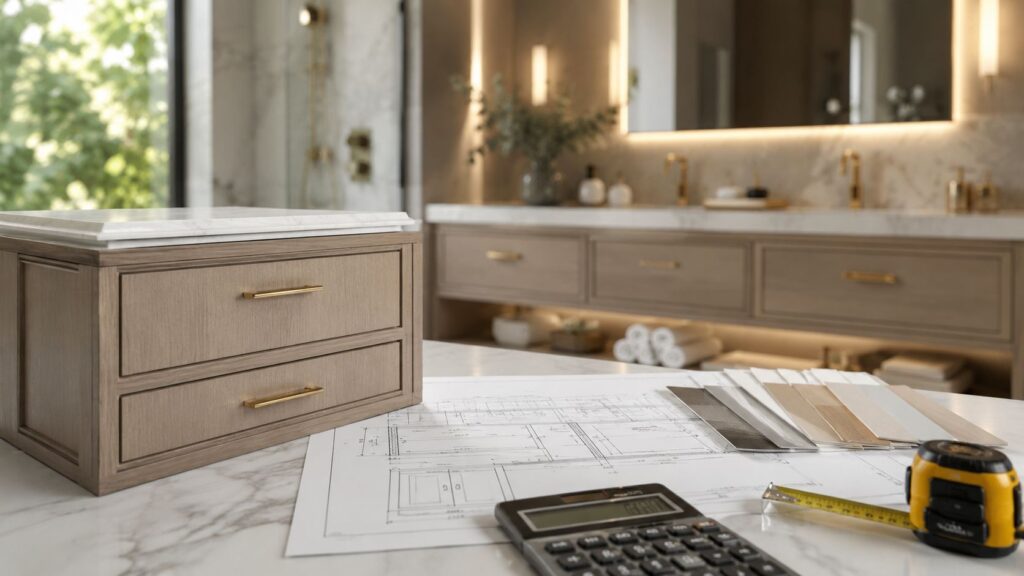
Most custom bathroom cabinet projects land between $4,000 and $12,000, and many typical installations with a vanity, countertop, and professional labor fall around $4,000 to $6,000. The final number moves up or down based on the bathroom's size, the materials you choose, and how much of the room has to change to make the cabinetry work.
If you're in South Jersey and you've started saving bathroom photos, comparing paint colors, or wondering whether a custom vanity is worth the jump from store-bought, you're in a familiar spot. Excitement usually shows up first. Then the pricing questions follow right behind it.
A lot of homeowners hit the same wall. One website says custom is affordable. Another makes it sound like every vanity belongs in a luxury showroom. The truth sits in the middle. The cost of custom bathroom cabinets is real, but it's also predictable once you understand how cabinet shops and installers build an estimate.
That's especially important in this area, where homes range from older colonials in Haddonfield to newer properties in Cherry Hill, Moorestown, and Mount Laurel. An older home may need layout adjustments, plumbing updates, or creative sizing. A newer home may have cleaner conditions for installation but higher expectations for finish quality and storage details. If you're trying to build a realistic budget, a bathroom remodel cost breakdown for South Jersey homeowners is a useful companion to cabinet-specific planning.
Table of Contents
- Planning Your Dream Bathroom Budget
- Understanding Custom Cabinet Pricing Models
- Key Factors That Drive Your Cabinet Cost
- Budgeting for Costs Beyond the Cabinets
- Adjusting Costs for the South Jersey Market
- How to Save Money Without Sacrificing Quality
- Start Your Bathroom Transformation with Confidence
Planning Your Dream Bathroom Budget
A homeowner in a 1970s split-level in Cherry Hill wants to replace a bulky 48-inch vanity with a cleaner layout, better drawer storage, and a top that can handle heavy daily use. The plan sounds simple at first. Then the true budget questions show up fast. Will the new cabinet need to be shallower to improve the walkway? Does the existing plumbing force the sink off-center? Is there room to add a bank of drawers without crowding the door swing?
Those details shape cost earlier than the finish selection does.
In South Jersey, bathroom cabinet budgets often shift because the room itself is working against you. Older homes in towns like Cherry Hill, Haddonfield, and Moorestown regularly bring uneven walls, out-of-level floors, tight clearances, and plumbing that was not placed with a custom vanity in mind. A project that looks like a basic vanity swap can turn into a custom fit job once field measurements are done.
A good starting budget is a range, not a single target number. I usually tell homeowners to decide three things first: what must be stored, who uses the bathroom every day, and what layout problem the new cabinetry needs to fix. That gives you a practical way to judge where the money is going. Deep drawers for hair tools and backup toiletries add daily value. Paying more for decorative details that do not improve storage or fit usually does not.
Practical rule: Set the budget around function first. Sink count, drawer storage, traffic flow, and plumbing location usually affect price before paint color or door style do.
It also helps to separate cabinet cost from full bathroom cost in your head. Cabinetry is only one part of the project, and homeowners often feel blindsided when tops, plumbing changes, flooring repairs, or electrical updates push the total higher. If you want a clearer picture of how those pieces stack up, this bathroom remodel cost breakdown for South Jersey homeowners is a useful next step.
Custom bathroom cabinetry works like built-in furniture installed inside a wet, hard-working room. You are paying for sizing, construction, finish durability, storage planning, and installation that fits the space correctly the first time.
That is the right mindset for an early budget. Build a working range, attach priorities to it, and leave room for the conditions the walls and floor may reveal once the project starts.
Understanding Custom Cabinet Pricing Models
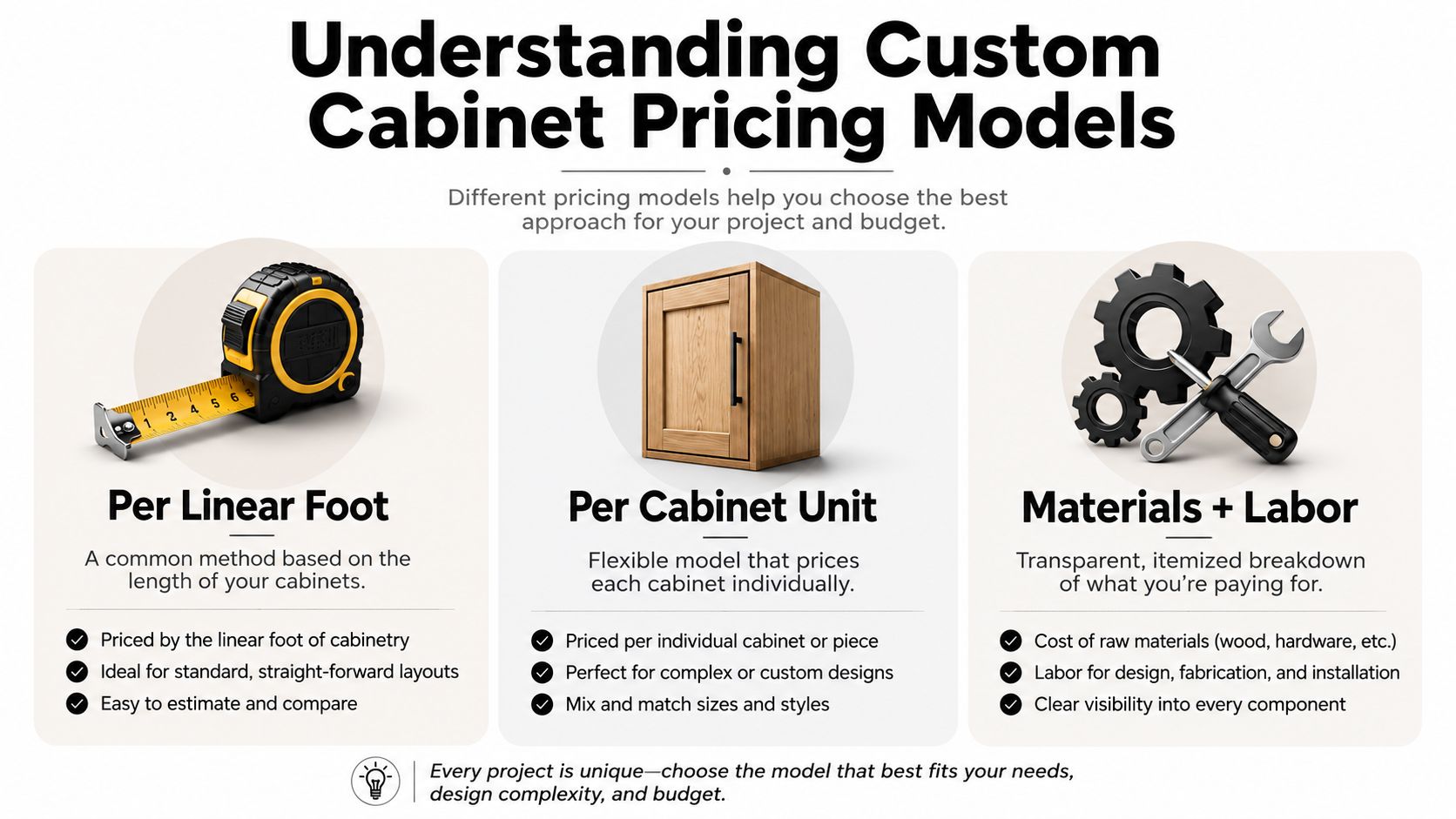
A South Jersey homeowner can get two quotes for the same bathroom and feel like they are pricing two different projects. One shop gives a single installed number. Another prices by linear foot. A third breaks out every vanity base, drawer bank, and side panel. The quote format changes how easy it is to compare value, and it often explains why one estimate looks lower at first glance.
Per project pricing
Project pricing gives you the clearest top-line number. In most cases, the shop bundles design time, cabinetry, installation, and often the countertop or sink base details into one proposal.
That format works well for homeowners who want to know the likely out-of-pocket cost before comparing finer construction details. It also reflects how many South Jersey bath projects are sold. A local remodel rarely stops at the cabinet box itself. Fillers, scribe work, plumbing cutouts, finished end panels, mirror coordination, and countertop templating usually affect the final number, so many shops prefer to price the whole package instead of separating every piece.
The trade-off is visibility. A project quote can be harder to compare line by line if one cabinetmaker includes installation, hardware upgrades, or countertop coordination and another does not. Before you compare totals, ask what is included, what is an allowance, and what would trigger a change order.
Per linear foot pricing
Linear-foot pricing is more useful as a budgeting shortcut than as a final buying tool. It gives homeowners a quick way to gauge how cabinet size affects cost, especially early in planning.
Analysts at HomeAdvisor's custom cabinet cost guide found national custom cabinetry pricing often lands between $500 and $1,200 per linear foot installed, with total custom projects varying widely based on scope. That range is broad because linear footage does not fully capture what makes bathroom cabinetry expensive. A simple 60-inch vanity and a 60-inch vanity with deep drawers, a furniture toe kick, interior organizers, and detailed end panels may measure the same length, but they do not take the same shop time.
I use linear-foot pricing as a first filter. It helps answer, “Are we building a straightforward vanity wall or a storage-heavy setup with towers and specialty pieces?” It is less reliable for final comparisons once the design gets more specific.
If you are still weighing standard cabinet lines against made-to-fit work, this guide to prefab kitchen cabinets vs custom cabinetry helps explain the bigger construction differences behind the price.
Per cabinet unit pricing
Unit pricing breaks the estimate into individual pieces. One vanity base has one cost. A separate drawer stack has another. Linen towers, open shelves, and decorative side pieces get priced on their own.
This is often the most transparent model for custom bathroom work because bathrooms are full of odd conditions. Off-center plumbing, tight wall returns, sloped floors, and narrow filler spaces are common in older South Jersey homes. Pricing by unit lets the shop assign cost where the labor is instead of forcing everything into a blanket rate.
It also makes revision decisions easier. If you remove a tower, switch one drawer bank to doors, or simplify a furniture-style end panel, you can usually see the cost effect right away.
Installation still needs special attention. Some quotes include delivery, fitting, trim work, and final adjustments. Others stop at the cabinet itself. Homeowners who want a clearer picture of labor steps can review this bathroom vanity installation guide, then use that framework to ask local installers what is covered.
The best pricing model is the one that matches the level of design detail you already have. Early budgeting usually works with project or linear-foot pricing. Final decisions are often clearer with a unit-by-unit quote because you can see exactly what you are paying for.
Key Factors That Drive Your Cabinet Cost
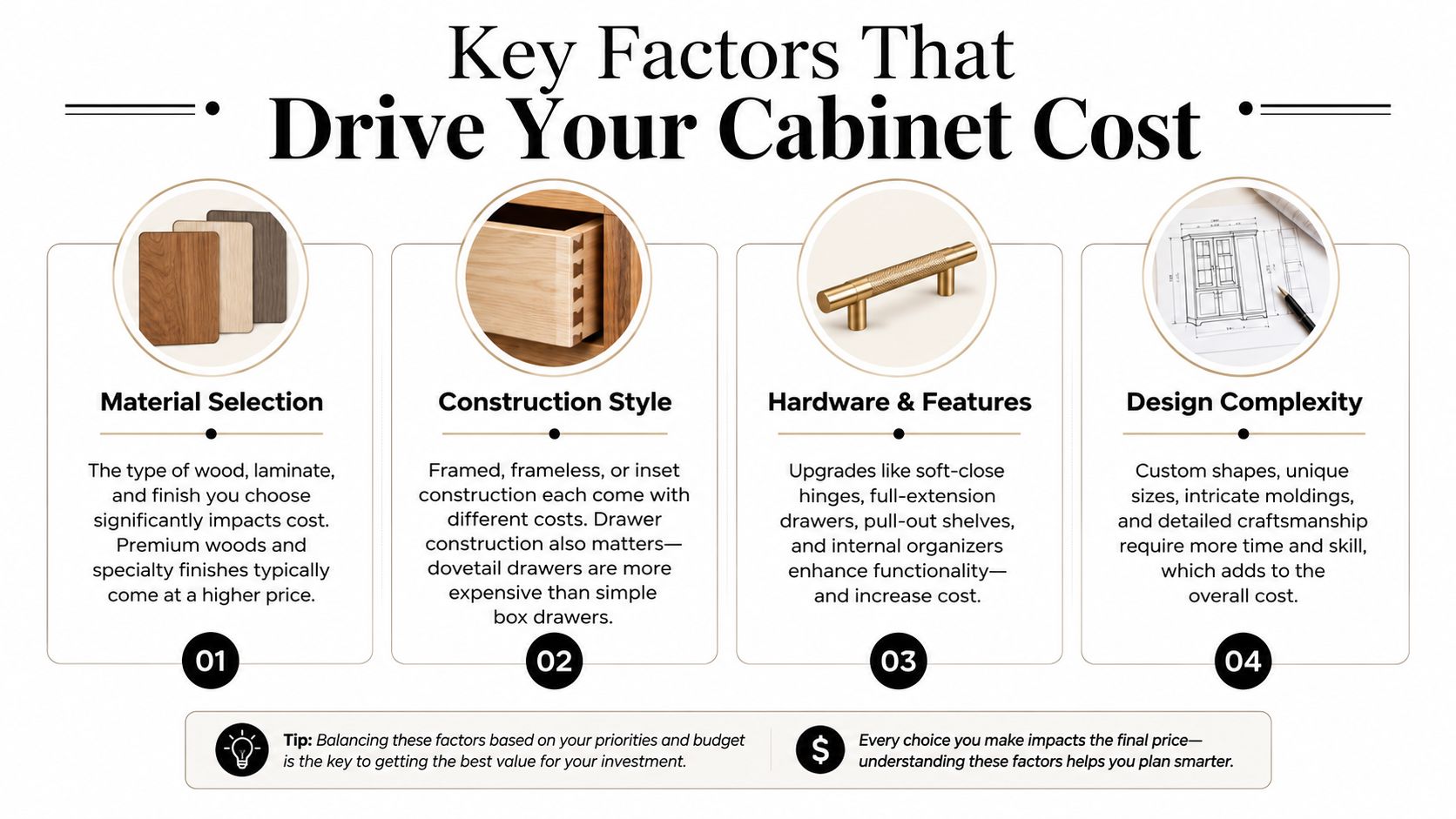
Two vanities can look nearly identical in a photo and still land in very different price ranges. The gap usually comes from the parts a homeowner does not see right away. Box construction, drawer hardware, finish prep, interior layout, and the amount of hand-fitting required for the room all affect the final number.
Material and construction choices
In South Jersey bathrooms, material choice is not just about appearance. It is about how the cabinet handles steam in August, forced-air heat in January, and the daily splash zone around sinks.
Plywood boxes usually hold up better than particleboard in those conditions because they resist swelling and fastener blowout more reliably over time. MDF has its place, especially for painted door fronts where a smooth finish matters, but I am careful about using it for exposed cabinet parts near plumbing or on floors that may see standing water. Solid wood can be beautiful, but it also moves with humidity, so species selection and finish quality matter just as much as the wood itself.
That is where good custom work earns its price. A well-built vanity is designed for the room it is going into, not just cut to a standard size.
Bathroom cabinetry also tends to cost more per foot than many homeowners expect because the work is compact and detailed. A 60-inch vanity may need sink alignment, storage planning around drain lines, filler adjustments at side walls, and a furniture-grade finish on all visible faces. A basic overview of cabinet cost per linear foot helps explain why shorter bathroom runs can still price higher than longer, simpler cabinet layouts.
Construction style changes cost too. Frameless cabinets can give you a little more usable interior space. Framed cabinets can suit a more traditional South Jersey home and offer a different look at the door opening. Inset fronts, floating vanities, and furniture legs all raise labor because reveal lines need tighter tolerances and the installation leaves less room for error.
If you're reviewing installation details before finalizing a design, this bathroom vanity installation guide offers a helpful overview of the practical side of getting a vanity into place.
Better value usually comes from choosing materials and finishes that handle bathroom humidity well, not from paying extra for the most expensive wood species.
Features and finish work
Features drive price fast because each upgrade adds either labor, hardware cost, or both. Sometimes all three.
Soft-close slides are usually worth it. Full-extension drawers are too, especially in a vanity where shallow storage quickly becomes wasted storage. On the other hand, specialty inserts, interior lighting, decorative legs, and highly customized organizer packages should be chosen because they solve a real problem, not because they looked good in a showroom sample.
Finish work deserves close attention in a bathroom. The cabinet has to be sealed well at sink cutouts, door edges, end panels, and toe kicks. In shore-adjacent parts of South Jersey, I pay even closer attention to finish durability because salt air and moisture can be hard on lower-grade paint systems. A cheaper vanity with a weak finish often costs more in frustration than a simpler cabinet finished properly from the start.
The upgrades that usually give homeowners the best return are:
- Deep drawers under a single-sink vanity for practical daily storage
- Plywood box construction where long-term moisture resistance matters
- Quartz tops for low-maintenance everyday use
- Simple door styles that are easier to clean and less likely to trap moisture at profile edges
The upgrade stack is where budgets often slip. Premium wood, custom paint, drawer accessories, a floating mount, and designer hardware can all be reasonable on their own. Put them together in one small bathroom, and the cabinet package can jump well beyond what the room needed to function and look good.
Budgeting for Costs Beyond the Cabinets
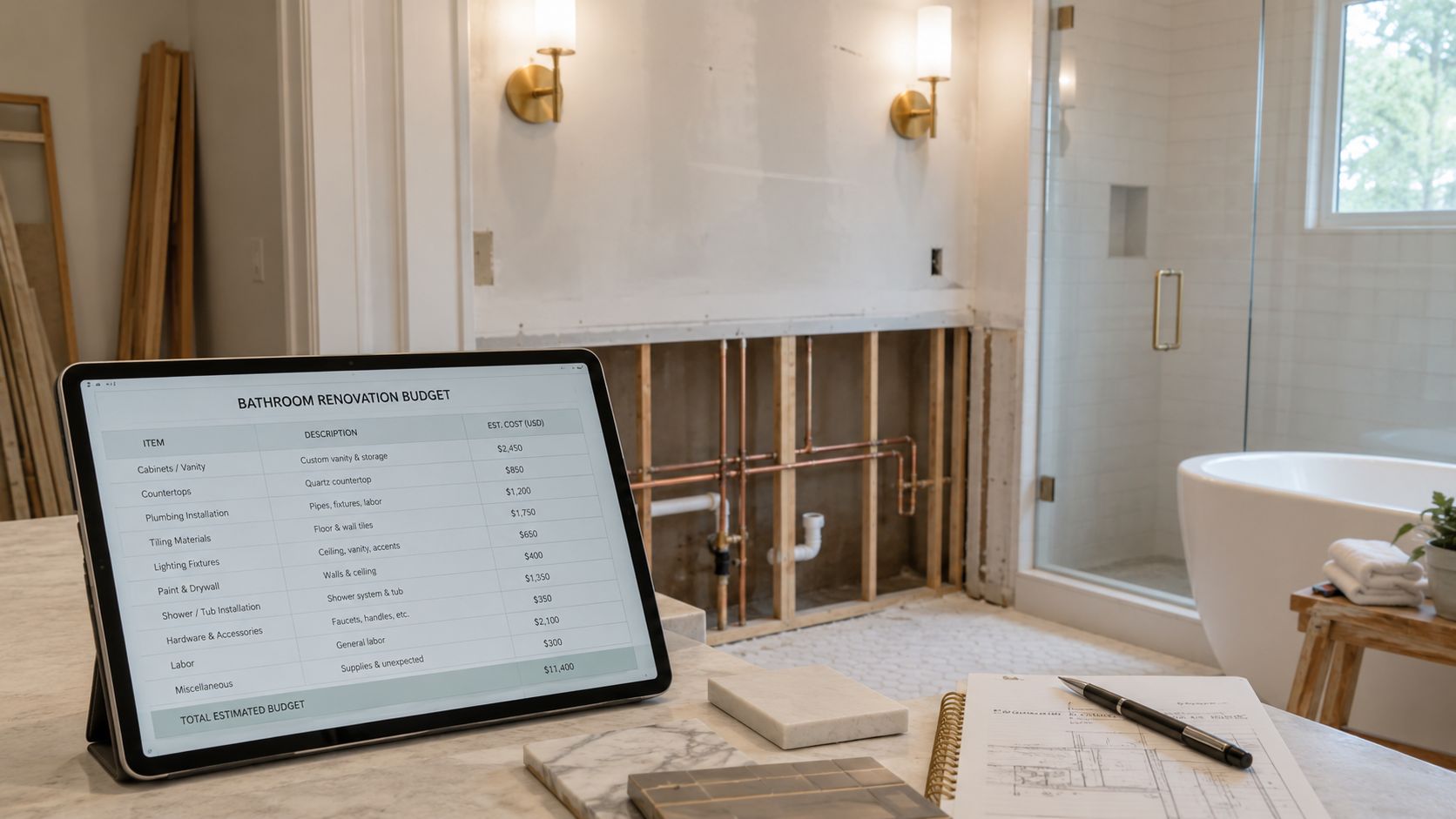
Cabinet budgets go sideways when homeowners price only the boxes and forget the work around them. The vanity may be the focal point, but it doesn't arrive in a vacuum. Old materials come out. New surfaces go in. Plumbing has to line up. Walls and floors have to cooperate.
Where budgets usually get stretched
Installation typically accounts for 25 to 40 percent of the total project cost, and beyond cabinet materials at $300 to $900 per linear foot, installation labor adds $200 to $300 per linear foot, with an additional $800 if plumbing needs to be moved or updated, according to Classic Cabinetry's bathroom cabinet cost breakdown.
That means a quote that looks reasonable at first can shift once the room itself starts making demands.
The common add-ons are usually these:
- Demolition and disposal of old vanities, tops, mirrors, and trim
- Countertop fabrication if the top isn't part of the cabinet package
- Hardware such as pulls and knobs, which are often priced separately
- Plumbing adjustments when drain locations don't match the new sink plan
- Electrical changes for lighting, outlets, or medicine cabinet upgrades
- Finish carpentry and wall repair after removal and installation
If a quote seems dramatically lower than others, check what it leaves out. The missing cost is often demolition, countertop work, plumbing, or finish repairs.
A better way to review an estimate
Read each proposal in layers.
First, identify what the cabinetmaker is building. Next, identify what the installer is doing on site. Then check the excluded items. Homeowners who skip that last step are usually the ones who get surprised.
If you already know the vanity will need trades coordination, it helps to look at bathroom vanity installation services and what they typically include. Even if you hire through one company, understanding the scope makes you better at spotting gaps.
A useful habit is to ask one simple question: what has to happen in the room before the new vanity can be fully functional? The answer usually reveals the actual budget.
Adjusting Costs for the South Jersey Market
National averages are a starting point. They don't price a specific home in Collingswood, Moorestown, Medford, or Haddonfield. South Jersey has a mix of housing styles that changes how custom cabinetry gets designed and installed.
Why local homes affect cabinet budgets
Older homes often bring quirks that never show up in online price calculators. Floors may be out of level. Plaster walls may not be perfectly true. Existing plumbing might sit in the wrong place for the vanity you want. In those homes, the cost of custom bathroom cabinets reflects labor coordination and fit as much as the cabinetry itself.
That's one reason local context matters. A simple vanity swap in a newer home can stay fairly controlled. A furniture-style custom vanity in an older home with trim work, tighter dimensions, and changed plumbing usually takes more design time and more field adjustment.
For high-end work, the ceiling rises quickly. Nelson Cabinetry's bathroom vanity pricing discussion notes that national averages for high-end custom bathrooms can reach $15,000, while projects in premium metropolitan markets can range from $13,000 to $30,000. South Jersey isn't a one-price market, but homeowners in higher-value neighborhoods should expect finish expectations and labor conditions to influence the quote in similar ways.
Where to spend and where to stay practical
That same Nelson reference notes that for owner-occupied homes, vanities in the $600 to $1,200 range with solid wood or plywood construction and quartz tops often offer the strongest return on investment. That idea holds up well in South Jersey. The best value usually isn't the cheapest vanity or the most elaborate one. It's the one that matches the home, the length of ownership, and the bathroom's daily use.
A practical local approach looks like this:
- Guest bath or hall bath: Keep the layout efficient and spend on durability.
- Primary bath: Prioritize drawer storage, finish quality, and countertop performance.
- Resale-focused update: Choose broad-appeal colors and avoid highly personal detailing.
- Long-term family home: Invest in materials that handle moisture and repeated use well.
If your project is happening locally, a South Jersey bathroom remodel planning resource can help you think through the room as a whole rather than pricing cabinets in isolation.
How to Save Money Without Sacrificing Quality
You don't need to cheapen the room to control cost. The better move is to spend where performance shows and simplify where it doesn't.
Smart design decisions that control cost
The first saver is size discipline. Standard widths and straightforward sink placements are easier to fabricate and easier to install. Once a vanity needs unusual depth, curved details, furniture legs, or complicated side panels, the labor goes up.
A few smart trade-offs usually work well:
- Choose a simpler door style and put the visual emphasis on the mirror, tile, or countertop.
- Use custom where it matters most if the room has one awkward wall or a single challenging area.
- Limit specialty storage to the drawers you'll use every day.
- Keep plumbing locations where they are if the layout already functions well.
- Skip unnecessary symmetry if forcing it creates filler panels or wasted cabinet space.
One of the easiest ways to preserve quality is to simplify the cabinet exterior while protecting the cabinet interior. Strong box construction and a bathroom-appropriate finish matter more over time than ornate detailing.
Good budgeting isn't about choosing the cheapest option. It's about refusing to pay custom prices for features that don't improve the way the room works.
The visual side helps too. This short video gives a useful sense of how bathroom vanity choices affect the finished look and feel of the room.
What not to cut
Some cuts backfire.
Don't downgrade the finish system in a humid bathroom just to save a little upfront. Don't ignore drawer quality if the vanity is going to store daily-use items. Don't assume every low quote includes the same installation care, adjustment work, and touch-up standards.
The cheapest path also tends to stumble when homeowners buy a beautiful vanity and then discover the room needs extra carpentry or plumbing to make it fit correctly. That's where “saving money” turns into paying twice.
The best results usually come from a clear priority list: what needs to last, what needs to look special, and what needs to be functional. Once those are clear, the quote becomes easier to shape.
Start Your Bathroom Transformation with Confidence
The cost of custom bathroom cabinets isn't random. It follows the choices you make about size, construction, finishes, storage, and installation conditions. Once you understand how those pieces interact, the budget gets much easier to manage.
For most homeowners, the goal isn't chasing the cheapest vanity or the most elaborate one. It's building a bathroom that fits the house, handles moisture well, provides storage that makes sense, and feels worth the investment every morning and every evening.
That's why the best bathroom projects start with clarity. Know what the room needs to do. Know which details matter to you. Ask for estimates that separate cabinetry from installation and room-side work. Then compare value, not just sticker price.
If you're planning a remodel in South Jersey, taking a measured approach now can save a lot of frustration later. Custom cabinetry should solve problems, not create them.
Ready to see what's possible for your home? The Cabinet Coach brings a mobile showroom experience directly to South Jersey homeowners, with personalized guidance on cabinetry, countertops, hardware, tile, and budget alignment. Schedule your complimentary video consultation today and get a preliminary estimate for your project.